
(D.Don) Hutch.
Description
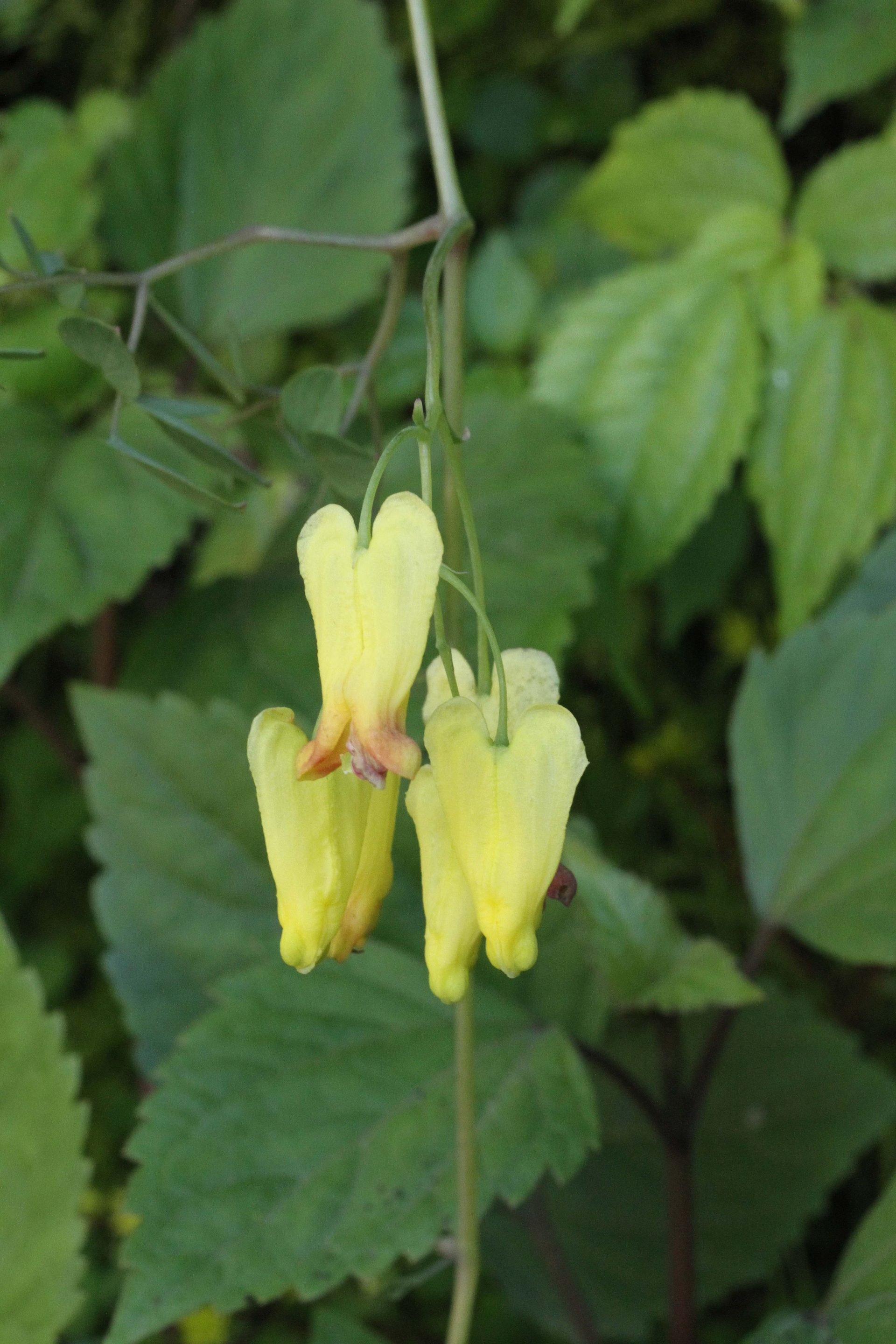
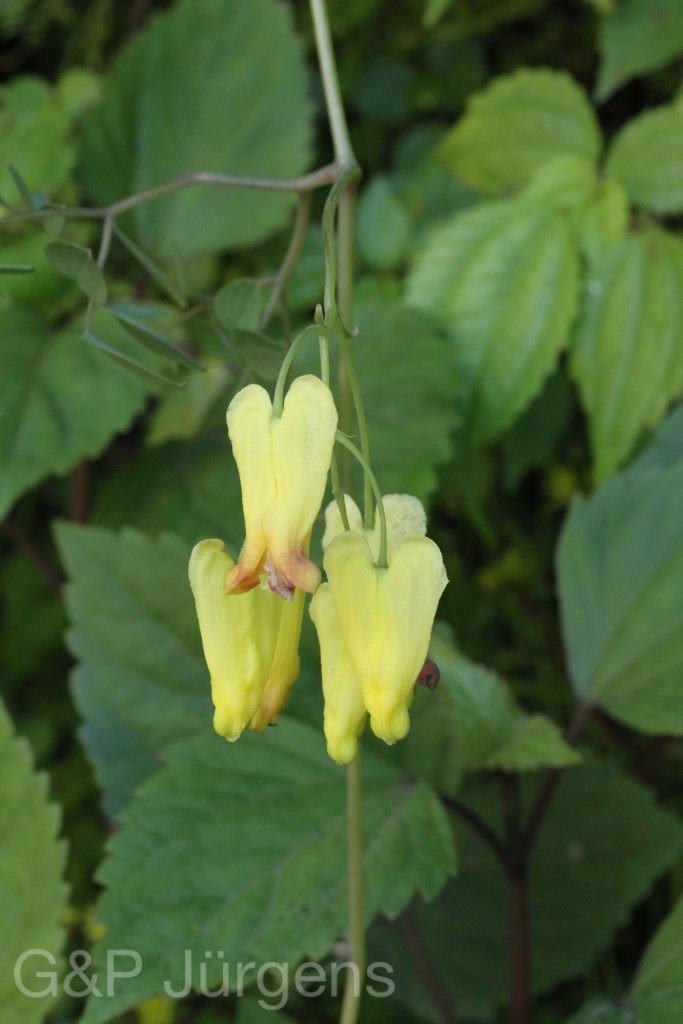
Dactylicapnos scandens is a climbing fumitory of the Himalaya and adjacent China and Indochina, native across China, India, Nepal, Bhutan, Myanmar, Vietnam, Thailand and Sri Lanka; its more than 300 GBIF records include numerous cultivated and naturalised occurrences in Europe, North America and New Zealand, reflecting its popularity as an ornamental climber. It grows in moist temperate forest, thickets and shrubby clearings, scrambling over other vegetation, mostly between about 1500 and 3300 m. The plant shown from Pele-La in Bhutan at 3300 m, flowering in June, sits at the upper edge of this range in cool broadleaved and conifer forest.
It is a herbaceous to suffrutescent perennial climber with slender, much-branched stems clinging by means of branched, tendril-like leaflet tips. The leaves are alternate, two- to three-pinnately compound and glaucous, the ultimate segments small and ovate, the terminal portions modified into coiling tendrils. The flowers hang in pendulous racemes and are zygomorphic with two bilaterally symmetrical, spurred or saccate outer petals enclosing two inner petals, the whole corolla bright golden-yellow. The fruit is an elongate, several-seeded capsule that dehisces to release shining black seeds, each bearing an elaiosome.
Dactylicapnos was separated from Dicentra and Corydalis on the basis of its climbing habit, tendrillate leaves and capsular fruit. D. scandens, based on D. Don's Fumaria scandens and transferred by Hutchinson, is widespread and not threatened, and its toxic isoquinoline alkaloids have attracted pharmacological interest in traditional medicine.
Author: (D.Don) Hutch. · Sources: POWO (Kew), GBIF, Flora of Bhutan, Flora of China, Lidén & Fukuhara revision of Dactylicapnos