Author

G & P Jürgens

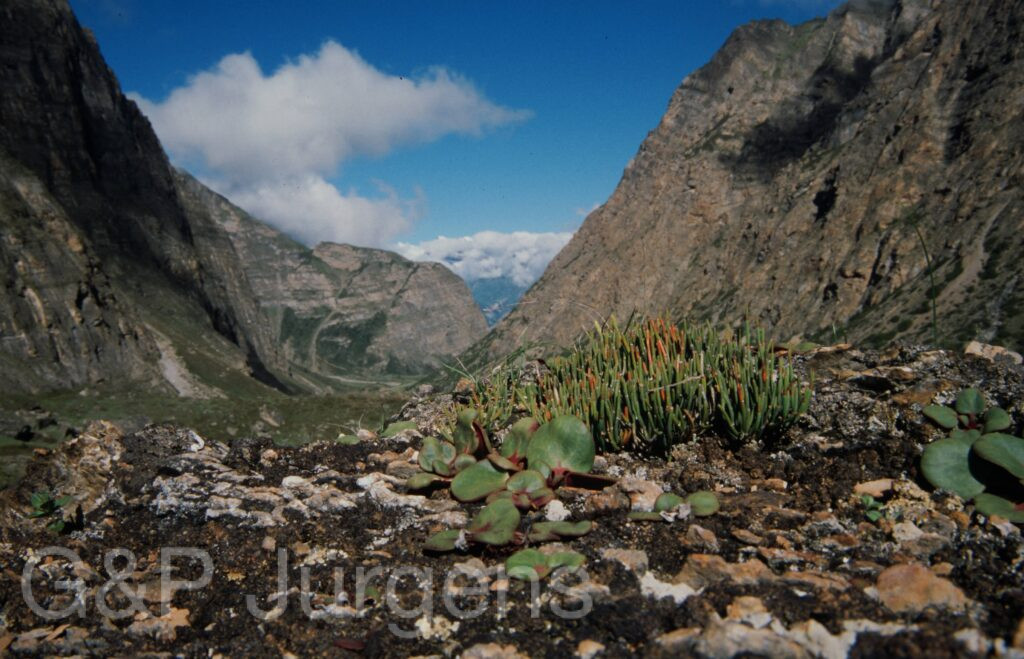
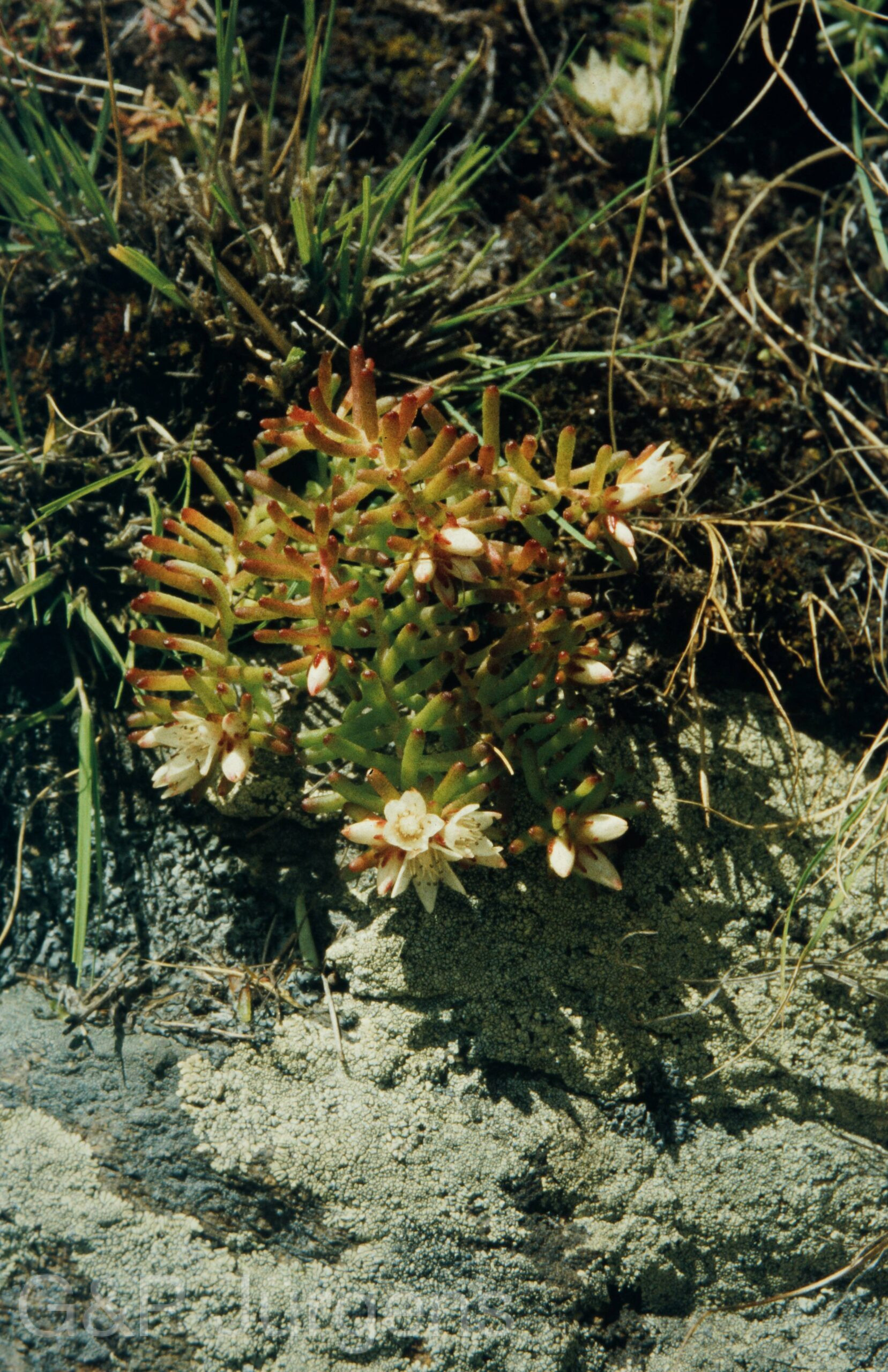
(Wall. ex Hook. f. & Thomson) Fu
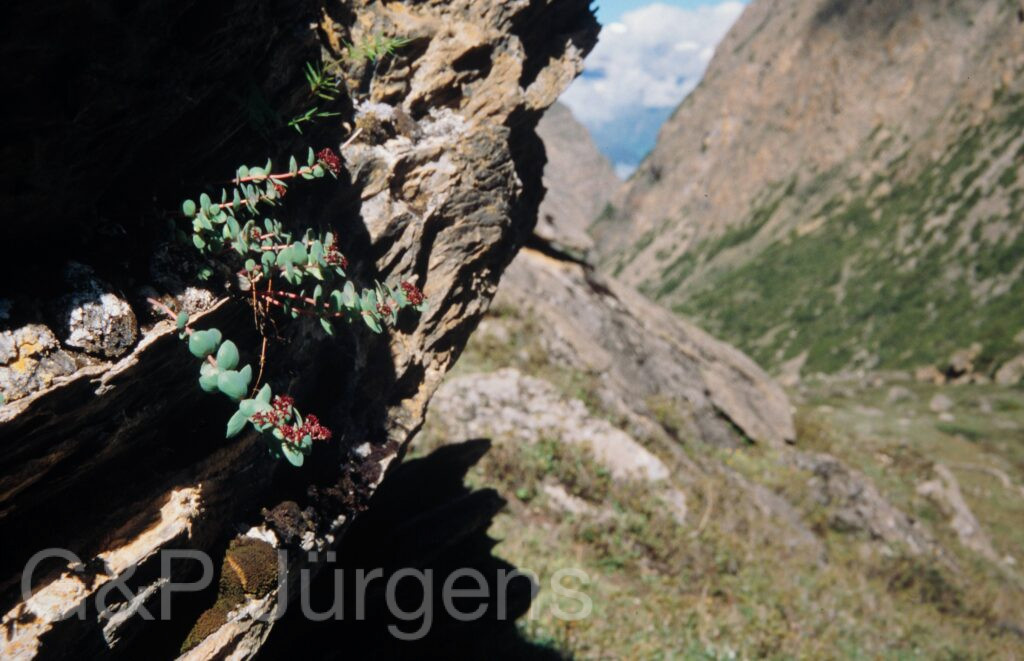
Nepal 99 839 ergebnis
West-Nepal Baga-La-Phedi 4000m, July

Description

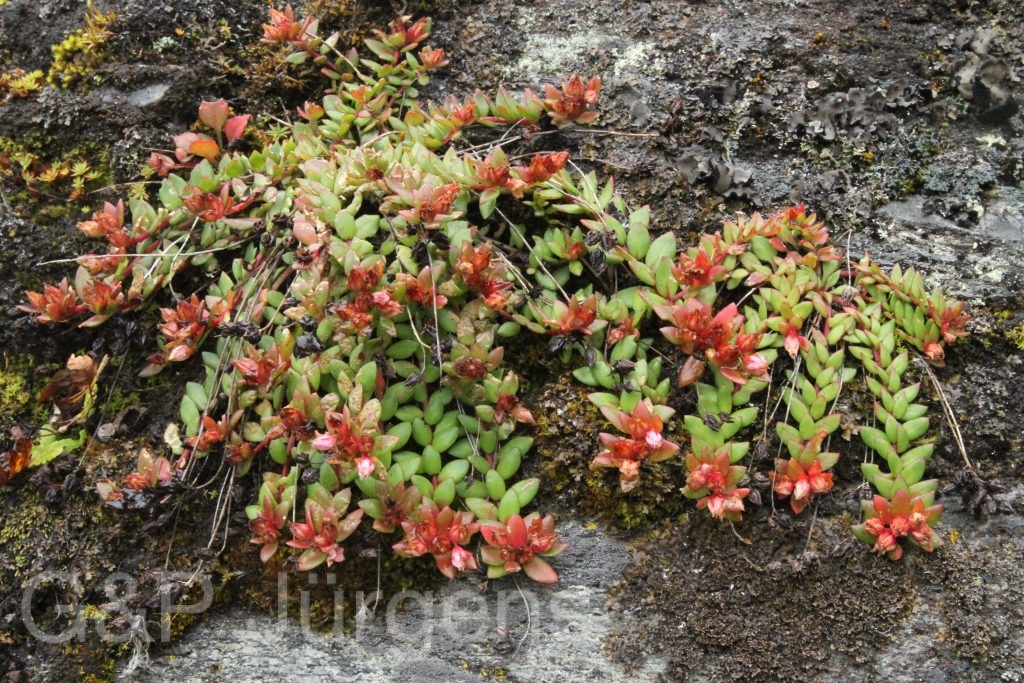
Rhodiola bupleuroides is a perennial succulent herb of the high Himalaya and the Qinghai-Tibetan Plateau, recorded by GBIF from China, Nepal, India, Bhutan and Myanmar across roughly 956 occurrences, with additional cultivated or erroneous records from Europe. It is a plant of alpine and subalpine habitats, growing on rocky slopes, screes, cliff ledges, grassy turf and the margins of alpine scrub, generally from about 3000 to over 5000 m. The plant photographed at Baga-La-Phedi in west Nepal at about 4000 m, flowering in July at the height of the brief alpine summer, is typical of these cold, exposed, well-drained sites.

The plant arises from a stout, woody, branched caudex topped by a swollen rootstock, from which emerge several erect or ascending unbranched flowering stems. The leaves are alternate, sessile, flat and fleshy, elliptic to oblong or obovate, with an entire to obscurely toothed margin, recalling the foliage of Bupleurum as the epithet suggests. The species is dioecious, the small flowers crowded in a dense terminal corymbose cyme; they are usually four- to five-merous, the petals dark red, purplish or greenish-yellow, with the staminate and pistillate flowers on separate plants. The fruit is a cluster of erect follicles that split to shed numerous minute seeds.

Rhodiola, segregated from Sedum, is a characteristic genus of cold high-mountain and arctic regions, and R. bupleuroides is one of the most widespread Himalayan-Tibetan species, displaying considerable variation in stature, leaf shape and flower colour. Several Rhodiola species are harvested for traditional medicine and adaptogenic compounds, and the genus as a whole is of pharmacological interest. The dioecious breeding system and dependence on cold alpine conditions make it a useful indicator of high-elevation environments under climatic change, and harvesting pressure affects some related taxa.

Author: (Wall. ex Hook. f. & Thomson) Fu · Sources: POWO (Kew), GBIF, Flora of China, Flora of Bhutan, Ohba revision of Himalayan Crassulaceae (Rhodiola/Sedum), Annotated Checklist of the Flowering Plants of Nepal
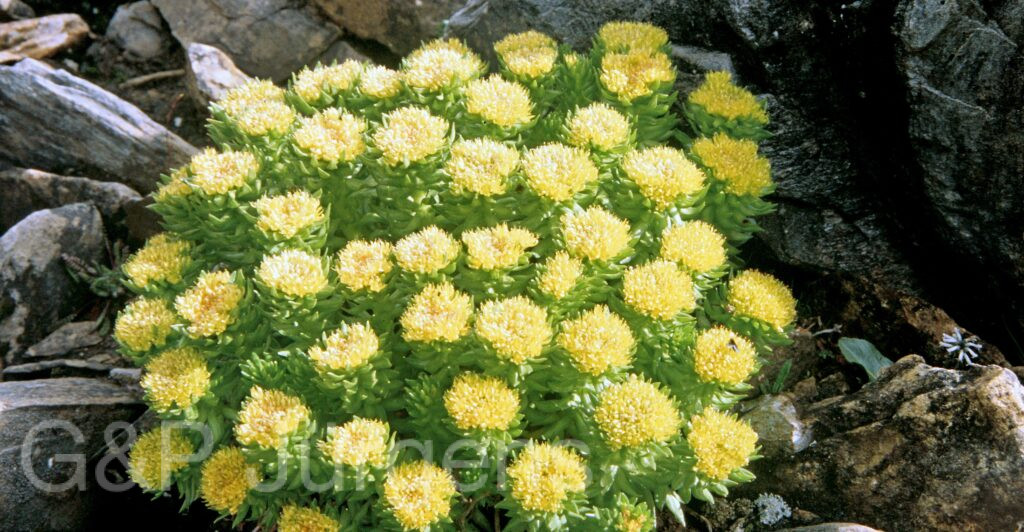
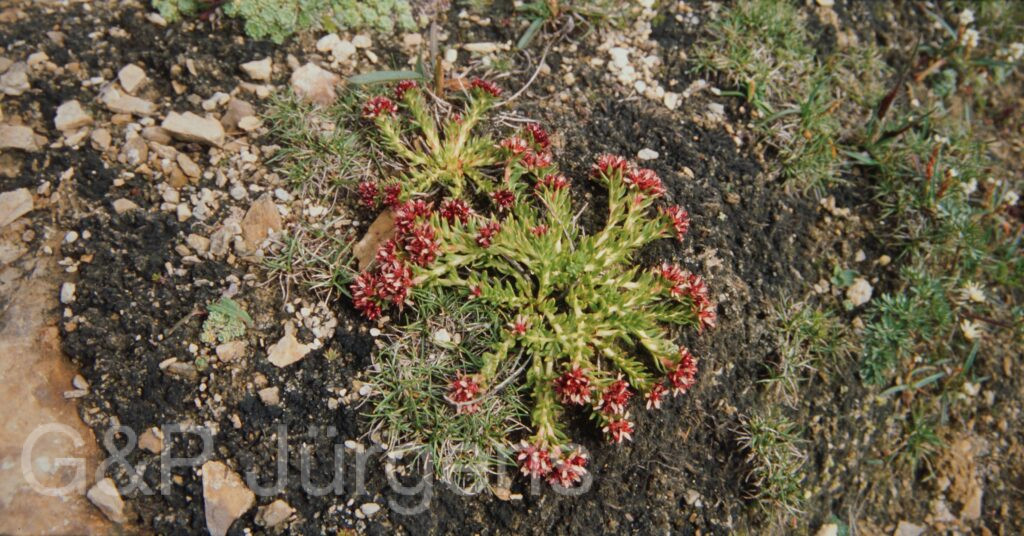
(Royle) Boriss.

Nepal 99 286 ergebnis
West-Nepal Kalmura 4200m, June

Description

Rhodiola coccinea (Royle) Boriss. is a high-alpine succulent of the stonecrop family ranging across the mountains of Central and High Asia, recorded by GBIF in 818 occurrences from China (CN), Nepal (NP), India (IN), Pakistan (PK), Afghanistan (AF) and Bhutan (BT) westward through Kazakhstan, Kyrgyzstan, Tajikistan, Uzbekistan, Russia and Mongolia. It is a plant of rock crevices, screes, moraines and stony alpine turf at very high elevations. It was photographed in West Nepal at Kalmura at 4200 m in June, well within the upper alpine zone where it endures intense radiation, drought and frost.

The plant grows from a stout, branched, woody caudex crowned with persistent papery leaf-bases, from which arise numerous short, densely leafy flowering stems. The leaves are small, fleshy, sessile, linear to oblong and entire or minutely toothed, crowded along the stems. As in many Rhodiola the species tends toward dioecy, with male and female flowers usually borne on separate plants in compact terminal cymes; the small flowers have four or five sepals and petals, the latter typically dark red to purplish, giving the epithet coccinea. The fruit is a cluster of erect, several-seeded follicles.

Formerly placed in a broadly circumscribed Sedum, Rhodiola is now well established as a distinct genus characterised by the persistent caudex and frequently unisexual flowers, an adaptation to the harsh, pollinator-poor alpine environment. Several Rhodiola species, notably R. rosea, are harvested for adaptogenic compounds, and high-elevation taxa such as this are of interest as cold- and drought-tolerant models. Its remote, rocky habitat affords some protection, though localised harvesting and climate change threaten alpine cushion communities.

Author: (Royle) Boriss. · Sources: POWO (Kew), GBIF, Flora of China, Flora of Nepal, Rhodiola monograph (Ohba; Crassulaceae of the Himalaya)

(Prain ex Raym.-Hamet) S.H.Fu

Bhutan2012 88
Bhutan Chele La 4150m, September

Description

Rhodiola hobsonii is an alpine succulent perennial of the eastern Himalaya and adjacent southwestern China, recorded from Bhutan, northern India (Sikkim, Arunachal), Nepal and the Chinese provinces of Xizang and Yunnan; GBIF holds about 101 records. It inhabits open stony slopes, gravelly screes, rock crevices and short alpine turf, generally between about 3800 and 5000 m, enduring intense insolation and a brief growing season. The photographed plant was collected at the Chele La pass in western Bhutan at around 4150 m in September, on the well-drained, frost-disturbed substrates it occupies near the upper limit of vascular plant growth.

The plant arises from a stout, woody, persistent caudex crowned by the scaly remains of old leaf bases, from which several short, fleshy, erect or ascending flowering stems develop. The leaves are alternate, sessile, succulent, oblong to obovate, entire or sparingly toothed toward the apex, and rather densely set. The inflorescence is a compact terminal cyme; the species is dioecious, the flowers four- or five-merous and dull purplish-red, the petals narrow. The fruit comprises several erect follicles that split to release minute seeds.

Rhodiola (Crassulaceae) is a large genus of cold alpine and arctic regions, segregated from Sedum by its perennial woody caudex and predominantly dioecious flowers. R. hobsonii belongs to the diverse Sino-Himalayan assemblage of the genus, many members of which are rich in rosavins and salidroside and used in regional traditional medicine. Restricted to high elevations, it is naturally localised but not currently assessed as threatened, though such cushion-zone specialists are vulnerable to warming.

Author: (Prain ex Raym.-Hamet) S.H.Fu · Sources: POWO (Kew), GBIF, Flora of China Vol. 8, Flora of Bhutan Vol. 1, Flora of Nepal, Flora of Pakistan, Ohba monograph of Himalayan Sedoideae and Rhodiola

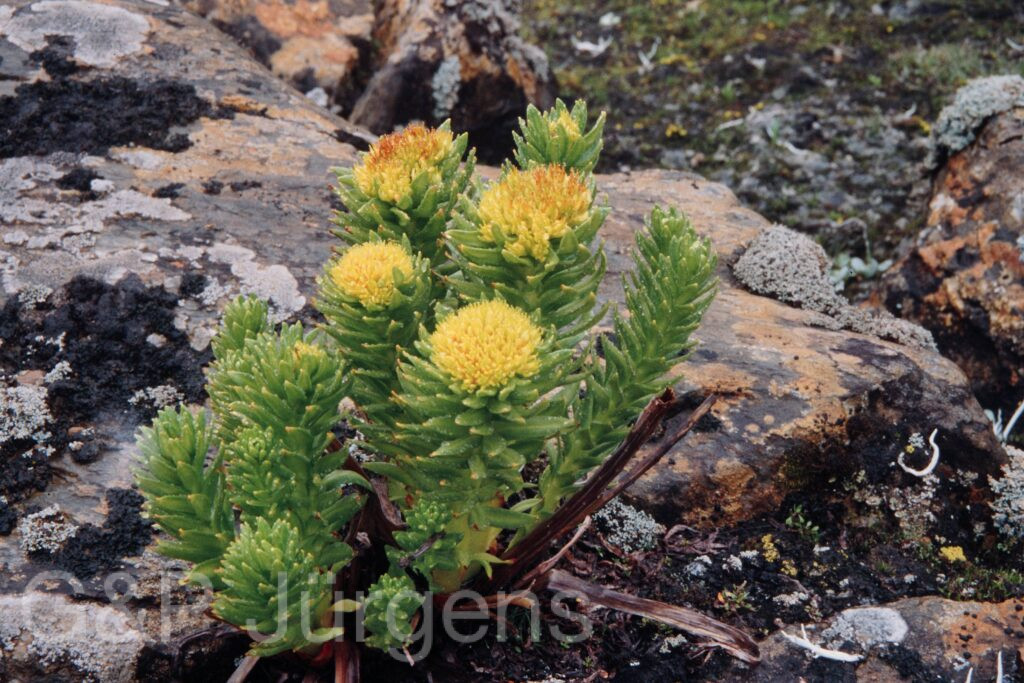
(Raym.-Hamet) H. Ohba

Nepal 99 836 ergebnis
West-Nepal Baga-La-Phedi 4200m, July

Description

Rhodiola prainii is a high-alpine succulent of the Himalaya and Tibetan borderlands, recorded by GBIF (98 occurrences) from Nepal, China, India and Bhutan (NP, CN, IN, BT). It grows on open, well-drained alpine substrates — rocky slopes, screes, cliff ledges, moraine and turf — in the upper subalpine to alpine zone, typically between about 3800 and 4800 m. The collection illustrated from Baga-La-Phedi in West Nepal at around 4200 m in July, the peak of the short monsoon-summer growing season, is representative of its habitat: cold, intensely insolated, seasonally moist ground above the treeline.

Like other members of the genus it is a perennial herb with a stout, fleshy, branched caudex or rhizome crowned by persistent old leaf-bases and giving rise to several short, erect, glabrous flowering stems. The leaves are alternate, sessile, succulent, oblong to obovate or spathulate, entire or sparsely toothed toward the apex, and rather crowded. The inflorescence is a dense terminal corymb or cyme; the flowers are small, usually 4-5-merous and functionally unisexual (the species dioecious), with narrow petals in shades of greenish-yellow to reddish. The fruit is a cluster of erect, beaked follicles releasing minute seeds.

Rhodiola prainii sits within the predominantly Sino-Himalayan genus Rhodiola (Crassulaceae, subfamily Sempervivoideae), segregated from Sedum on its thick perennating rootstock, scale-leaved lower stem and frequently dioecious flowers. The genus is renowned for tissues rich in salidroside and rosavin, and several species are harvested as adaptogenic 'golden root'. Such collection pressure, combined with the slow growth and narrow alpine niche characteristic of the group, makes high-elevation Rhodiola populations vulnerable to over-exploitation and climate-driven habitat contraction.

Author: (Raym.-Hamet) H. Ohba · Sources: POWO (Kew), GBIF, Flora of China, Annotated Checklist of the Flowering Plants of Nepal, Ohba Monograph of the Genus Rhodiola, Crassulaceae of the Himalaya

L.

Nepal 99 624 ergebnis
Nepal Kagmara Phedi 4000m, July
Nepal 99 623 ergebnis
Nepal Kagmara-La 4100m, July

Description

Rhodiola rosea is a circumboreal, arctic-alpine succulent with one of the broadest ranges in its genus, GBIF documenting over 54,000 occurrences across Scandinavia, the British Isles, Iceland, Greenland, Russia, the Alps, Japan, China, Mongolia and North America. It grows on cliff ledges, scree, stony tundra, rock crevices and stream banks from Arctic sea level to above 4000 m in Asia. The Nepalese material photographed at Kagmara Phedi (4000 m) and the Kagmara-La pass (4100 m), flowering in July, illustrates its occurrence at the upper margins of its Himalayan range on cool, well-drained, base-rich rock.

It is a glabrous, glaucous perennial herb arising from a thick, branched, woody rootstock that smells of roses when cut. Numerous unbranched erect stems, 5–35 cm tall, bear sessile, fleshy, oblong to ovate leaves, flat and entire or apically toothed. The species is dioecious: flowers are densely clustered in terminal corymbose cymes, the parts in fours or fives; male flowers are yellow with conspicuous stamens, female greenish-yellow to reddish, maturing into erect, often purplish-red follicles.

Linnaeus described the species, long placed in Sedum (S. rosea) before transfer to Rhodiola; its taxonomy remains intricate, with numerous infraspecific and segregate taxa. The rose-scented rhizome has a long ethnobotanical history as an adaptogen ("golden root"), driving harvesting that has caused local depletion and prompted conservation and cultivation programmes. Ecologically it is a hardy pioneer of disturbed alpine and arctic rock.

Author: L. · Sources: POWO (Kew), GBIF, Flora of China, Flora Europaea, Crassulaceae of the World (Eggli, ed.)

(Royle ex Edgew.) Fu

Description

Rhodiola sinuata (Royle ex Edgew.) Fu is a high-altitude succulent perennial of the Himalaya, recorded from India, Nepal, Bhutan, Pakistan and adjacent China, with comparatively few collections (GBIF lists about 349 occurrences, the European and Central Asian points representing herbarium or database artefacts rather than native range). It grows on rock ledges, cliff crevices, stony slopes and moist alpine turf, generally between 3,000 and 4,500 m. The illustrated plant was gathered in the Indian Garhwal Himalaya near Tali at 3,100 m in September, when the inflorescences are maturing and the foliage takes on autumnal reddish tints.

The plant arises from a stout, woody, perennating rhizome (caudex) crowned with scarious scale-leaves, from which spring several erect to ascending leafy flowering stems. The cauline leaves are alternate, sessile, fleshy, oblong to obovate, with a characteristically sinuate-dentate to coarsely toothed margin. The flowers are small and clustered in a dense terminal corymbose cyme; the species is typically dioecious, with 4- or 5-merous flowers bearing narrow yellowish to greenish-yellow petals, the staminate flowers with exserted stamens. The fruit is a cluster of erect follicles releasing minute seeds.

Rhodiola (Crassulaceae) comprises the Asian-alpine "roseroots" formerly placed in Sedum, distinguished by their thick perennial rhizome and frequently unisexual flowers. Like its congeners, R. sinuata accumulates phenylpropanoid glycosides in the rootstock and is gathered in Himalayan folk medicine, a pressure that, with grazing, warrants monitoring although the species is not formally assessed. Its restricted Sino-Himalayan distribution reflects adaptation to cold, exposed, high-elevation rock habitats.

Author: (Royle ex Edgew.) Fu · Sources: POWO (Kew), GBIF, Flora of China, Flora of Pakistan, Annotated Checklist of the Flowering Plants of Nepal, Ohba monograph of Himalayan Sedoideae, Hooker Flora of British India

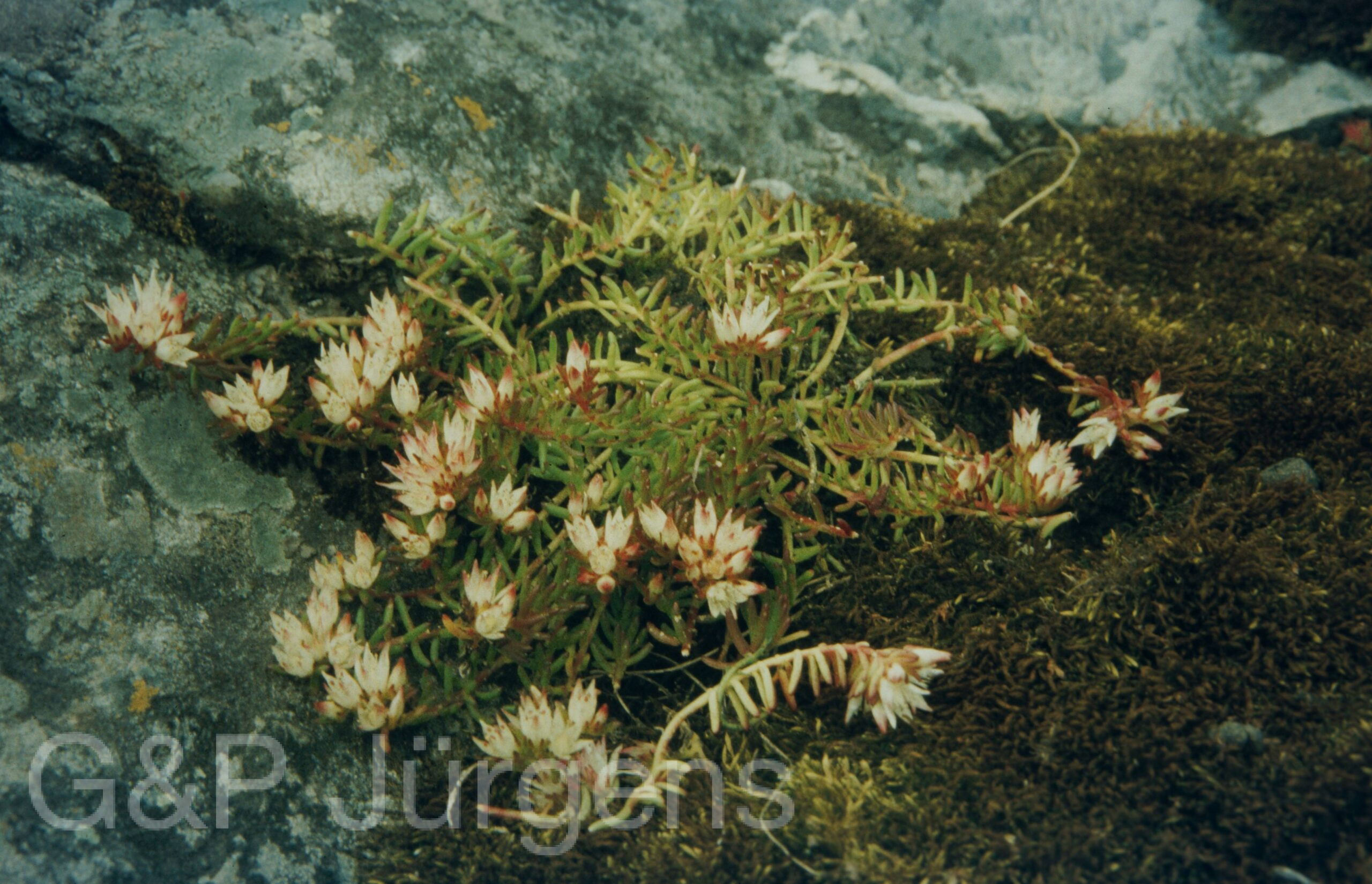
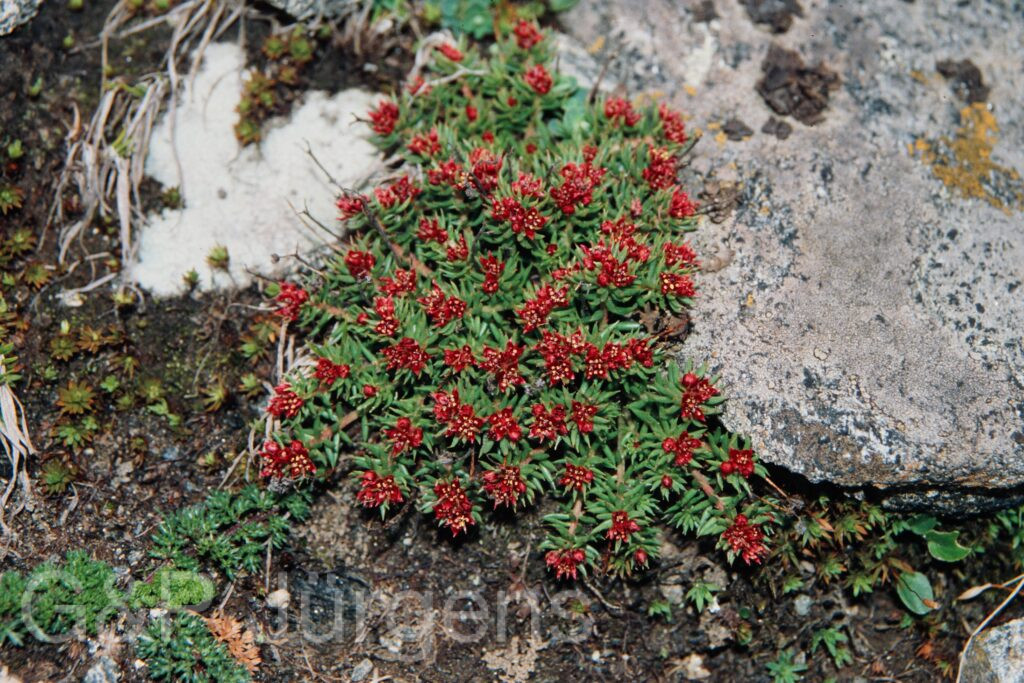
(Raym.-Hamet) S.H. Fu

Nepal 99 668 ergebnis
West-Nepal Kagmara-La 5500m, July

Description

Rhodiola smithii is a cushion-forming succulent of the highest Himalayan and Tibetan altitudes, recorded by GBIF (145 occurrences) from China, Nepal and Bhutan (CN, NP, BT). It is a true alpine to subnival plant of rock crevices, screes, moraines and stony turf, enduring intense radiation, wind, frost and a very short growing season. The illustrated population from the Kagmara-La in West Nepal at about 5500 m in July is exceptional in elevation, lying near the upper limit of vascular plant life and exemplifying the extreme high-alpine niche this species occupies, generally between roughly 4500 and 5600 m.

It is a low, tufted perennial herb growing from a thick, woody, branched caudex clothed in persistent scarious old leaf-bases, the whole forming compact mats or cushions that minimise exposure. The flowering stems are short and crowded, bearing small, sessile, fleshy, oblong to linear-oblong leaves that are entire or minutely toothed. The flowers are aggregated in a dense terminal head or compact corymb; they are small, mostly 4-5-merous and unisexual on dioecious plants, with narrow petals ranging from yellowish to deep red or purplish. The fruit comprises a cluster of small erect follicles producing minute seeds.

Within the Sino-Himalayan genus Rhodiola, R. smithii belongs to the dwarf, densely caespitose species adapted to the coldest, most exposed alpine and subnival habitats. Its cushion habit, perennating woody rootstock and dioecy are convergent strategies of high-mountain succulents. Like its congeners it accumulates the bioactive compounds that drive medicinal harvesting of 'golden root', and its restriction to a narrow, climatically marginal high-elevation band makes it especially exposed to warming-driven habitat loss.

Author: (Raym.-Hamet) S.H. Fu · Sources: POWO (Kew), GBIF, Flora of China, Annotated Checklist of the Flowering Plants of Nepal, Ohba Monograph of the Genus Rhodiola, Crassulaceae of the Himalaya

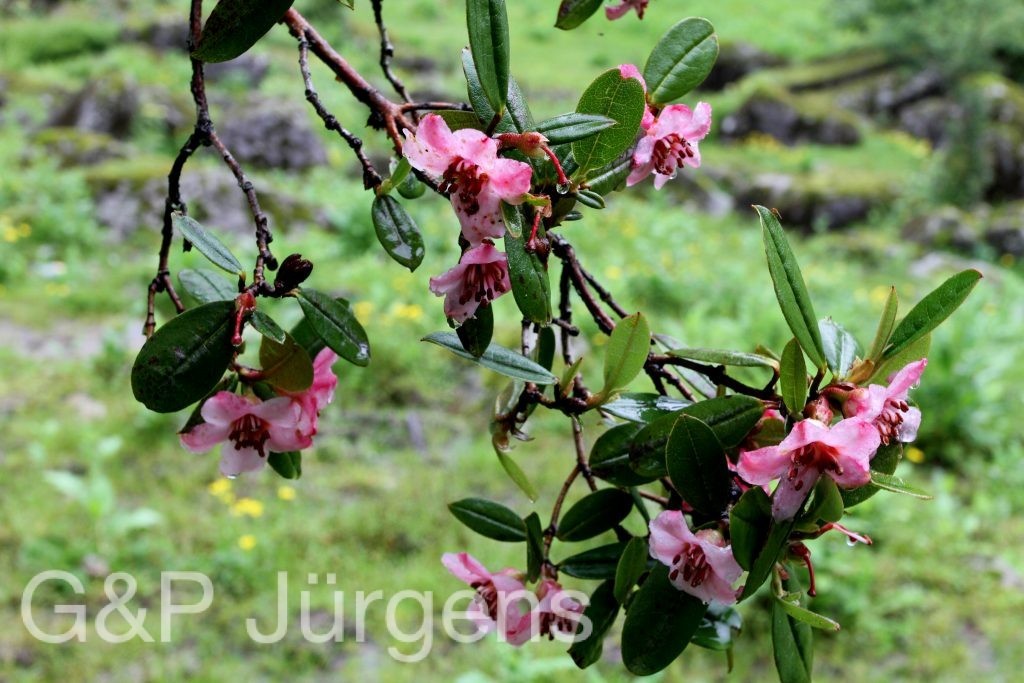
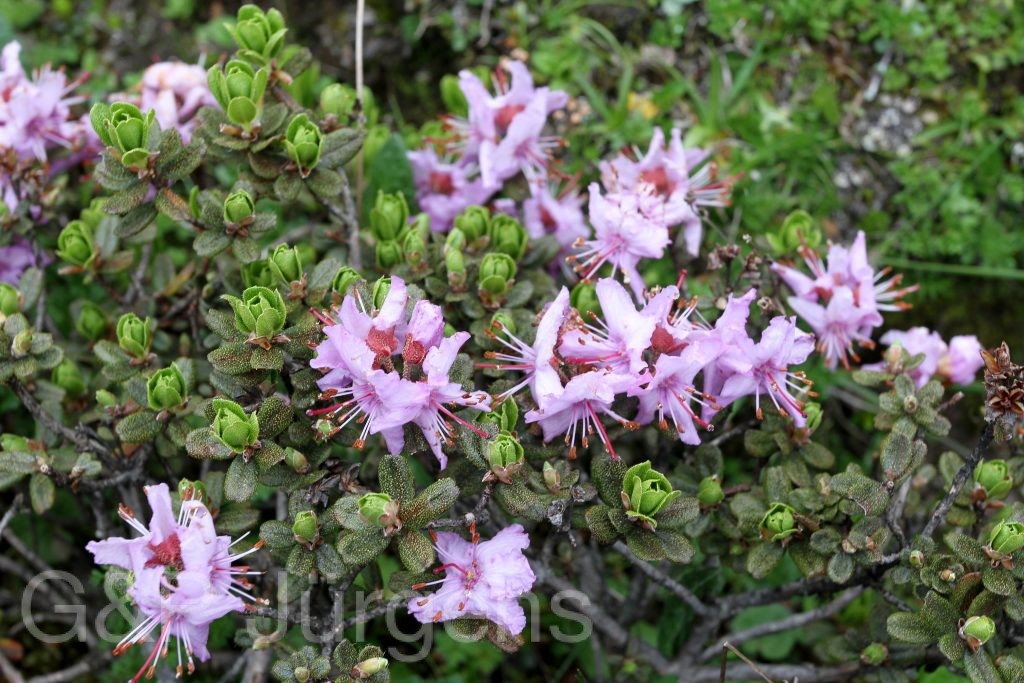
Hook.f.

BhutanPG2011 31
Bhutan Pele-La, 2800m June
BhutanPG2011 693 1
Bhutan Luksor, 2900m July

Description

Rhododendron camelliiflorum is a Himalayan endemic shrub restricted to the moist temperate belt of Nepal, India, Bhutan and adjacent China (Xizang), with 165 GBIF occurrences. It is characteristically epiphytic or lithophytic, growing on mossy tree trunks, rocks and banks within humid Abies, Tsuga and broadleaved forest, typically between about 2500 and 3500 m. The photographs were taken in Bhutan at Pele-La at 2800 m in June and at Luksor at 2900 m in July, cool cloud-forest sites where persistent mist and abundant epiphytic moss create the damp microhabitats this species favours.

It is a small, straggling evergreen shrub with scaly young shoots and coriaceous, elliptic to oblanceolate leaves that are dark green and lepidote (densely scaly) beneath, with revolute margins and an acute, mucronate apex. The flowers are borne singly or in small terminal clusters and are notably fleshy; the campanulate to broadly tubular, five-lobed corolla is waxy white, often flushed with pink or rose, recalling a small camellia, whence the epithet. The stamens are typically ten, with the ovary and style densely scaly. The fruit is a dry, scaly, septicidal capsule releasing numerous minute seeds.

The species belongs to subgenus Rhododendron, section Rhododendron (the lepidote rhododendrons), and its thick-textured flowers and epiphytic tendency distinguish it within the Himalayan assemblage. Its summer flowering and inaccessible epiphytic habit have kept it scarce in cultivation. Though confined to a narrow elevational band, it remains locally frequent in intact forest and is not currently considered globally threatened, but it is vulnerable to forest degradation across the eastern Himalaya.

Author: Hook.f. · Sources: POWO (Kew), GBIF, Flora of Bhutan, Flora of China, The Genus Rhododendron (Royal Botanic Garden Edinburgh), Rhododendrons of the Himalaya

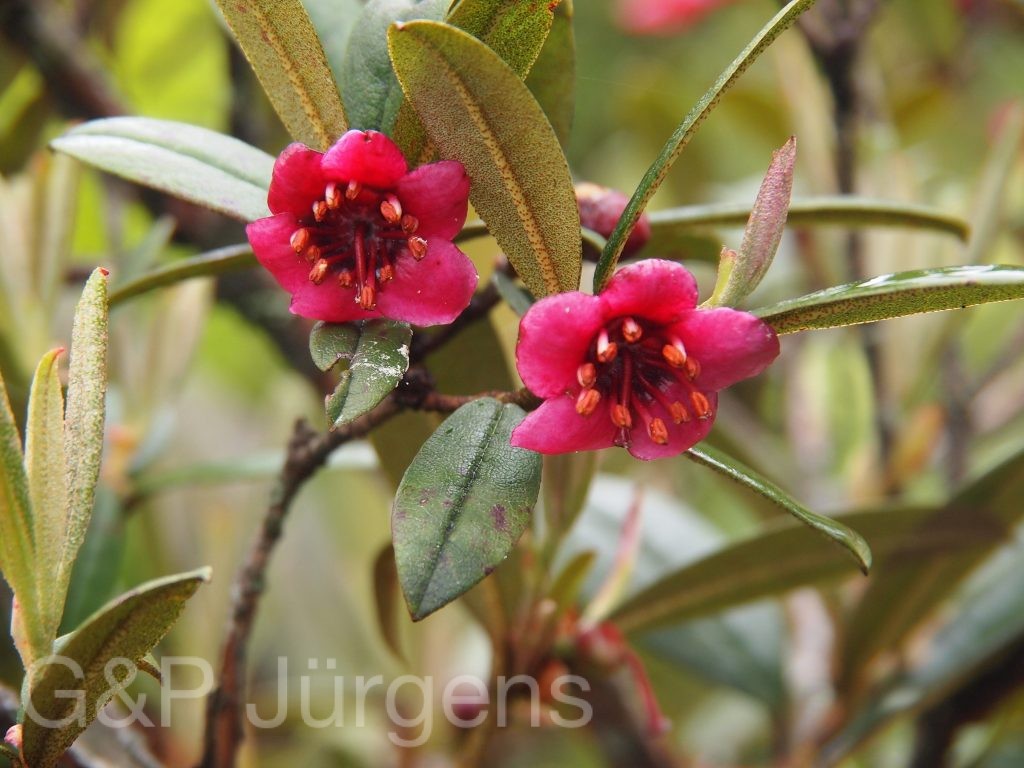
Kingdon-Ward

BhutanPG2011 241
Bhutan Tsochenchen, 3800m June

Description

Rhododendron fragariiflorum (correctly orthographed as R. fragariflorum) is a dwarf, cushion-forming shrub endemic to the high eastern Himalaya and adjacent southeastern Tibet. Its distribution, documented by GBIF across China (Xizang), India (Sikkim, Arunachal Pradesh) and Bhutan, is restricted to the alpine zone, where it grows on open, peaty slopes, in moist meadows and among rocks at elevations of roughly 3,800–5,000 m. The photographed population near Tsochenchen in Bhutan at 3,800 m in June illustrates its typical habitat above the treeline, where it forms low mats in the company of alpine sedges, primulas and other prostrate rhododendrons subjected to strong insolation, frost and a brief summer growing season.

The plant is a low, much-branched, semi-prostrate shrublet seldom exceeding 10–20 cm in height, with slender, often decumbent stems clad in persistent leaf scales. The small, elliptic to obovate leaves are coriaceous, scaly (lepidote) beneath, and dark green above, frequently with revolute margins. Distinctively, the flowers are solitary or borne in pairs and are a deep purplish-crimson to magenta, often described as strawberry-coloured, hence the epithet fragariflorum. The corolla is broadly campanulate to rotate, five-lobed and lepidote on the outer surface, with ten exserted stamens; the fruit is a small, scaly, dehiscent capsule.

The species belongs to subgenus Rhododendron, section Pogonanthum-related lepidote groups, and is taxonomically notable for its unusually open, non-tubular corolla among scaly rhododendrons. As a strict high-alpine specialist with a narrow range and modest occurrence record, it is of biogeographic interest as an indicator of intact Sino-Himalayan alpine habitats. Climate-driven upward shifts of the treeline pose the principal long-term threat to such cushion communities.

Author: Kingdon-Ward · Sources: POWO (Kew), GBIF, Flora of Bhutan Vol. 2, Flora of China Vol. 14, Cullen: Revision of Rhododendron subgenus Rhododendron (Notes RBG Edinburgh)

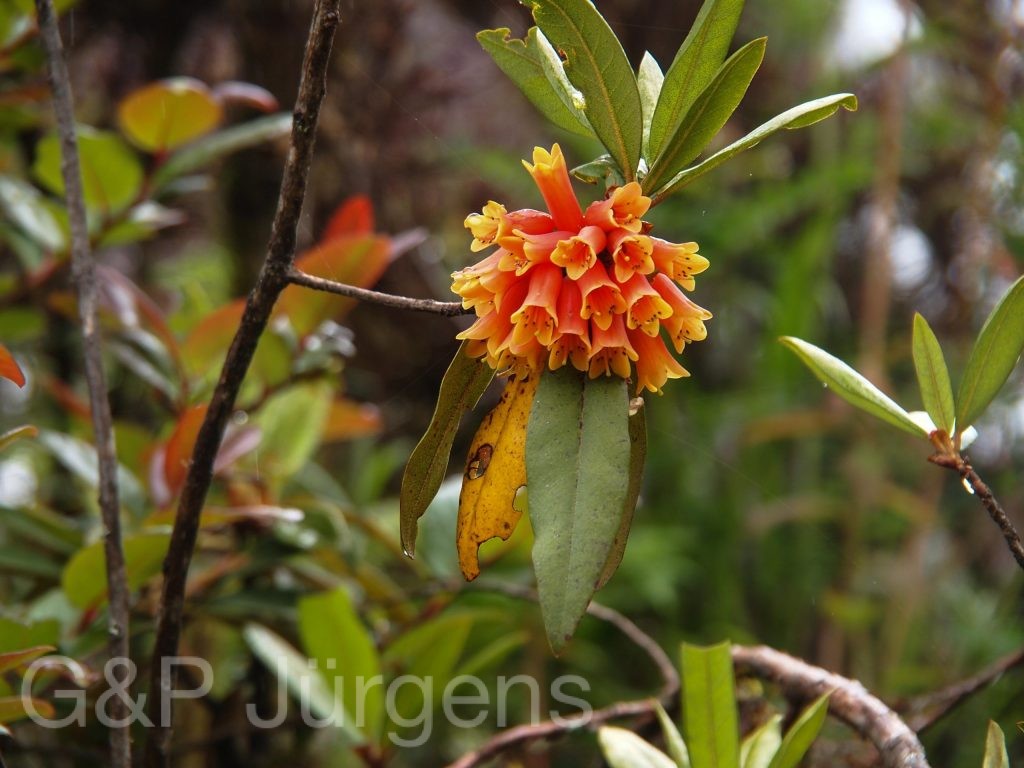
Nutt.

Bhutan2014 529
Bhutan Pele-La 2900m, May
Bhutan2014 643
Bhutan Pele-La 2900m, May
BhutanPG2011 262011 Bhutan Rhod. keysii scaled
Bhutan Pele-La, 2800m June

Description

Rhododendron keysii is an eastern Himalayan shrub native to Bhutan, India (Arunachal Pradesh, Sikkim) and southern Tibet (China), with 202 georeferenced occurrences; further records from Canada, Great Britain and New Zealand reflect its cultivation as a curiosity in temperate gardens rather than a natural range. It grows in cool, humid montane and temperate forest, in scrub, forest margins and as an epiphyte or terrestrial shrub among conifers and broad-leaved trees, generally between about 2400 and 3300 m. It was photographed at the Pele-La pass in Bhutan at 2800 to 2900 m in May and June, within the moist mid-montane belt where mist and high rainfall favour its growth.

It is an erect, sparsely branched evergreen shrub 1 to 3 m tall, with scaly young shoots and rather thin, elliptic-lanceolate leaves that are lepidote beneath. The flowers are highly distinctive among rhododendrons: borne in small axillary clusters along the upper stems, they are narrowly tubular to cylindrical, only slightly flared at the mouth, and bicoloured, with an orange-red to brick-red tube and contrasting yellow-green lobes. The corolla shape recalls a Correa or a small Cestrum rather than a typical rhododendron. The fruit is a slender scaly capsule.

The species belongs to Rhododendron subgenus Rhododendron, section Rhododendron (subsection Cinnabarina, the keysii alliance), and its tubular axillary flowers make it instantly recognisable. The narrow tube and exserted style point to pollination by sunbirds. Ecologically it is a component of mossy montane forest undergrowth. It is not regarded as threatened, though uncommon and locally distributed, and is valued horticulturally for its unusual floral form.

Author: Nutt. · Sources: POWO (Kew), GBIF, Flora of Bhutan, Flora of China, The Genus Rhododendron (Cullen & Chamberlain monograph)