
(Raym.-Hamet) S.H. Fu
Description
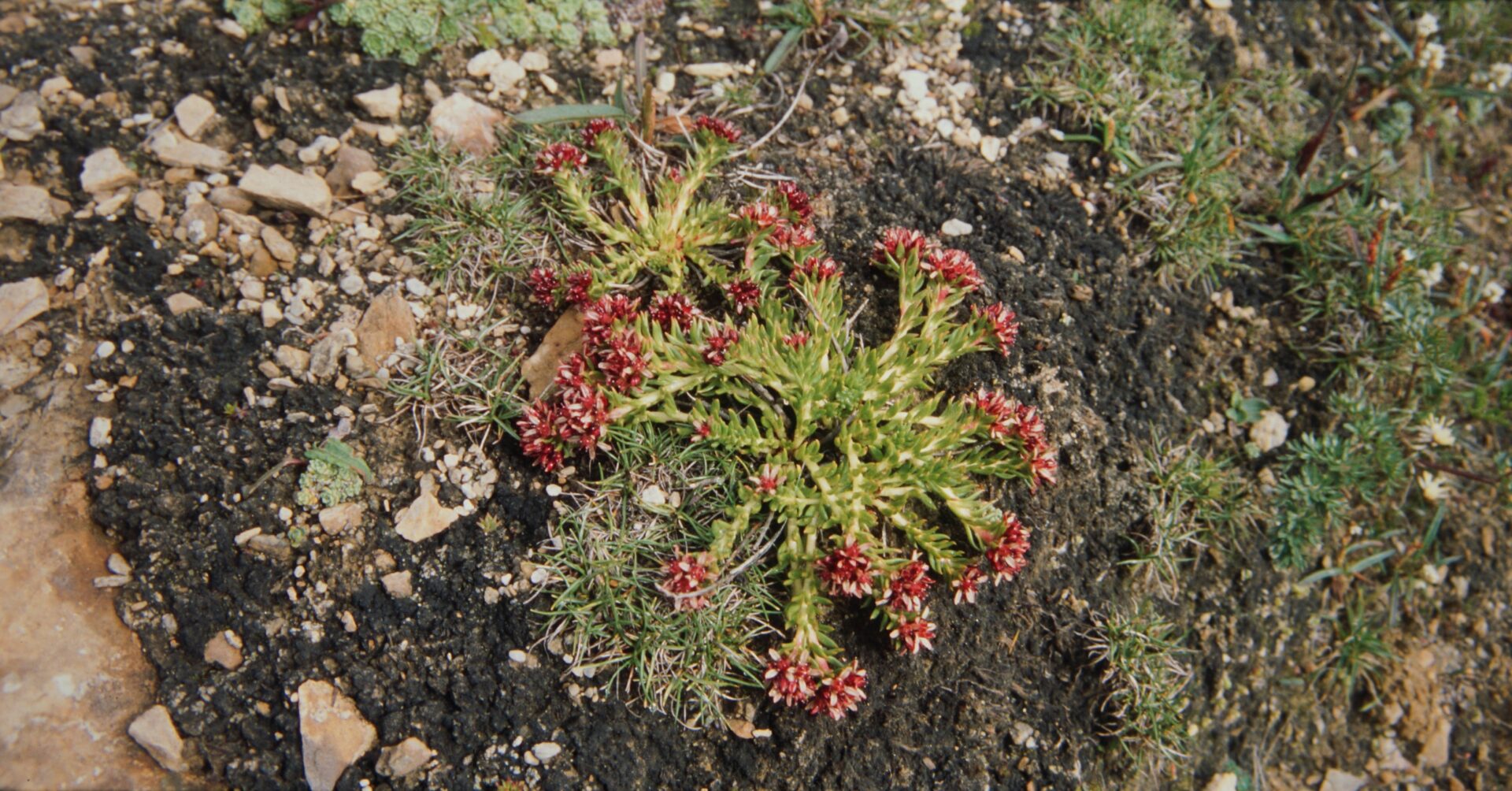
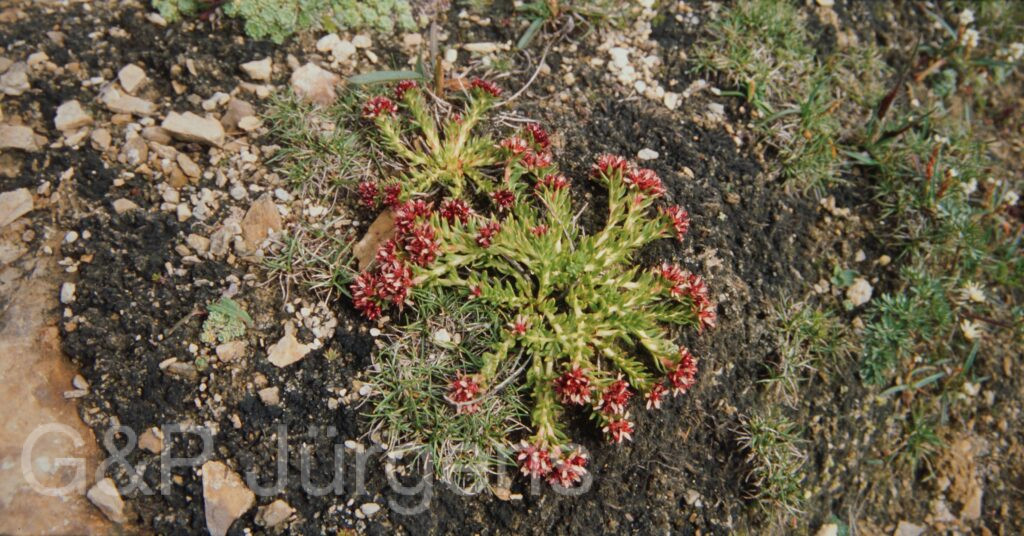
Rhodiola smithii is a cushion-forming succulent of the highest Himalayan and Tibetan altitudes, recorded by GBIF (145 occurrences) from China, Nepal and Bhutan (CN, NP, BT). It is a true alpine to subnival plant of rock crevices, screes, moraines and stony turf, enduring intense radiation, wind, frost and a very short growing season. The illustrated population from the Kagmara-La in West Nepal at about 5500 m in July is exceptional in elevation, lying near the upper limit of vascular plant life and exemplifying the extreme high-alpine niche this species occupies, generally between roughly 4500 and 5600 m.
It is a low, tufted perennial herb growing from a thick, woody, branched caudex clothed in persistent scarious old leaf-bases, the whole forming compact mats or cushions that minimise exposure. The flowering stems are short and crowded, bearing small, sessile, fleshy, oblong to linear-oblong leaves that are entire or minutely toothed. The flowers are aggregated in a dense terminal head or compact corymb; they are small, mostly 4-5-merous and unisexual on dioecious plants, with narrow petals ranging from yellowish to deep red or purplish. The fruit comprises a cluster of small erect follicles producing minute seeds.
Within the Sino-Himalayan genus Rhodiola, R. smithii belongs to the dwarf, densely caespitose species adapted to the coldest, most exposed alpine and subnival habitats. Its cushion habit, perennating woody rootstock and dioecy are convergent strategies of high-mountain succulents. Like its congeners it accumulates the bioactive compounds that drive medicinal harvesting of 'golden root', and its restriction to a narrow, climatically marginal high-elevation band makes it especially exposed to warming-driven habitat loss.
Author: (Raym.-Hamet) S.H. Fu · Sources: POWO (Kew), GBIF, Flora of China, Annotated Checklist of the Flowering Plants of Nepal, Ohba Monograph of the Genus Rhodiola, Crassulaceae of the Himalaya