
(Hook.f. & Thomson) Botsch.
Description
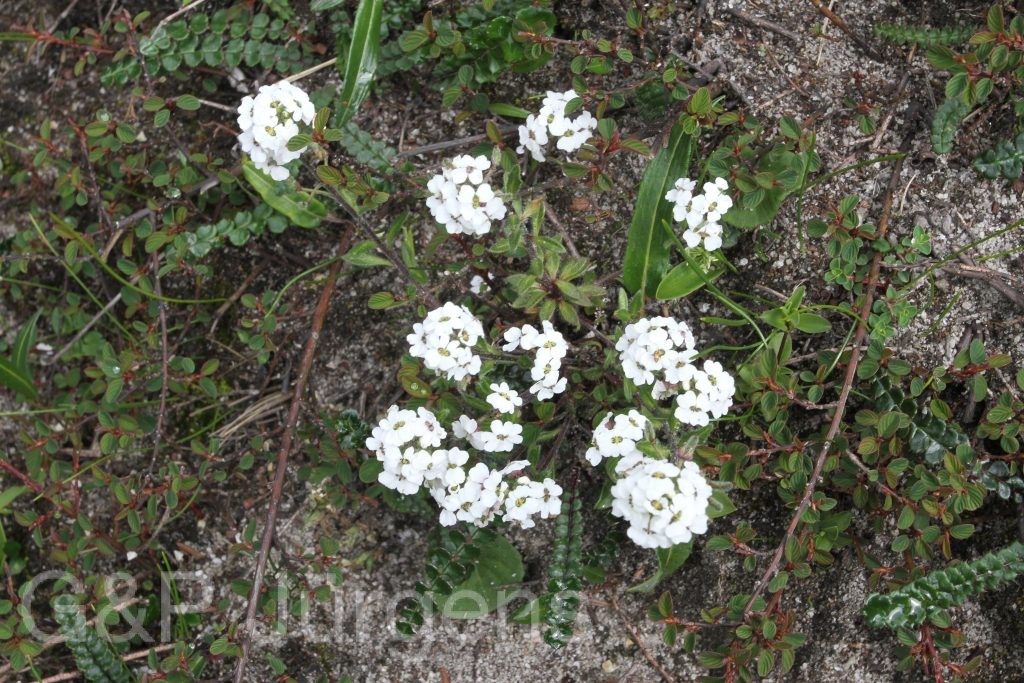
Solms-laubachia platycarpa is a high-alpine crucifer of the eastern Himalaya and the Hengduan-Tibetan region, recorded from China, India and Bhutan, with only about 26 GBIF occurrences reflecting its restricted, hard-to-reach habitat. It is a true cushion-plant of the upper alpine zone, growing among scree, gravel, rock crevices and stony turf, typically above about 3500 m and often to well over 4000 m. The plant shown from Tsochenchen in Bhutan at 3700 m, flowering in June, occupies the exposed, frost-prone substrates characteristic of the genus.
It is a low, densely tufted perennial herb with a stout, branched woody caudex clothed in the persistent petiole-bases of former leaves and topped by rosettes of small, entire, fleshy, oblanceolate to spathulate leaves. The flowers are borne singly or few on short scapes scarcely exceeding the leaf cushions and have four white to pale lilac or purplish petals in the typical cruciferous arrangement. The diagnostic fruit is a flattened, broadly elliptic to orbicular, latiseptate silicula with a persistent style and a few large seeds, the broad flat silique giving the epithet platycarpa.
Solms-laubachia (combined by Botschantzev from Hooker & Thomson's basionym) is a small genus centred on the Qinghai-Tibetan Plateau, allied to Desideria and the alpine Crucifereae; molecular work has clarified its boundaries within tribe Euclidieae. Restricted to fragile high-alpine substrates, such narrowly distributed cushion crucifers are potentially vulnerable to climate-driven habitat contraction and merit monitoring.
Author: (Hook.f. & Thomson) Botsch. · Sources: POWO (Kew), GBIF, Flora of Bhutan, Flora of China, Yue et al. systematics of Solms-laubachia