Tag:

Bhutan

Flowers of Bhutan — 1326 plant species documented across the Bhutanese Himalaya, from dense broadleaf and conifer forests to alpine scrub and meadows. Bhutan’s largely intact wilderness shelters an exceptional diversity of orchids, rhododendrons, primulas and Himalayan poppies, many of them regional endemics. Each species page includes a botanical description, distribution, habitat and flowering time, with the original photograph and its recorded altitude and locality.

D.Don

Sikkim2003 363 P512
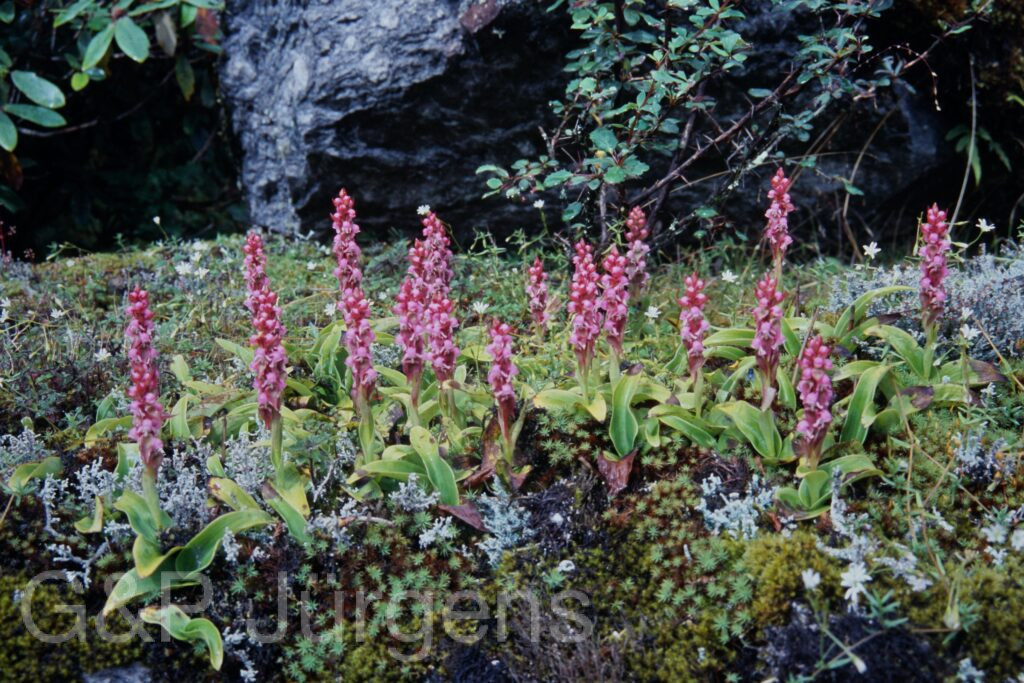
Sikkim Lachen Tista Tal 3450m August
Sikkim2003 364 P511
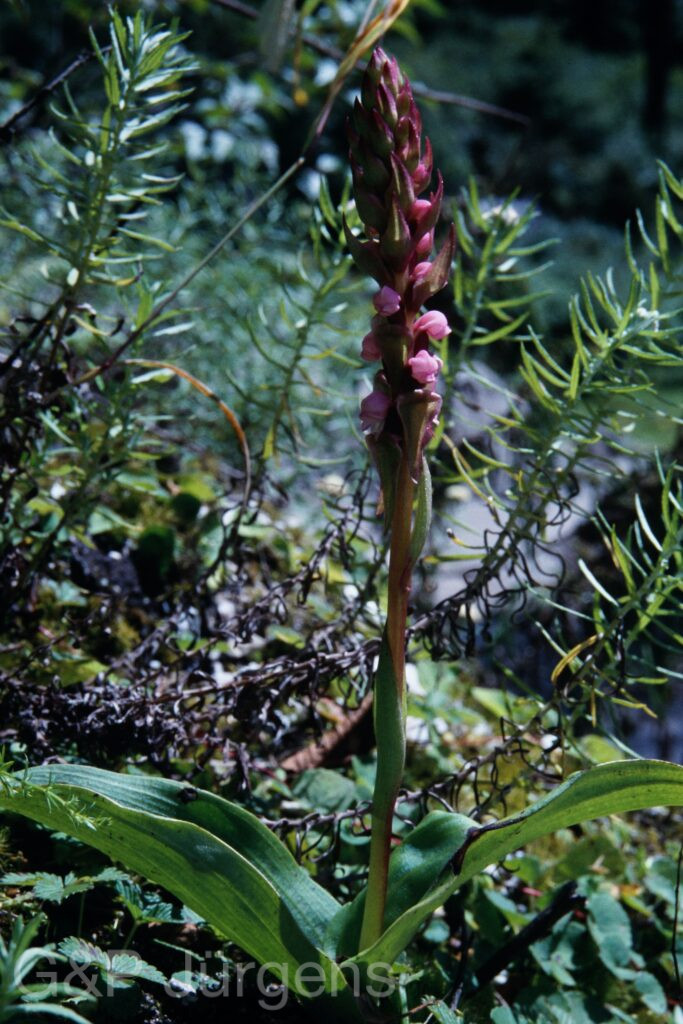
Sikkim Lachen Tista Tal 3450m August
Nepal 95 100 P178 ergebnis
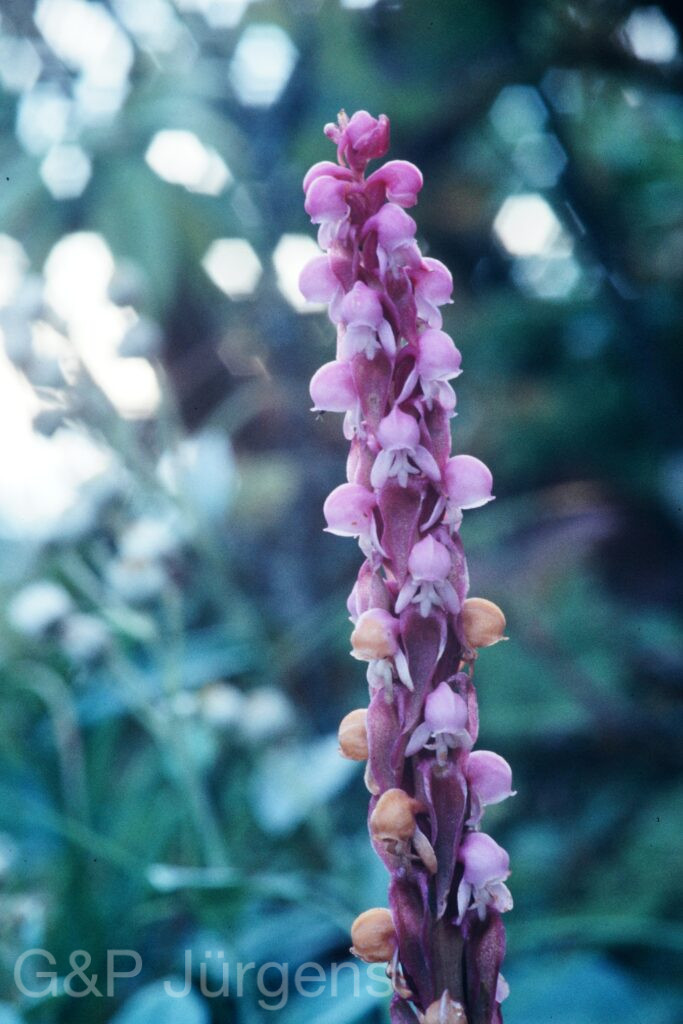
Nepal Barphak 2450m October
Nepal 95 135 P228 ergebnis
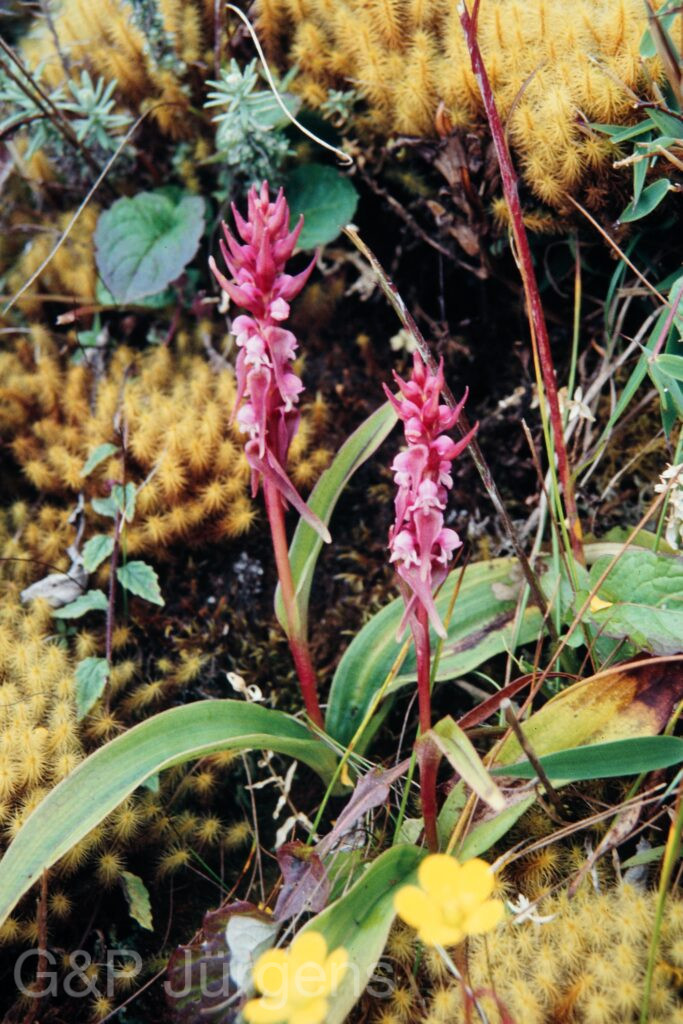
Nepal Barphak 2450m October

Description

Satyrium nepalense D.Don is a terrestrial orchid of remarkably wide distribution, ranging across the Himalaya and southern Asia from Pakistan, India, Nepal, Bhutan, Sri Lanka and southern China to Myanmar, and extending through tropical and southern Africa; GBIF records nearly 1921 occurrences, reflecting its broad ecological tolerance. It grows in open grassy slopes, meadows, scrub and forest clearings from the submontane belt to high alpine pastures, broadly between about 1500 and 3700 m. The cited material from Lachen in Sikkim at 3450 m in August and Barphak in central Nepal at 2450 m in October illustrates its long flowering season across a wide altitudinal range.

The species is a terrestric herb arising from paired ovoid, tomentose tubers, with an erect leafy stem bearing a few ovate to lanceolate sheathing leaves. The inflorescence is a dense cylindrical raceme of many small, pink to rose-purple, fragrant flowers; each flower is non-resupinate, with the lip uppermost and produced into two slender, parallel spurs at its base, a diagnostic feature of the genus. The fruit is a small dehiscent capsule releasing abundant dust-like seeds.

Satyrium (Orchidaceae, subtribe Satyriinae) is a chiefly African genus with an outlying Asian representation, of which S. nepalense is the most widespread; its twin-spurred, non-resupinate flowers and moth pollination are characteristic. Valued in traditional medicine for its tubers, the species is locally collected, and although still common it warrants monitoring where harvesting pressure is intense.

Author: D.Don · Sources: POWO (Kew), GBIF, Flora of Bhutan, Flora of China, Orchids of Sikkim Himalaya, Pridgeon et al. Genera Orchidacearum

DC.

Bhutan2012 757
Bhutan Zemgang 1200m, October
Bhutan2012 758
Bhutan Zemgang 1200m, October

Description

Saurauia napaulensis is a subtropical tree or large shrub widely distributed through the southern Himalaya and Southeast Asia, with abundant GBIF occurrences in China, Nepal, India, Bhutan, Bangladesh, Myanmar, Thailand, Laos, Vietnam, Malaysia and Sri Lanka. It is a frequent component of moist subtropical broad-leaved forest, secondary forest, ravines and stream sides, generally between 600 and 2,100 m. The photographed individual was recorded at Zhemgang in central Bhutan at about 1,200 m in October, within the warm mid-hill belt where the species is a conspicuous understorey and gap-colonising tree.

The plant is a small evergreen tree, typically with stout twigs and young parts clothed in scaly or bristly indumentum characteristic of the genus. The leaves are large, alternate, oblanceolate to elliptic, leathery, with serrate margins and prominent lateral venation, the lower surface bearing scattered scales or appressed setae. The flowers are borne in branched axillary panicles; each is five-merous with white to pink, somewhat cup-shaped petals, numerous stamens, and several distinct or basally united styles. The fruit is a small, fleshy, depressed-globose, greenish to whitish berry containing many minute seeds, attractive to birds and other animal dispersers.

Saurauia is the only genus of Actinidiaceae with a wide Old World tropical distribution, the family also containing the kiwifruit genus Actinidia, and the scaly indumentum and many-styled flowers are diagnostic. Saurauia napaulensis is among the most common and widespread Asian species, used locally for fuel, fodder and edible fruit. It is abundant, regenerates readily in disturbed ground, and is not of conservation concern.

Author: DC. · Sources: POWO (Kew), GBIF, Flora of China Vol. 12 (Actinidiaceae), Grierson & Long: Flora of Bhutan Vol. 2, Hunter: Revision of the Asian species of Saurauia

(Wall. ex Schott) Cusimano & Hett.

Nepal 99 241 ergebnis
West-Nepal Tallekh 3000m, June
Nepal 2009 97 ergebnis
Nepal Helambu Samathang 2410, May

Description

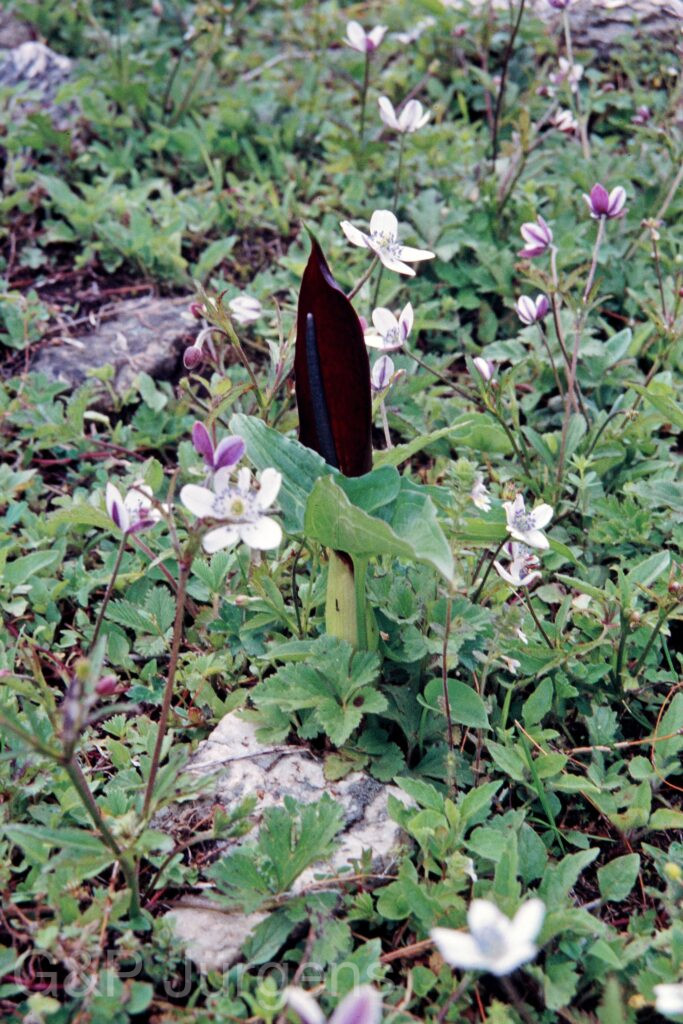
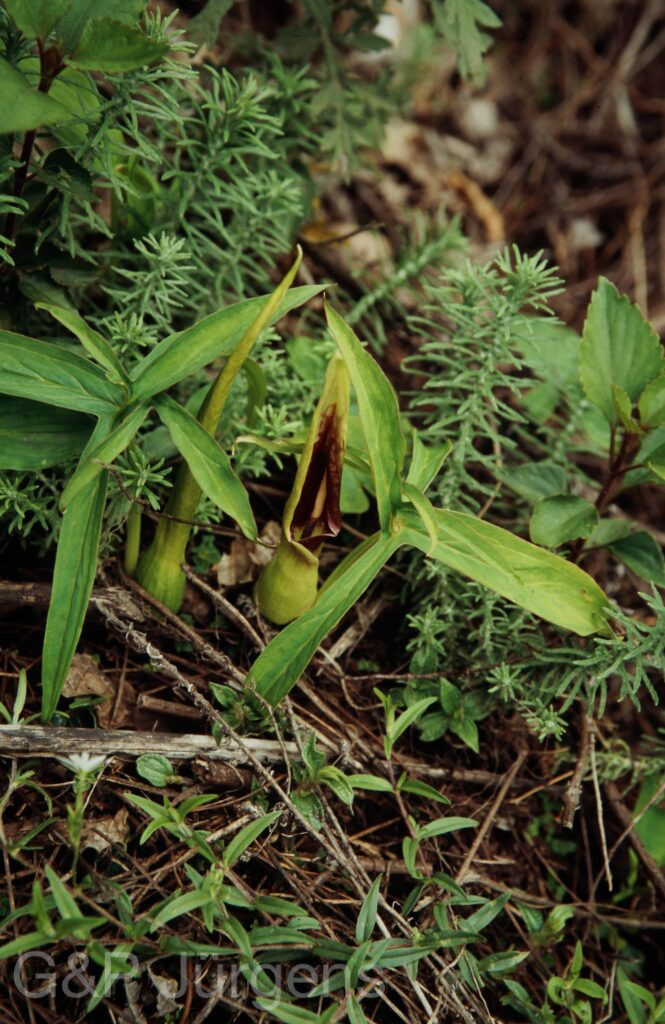
Sauromatum diversifolium is a tuberous aroid of the Himalaya and adjacent uplands, distributed through India, China, Nepal, Bhutan, Myanmar and Thailand, with around 146 recorded occurrences. It grows in moist temperate forest, on shaded banks, in open grassy slopes and among rocks where seasonal soil moisture is reliable, emerging with the onset of the warm season and dying back to its tuber during the dry winter. In Nepal it occupies the middle to upper montane zone, as shown by collections from Tallekh in the west at about 3000 m in June and from Samathang in the Helambu region at 2410 m in May, the latter dates coinciding with its early-season flowering.

The plant arises from a subglobose, depressed tuber and typically produces a single long-petiolate leaf whose blade is deeply pedately divided into several lanceolate to elliptic segments, the lobes acuminate and the petiole often mottled. The inflorescence is a typical aroid spadix subtended by a spathe, the spathe tube convolute and the limb expanded, lanceolate and often dull purple or marked within. The spadix bears a sterile terminal appendix above separated zones of female and male flowers, and emits a faint odour at anthesis to attract small dipteran and beetle pollinators. The fruiting head is a cluster of small berries.

The species was transferred to Sauromatum by Cusimano and Hettich on molecular and morphological evidence that united the former Typhonium diversifolium with the saururoid lineage. The genus is protogynous and largely sapromyophilous, with thermogenic spadices that volatilise scent to lure pollinators into the floral chamber. Widespread and locally frequent in suitable montane habitat, S. diversifolium is not regarded as threatened, though like many tuberous aroids it is sensitive to grazing pressure and the loss of forest-edge microhabitats.

Author: (Wall. ex Schott) Cusimano & Hett. · Sources: POWO (Kew), GBIF, Flora of China Vol. 23, Flora of Bhutan Vol. 3, Flora of Nepal, Cusimano et al. molecular phylogeny of Areae (Araceae)

(Decne.) Sch.Bip.

Garw 2005 170 ergebnis
India Garhwal Simka 2800m, October

Description

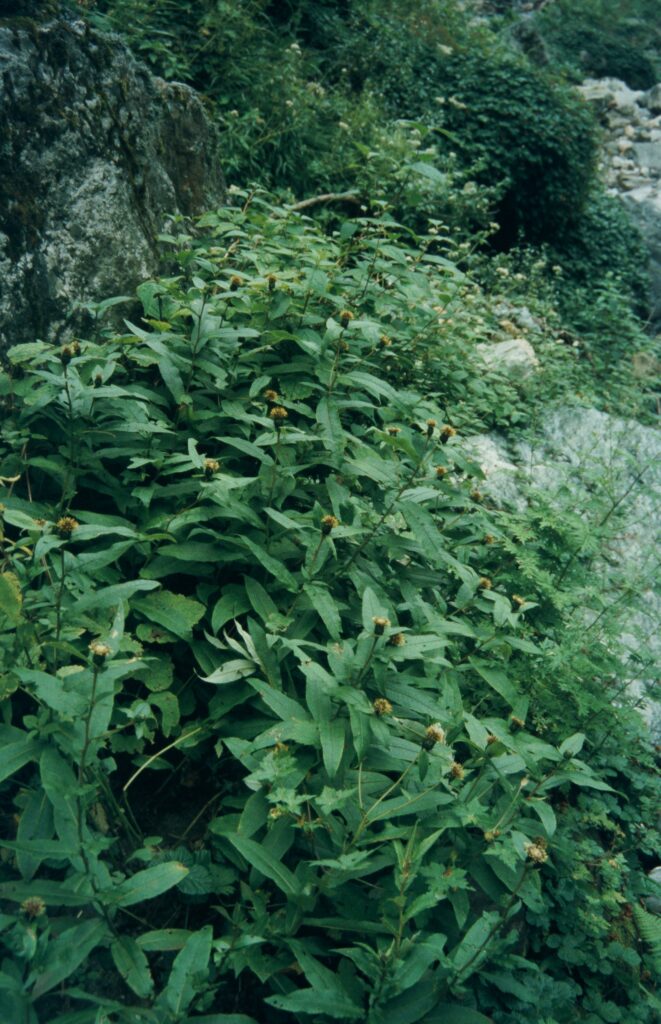
Saussurea fastuosa is a Sino-Himalayan species distributed across the high mountain ranges of China, India, Nepal and Bhutan, with around 94 georeferenced occurrences documenting a coherent eastern Himalayan to southwest Chinese range. It is a plant of temperate and subalpine zones, favouring forest margins, moist grassy slopes, scrub and stream banks, typically between roughly 2500 and 3800 m. The photographed material from Simka in Indian Garhwal at 2800 m, flowering in October, is representative of its autumn-flowering behaviour in the western part of its range, where it occupies cool, humid clearings within mixed conifer and broad-leaved forest.

It is a robust perennial herb with an erect, leafy, often glandular-pubescent stem arising from a stout rootstock. The leaves are alternate, the lower ones petiolate and lyrate-pinnatifid to broadly ovate, the upper progressively smaller, sessile and somewhat amplexicaul, with dentate margins and a thinly arachnoid-hairy lamina beneath. The capitula are medium-sized and aggregated in a corymbose synflorescence, each surrounded by an ovoid to campanulate involucre of imbricate, often purple-tinged, frequently squarrose phyllaries. The florets are all tubular and purple; the achenes are glabrous and crowned by a double pappus, the outer row scabrid and caducous, the inner of plumose, basally connate bristles.

Within the very large and taxonomically complex genus Saussurea, this species belongs to the broad-leaved, lowland-to-subalpine assemblage rather than the cushion-forming snow lotuses of the highest alpine zone. The name S. fastuosa (Decne.) Sch.Bip. is the accepted name. As an entomophilous late-season nectar source it is visited by bumblebees and other long-tongued insects, and like its congeners it disperses by anemochory via the plumose pappus. It is locally frequent and not regarded as threatened.

Author: (Decne.) Sch.Bip. · Sources: POWO (Kew), GBIF, Flora of China Vol. 20-21, Flora of Bhutan Vol. 2, Flora of Nepal, Lipschitz Genus Saussurea (monograph)

Wall. ex DC.

Garw 2005 328 ergebnis
India Garhwal Bagubasa 4100m, September

Description

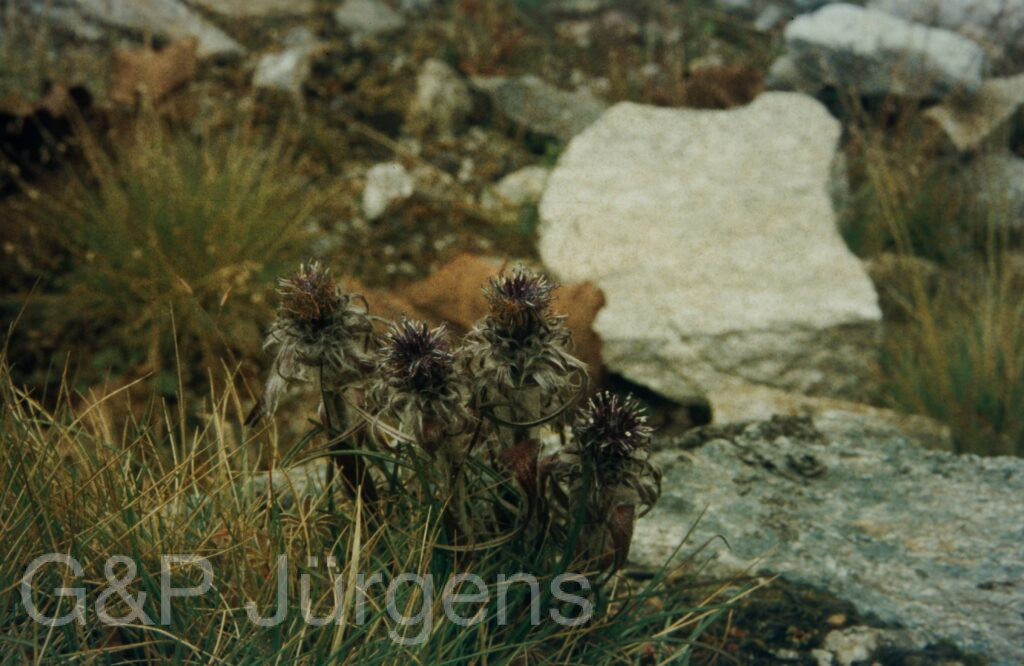
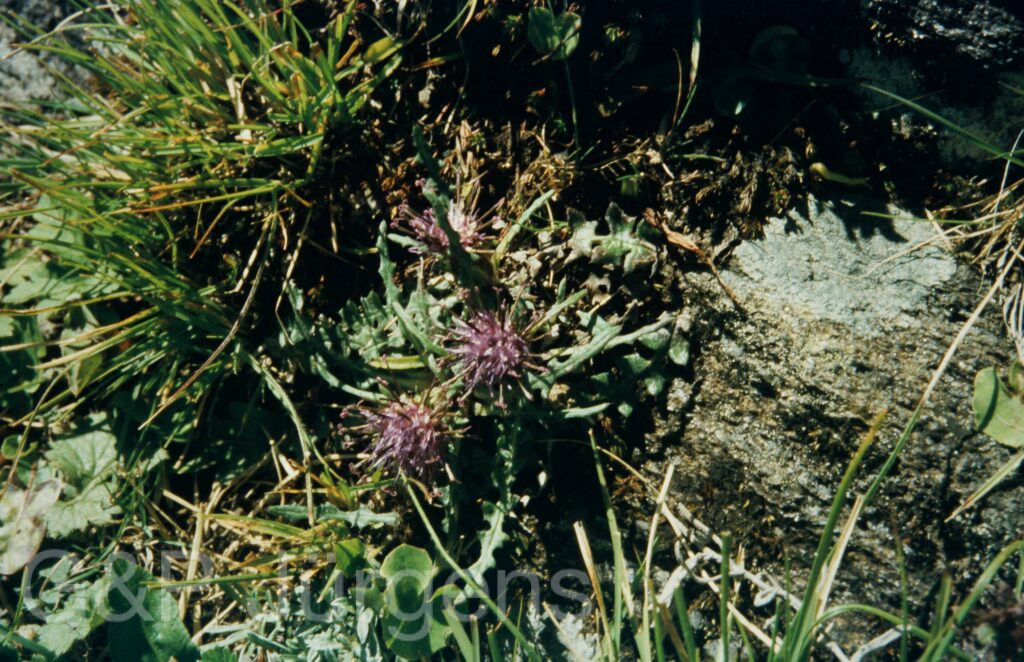
Saussurea graminifolia is a high-alpine composite of the Himalaya and Tibetan borderlands, distributed across Nepal, India, China and Bhutan, with about 127 GBIF occurrences. It is a true plant of the upper alpine zone, occupying screes, fine gravel, glacial moraine, stony meadows and exposed ridges generally above 4000 m and reaching well over 4500 m. The collection from Bagubasa in Garhwal, India, at 4100 m in September corresponds to its late-season flowering, when these wind-swept slopes near the limit of vascular plant life carry the characteristic cushion and rosette flora of the region.

It is a low, tufted perennial herb growing from a stout rootstock, with very narrow, grass-like (graminifolious) basal leaves that form a dense rosette, the epithet alluding to this distinctive linear foliage. One or few short scapes bear a cluster of capitula crowded among the leaves and often partly enveloped by them. The flower heads are discoid, containing only tubular florets that are purple to violet, surrounded by overlapping involucral bracts. As in Saussurea generally the fruit is an achene topped by a pappus of feathery (plumose) inner bristles and shorter outer ones.

Saussurea belongs to tribe Cardueae of the Asteraceae and is a hallmark genus of the Sino-Himalayan alpine zone, where many species show adaptations such as woolly indumentum or translucent bracts (the "snowball" and "glasshouse" plants) that buffer the harsh, cold, high-radiation environment. Though not formally threatened, such specialised high-elevation endemics are sensitive to climate warming and to harvesting where Saussurea species are used medicinally.

Author: Wall. ex DC. · Sources: POWO (Kew), GBIF, Flora of China, Flora of Bhutan, Saussurea monograph (Lipschitz)

(DC.) Sch.Bip.

Garw 2005 104 ergebnis ergebnis
India Garhwal Gaushon 3200m, September
Nepal 95 160 P261 ergebnis
Nepal South of Rupina La October

Description

Saussurea leontodontoides is a widespread high-alpine composite of the Himalaya and the Tibetan plateau, distributed through China, India, Nepal, Myanmar and Bhutan and well documented with some 683 GBIF records. It colonises stony alpine slopes, screes, gravelly pastures and open turf, generally between about 3000 and 5000 m. The cited material from Garhwal at Gaushon (3200 m, September) and from south of the Rupina La in Nepal (October) illustrates its broad longitudinal range and its late-summer to autumn flowering, when the rosettes persist on exposed, well-drained substrates baked by intense montane sun and chilled by night frosts.

The plant is a low, more or less stemless perennial herb forming a flat basal rosette from a stout, often woody taproot. The leaves, evoking those of Leontodon as the epithet implies, are oblanceolate in outline and deeply pinnatifid to runcinate, with the surfaces frequently grey-tomentose, and they spread radially against the ground. The capitula are sessile or shortly stalked at the rosette centre, solitary or few, with imbricate, often purple-tinged involucral bracts. The florets are all tubular (discoid) and purple to pink-purple, characteristic of the genus, and the cypselae bear a feathery, plumose pappus aiding wind dispersal.

Saussurea belongs to tribe Cardueae of the Asteraceae, and S. leontodontoides sits among the cushion- and rosette-forming alpine snow-line species adapted to extreme cold, desiccation and high irradiance. Its tap-rooted, ground-hugging habit and woolly indumentum are classic alpine survival traits. Pollination is by alpine insects, and the plumed achenes disperse readily on mountain winds. The species is common and not of conservation concern, though, like related Saussurea, it may be gathered locally for traditional medicinal use.

Author: (DC.) Sch.Bip. · Sources: POWO (Kew), GBIF, Flora of China (Asteraceae), Annotated Checklist of the Flowering Plants of Nepal, Lipschitz Saussurea monograph

(DC.) Edgew.

Sikkim2003 453 G623
Sikkim Chopta Valley 3800m August
Sikkim2003 451 P628
Sikkim Chopta Valley 3800m August

Description

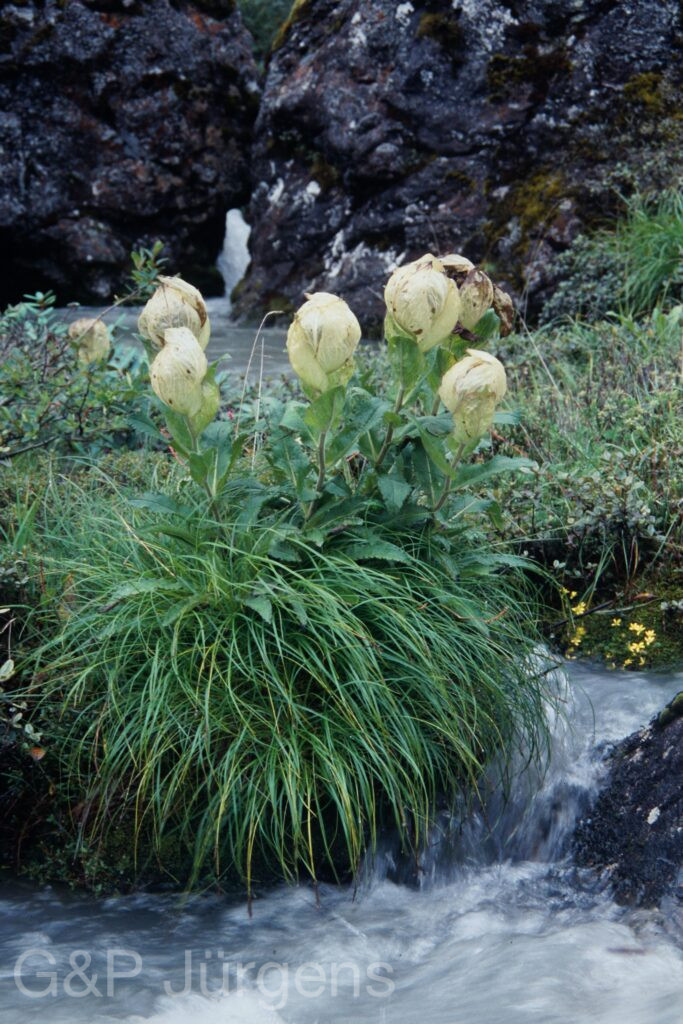
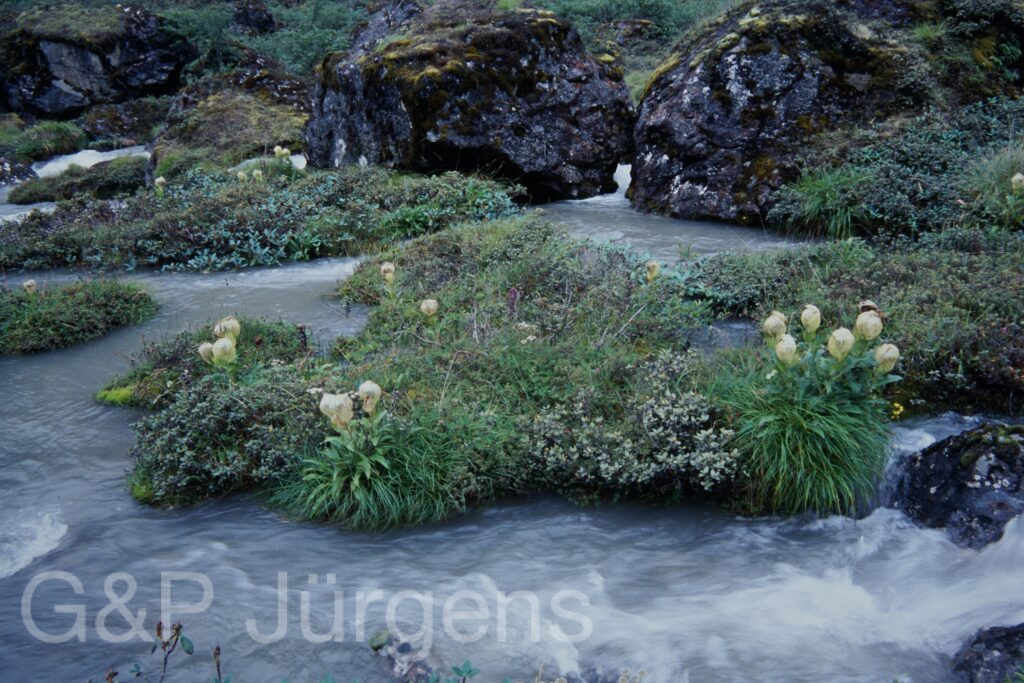
Saussurea obvallata is a high-alpine herb of the Sino-Himalayan region, distributed across the mountains of China, India, Bhutan, Nepal, Myanmar and Pakistan, with some 350 georeferenced records documenting a broadly continuous arc along the Greater Himalaya. It is a plant of open alpine meadows, moraines, scree slopes and rocky pastures, typically between about 3500 and 4800 m. The photographed material from the Chopta Valley in Sikkim at 3800 m, flowering in August, is characteristic of its preferred late-monsoon habitat on moist, well-drained alpine turf where snow lies long into early summer.

The species is a stout perennial arising from a thick taproot, with an erect, simple, leafy stem. The lower leaves are oblanceolate and dentate, narrowing to a winged petiole, while the upper leaves grade into membranous, pale, semi-translucent bracts that arch inward to enclose the inflorescence. These greenish-straw involucral bracts form the conspicuous globose to urn-shaped "lantern" that almost entirely hides the cluster of dark purple capitula within. The florets are tubular and purple-black, and the achenes bear a feathery, plumose pappus that aids wind dispersal.

The enclosing bract chamber is widely interpreted as an adaptation that buffers temperature, protects pollinating insects from cold and wind, and shelters developing florets at extreme elevation, a striking example of greenhouse-like alpine convergence shared with Rheum nobile. Long known in Himalayan tradition as the sacred "Brahma Kamal," the plant is heavily collected for ornament and medicine, and populations near pilgrimage routes face local pressure of regional conservation concern.

Author: (DC.) Edgew. · Sources: POWO (Kew), GBIF, Flora of China, Flora of Bhutan, Annotated Checklist of the Flowering Plants of Nepal, Lipschitz monograph of Saussurea

Hook.f.

Sikkim2003 307 P433
Sikkim Saniti-Lake 4250m August

Description

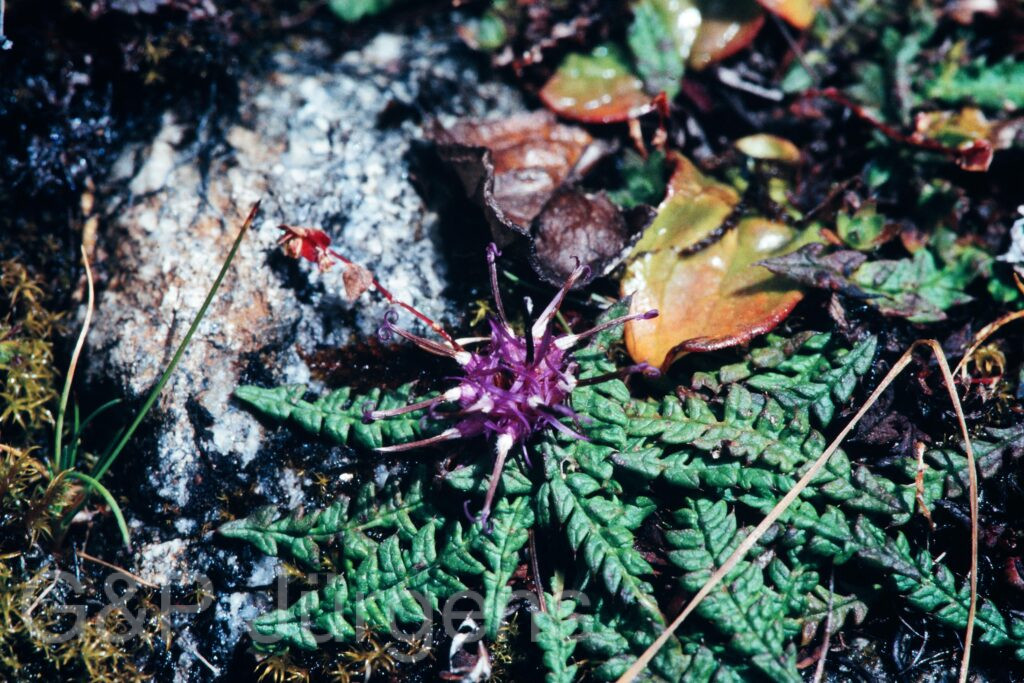
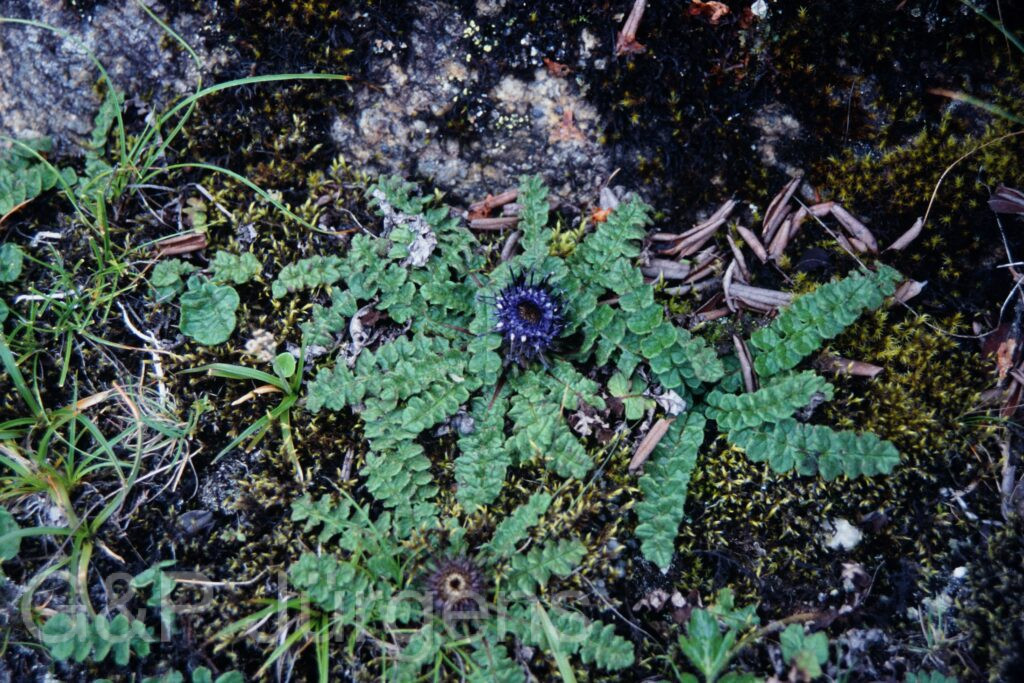
Saussurea polystichoides is a high-alpine perennial herb of the eastern and central Himalaya, recorded from Nepal, northern India, Bhutan and adjacent south-western China, with a small documented base of about 43 occurrences consistent with its restricted, high-elevation habitat. It grows on open alpine turf, screes, moraines and rocky slopes, typically between roughly 4000 and 4800 m. The specimen shown was photographed near Saniti Lake in Sikkim at about 4250 m in August, when these short-season alpines flower during the brief post-monsoon window above the treeline.

The plant is a low, cushion-forming or tufted herb arising from a stout caudex clothed in old leaf bases, the name polystichoides alluding to the fern-like, many-ranked rosette of finely divided leaves. The leaves are pinnately lobed to pinnatisect, narrow and densely arranged, often white-woolly to give protection against cold and intense radiation. The capitula are sessile or shortly stalked and aggregated within the leaf rosette; each head bears tubular, purple to violet disc florets enclosed by imbricate, often lanate phyllaries. The fruit is a glabrous cypsela crowned by a feathery, plumose pappus.

Saussurea (Asteraceae, tribe Cardueae) is a large Asian genus particularly diversified in the high Himalaya and Tibetan Plateau, where many species have evolved dense indumentum or translucent bracts as adaptations to extreme alpine conditions. S. polystichoides belongs to the group of cushion- or rosette-forming saw-worts of the highest screes. Pollinated by alpine insects and wind-dispersed via its plumose pappus, it is a narrow-range, habitat-specialist endemic of conservation interest given its limited area and sensitivity to climatic warming.

Author: Hook.f. · Sources: POWO (Kew), GBIF, Flora of China, Flora of Bhutan, Annotated Checklist of the Flowering Plants of Nepal, Lipschitz monograph of Saussurea

(Fielding & Gardner) Lipsch.

Garw 2005 337 ergebnis
India Garhwal Bagubas 4150m, October
Garw 2005 336 ergebnis
India Garhwal Bagubas 4150m, October

Description

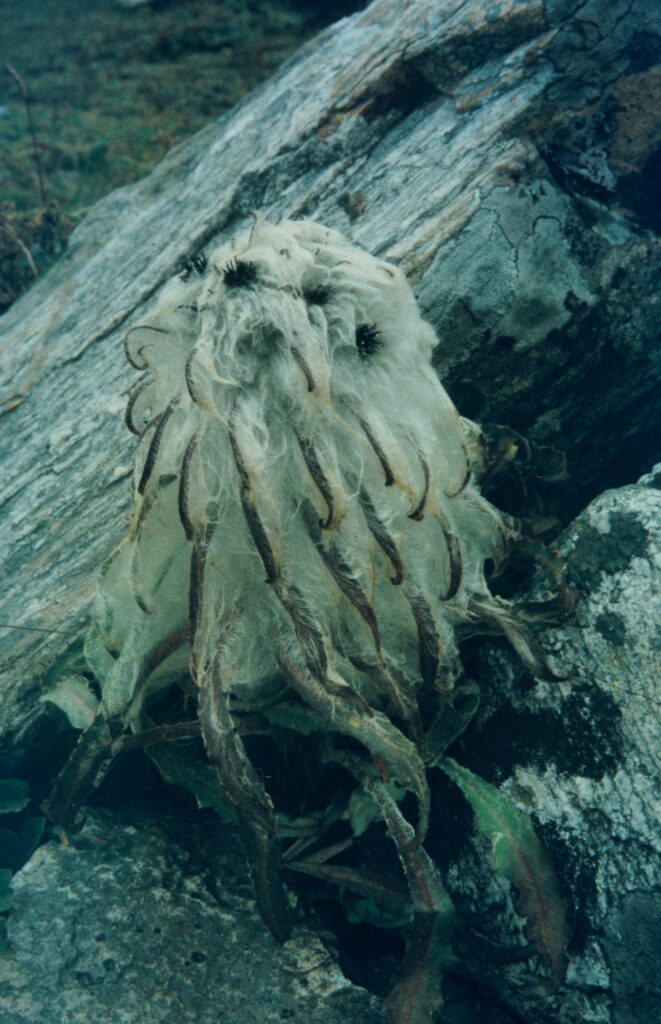
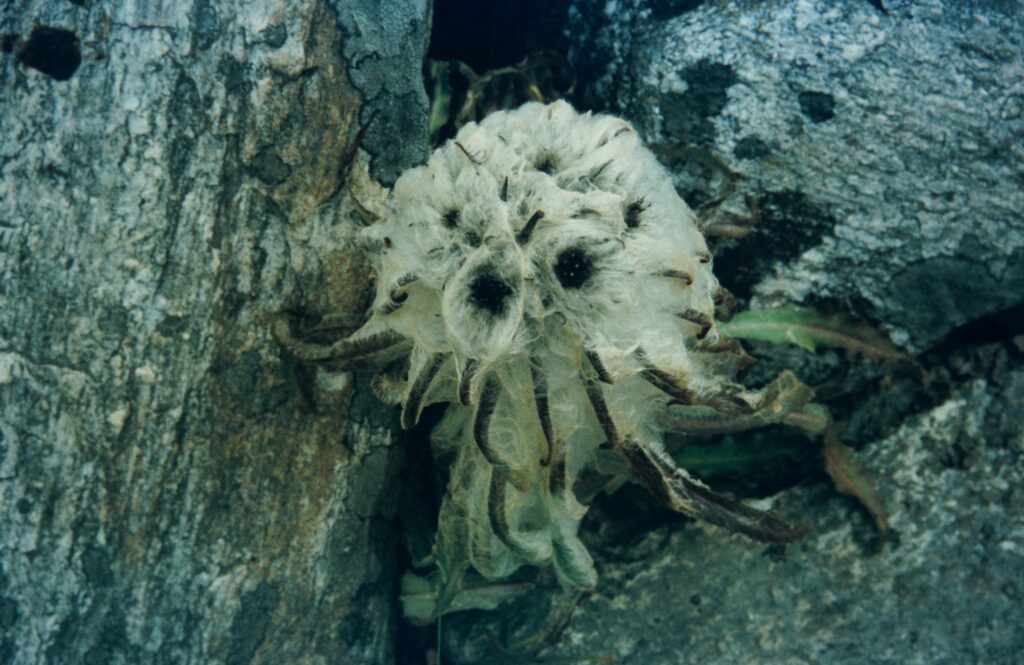
Saussurea simpsoniana is a high-alpine cushion thistle of the Himalaya and adjacent ranges. GBIF documents it from Nepal, India, China, Pakistan and Bhutan, with around 260 occurrences concentrated along the main Himalayan axis. It inhabits open stony slopes, screes, glacial moraines and alpine turf, typically between 4000 and 5500 m, often in the uppermost zone where vascular plant life thins out. The collection figured here was made at Bagubas in Garhwal, northern India, at 4150 m in October, late in the alpine season when the plant persists as a dense persistent rosette.

It forms a compact, stemless or short-stemmed perennial with a thick taproot and a rosette of oblanceolate, white-woolly leaves. The capitula are aggregated into a dense terminal cluster nestled among the leaves and enveloped by long, dense, silky-white lanate hairs that form a protective woolly mass. Individual florets are tubular and purple, with bristly pappus; the involucral bracts are concealed within the wool. This dense indumentum, characteristic of the snowball saussureas, traps heat and shelters the developing achenes from intense ultraviolet radiation, desiccation and frost.

The species belongs to Saussurea subgenus Amphilaena, the woolly snowball group whose adaptations to extreme altitude have made them classic subjects of alpine ecophysiology. The woolly bracts elevate floral temperatures and attract the few high-altitude pollinators active in this environment. Widely collected for Tibetan and Ayurvedic medicine, several relatives in this group face harvesting pressure; although S. simpsoniana is not formally assessed as threatened, its restricted high-elevation habitat warrants monitoring under warming alpine climates.

Author: (Fielding & Gardner) Lipsch. · Sources: POWO (Kew), GBIF, Flora of China, Flora of Pakistan, Annotated Checklist of the Flowering Plants of Nepal, A revision of the genus Saussurea (Asteraceae: Cardueae)

Maxim.

Sikkim2003 511 G712
Sikkim Yume Samdong 4600m August

Description

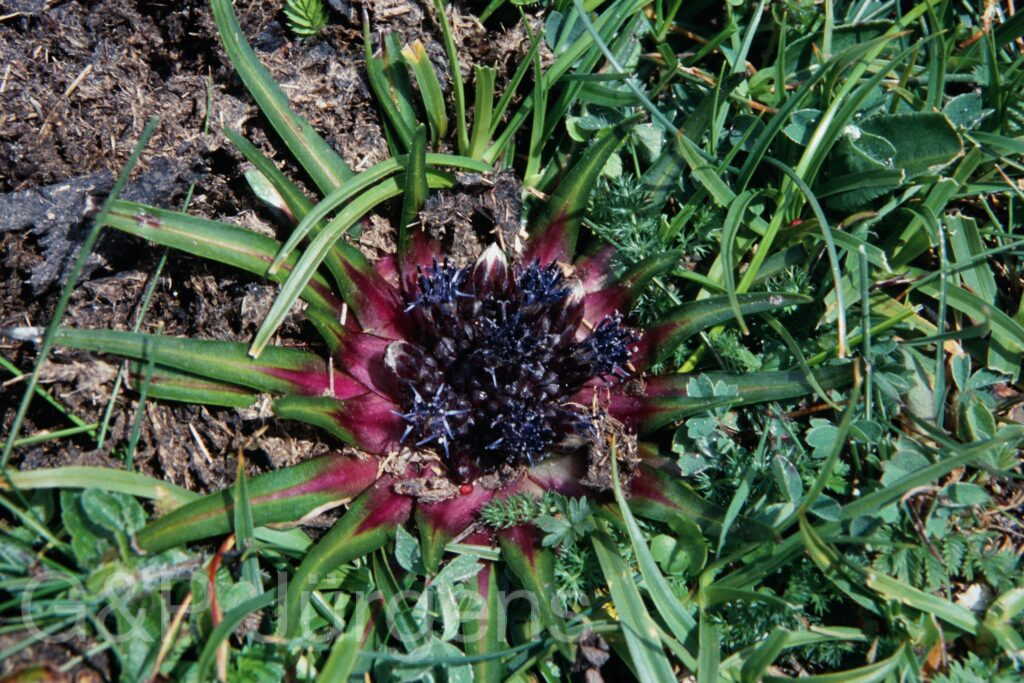
Saussurea stella is a high-alpine herb distributed across the eastern Himalaya and the Tibetan Plateau, recorded from China (Xizang, Yunnan, Sichuan, Qinghai, Gansu), Bhutan and India, with some 821 georeferenced occurrences documented in GBIF. It occupies open alpine meadows, marshy turf, gravelly flushes and the margins of glacial streams, typically between 3000 and 5400 m. The plant photographed at Yume Samdong in northern Sikkim at about 4600 m in August is characteristic of the wet, peaty seepage slopes the species favours during the monsoon, where it forms part of a low cushion-and-rosette sward exposed to intense radiation, nightly frost and a brief growing season.

The species is a stemless, near-acaulescent perennial forming a flat, star-shaped rosette pressed against the substrate from a stout taproot. The numerous lanceolate to linear leaves are glabrous, entire and often suffused with purplish-red, radiating symmetrically and giving the plant its epithet stella. The capitula are sessile and densely clustered at the rosette centre, each involucre with imbricate, purple-tinged phyllaries enclosing tubular purple florets; the corollas are deeply lobed and the anthers tailed at the base. Fruit is a glabrous cylindrical achene with a double pappus of short outer and longer plumose inner bristles.

A member of the large genus Saussurea (subtribe Saussureinae, tribe Cardueae), S. stella belongs to the rosette-forming, ground-hugging guild that recurs in Tibetan alpine floras as an adaptation to cold, windy, high-irradiance environments, the flattened habit and dark pigmentation enhancing heat capture and protecting against ultraviolet stress. Pollination is by alpine flies and bees, and the plumose pappus enables wind dispersal. Though not formally assessed as threatened and locally abundant, it is sensitive to grazing and the warming-driven contraction of alpine seepage habitats.

Author: Maxim. · Sources: POWO (Kew), GBIF, Flora of China, Flora of Bhutan, Lipschitz Monograph of Saussurea