Tag:

Bhutan

Flowers of Bhutan — 1326 plant species documented across the Bhutanese Himalaya, from dense broadleaf and conifer forests to alpine scrub and meadows. Bhutan’s largely intact wilderness shelters an exceptional diversity of orchids, rhododendrons, primulas and Himalayan poppies, many of them regional endemics. Each species page includes a botanical description, distribution, habitat and flowering time, with the original photograph and its recorded altitude and locality.

Hook. f.

Sikkim2003 317 P451
Sikkim Saniti-Lake 4300m August

Description

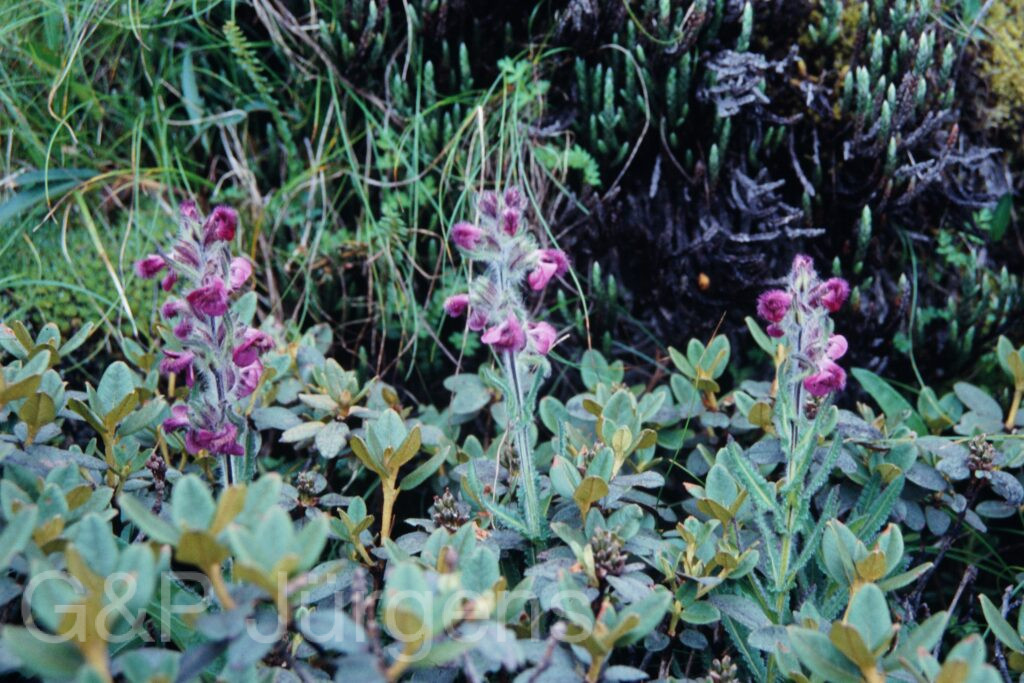
Pedicularis trichoglossa is a striking alpine lousewort of the Himalaya and Sino-Himalayan mountains, with 547 georeferenced records from China (CN), Nepal (NP), Bhutan (BT), India (IN) and Myanmar (MM). It is a plant of high alpine meadows, moist grassy slopes, streamsides and the margins of glacial lakes, typically between about 3500 and 4800 m. The population recorded at Saniti Lake in Sikkim at 4300 m in August is characteristic of its occurrence in damp, late-season alpine turf, where it flowers in the post-monsoon weeks alongside other high-elevation herbs. Its broad east-Himalayan distribution makes it a conspicuous element of the upper alpine flora.

It is an erect perennial herb with one to several simple or sparingly branched stems arising from a short rootstock. The leaves are alternate to subopposite, pinnatisect into many small, toothed segments, in the typical fern-like fashion of the genus. The flowers are crowded into a dense, elongate terminal spike, deep reddish-purple to wine-red, conspicuous against the foliage. Each strongly two-lipped corolla has a hooded, beaked galea formed by the upper lip, the beak conspicuously fringed with long purple hairs, a feature reflected in the epithet trichoglossa (hairy-tongued). The fruit is an oblique, beaked capsule containing several seeds.

Pedicularis (Orobanchaceae) is one of the largest and most diverse genera of the Himalayan alpine zone, where it has undergone remarkable radiation in floral form linked to bumblebee pollination; the hairy, beaked galea of P. trichoglossa is one such specialised adaptation. Like all members of the genus it is a hemiparasite, drawing water and nutrients from the roots of neighbouring plants via haustoria while retaining green, photosynthetic foliage. The species is widespread and frequent, of no conservation concern, but it is a valuable indicator of intact high-alpine meadow communities.

Author: Hook. f. · Sources: POWO (Kew), GBIF, Flora of China, Flora of Bhutan, Annotated Checklist of the Flowering Plants of Nepal, Prain and Tsoong monographic studies of Asian Pedicularis
?

Nepal 99 597 ergebnis
West-Nepal Churta-Khola 3800m, June

Description

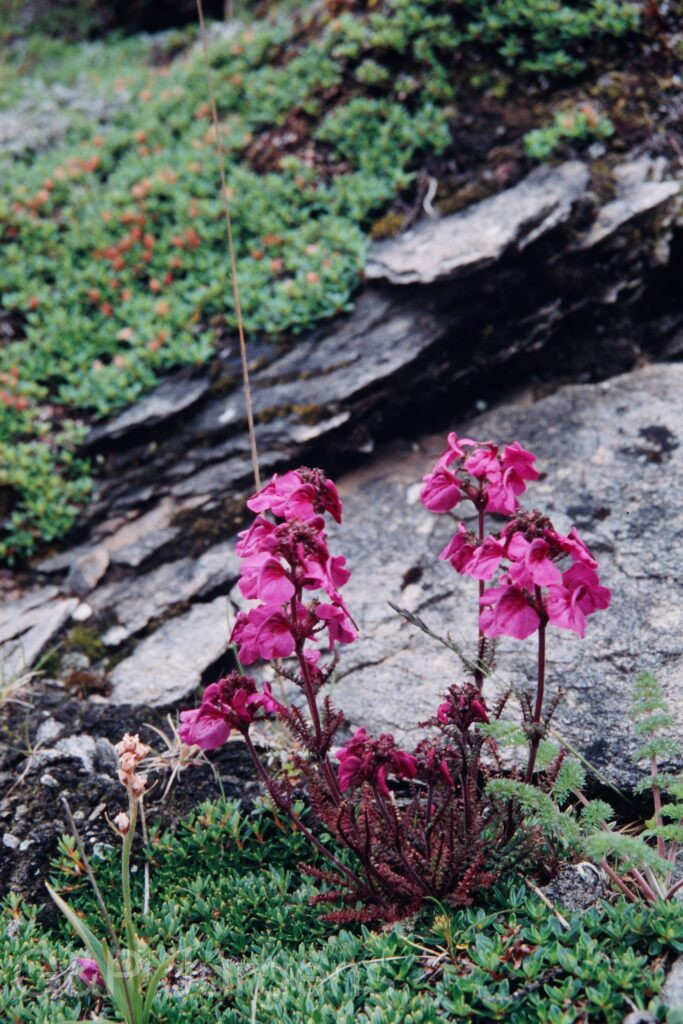
Pedicularis X denotes a Himalayan lousewort of uncertain or hybrid identity (the GBIF return resolves only to Plantae, with the global occurrence figure of over 634 million reflecting that kingdom-level match rather than the taxon itself, so distributional data here are uninformative). On evidence of the genus and the locality, it is a montane to alpine plant of moist meadows, scrub margins and tall-herb communities in the Western Himalaya. The image record from Churta-Khola in West Nepal at 3800 m, in June, places it in the early-summer subalpine-to-alpine zone where Pedicularis is most diverse and conspicuous.

Louseworts are perennial (sometimes annual) herbs with leaves that are typically alternate to whorled and pinnately divided into toothed segments, often fern-like in aspect. The flowers are borne in terminal spikes or racemes and are strongly zygomorphic: the calyx is tubular and toothed, and the bilabiate corolla has an upper lip (galea) frequently produced into a beak or rostrum enclosing the anthers, while the three-lobed lower lip forms a landing platform. Corolla colour ranges from pink and purple to yellow and white. The fruit is a flattened, often asymmetric capsule containing several seeds. Such floral architecture is adapted to pollination by long-tongued bumblebees.

Pedicularis (Orobanchaceae, formerly Scrophulariaceae) is a hemiparasitic genus of extraordinary richness in the Sino-Himalaya, where rapid radiation and frequent hybridisation produce taxonomically difficult complexes, consistent with the provisional designation here. As root hemiparasites the plants form haustorial connections to host roots, influencing meadow community composition. Firm identification requires examining galea form, leaf division and corolla details against regional monographs.

Author: ? · Sources: POWO (Kew), GBIF, Flora of Bhutan, Annotated checklist of the flowering plants of Nepal, Yamazaki revision of Asian Pedicularis

(G.Forst.) Hook. & Arn.

Bhutan2012 1010
Bhutan Trithangebe 1000m, October
Bhutan2012 1011
Bhutan Trithangebe 1000m, October
Sikkim 2006 472 ergebnis
India West-Bengal, Ruigi-Chu 2000m, May

Description

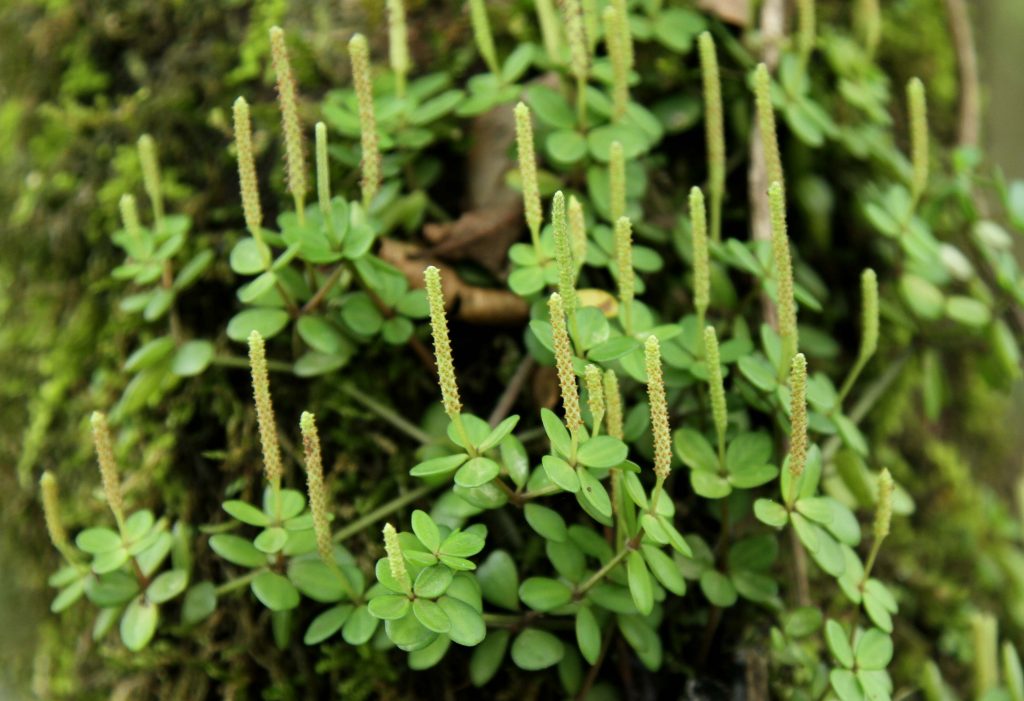
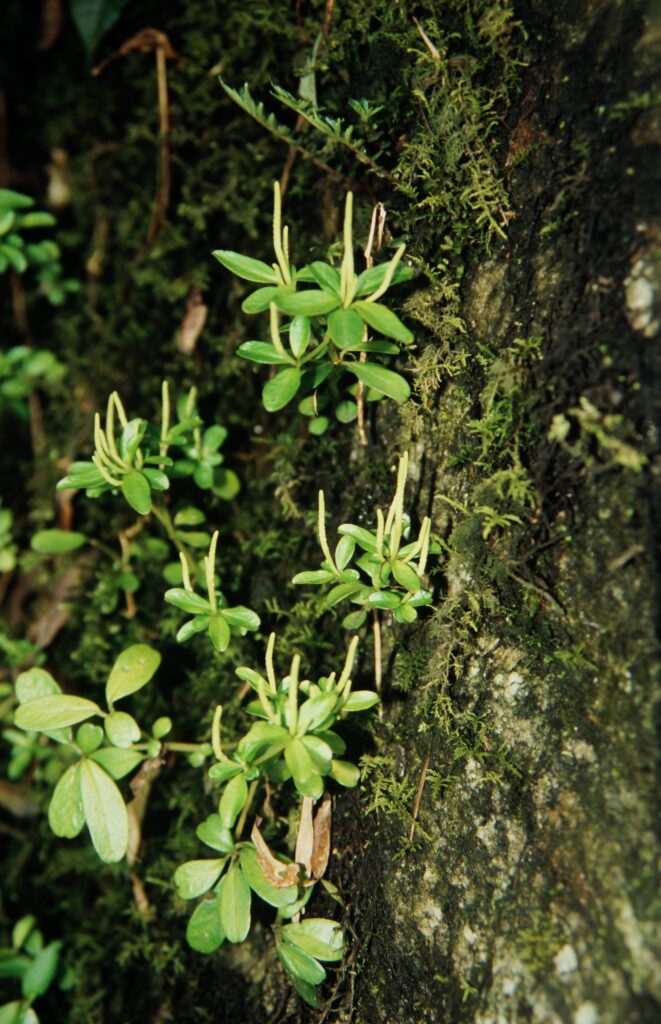
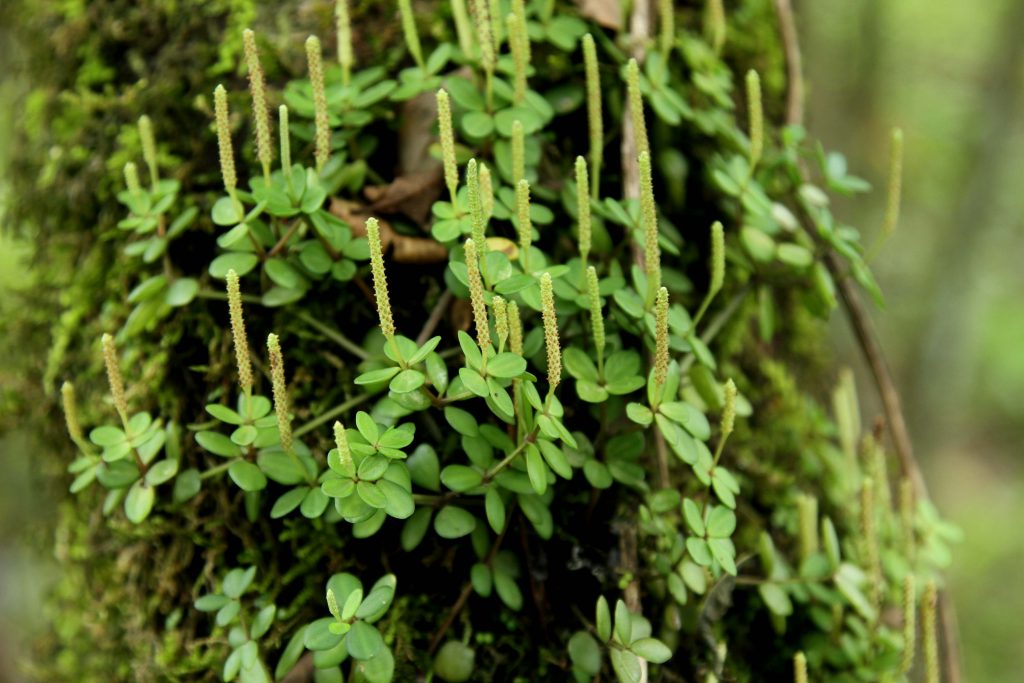
Peperomia tetraphylla is a small succulent herb of pantropical and warm-temperate distribution. GBIF (some 13,039 occurrences) documents it from the Americas (Brazil, Mexico, the United States, the Andes), Africa and the Indian Ocean islands, Asia (China, India, Indonesia, Taiwan) and Australasia, reflecting an extraordinarily wide range. It grows as an epiphyte on mossy trunks and as a lithophyte on shaded, humid rocks in forest. The illustrated plants are from Bhutan at Trithangbi (1,000 m, October) and West Bengal at Ruigi-Chu (2,000 m, May), spanning its Himalayan altitudinal range in moist broadleaved forest.

The plant is a fleshy, glabrous to finely pubescent herb with creeping then ascending stems rooting at the nodes. The leaves are succulent, characteristically borne in whorls of three to four (whence tetraphylla), small, elliptic to obovate and shortly petiolate. The inflorescence is a slender terminal or axillary spike of minute, naked, bisexual flowers lacking a perianth, each subtended by a peltate bract; the stamens are two and the stigma single. The fruit is a tiny ovoid drupelet, often borne sessile along the rachis.

Peperomia (Piperaceae) is a large pantropical genus, and P. tetraphylla is notable as one of its most widespread species, occurring on most continents. Its small succulent leaves and CAM-like physiology suit it to the seasonally dry, epiphytic microhabitats it occupies. Of no conservation concern given its vast range, it is locally used in folk medicine and is grown as a miniature ornamental, illustrating the cosmopolitan tropical element reaching into the lower Himalaya.

Author: (G.Forst.) Hook. & Arn. · Sources: POWO (Kew), Flora of China Vol. 4, Flora of Bhutan Vol. 1, GBIF, Wanke et al.: Phylogeny of Piperaceae

Lindl.

Sikkim2003 20 P24
Sikkim Rathong-Chu 1200m 08.2003
Sikkim2003 21 P25
Sikkim Rathong-Chu 1200m 08.2003

Description

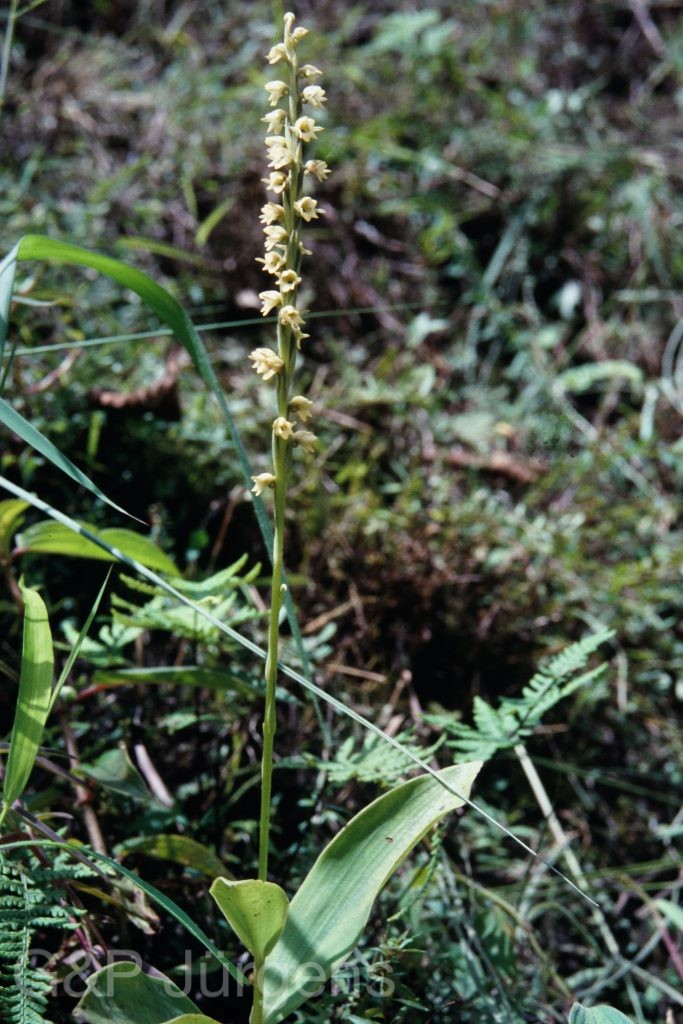
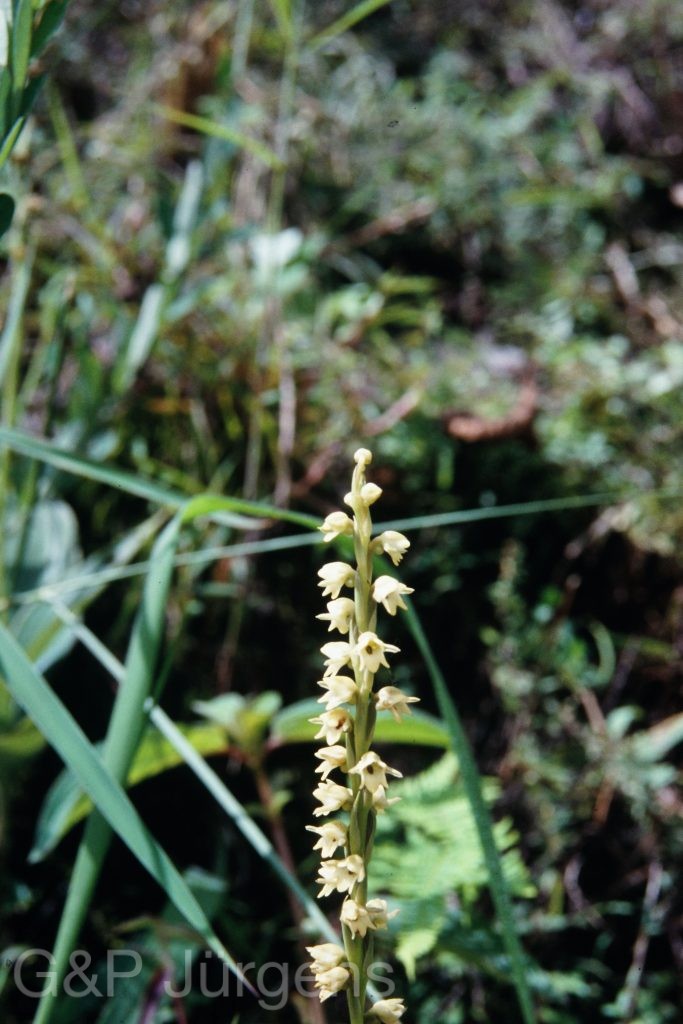
Peristylus goodyeroides is a terrestrial orchid with a broad tropical and subtropical Asian range, the 545 GBIF records spanning China, the Indian subcontinent, Nepal, Bhutan, much of Southeast Asia, Taiwan, Hong Kong, Japan, Timor-Leste and Papua New Guinea. It occupies grassy slopes, open forest, forest margins and scrub from the lowlands to around 2000 m. The photographed plant was found in the Rathong-Chu valley of Sikkim at 1200 m in August, during the monsoon flowering period typical of the species at lower Himalayan elevations.

It is a tuberous geophyte producing an erect leafy stem 20-60 cm tall from ellipsoid underground tubers. The few to several leaves are clustered toward the lower-middle stem, ovate to elliptic-lanceolate, acuminate and sheathing at the base. The inflorescence is a many-flowered cylindrical raceme of small, greenish-white to pale green flowers subtended by lanceolate bracts. Each flower has connivent sepals and petals forming a hood, a small three-lobed lip with a short saccate or conical spur, and the column structure characteristic of the genus, lacking the distinct rostellar arms of related Habenaria.

The genus Peristylus, long confused with Habenaria, is distinguished by its short blunt spur and small viscidia, and P. goodyeroides is the widespread type-like species of the group. Its inconspicuous greenish flowers are pollinated by small insects, and the tuberous habit allows it to survive the seasonal dry period. Given its wide distribution and tolerance of disturbed grassland, it is among the more common members of the genus and is not regarded as threatened, though, like all orchids, it is listed under CITES Appendix II.

Author: Lindl. · Sources: POWO (Kew), GBIF, Flora of China, Flora of Bhutan, Pridgeon et al.: Genera Orchidacearum

(Hook.f.) Ronse Decr.

Bhutan2012 20
Bhutan Shele-La, 3200m September
Bhutan2012 91
Bhutan Shele-La, 3200m September

Description

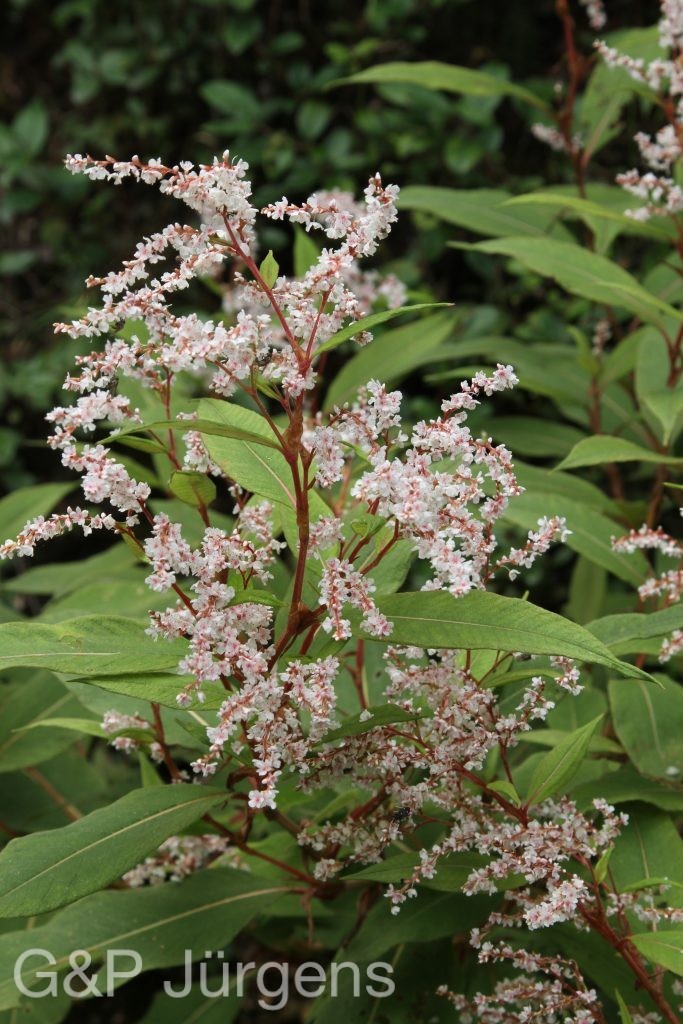
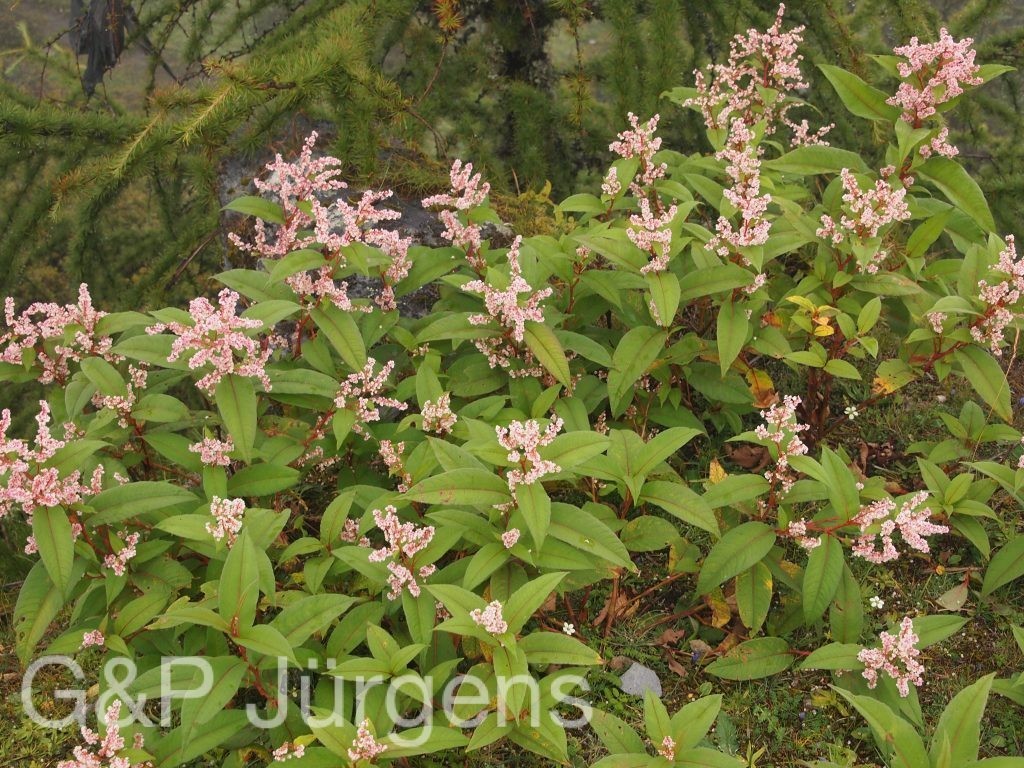
Persicaria campanulata is a clump-forming perennial of the eastern Himalaya and western China, also widely naturalised in temperate gardens elsewhere. GBIF records show its native range across China, Nepal and Bhutan, together with introduced populations in Ireland, Britain, Denmark and New Zealand, totalling around 66 occurrences. It grows on damp, shaded banks, woodland margins, streamsides and moist montane meadows, favouring cool, humid sites with reliable moisture. The photographed plant from the Shele-La in Bhutan at 3200 m, recorded in September, is characteristic of its occurrence in the upper temperate forest and subalpine zone, where it flowers into the late summer and autumn. GBIF lists the name as a synonym (the species having previously been placed in Aconogonon and Polygonum), but Persicaria campanulata is the currently accepted combination.

It is a rhizomatous, spreading herb with erect to ascending, branched stems. The leaves are ovate to elliptic-lanceolate, acuminate, often softly tomentose and pale beneath, with the membranous, tubular ochreae sheathing the nodes characteristic of the family. The flowers are small and bell-shaped, fragrant, borne in dense, branched terminal panicles; the campanulate perianth, from which the epithet derives, is pink to white with five lobes, enclosing eight stamens and a three-styled ovary. The fruit is a small, trigonous, brown achene.

The genus Persicaria comprises knotweeds segregated from a broadly defined Polygonum, distinguished by their fringed ochreae and spicate or paniculate inflorescences. P. campanulata is valued horticulturally for its long autumn flowering, but the same vigorous rhizomatous habit that makes it ornamental has allowed it to escape and naturalise, becoming locally invasive in damp ground in parts of the British Isles and New Zealand.

Author: (Hook.f.) Ronse Decr. · Sources: POWO (Kew), GBIF, Flora of Bhutan, Flora of China (Polygonaceae), Polygonaceae monograph (Brandbyge)

(Buch.-Ham. ex D.Don) H.Gross

Bhutan2012 949
Bhutan Tumching-La 2900m, October
Bhutan2012 950
Bhutan Tumching-La 2900m, October

Description

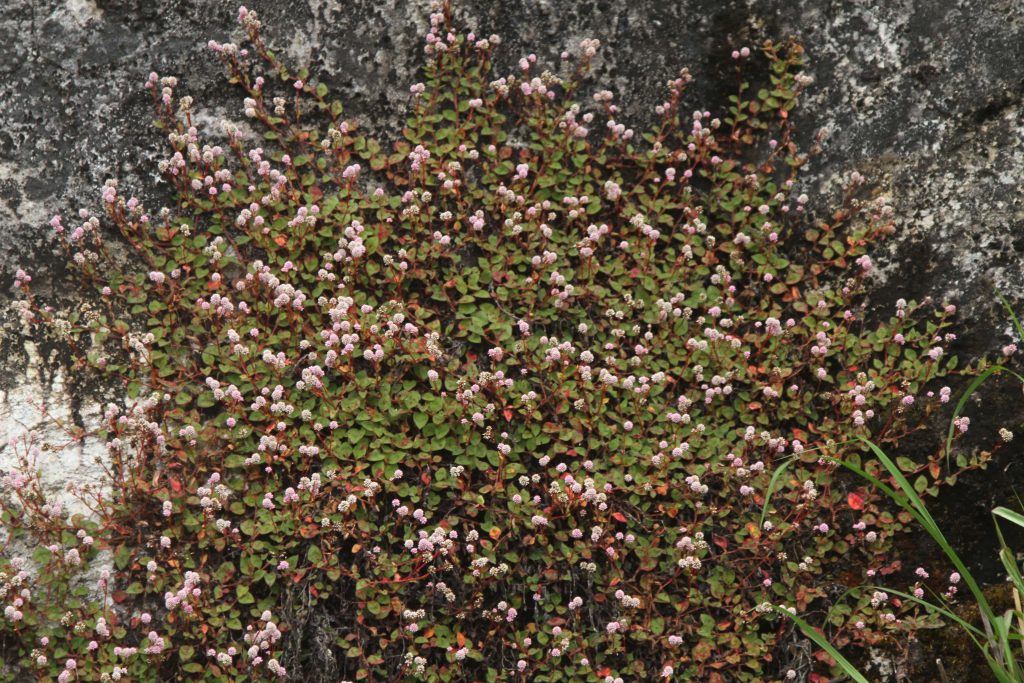
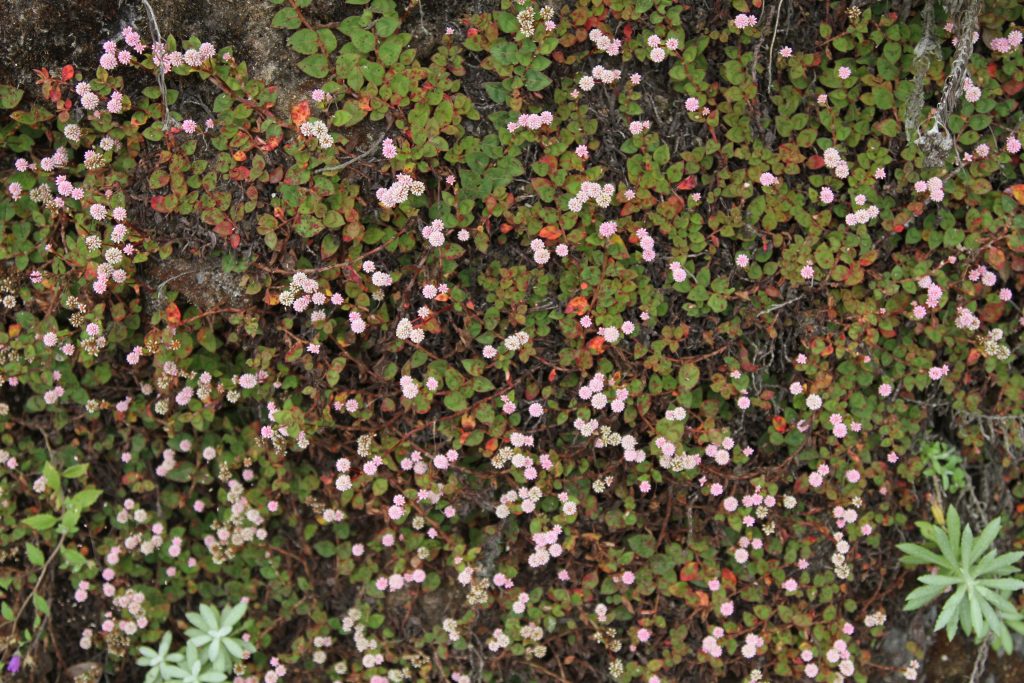
Persicaria capitata (Buch.-Ham. ex D.Don) H.Gross is a mat-forming perennial native to the Himalaya and southern China that has become widely naturalised as an ornamental and weed. GBIF documents nearly 23,000 occurrences, with native records from India, Nepal, China and Taiwan and extensive introduced populations across Portugal, Spain, Italy, the Netherlands, Great Britain, the United States, Mexico, Brazil, Colombia, Ecuador, Costa Rica, Australia, New Zealand, South Africa, Japan and Réunion. In its native range it grows on rocky banks, walls, gravelly slopes and disturbed mid-montane ground. The Bhutanese plant photographed at the Tumching-La, at about 2900 m in October, reflects its occurrence in the cool temperate zone of the eastern Himalaya.

The plant is a low, creeping herb that roots at the nodes to form dense mats; the slender, often reddish stems bear membranous ochreae at the swollen nodes. The leaves are ovate to elliptic, frequently marked with a dark V-shaped band and sometimes tinged purple. The flowers are aggregated into small, dense, globose heads borne on slender peduncles; the perianth is pink, five-lobed and persists in fruit. The fruit is a small trigonous achene enclosed by the perianth.

Widely grown as a ground-cover ornamental, P. capitata escapes readily and is recorded as an environmental weed in parts of the Mediterranean, Macaronesia, Australasia and the Americas. Its capacity to root at the nodes and spread vegetatively, combined with prolific seed production, underlies its colonising success. The species is not of conservation concern; instead it exemplifies how a Himalayan native can attain a near-cosmopolitan distribution through horticultural dispersal and subsequent naturalisation.

Author: (Buch.-Ham. ex D.Don) H.Gross · Sources: POWO (Kew), GBIF, Flora of China, Flora of Bhutan, Flora of Nepal, Hara & Williams Polygonaceae treatments

(L.) H. Gross

Bhutan2015 92
Bhutan Galephug, 600m, October

Description

Persicaria chinensis (L.) H. Gross is a widespread, often weedy perennial of warm-temperate to subtropical Asia, now naturalised well beyond its native range. GBIF records over 12,500 occurrences spanning China, Taiwan, Japan, India, Nepal, Thailand, Myanmar, the Malesian archipelago and the Philippines, with introduced populations in Australia, New Zealand, Réunion, the United States and Jamaica. It favours moist, disturbed ground, forest margins, roadside banks, streamsides and clearings from the lowlands to mid-montane elevations. The Bhutanese plant photographed at Galephug, at about 600 m in October, reflects its abundance in the humid foothill belt of the eastern Himalaya.

The plant is a sprawling to scrambling herb with branched, often reddish stems that are swollen at the nodes and sheathed by membranous ochreae characteristic of the family. The leaves are ovate to ovate-lanceolate, frequently with a dark chevron-shaped marking, and taper to an acute apex. The inflorescence comprises numerous small, capitate clusters of flowers; the perianth is white to pinkish and five-lobed, becoming fleshy and bluish-black in fruit. The fruit is a trigonous achene enclosed by the persistent, juicy perianth, which gives the fruiting heads a berry-like appearance.

Segregated by some authors as Polygonum chinense, the taxon is morphologically variable, and several varieties and forms have been recognised across its vast range. Its fleshy fruiting perianth promotes endozoochorous dispersal by birds, contributing to its colonising success and to its status as an invasive in several introduced territories. The species is of no conservation concern; rather, its broad ecological amplitude and ready establishment on disturbed soils make it one of the more conspicuous and adaptable knotweeds of monsoonal Asia.

Author: (L.) H. Gross · Sources: POWO (Kew), GBIF, Flora of China, Flora of Bhutan, Flora of Nepal, Hara & Williams Polygonaceae treatments

Greuter & Burdet

Bhutan2015 483
Bhutan Pele-La 3100m, October
Sikkim2003 410 G570
Sikkim Zemu Valley 3400m August

Description

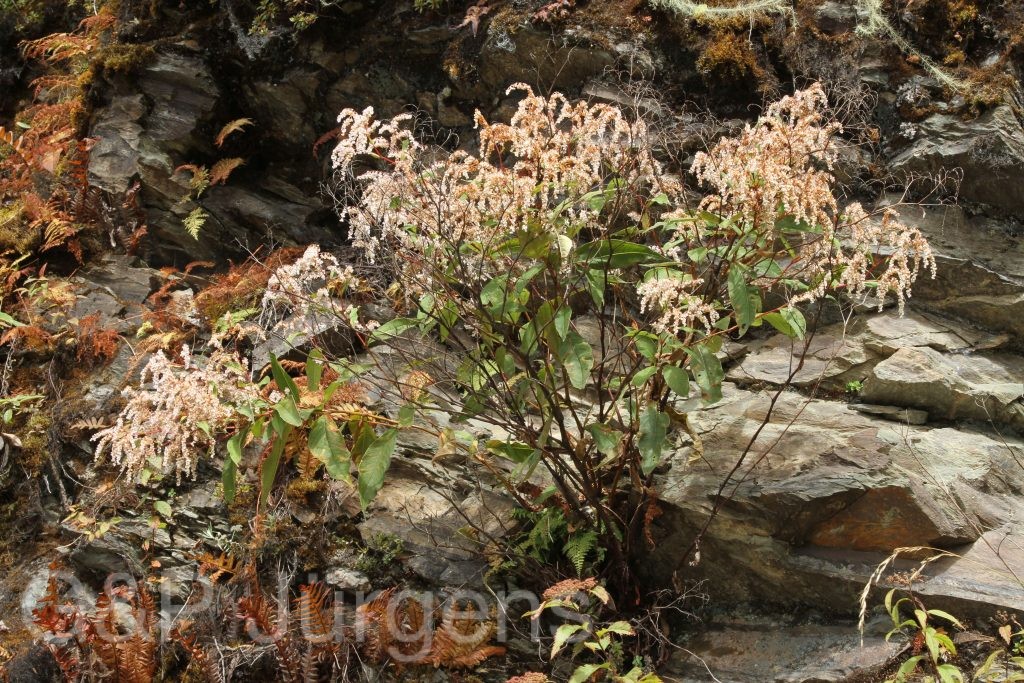
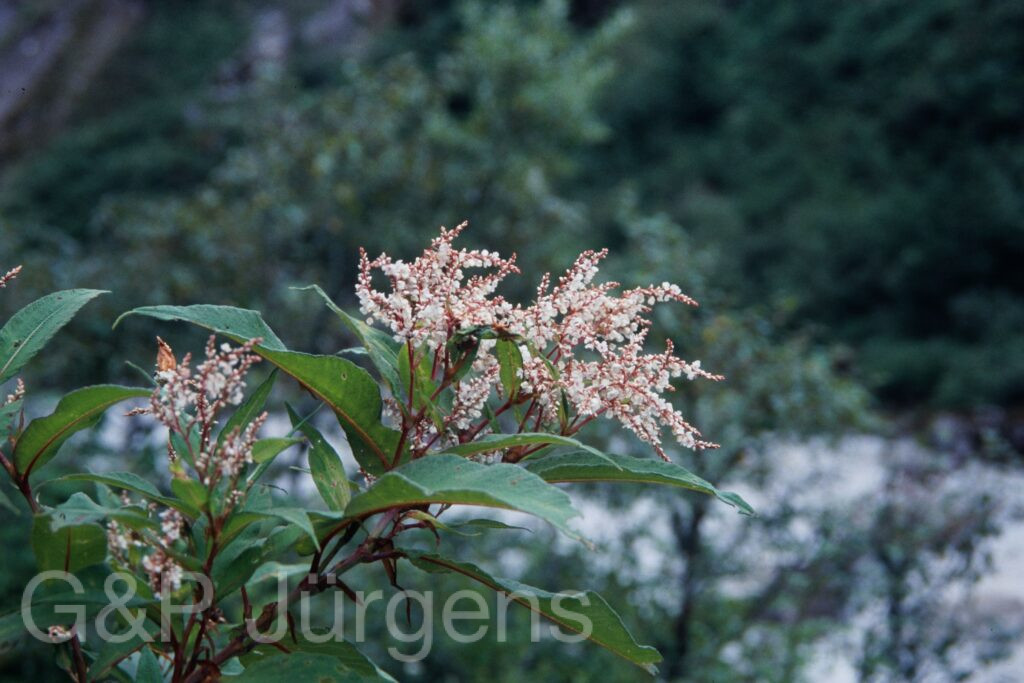
Persicaria wallichii (the accepted name under which this taxon is listed, the binomial here being treated as a synonym in GBIF) is a robust perennial knotweed native to the Himalaya and adjacent mountains of China and Myanmar, where it occupies open hillsides, forest margins, riverbanks and disturbed ground in the temperate and subalpine zones. From its Himalayan homeland it has spread widely as an introduced and frequently invasive plant, the GBIF dataset recording it across much of Europe as well as North and South America and New Zealand, totalling well over a thousand occurrences. The illustrated plants from Pele-La in Bhutan at 3100 m, flowering in October, and from the Zemu Valley in Sikkim at 3400 m in August, exemplify its native montane setting.

The plant forms tall, spreading clumps from a vigorous, far-creeping rhizome, with erect to ascending stems that are reddish-tinged and somewhat woody at the base. The leaves are large, ovate-lanceolate to triangular, acuminate, cordate to truncate at the base, often white-tomentose beneath, and subtended by membranous, brownish ochreae sheathing the swollen nodes. The numerous small flowers are borne in much-branched, lax panicles of slender spike-like racemes; each flower has a white to pinkish perianth of five tepals enclosing eight stamens and a trifid style. The fruit is a small, glossy, three-angled (trigonous) achene enclosed by the persistent perianth.

Formerly placed in Polygonum and Aconogonon (reflected in the synonymy and field labels), the species sits within a much-revised section of Persicaria. Its dense rhizomatous growth allows it to form persistent thickets, and outside its native range it behaves as an aggressive colonist of riverbanks and waste ground, prompting management concern in several countries; within the Himalaya it remains a common and ecologically benign component of moist montane vegetation.

Author: Greuter & Burdet · Sources: POWO (Kew), GBIF, Flora of Bhutan, Flora of China (Polygonaceae), Annotated Checklist of the Flowering Plants of Nepal

(Banks) Blume

Bh2008 482 G750
Bhutan Samtengang, 2040m April
Bh2008 483 P751
Bhutan Samtengang, 2040m April
Bh2008 485 G753
Bhutan Samtengang, 2040m April

Description

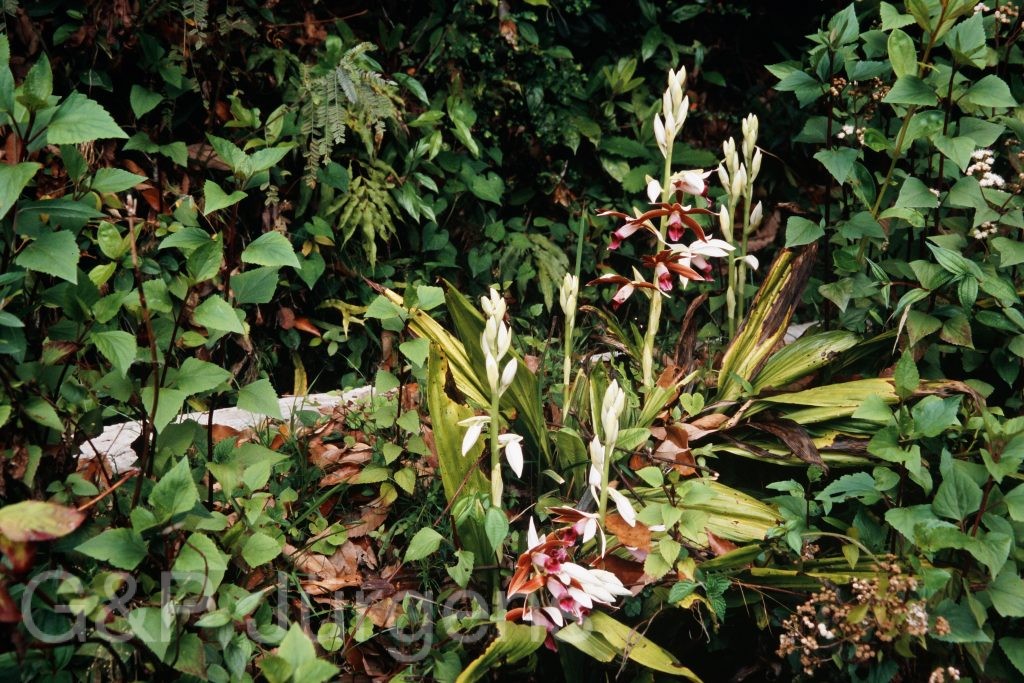
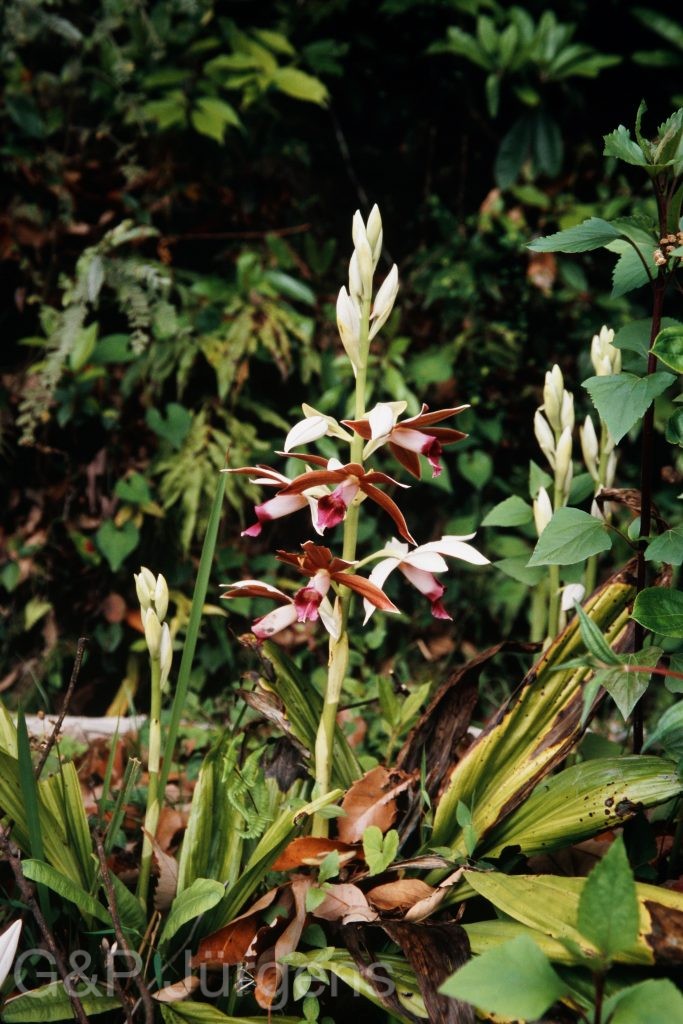
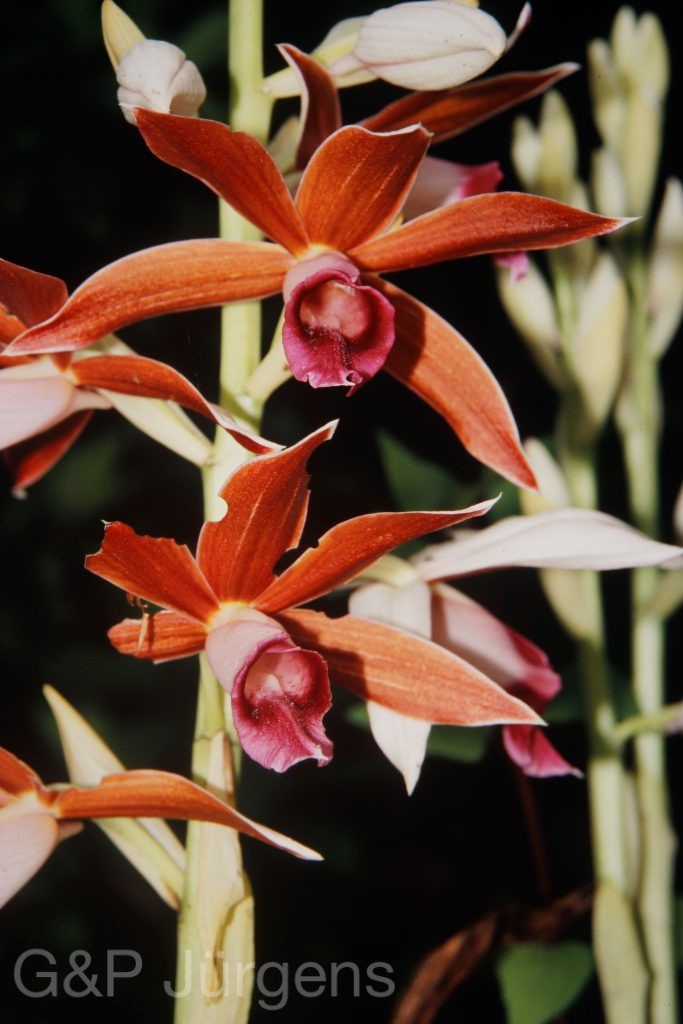
Phaius tankervilleae, the nun's-hood or swamp orchid, is a robust terrestrial orchid with an exceptionally wide Old World tropical and subtropical distribution, recorded from China, India, Bhutan, Indonesia, Malaysia, Papua New Guinea, Australia, the Pacific islands and many other regions, with around 660 occurrence records (some, as in the Americas and Caribbean, reflecting introduction). It grows in damp grassland, marsh margins, swampy forest clearings and moist roadside banks from the lowlands into the lower hills. The photographed plant from Samtengang in western Bhutan at 2040 m, flowering in April, lies toward the upper part of its montane range.

It is a large terrestrial orchid arising from clustered, conical pseudobulbs partly buried in the substrate. The leaves are few, large, broadly lanceolate, plicate (longitudinally pleated) and tapered to a sheathing base. The inflorescence is a tall, erect raceme bearing many showy flowers; the sepals and petals are similar, brownish-red to maroon within and silvery-white outside, while the prominent labellum is tubular and rolled, white flushed with rose-purple and yellow in the throat, with a short basal spur. The fruit is a pendulous capsule releasing innumerable dust-like seeds.

The accepted name Phaius tankervilleae, based on Banks's epithet and combined by Blume, is treated as current despite synonym status in the source dataset; the input family spelling "Orchideaceae" is a variant of the correct Orchidaceae. Like nearly all orchids it depends on mycorrhizal fungi for seed germination. Widely grown as an ornamental and broadly distributed in the wild, it is nonetheless locally threatened by wetland drainage and over-collection in parts of its range.

Author: (Banks) Blume · Sources: POWO (Kew), GBIF, Flora of China (Orchidaceae), Grierson & Long Flora of Bhutan, The Orchids of Bhutan (Pearce & Cribb), Seidenfaden's revisions of mainland Asian Orchidaceae

(Lindl.) Christenson & Pradhan

Bhutan2014 674
Bhutan Wangdi 2280m, May
Bhutan2014 676 scaled
Bhutan Wangdi 2280m, May
Bh2008 511 G785
Bhutan Chongsakha, 1800m April

Description

Phalaenopsis taenialis is a small epiphytic orchid distributed through the eastern Himalaya and adjacent regions, recorded from China, India, Nepal, Bhutan, Vietnam and Myanmar, with about 161 georeferenced occurrences. It grows on tree trunks and mossy branches in humid, broadleaved evergreen and semi-evergreen forest of the subtropical to lower temperate belt, broadly between 1500 and 2500 m. The cited Bhutanese localities at Wangdue (2280 m) in May and Chongsakha (1800 m) in April are typical of its moist, sheltered mid-elevation forest habitat, where it flowers in spring before the full monsoon.

It is a dwarf, monopodial epiphyte, often nearly leafless at flowering, with a short stem bearing well-developed, flattened, photosynthetic roots that clasp the bark. The leaves, when present, are few, thin and elliptic, and may be shed during the dry season. The inflorescence is a slender raceme of small, delicate flowers; the sepals and petals are pinkish to pale lilac, spreading, and the three-lobed labellum is the distinctive feature, with a callus and small lateral lobes characteristic of the species. The fruit is a dry, ribbed capsule releasing dust-fine seeds.

The species was long placed in Kingiella or Doritis and is sometimes segregated as Hygrochilus or Aerides allies, but is now treated within an enlarged Phalaenopsis following the combination by Christenson and Pradhan. Its deciduous, root-dominated habit is an adaptation to seasonally dry epiphytic perches. As a forest-dependent epiphyte vulnerable to habitat loss and orchid collection, it is of conservation interest across its range.

Author: (Lindl.) Christenson & Pradhan · Sources: POWO (Kew), GBIF, Flora of China, Flora of Bhutan, Christenson's monograph of Phalaenopsis