Tag:

Subalpine (2500-3500 m)

(Bureau & Franch.) Pinto-Carr., E.Rico & M.M.Mart.Ort.
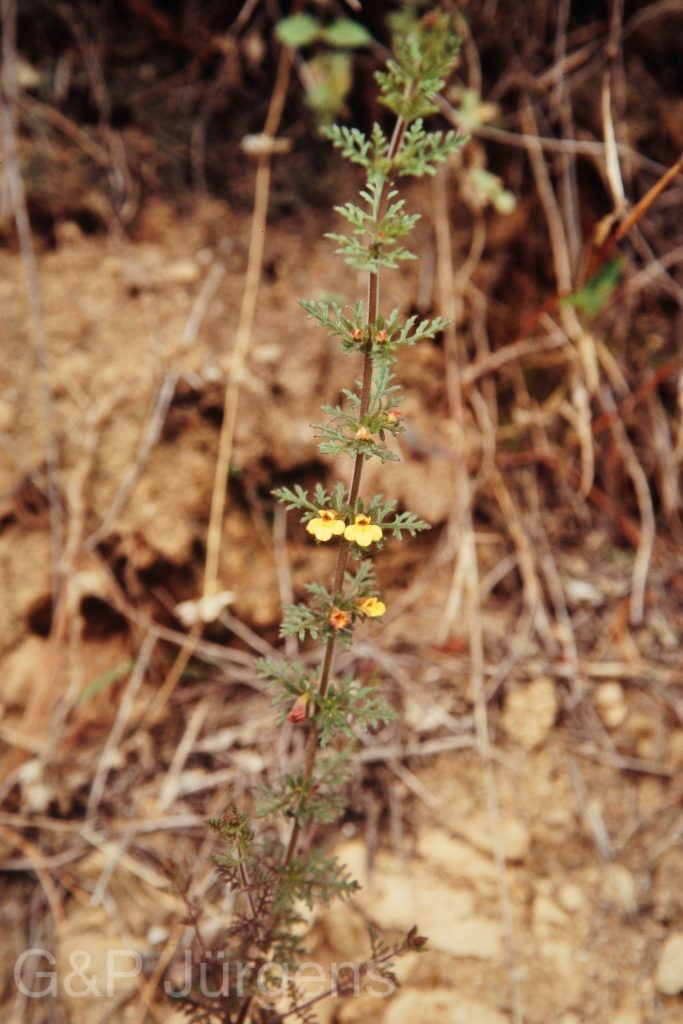
Bh09 414 P652
Bhutan Paro, 2500m June

Description

Pterygiella tenuisecta (Bureau & Franch.) Pinto-Carr., E.Rico & M.M.Mart.Ort. is a hemiparasitic annual herb of the Sino-Himalayan region, distributed through Bhutan, northern India and south-western China (notably Yunnan and Sichuan), with the GBIF dataset of roughly 883 occurrences also carrying determinations referable to material in Japan. Often treated under the name Phtheirospermum tenuisectum, it occupies open grassy slopes, forest margins, scrub and disturbed banks at montane elevations, where like other root-hemiparasites it attaches to the roots of neighbouring grasses and herbs while retaining functional green foliage. The illustrated plant was photographed at Paro in western Bhutan at around 2500 m in June, an elevation and season typical of its flowering in the temperate montane belt.

It is a slender, erect to ascending annual with branched, glandular-pubescent stems. The leaves are opposite below and may become alternate above, the blades pinnatisect to bipinnatisect with narrow, almost filiform ultimate segments, giving the foliage a finely divided, feathery appearance reflected in the epithet tenuisecta. The flowers are solitary in the upper leaf axils, shortly pedicellate, with a tubular, ribbed, glandular calyx of fused sepals. The corolla is yellow, two-lipped, the upper lip hooded and the lower three-lobed and spreading, enclosing four didynamous stamens. The fruit is a loculicidal, ovoid to oblong capsule containing numerous small seeds.

The species has been shuttled between several genera of the broomrape family, having been described in Gerardia and later placed in Phtheirospermum before molecular and morphological work supported its transfer to Pterygiella; the synonymy underlies the differing names on the source page. As a facultative hemiparasite it plays a part in regulating grassland community structure, drawing water and nutrients from hosts while contributing its own photosynthesis. No conservation concern is recorded, the plant being a widespread component of seasonally moist montane grasslands across its Sino-Himalayan range.

Author: (Bureau & Franch.) Pinto-Carr., E.Rico & M.M.Mart.Ort. · Sources: POWO (Kew), GBIF, Flora of China, Flora of Bhutan, Orobanchaceae phylogenetic studies (Pinto-Carrasco et al.)
n.n.

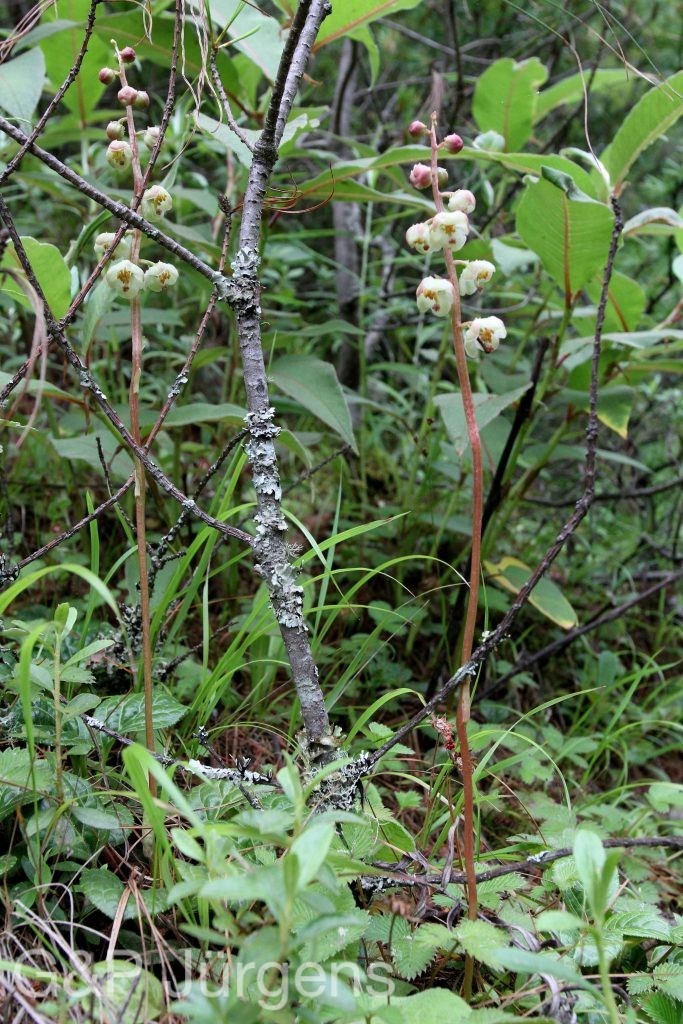
BhutanPG2011 732 01 01
Bhutan Haa-Valley, 2750m July

Description

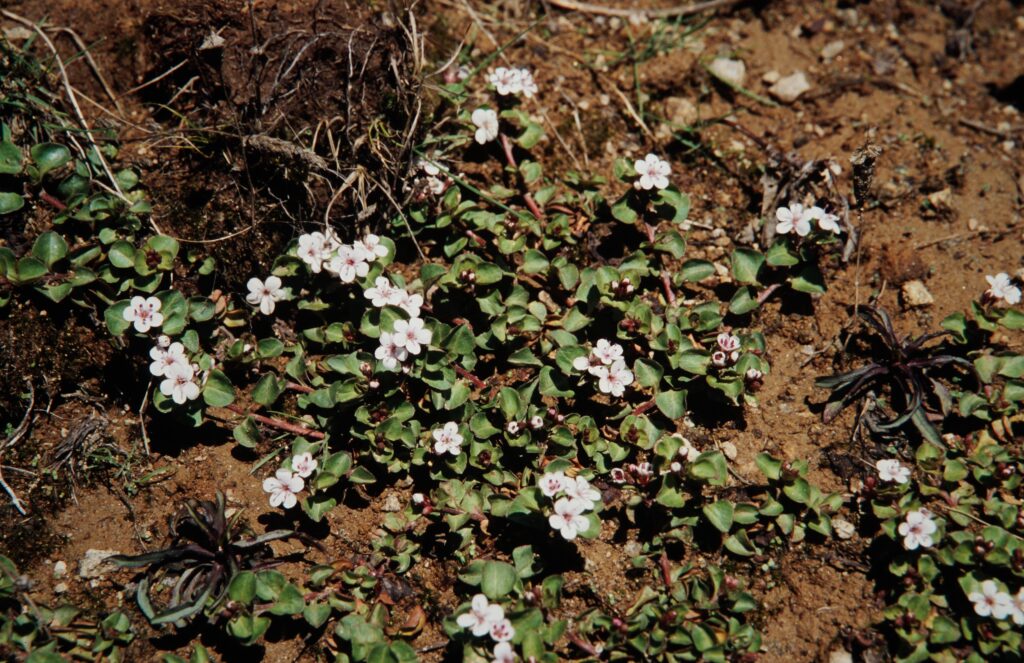
Pyrola asarifolia subsp. asarifolia is a small evergreen perennial herb traditionally placed in the family Pyrolaceae, now usually treated within Ericaceae (subfamily Monotropoideae). It is a circumboreal taxon, and its GBIF records span North America, eastern Asia and the Himalaya, including the United States, Canada, Japan, China, India and Bhutan, reflecting a broad cool-temperate to boreal range. It grows in moist, shaded coniferous and mixed forest, on humus-rich, often mossy soils, generally between about 2,500 and 3,500 m in its Himalayan stations. The plant illustrated from the Haa Valley in western Bhutan at 2,750 m in July typifies this shaded, damp montane forest-floor habitat.

The species is a low, rosette-forming herb arising from a slender, creeping rhizome. The leaves are basal, long-petiolate, with rounded to broadly ovate or reniform, somewhat leathery and glossy blades that persist through the winter, the shape recalling that of Asarum and giving the epithet asarifolia. The flowering scape is erect and leafless, bearing a many-flowered raceme of nodding, cup-shaped flowers; these are pink to rose-purple, with five spreading petals, ten anthers opening by pores, and a long, characteristically curved and exserted style, a key generic feature. The fruit is a dry, pendent capsule releasing extremely numerous dust-like seeds.

Like other members of the Pyroloideae the plant is partially mycoheterotrophic, supplementing photosynthesis through mycorrhizal fungi that link it to surrounding trees, an adaptation suited to deeply shaded forest floors. The dust seeds depend on appropriate fungal partners for germination. The transfer of the old Pyrolaceae into Ericaceae reflects molecular evidence of their nesting within that family. Widespread across the Northern Hemisphere, the species is not threatened, though its Himalayan populations occupy the southern margin of a primarily boreal distribution and are of phytogeographic interest.

Author: n.n. · Sources: POWO (Kew), GBIF, Flora of China Vol. 14, Flora of Bhutan Vol. 2, Flora of North America Vol. 8, Haber: Systematics of the Pyroloideae

A.Camus

Garh 07 580 ergebnis
India Garhwal Seena 3350m, June

Description

Quercus leucotrichophora, commonly known as banj oak, is a dominant broadleaved tree of the western and central Himalaya, distributed from northern Pakistan through India (Jammu & Kashmir, Himachal Pradesh, Uttarakhand) to Nepal, Bhutan, and adjacent parts of Myanmar. It forms extensive forests on north-facing slopes and mesic sites at elevations of 1,500–3,500 m, constituting one of the most ecologically important tree species in the Himalayan mid-montane zone. The species has been documented at Seena in the Garhwal Himalaya of Uttarakhand at 3,350 m in June, representing the upper elevational margin of its range where it transitions into subalpine communities.
Quercus leucotrichophora is an evergreen tree, typically 15–25 m tall, with a stout trunk and spreading, dense crown. The bark is dark grey to blackish, deeply furrowed on mature trees. Leaves are elliptic to lanceolate, 6–15 cm long and 2–5 cm wide, with a sharply serrate margin bearing spine-tipped teeth, coriaceous in texture, dark green and glabrous above, and distinctly white-tomentose beneath — the specific epithet referring to these white (leuco-) hairs (tricho-) on the leaf (phora). Flowers are unisexual and monoecious; male catkins are pendulous, 5–10 cm long, while female flowers are borne in short, erect spikes. The acorn is ovoid, 1–1.5 cm long, seated in a shallow, scaly cupule with appressed, imbricate scales.
Quercus leucotrichophora belongs to the subgenus Cerris, section Ilex, a group of evergreen oaks centred in East and South Asia. It is a keystone species in western Himalayan forests, supporting a rich community of epiphytes, mycorrhizal fungi, and avifauna. The leaf litter is a critical source of organic matter and nutrient cycling in montane soils. Banj oak forests are widely exploited for fuelwood and fodder — the leaves being an essential winter fodder resource for livestock — and ongoing lopping pressure has led to degradation of many stands, prompting conservation and restoration efforts across Uttarakhand and Himachal Pradesh.

Author: A.Camus · Sources: POWO (Kew), GBIF, Flora of China Vol. 4, Singh & Rawat: Flora of the Great Himalayan National Park (2000), Troup: Silviculture of Indian Trees Vol. 3

Sm.

Bhutan2014 857
Bhutan Chele-La 3000m, May
Bhutan2014 1039
Bhutan Chele-La 3000m, May
Nepal 99 374 ergebnis
West-Nepal Linji-Khola 3300m, June

Description

Quercus semecarpifolia, the kharsu oak, is an evergreen oak forming the highest-altitude oak forests of the Himalaya, native across China, Nepal, India, Bhutan, Pakistan and Afghanistan and extending into Myanmar and Thailand. It dominates upper montane and subalpine slopes, often at the treeline, generally between about 2400 and 3800 m, on cool, moist exposures. The trees photographed at Chele-La in Bhutan at 3000 m in May and along the Linji-Khola in West Nepal at 3300 m in June illustrate its role as the uppermost broad-leaved forest belt, frequently mixed with rhododendron, fir and birch near the limit of arborescent growth.

It is a large evergreen tree, gnarled and spreading at high elevations, with thick, fissured bark. The leaves are leathery and elliptic to oblong, dark glossy green above and golden- to rusty-tomentose beneath when young, the margin entire or with a few spiny teeth, especially on younger and coppice growth. It is monoecious, the male flowers in slender pendulous catkins and the female flowers solitary or few. The fruit is a large, hemispherical acorn seated in a shallow cup of appressed scales, maturing over a second season and providing important mast.

Quercus semecarpifolia belongs to subgenus Cerris (section Ilex, the ring-cupped oaks), the predominant oak lineage of the Sino-Himalayan mountains. As a treeline keystone it stabilises soils, supports rich epiphyte and understorey communities and yields hard timber, fuelwood and fodder, which makes it heavily exploited and in places poorly regenerating. Its acorns are dispersed by birds and rodents, and the species is regarded as ecologically critical yet locally threatened by overcutting and grazing across the Himalaya.

Author: Sm. · Sources: POWO (Kew), GBIF, Flora of China, Annotated Checklist of the Flowering Plants of Nepal, Flora of Bhutan, Menitsky's Oaks of Asia

Hand.-Mazz.

Nepal 2001 305 ergebnis ergebnis
Nepal (Gorkha) Kharka 3140m, May

Description

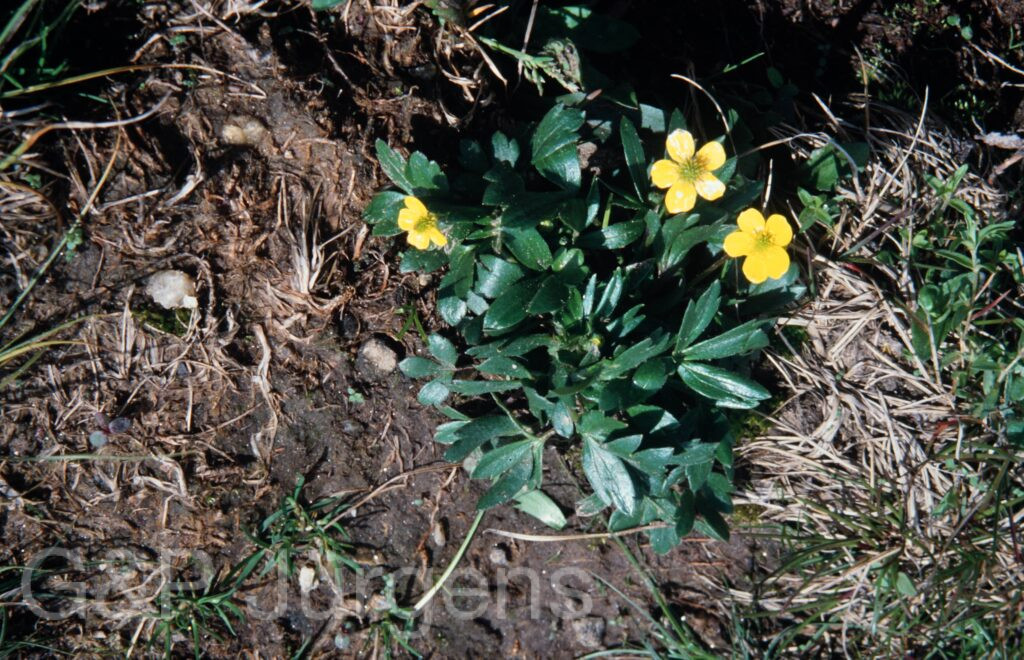
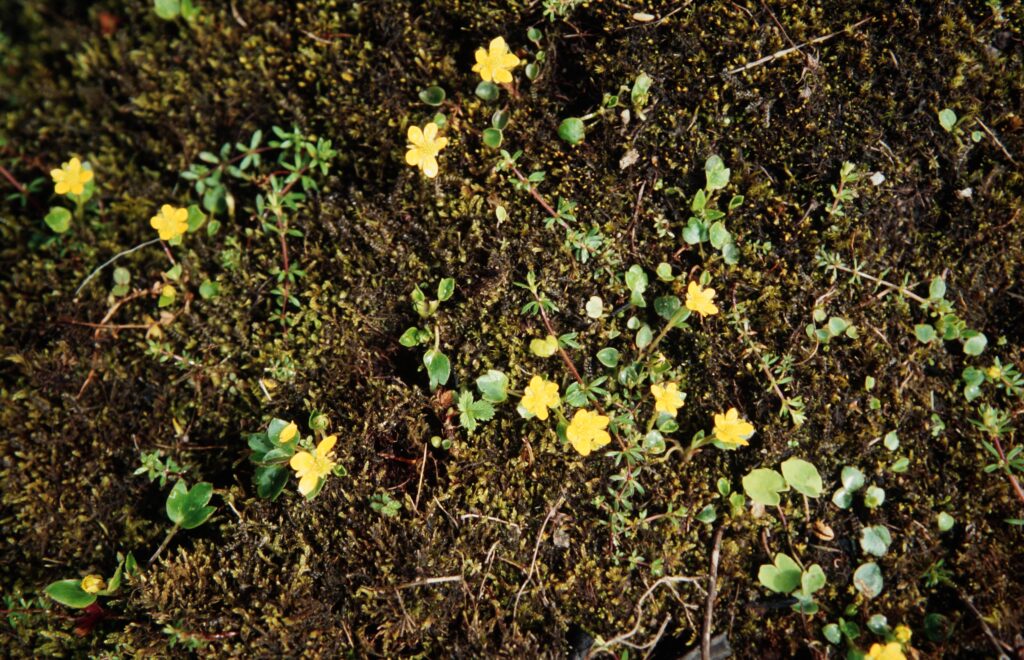
Ranunculus adoxifolius is a small buttercup of the Sino-Himalayan region, recorded from Nepal, India and Bhutan, with GBIF listing about 76 occurrences (the French record reflecting herbarium or cultivated provenance). It occupies moist subalpine to alpine habitats, including shaded forest margins, damp meadows, mossy banks and seepage slopes, generally between roughly 3000 and 4000 m. The photographed plant was found in the Gorkha district of Nepal at a kharka (high pasture) at 3140 m in May, flowering early in the season as snowmelt moistens the ground beneath open forest and on grassy slopes.

It is a delicate, low perennial herb with a short rhizome and fibrous roots. The basal leaves are long-petiolate with rounded, three-lobed to ternately divided blades whose segments are crenate-lobed, recalling the foliage of Adoxa, hence the epithet. The slender, few-leaved stems bear one to a few small flowers. Each flower has five (sometimes more) spreading, glossy yellow petals each with a basal nectary scale, numerous yellow stamens, and a domed receptacle of many free carpels. The fruiting head is a globose to ovoid cluster of small, glabrous, beaked achenes.

The species belongs to the cosmopolitan genus Ranunculus (Ranunculaceae), within the assemblage of small-flowered Asian alpine buttercups. Like its relatives it contains the acrid glycoside ranunculin, rendering the fresh plant unpalatable to grazing stock. With a restricted Himalayan range tied to undisturbed moist montane habitat, it is a useful indicator of intact subalpine vegetation; it has not been formally assessed, but its specialised habitat warrants attention where disturbance and grazing intensify.

Author: Hand.-Mazz. · Sources: POWO (Kew), GBIF, Flora of Nepal, Flora of China, Annotated Checklist of the Flowering Plants of Nepal, Ranunculus monographs (Tamura)

Royle

Garh 07 105 ergebnis 1
India Garhwal Meggu Kichatti 3100m, June

Description

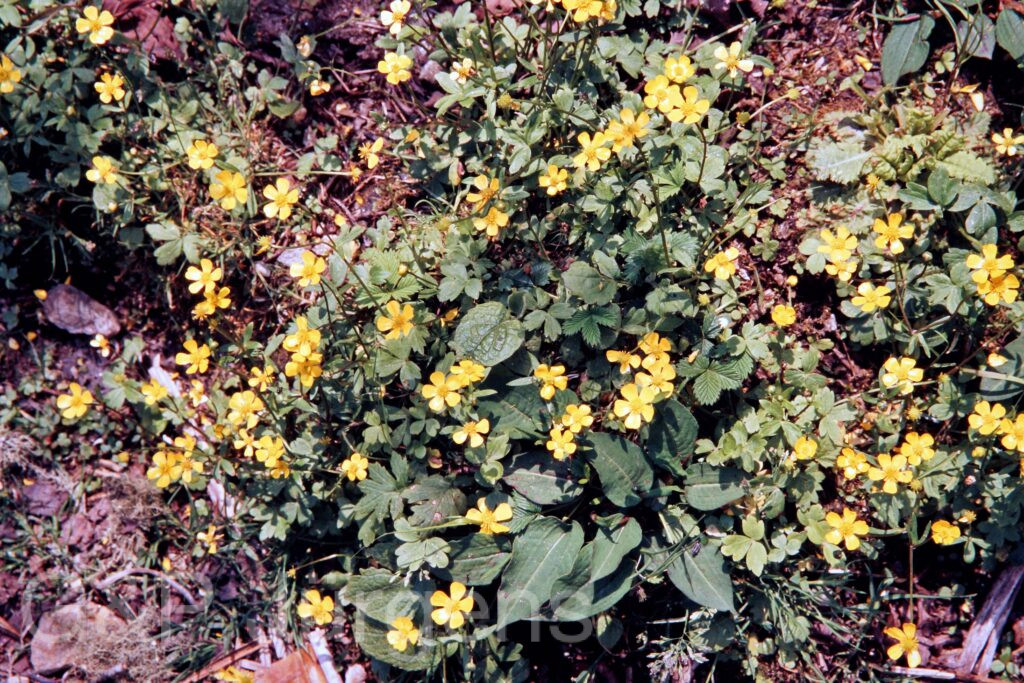
Ranunculus hirtellus is a widespread buttercup of the Himalaya and adjacent high mountains of Central Asia, recorded across India, Nepal, Pakistan, Afghanistan, China and Bhutan, its more than 770 georeferenced collections also reflecting extralimital and cultivated records in Iran, Japan, Korea and North America. It occupies alpine and subalpine meadows, open turf, moist grassy slopes and the margins of seasonal flushes, typically between about 2500 and 4500 m. The plant photographed at Meggu Kichatti in Garhwal at 3100 m in June shows its characteristic habitat in damp, herb-rich pasture during the early monsoon, when snowmelt keeps the soil moist.

It is a small perennial herb forming tufts from a short rootstock bearing fascicled, fibrous roots. The basal leaves are long-petioled, the blade orbicular to reniform and palmately three- to five-lobed or divided, the segments cuneate and again toothed or lobed, often hirsute with spreading hairs. Cauline leaves are smaller, sessile and more deeply dissected into narrow lobes. The flowering stems are erect to ascending and bear one to few solitary flowers; the five glossy golden-yellow petals each enclose a nectary scale and surround numerous stamens and free carpels. The fruit is an aggregate of glabrous to minutely pubescent achenes with a short, often curved beak.

Within the large and taxonomically complex genus Ranunculus, R. hirtellus belongs to a Himalayan assemblage of yellow-flowered alpine species distinguished by leaf dissection and achene characters, and it has frequently been confused with R. pulchellus and allies. Its broad altitudinal and geographic range, coupled with abundant occurrence data, indicates a secure conservation status. Like many high-elevation buttercups it contains acrid protoanemonin compounds that deter grazing, and it functions ecologically as an early-season nectar source for montane pollinators.

Author: Royle · Sources: POWO (Kew), GBIF, Flora of Pakistan, Flora of China, Annotated Checklist of the Flowering Plants of Nepal, Tamura's monograph of Ranunculaceae

Hand.-Mazz.

Sikkim2011 233
Sikkim Yumthang 3700m, June
Nepal 2001 304 ergebnis ergebnis
Nepal (Gorkha) Lambra Kharka 3200m, May

Description

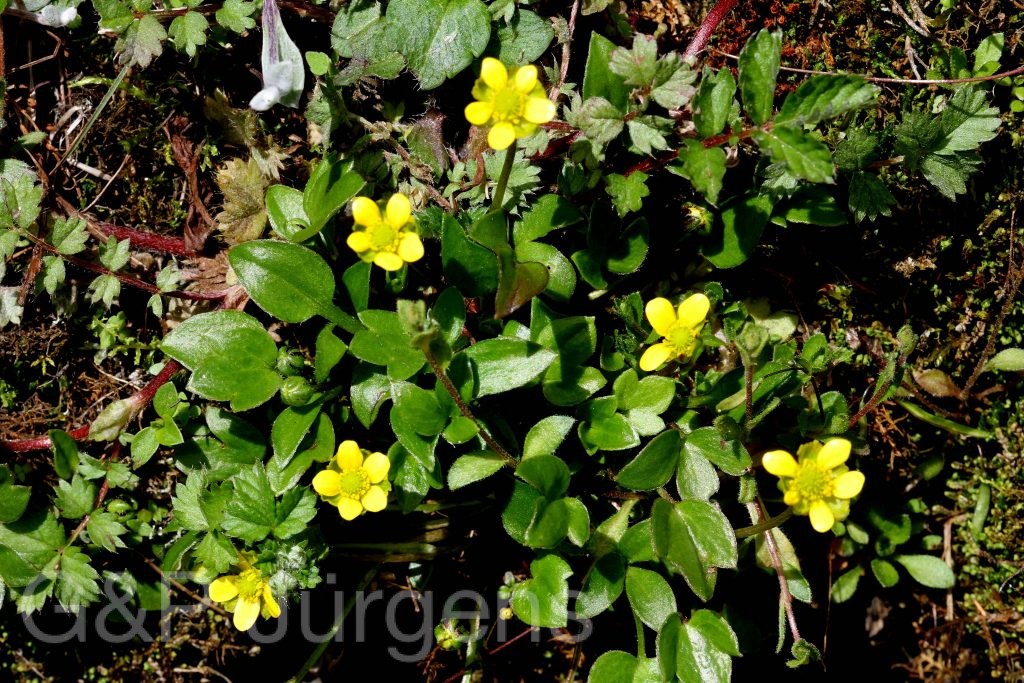
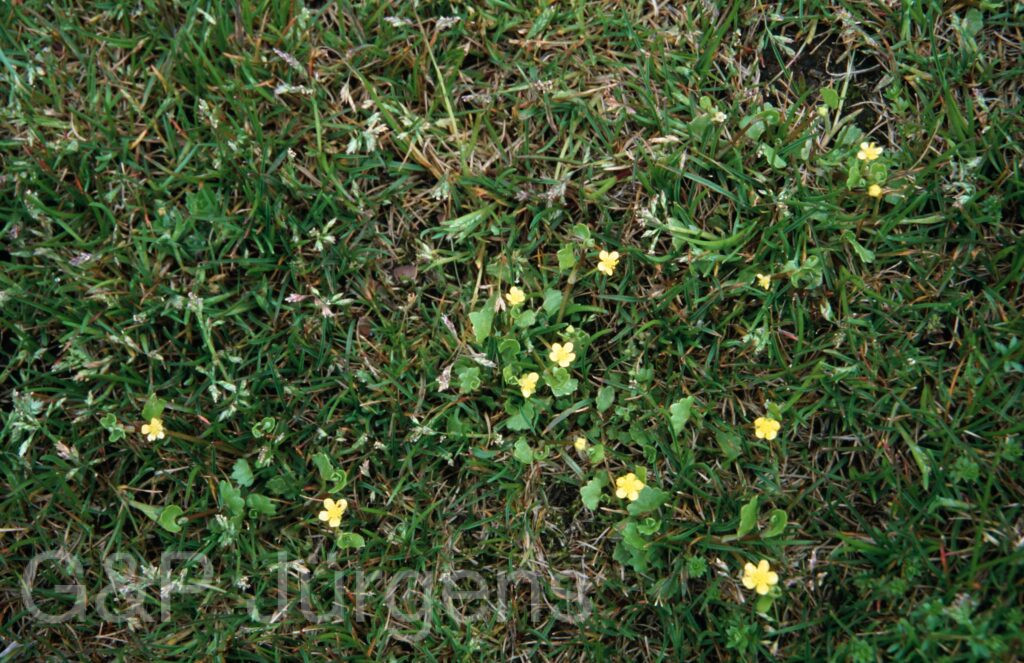
Ranunculus microphyllus is a Sino-Himalayan alpine buttercup whose core GBIF range (c. 399 occurrences) lies in China, Nepal, India and Bhutan, with scattered records elsewhere reflecting cultivated or misdetermined material. It grows in open alpine turf, moist meadows, snowmelt flushes, damp rock ledges and stream banks, typically between about 3000 and 4200 m. The cited localities—Yumthang in Sikkim at 3700 m in June, Lambra Kharka in the Nepalese Gorkha at 3200 m, and Sandakphu in West Bengal at 3200 m, both in May—illustrate its spring-to-early-summer flowering across moist, cool, high-elevation grasslands and seepage of the central and eastern Himalaya.

It is a small, tufted perennial herb, the stems low and ascending, often somewhat hairy, arising from a fibrous-rooted base. As the epithet implies the leaves are small; the basal leaves are petiolate and shallowly to deeply three-lobed or crenate, while the stem leaves are reduced and more dissected. The flowers are solitary or few, with the typical buttercup plan: five green sepals, five glossy bright-yellow petals each with a basal nectary, and numerous spirally arranged stamens and free carpels. The fruit is a globose head of small, slightly beaked achenes.

Described by Handel-Mazzetti, R. microphyllus belongs to the large, taxonomically intricate genus Ranunculus, in which the small-leaved Himalayan alpines form a closely related and often confused complex. It is locally common and not of conservation concern, though confined to moist high-altitude habitats sensitive to warming. Ecologically it is characteristic of snowmelt-fed alpine meadows, its open flowers offering accessible nectar and pollen to flies and other high-altitude insects.

Author: Hand.-Mazz. · Sources: POWO (Kew), GBIF, Flora of China, Annotated Checklist of the Flowering Plants of Nepal, Tamura monograph of Ranunculaceae

(H. Lév.) Fu

Sikkim2003 396 G557
Sikkim Zemu Valley 3450m August
Sikkim2003 397 P558
Sikkim Zemu Valley 3450m August

Description

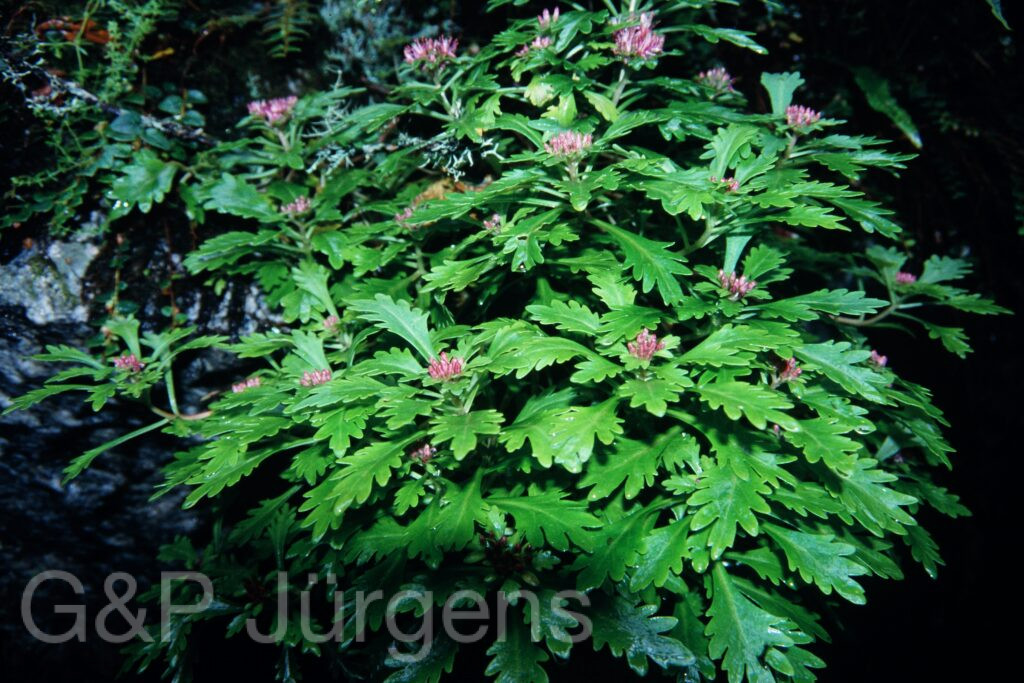
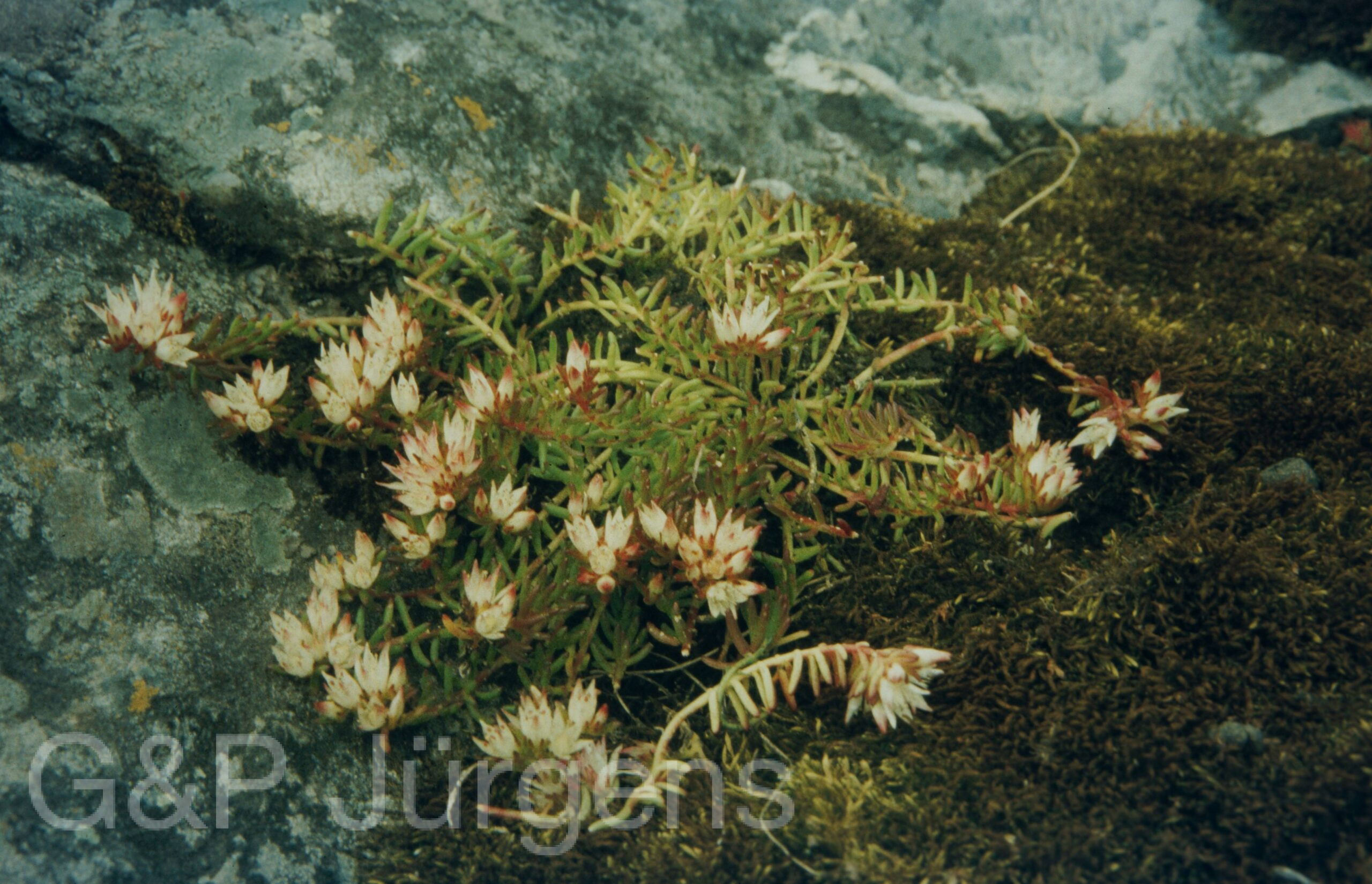
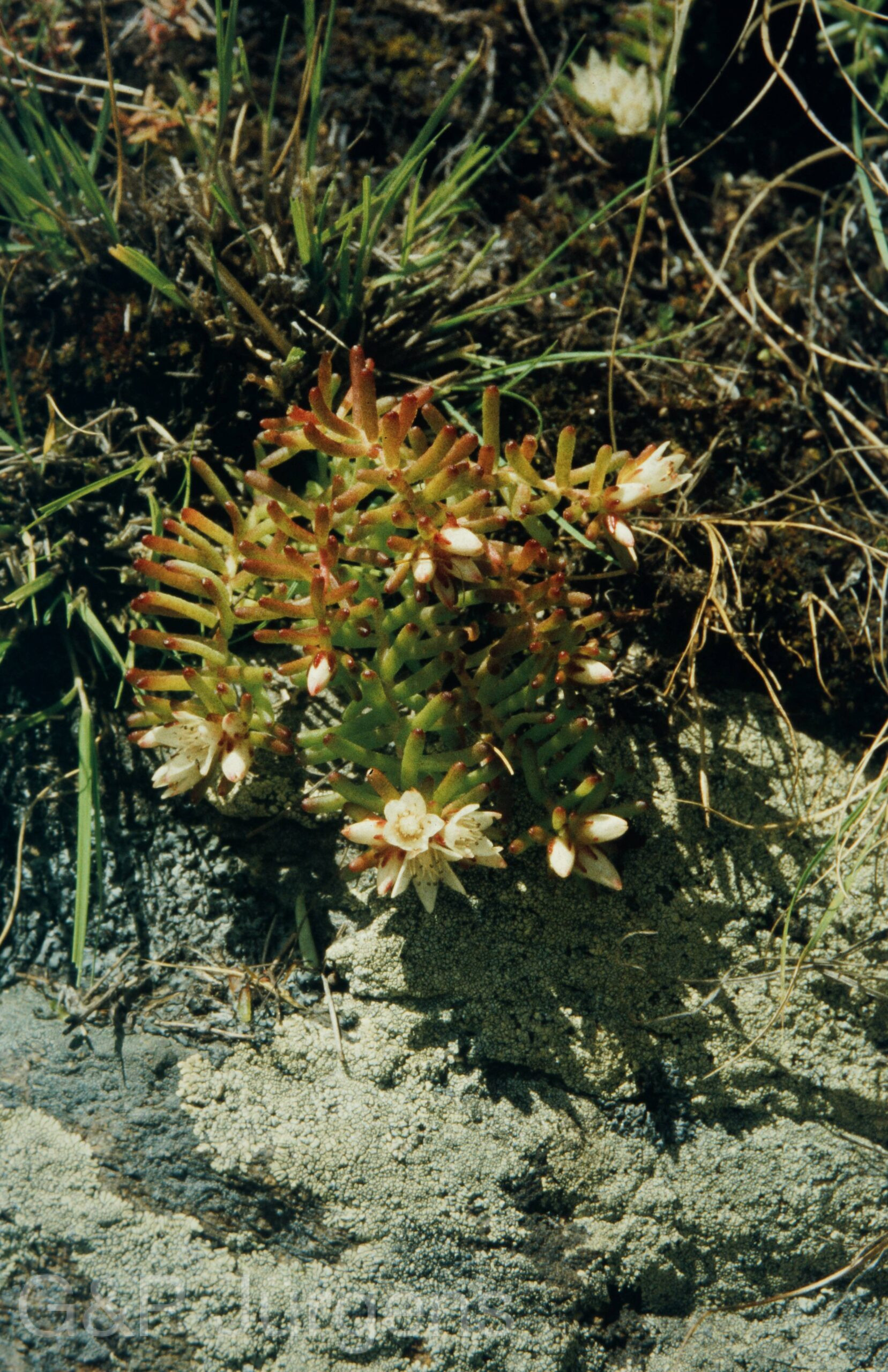
Rhodiola chrysanthemifolia is a high-altitude succulent of the Himalaya and adjacent China, recorded from China, Nepal, India and Bhutan with more than 630 georeferenced occurrences. It is a plant of alpine meadows, rocky slopes, cliff crevices and stabilised screes, typically growing well above the treeline. The population photographed in the Zemu Valley of northern Sikkim at about 3450 m in August represents its characteristic alpine habitat, flowering and fruiting in late summer on cool, well-drained, often rocky substrates exposed to intense montane conditions.

The species is a glabrous perennial arising from a stout, woody, often branched caudex topped by a persistent rootstock. The annual flowering stems bear numerous alternate, fleshy leaves that are toothed to pinnately incised, the dissection recalling the foliage of Chrysanthemum and reflected in the epithet chrysanthemifolia. The flowers are grouped in dense terminal cymes; as in Rhodiola the plant is typically dioecious, with the small four- to five-merous flowers bearing distinct sepals and yellow to greenish-yellow or reddish-tinged petals. The fruit comprises erect, beaked follicles that split along the inner suture to release the small seeds.

Rhodiola, segregated from Sedum on the basis of its perennial caudex, dioecy and basally connate carpels, is a circumboreal and alpine Asian genus of considerable interest for its adaptogenic secondary chemistry. Several Himalayan congeners are intensively harvested for medicinal roots, placing wild populations under pressure, although R. chrysanthemifolia itself remains widespread and locally common across the high Himalaya and is not presently regarded as threatened.

Author: (H. Lév.) Fu · Sources: POWO (Kew), GBIF, Flora of Nepal, Flora of China, Flora of Bhutan, Ohba's studies of Himalayan Crassulaceae

(Royle ex Edgew.) Fu

Description

Rhodiola sinuata (Royle ex Edgew.) Fu is a high-altitude succulent perennial of the Himalaya, recorded from India, Nepal, Bhutan, Pakistan and adjacent China, with comparatively few collections (GBIF lists about 349 occurrences, the European and Central Asian points representing herbarium or database artefacts rather than native range). It grows on rock ledges, cliff crevices, stony slopes and moist alpine turf, generally between 3,000 and 4,500 m. The illustrated plant was gathered in the Indian Garhwal Himalaya near Tali at 3,100 m in September, when the inflorescences are maturing and the foliage takes on autumnal reddish tints.

The plant arises from a stout, woody, perennating rhizome (caudex) crowned with scarious scale-leaves, from which spring several erect to ascending leafy flowering stems. The cauline leaves are alternate, sessile, fleshy, oblong to obovate, with a characteristically sinuate-dentate to coarsely toothed margin. The flowers are small and clustered in a dense terminal corymbose cyme; the species is typically dioecious, with 4- or 5-merous flowers bearing narrow yellowish to greenish-yellow petals, the staminate flowers with exserted stamens. The fruit is a cluster of erect follicles releasing minute seeds.

Rhodiola (Crassulaceae) comprises the Asian-alpine "roseroots" formerly placed in Sedum, distinguished by their thick perennial rhizome and frequently unisexual flowers. Like its congeners, R. sinuata accumulates phenylpropanoid glycosides in the rootstock and is gathered in Himalayan folk medicine, a pressure that, with grazing, warrants monitoring although the species is not formally assessed. Its restricted Sino-Himalayan distribution reflects adaptation to cold, exposed, high-elevation rock habitats.

Author: (Royle ex Edgew.) Fu · Sources: POWO (Kew), GBIF, Flora of China, Flora of Pakistan, Annotated Checklist of the Flowering Plants of Nepal, Ohba monograph of Himalayan Sedoideae, Hooker Flora of British India

(Hook.) Fu

Nepal 99 261 ergebnis
Nepal Kalomura 4000m, July
Sikkim2003 395 G556
Sikkim Zemu Valley 3400m August
Sikkim2003 480 P666
Sikkim Zemu Valley 3400m August

Description

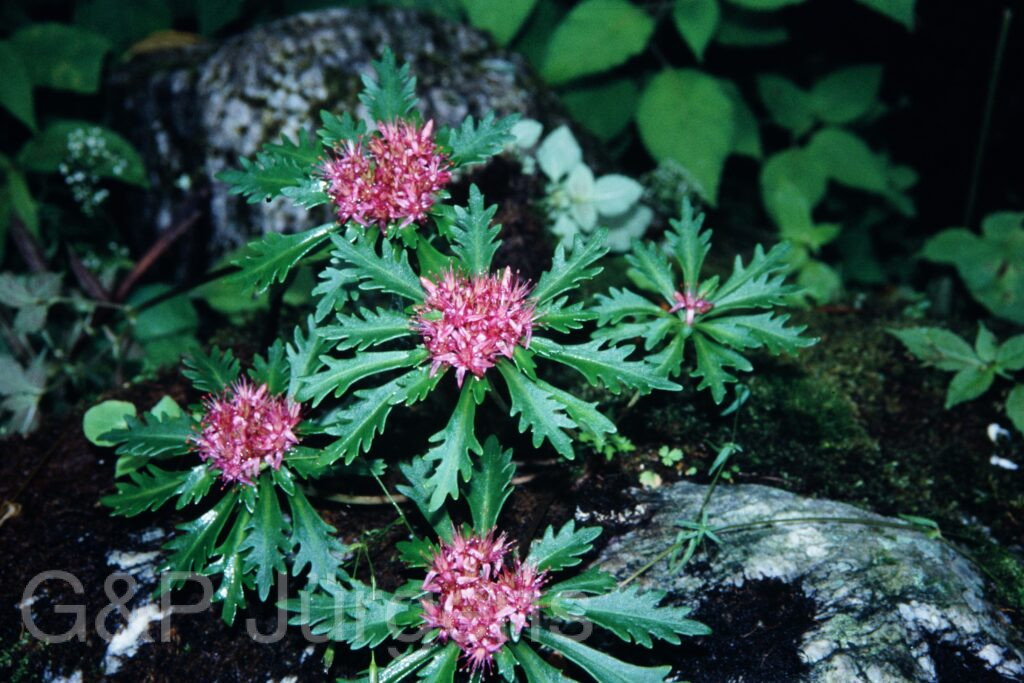
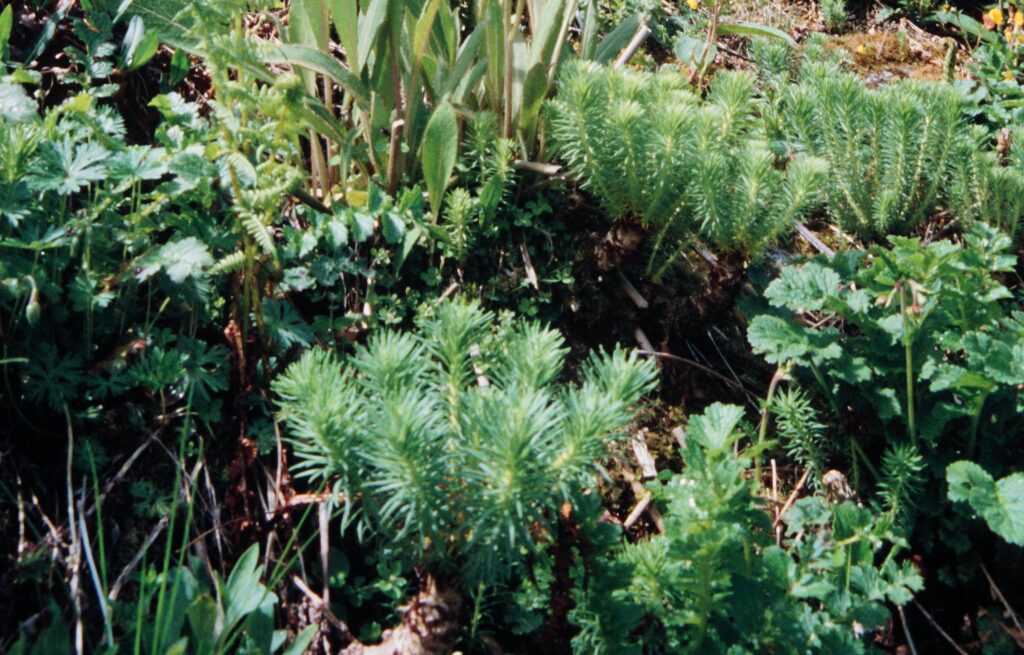
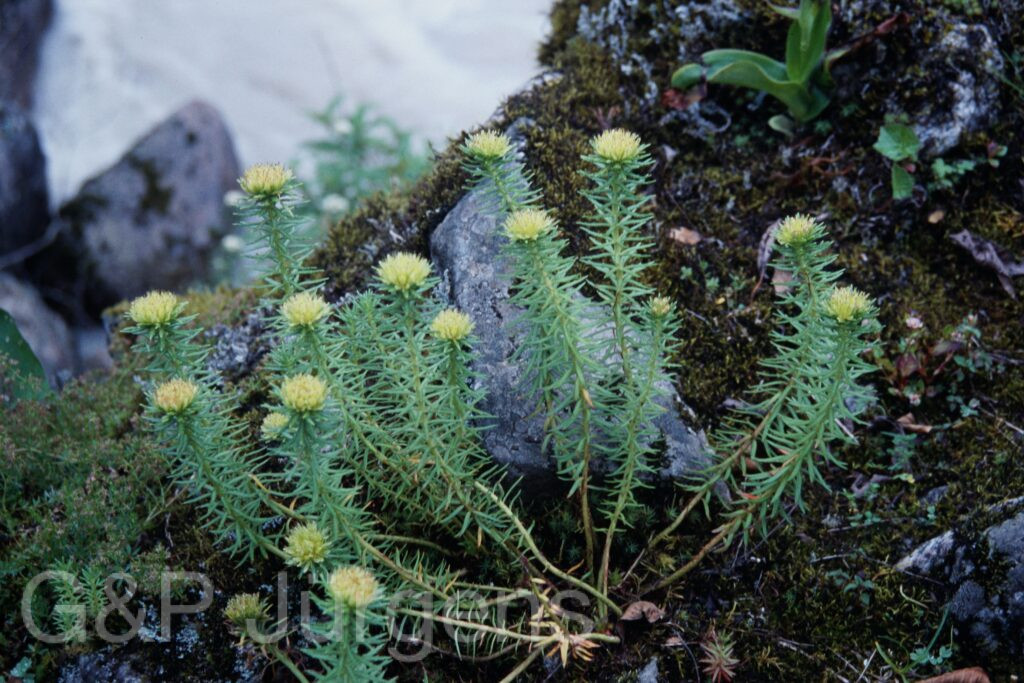
Rhodiola wallichiana is a high-elevation succulent perennial of the Himalaya and Tibetan margins, native from Nepal and the Indian Himalaya through Sikkim and Bhutan into southern China, Pakistan and Afghanistan; the many European and North American GBIF records reflect cultivated and herbarium material rather than wild occurrence. It grows in the alpine and upper subalpine zone, on rocky slopes, cliff ledges, moraines and among boulders. The cited collections from Kalomura in Nepal at about 4000 m in July and the Zemu valley in Sikkim at 3400 m in August place it firmly in the summer-flowering high-mountain flora.

The plant arises from a stout, branched, woody caudex (rootstock) bearing several erect or ascending leafy flowering stems. The leaves are alternate, sessile, fleshy, linear-lanceolate to oblong, flat, with entire or finely toothed margins, densely clothing the stems. The inflorescence is a terminal corymbose cyme of numerous small flowers. The species is functionally dioecious; the flowers are typically four- to five-merous, with greenish-yellow to reddish petals, the staminate flowers bearing stamens twice the number of petals, and the pistillate flowers developing several erect follicles that ripen reddish and split to shed minute seeds.

Rhodiola, segregated from Sedum, comprises the rosette- and caudex-forming stonecrops of cold northern and montane regions. Like its relatives the genus accumulates protective metabolites, and several species are harvested as adaptogenic medicinals, placing wild Himalayan populations under collection pressure. Adapted to short alpine summers, intense radiation and cold, R. wallichiana is locally frequent within its range and not currently assessed as globally threatened.

Author: (Hook.) Fu · Sources: POWO (Kew), GBIF, Flora of China, Flora of Bhutan, Ohba's monographic studies of Himalayan Crassulaceae (Rhodiola)