Author

GP Jürgens

(Hornem.) Friis & Wilmot-Dear
Bhutan2012 730
Bhutan Galephu 500m, October

Description

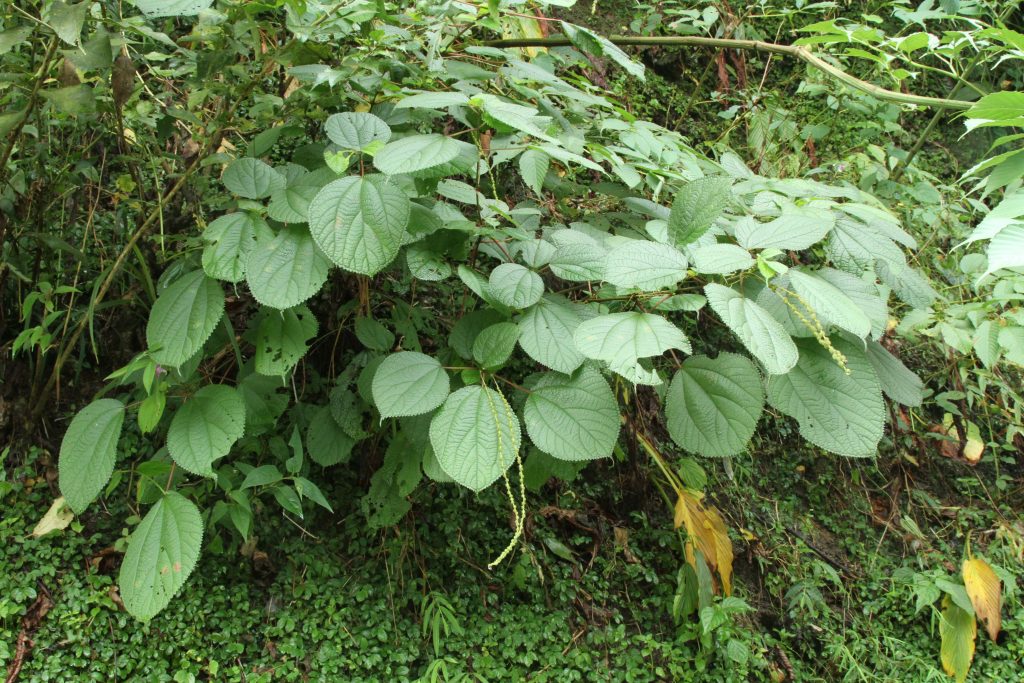
Boehmeria virgata subsp. macrophylla (Hornem.) Friis & Wilmot-Dear is a widespread paleotropical shrub of the nettle family, recorded by GBIF in over 2500 occurrences across an extraordinarily broad range that includes India (IN), Nepal (NP), China (CN), Thailand (TH) and Indonesia (ID), as well as much of tropical Africa (Tanzania, Cameroon, Gabon, Uganda, Angola), the Indian Ocean islands (Madagascar, Réunion, Mauritius, Comoros) and Australia (AU). It occupies forest margins, streambanks, clearings and disturbed secondary vegetation at low to mid elevations, and was photographed at Galephu in southern Bhutan at 500 m in October, in the warm subtropical foothills.

The plant is a shrub or coarse perennial herb with terete, often pubescent stems. The leaves are large, alternate or subopposite, broadly ovate to elliptic with a serrate margin, acuminate apex and three prominent basal veins, the lower surface frequently pale and softly hairy. As in all Boehmeria, the foliage lacks the stinging hairs found elsewhere in Urticaceae. The plant is monoecious, with minute unisexual flowers crowded into globose clusters arranged along slender, often elongate, interrupted spike-like inflorescences; female flowers have a tubular perianth enclosing a single ovule. The fruit is a small achene enclosed in the persistent, sometimes winged perianth.

This taxon belongs to a polymorphic complex that has been treated under various names including Boehmeria macrophylla, and the subspecific rank reflects Friis and Wilmot-Dear's revision integrating the Asian and African material. Wind pollination and the dust-like achenes account for its vast distribution. Stem fibres of Boehmeria species, notably ramie, are economically important, and the plant readily colonises disturbed ground, making it a frequent component of regenerating tropical and subtropical forest.

Author: (Hornem.) Friis & Wilmot-Dear · Sources: POWO (Kew), GBIF, Flora of Bhutan, Flora of China, Urticaceae revision (Friis & Wilmot-Dear)
(Hook.) Meisn.

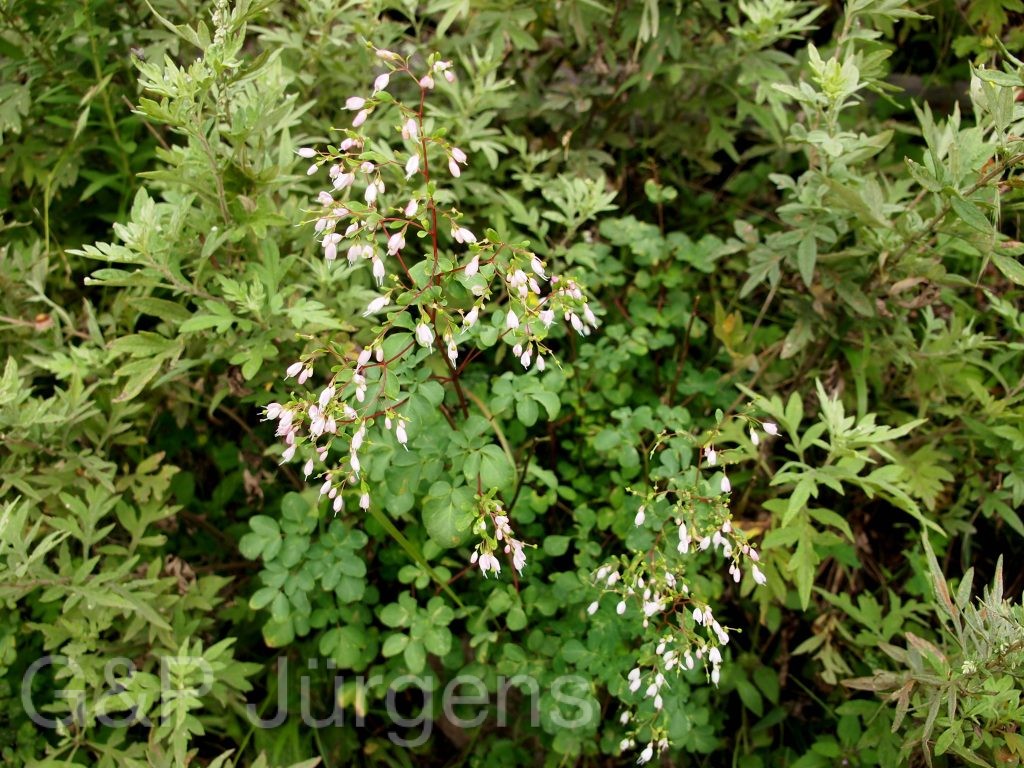
Bhutan2012 123
Bhutan Haar-Valley, 3100m September
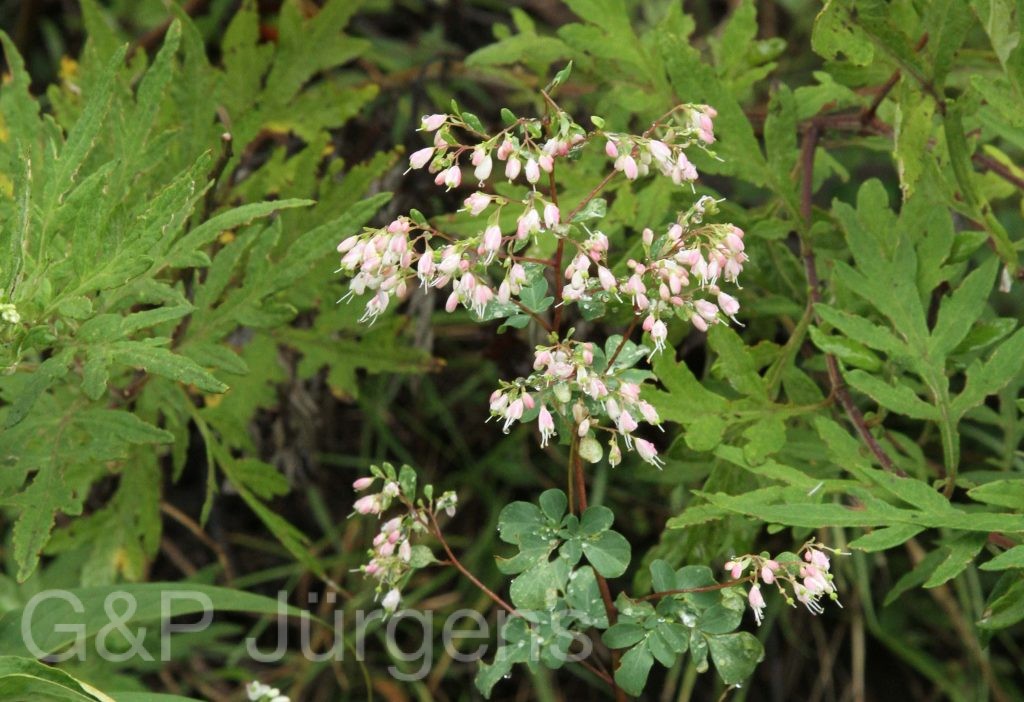
Bhutan2012 125
Bhutan Haar-Valley, 3100m September

Description

Boenninghausenia albiflora is a delicate, aromatic herb of the Sino-Himalayan and East Asian region, recorded by GBIF from China, Japan, Taiwan, the Himalaya and Southeast Asia, with more than 5600 occurrences attesting to its frequency. It grows on shaded forest floors, mossy banks, rocky stream gullies and clearings in temperate and subtropical woodland, often on humus-rich or stony ground. The photographed population occurs in Bhutan in the Haa Valley at about 3100 m, flowering in September toward the end of the monsoon; the species ranges broadly from around 1000 to 3500 m across its Himalayan distribution.

The plant is a glabrous, gland-dotted perennial or subshrub with slender, much-branched stems woody only at the base, the whole exuding the citrus-rue scent characteristic of the family. The leaves are alternate and two- to three-pinnately compound, the small ultimate leaflets obovate to oblong, thin, glaucous beneath and conspicuously pellucid-punctate. Numerous small white to cream flowers are borne in lax terminal panicles, each with four petals, eight long-exserted stamens, and a gynophore-borne ovary. The fruit comprises four spreading follicle-like carpels that dehisce to release small reniform seeds.

Boenninghausenia is a small genus of the Rutaceae allied to Ruta, distinguished by its herbaceous habit and stipitate ovary. The pellucid oil glands contain volatile compounds and coumarins, and the plant has a history of use in traditional medicine and as an insect repellent. Variable in leaf division and stature, it has been split into several infraspecific taxa across its wide range. It is common and of least concern, readily recolonising disturbed shady ground.

Author: (Hook.) Meisn. · Sources: POWO (Kew), GBIF, Flora of China, Flora of Bhutan, Rutaceae monograph (Hartley)

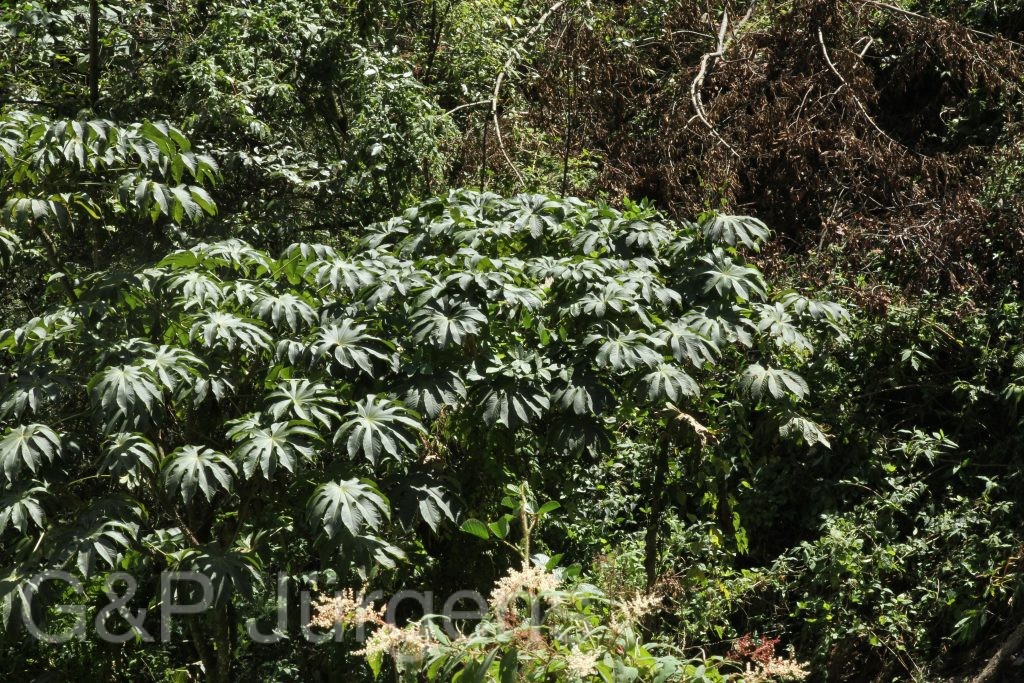
(Blume) Regel

Bhutan2014 186
Bhutan Trashyangtse 2150m, May

Description

Brassaiopsis glomerulata is a small tree or large shrub of the eastern Himalaya and Southeast Asia, distributed from India, Nepal and Bhutan through Myanmar, Thailand, Laos, Vietnam, Cambodia, Malaysia and Indonesia into southern China; its c. 954 georeferenced records make it the most widespread member of its genus. It inhabits evergreen broadleaf forest, secondary woodland, ravines and forest margins, generally between 1000 and 2400 m. The plant photographed at Trashyangtse in eastern Bhutan at 2150 m in May grows in the humid subtropical to warm-temperate forest belt where it occupies the understorey and disturbed forest gaps along streams.

It is an evergreen, sparsely branched tree to c. 8-10 m, the young stems and petioles often armed with short prickles. The leaves are large and palmately compound or deeply palmately lobed, long-petioled, with serrate, acuminate leaflets, clustered toward the branch tips in typical araliaceous fashion. The inflorescence is a large terminal panicle of numerous small umbels, the flowers densely aggregated into globose clusters (hence "glomerulata"). The flowers are small, greenish to whitish, with five petals and five stamens and an inferior ovary crowned by a short style. The fruit is a small, globose, fleshy purple-black drupe containing flattened seeds.

Described originally in Hedera by Blume and transferred to Brassaiopsis by Regel, the species belongs to the Araliaceae, the ivy and ginseng family. Its small drupes are dispersed by frugivorous birds, while the open umbels are visited by generalist insects. The leaves and bark feature in regional ethnomedicine. Widespread and adaptable to disturbed habitats, B. glomerulata is not considered threatened across its broad range.

Author: (Blume) Regel · Sources: POWO (Kew), GBIF, Flora of Bhutan, Flora of China, Flora of Thailand, Lowry & Wen's studies of Asian Araliaceae

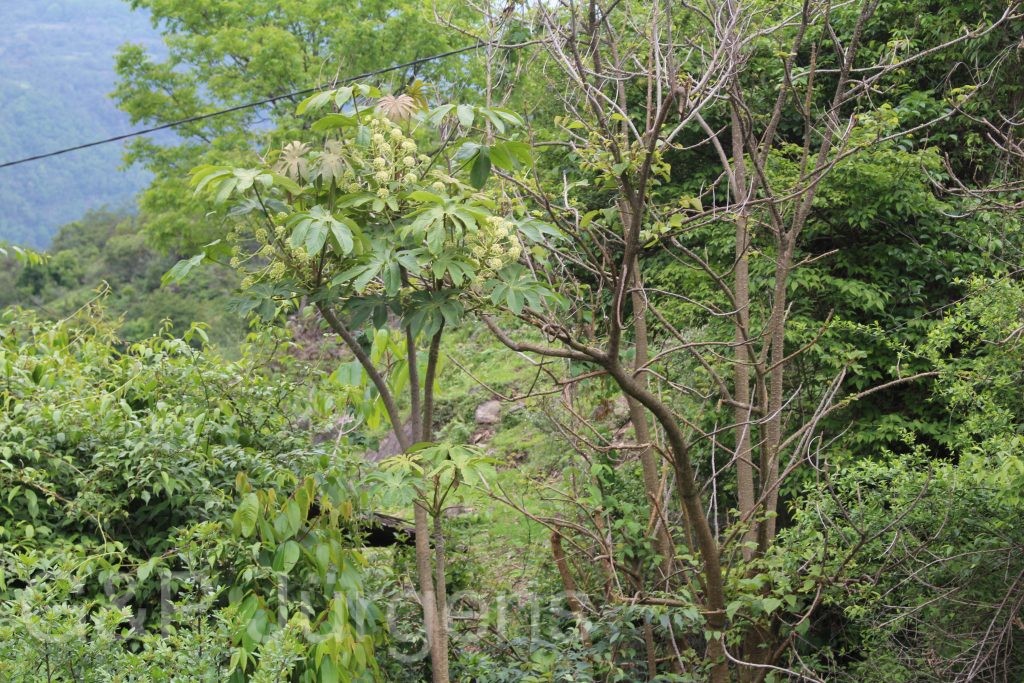
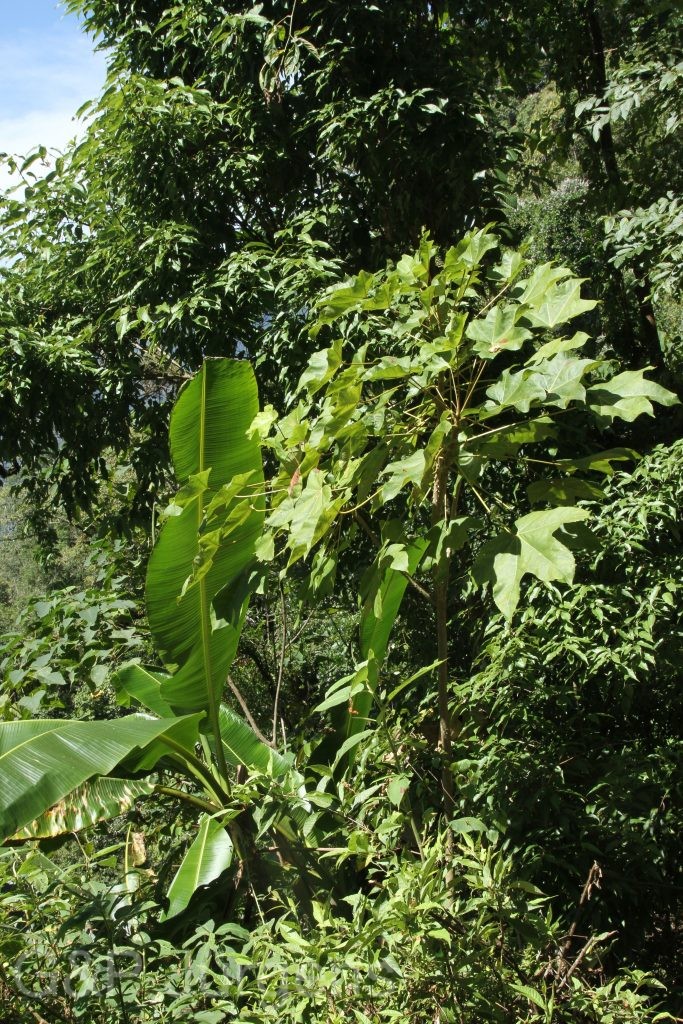
Seem.

Bhutan2015 205
Bhutan Zhemgang 910m, October

Description

Brassaiopsis hainla is a small tree or treelet of the eastern Himalaya and adjacent Southeast Asia, distributed from northern India, Nepal and Bhutan through southern China into Myanmar, Thailand, Malaysia and Indonesia. GBIF records some 350 occurrences, the core in China, India, Nepal and Myanmar. It is a plant of subtropical to warm-temperate broad-leaved forest, growing along streamsides, ravine slopes, forest margins and secondary woodland, broadly from the foothills up to around 1500–2000 m. The individual shown was photographed in Bhutan at Zhemgang at 910 m in October, in humid hill forest characteristic of its lower-montane habitat.

The plant is a sparingly branched small tree with stout, often prickly stems and large, palmately lobed or palmately compound leaves clustered toward the branch tips on long petioles; the lobes are oblong-lanceolate, acuminate and serrate, and young growth is frequently armed with scattered prickles. The minute, greenish-white flowers are five-merous and borne in umbels arranged into large terminal, paniculate or racemose compound inflorescences. Each flower has a reduced calyx, free petals and an inferior ovary crowned by a stylar column. The fruit is a small, globose to slightly flattened drupe-like berry, ripening dark, containing several flattened pyrenes.

Brassaiopsis is a genus of the Araliaceae centred on the Sino-Himalaya and Indochina, allied to Aralia and Schefflera and distinguished by its armed stems, palmate leaves and umbellate inflorescences. The young shoots and leaves of B. hainla are eaten as a vegetable in parts of the Himalaya, and the species has local ethnobotanical use. It is reasonably widespread across its montane forest range and is not regarded as globally threatened, though it depends on the persistence of intact broad-leaved forest.

Author: Seem. · Sources: POWO (Kew), GBIF, Flora of China, Flora of Bhutan, An Annotated Checklist of the Flowering Plants of Nepal, A Systematic Revision of the Genus Brassaiopsis (Araliaceae)

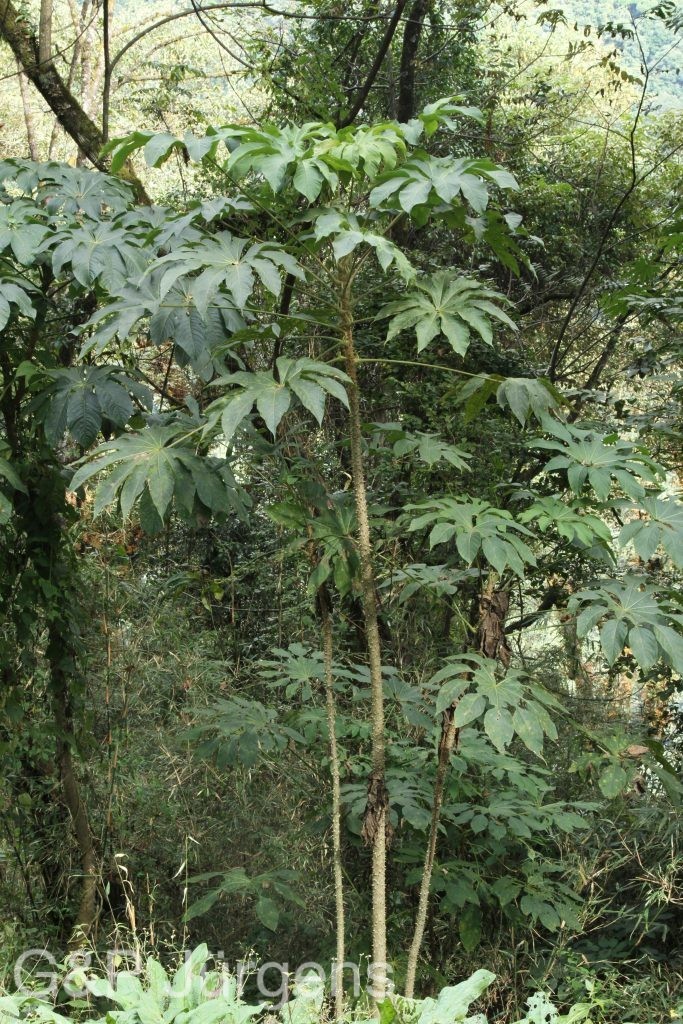
C.B.Clarke

Bhutan2015 583
Bhutan Gasa 2000m, October
Bhutan2015 590
Bhutan Gasa 2200m, October

Description

Brassaiopsis mitis is an East Himalayan small tree or large shrub of the ginseng family, GBIF holding only about 61 occurrences from India, Bhutan, Nepal and Myanmar. It inhabits humid, shaded broadleaved and evergreen montane forest, occurring along stream gullies, ravine slopes and forest margins generally between about 1500 and 2500 m. The individuals photographed from the Gasa district of northern Bhutan at 2000 and 2200 m, in October, are typical of its occurrence in cool, moist mid-montane forest of deep shade and high humidity, the autumn date corresponding to its fruiting season.

It is an evergreen shrub or small tree to several metres tall, the stems and petioles often prickly, as in many species of Brassaiopsis. The leaves are large, long-petiolate and palmately lobed or palmately compound, the lobes or leaflets entire to serrate, giving the crown a coarse, tropical aspect. The minute, greenish flowers are five-merous with an inferior ovary and are aggregated into umbels grouped into large terminal panicles. The fruit is a small, fleshy, more or less globose drupe crowned by the persistent stylopodium, ripening dark and containing a few flattened pyrenes.

Described by C. B. Clarke, B. mitis belongs to the predominantly Sino-Himalayan and Southeast Asian genus Brassaiopsis within Araliaceae, characterised by prickly, large-leaved understorey trees. With its few records and restricted East Himalayan range it is of regional biogeographic interest, dependent on intact mid-montane forest. Ecologically its umbellate inflorescences attract generalist insects, while its drupaceous fruit is dispersed by frugivorous birds and mammals of the forest interior.

Author: C.B.Clarke · Sources: POWO (Kew), GBIF, Flora of Bhutan, Flora of China, Lowry & Frodin studies of Brassaiopsis (Araliaceae)

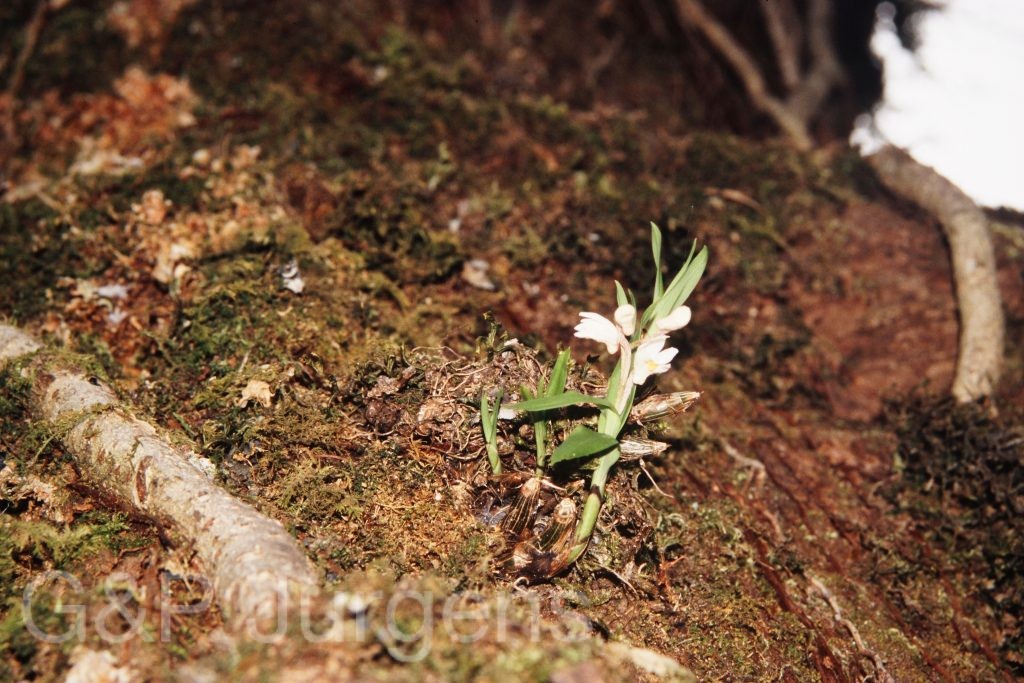
(F.M.Bailey) M.A.Clem. & D.L.Jones

Bh2008 509 G780
Bhutan Chongsakha 2200m, May

Description

Bryobium eriaeoides is a small epiphytic orchid formerly placed in the genus Eria, transferred to Bryobium by Clements & Jones based on molecular phylogenetic evidence. The genus Bryobium comprises species previously assigned to Eria section Mycaranthes and allied sections. The species has a disjunct distribution spanning the eastern Himalayas (Bhutan, northeast India) to Southeast Asia and Australasia (Papua New Guinea, Queensland), occurring in montane cloud forests at elevations of 400–2,200 m.

The plant forms small, clustered pseudobulbs 1–3 cm tall on a creeping rhizome, each bearing 2–4 narrowly elliptic leaves 3–8 cm long. The inflorescence arises from the base of the pseudobulb, producing a short raceme of small, densely arranged flowers. Individual flowers are 4–6 mm across, white to pale cream, with a densely pubescent ovary and floral bracts. The lip is trilobed, the mid-lobe fleshy with low keels. Flowering in the Himalayas occurs from April to June.

The taxonomy of Bryobium and closely related genera remains in flux, as ongoing molecular studies continue to refine the classification of the large, polyphyletic former genus Eria. Like all orchids, the species is subject to CITES Appendix II trade regulations.

Author: (F.M.Bailey) M.A.Clem. & D.L.Jones · Sources: POWO (Kew), GBIF, Clements & Jones: Nomenclatural changes in the Eriinae (2002), Pearce & Cribb: The Orchids of Bhutan (2002)

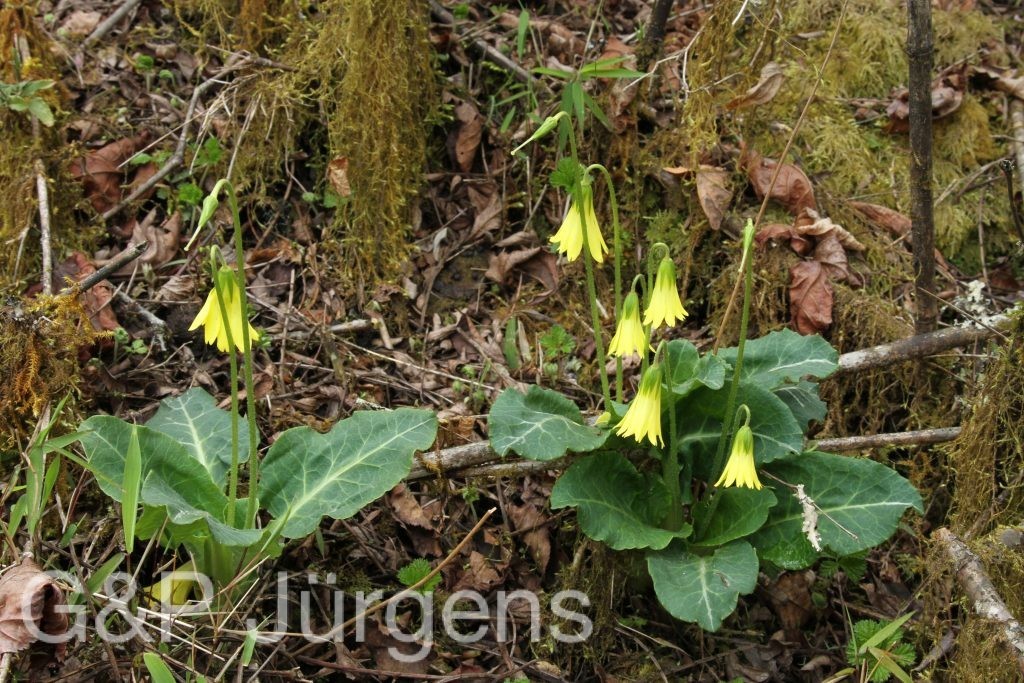
Hook.f. & Thomson

Bhutan2014 497
Bhutan Phobjika 2800m, May
Bhutan2014 499
Bhutan Phobjika 2800m, May

Description

Bryocarpum himalaicum is the sole species of its genus, a primuloid herb endemic to the eastern Himalaya and recorded from Bhutan, India (Sikkim), Nepal and southern China; GBIF documents around 86 occurrences across this narrow range. It grows in moss-rich, humus-laden ground in cool, shaded forest, among rhododendron and bamboo thickets and on damp, mossy banks in the upper temperate and subalpine zones, typically between about 2700 and 3700 m. The illustrated plant from Phobjika in central Bhutan at 2800 m, flowering in May, is characteristic of these humid, sheltered montane habitats.

It is a small, delicate perennial herb arising from a slender rhizome, forming a rosette of long-petioled, ovate to cordate, crenate leaves with a soft texture. The flowers are solitary and nodding on slender scapes, the corolla being narrowly tubular to bell-shaped and clear yellow, with a slender tube expanding into five spreading lobes, evoking a miniature pendent primrose. A distinctive feature giving the genus its name is the elongate, beaked, septicidal capsule that buries or lowers itself among the moss as it matures before releasing the seeds.

Bryocarpum is a monotypic genus traditionally allied to Primula and the cyclamenoid primulas within Primulaceae, distinguished by its solitary yellow flowers and peculiar elongate fruiting capsule. Its restricted high-Himalayan range and dependence on undisturbed mossy forest floor make it a botanically significant relict of conservation interest, vulnerable to habitat disturbance and changing montane moisture regimes.

Author: Hook.f. & Thomson · Sources: POWO (Kew), GBIF, Flora of Bhutan, Flora of China, Primula (J. Richards monograph)

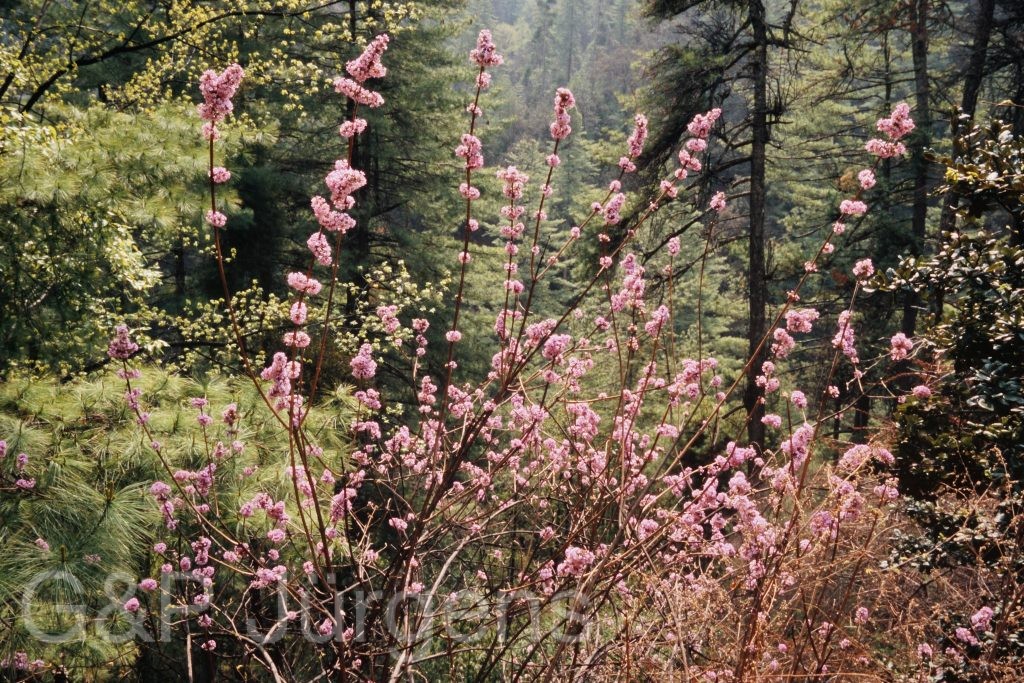
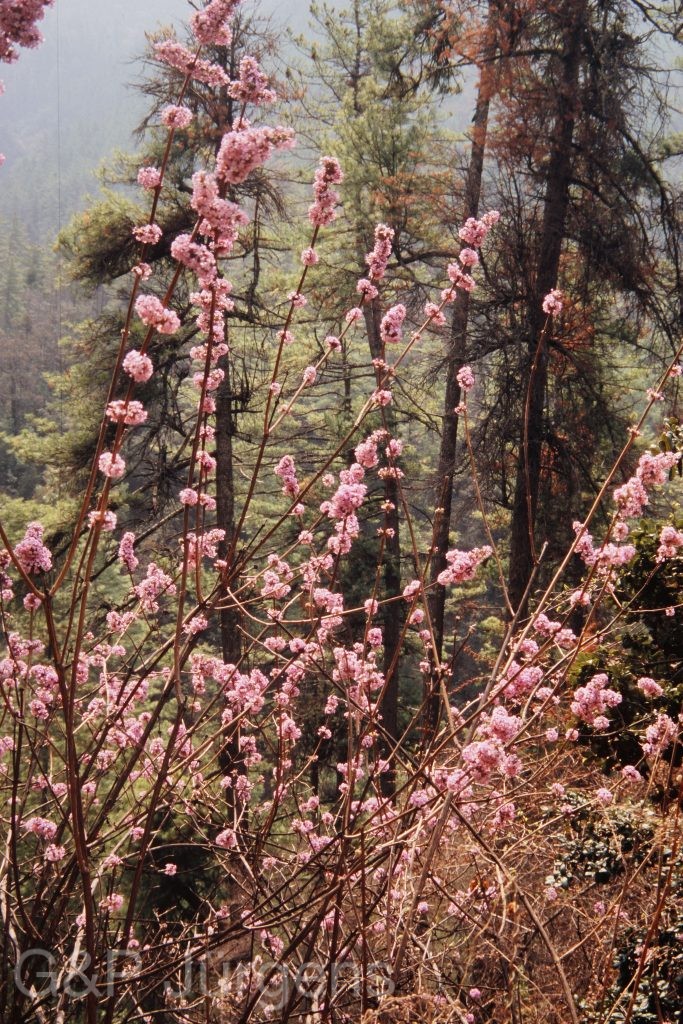
Benth.

Bh2008 26 P45
Bhutan Doch-La, 1400m April
Bh2008 27 G47
Bhutan Doch-La, 1400m April

Description

Buddleja crispa is a shrub of the dry inner valleys and warm temperate slopes of the Himalaya and adjacent mountains, distributed through China, Pakistan, India, Nepal, Afghanistan and Bhutan, with close to 1100 occurrences in GBIF. It favours open, sunny, often rocky and somewhat arid sites: cliff ledges, river gravels, dry hillsides, roadside banks and the margins of cultivation, generally between about 1000 and 3000 m. The plant photographed at the Doch La in Bhutan at 1400 m in April, flowering in spring on a warm montane pass, is typical of its early-season bloom on exposed, well-drained slopes where its grey-felted foliage withstands strong insolation and seasonal drought.

The species is a much-branched, deciduous to semi-evergreen shrub reaching 1–4 m, densely clothed throughout in white to greyish stellate and woolly tomentum that gives it a markedly silvery appearance. The leaves are opposite, ovate to lanceolate, with crisped, crenate or dentate, often undulate margins (the source of the epithet), and a thick indumentum, particularly beneath. The fragrant flowers are borne in dense, terminal and axillary panicles; each has a tubular corolla that is lilac to pale purple with an orange or yellow throat, the four-lobed limb spreading. The fruit is a small, two-valved septicidal capsule containing numerous minute seeds.

Buddleja, formerly placed in its own family Buddlejaceae or in Loganiaceae, is now treated within an expanded Scrophulariaceae, as on the source page. B. crispa is a variable species across its wide range and has given rise to several named varieties and to horticultural selections valued for their scented, early flowers and tolerance of dry, sunny conditions. The flowers attract butterflies and other insects. The species is widespread, often pioneering on disturbed ground, and is not of conservation concern.

Author: Benth. · Sources: POWO (Kew), GBIF, Flora of China Vol. 15, Flora of Bhutan Vol. 2, Flora of Pakistan, A Revision of the Asiatic Species of Buddleja (Scrophulariaceae)

Benth.

Bhutan2015 445
  Bhutan Jakar 2900m, October
Bhutan2015 446
  Bhutan Jakar 3100m, October

Description

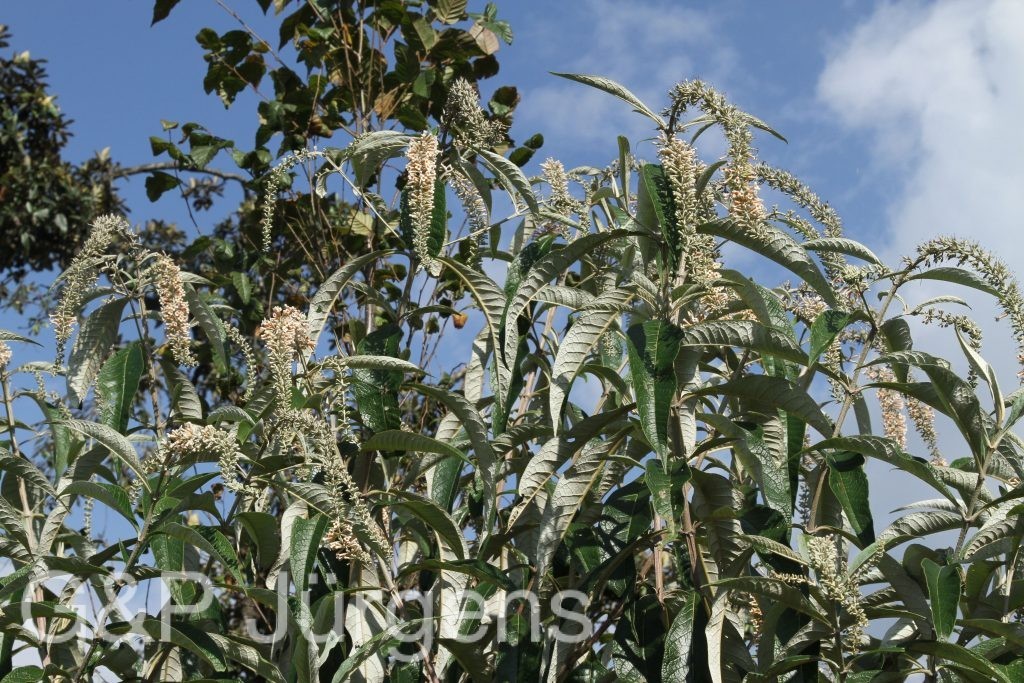
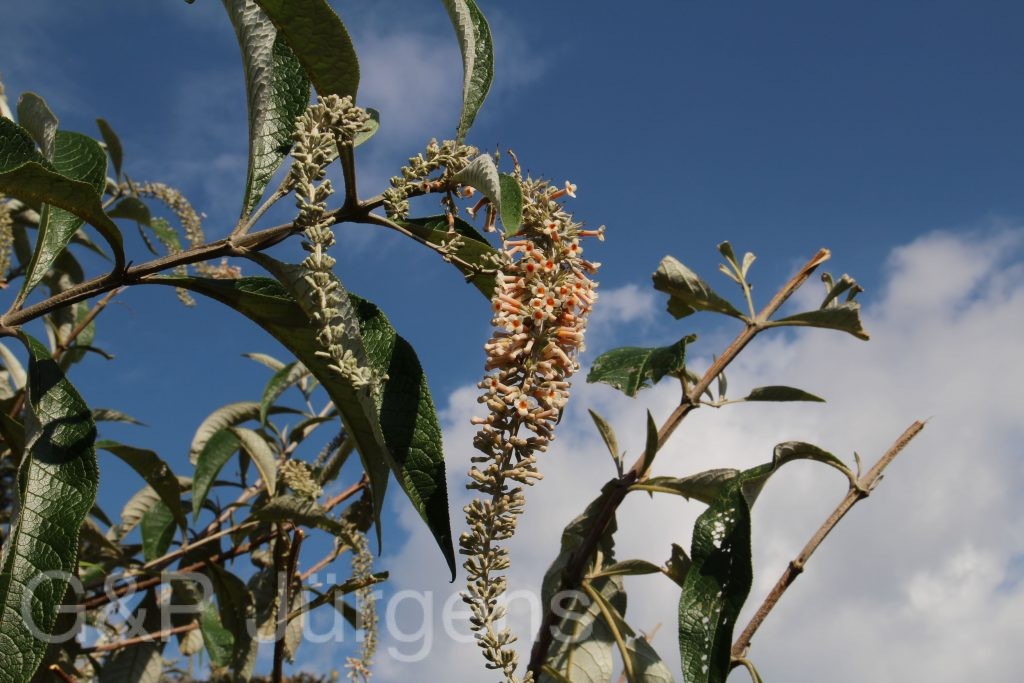
Buddleja macrostachya is a widespread Sino-Himalayan and Indochinese shrub, recorded from China, India, Vietnam, Myanmar, Thailand, Bhutan, Bangladesh and Nepal, with over 400 documented occurrences spanning the eastern Himalaya into mainland Southeast Asia. It is a plant of open hillsides, forest margins, thickets, roadsides and disturbed slopes in subtropical to temperate zones, generally between about 1000 and 3200 m. The illustrated plants from Jakar in central Bhutan at 2900 and 3100 m, flowering in October, demonstrate its autumn flowering at the upper end of its altitudinal range, where it forms conspicuous shrubs in sunny, often disturbed montane habitats.

It is a large shrub with quadrangular, densely stellate-tomentose young branches. The leaves are opposite, lanceolate to narrowly elliptic, long-acuminate, with a crenate-serrate margin, dark green and rugose above and grey- to fawn-tomentose beneath, the bases joined by an interpetiolar stipular line. The inflorescence is a long, narrow, interrupted spike-like thyrse (reflected in the epithet macrostachya, large-spiked) of many congested cymose clusters. Individual flowers are small, with a four-lobed campanulate corolla that is pale lilac to pink or purplish with an orange throat, and four included stamens. The fruit is a small, septicidal, two-valved capsule releasing numerous minute seeds.

Although listed here under Scrophulariaceae following the broad APG placement of Buddleja, the genus is also frequently treated in its own family Buddlejaceae; B. macrostachya Benth. is the accepted name. The nectar-rich, fragrant inflorescences attract butterflies, moths and other long-tongued insects, while the light, winged seeds are wind-dispersed. As a vigorous coloniser of open and disturbed ground it is common and widespread, and of least conservation concern.

Author: Benth. · Sources: POWO (Kew), GBIF, Flora of China Vol. 15, Flora of Bhutan Vol. 2, Flora of Nepal, Leeuwenberg The Loganiaceae of Africa and Buddleja revisions (monograph)

Wall.

Nepal 97 331 P656
Nepal Arun-Valley 1900m, May

Description

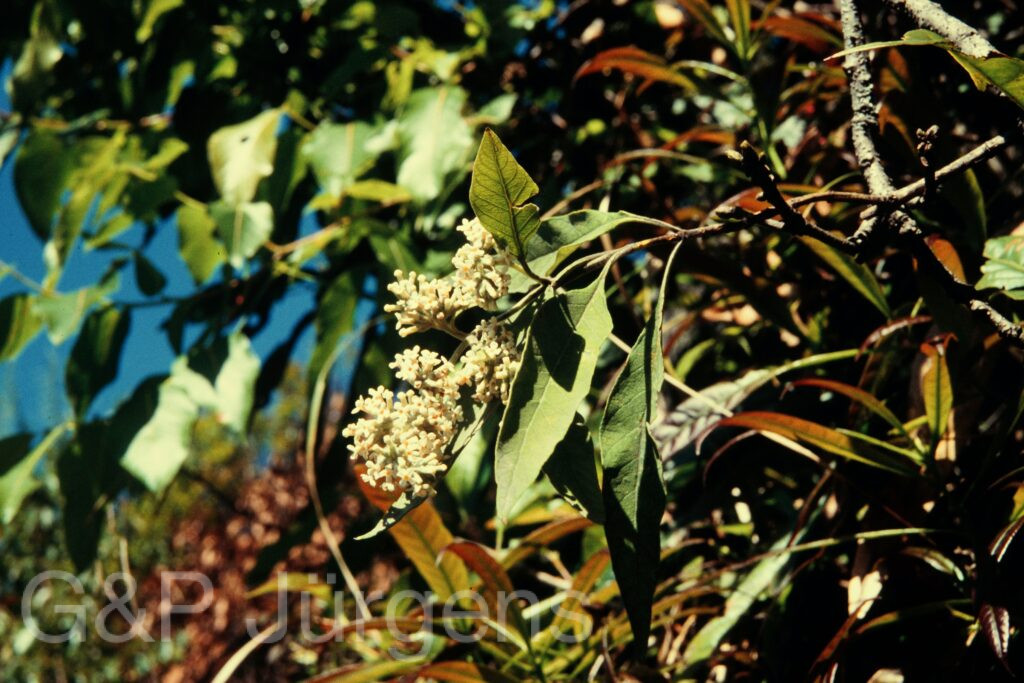
Buddleja paniculata is a shrubby butterfly-bush of the Himalaya and adjacent China, with GBIF occurrences across Nepal, northern India, Bhutan, Myanmar, Vietnam, Thailand and southwest China (further codes being cultivated and herbarium records). It favours open, sunny situations on dry slopes, river terraces, cliffs, roadsides and forest margins in the subtropical to warm-temperate zone, mostly between 1,000 and 2,800 m. The illustrated plant was photographed in the Arun Valley of eastern Nepal at about 1,900 m in May, where it flowers in the dry pre-monsoon season on stony, well-drained ground.

The plant is an erect, much-branched shrub 1-3 m tall with quadrangular, stellate-tomentose young branches. The leaves are opposite, lanceolate to ovate-lanceolate, with a green, somewhat rugose upper surface and a paler, densely stellate-hairy underside, and crenate-serrate margins. The flowers are small and fragrant, crowded into slender, often nodding panicles of cymose clusters; the corolla is tubular with four short lobes, white to pale lilac with an orange or yellow throat, and the calyx is densely tomentose. The fruit is a small, two-valved septicidal capsule releasing numerous minute, narrowly winged seeds dispersed by wind.

The genus Buddleja, formerly placed in its own family Buddlejaceae or in Loganiaceae, is now treated within an enlarged Scrophulariaceae. Buddleja paniculata is among the more cold-tolerant Asian species and an important early-season nectar source for butterflies and other insects. It is widespread, often colonising disturbed and degraded ground, and is not of conservation concern; some forms are grown ornamentally for their scented winter-to-spring bloom.

Author: Wall. · Sources: POWO (Kew), GBIF, Flora of China Vol. 19 (Buddlejaceae), Flora of Nepal, Leeuwenberg: The Loganiaceae of Africa – Buddleja revision works