Author

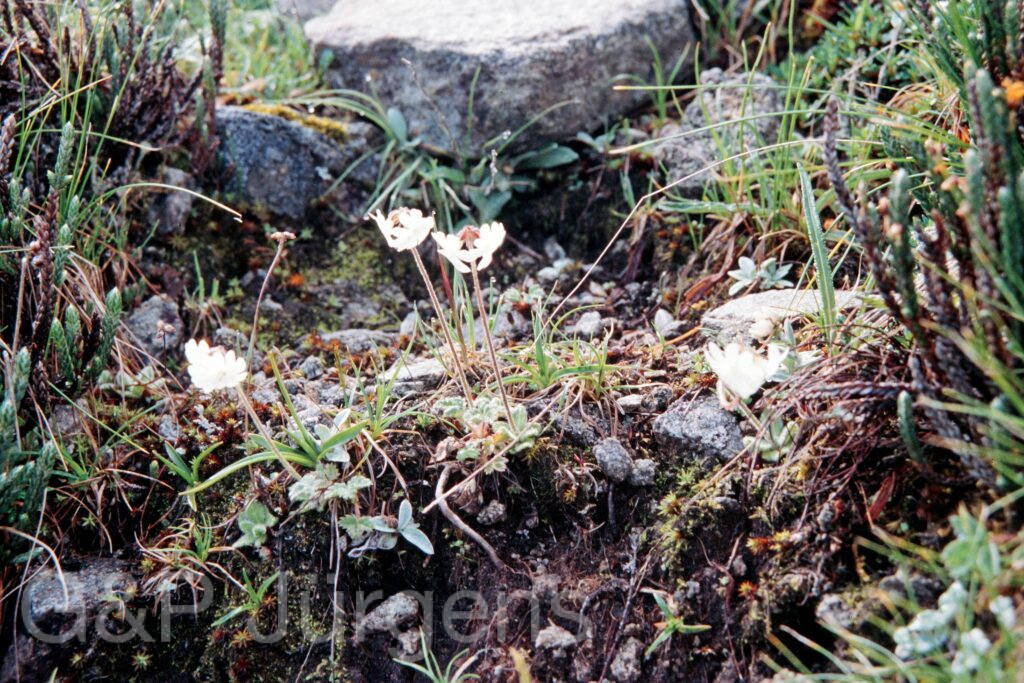
G & P Jürgens

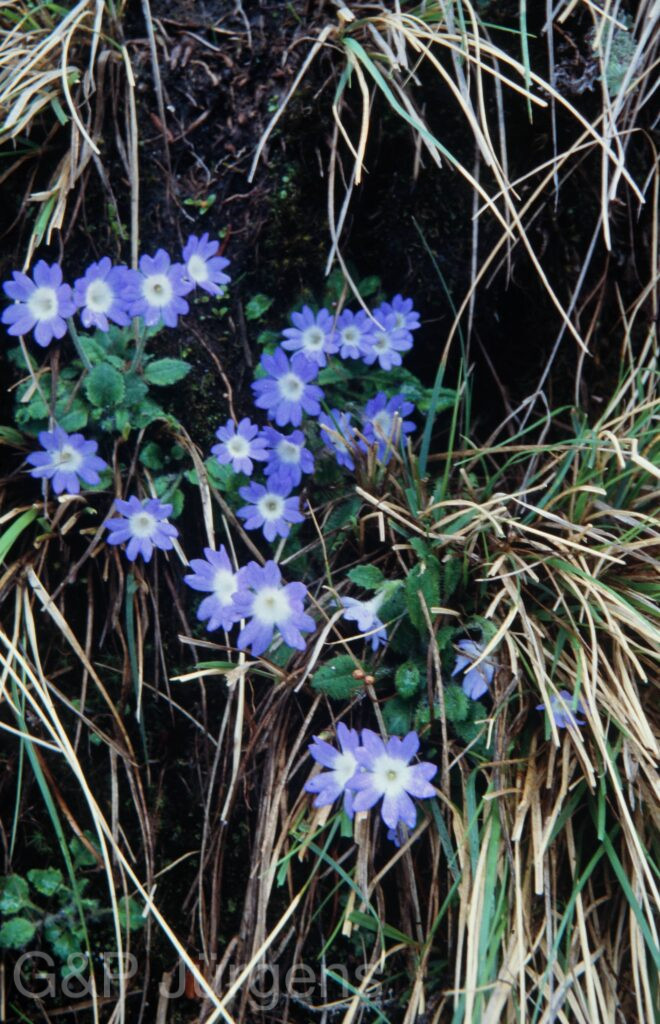
H.R.Fletcher

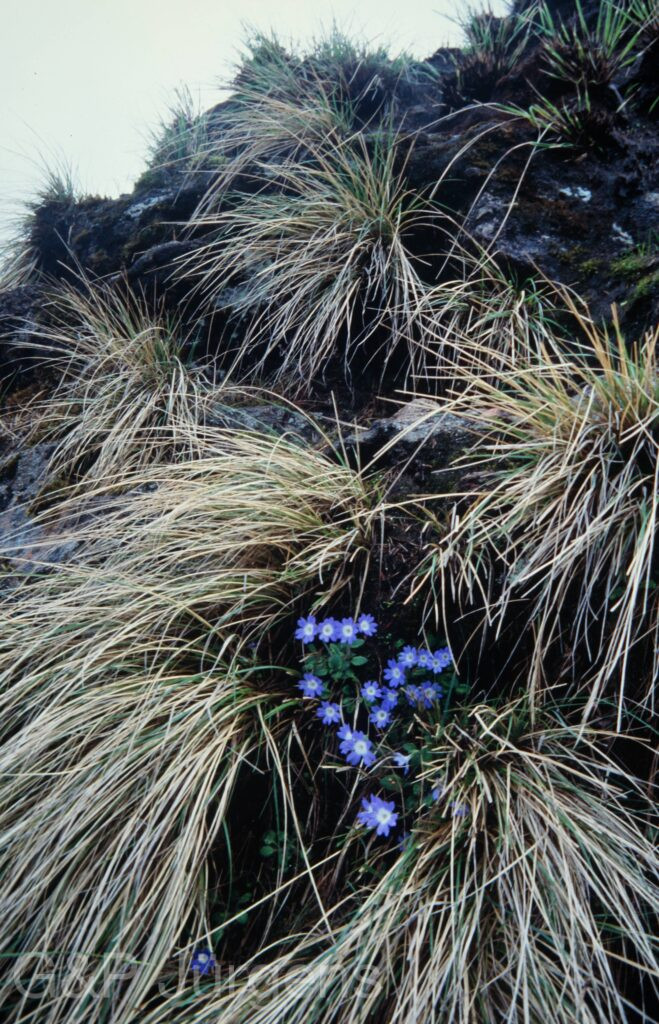
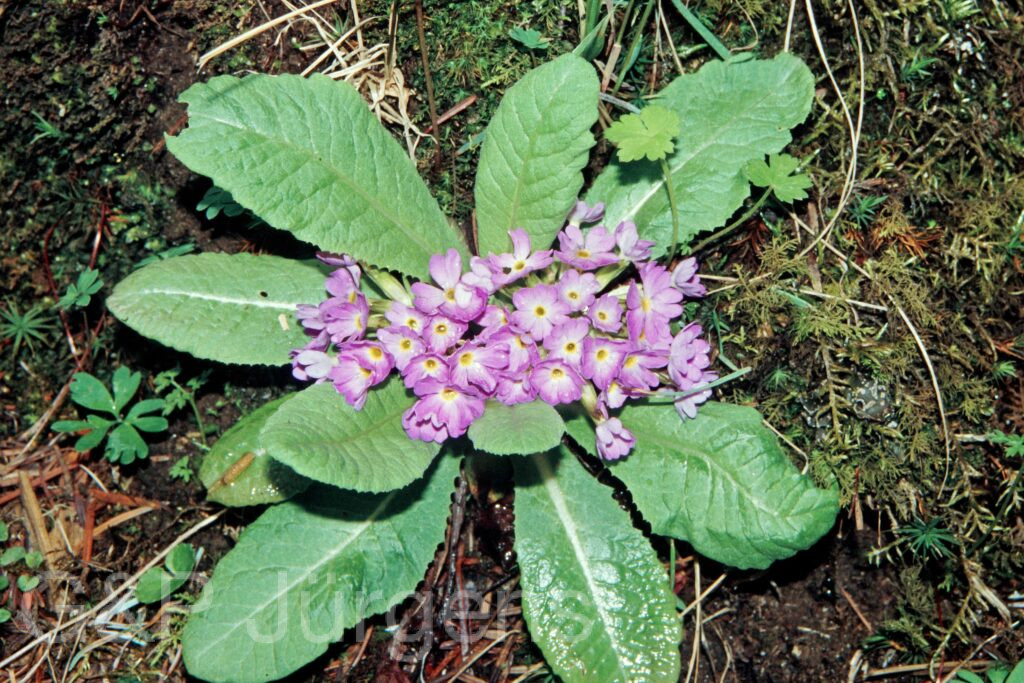
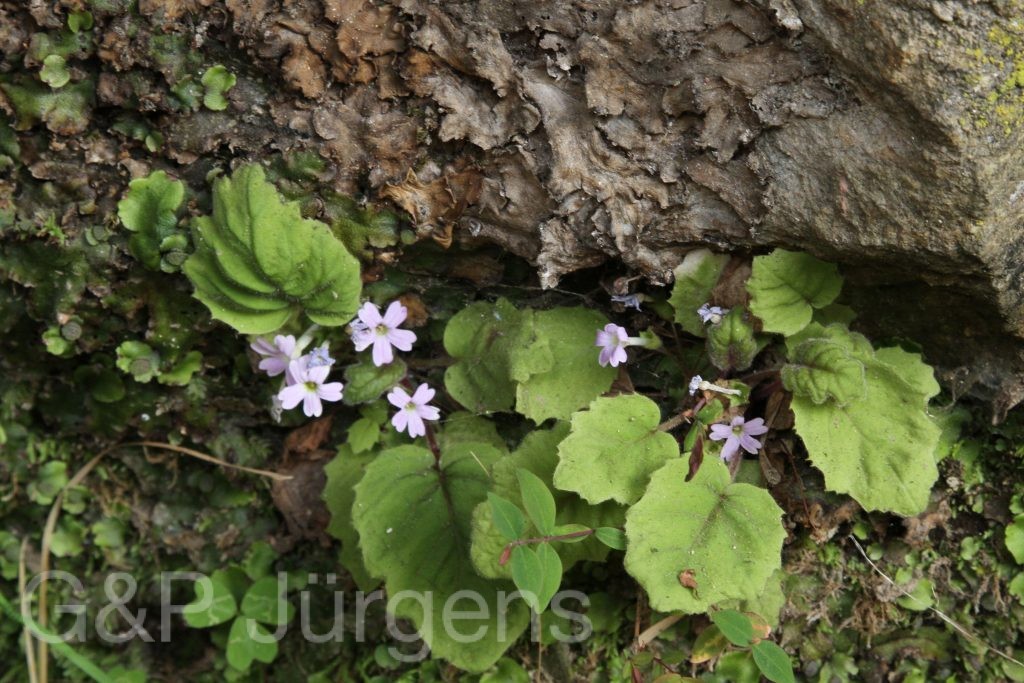
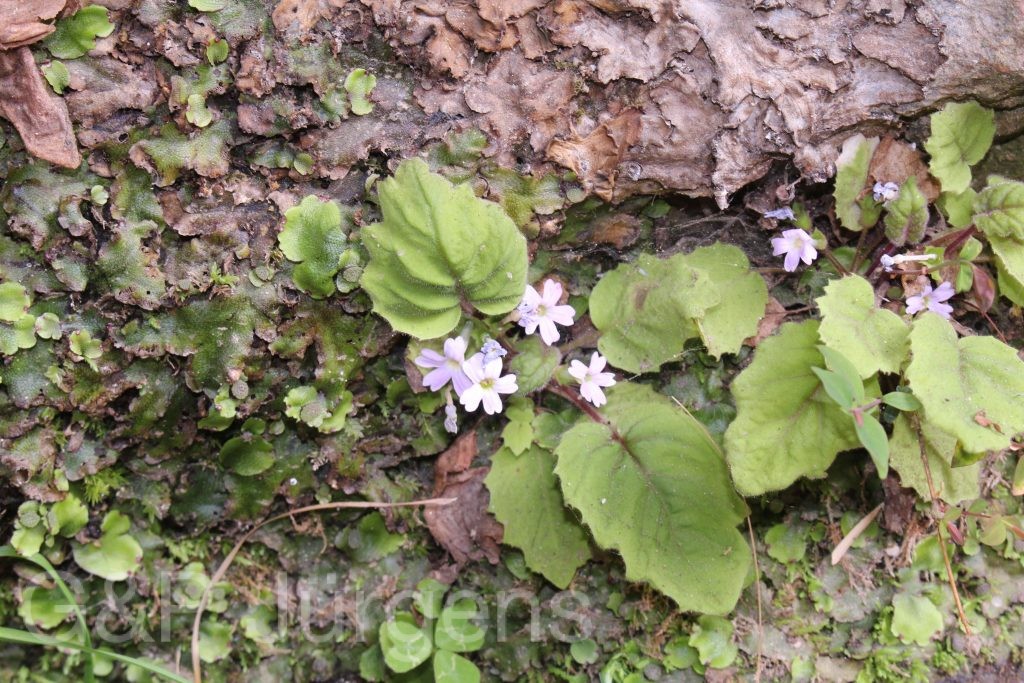
Nepal 2009 49 ergebnis
Nepal Helambu Nasem Pati 3550, May

Description

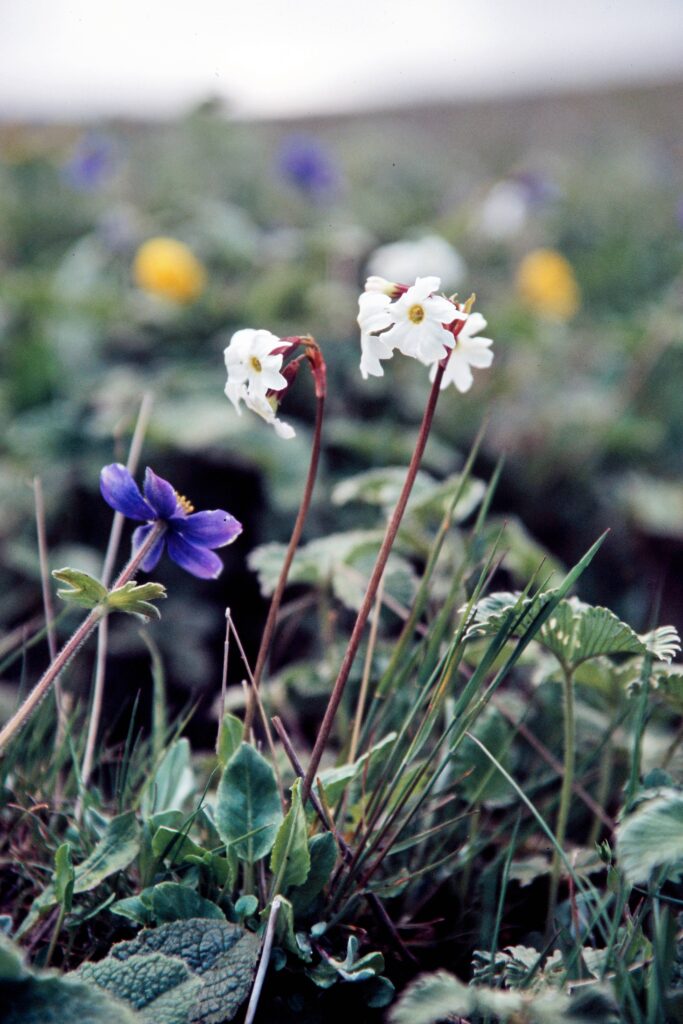
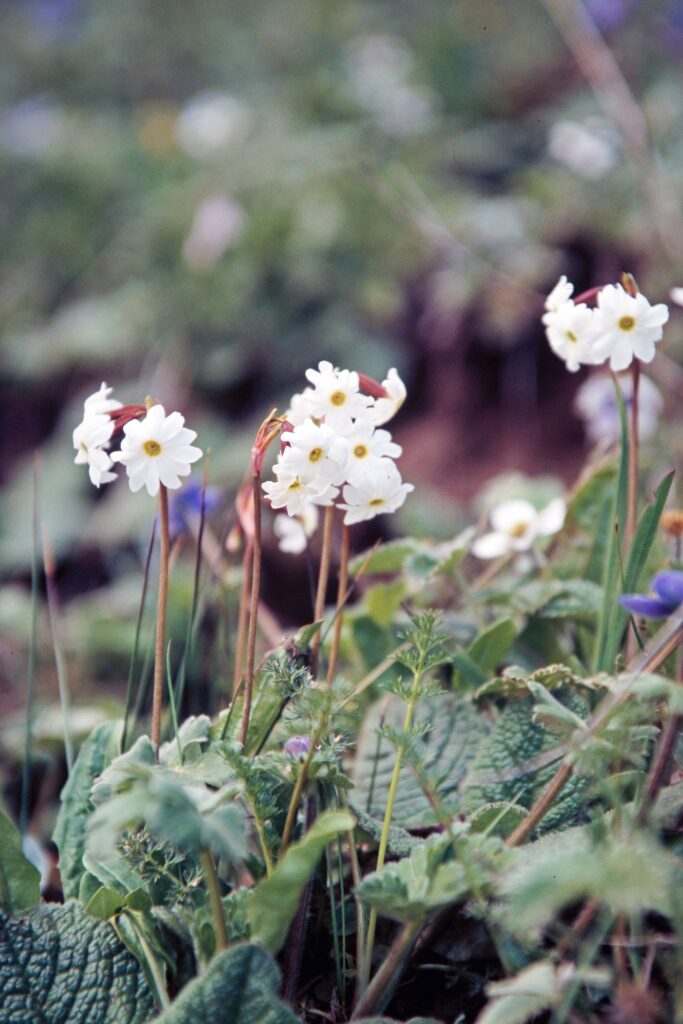
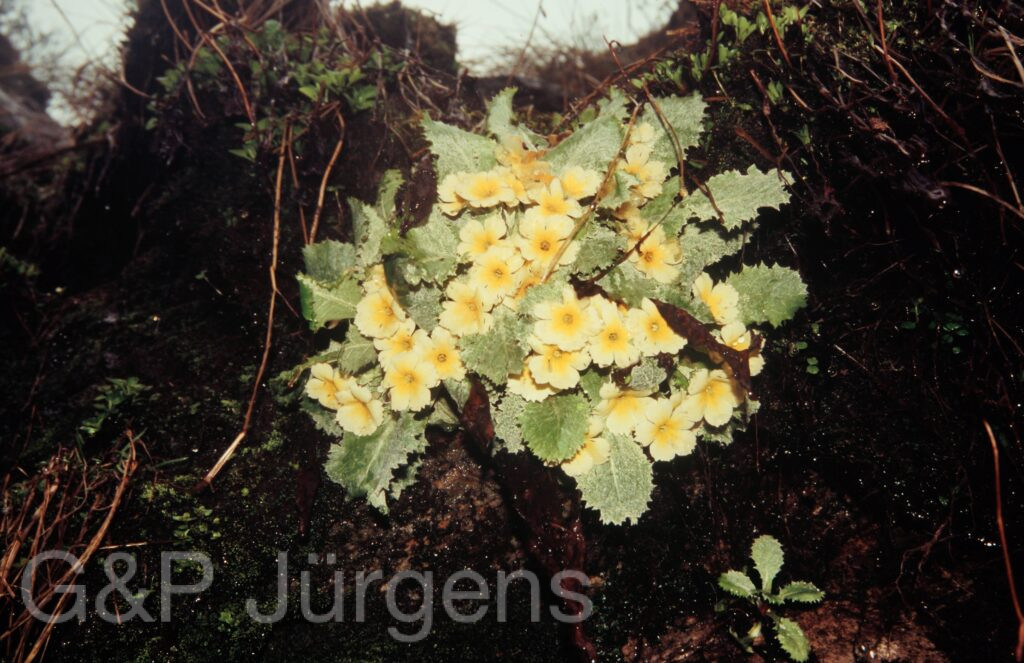
Primula aureata is a narrowly endemic primrose known only from central Nepal, where GBIF records (about 35 occurrences, all from Nepal) confirm its restricted range. It is a plant of cool, shaded, perpetually humid sites, growing on damp, mossy cliffs, dripping rock faces and shaded gully walls in the upper temperate and subalpine zone. The illustrated plant was photographed in the Helambu region at Nasem Pati at about 3550 m in May, a locality representative of the species' small known distribution along the moist ridges north of the Kathmandu valley, where it flowers soon after the winter snows clear.

The plant is a small, stemless perennial forming a basal rosette of leaves that emerge from a resting bud heavily coated in pale farina. The leaves are obovate to spathulate, toothed towards the apex, narrowed to a winged petiole, and dusted beneath with white meal. From the rosette rises a short scape bearing a few-flowered umbel; each flower has a tubular, farinose calyx and a flat-faced, pale yellow corolla with a deeper golden-yellow eye, the epithet aureata alluding to this golden centre. The corolla lobes are obcordate and notched, and the species is heterostylous with pin and thrum forms. The fruit is a small capsule enclosed in the persistent calyx.

Primula aureata belongs to section Petiolares, a largely Himalayan group of farinose, rosette-forming primulas of shaded, moist rock habitats. Its very limited range, dependence on specialised cliff microhabitats and small known population make it a plant of conservation interest, vulnerable to disturbance and collection; it is also esteemed in cultivation by alpine specialists. Localised endemics of this kind underline the high level of plant endemism in the central Nepal Himalaya.

Author: H.R.Fletcher · Sources: POWO (Kew), GBIF, Annotated Checklist of the Flowering Plants of Nepal, Flora of Bhutan, Smith and Fletcher's monographs of Primula section Petiolares, Richards' monograph Primula
Craib

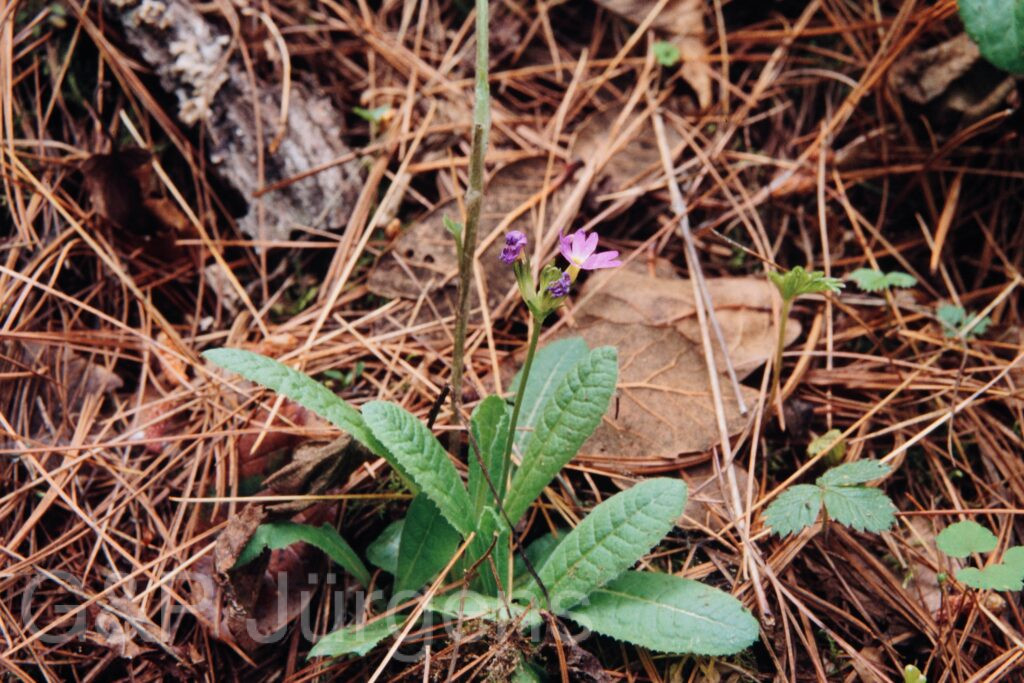
Sikkim 2006 345 ergebnis
India West-Bengal, Tolung 2500m, May

Description

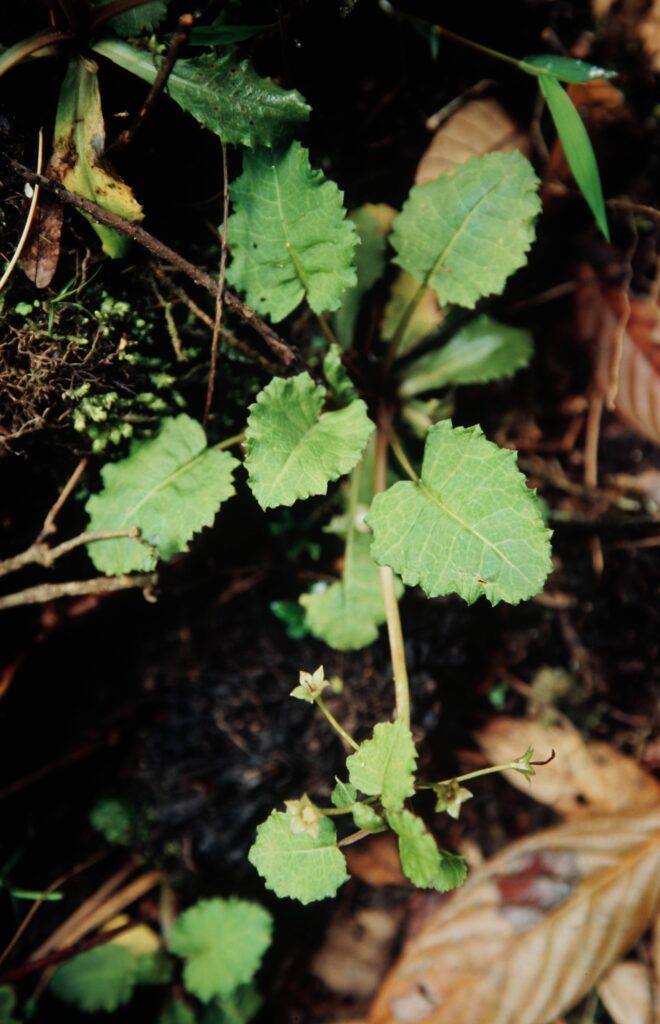
Primula bracteosa is a temperate to subalpine primrose of the eastern Himalaya, recorded from Bhutan, India and Nepal, with 51 georeferenced occurrences across this comparatively narrow range. It favours cool, shaded, moist situations such as mossy banks, damp rock ledges and the humus-rich floor of broadleaved and conifer forest. The plant photographed at Tolung in West Bengal, India, at 2500 m in May documents its spring flowering in the moist temperate forest belt, when the rosettes emerge and bloom early in the season following snowmelt and the first monsoon moisture.

The plant forms a basal rosette of obovate to spathulate leaves that are toothed to crenate along the margin, often farinose (mealy) beneath and tapering to a winged petiole. The flowers are borne in a terminal umbel atop a slender scape; as the epithet indicates, the umbel is subtended by conspicuous bracts. The individual flowers are salverform with a slender corolla tube and a spreading, notched-lobed limb, pink to rose-purple or lilac with a yellow or greenish eye. Like most Primula the species is typically heterostylous, with pin and thrum flower morphs promoting outcrossing. The fruit is a small capsule releasing numerous minute seeds.

Within the large and taxonomically complex genus Primula, P. bracteosa is placed in section Petiolares, a group of early-flowering, often farinose eastern-Himalayan primroses centred on Sikkim, Bhutan and adjacent regions. The section is prized but demanding in cultivation. Restricted to cool, humid montane forest, the species is locally frequent in suitable habitat but potentially vulnerable to forest disturbance and a warming climate.

Author: Craib · Sources: POWO (Kew), GBIF, Flora of Bhutan, Flora of China, The Genus Primula monograph (Richards), Flowers of the Himalaya (Polunin & Stainton)

Balf. f.

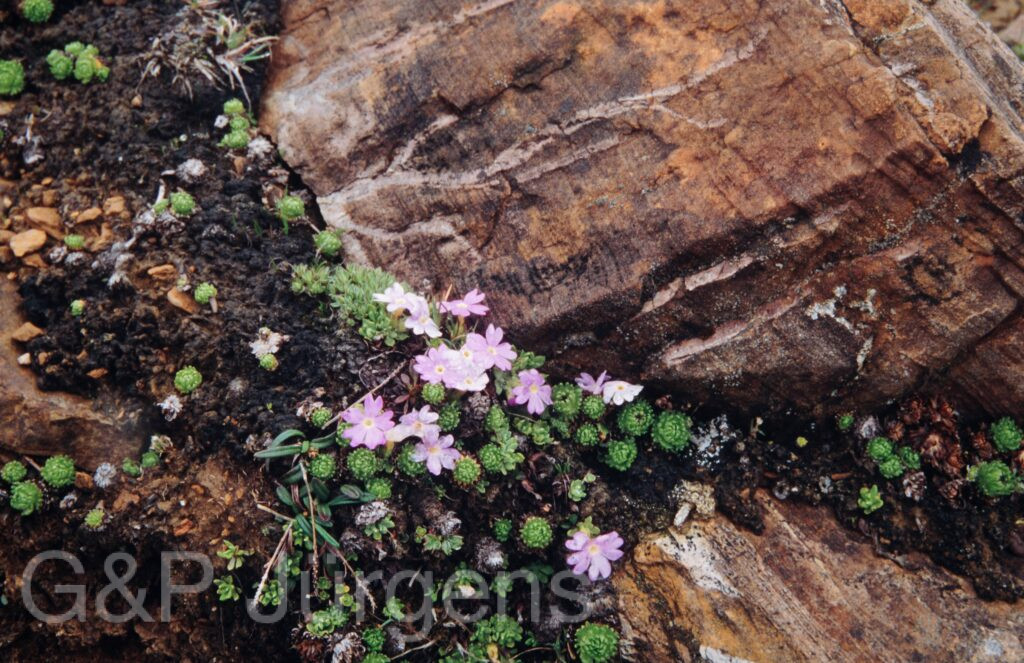
Nepal 99 540 ergebnis
West-Nepal Churta-Khola 4100m, June

Description

Primula buryana is a high-alpine primrose of the central and western Himalaya, recorded from Nepal and adjacent south-central China (Xizang), with around one hundred and twenty-two GBIF occurrences indicating a localised but well-documented range. It grows in damp alpine meadows, on grassy and rocky slopes, beside snowmelt rills and in moist turf above the treeline, typically around 4000 to 4500 m. The illustrated plant from the Churta-Khola in West Nepal at 4100 m, flowering in June, is characteristic of its early-summer phenology, blooming shortly after the snow retreats from the high pastures it favours.

The species is a small perennial herb forming a basal rosette of leaves that are often farinose (mealy with white or yellowish farina) and oblong to spathulate with crenate to denticulate margins. From the rosette rises a slender scape bearing a one- to several-flowered umbel subtended by an involucre of bracts. The flowers are heterostylous (pin and thrum), with a tubular calyx and a salverform to funnelform corolla that is violet to purple or pinkish with a contrasting yellowish or white eye. The fruit is a small capsule shorter than or about equalling the calyx, releasing numerous angular seeds.

Primula buryana is an accepted species placed within the petiolarid alliance of Primula (Primulaceae), the Himalayan group of farinose, small-statured alpine primroses. Its heterostyly promotes outcrossing, while the farina and compact rosette habit are adaptations to high insolation and the brief, moisture-rich alpine season. The species has a restricted range and, although not formally assessed, its dependence on intact high-altitude wet meadows makes it potentially vulnerable to grazing and climatic change.

Author: Balf. f. · Sources: POWO (Kew), GBIF, Annotated Checklist of the Flowering Plants of Nepal, Flora of China, Richards monograph Primula (Primulaceae)

H.R.Fletcher

Nepal 2001 362 ergebnis ergebnis
Nepal (Gorkha) Rupina-La 3350m, May
Nepal 2001 361 ergebnis ergebnis
Nepal (Gorkha) Rupina-La 3350m, May

Description

Primula buryana var. purpurea is an alpine primrose found in central and eastern Nepal, growing in moist rocky crevices, moss-covered banks, and shaded cliff faces at 3,000–4,200 m elevation.

This compact perennial forms rosettes of small, rounded to spathulate leaves with a mealy (farinose) coating on the undersurface. The flowers are borne in umbels of 2–6 on slender scapes 5–15 cm tall. The variety purpurea is distinguished by its deep purple to violet-purple flowers with a contrasting yellow eye, differing from the type variety which has paler, lilac blooms.

Primula buryana belongs to the section Petiolares, a group of Himalayan primulas that are notoriously difficult to cultivate outside their native habitat due to their requirement for cool, humid conditions with excellent drainage.

Author: H.R.Fletcher · Sources: POWO (Kew), Flora of Nepal, Richards: Primula (2003)

Craib

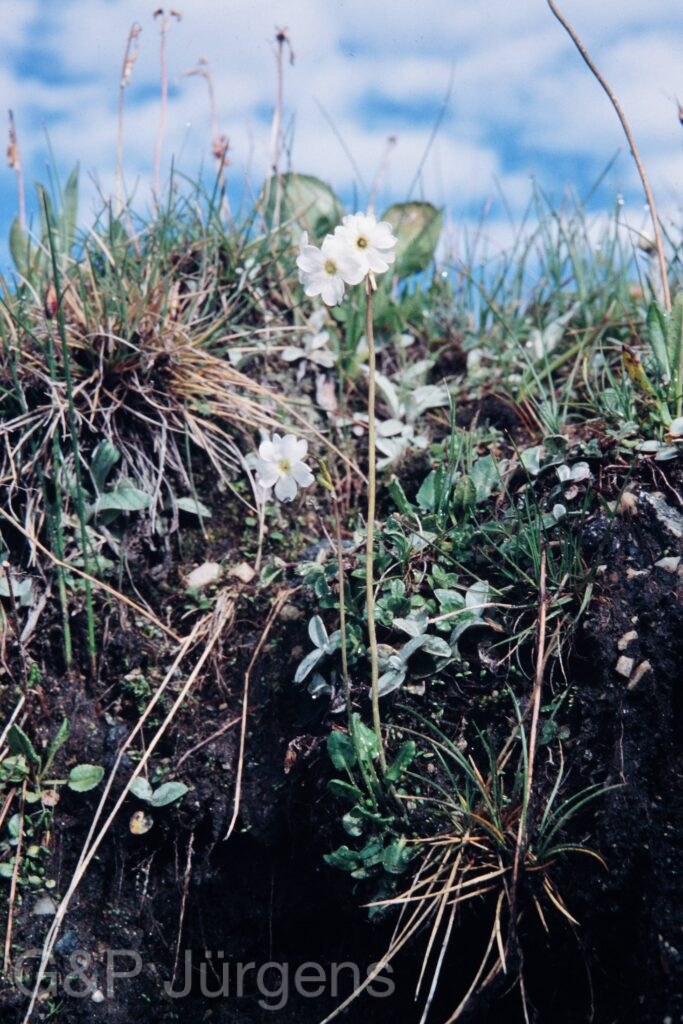
Nepal 99 472 ergebnis
West-Nepal Churta-Khola 3250m, June

Description

Primula drummondiana is a narrowly distributed Himalayan primrose confined to the central and western Himalaya, with GBIF records from India, Nepal and Bhutan totalling only about 37 collections, reflecting both its restricted range and limited herbarium representation. It grows on damp alpine and subalpine slopes, moist rock ledges, snow-melt flushes and grassy stream margins, generally between 3000 and 4000 m. The plant photographed at Churta-Khola in west Nepal at 3250 m in June, flowering soon after snowmelt, illustrates its dependence on cool, moisture-retentive ground in the brief Himalayan growing season.

It is a small rosette-forming perennial herb. The leaves are obovate to oblong-spathulate, narrowed to a winged petiole, with a crenate-dentate margin and frequently a farinose (mealy white) coating on the undersurface, as is characteristic of many farinose-section primulas. The flowers are borne in a terminal umbel on a slender scape overtopping the foliage; the corolla is salver-shaped with a narrow tube and spreading, notched lobes, typically violet to pinkish-purple with a contrasting yellow or whitish eye. Plants are heterostylous, producing pin and thrum morphs, and the fruit is a small capsule dehiscing to release numerous minute seeds.

The genus Primula reaches its greatest diversity in the Sino-Himalayan mountains, and P. drummondiana belongs to the farinose-leaved alliance whose members are taxonomically intricate and often distinguished by subtle leaf, farina and corolla characters. Heterostyly enforces outcrossing in these alpine populations. Its small known range and few documented sites mean the species merits conservation attention, as such restricted-range alpine primulas are particularly sensitive to warming and grazing pressure on high pastures.

Author: Craib · Sources: POWO (Kew), GBIF, Annotated Checklist of the Flowering Plants of Nepal, Flora of Bhutan, Smith & Fletcher revision of Primula, The Genus Primula (Richards)

(Wall. ex. Duby) Regel

Nepal 99 381 ergebnis
West-Nepal Linji-Khola 3200m, June
Nepal 99 394 ergebnis
West-Nepal Sallibagar-Khola 3100m, June

Description

Primula erosa (Wall. ex Duby) Regel is a Himalayan primrose with a comparatively narrow range, recorded only from India and Nepal, with about 30 georeferenced occurrences in GBIF, reflecting its restricted and localised distribution. It grows in moist, shaded situations such as forest floors, damp banks, mossy rocks and the margins of streams in the temperate to subalpine belt, broadly between about 2500 and 3500 m. The illustrated plants were gathered in West Nepal along the Linji-Khola at 3200 m and the Sallibagar-Khola at 3100 m, both in June, in the cool, humid gorge habitats favoured by this spring-flowering herb.

The plant is a low, rosette-forming perennial growing from a short rhizome with fibrous roots. The leaves form a basal rosette and are oblong to obovate, the margin characteristically erose to crenate-dentate (the epithet erosa) and the blade often farinose or mealy on the lower surface, tapering into a winged petiole. The flowers are borne in a terminal umbel atop a slender, erect scape; the corolla is typically pink to rose-purple with a yellowish eye, the limb of five notched lobes spreading from a slender tube above a campanulate calyx. Plants are heterostylous, with pin and thrum forms. The fruit is a small capsule releasing numerous seeds.

Within the vast genus Primula, this species belongs among the farinose Himalayan primroses and is allied to other small, mealy-leaved montane taxa. Its mealy farina and heterostylous breeding system are characteristic adaptations promoting outcrossing in cool, humid environments. Owing to its limited distribution and dependence on undisturbed moist forest habitat, the species merits monitoring, although no formal conservation assessment has been published.

Author: (Wall. ex. Duby) Regel · Sources: POWO (Kew), GBIF, Annotated Checklist of the Flowering Plants of Nepal, Flora of British India, Richards Primula monograph, Smith & Fletcher revision of Asiatic Primula

G.Watt

Bhutan2014 1057
Bhutan Takthsang 2900m, May
Bhutan2014 1060
Bhutan Takthsang 2900m, May

Description

Primula filipes is a slender, delicate primrose of the eastern Himalayas, distributed across Bhutan, Sikkim and adjacent northeast India, eastern Nepal, northern Myanmar and southwest China (Xizang, Yunnan). It is a plant of cool, humid montane forest, favouring mossy banks, shaded streamsides and damp rock ledges within mixed broad-leaved and conifer woodland. The species typically occurs between roughly 2,500 and 3,600 m; the population photographed near the cliffside monastery of Taktshang (Tiger's Nest) in Bhutan at about 2,900 m in May is characteristic of its preferred shaded, moist forest understorey.

The plant is a small perennial herb forming a loose rosette of thin, ovate to oblong-elliptic leaves that are crenate-dentate at the margin and gradually narrowed into a slender, winged petiole, the lamina often farinose beneath. From the rosette arises a filiform, erect scape, frequently efarinose, terminating in a lax umbel of few flowers. The flowers are small, with a campanulate calyx and a pale to deep purple-violet corolla bearing a yellow eye and a notched, spreading limb; the capsule is globose and shorter than or subequal to the persistent calyx.

Primula filipes belongs to section Petiolares, a large and taxonomically intricate Himalayan group characterised by farinose, rosette-forming herbs of moist forest habitats. The species was described by the botanist George Watt from Himalayan material. As a narrowly montane forest endemic dependent on undisturbed humid woodland, it is sensitive to deforestation and trampling at popular pilgrimage sites, though it remains locally frequent within suitable habitat.

Author: G.Watt · Sources: POWO (Kew), Flora of Bhutan Vol. 1, Flora of China Vol. 15, GBIF, Richards: Primula (2003)

Balf.f. & W.W.Sm.

Nepal 99 669 ergebnis
West-Nepal, Kagmara-La 4900m, July

Description

Primula glandulifera is a high-alpine primrose of the western Himalaya, known from Nepal and India, with GBIF recording 31 occurrences. It inhabits damp alpine turf, moist gravelly slopes, streamsides and the margins of late snowbeds well above the treeline. The photographed plant grows on the Kagmara La in West Nepal at about 4900 m, flowering in July, an exacting high-elevation setting where short summers, intense radiation and cold, wet substrates govern plant life.

The species is a small perennial herb forming a basal rosette of leaves, often glandular as the epithet glandulifera indicates, the lamina oblong to spathulate and frequently bearing farina or glandular hairs. The flowering scape is slender, bearing one to several flowers in a terminal umbel above a whorl of bracts. Each flower has a tubular calyx and a salverform corolla, typically violet to purple with a contrasting eye, the limb of five notched lobes; the species is heterostylous, and the fruit is a small capsule.

The taxon is accepted and was described by Balfour and W.W. Smith, prolific authors on Asiatic Primula. It belongs to one of the genus's many Himalayan sections, a group whose species boundaries rest on farina, indumentum and floral detail. As a narrow-range, very high-altitude orophyte it is biogeographically significant and potentially sensitive to climate-driven upward shifts of the alpine zone, meriting monitoring of its restricted populations.

Author: Balf.f. & W.W.Sm. · Sources: POWO (Kew), GBIF, Flora of Nepal, Richards' monograph Primula, Smith & Fletcher's studies of Asiatic Primula

G.Watt

Sikkim 2006 387 ergebnis
India West-Bengal, Kishong 3600m, May

Description

Primula hookeri is a diminutive alpine primrose of the eastern Himalaya, recorded from China, Nepal, India, Bhutan and Myanmar. It is a plant of high alpine meadows, mossy banks, rhododendron scrub margins and moist turf near the treeline and above, typically between about 3300 and 4500 m. The photographed plant from Kishong in West Bengal, India, at around 3600 m and flowering in May, is characteristic of its early-season blooming soon after snowmelt in cool, humid, high-montane meadow where moisture from melting snow and abundant atmospheric humidity sustain the small rosettes.

The species is a small, tufted perennial forming neat basal rosettes. The leaves are obovate to spathulate, narrowed to a winged petiole, crenate to denticulate, glabrous or nearly so, and lack the conspicuous farina of many Himalayan primulas. The flowers are typically solitary or few on short scapes, sometimes nearly sessile among the leaves; the corolla is white to pale lilac with a yellow eye, salverform, with an elongated tube and spreading, notched lobes. The fruit is a small capsule shorter than or about equalling the persistent calyx, releasing numerous minute seeds.

The epithet honours Sir Joseph Dalton Hooker, whose mid-nineteenth-century Sikkim explorations transformed knowledge of Himalayan Primula. The species belongs to the small-flowered section Minutissimae (the dwarf alpine primulas), a group of cushion- and turf-forming high-elevation specialists. Like many narrowly montane primulas it is heterostylous, promoting outcrossing. Restricted to fragile high-alpine habitats, such species are potentially sensitive to grazing and warming-induced upslope vegetation shifts, though P. hookeri is not presently regarded as threatened.

Author: G.Watt · Sources: POWO (Kew), GBIF, Flora of China Vol. 15, Flora of Bhutan Vol. 2, Flora of Nepal, The Genus Primula (Richards)

Wall. ex Duby

Nepal 99 492 ergebnis
West-Nepal Churta-Khola 3850m, June

Description

Primula involucrata Wall. ex Duby is a perennial of the high Himalaya and adjacent Tibetan plateau, ranging through Nepal, northern India, Bhutan and western China, with disjunct populations extending into Central Asia. The species is documented from West-Nepal at Churta-Khola near 3850 m and from the Garhwal Himalaya at Khiar Kutti around 3900 m, both flowering in June. It is a plant of damp alpine and subalpine meadows, marshy stream margins, seepage slopes and the moist turf bordering glacial pools, typically between 3000 and 4500 m, where snowmelt sustains saturated soils through the brief growing season. The very high GBIF occurrence count chiefly reflects records aggregated under the broadly circumscribed genus Primula rather than this taxon alone.

The plant forms a small, glabrous rosette of long-petiolate, elliptic to ovate-oblong leaves with entire or finely crenulate margins, often faintly farinose beneath. A slender, leafless scape rises to 10–25 cm and bears a terminal umbel of few to several flowers subtended by a conspicuous involucre of lanceolate bracts, from which the epithet derives. The flowers are sweetly fragrant, with a tubular calyx and a white to pale lilac or pinkish corolla marked by a yellow eye, the limb divided into five emarginate, spreading lobes. The fruit is a small cylindrical capsule dehiscing by apical valves and releasing numerous minute seeds.

Primula involucrata belongs to section Aleuritia (the farinose primulas), a group centred on the Sino-Himalayan and arctic-alpine zones and characterised by farina, heterostyly and umbellate inflorescences. Its preference for wet, base-rich alpine flushes makes it a useful indicator of stable hydrological conditions. Though locally common across its wide montane range and not currently of conservation concern, populations are vulnerable to grazing pressure, trampling and the drying of high-altitude wetlands under a warming climate.

Author: Wall. ex Duby · Sources: POWO (Kew), GBIF, Flora of Nepal, Flora of China, Flora of British India, Primula (Richards, monograph of the genus)