Orchideaceae

Rolfe ex. Hemsl.

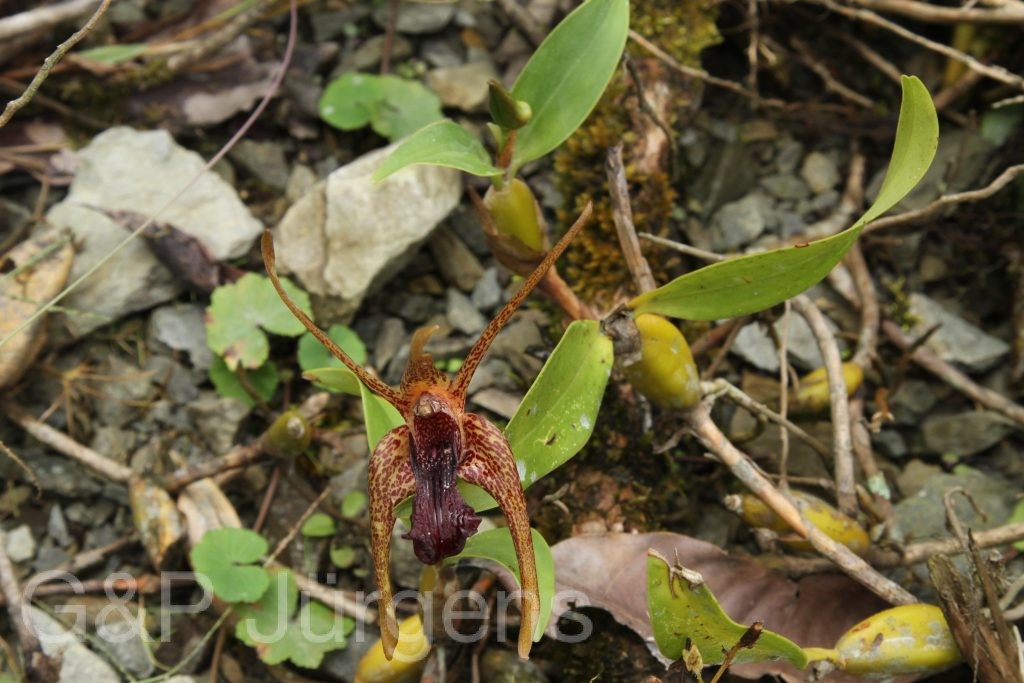
BhutanPG2011 188
Bhutan Tsochenchen, 3600m June
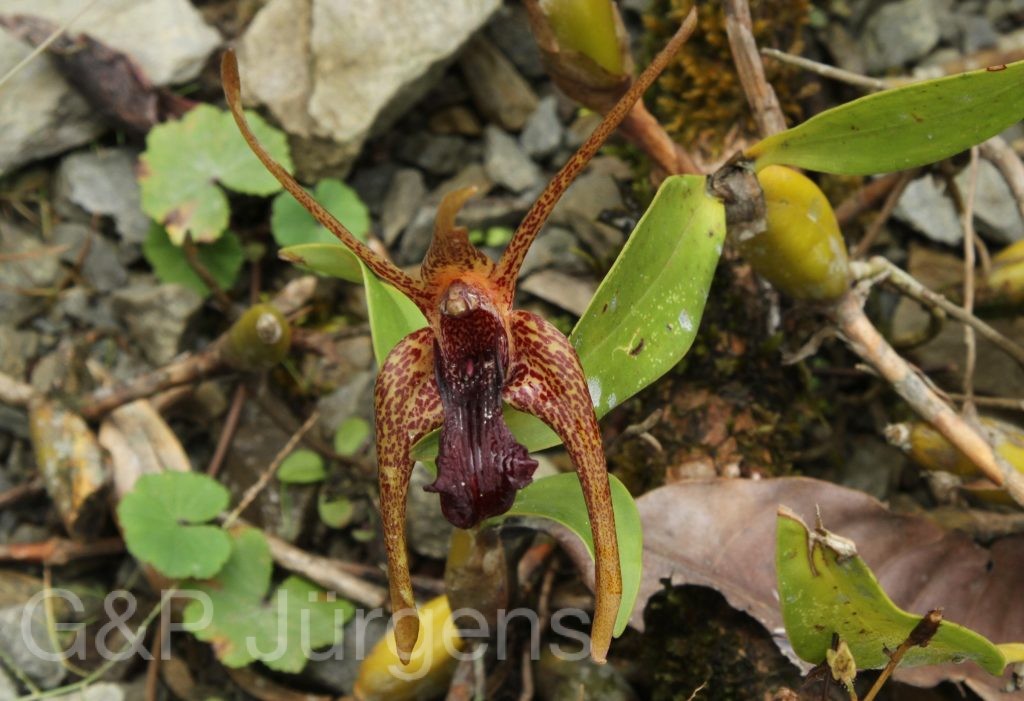
BhutanPG2011 794
Bhutan Chele-La, 3850m July
Nepal 99 48 ergebnis
West-Nepal Nyor Gaad 2700m, June
Nepal 99 51 ergebnis
West-Nepal Nyor Gaad 2700m, June
Nepal 99 370 ergebnis
West-Nepal Nyor Gaad 2700m, June

Description

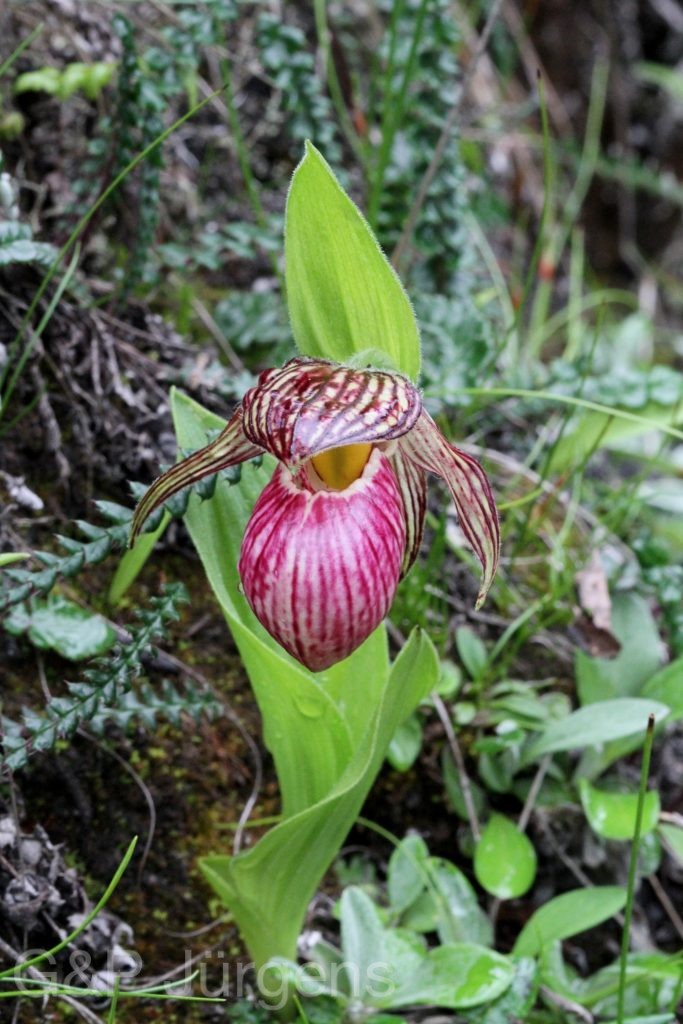
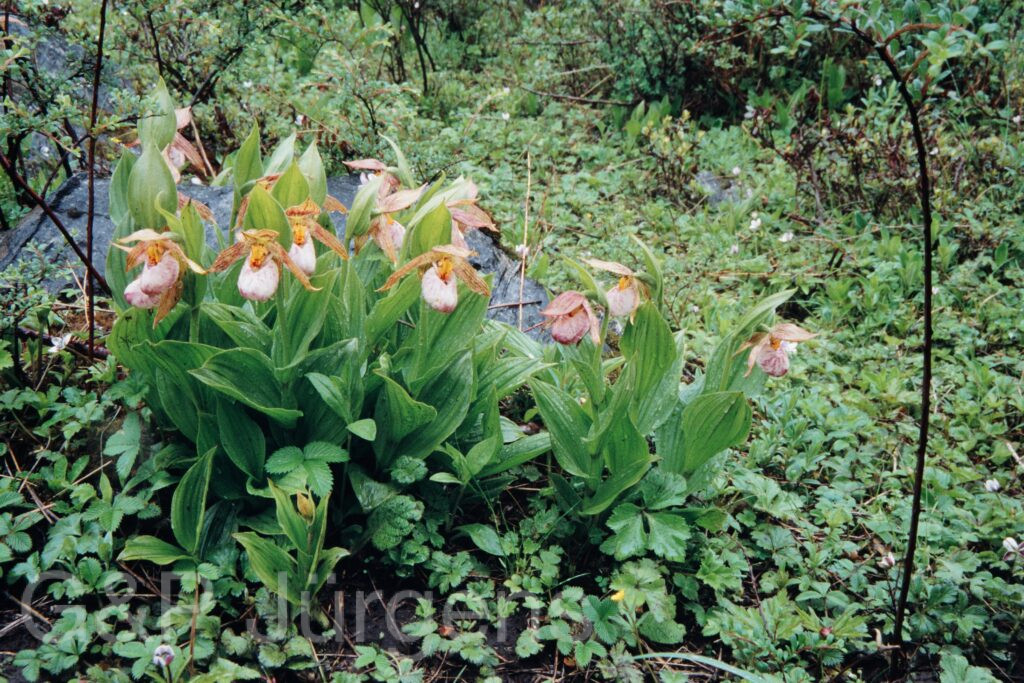
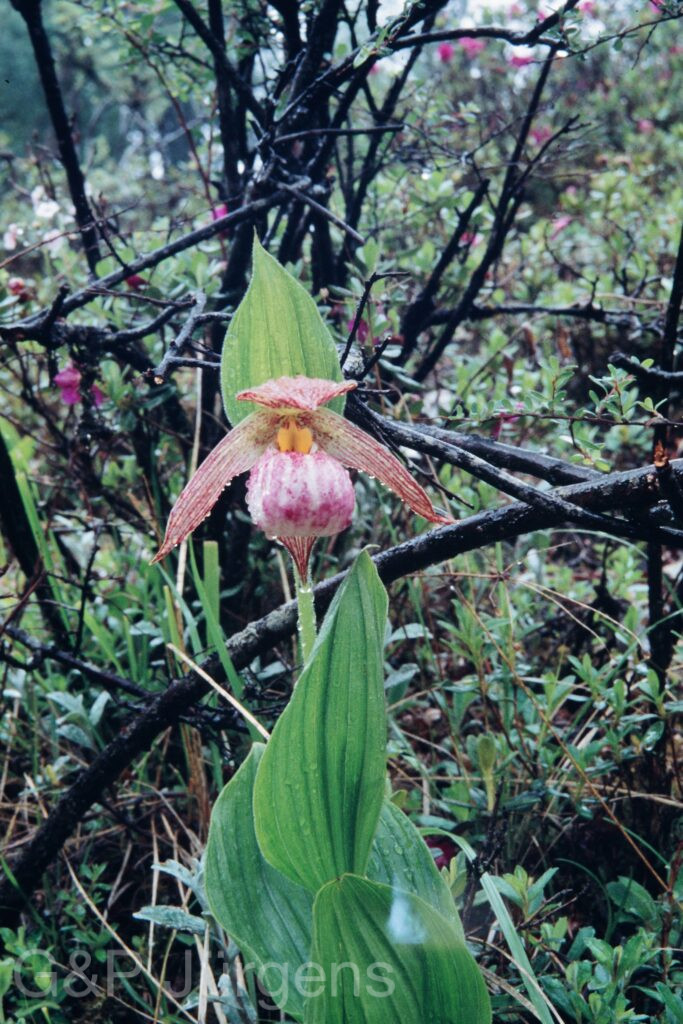
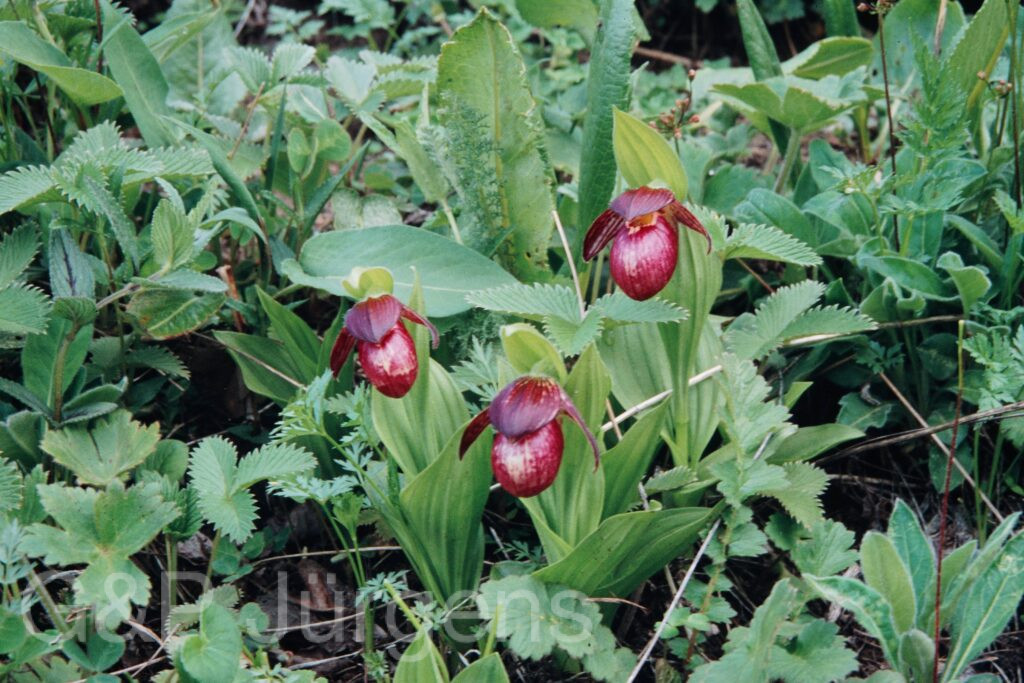
Cypripedium himalaicum is a terrestrial slipper orchid native to the eastern Himalayas, found in Bhutan, Nepal, Sikkim, and southern Tibet. It grows in alpine meadows and open forests at elevations of 3,000 to 4,500 m.

The plant reaches 15–35 cm in height, bearing one or two broadly elliptic leaves. The solitary flower is distinctive: the dorsal sepal is greenish-white with purple veins, the petals are narrow and twisted, and the lip forms a large inflated pouch, pale yellowish-green with purple spotting. Flowering occurs from May to July.

Cypripedium himalaicum is one of the highest-altitude slipper orchids in the world. It is classified as vulnerable due to habitat loss and overcollection. All Cypripedium species are listed under CITES Appendix II.

Author: Rolfe ex. Hemsl. · Sources: POWO (Kew), Flora of Bhutan, CITES Checklist
King ex Rolfe

BhutanPG2011 177
Bhutan Tsochenchen, 3600m June

Description

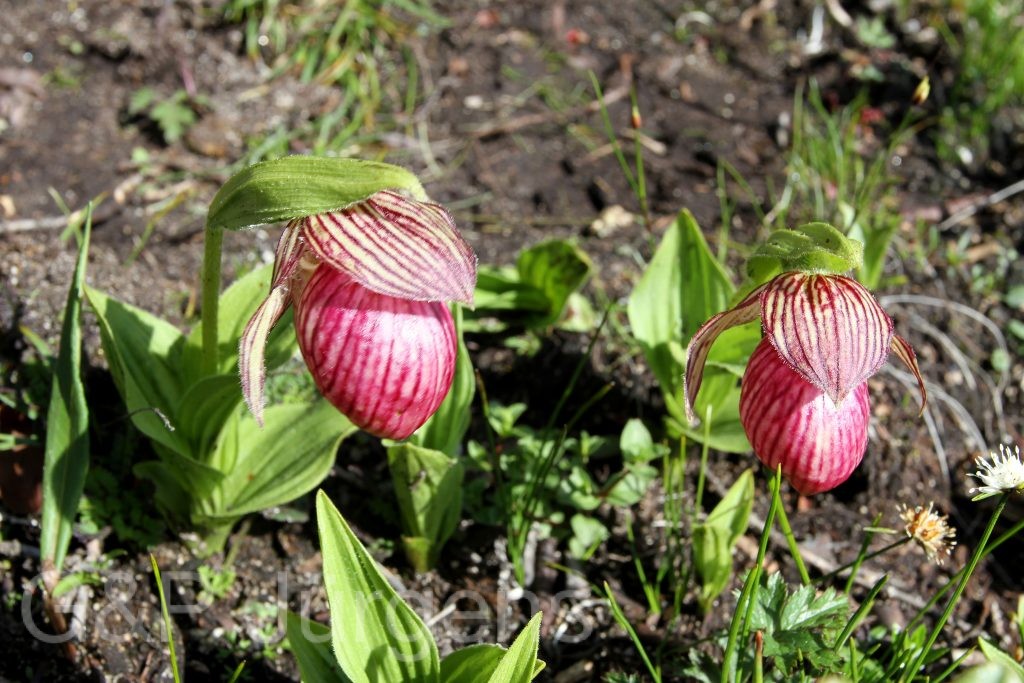
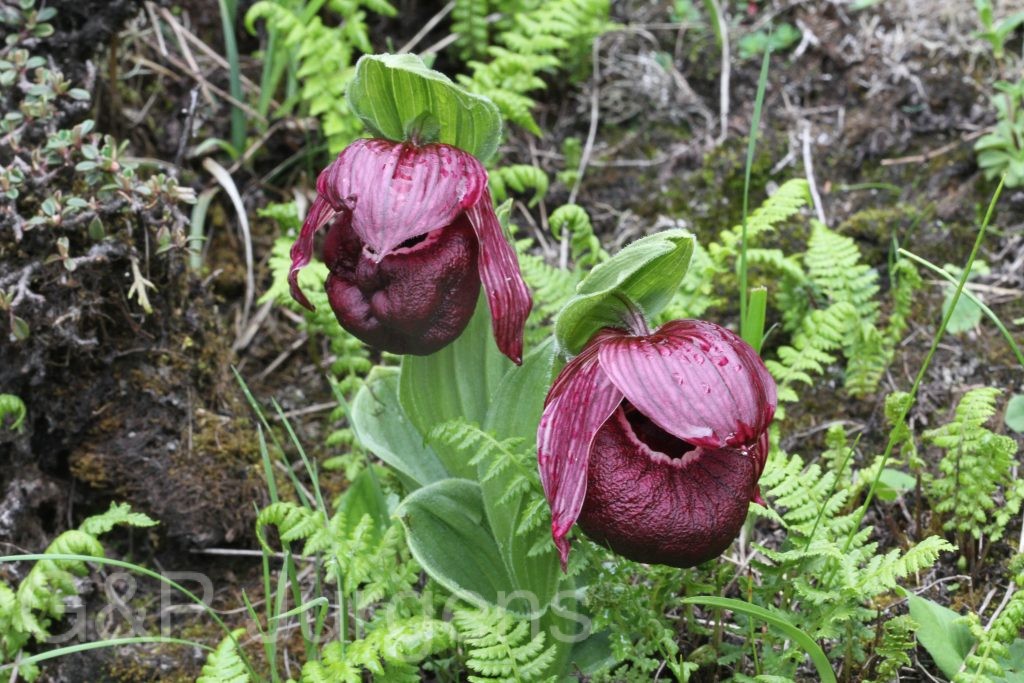
Cypripedium tibeticum is a terrestrial slipper orchid of the high Sino-Himalaya, native to China, India and Bhutan and reaching the eastern Tibetan plateau, with several hundred recorded occurrences concentrated in the mountains of southwest China. It is a plant of subalpine and alpine habitats, growing in open coniferous and Rhododendron woodland, scrub margins, grassy slopes and damp meadows, generally between about 2300 and 4200 m. The individual shown at Tsochenchen in Bhutan at 3600 m in June illustrates its flowering in early summer in cool, humus-rich montane turf.

The plant is a perennial herb arising from a short, creeping rhizome with fleshy roots, producing erect stems each bearing usually three to four broadly elliptic to ovate, plicate leaves with prominent venation. The solitary, terminal flower is large and conspicuous, subtended by a leafy bract. The sepals and petals are deep purple to blackish-maroon, often paler-veined, the dorsal sepal broad and the lateral sepals fused into a synsepal beneath the lip. The defining feature is the large, inflated, pouch-like labellum, deep wine-purple and reticulately veined, which functions as a trap pollination chamber. The column bears a flat, sterile staminode, and the fruit is an erect capsule.

The species belongs to Cypripedium section Cypripedium, the temperate slipper orchids, and is among the most variable and widespread members in the Himalayan–Tibetan region, with several varieties described. Its showy flowers and deceptive food-mimic pollination by bees make it of pollination-biological interest. Heavily threatened by collection and habitat disturbance, it is listed on CITES Appendix II and is of genuine conservation concern across its range.

Author: King ex Rolfe · Sources: POWO (Kew), GBIF, Flora of China, The Orchids of Bhutan (Pearce & Cribb), Cribb The Genus Cypripedium, CITES Appendices

Hook.f. & Thomson

Sikkim 2006 306 ergebnis
Sikkim Ringi-Chu Tolung Gompa 2410m, May
Sikkim 2006 477 ergebnis
Sikkim Ringi-Chu Tolung Gompa 2410m, May
Sikkim 2006 475 ergebnis
Sikkim Ringi-Chu Tolung Gompa 2410m, May

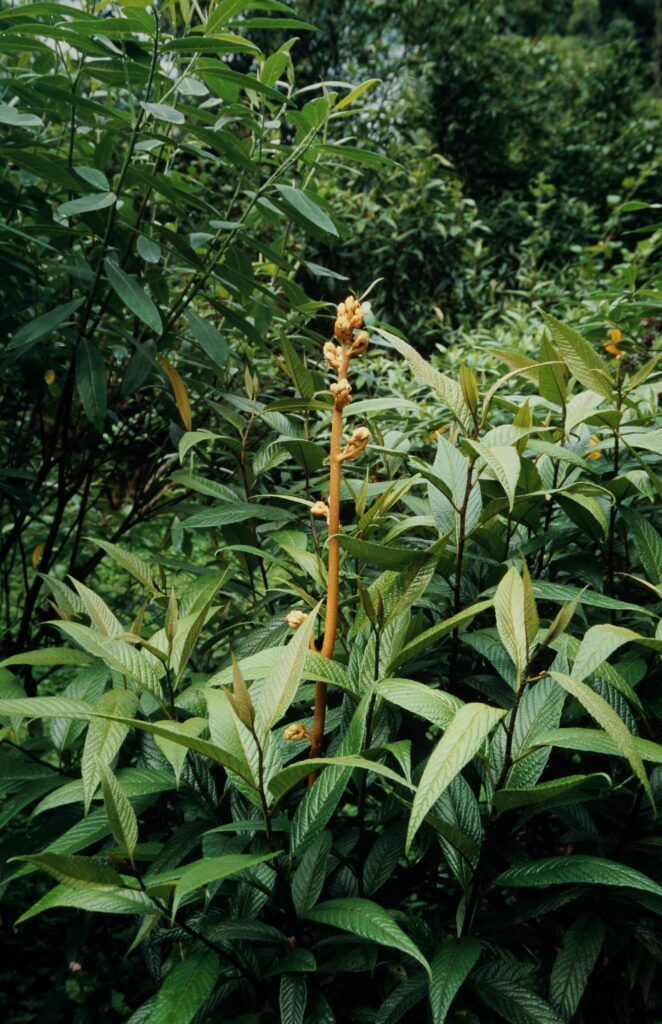
Description

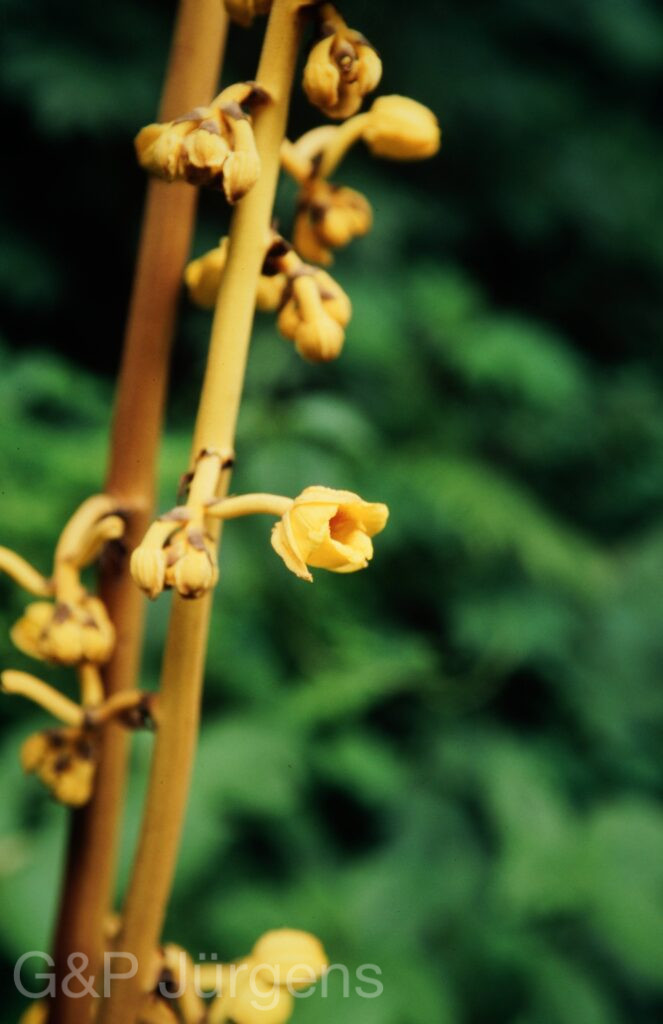
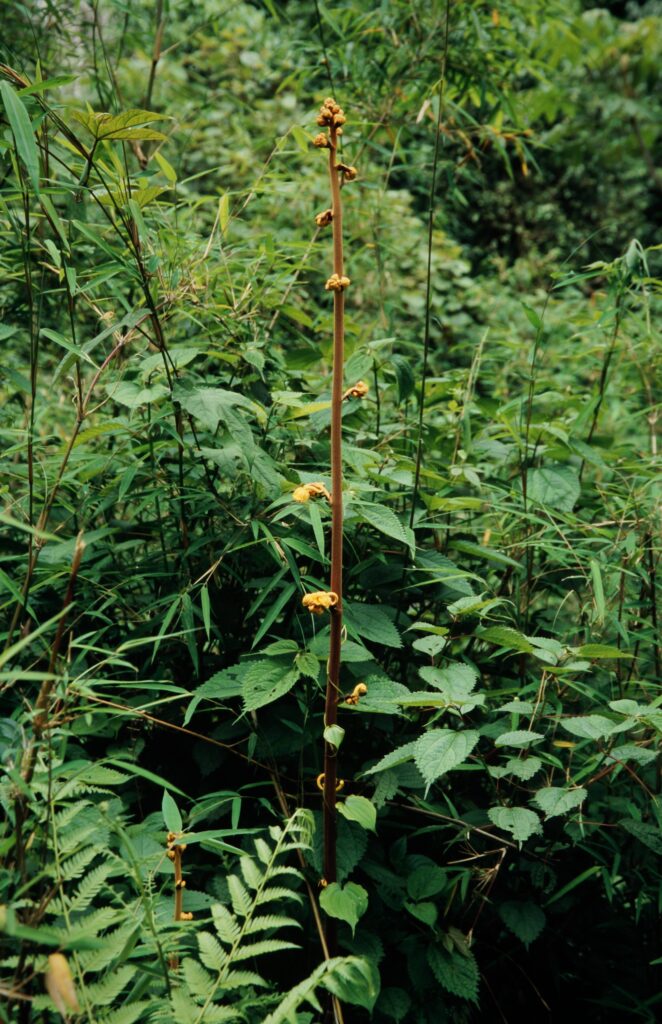
Cyrtosia lindleyana Hook.f. & Thomson is a leafless, mycoheterotrophic orchid of the tribe Vanilleae, distributed across the eastern Himalaya and into mainland and insular Southeast Asia. Its range, documented through some 400 georeferenced records, spans Nepal, northeast India, Bhutan, southern China, Taiwan, Myanmar, Vietnam and Indonesia. The species favours the deep humus and leaf litter of shaded, humid broad-leaved and mixed forests, where it depends on a mycorrhizal fungal partner for its entire nutrition. It typically occurs at montane elevations between roughly 1,500 and 2,800 m, consistent with the photographed population at Ringi-Chu near Tolung Gompa in Sikkim, recorded at 2,410 m in May.

Lacking chlorophyll, the plant emerges only to flower and fruit, arising from a stout, fleshy, coralloid rhizome that ramifies through the substrate. The erect, brownish to ochre, scale-clad inflorescence bears a loose raceme or panicle of comparatively large flowers. These are fleshy and yellowish, often suffused with brown or russet tones, with spreading sepals and petals and a concave, somewhat saccate lip bearing internal ridges. The fruit is distinctive among orchids: a large, fleshy, berry-like, indehiscent capsule, red at maturity, containing hard-coated seeds rather than the typical dust-fine orchid seed.

The genus Cyrtosia, together with allied Galeola, exemplifies the repeated evolution of full mycoheterotrophy within Vanilleae and is of considerable interest for studies of orchid–fungus associations. Because the plants are inconspicuous and only briefly visible, the species is easily overlooked and under-recorded. As an obligate forest-floor mycoheterotroph it is highly sensitive to logging and disturbance of soil mycota, and like all orchids is afforded protection under CITES Appendix II.

Author: Hook.f. & Thomson · Sources: POWO (Kew), GBIF, Flora of China Vol. 25, Flora of Bhutan Vol. 3, Pearce & Cribb: The Orchids of Bhutan (2002)

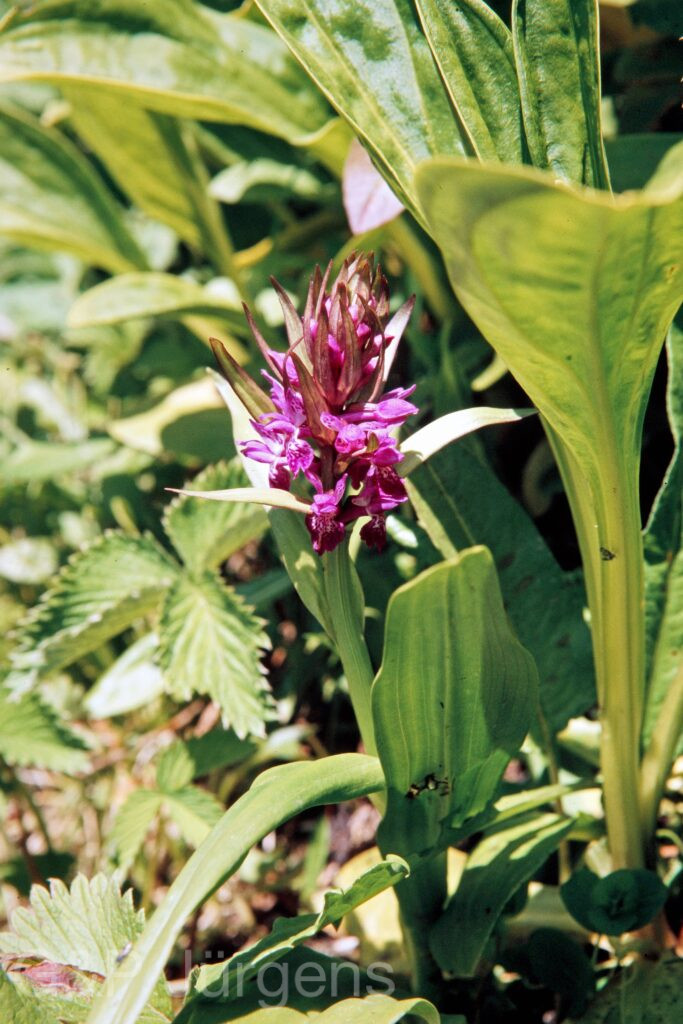
(D.Don) Soó

Nepal 99 109 ergebnis
West-Nepal South of Rara-Lake 3600m, June
Garh 07 43 ergebnis
India Garhwal Nanu at Mandakini 2400m, June

Description

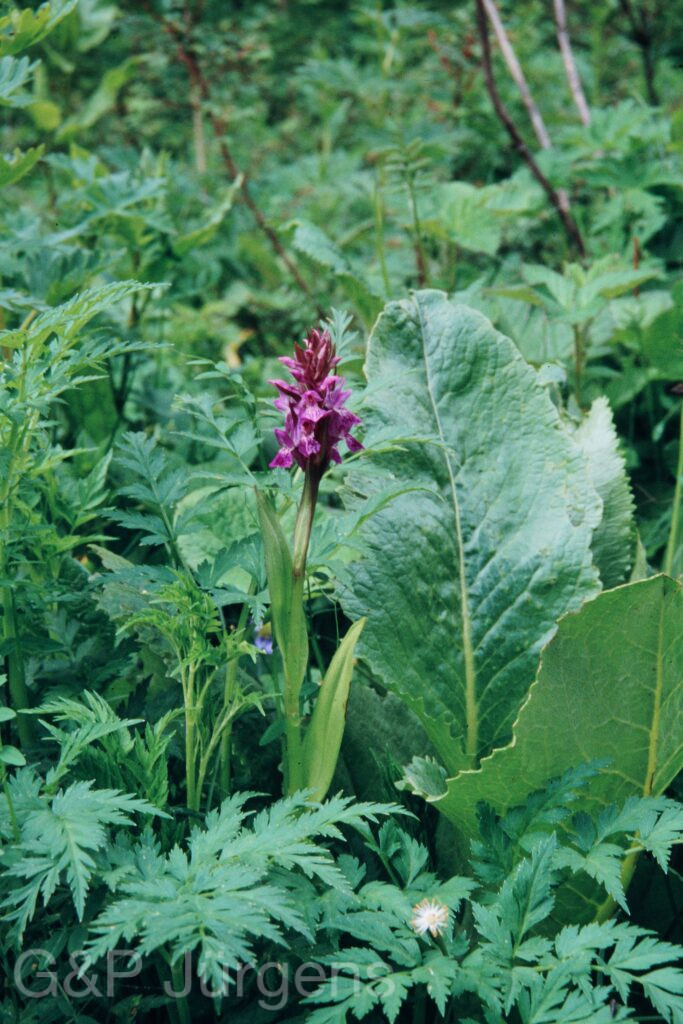
Dactylorhiza hatagirea (D.Don) Soó is a terrestrial marsh orchid of the Himalaya and Central Asia, recorded from Afghanistan, Pakistan, India, Nepal, Bhutan, China, Mongolia and Russia; the GBIF dataset of 311 occurrences reflects a wide but increasingly fragmented high-altitude range. It grows in moist alpine and subalpine meadows, marshy grassland, streamsides and damp slopes, broadly between 2500 and 4000 m. The photographed plants from south of Rara Lake in West Nepal at about 3600 m and from Nanu at the Mandakini in Garhwal, India, at about 2400 m, both flowering in June, exemplify its early-summer anthesis in cool, wet, open meadows across the western and central Himalaya.

The species is an erect, glabrous, tuberous perennial herb arising from palmately lobed, hand-shaped root-tubers — the digitate tubers giving both the generic name and the local trade name "Hatajari" or "Salampanja." The stem is stout and hollow, bearing several oblong-lanceolate, sheathing, usually unspotted leaves grading into bracts above. The inflorescence is a dense, many-flowered terminal spike of pink to purple-violet flowers; each has spreading sepals, a hooded arrangement of the upper segments, and a broad, three-lobed, darkly spotted labellum with a stout, descending spur. The column bears two pollinia, and the fruit is a ribbed, dehiscent capsule releasing minute, dust-like seeds.

Dactylorhiza (Orchidaceae, subtribe Orchidinae) is a north-temperate genus of tuberous marsh orchids defined by palmately divided tubers and spurred, lobed labella; D. hatagirea is its principal Himalayan representative. The dried tubers are intensively harvested for the salep trade and traditional medicine, and this over-collection, compounded by grazing and habitat loss, has driven steep population declines. It is consequently listed on CITES Appendix II and regarded as threatened and legally protected across much of its range, making it a priority for conservation and sustainable management.

Author: (D.Don) Soó · Sources: POWO (Kew), GBIF, Flora of China, Flora of Bhutan, Annotated Checklist of the Flowering Plants of Nepal, Pridgeon et al. — Genera Orchidacearum

Lindl.

Bhutan2012 1365
Bhutan Sandrup 1400m, October
Bhutan2012 1366
Bhutan Sandrup 1400m, October

Description

Dendrobium amplum (often treated under the segregate genus Epigeneium as E. amplum) is an epiphytic orchid distributed across the eastern Himalaya and adjacent Southeast Asia. GBIF documents 230 occurrences from China, India, Nepal, Bhutan, Myanmar, Bangladesh, Vietnam and Thailand, with herbarium and cultivated records also in Europe and North America. It inhabits mossy trunks and large branches in humid subtropical broadleaved forest, generally between roughly 1000 and 2000 m. The plant shown was recorded at Sandrup in Bhutan at 1400 m in October, a warm-temperate forest belt where seasonal monsoon moisture sustains a rich epiphytic flora.

The species has a creeping rhizome from which arise well-spaced, ovoid to fusiform pseudobulbs, each conspicuously four-angled and topped by two (rarely three) ovate-elliptic, coriaceous leaves. The inflorescence emerges from the apex of the pseudobulb and carries one to a few comparatively large, showy flowers. The spreading sepals and petals are pale green to yellowish, variously suffused or veined with brown and purple, while the three-lobed labellum bears a recurved, acute or apiculate midlobe and is marked with reddish-purple lines over a callused disc. The mentum is short and the column foot prominent.

Described by John Lindley, the species belongs to a group of broad-bulbed Dendrobium species frequently placed in Epigeneium, a genus whose limits remain debated; POWO accepts the Dendrobium placement. The autumn-flowering habit and large flowers make it attractive to collectors. While ranging widely and not formally listed as threatened, it depends on intact mature forest and is sensitive to habitat loss and over-collection.

Author: Lindl. · Sources: POWO (Kew), GBIF, Flora of Bhutan, Flora of China, Orchids of Bhutan, Dendrobium and its Relatives (Lavarack et al.)

C.E.C. Fisch.

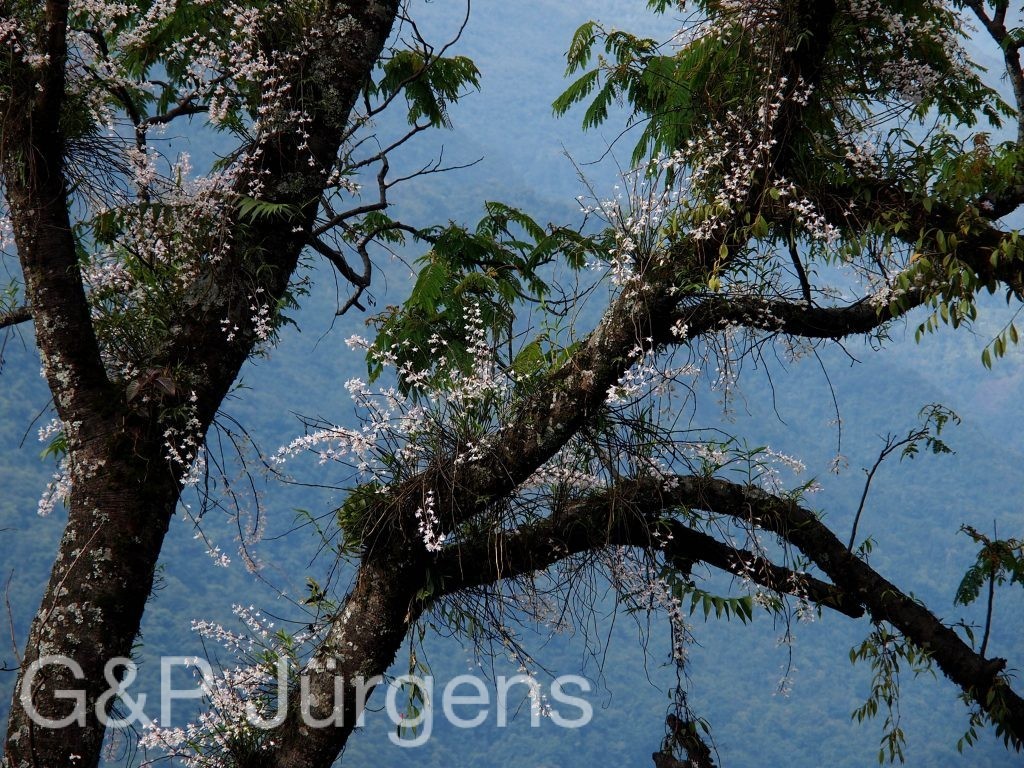
Sikkim2011 17
Sikkim Lachen 2460m, June
Bhutan2014 703
Bhutan Wangdi Phodrang 2280m, May
BhutanPG2011 56 ergebnis
Bhutan Jakar, 20m June
Bhutan2014 702
Bhutan Jakar, 2600m June
Nepal 1994 8 ergebnis
Ost-Nepal Tumlingtar 340m April

Description

Dendrobium aphyllum is a widespread epiphytic orchid of tropical and subtropical Asia, ranging from India and Nepal through southern China and across mainland Southeast Asia, with GBIF documenting occurrences from India, China, Thailand, Bhutan, Nepal, Vietnam, Myanmar and Laos among many territories. It grows as an epiphyte, and sometimes a lithophyte, on tree trunks and rocks in warm, humid lowland and lower montane forest, enduring a distinct dry season during which the canes shed their leaves. It occupies low to middle elevations; the records span Tumlingtar in eastern Nepal at about 340 m to Sikkim's Lachen and Bhutanese sites up to roughly 2600 m, with the photographed material flowering from April through June across this broad altitudinal range.

The plant produces long, slender, pendulous cane-like stems that branch and trail from the host, leafy when young and largely leaf-shedding before flowering. The leaves are thin, lanceolate and deciduous. The flowers emerge in twos and threes from the nodes of the bare, hanging canes, fragrant and delicately coloured, with pale rose-pink to lilac sepals and petals. The labellum is broadly funnel-shaped to subobicular, cream to pale yellow and finely downy within, often marked with darker veining and rolled around the column to form a trumpet, the lower margin sometimes faintly fringed. The fruit is a pendent capsule.

D. aphyllum is placed in Dendrobium section Dendrobium and is characterised by its leafless flowering canes, as reflected in the epithet; it has accumulated synonymy and is sometimes confused with related pendent species such as D. primulinum and D. anosmum. Long cultivated as an ornamental and used in some traditional medicines, it remains common over much of its vast range, though localised populations are depleted by wild collection and lowland forest clearance.

Author: C.E.C. Fisch. · Sources: POWO (Kew), GBIF, Flora of China, The Orchids of Bhutan (Pearce & Cribb), Dendrobium and its Allies (Lavarack et al.)

Dalzell

Nepal 95 433 P754 ergebnis
Nepal Trisuli 2500m October
Nepal 95 434 P755 ergebnis
Nepal Trisuli 2500m October

Description

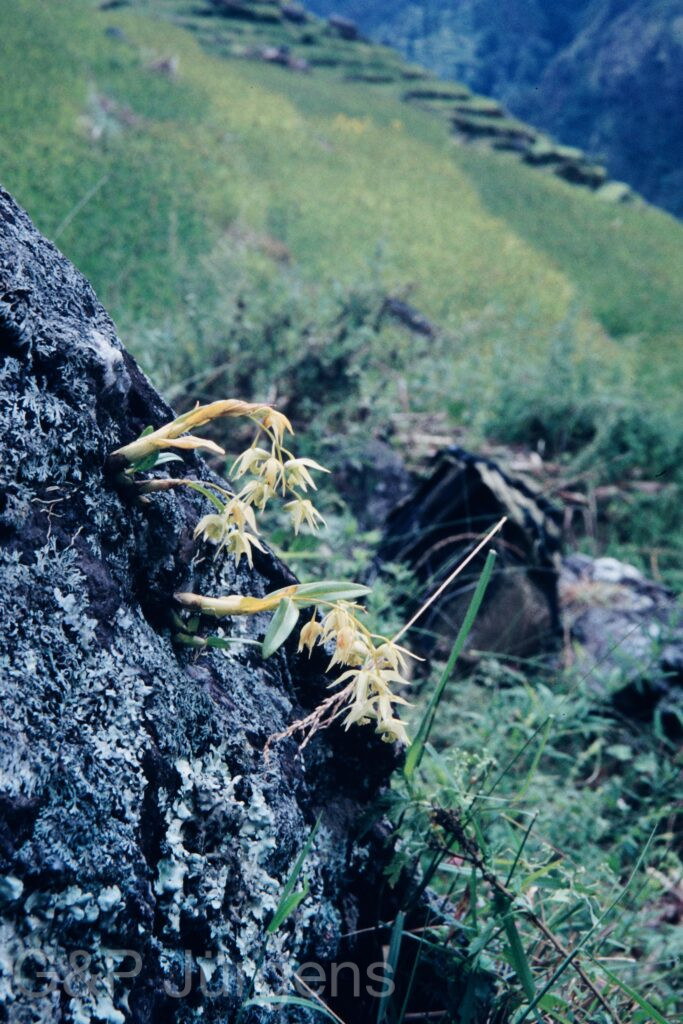
Dendrobium crispum, as applied here, is an epiphytic orchid of the Himalayan and Indo-Burmese region. Under current taxonomy the name Dendrobium crispum Dalzell is treated as a synonym, the accepted concept here being Dendrobium crispum (with the linked material referable to Dendrobium peguanum); GBIF records, though few, point to occurrence in India and adjacent Himalaya. It grows as an epiphyte on tree trunks and mossy branches in humid broadleaved and subtropical forest. The photograph was taken near Trisuli in Nepal at about 2500 m in October, indicating a montane forest habitat with seasonal monsoon moisture.

The plant forms clustered, slender, often pendent or ascending stems (pseudobulbs) bearing distichous, narrowly oblong to lanceolate leaves with sheathing bases. The flowers are small, borne in short few-flowered racemes from the upper nodes; the sepals and petals are pale, the lateral sepals forming a short mentum with the column foot, and the labellum is the most ornamented part of the flower, with a recurved, often crisped or fringed margin and a coloured, sometimes pubescent disc. The column is short, bearing a terminal anther with waxy pollinia, and the small fruit is a ribbed dehiscent capsule releasing dust-like seed.

Dendrobium is one of the largest orchid genera, and the taxonomy of small-flowered Himalayan species has been repeatedly revised, with several names entering synonymy as concepts were clarified, including the present one. Like most epiphytic orchids the species depends on mycorrhizal fungi for germination and on insect pollinators. All Dendrobium are listed on CITES Appendix II; the chief threats are forest clearance and collection for the horticultural trade.

Author: Dalzell · Sources: POWO (Kew), GBIF, Flora of China, Orchids of Nepal, CITES Appendix II listings, Seidenfaden's revisions of Asian Dendrobium

Lindl. ex. Wall.

Nepal 97 359 P703
Nepal Arun-Valley 1650m
Nepal 97 358 P701
Nepal Arun-Valley 1650m

Description

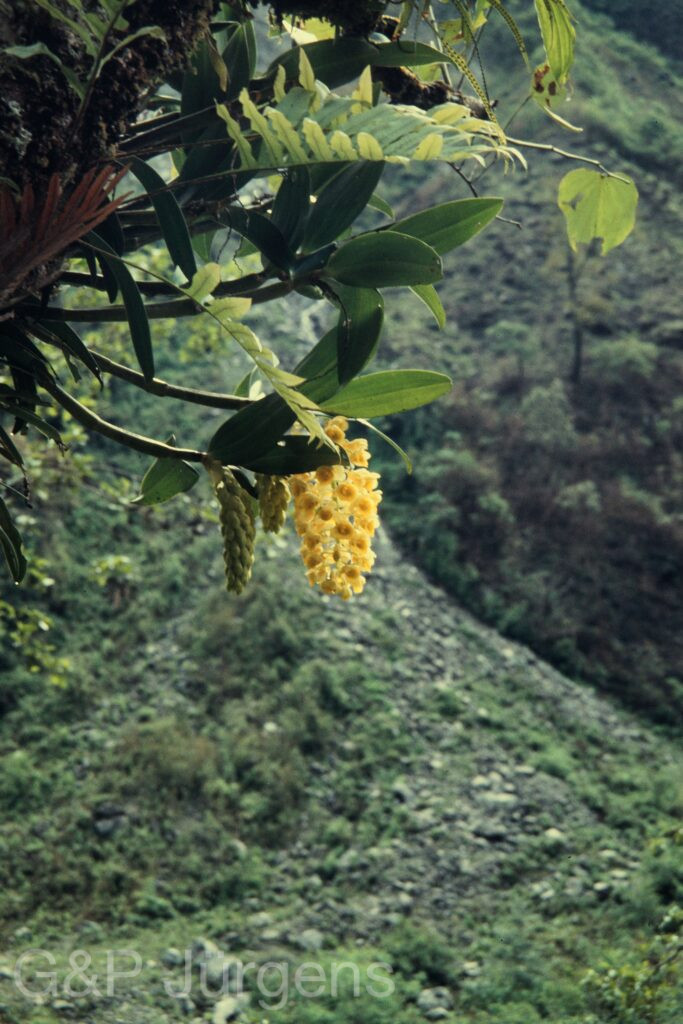
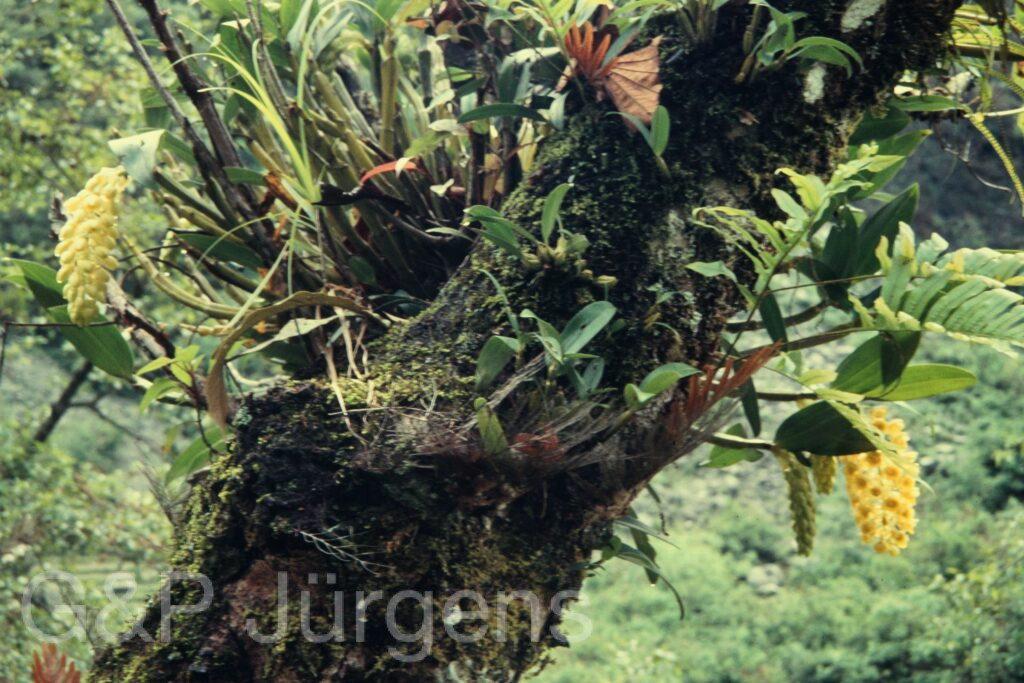
Dendrobium densiflorum is a robust epiphytic orchid of the subtropical and warm-temperate forests of the eastern Himalaya and Indochina, recorded natively from China, India, Nepal, Bhutan, Vietnam, Laos and Myanmar, with 247 GBIF occurrences (several extralimital records reflecting cultivation). It grows as an epiphyte, and occasionally a lithophyte, on mossy trees and shaded rock faces in humid broadleaved forest, generally between about 1000 and 1800 m. The illustrated plant comes from the Arun Valley of eastern Nepal at around 1650 m, a deep monsoon-fed gorge where rich epiphyte communities clothe the evergreen forest.

The species forms stout, clustered, club-shaped to fusiform pseudobulbous canes that are four-angled and longitudinally furrowed, bearing several leathery, oblong-elliptic leaves toward the apex. The inflorescence is its glory: a dense, pendulous, cylindrical raceme arising near the cane apex and carrying many closely set flowers. Each flower has bright golden-yellow, spreading sepals and broader petals, and a conspicuous, broadly orbicular, downy lip of deep egg-yolk orange-yellow, fringed at the margin. The fruit is a ribbed capsule.

The species belongs to Dendrobium section Densiflora, distinguished by these massed, pendent, golden 'pineapple' inflorescences. Spectacular in flower, it has long been prized in horticulture, and over-collection from the wild together with forest clearance has reduced many accessible populations; as with all Dendrobium it is regulated under CITES Appendix II. Its biogeography typifies the Sino-Himalayan epiphytic orchid flora that reaches its western limit in the wet middle-hill forests of Nepal.

Author: Lindl. ex. Wall. · Sources: POWO (Kew), GBIF, Flora of China, Orchids of Nepal, Dendrobium and its Allies (Lavarack, Harris & Stocker)

Griff.

Nepal 95 303 P547 ergebnis
Nepal Bharang 1850m October

Description

Dendrobium eriiflorum is an epiphytic orchid of the eastern Himalaya and Indo-Burmese region, distributed through Nepal, northern India, Bhutan, Bangladesh and Myanmar into Thailand, peninsular Malaysia and Indonesia; GBIF records about 112 occurrences across this range. It is a plant of the subtropical to lower temperate broadleaved forest, growing as an epiphyte on tree trunks and mossy branches in humid, shaded montane woodland, as documented at Bharang in Nepal at 1850 m. In this elevational band it benefits from high atmospheric moisture and a pronounced monsoon, and is recorded in flower in October toward the close of the wet season.

It is a small, tufted epiphyte with clustered, slender, erect to pendent stems (pseudobulb-like canes) sheathed by the membranous bases of the leaves. The leaves are thin, narrowly lanceolate, distichous and deciduous, leaving the older canes leafless. The inflorescences are short, few-flowered racemes arising laterally near the stem apex; the flowers are small, pale greenish-white to cream and densely covered externally with fine hairs, the hairy perianth recalling the genus Eria and giving rise to the epithet "eriiflorum". The lip is three-lobed with a recurved apex, and the column bears a short foot forming a mentum, with the pollinia waxy in the manner typical of Dendrobium.

The species was described by William Griffith, an early explorer of the Himalayan and Burmese flora. Within the large, taxonomically complex genus Dendrobium it falls among the small-flowered Himalayan species; the distinctive pubescent flowers are an unusual diagnostic feature among its relatives. Pollination in such Dendrobium is generally by small bees attracted to the lip. As an epiphyte dependent on intact, humid forest canopy, it is sensitive to deforestation and to the horticultural collection that affects many Himalayan orchids; like all Dendrobium it is listed on CITES Appendix II, regulating international trade.

Author: Griff. · Sources: POWO (Kew), GBIF, Flora of Bhutan, Orchids of Nepal, Seidenfaden's monographic studies of Dendrobium

Hook.

BhutanPG2011 8
Bhutan Paro, 2400m June

Pendent epiphyte to 50 cm long and slender branched, bearing few linear-oblong leaves from bead-like.

Description

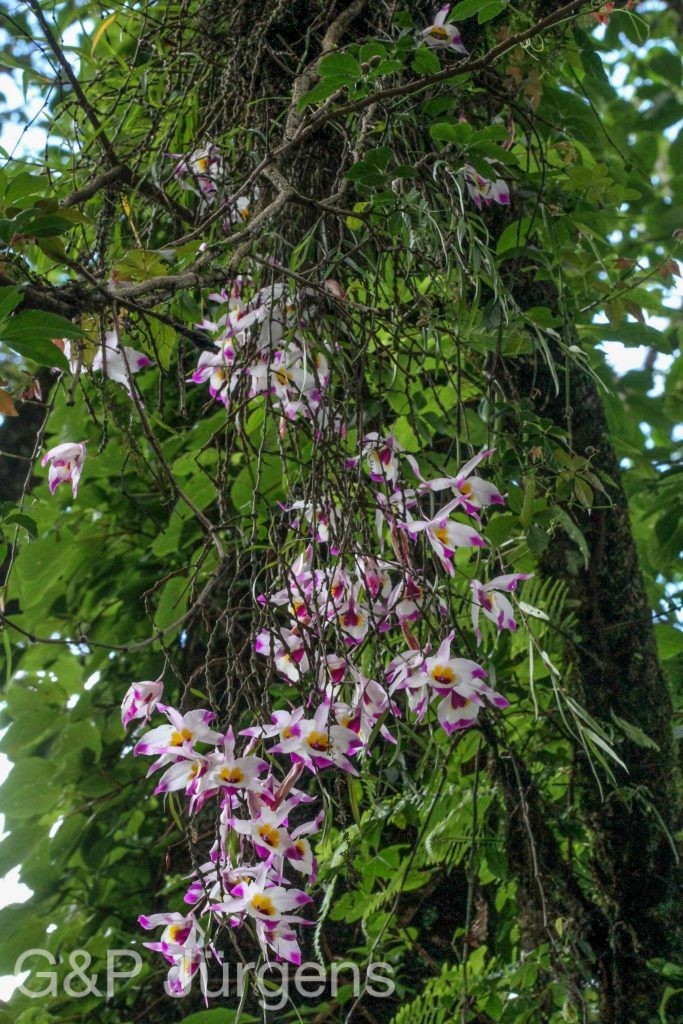
Dendrobium falconeri is a pendent epiphytic orchid native to the Himalayas, ranging from Nepal and northeast India through Bhutan to Myanmar, Thailand, and southwest China. It grows on mossy tree trunks and branches in humid montane forests at 800–2,000 m elevation.

The plant has slender, branching, wiry stems up to 50 cm long, bearing small, linear-oblong leaves at intervals along bead-like nodes. The flowers are among the most beautiful in the genus: 4–5 cm across, white to pale pink with bright purple tips on the petals and a large, trumpet-shaped lip marked with two conspicuous maroon-purple blotches and a yellow throat. Flowers appear singly or in pairs from leafless nodes, typically from March to May.

Dendrobium falconeri is prized in orchid cultivation for its striking colour pattern. In the wild, it is increasingly rare due to overcollection and deforestation. Listed under CITES Appendix II.

Author: Hook. · Sources: POWO (Kew), Flora of Bhutan, CITES Checklist, OrchidSpecies.com