Orchideaceae

Lindl.

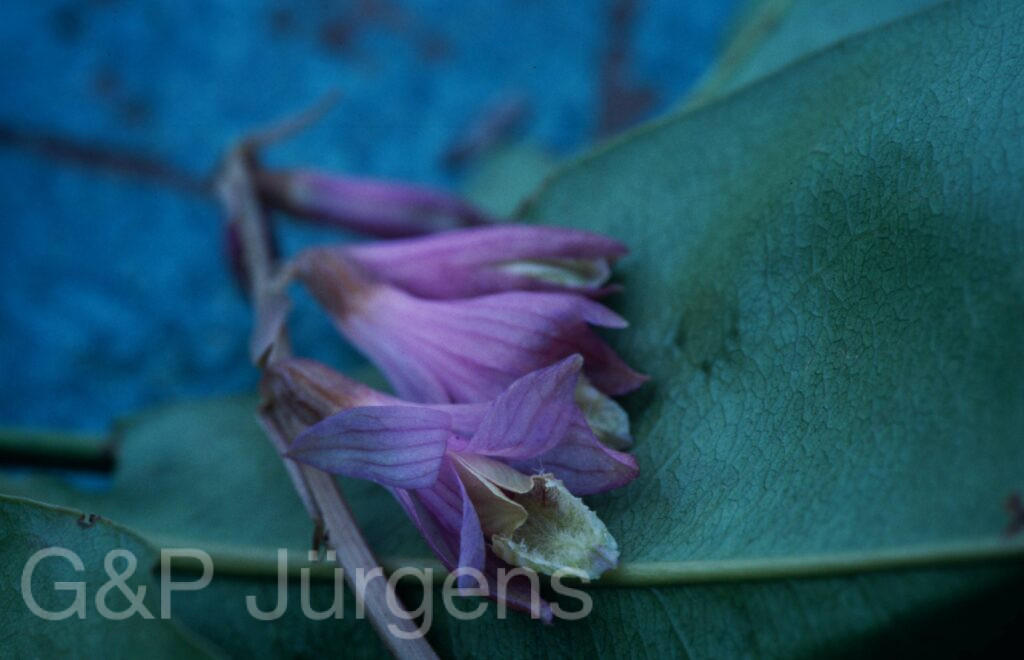
Nepal 99 891 ergebnis
West-Nepal Suli-Khola 2900m, July

Description

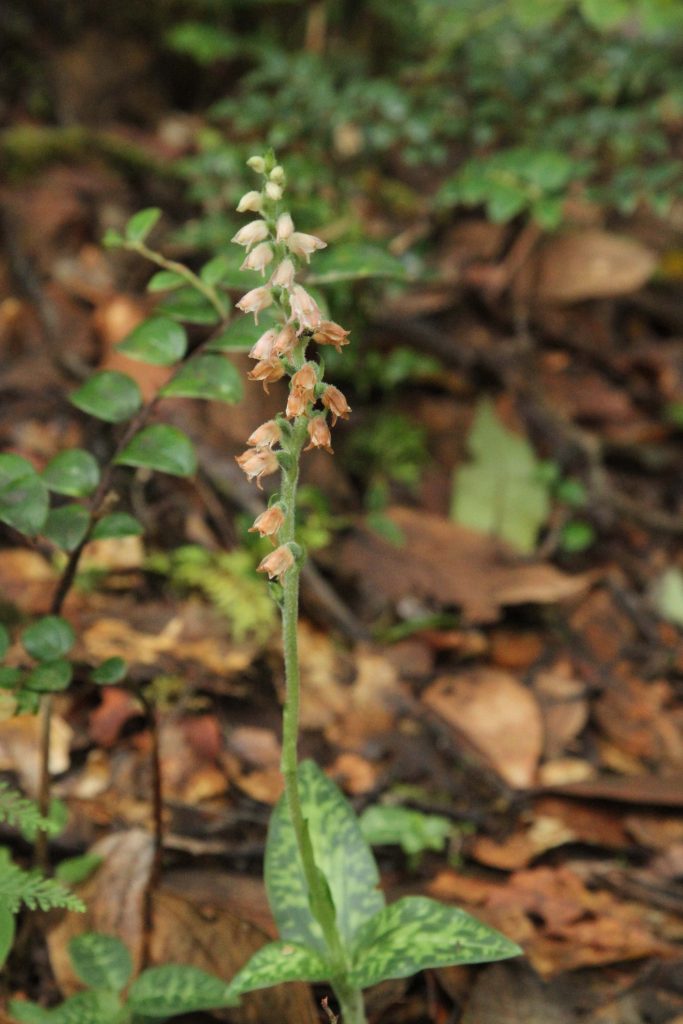
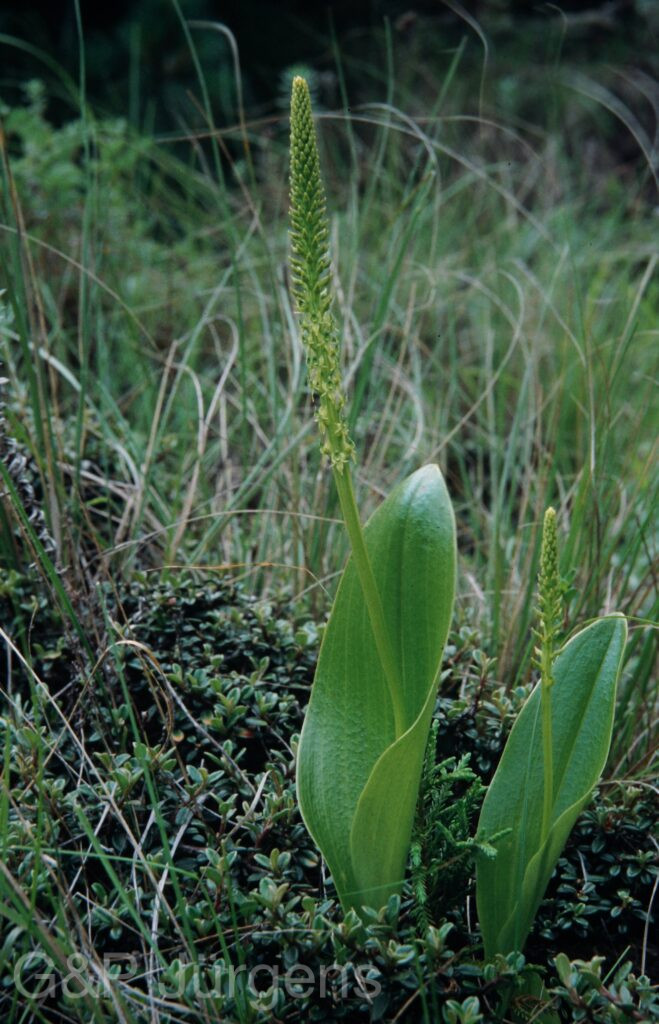
Dienia cylindrostachya is a terrestrial orchid distributed across the Himalaya and adjacent montane Asia, recorded from India, Nepal, Bhutan, China, Hong Kong, Myanmar and Pakistan, with GBIF documenting some 98 georeferenced occurrences. It favours humus-rich, shaded forest floors, mossy banks and damp grassy slopes in the temperate zone, typically between about 1500 and 3000 m. The photographed plant was found in West Nepal along the Suli-Khola at 2900 m in July, an elevation and season that coincide with its summer flowering during the monsoon, when soil moisture and atmospheric humidity are at a maximum.

The species is a small, glabrous herb arising from a fleshy, ovoid pseudobulb or thickened stem-base. It bears a few thin, plicate, ovate-elliptic to lanceolate leaves that are membranous and sheathing at the base. The inflorescence is an erect, slender, densely many-flowered cylindrical raceme, from which the epithet derives, carrying numerous minute, non-resupinate flowers in shades of greenish-yellow to purplish. The sepals and petals are small and spreading; the lip is broad, often auriculate or saccate at the base, and the column is short and stout. The fruit is a small, ellipsoid, ribbed capsule releasing dust-like seeds.

Long placed in Malaxis, the species is now treated in Dienia (Malaxidinae, Epidendroideae), a segregate distinguished by non-resupinate flowers and column structure. The family is rendered "Orchideaceae" in the source but the taxon belongs to the Orchidaceae. As an easily overlooked terrestrial of intact temperate forest, it is sensitive to deforestation, though its wide Asian range affords some resilience.

Author: Lindl. · Sources: POWO (Kew), GBIF, Flora of Nepal, Flora of China, Flora of Bhutan, Genera Orchidacearum (Pridgeon et al.)
(L.) Crantz

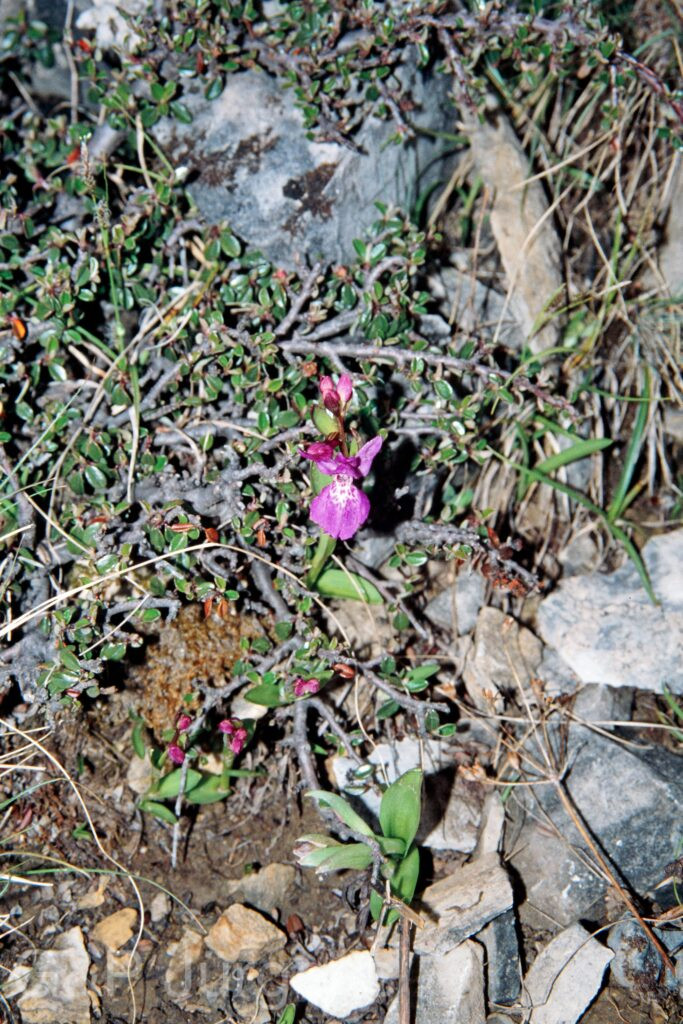
Nepal 99 880 ergebnis
West-Nepal Suli-Khola 3200m, July

Description

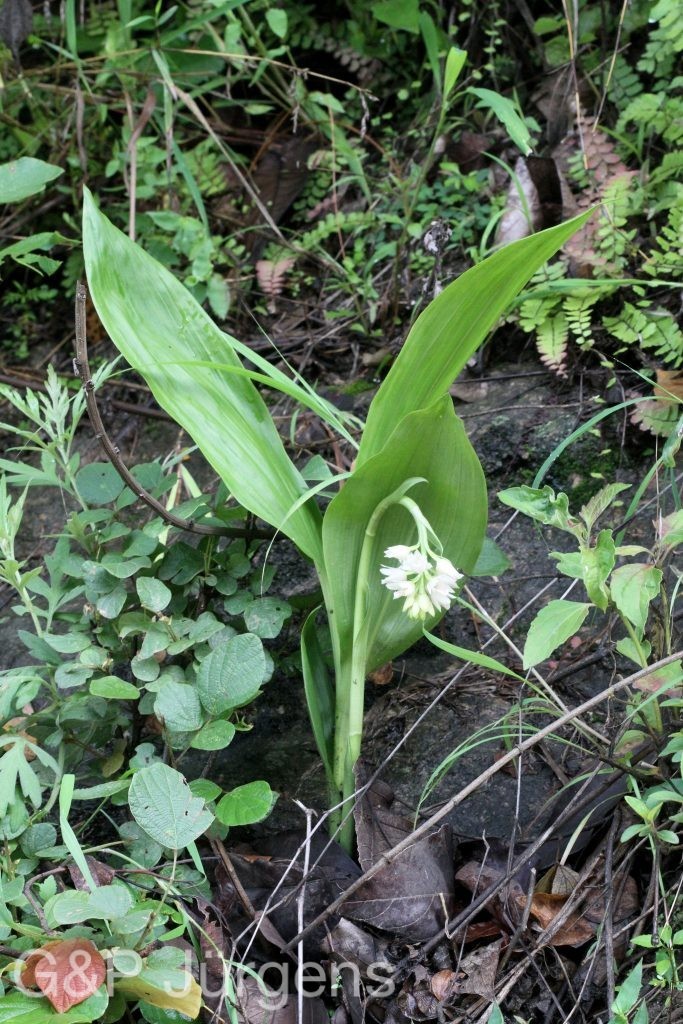
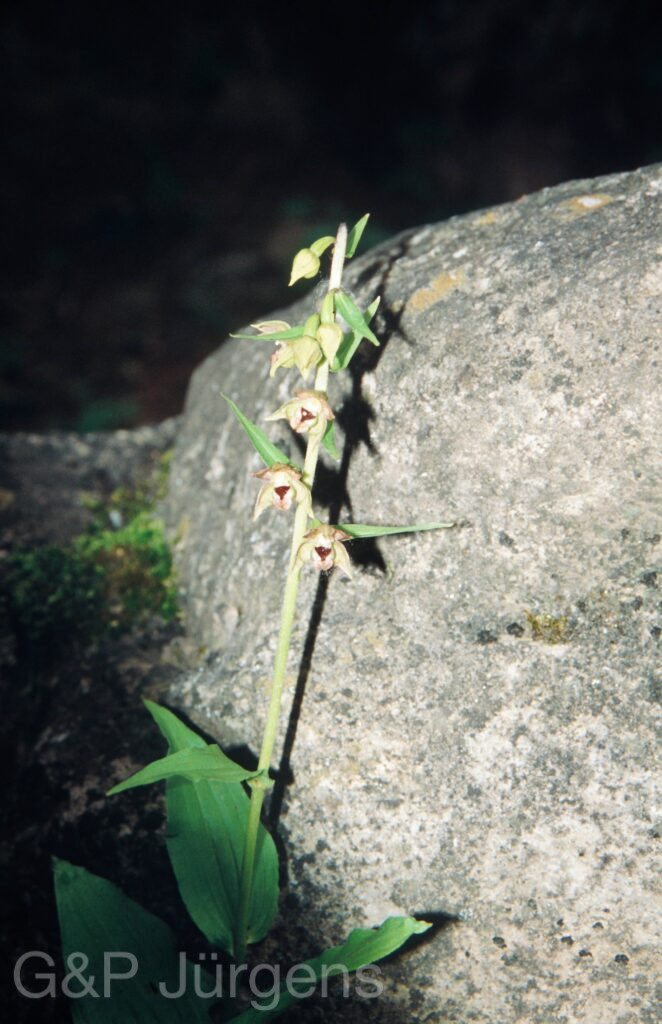
Epipactis helleborine, the broad-leaved helleborine, is among the most widespread terrestrial orchids in the world, native across Europe, North Africa and temperate Asia and naturalised extensively in North America. Its enormous GBIF dataset of over 378,000 occurrences spans France, the Netherlands, Germany, Britain, the United States, Canada and much of Eurasia, reflecting its tolerance of woodland, scrub, road verges and disturbed ground from the lowlands to the mountains. Within the Himalaya it ascends to high elevations, the material illustrated here coming from West Nepal at Suli-Khola at 3200 m in July, where it flowers in shaded summer pastures and forest edges on calcareous or humic soils.

The plant is a stout, leafy perennial herb growing from a short rhizome with numerous fleshy roots. The erect stem bears several broadly ovate to lanceolate, plicate, spirally arranged cauline leaves that diminish into bracts upward. The inflorescence is a one-sided, many-flowered raceme of nodding flowers; each flower has greenish to purplish ovate tepals and a distinctive two-part labellum comprising a cup-shaped hypochile holding nectar and a heart-shaped, recurved epichile bearing two basal bosses. The column is short, and pollination is typically effected by wasps; the fruit is a pendent, ribbed capsule releasing innumerable dust-like seeds.

Epipactis helleborine is taxonomically variable, encompassing numerous regional ecotypes and segregate microspecies, and is notable for its partial mycoheterotrophy, drawing carbon from ectomycorrhizal fungi which permits it to grow in deep shade. Its colonisation of urban and ruderal habitats has made it a successful adventive, and in parts of North America it is regarded as weedy. The species is of least conservation concern globally given its abundance and ecological adaptability.

Author: (L.) Crantz · Sources: POWO (Kew), GBIF, Flora Europaea, Genera Orchidacearum, The Genus Epipactis: A Monograph, Orchids of the Himalaya

Lindl.

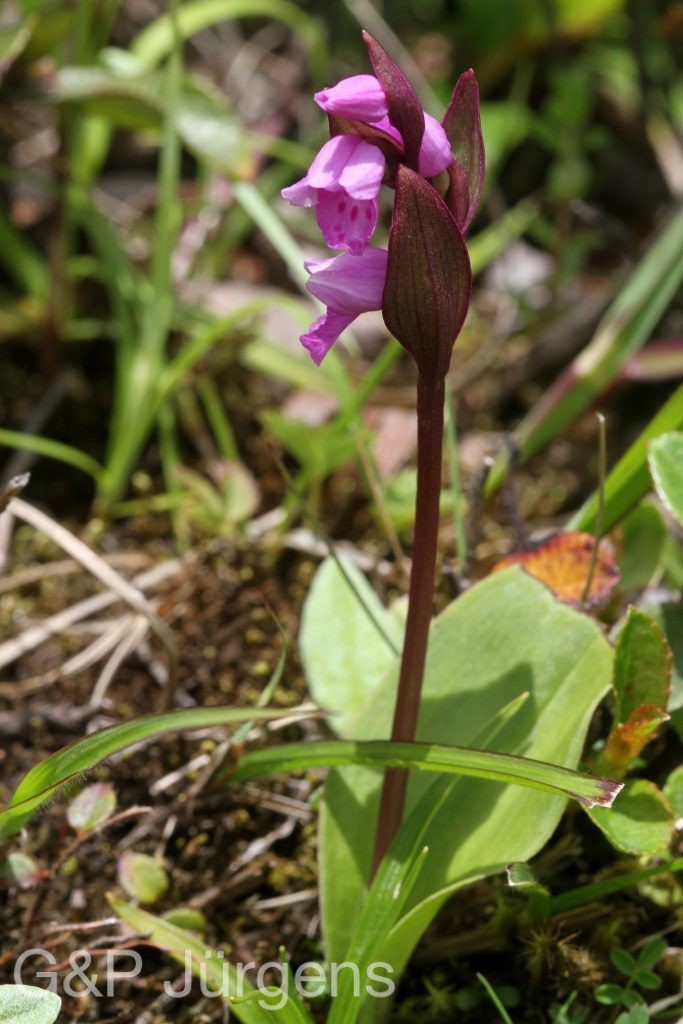
Nepal 99 177 ergebnis
West-Nepal Lara-Lake 3000m, June

Description

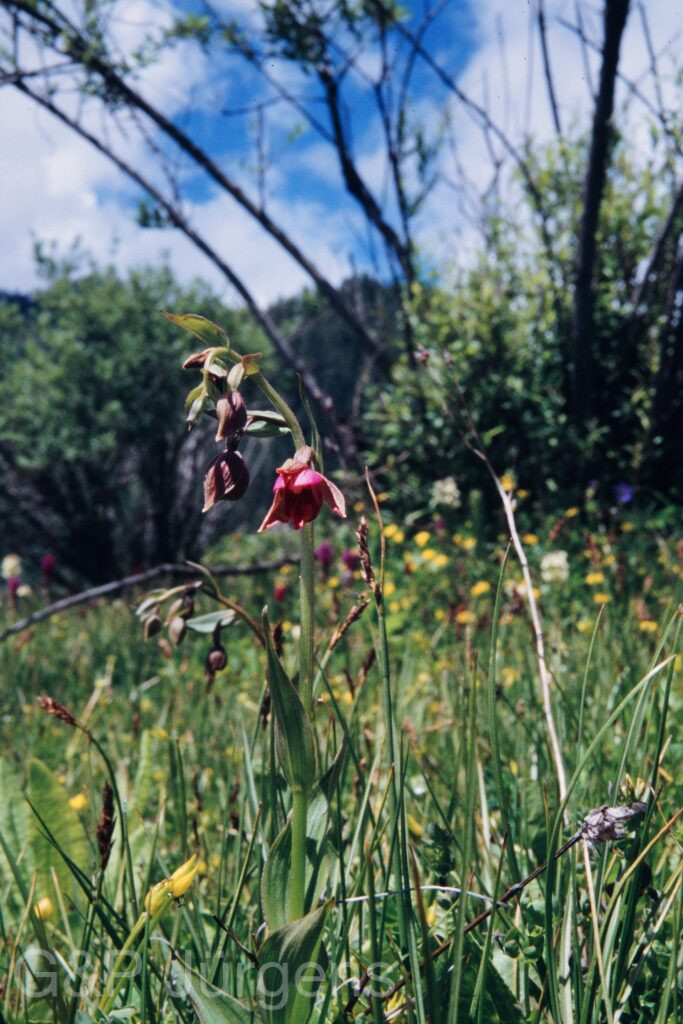
Epipactis royleana Lindl. is a terrestrial orchid of central and western Asia and the Himalaya, with GBIF documenting some 262 occurrences across Nepal, India, China, Pakistan, Afghanistan, Tajikistan, Kyrgyzstan, Uzbekistan, Bhutan, Myanmar and Russia, with scattered records farther afield. It typically grows in moist habitats such as streamsides, marshy meadows, seepage slopes and open coniferous woodland from the montane to subalpine zones, often between about 1500 and 3500 m. The plant photographed at Lara-Lake in West Nepal, at roughly 3000 m in June, illustrates its preference for the damp, lake-margin grasslands of the high Himalayan valleys.

The species is a rhizomatous perennial with erect, leafy stems arising from a short creeping rootstock. The leaves are alternate, ovate to lanceolate, sheathing at the base and prominently veined. The inflorescence is a lax, one-sided terminal raceme of several to many resupinate flowers; each flower has spreading, greenish to purplish-tinged sepals and petals, with a labellum divided into a cup-like basal hypochile and a triangular, often pinkish epichile. As in all Epipactis, the column bears a single anther and the pollinia are mealy, and the fruit is a pendulous, ridged capsule releasing dust-like seeds.

Epipactis is a Holarctic genus in which Himalayan and central Asian taxa form a distinct group; E. royleana is among the more widespread members, exhibiting considerable variation in flower colour across its range. Like other members of the genus it depends on mycorrhizal fungi for germination and early establishment, and its small seeds are wind-dispersed. The species is not currently regarded as threatened across its broad distribution, though, as a wetland-associated orchid, local populations are sensitive to drainage and habitat disturbance.

Author: Lindl. · Sources: POWO (Kew), GBIF, Flora of China, Flora of Pakistan, Flora of Nepal, Delforge Orchids of Europe and Asia

Hochr.

Nepal 2001 226 ergebnis ergebnis
Nepal Gorkha Tullikot 2000m, May

Description

Eulophia dabia is a terrestrial orchid distributed across the temperate and subtropical belts of Central and southern Asia, with verified records (some 166 GBIF occurrences) spanning China, India, Nepal, Bhutan, Pakistan, Afghanistan, Tajikistan, Turkmenistan and Uzbekistan, reflecting a broadly Irano-Turanian to Sino-Himalayan range. In the Himalaya it favours open grassy slopes, scrubland and disturbed pasture on well-drained soils, flowering with the onset of pre-monsoon warmth. The plant illustrated was photographed near Tullikot in the Gorkha district of central Nepal at about 2000 m in May, typical of the species' preference for sunlit, seasonally dry meadow habitats at middle elevations.

The species is a tuberous geophyte producing subterranean, somewhat cormous pseudobulbs from which arise erect, often leafless or scarcely leafy flowering scapes that emerge before or with the foliage. The leaves are linear-lanceolate, plicate and grass-like, sheathing at the base. Flowers are borne in a loose terminal raceme; the tepals are narrow and spreading, typically dull greenish to purplish-brown, while the trilobed labellum bears longitudinal lamellae or papillose crests and a short spur or saccate base. The fruit is a pendent, ellipsoid dehiscent capsule releasing dust-like seeds adapted for wind dispersal and obligate mycorrhizal germination.

Within Eulophia, a large pantropical genus, E. dabia belongs to the group of dry-ground terrestrials whose seasonal, drought-deciduous habit suits monsoonal climates. Like all orchids it is listed under CITES Appendix II, restricting international trade, though the species itself is not regarded as globally threatened owing to its wide range. Its dependence on mycorrhizal fungi and on grazed or open grassland makes it sensitive to land-use change and overgrazing at the local scale.

Author: Hochr. · Sources: POWO (Kew), GBIF, Flora of Nepal, Flora of China, The Orchids of the Himalaya (King & Pantling), CITES Appendix II

(Maxim.) S.C.Chen, P.J.Cribb & S.W.Gale

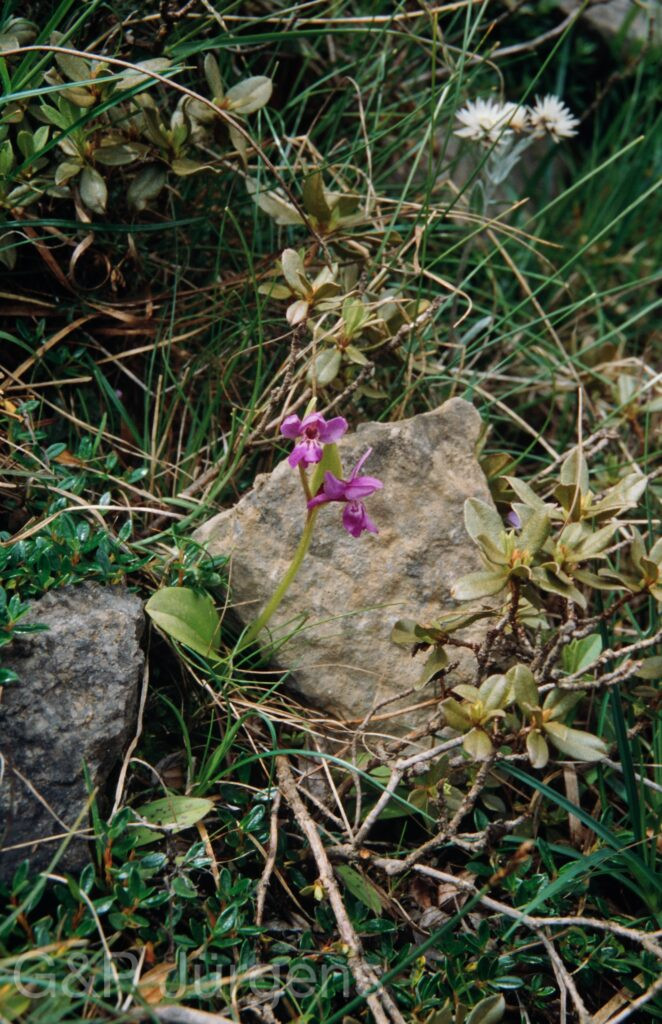
Nepal 99 34 ergebnis
West-Nepal Chere 3000m June

Description

Galearis roborovskii is a terrestrial orchid distributed across the high mountains of Central and East Asia, with georeferenced records documented from China, Nepal, Bhutan, India, Myanmar, Japan and Russia, comprising about 154 occurrences in GBIF. It is a plant of cool, moist alpine and subalpine habitats, favouring open meadows, grassy slopes, streambanks and forest margins where snowmelt maintains soil moisture through the growing season. The species generally occurs between roughly 2500 and 4000 m, and the population photographed at Chere in West Nepal at about 3000 m in June, at the onset of the monsoon flowering season, falls within this montane belt.

It is a small, glabrous, tuberous geophyte arising from ovoid to oblong fleshy tuberoids. The slender, erect stem bears one or two basal leaves that are oblong-elliptic to lanceolate, sheathing at the base and often fleshy. The inflorescence is a short, few-flowered terminal raceme subtended by leaf-like bracts. The flowers are purple to rose-pink, with the dorsal sepal and petals converging to form a loose hood (galea) over the column; the lateral sepals spread or are reflexed, and the trilobed labellum is deflexed and produced basally into a slender, cylindric to clavate spur. The fruit is a small erect dehiscent capsule releasing abundant dust-like seeds.

The genus Galearis was resurrected and recircumscribed on molecular grounds, and this species was transferred from Orchis by S.C.Chen, P.J.Cribb and S.W.Gale; it sits within subtribe Orchidinae. Like most temperate terrestrial orchids it depends on mycorrhizal fungi for germination and establishment, rendering it sensitive to grazing, trampling and habitat disturbance. Though presently widespread and not formally assessed as threatened across its broad Himalayan to Sino-Russian range, localised populations warrant monitoring against alpine land-use pressures.

Author: (Maxim.) S.C.Chen, P.J.Cribb & S.W.Gale · Sources: POWO (Kew), GBIF, Flora of China, Flora of Bhutan, Flora of Nepal, Pearce & Cribb The Orchids of Bhutan

(Lindl.) P.F.Hunt

Sikkim2011 207
Sikkim Lachung 3100m, June
Nepal 99 809 ergebnis
West-Nepal Baga-La-Phedi 4300m, July

Description

Galearis spathulata is a small terrestrial orchid of the high Himalaya and the mountains of western China, recorded from China, India, Nepal, Bhutan and Myanmar, with over 500 occurrences in GBIF. It is a plant of moist alpine and subalpine meadows, open Rhododendron and juniper scrub, grassy slopes and rocky turf, generally between about 3,000 and 4,500 m. The illustrated gatherings span this range, from Lachung in Sikkim at around 3,100 m in June to Baga-La-Phedi in West Nepal at about 4,300 m in July, where the species flowers through the early summer monsoon.

It is a dwarf, glabrous perennial herb arising from slender, fleshy root-tubers and bearing usually one or two basal, spathulate to oblong leaves that taper to a sheathing base. The short, erect stem terminates in a few-flowered raceme of small purplish-pink flowers, each subtended by a bract. The dorsal sepal and petals converge to form a hood over the column, the lateral sepals spreading; the labellum is entire to obscurely lobed, directed forward and produced at the base into a short, cylindrical to saccate spur. The fruit is an erect, ribbed capsule releasing dust-like seeds.

Galearis is a small holarctic-temperate to Sino-Himalayan genus segregated from Orchis, and G. spathulata is distinguished by its spathulate basal leaves and short-spurred, hooded flowers. Pollination is by insects, with seedling establishment dependent on mycorrhizal association, as in all orchids. Widespread and locally common across the alpine Himalaya, the species is not regarded as threatened, although, being an orchid, it falls under the general CITES Appendix II listing for the family.

Author: (Lindl.) P.F.Hunt · Sources: POWO (Kew), GBIF, Flora of China, Flora of Bhutan, Annotated Checklist of the Flowering Plants of Nepal, Pridgeon et al. Genera Orchidacearum

(Buch.-Ham. ex Sm.) D.Don

Bhutan2014 463
Bhutan Trongtsa 2030m, May
Bhutan2014 464
Bhutan Trongtsa 2030m, May

Description

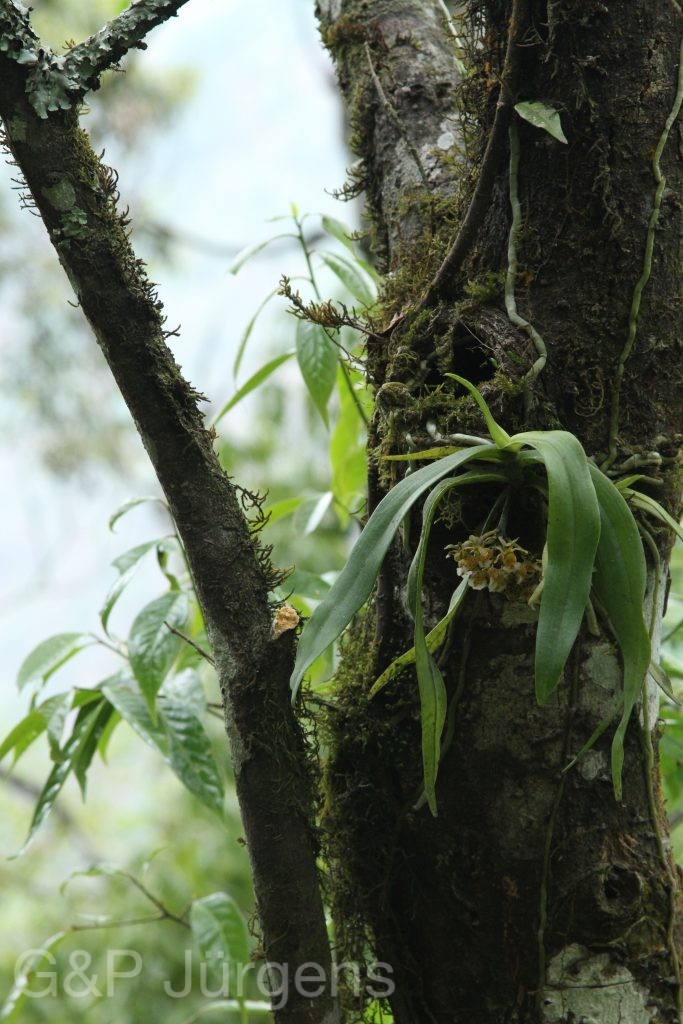
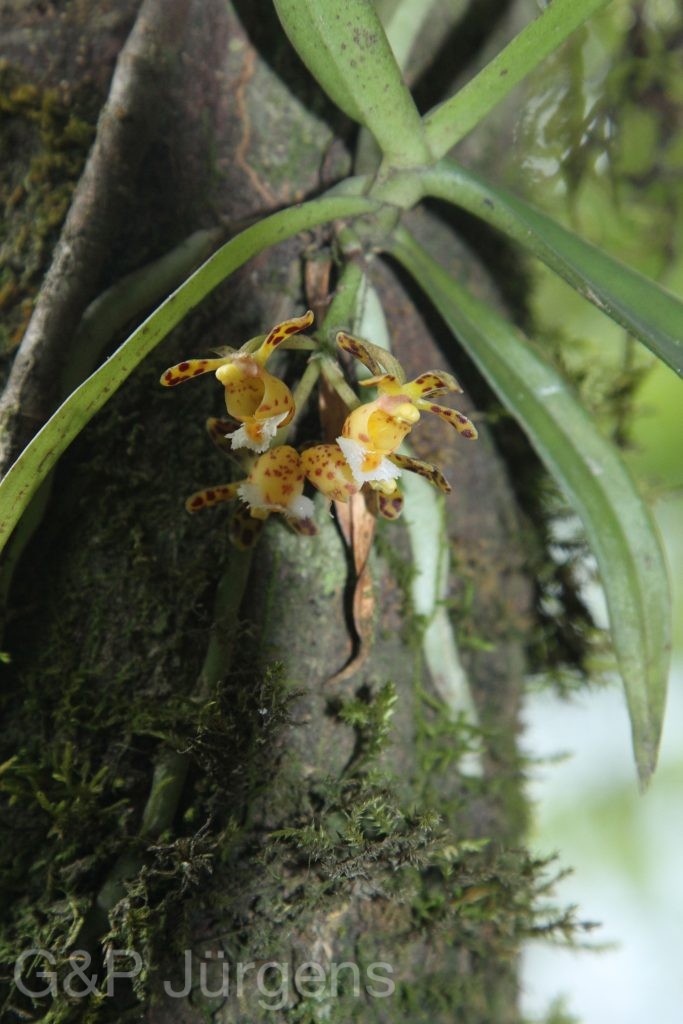
Gastrochilus calceolaris is a widespread epiphytic orchid of the eastern Himalaya and tropical-subtropical Asia, recorded by GBIF from China, India, Nepal, Bhutan, Myanmar and onwards through Vietnam, Thailand, Malaysia, the Philippines and Indonesia, with 356 georeferenced occurrences. It grows on the trunks and branches of broadleaved evergreen trees in humid montane and lower temperate forest, typically between about 1000 and 2300 m. The plant illustrated was photographed near Trongtsa (Trongsa) in central Bhutan at 2030 m in May, a setting of mossy oak and rhododendron forest where atmospheric moisture favours vandaceous epiphytes.

The species is a monopodial epiphyte with a short, stout stem clad in the persistent sheathing bases of distichous, ligulate to oblong leaves that are coriaceous and unequally bilobed at the apex. Numerous flexuous aerial roots anchor the plant. The short, pendent racemes bear several to many subumbellate flowers; the sepals and petals are yellowish green blotched with reddish brown. The labellum is three-lobed with a conspicuous saccate, helmet- or slipper-shaped hypochile (the source of the epithet calceolaris) and a fringed, transversely oblong epichile bearing a hairy central callus. The column is short and the pollinia are waxy.

First described as Aerides calceolaris by Buchanan-Hamilton ex Smith and transferred to Gastrochilus by D. Don, the species is the type-bearing representative of a genus of some five dozen Asian epiphytes segregated from Saccolabium. Though locally frequent across a vast range and not assessed as globally threatened, populations are vulnerable to forest clearance and to collection for the ornamental orchid trade.

Author: (Buch.-Ham. ex Sm.) D.Don · Sources: POWO (Kew), GBIF, Flora of Bhutan, Flora of China, The Genus Gastrochilus (Z.H. Tsi monograph), Orchids of Bhutan

(Lam.) Schltr.

Geodorum densiflorum ergebnis
Bhutan Paro, 2400m June

Description

Geodorum densiflorum is a widespread terrestrial orchid ranging across tropical and subtropical Asia and into the Pacific, recorded from India, Nepal, Bhutan, Sri Lanka, China, Japan, Taiwan, Thailand, Vietnam, Malaysia, Indonesia, the Philippines, New Guinea, Australia and numerous islands, with well over a thousand documented occurrences. It grows in open deciduous and bamboo forest, grassy slopes, scrub and roadside banks, usually in seasonally dry, well-drained ground from the lowlands to mid-elevations. The plant photographed near Paro in Bhutan at 2400 m in June represents the upper part of its altitudinal range, flowering with the onset of the monsoon.

The species arises from underground, corm-like pseudobulbs that store water and reserves through the dry season. The leaves are few, large, broadly elliptic-lanceolate and plicate, with prominent parallel venation, narrowed to a petiole-like base and often appearing with or after the flowers. The inflorescence is unmistakable: a stout scape terminating in a dense, sharply nodding or recurved raceme so that the flowers face downward, the apex curving over before erecting in fruit. The flowers are pink to white with a pouched, whitish labellum marked yellow or purple within. The column is short and the fruit a pendent capsule.

In GBIF the name appears as a synonym, with Geodorum densiflorum treated as the accepted name; the species is the type of the small palaeotropical genus Geodorum within tribe Cymbidieae, distinguished by its characteristic nodding inflorescence. Its wide range, ecological tolerance and frequent occurrence in disturbed habitats make it relatively secure, though, like all orchids, it is listed on CITES Appendix II.

Author: (Lam.) Schltr. · Sources: POWO (Kew), GBIF, Flora of China, The Orchids of Bhutan (Pearce & Cribb), Flora of British India, CITES Appendices

Hook.f.

Sikkim2003 457 K631.2
Sikkim Chopta Valley 3900m August

Description

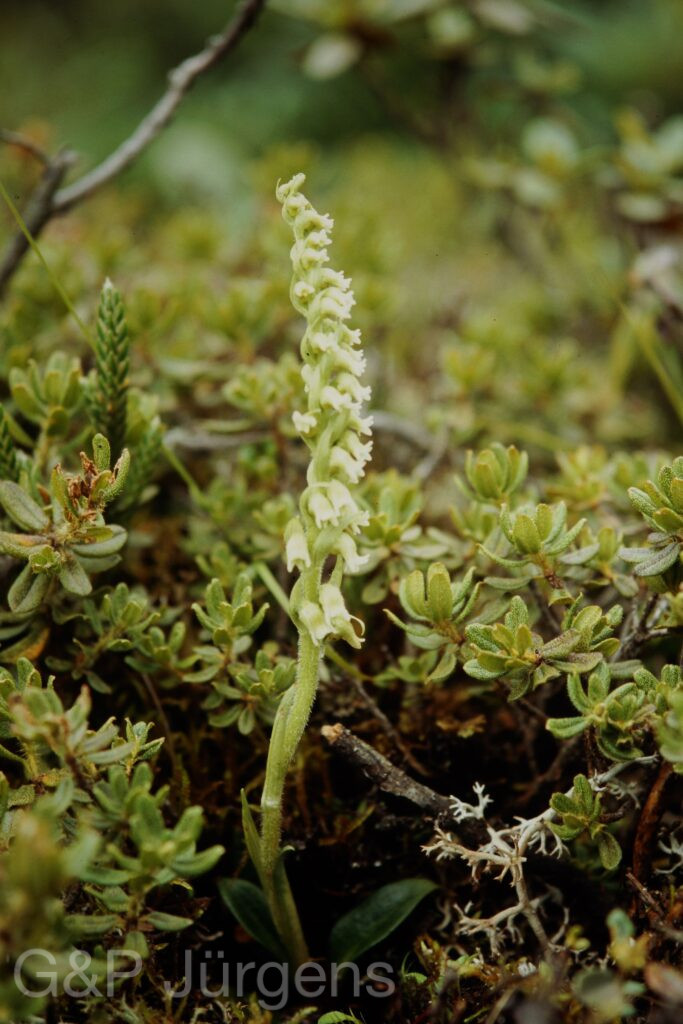
Goodyera fusca is a terrestrial orchid of the higher Himalaya, ranging through Nepal, China, Bhutan, India and Myanmar (NP, CN, BT, IN, MM), with about 101 recorded occurrences. It grows in cool, shaded humus among mossy rocks, in subalpine Rhododendron and conifer thickets and at the upper forest margin, generally in the upper temperate to subalpine zone. The plant illustrated was found in the Chopta Valley of Sikkim at 3900 m in August, an elevation and late-summer flowering period typical of the species, where it occupies damp, sheltered pockets of leaf litter and bryophyte cover beneath open scrub near the treeline.

It is a small, erect herb arising from a creeping, fleshy, few-noded rhizome rooting at the nodes. The leaves are few and clustered toward the stem base, ovate to elliptic, somewhat fleshy, and in many populations marked with the reticulate veining characteristic of the 'jewel orchids'. The inflorescence is an erect, glandular-pubescent spike bearing a secund to spiralled series of small, dull brownish to greenish flowers, each subtended by a lanceolate bract. The dorsal sepal and petals are connivent to form a hood over the column, the lateral sepals spreading, and the saccate, concave lip lacks a free spur. The fruit is a small, erect, ribbed capsule releasing dust-fine seeds.

Goodyera (subtribe Goodyerinae, tribe Cranichideae of the Orchidaceae) is a chiefly Asian genus of forest-floor orchids whose germination and establishment depend on association with mycorrhizal fungi. The small, drab, nectar-bearing flowers are pollinated by small bees and other insects, and the minute seeds are wind-dispersed. As an obligately mycotrophic forest understorey orchid, G. fusca is vulnerable to disturbance of its humus-rich habitat, though across its wide Himalayan-Chinese range it is not currently regarded as threatened.

Author: Hook.f. · Sources: POWO (Kew), GBIF, Flora of Bhutan, Flora of China, Genera Orchidacearum (Goodyerinae)

King & Pantl.

Bhutan2012 347
Bhutan Dochu-La 3000m, September

Description

Goodyera hemsleyana is a terrestrial orchid of the cool, humid temperate forests of the eastern Himalaya and adjoining southwestern China. Documented occurrences (21 GBIF records) span India, Nepal, China, Bhutan and Myanmar, following the moist mid- to upper-montane belt of the Sino-Himalayan region. The species favours the deep, mossy humus and leaf litter of shaded broadleaved and mixed conifer forest, typically between about 2500 and 3500 m. The illustrated material was gathered at Dochu-La in western Bhutan at roughly 3000 m in September, a pass clothed in cloud forest where rhododendron and fir provide the shade and atmospheric moisture this orchid requires.

The plant is a small, creeping geophyte arising from a slender, fleshy, decumbent rhizome that roots at the lower nodes. The leaves are few, gathered toward the base, ovate to elliptic, and characteristically marked with a fine reticulate venation that distinguishes the 'jewel orchid' alliance. The erect inflorescence is a pubescent scape bearing a rather lax, secund raceme of small white to greenish-white flowers. Each flower shows the connivent dorsal sepal and petals forming a hood over the column, spreading lateral sepals, and a saccate, concave lip with an incurved, often shortly bifid apex; the ovary is glandular-hairy and twisted.

Goodyera is a large, near-cosmopolitan genus within tribe Cranichideae, subtribe Goodyerinae, and G. hemsleyana belongs to the assemblage of Himalayan species described from the King & Pantling collections. Like its congeners it is mycoheterotrophic in establishment, dependent on rhizoctonia-type fungal symbionts in the forest humus, which restricts it to undisturbed old-growth stands. Though not formally assessed as threatened, its reliance on intact mossy forest makes it sensitive to logging and grazing pressure across its range.

Author: King & Pantl. · Sources: POWO (Kew), GBIF, Flora of Bhutan, Flora of China, The Orchids of Bhutan (Pearce & Cribb)