Tag:

Alpine (>3500 m)

Baker

Sikkim2011 51
Sikkim Vista-valley 3800m, June
Bhutan2014 991
Bhutan Chele-La 4000m, May

Description

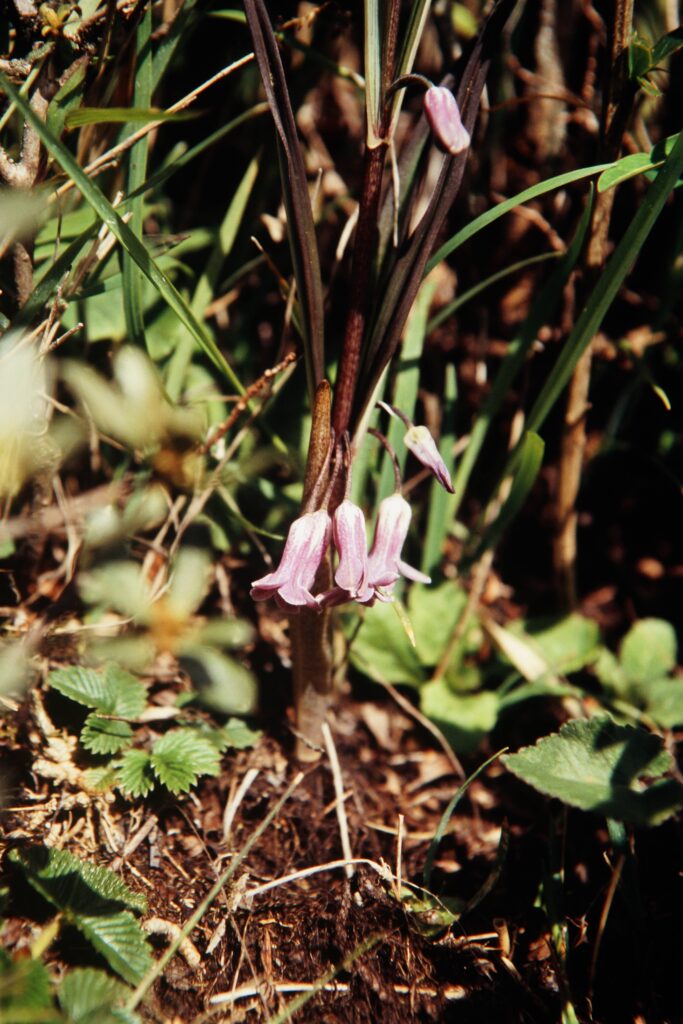
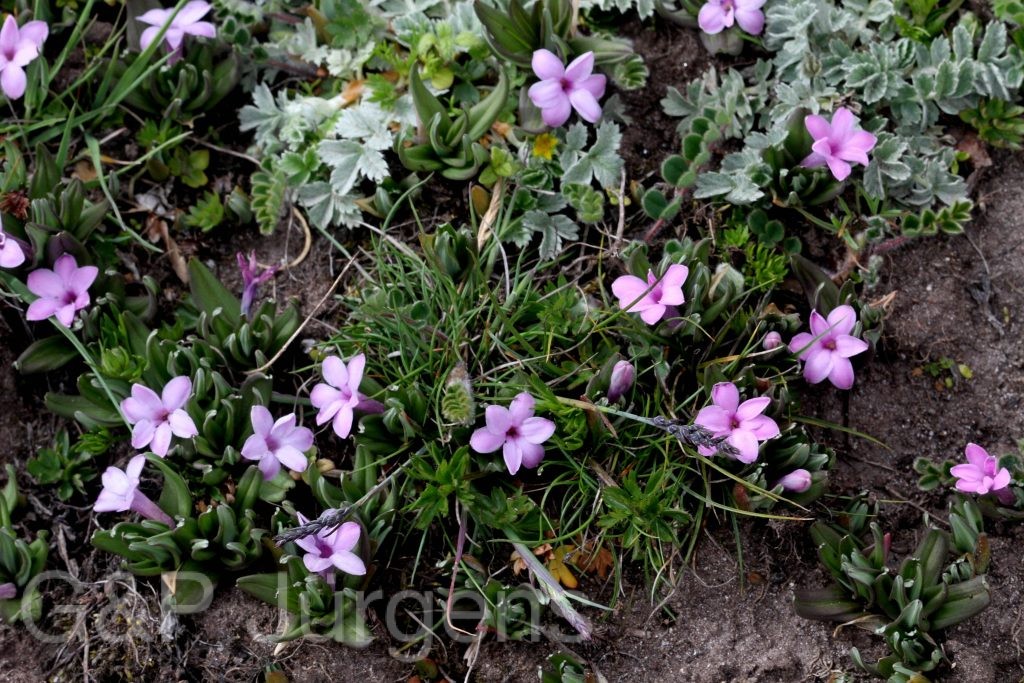
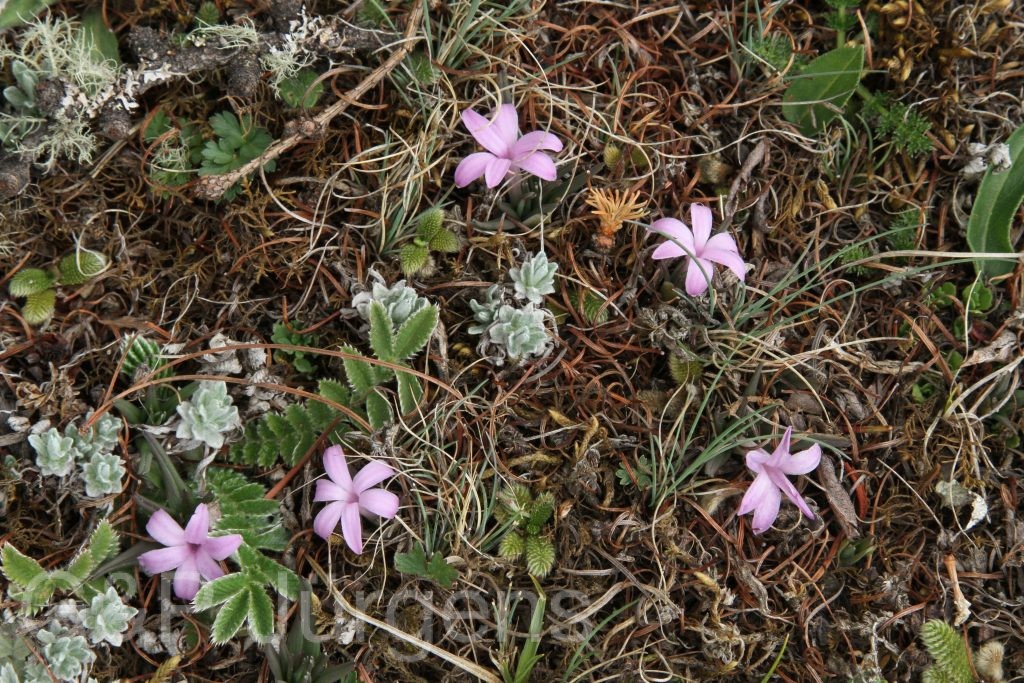
Polygonatum hookeri is a dwarf alpine Solomon's-seal of the Sino-Himalayan high mountains, recorded from China, Nepal, India, Bhutan and Pakistan across some 400 GBIF occurrences. The illustrated plants were photographed in the Vista-valley of Sikkim at 3800 m in June and on the Chele-La in Bhutan at 4000 m in May. It grows in open alpine turf, on grassy slopes, stony meadows and the margins of rhododendron scrub, typically between 3000 and 4500 m, forming low patches in short high-elevation vegetation where it flowers soon after snowmelt.

The plant is a diminutive rhizomatous perennial, spreading by a slender creeping rhizome and producing very short, sometimes almost stemless aerial shoots. The leaves are small, narrowly elliptic to oblong and crowded toward the top of the shoot. The flowers are solitary or paired and conspicuously large relative to the plant, bell- to funnel-shaped, lilac, rose-pink or purplish, borne low among the leaves; the perianth is tubular with six short lobes. The fruit is a small globose berry, ripening red, containing few seeds.

Long placed in the Liliaceae or Convallariaceae, Polygonatum is now treated in the Asparagaceae (subfamily Nolinoideae). P. hookeri is among the smallest and most alpine members of the genus, its dwarf cushion-like habit an adaptation to the harsh high-mountain environment, and it is much esteemed by rock-garden growers. The bird-dispersed berries aid colonisation of new ground. The species is widespread across the high Himalaya and of least conservation concern.

Author: Baker · Sources: POWO (Kew), GBIF, Flora of China, Flora of Bhutan, Flora of Nepal, Jeffrey – The Genus Polygonatum (Liliaceae/Asparagaceae) revision
H. Hara

BhutanPG2011 164
Bhutan Tsochenchen, 3600m June
Bh09 183 P318
Bhutan Phajoding, 3600m June

Description

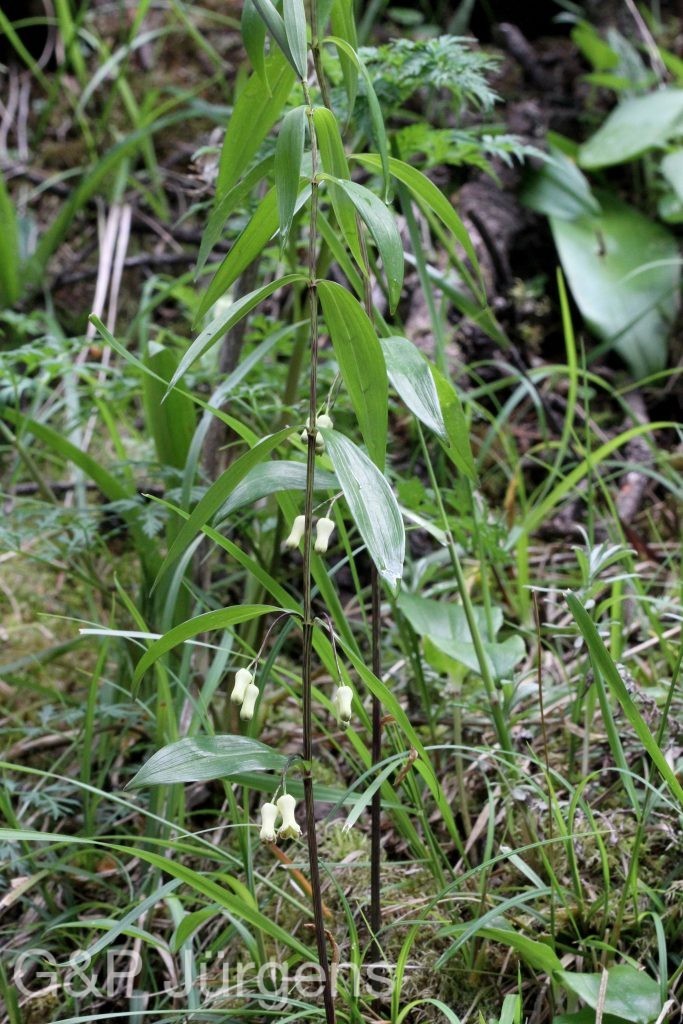
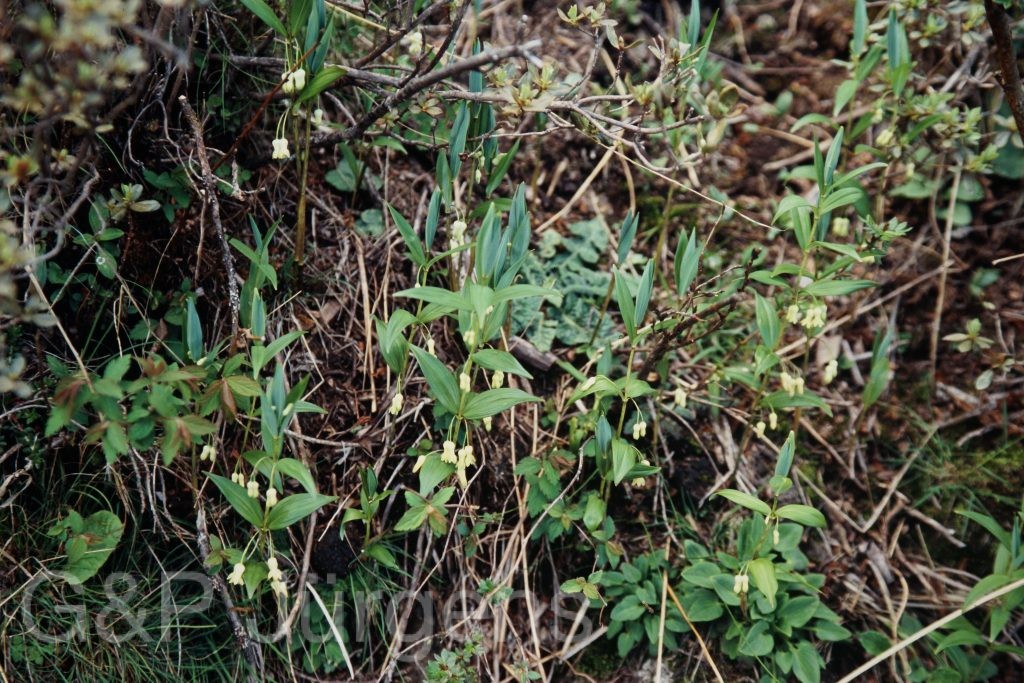
Polygonatum singalilense H.Hara is an alpine Solomon's-seal of the eastern Himalaya, named for the Singalila ridge and known from about 66 records in Nepal, India, Bhutan and adjacent China, with herbarium material in Great Britain. It occurs in moist alpine meadows, dwarf-shrub heath, rhododendron scrub and the edges of fir forest, typically among rocks and mossy banks in the upper temperate to subalpine zone. The plants illustrated from Tsochenchen and Phajoding in Bhutan, both near 3600 m in June, are characteristic of its cool, humid, snow-influenced habitats with a brief flowering season at the onset of the monsoon.

This is a small rhizomatous perennial herb growing from a knotty, horizontally creeping rhizome bearing the scars ("seals") of previous shoots. The stem is short, erect to arching and unbranched. Leaves are alternate to subverticillate, sessile or shortly petiolate, ovate to lanceolate, and glabrous. The flowers are solitary or few in the leaf axils, pendulous, with a tubular to campanulate, gamophyllous perianth that is whitish to greenish, often tinged purple; the six tepals are fused with short free lobes, the stamens inserted within the tube. The fruit is a small globose berry, ripening dark blue to blackish and containing few seeds.

The species belongs to a complex of dwarf, alpine Himalayan Polygonatum often confused with P. hookeri and relatives, distinguished by stature, leaf arrangement and perianth proportions. Its nectar-rich tubular flowers are bumblebee-pollinated, and the fleshy berries are bird-dispersed. As a narrow-range montane endemic of the eastern Himalaya, P. singalilense is potentially sensitive to grazing, collection and upward shifts of vegetation belts under climate warming, though it has not been formally assessed.

Author: H. Hara · Sources: POWO (Kew), GBIF, Flora of Bhutan, Flora of Nepal, Flora of China, Hara's Flora of Eastern Himalaya, monograph/revision of Polygonatum

(L.) All.

Bh09 60 P108 ergebnis
Bhutan Jili-La 3500m, May

Description

Polygonatum verticillatum ((L.) All.), the whorled Solomon's-seal, is a temperate to subalpine rhizomatous herb with a remarkably broad Eurasian range. It extends from western and central Europe across Russia and the Caucasus to Central Asia, the Himalaya and southwest China; the very large number of GBIF occurrences (over 121,000) reflects its abundance across European mountains, though the Himalayan populations recorded from Nepal and Bhutan represent the easternmost segment of its distribution. It grows in shady deciduous and coniferous woodland, on grassy slopes and among rocks in alpine meadows, ascending to around 3,800 m, as exemplified by the collection from Jili-La in Bhutan at 3,500 m in May.

The plant arises from a creeping, knotted, horizontal rhizome and produces erect, terete, glabrous stems 30–80 cm tall. The leaves are sessile and arranged in distinct whorls of three to eight at each node, narrowly lanceolate to linear-oblong and acuminate, with the upper ones often subverticillate. The pendent, tubular-campanulate flowers are greenish-white, borne singly or in axillary clusters of two to four on slender pedicels; the perianth tube is six-lobed at the mouth and encloses six included stamens. The fruit is a globose berry that ripens from green through red to a deep purplish-black.

Within the genus the species is distinguished by its whorled leaf arrangement, contrasting with the alternate, distichous leaves of the related P. multiflorum and P. odoratum. The Himalayan rhizomes are valued in Ayurvedic and Tibetan medicine, where the plant is one of the sources traded as "Meda," a use that locally threatens wild stands through overharvesting. Across its wide global range, however, the species remains common and is assessed as of least concern.

Author: (L.) All. · Sources: POWO (Kew), Flora of Nepal, GBIF, Flora of China Vol. 24, Jeffrey: The Genus Polygonatum (Liliaceae) in Eastern Asia (1980)

Poir.

Sikkim2003 516 G716
Sikkim Yume Samdong 4700m August

Description

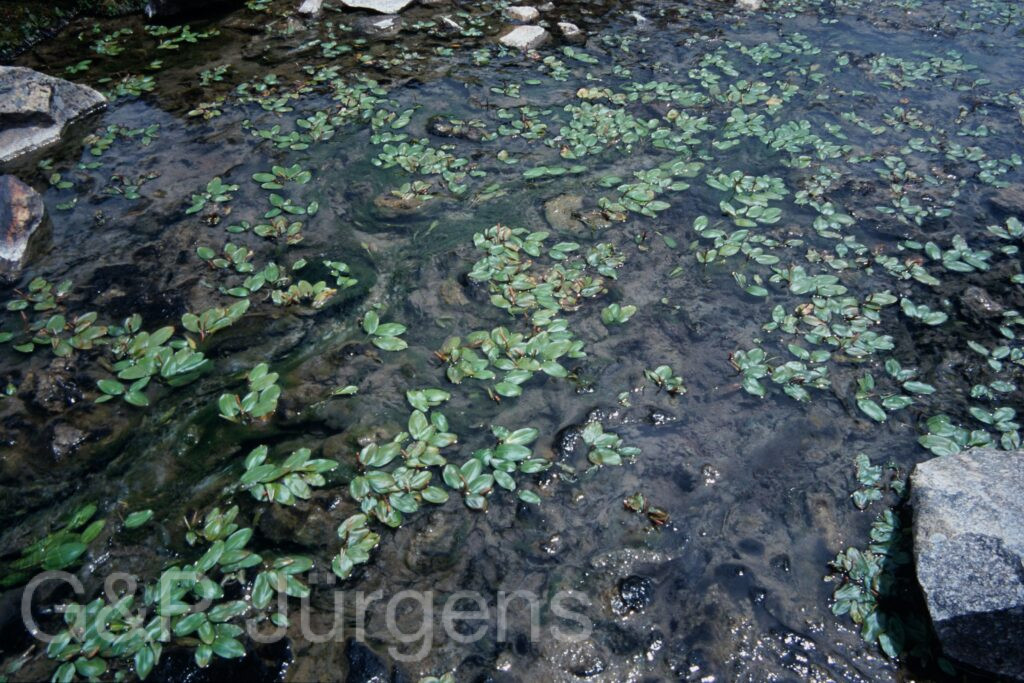
Potamogeton nodosus Poir. is a cosmopolitan aquatic perennial of the Potamogetonaceae, one of the most widely distributed pondweeds. Its extensive GBIF record (over 40,000 occurrences) spans Europe, the Americas, North Africa, the Middle East, and temperate Asia including China and Japan, reflecting a near-global range in suitable freshwater habitats. It was recorded in Sikkim at Yume Samdong at the remarkable altitude of 4,700 m in August, an unusually high station that illustrates the species' tolerance of cold, high-altitude standing and slow-flowing waters. It typically colonises ponds, ditches, lakes, and gently flowing rivers on fine, nutrient-rich substrates.

The plant is rooted, with a creeping rhizome bearing slender, branching stems. It is heterophyllous: the floating leaves are long-petiolate, elliptic to oblong, leathery and parallel-veined, while submerged leaves, when present, are narrower and more translucent. The membranous stipules are conspicuous and free from the leaf base. Small greenish flowers are borne in a dense, emergent, cylindrical spike on a stout peduncle; pollination is by wind and water, and the fruit is a small, beaked, dorsally keeled drupelet.

Potamogeton nodosus belongs to a taxonomically difficult genus prone to hybridisation, with broad-leaved species often requiring careful examination of fruit and stipule characters for identification. As a near-cosmopolitan generalist it is of no conservation concern; indeed it can become locally dominant in nutrient-enriched waters. Its presence provides oxygenation, food, and shelter within freshwater ecosystems.

Author: Poir. · Sources: POWO (Kew), Flora of China Vol. 23, Flora of Pakistan, GBIF, Wiegleb & Kaplan: Account of the Species of Potamogeton (1998)

Wall.

Nepal 99 360 ergebnis
West-Nepal Kalmura 3800m, June
Nepal 99 128 ergebnis
West-Nepal Kalmura 3800m, June

Description

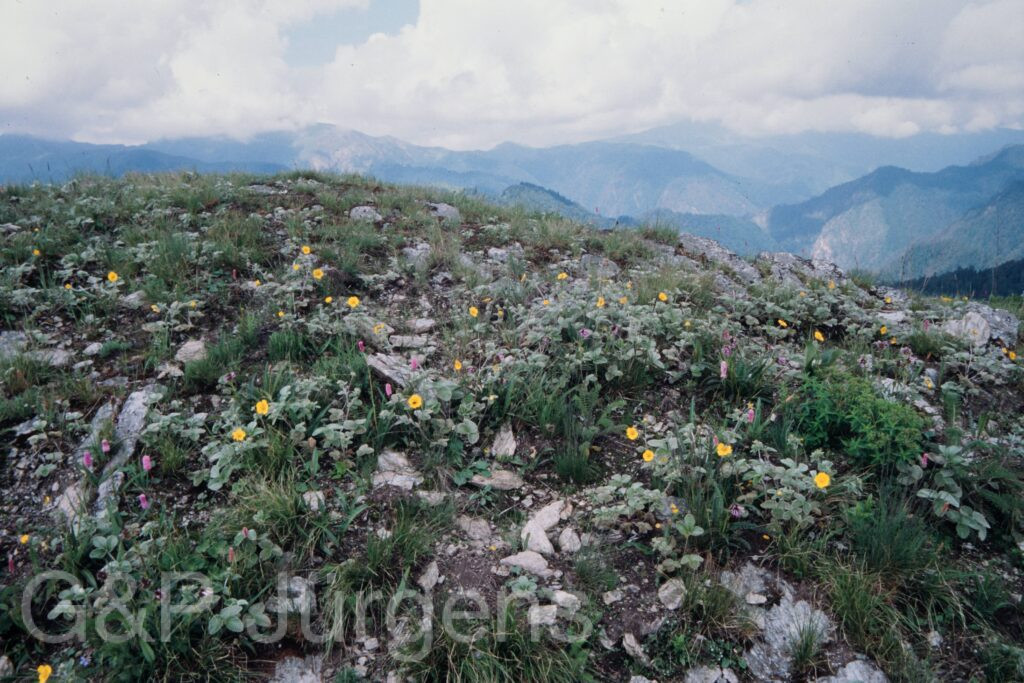
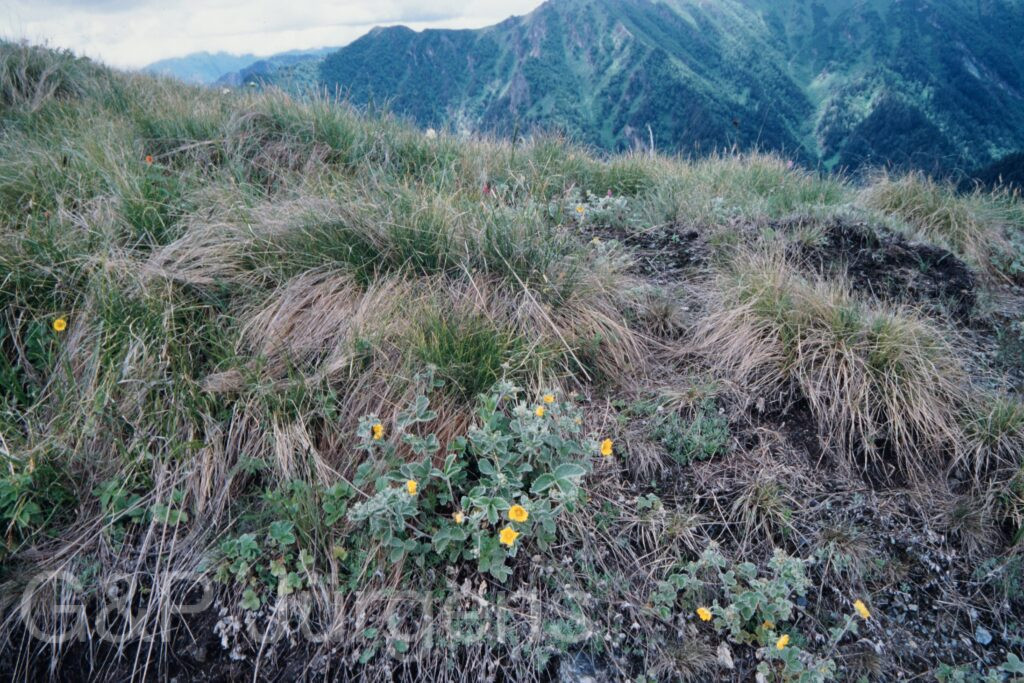
Potentilla argyrophylla is a showy alpine cinquefoil of the Himalaya, native across India, Nepal, Pakistan, Afghanistan and China. Its large GBIF tally (over 1300 occurrences) includes numerous European and North American records (Sweden, Germany, Norway, France, the United States and others) that reflect its long cultivation as a hardy garden perennial rather than any natural range there. In the wild it occupies open alpine meadows, grassy slopes, forest margins and rocky pastures of the upper subalpine and alpine zones. The illustrated plant was photographed in West Nepal at Kalmura at about 3800 m in June, a typical high-meadow station near the centre of its altitudinal range of roughly 3000 to 4500 m.

The plant is a tufted perennial herb arising from a stout, woody rootstock and bearing several ascending flowering stems. The leaves are pinnate or trifoliolate with three to several obovate, toothed leaflets, conspicuously silvery-white tomentose beneath (the epithet argyrophylla, silver-leaved) and greener above. The flowers are borne in loose, branched cymes; each has five green sepals alternating with an epicalyx, and five broad, obcordate petals that are typically golden-yellow but in some forms deep red or apricot. The numerous stamens surround a domed receptacle bearing many free carpels, which mature into a head of small, dry achenes.

Potentilla is a large, taxonomically complex genus of the Rosaceae, and P. argyrophylla together with the closely allied P. atrosanguinea forms a Himalayan group much hybridised in horticulture, where it has given rise to many garden cultivars. In the wild it is common and widespread, of no conservation concern, and an important nectar source for high-altitude bees and other insects.

Author: Wall. · Sources: POWO (Kew), GBIF, Flora of Pakistan, Flora of China, Annotated Checklist of the Flowering Plants of Nepal, Soják's revisional studies of Potentilla (Rosaceae)

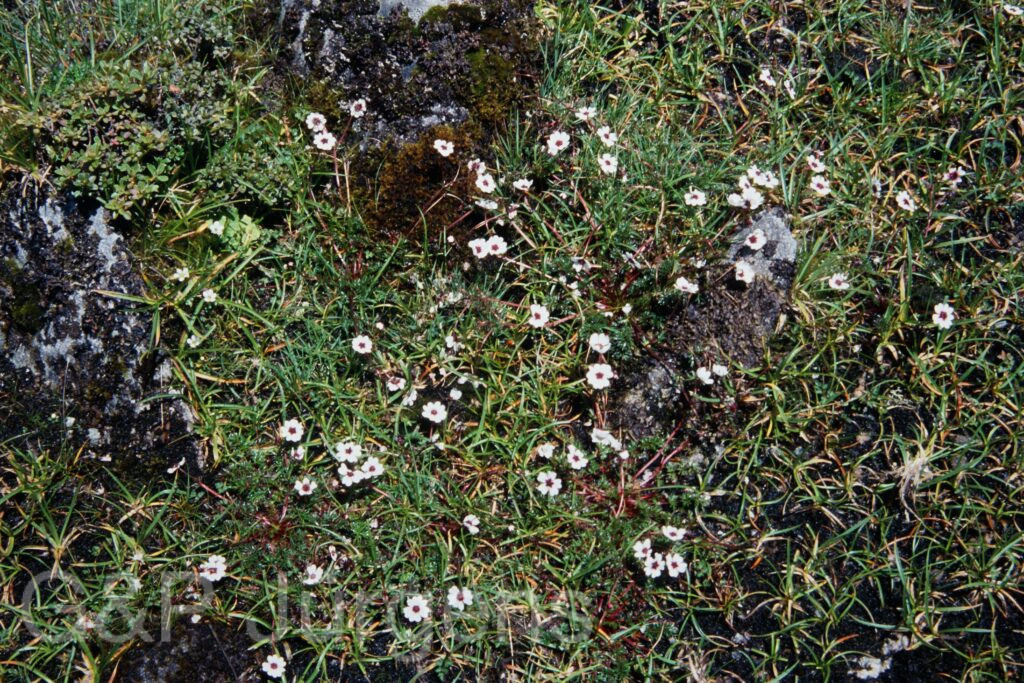
(C.E.C. Fisch.) T.T. Yu & C.L. Li

Sikkim2003 506 P706 ergebnis
Sikkim Yume Samdong 4400m, August

Description

Potentilla articulata var. latipetiolata is a high-altitude perennial herb found in the eastern Himalayas and extending into the Sino-Himalayan region. It has been recorded from northeast India (Sikkim), Bhutan, and China (Xizang, Yunnan). The variety inhabits alpine scree, rocky moraine margins, and gravelly slopes at elevations of 3,800–5,000 m, favouring well-drained, mineral substrates with sparse vegetation cover. It has been collected from the Yume Samdong area in Sikkim at 4,400 m, flowering in August at the height of the eastern Himalayan monsoon.
The plant forms a compact, caespitose rosette from a stout, woody caudex covered with persistent, fibrous leaf-base remnants. The basal leaves are pinnately compound with 5–9 leaflets that are obovate to elliptic, 5–12 mm long, densely sericeous to villous on both surfaces, giving the foliage a silvery appearance. The petioles are broad and somewhat winged, a diagnostic character of var. latipetiolata distinguishing it from the typical variety. The flowering stems are short, 3–10 cm tall, bearing 1–3 flowers. The flowers are 10–15 mm in diameter, with five bright yellow, broadly obovate petals exceeding the sepals. The epicalyx segments are lanceolate, slightly shorter than the sepals. The achenes are smooth, ovoid, approximately 1.5 mm long.
This variety was originally described by C.E.C. Fischer and subsequently recombined by T.T. Yu and C.L. Li. It is distinguished from the typical Potentilla articulata primarily by its broader, more conspicuously winged petioles. With approximately 39 occurrence records in GBIF, it is a relatively uncommon taxon. The high-alpine habitats it occupies are among the most climate-sensitive ecosystems in the Himalayas, and long-term monitoring of such specialised alpine rosette plants is important for understanding biotic responses to warming temperatures and glacial retreat in the region.

Author: (C.E.C. Fisch.) T.T. Yu & C.L. Li · Sources: POWO (Kew), GBIF, Flora of China Vol. 9, Flora of Bhutan Vol. 1, Grierson & Long: Flora of Bhutan Vol. 1 (1987)

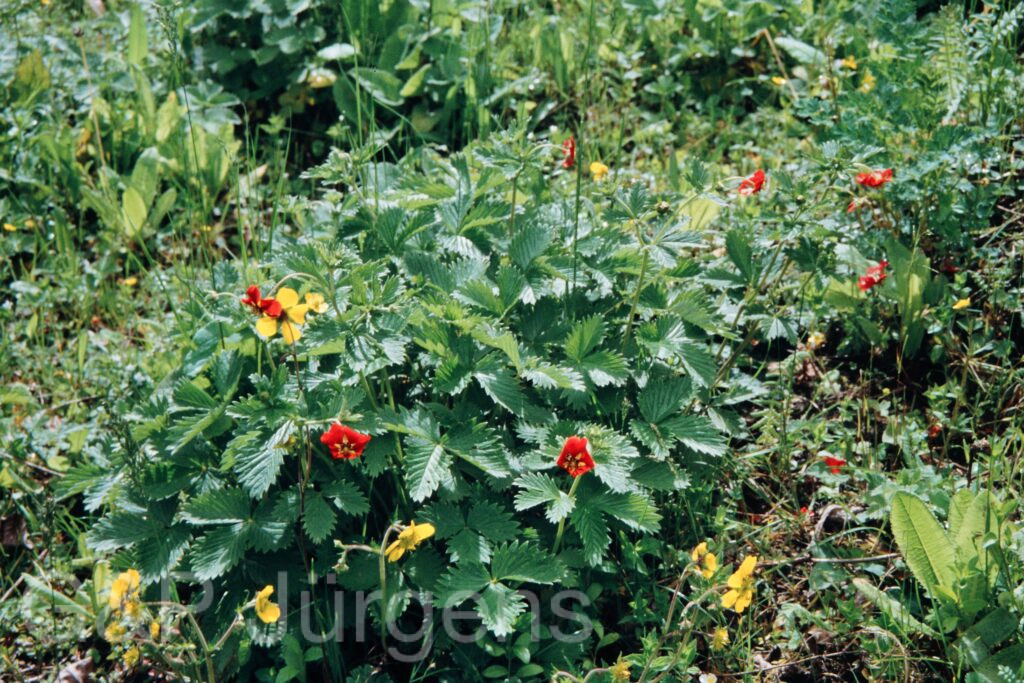
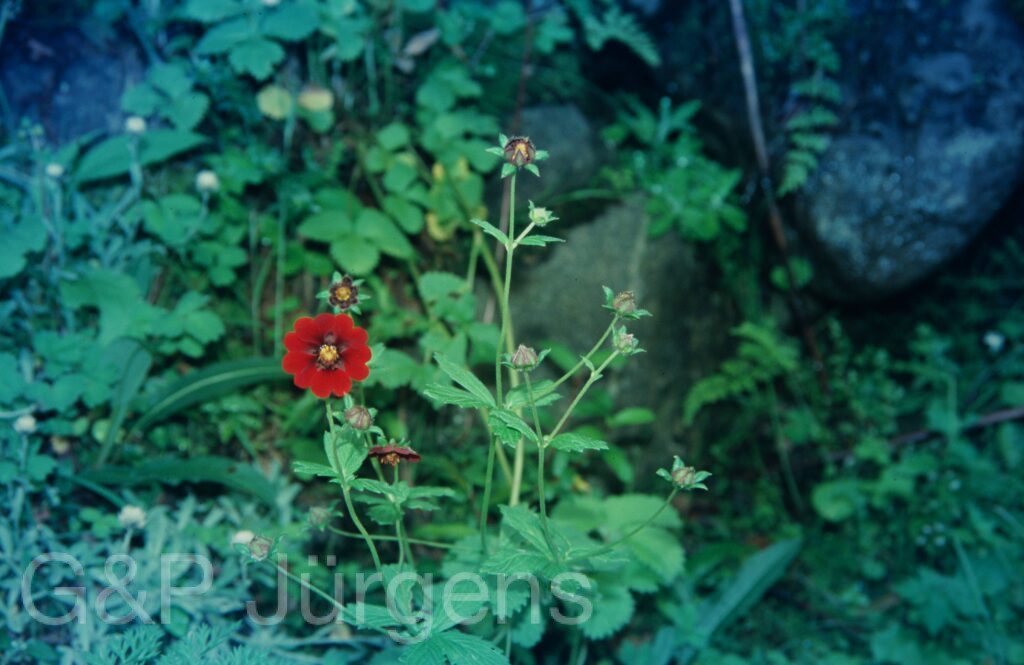
Lodd, G.Lodd. & W.Lodd

Nepal 99 110 ergebnis
West-Nepal South of Rara-Lake 3600m, June
Garw 2005 48 ergebnis ergebnis
India Garhwal Valley of flowers 3350m, September

Description

Potentilla atrosanguinea is a Himalayan alpine herb ranging from Pakistan through the western and central Himalaya into Nepal. GBIF documents about 450 occurrences, drawing on native populations in India, Nepal and Pakistan plus numerous cultivated and naturalised records across Europe and North America. It grows in alpine and subalpine meadows, open grassy slopes and rocky ground, typically between about 2500 and 4000 m. The photographed plants come from West Nepal south of Rara Lake at roughly 3600 m in June and the Valley of Flowers in Garhwal, India, at about 3350 m in September, both species-rich high-meadow settings.

The species is a tufted perennial arising from a stout, woody rootstock. The basal leaves are long-petioled and pinnately or digitately compound, with three to five obovate, coarsely toothed leaflets that are green above and densely white-tomentose beneath. The stems are erect, branched and silky-hairy, bearing reduced cauline leaves. The flowers are borne in lax cymes and are showy, with five spreading petals ranging from deep blood-red and orange to occasionally yellow, an epicalyx alternating with the calyx lobes, and numerous stamens. The fruit is an aggregate of small dry achenes on a dry receptacle.

GBIF flags the recorded name as a SYNONYM, with Potentilla atrosanguinea as the accepted name. The species is variable in flower colour and leaf division, and several varieties and segregates have been recognised. Its richly coloured forms have entered horticulture and underlie garden hybrids. Widespread and common across its native alpine range, it is of no conservation concern and is an important component of Himalayan meadow communities.

Author: Lodd, G.Lodd. & W.Lodd · Sources: POWO (Kew), GBIF, Flora of Nepal, Flora Simlensis, Th. Wolf: Monographie der Gattung Potentilla

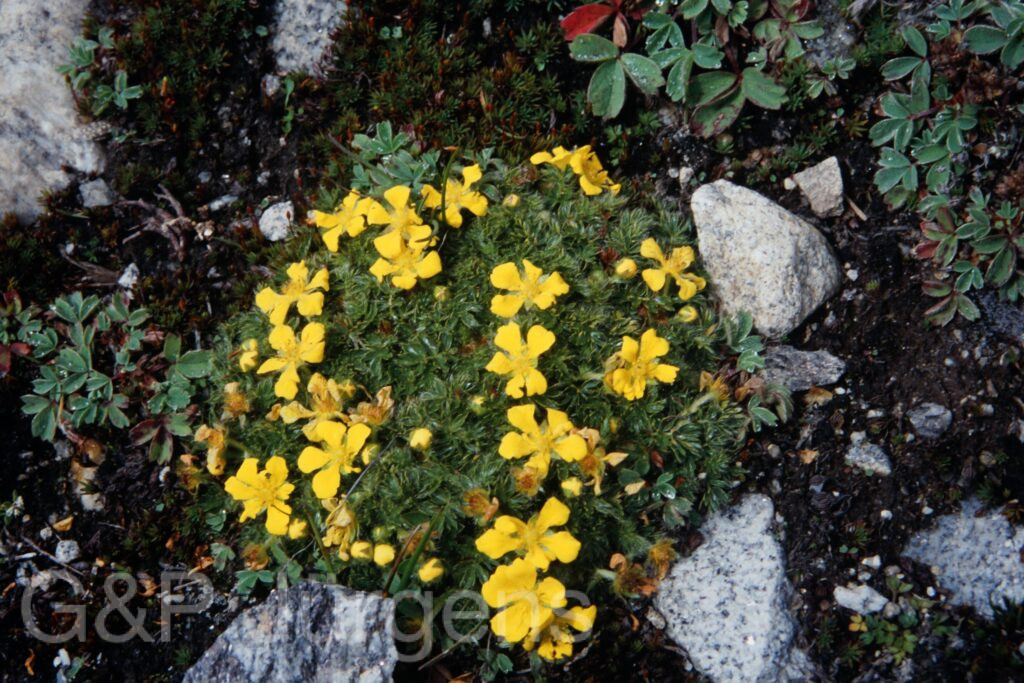
D.Don

Sikkim2003 132 G180
Sikkim Dzongri 3900m, August
Sikkim2003 133 W181
Sikkim Dzongri 3900m, August

Description

Potentilla coriandrifolia D.Don is a high-alpine perennial distributed across the eastern and central Himalaya and adjacent mountains, recorded from China, Nepal, India, Bhutan and Myanmar, with extralimital cultivated records elsewhere; some 542 georeferenced occurrences are documented in GBIF. It inhabits open turf, stony alpine meadows, gravelly slopes and the margins of moraines, typically between 3500 and 4800 m. The photographed plant grows at Dzongri in Sikkim at about 3900 m, flowering in August, a setting typical of the cool, well-drained alpine sward where this cushion-forming herb thrives among dwarf rhododendrons and graminoids.

The plant develops from a stout, woody, branched rootstock crowned by the persistent remains of old petioles, forming low tufts or loose mats. The leaves are radical, pinnate or pinnatisect with a coriander-like (coriandrifolium) dissection, the leaflets deeply incised into narrow oblong segments and often somewhat glaucous or silky beneath. Flowering stems are slender, ascending and few-flowered. The flowers are typically yellow, occasionally suffused with reddish or purplish tones at the base of the petals, with five obcordate petals exceeding the calyx, an epicalyx alternating with the sepals, and numerous stamens surrounding a central tuft of carpels. The fruit is an aggregate of dry achenes seated on a hairy receptacle.

A member of the large and taxonomically intricate genus Potentilla, this species belongs to the assemblage of dwarf Himalayan cinquefoils adapted to short growing seasons and intense insolation. Its distinctive finely cut foliage distinguishes it from related alpine taxa such as P. microphylla. Though not assessed as threatened, populations are restricted to fragile high-altitude habitats sensitive to grazing pressure and climate-driven upslope shifts, making the species a useful indicator of alpine ecosystem condition.

Author: D.Don · Sources: POWO (Kew), GBIF, Flora of China, Flora of Bhutan, Annotated Checklist of the Flowering Plants of Nepal, Soják monograph of Potentilla

Wall. & Lehm.

Nepal 99 481 ergebnis
West-Nepal Churta-Khola 3700m, June
Garw 2005 309 ergebnis
India Garhwal Patanathi 3600m, September

Description

Potentilla eriocarpa is a mat-forming alpine cinquefoil distributed throughout the Himalaya and adjacent ranges, from Afghanistan and Pakistan eastward through India, Nepal and Bhutan into south-western China and Myanmar. GBIF records some 667 occurrences, densest in Nepal, the Indian Himalaya and the Chinese borderlands. It is a plant of the high alpine zone, colonising rock crevices, screes, stony meadows, moraines and exposed ridges, characteristically between about 3000 and 4800 m. The populations imaged in West-Nepal at Churta-Khola (3700 m, June) and in Indian Garhwal at Patanathi (3600 m, September) reflect its broad flowering season across the western Himalaya, from early summer into autumn near the upper limits of vascular plant growth.

The species forms low, dense cushions or tufts from a stout, woody, branched caudex clothed in the persistent remains of old stipules and leaf-bases. The leaves are ternate, the three obovate to cuneate leaflets coarsely toothed toward the apex, dark green and glabrescent above, paler and often silky beneath. The flowering stems are short, ascending to decumbent, bearing one to few flowers. Each flower has five sepals alternating with five epicalyx segments, five broadly obovate, often emarginate yellow petals, numerous stamens and many carpels on a hairy receptacle. The diagnostic feature, reflected in the epithet, is the densely woolly-hairy (eriocarpous) achenes forming the fruiting head.

Potentilla is a large and taxonomically intricate northern-temperate genus, and P. eriocarpa, described by Wallich and Lehmann, belongs to the predominantly Asian alpine cushion-forming group. Its ternate leaves and conspicuously hairy achenes separate it from the many associated Himalayan cinquefoils. As a widespread, abundant high-alpine perennial it is of no conservation concern, and is a significant component of cushion-plant and fellfield communities at extreme elevations.

Author: Wall. & Lehm. · Sources: POWO (Kew), GBIF, Flora of China, Flora of Pakistan, Flora of Bhutan, Annotated Checklist of the Flowering Plants of Nepal, monograph of the genus Potentilla (Wolf)

(D.Don) Maxim.

Sikkim2003 189 P260
Sikkim Dzongri 4100m, August

Description

Potentilla fruticosa var. arbuscula is a shrubby cinquefoil of the high mountains of the Sino-Himalayan region, recorded from China, Nepal, Bhutan and Japan. GBIF treats the name as a synonym, with Potentilla fruticosa var. arbuscula (here cited following the source) regarded as the accepted designation for this entity; in modern treatments the shrubby cinquefoils are often placed in the segregate genus Dasiphora. It grows in alpine and subalpine scrub, open meadows, rocky slopes and stream-sides above and near the treeline, generally between about 3000 and 4500 m. The photographed plant comes from Dzongri in Sikkim at around 4100 m, flowering in August. With over 400 georeferenced records it is a well-documented high-montane shrub.

It forms a low, much-branched deciduous shrub, often spreading or cushion-like at the highest elevations, the bark shredding and the young shoots silky-hairy. The leaves are pinnate with usually five small, narrow, oblong leaflets that are green above and densely silvery-silky beneath, with revolute margins. The flowers are solitary or few in the leaf axils and at the branch tips; each has five green sepals alternating with epicalyx segments and five broad, rounded, golden-yellow petals exceeding the calyx. The numerous stamens surround a hairy receptacle bearing many free carpels, which ripen into a head of small hairy achenes.

The shrubby cinquefoil complex is taxonomically intricate and widely cultivated in horticulture; var. arbuscula is distinguished within it by its dense indumentum and Himalayan high-altitude form. Its abundant nectar-rich flowers attract a range of insect pollinators. As a common and broadly distributed alpine shrub it is of least conservation concern.

Author: (D.Don) Maxim. · Sources: POWO (Kew), GBIF, Flora of China, Flora of Bhutan, Soják's revisions of Potentilla and Dasiphora