Tag:

Alpine (>3500 m)

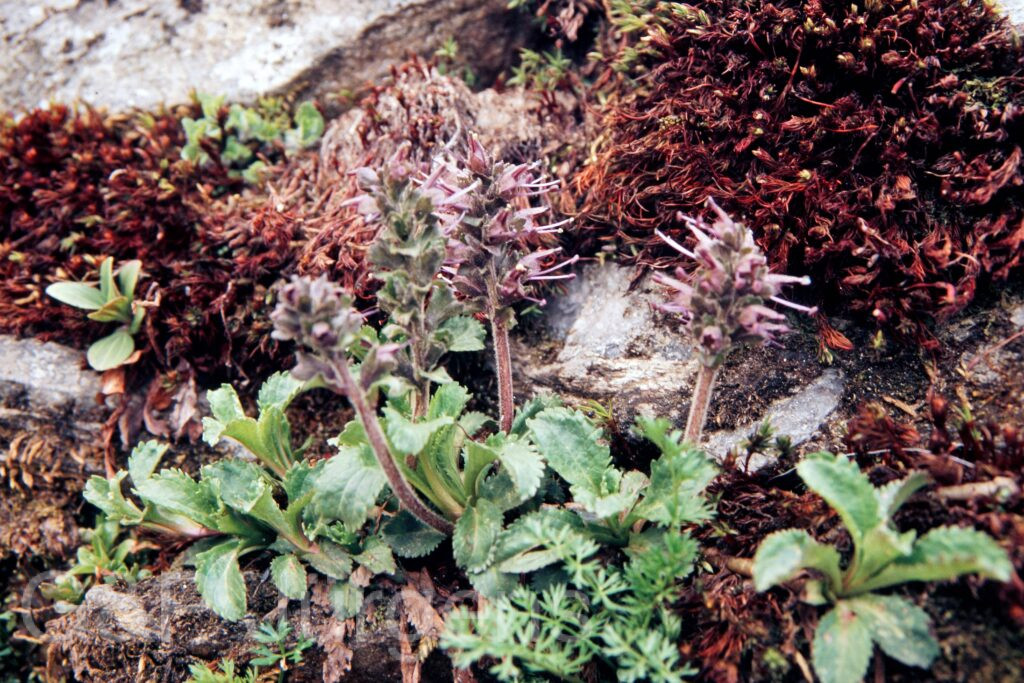
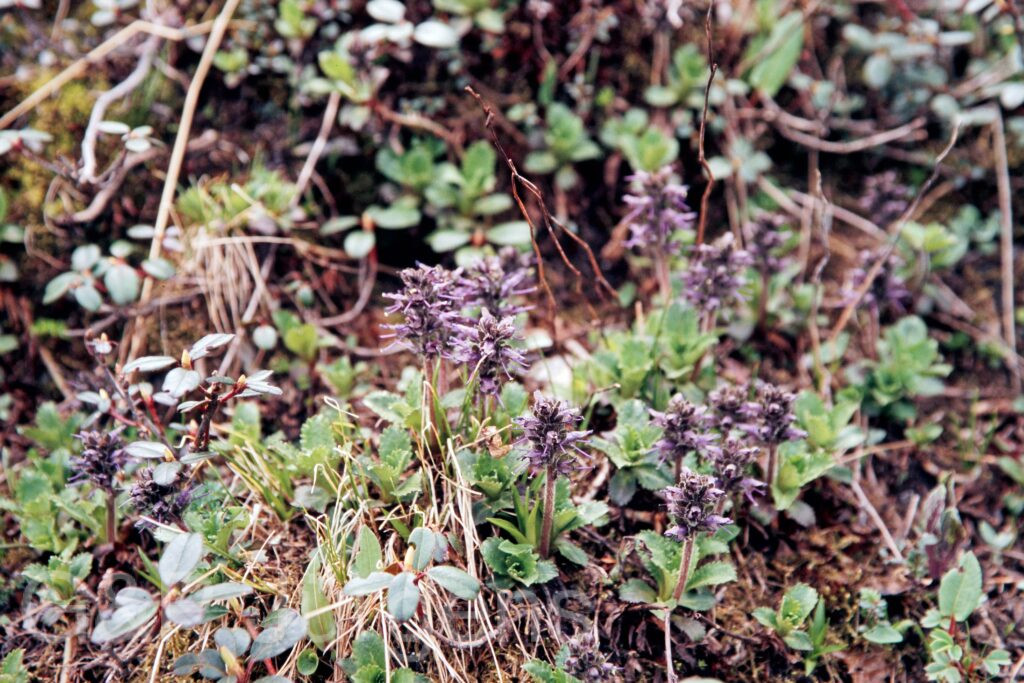
Phlomoides rotata

by GP Jürgens

(Benth. ex Hook.f.) Mathiesen
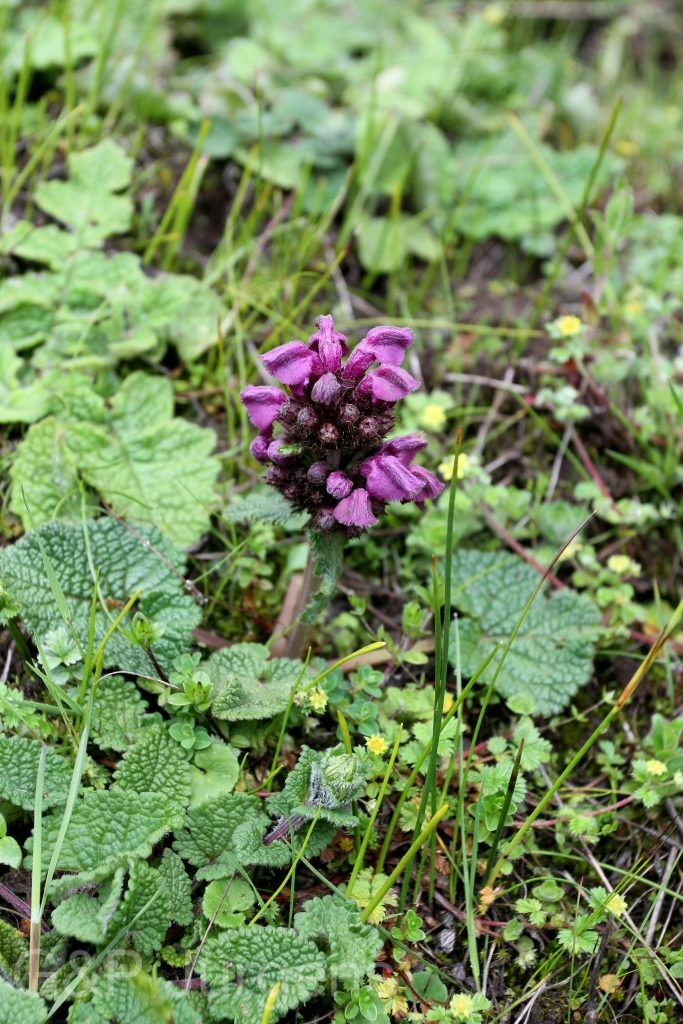
BhutanPG2011 369
Bhutan Jule-Tso, 4000m June

Description

Phlomoides rotata (formerly Phlomis rotata) is a distinctive stemless mint of the high Himalaya and Tibetan plateau. GBIF records it from China, Nepal, India, Bhutan and Pakistan, with around 700 occurrences spanning the alpine zone of the Sino-Himalayan region. It grows on open stony slopes, gravelly alpine turf, screes and pasture between roughly 3700 and 5200 m. The plant illustrated was photographed at Jule-Tso in Bhutan at 4000 m in June, forming a flattened rosette pressed against the ground, the characteristic habit by which the species hugs the substrate in the windswept high-alpine environment.

It is an acaulescent (stemless) perennial arising from a thick rootstock, the leaves forming a low basal rosette appressed to the soil. The leaves are ovate to orbicular, crenate, rugose with impressed venation and clothed in greyish indumentum. As the epithet rotata (wheel-like) implies, the verticillasters are condensed into a dense, radiating, disc-like terminal head sessile in the centre of the rosette. The bilabiate corollas are purple to violet, the hooded upper lip protecting the four didynamous stamens; the fruit comprises four smooth nutlets enclosed in the persistent tubular calyx.

The genus Phlomoides was reinstated and broadened to absorb much of Phlomis following molecular phylogenetic studies in subfamily Lamioideae, hence the binomial transfer. The ground-hugging rosette habit is a classic adaptation to alpine cold, wind and grazing, minimising exposure while exploiting the warmer boundary layer at soil level. Widely used in Tibetan medicine, the species is collected from the wild; it remains common across its broad high-altitude range and is not considered threatened.

Author: (Benth. ex Hook.f.) Mathiesen · Sources: POWO (Kew), GBIF, Flora of China, Flora of Pakistan, Annotated Checklist of the Flowering Plants of Nepal, Phylogeny and classification of subfamily Lamioideae (Lamiaceae)
(Decne.) Miers

Nepal 99 777 ergebnis
West-Nepal, Baga-La-Phedi 3800m, July

Description

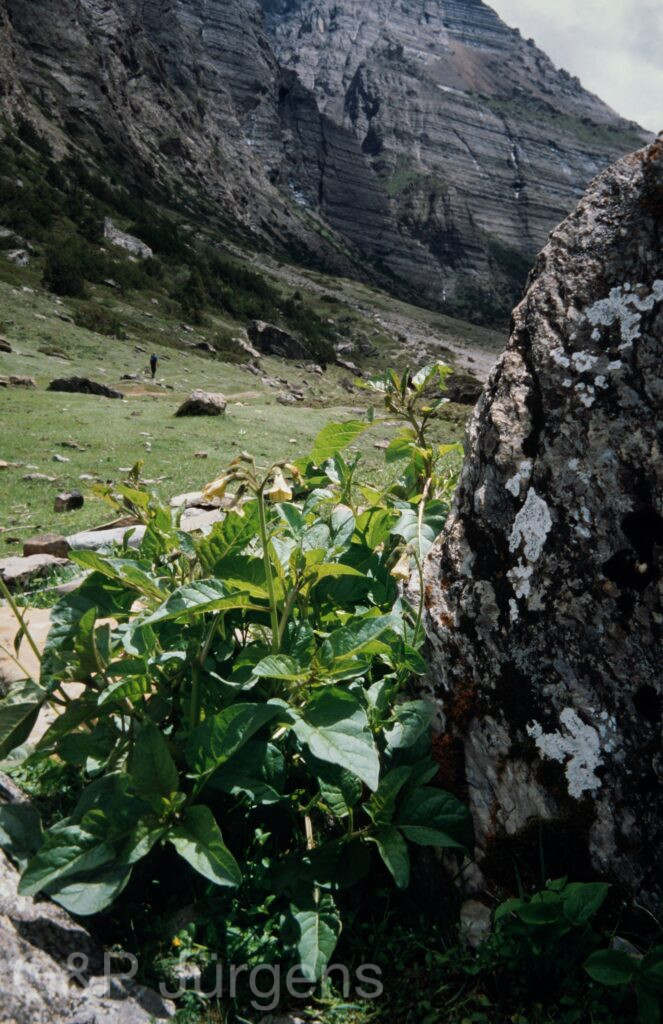
Physochlaina praealta (Decne.) Miers is a robust perennial herb of the high alpine and subalpine zones of the western and central Himalaya and the Tibetan borderlands. GBIF records it from India, China, Nepal and Pakistan (about 360 occurrences), a distribution centred on the cold, arid inner-Himalayan and trans-Himalayan ranges. It grows on open stony slopes, screes, grazed alpine pastures and around herders' camps where the soil is nitrogen-enriched, typically between roughly 3,000 and 4,500 m; the photographed plant is from West Nepal, Baga-La-Phedi, at 3,800 m in July, at the height of the brief alpine growing season.

The plant arises from a stout, perennial rootstock and forms an erect, branched, somewhat viscid-pubescent stem. The leaves are alternate, ovate to elliptic, entire to sinuate, narrowed to a winged petiole and soft in texture. The flowers are borne in terminal, somewhat scorpioid cymes; the corolla is campanulate to tubular, dull yellowish or greenish often tinged purple, with a five-lobed limb, and the calyx is accrescent. In fruit the calyx enlarges into an inflated, bladder-like, membranous structure (Physochlaina meaning swollen cloak) that encloses the circumscissile capsule (pyxidium), an adaptation aiding wind dispersal across open terrain.

Like many Hyoscyameae, the genus is rich in tropane alkaloids (hyoscyamine, scopolamine) and is poisonous yet medicinally used in Himalayan and Tibetan traditional systems. Physochlaina is a small Central Asian–Himalayan genus exemplifying the cold-desert Solanaceae element. The species is naturally localised but not currently regarded as threatened.

Author: (Decne.) Miers · Sources: POWO (Kew), GBIF, Flora of China Vol. 17, Flora of Pakistan, Flora of Nepal, Hunziker: The Genera of Solanaceae

(DC.) C. Norman

Sikkim2003 247 P340
Sikkim Dzongri 4100m 08.2003

Description

Physospermopsis obtusiuscula is an alpine umbellifer of the eastern and central Himalaya, distributed across China (Tibet and adjacent provinces), Nepal, northern India and Bhutan, the roughly 136 GBIF records tracing this high-mountain arc. It inhabits open alpine meadows, moist grassy slopes, scree margins and the edges of dwarf-rhododendron and juniper scrub, characteristically between about 3500 and 4800 m. The photographed plant from Dzongri in Sikkim at 4100 m in August illustrates its late-summer flowering on a damp, high-alpine pasture, where it grows among cushion plants and short turf.

It is a small to medium perennial herb arising from a slender taproot or short rhizome, with one to few erect, ribbed, sometimes purplish stems. The leaves are mostly basal, with sheathing petioles, the blade ternately to pinnately dissected into narrow, obtuse ultimate segments. The inflorescence is a compound umbel subtended by conspicuous, often leafy bracts and bracteoles; the small flowers bear white to pinkish petals. The fruit is a mericarp pair, ovoid and somewhat laterally compressed, with prominent ribs, the genus name alluding to the inflated or bladder-like fruit character within the Apioideae.

The genus Physospermopsis comprises a small group of high-Asian umbellifers centred on the Himalaya and the Hengduan Mountains, allied to Pleurospermum and segregated chiefly on fruit and vittae characters. P. obtusiuscula, distinguished by its blunt leaf segments, is a typical element of the wet alpine flora at the upper limit of vascular plant growth. It is not formally assessed for conservation but, like other narrowly distributed alpine umbellifers, is potentially sensitive to grazing pressure and climate-driven upslope shifts.

Author: (DC.) C. Norman · Sources: POWO (Kew), GBIF, Flora of China, Flora of Bhutan, Annotated Checklist of the Flowering Plants of Nepal, Umbelliferae of the Himalaya (revision)

Royle ex Benth.

Description

Picrorhiza kurroa Royle ex Benth. is a high-alpine perennial herb of the western and central Himalaya. GBIF records (238 occurrences) place it in India, Pakistan, Nepal, Bhutan, and adjacent China, with its core range along the alpine zone of the Himalayan arc. It was photographed in Garhwal at Kinkhola at 3,550 m in June, a characteristic station on open, rocky alpine slopes, moist screes, and herb-rich meadows between about 3,000 and 4,500 m. The species favours cool, well-drained, often north-facing situations where snow lies late.

The plant develops a creeping, woody, bitter-tasting rhizome from which arise rosettes of leaves. The foliage is mostly basal, the leaves spatulate to obovate, sharply serrate, and tapering into a winged petiole. Erect, leafless scapes bear a dense, cylindrical, spike-like raceme of small flowers; the corolla is bluish-purple to pale, five-lobed, with conspicuously exserted stamens, giving the inflorescence a bristly appearance. The fruit is a small, ovoid capsule containing numerous seeds. The genus is now placed in Plantaginaceae following the dismantling of the traditional Scrophulariaceae.

Picrorhiza kurroa is one of the most heavily exploited Himalayan medicinal plants, the rhizome ("kutki") being a long-established source of the hepatoprotective iridoid glycosides picroside I and II. Sustained wild harvesting for the herbal trade, combined with its narrow alpine niche, has driven steep population declines; it is listed on CITES Appendix II and is regarded as threatened across much of its range, prompting cultivation and conservation initiatives.

Author: Royle ex Benth. · Sources: POWO (Kew), Flora of Pakistan, Flora of Bhutan Vol. 2, GBIF, Hooker: Flora of British India Vol. 4

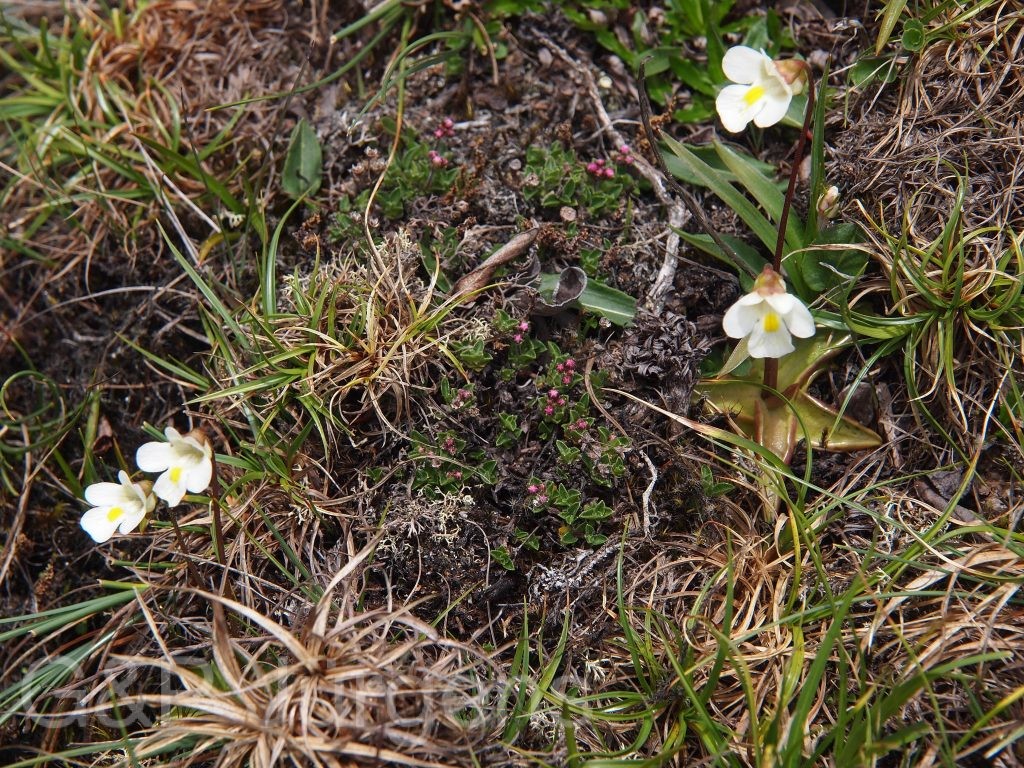
L.

Sikkim2011 109
Sikkim, Chopta-valley 4300m, June

Description

Pinguicula alpina is a circumboreal-alpine carnivorous herb with a vast range across the mountains and high latitudes of Eurasia, from the Alps, Pyrenees and Scandinavia through Russia to China, with disjunct outliers in the Himalaya including Nepal and Sikkim. Its tens of thousands of catalogued occurrences reflect this broad distribution. It grows in wet, base-rich, often calcareous habitats — flushes, dripping rocks, fens, streamsides and damp turf — from the montane belt to high alpine elevations, reaching about 4,300 m in the Himalaya, as in the plant photographed in the Chopta valley of Sikkim at 4,300 m in June, where it flowers at the height of the alpine spring.

It is a small, perennial, insectivorous herb forming a flat basal rosette of yellow-green, oblong to elliptic leaves whose upper surfaces are sticky with glandular hairs that trap and digest minute insects, the margins slightly involute. From the rosette arise one to few erect, leafless scapes bearing a single nodding flower; the corolla is white with one or two yellow spots on the palate, two-lipped and spurred at the base, the spur short and conical. The fruit is a small ovoid capsule releasing numerous minute seeds. The plant overwinters as a resting bud (hibernaculum).

Within Lentibulariaceae, Pinguicula employs flypaper-type passive carnivory, supplementing nutrient uptake in the poor, wet soils it favours. P. alpina is distinguished from the violet-flowered P. vulgaris by its white, yellow-spotted corolla and shorter spur, and the two occasionally co-occur. Though globally secure, its Himalayan populations are localised and dependent on undisturbed calcareous wetlands sensitive to drainage and warming.

Author: L. · Sources: POWO (Kew), Flora of China Vol. 19, Flora of Nepal, GBIF, Casper: Monographie der Gattung Pinguicula (1966)

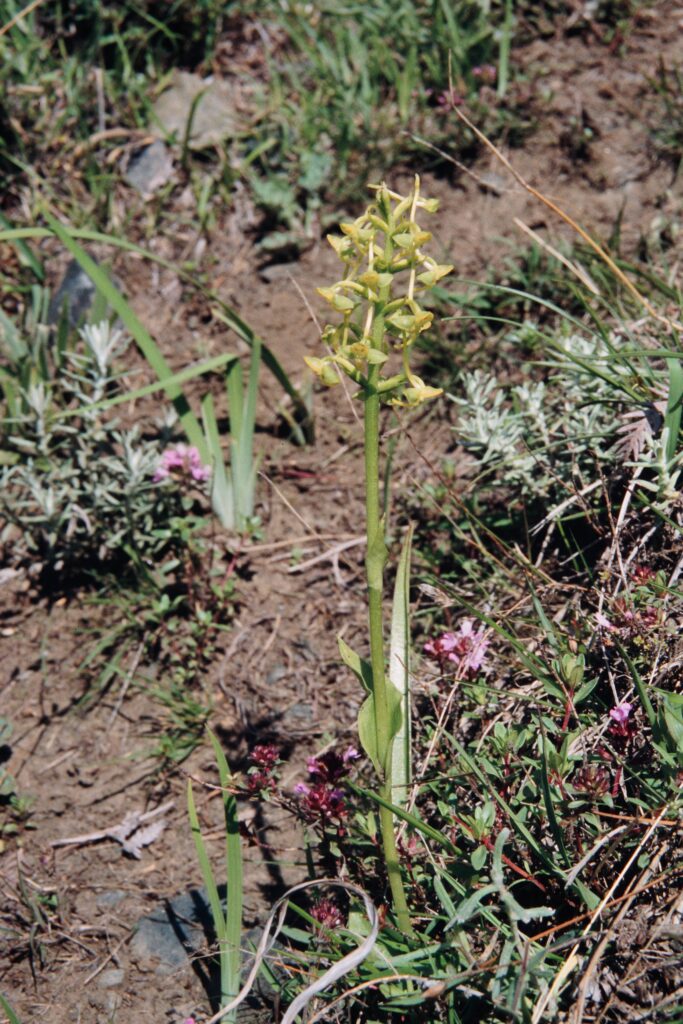
(Hook.f.) Kraenzl.

Nepal 99 395 ergebnis
Nepal, Dzongri 3800m, June

Description

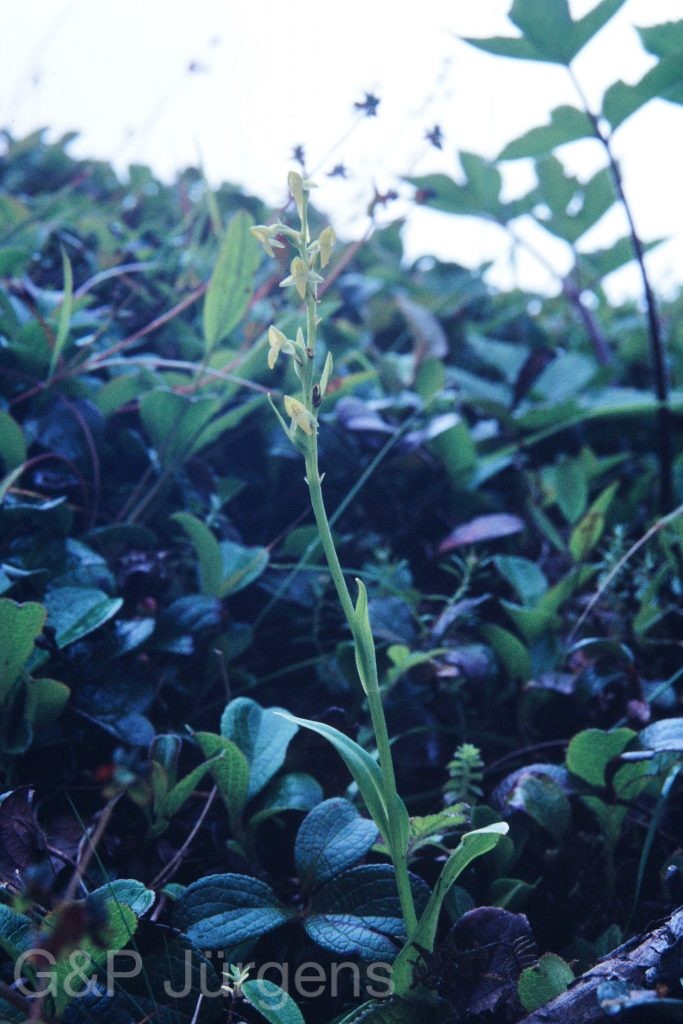
Platanthera concinna (Hook.f.) Kraenzl. is a terrestrial orchid of the high eastern Himalaya. GBIF records, though few (around two dozen occurrences), place it in India and Bhutan, with an anomalous South African record almost certainly representing misidentification or a database error; in practice it is a narrowly Himalayan species. It grows in alpine and subalpine meadows, grassy slopes and open scrub near and above the treeline, at elevations of roughly 3,000 to 4,200 m. The plant recorded at Dzongri at 3,800 m, flowering in June, is characteristic of its high-elevation summer anthesis on humid alpine turf.

The species is a slender, erect terrestrial herb arising from ellipsoid to fusiform root-tubers. The stem bears a few narrow, lanceolate to oblong cauline leaves that sheath at the base. The inflorescence is a lax to moderately dense terminal raceme of small flowers, typically greenish to greenish-white; the dorsal sepal and petals form a hood, the lateral sepals spread, and the lip is narrow and entire to obscurely lobed with a slender, descending spur containing nectar, adapted to pollination by long-tongued insects.

Platanthera is a large, mainly north-temperate genus of butterfly-orchids, and the Himalayan species form a taxonomically difficult complex once dispersed among Habenaria and allied genera. The limited number of records reflects both its restricted high-altitude habitat and undercollection. As an alpine orchid with a small documented range, it warrants conservation attention, and like all Orchidaceae it is protected under CITES Appendix II.

Author: (Hook.f.) Kraenzl. · Sources: POWO (Kew), GBIF, Flora of Bhutan Vol. 3 Part 3 (Orchids), Flora of China Vol. 25, Pearce & Cribb: The Orchids of Bhutan (2002)

(Hook.f.) Soó

Sikkim2003 96 P133
Sikkim above Chora 3600m 08.2003
Sikkim2003 97 P134
Sikkim above Chora 3600m 08.2003

Description

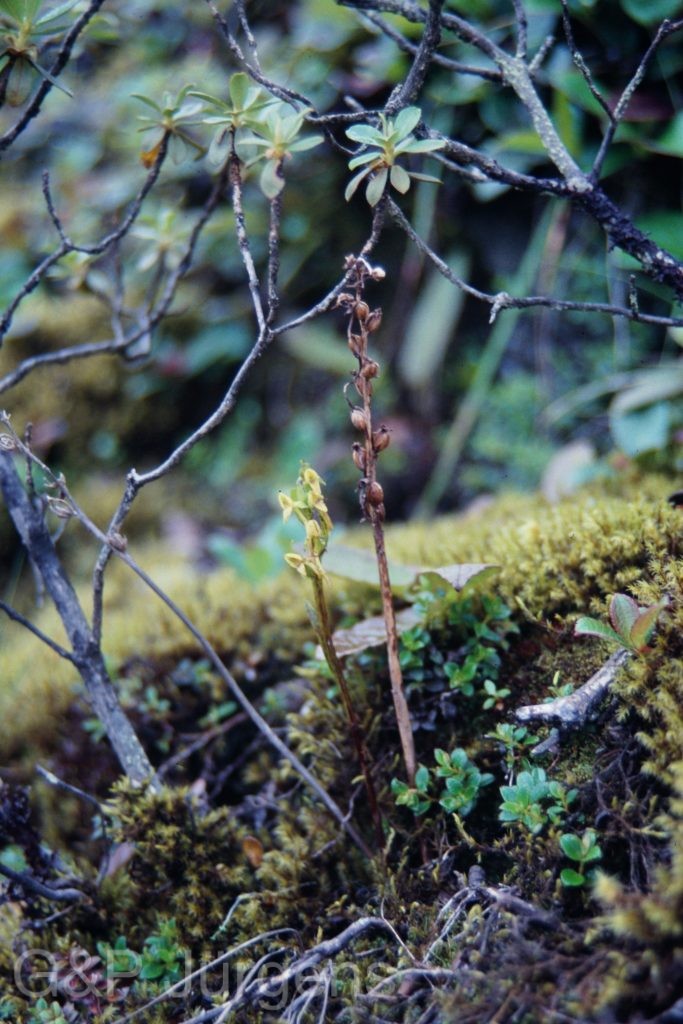
Platanthera leptocaulon is a terrestrial orchid of the eastern Himalaya and adjacent mountains of south-western China, recorded from Sikkim and the rest of northern India, Nepal, Bhutan, Myanmar and Yunnan and Sichuan in China. The roughly 67 georeferenced collections concentrate in the high subalpine to alpine belt, where the species occupies moist open turf, the margins of dwarf-shrub thickets and grassy hollows kept damp by snowmelt. The plant photographed above Chora in Sikkim at 3600 m in August typifies its habitat, flowering during the late-summer monsoon at elevations of roughly 3000-4200 m on humus-rich, well-drained slopes.

It is a slender, glabrous herb arising from ovoid to fusiform root-tubers, the erect stem comparatively thin and wiry (the epithet leptocaulon meaning "slender-stemmed"). The few cauline leaves are oblong-lanceolate to linear, sheathing at the base and grading upwards into bracts. The lax terminal raceme bears small greenish to greenish-white flowers; the dorsal sepal and petals are connivent to form a hood over the column, the lateral sepals spreading, and the entire, narrowly oblong labellum extends backwards into a slender cylindrical spur. The viscidia are naked and the pollinia are attached by slender caudicles, with fruit a small erect dehiscent capsule releasing dust-like seed.

The genus Platanthera is a large Holarctic and Asian assemblage centred on temperate and montane regions, and P. leptocaulon belongs to the species-rich Sino-Himalayan radiation, the basionym having been transferred by Soo from Habenaria. Like most members of the genus it depends on mycorrhizal fungi for germination and probably on long-tongued nocturnal pollinators attracted to the spurred flowers. Though not formally assessed, its broad transboundary range and tolerance of grazed alpine pasture suggest reasonable security, but populations remain vulnerable to overgrazing and the warming-driven upslope contraction of alpine grassland.

Author: (Hook.f.) Soó · Sources: POWO (Kew), GBIF, Flora of China, Flora of Bhutan, The Genus Platanthera (Orchidaceae) monograph

(Hook.f.) Soó

BhutanPG2011 818 01 01
Bhutan Chele-La 3500m, July

Description

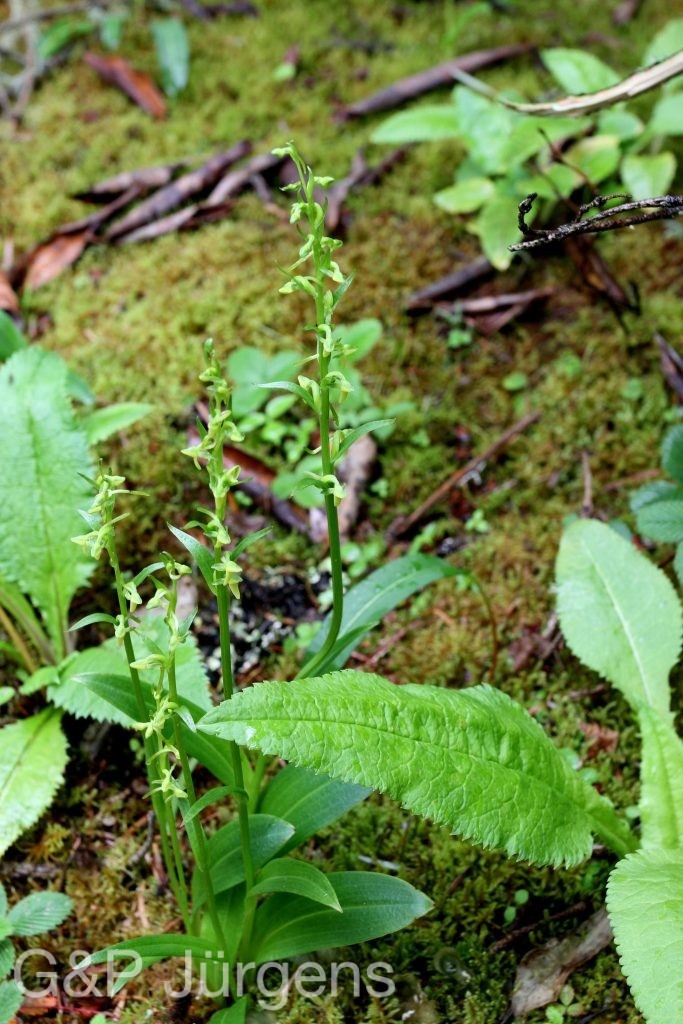
Platanthera stenantha (Hook.f.) Soó is a terrestrial orchid of the Himalaya and western China, recorded by GBIF from China, Nepal, India, Myanmar and Bhutan across some 138 occurrences. It inhabits open subalpine and alpine slopes, grassy meadows, and the edges of Rhododendron and birch scrub, typically between about 3000 and 4000 m. The plant photographed on the Chele-La pass in Bhutan at around 3500 m in July, at the height of the monsoon flowering season, exemplifies its association with cool, moist, well-lit high-montane grassland.

The species grows from elongate, fleshy root-tubers and produces an erect leafy stem bearing several oblong to lanceolate cauline leaves that grade upwards into bracts. The inflorescence is a slender, fairly dense terminal raceme of small greenish to yellowish-green flowers, the specific epithet stenantha referring to their narrow form. The dorsal sepal and petals form a loose hood over the column, the lateral sepals spread, and the narrow, tongue-shaped labellum hangs downward and is prolonged at its base into a slender spur, usually about equalling or exceeding the ovary, that holds nectar for moth or butterfly pollinators.

Platanthera is a large genus of tribe Orchideae characterised by its spurred labellum and widely separated, often divergent pollinia-bearing anther cells. Platanthera stenantha belongs among the green-flowered Sino-Himalayan species and is distinguished from its relatives by floral proportions and spur length. With a moderately wide distribution it is not regarded as globally threatened, but its high-grassland habitat is subject to grazing and climatic pressures, and like all orchids it falls under CITES Appendix II.

Author: (Hook.f.) Soó · Sources: POWO (Kew), GBIF, Flora of Bhutan, Flora of China, Pearce and Cribb Orchids of Bhutan, World Checklist of Orchidaceae

Royle

Sikkim2011 57
Sikkim Tanghu 3900m, June
Sikkim2011 70
Sikkim Tanghu 3900m, June
Sikkim2011 72
Sikkim Tanghu 3900m, June

Description

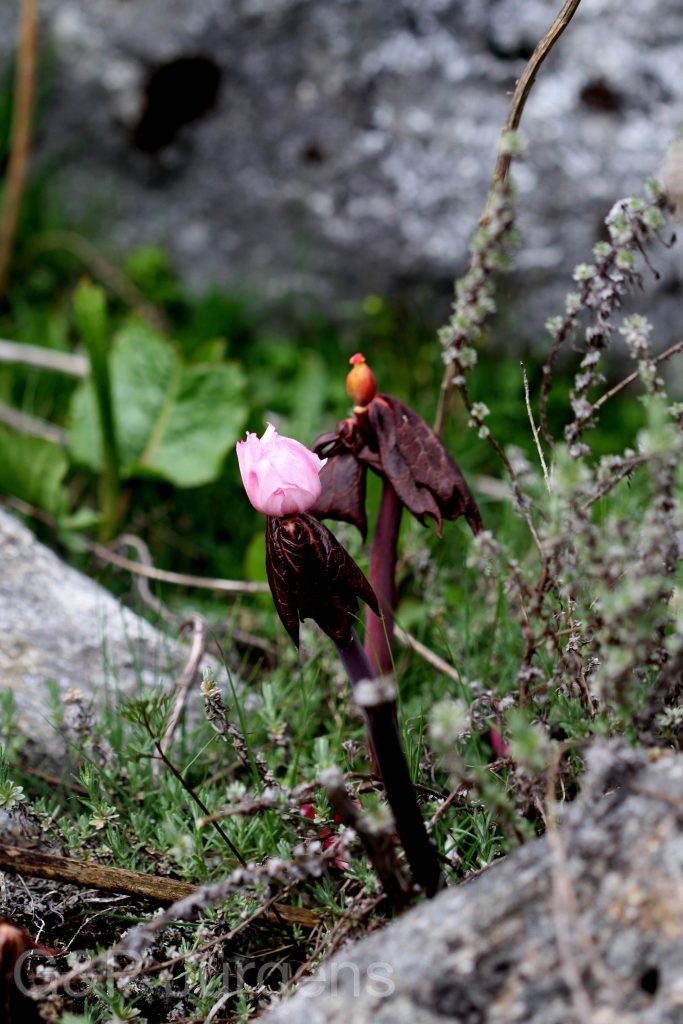
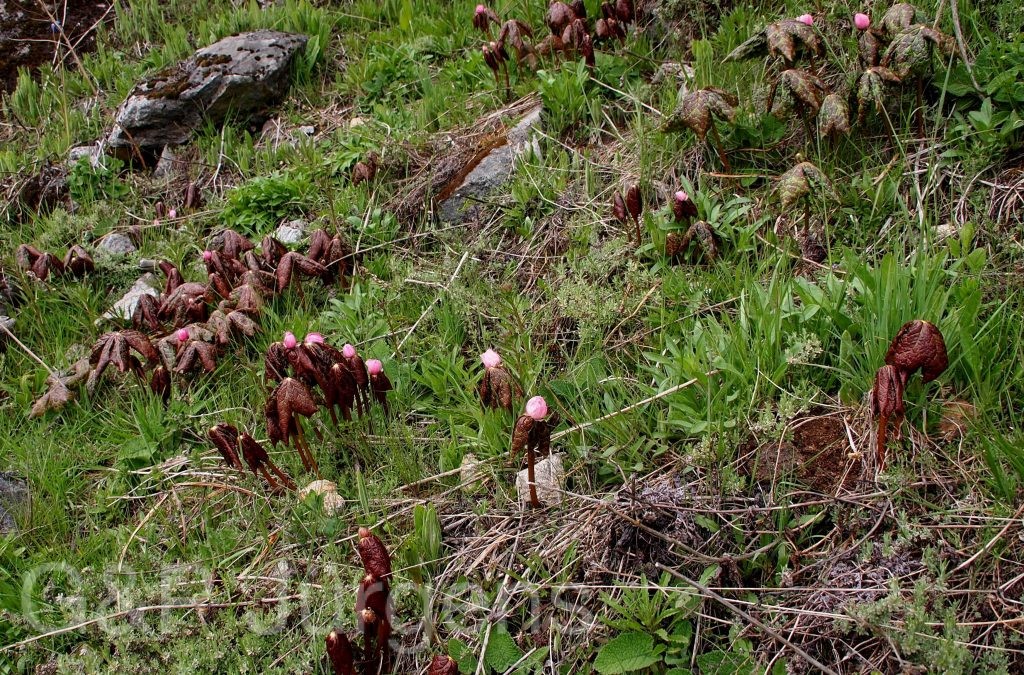
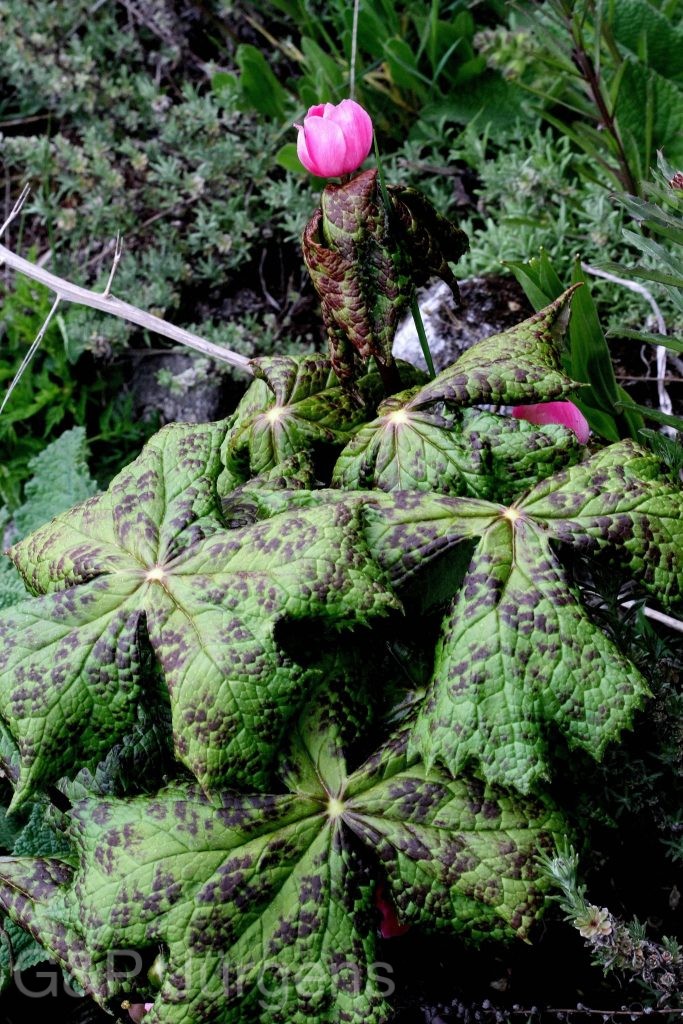
Podophyllum hexandrum, the Himalayan mayapple, is a perennial herb of the high temperate and subalpine Himalaya, occurring through China, India, Pakistan, Nepal, Bhutan and Afghanistan, with around 860 occurrences in GBIF. It grows in moist alpine meadows, open fir and birch forest, shaded scrub and along the margins of melting snowfields, typically between about 2500 and 4500 m. The plant photographed at Tanghu in northern Sikkim at 3900 m in June, emerging and flowering as the snow recedes, is characteristic of its high-elevation niche, where the rich, moist humus of the upper forest and meadow ecotone supports dense local stands.

The species arises from a stout, creeping, knotty rhizome and produces a single erect aerial stem 15–50 cm tall bearing usually two large, long-petiolate leaves that are deeply palmately three- to five-lobed, the lobes themselves further cut and toothed, often bronze-mottled when young. A solitary, nodding to erect flower is borne at the fork of the leaves; it is cup-shaped with white to pale pink petals and (as the epithet indicates) commonly six stamens. The fruit is a large, fleshy, ovoid berry ripening to bright red and containing numerous seeds embedded in pulp.

GBIF flags the name as a synonym, the species being widely treated under the accepted name Podophyllum hexandrum, with the genus Sinopodophyllum (S. hexandrum) recognised by some authors to accommodate the Asian taxon apart from the North American Podophyllum peltatum; the source page links to that segregate name. The plant is the principal natural source of podophyllotoxin, a lignan of major pharmaceutical importance as a precursor of anticancer agents. Heavy harvesting of the rhizomes for this trade, together with habitat disturbance, has caused marked local declines, and the species is regarded as threatened and is subject to conservation and CITES-related concern across much of its range.

Author: Royle · Sources: POWO (Kew), GBIF, Flora of China Vol. 19, Flora of Bhutan Vol. 1, Flora of Pakistan, Medicinal Plants of the Himalaya: A Monograph of Podophyllum

Hook.

Nepal 99 117 ergebnis
West-Nepal South of Rara-Lake 3750m, June

Description

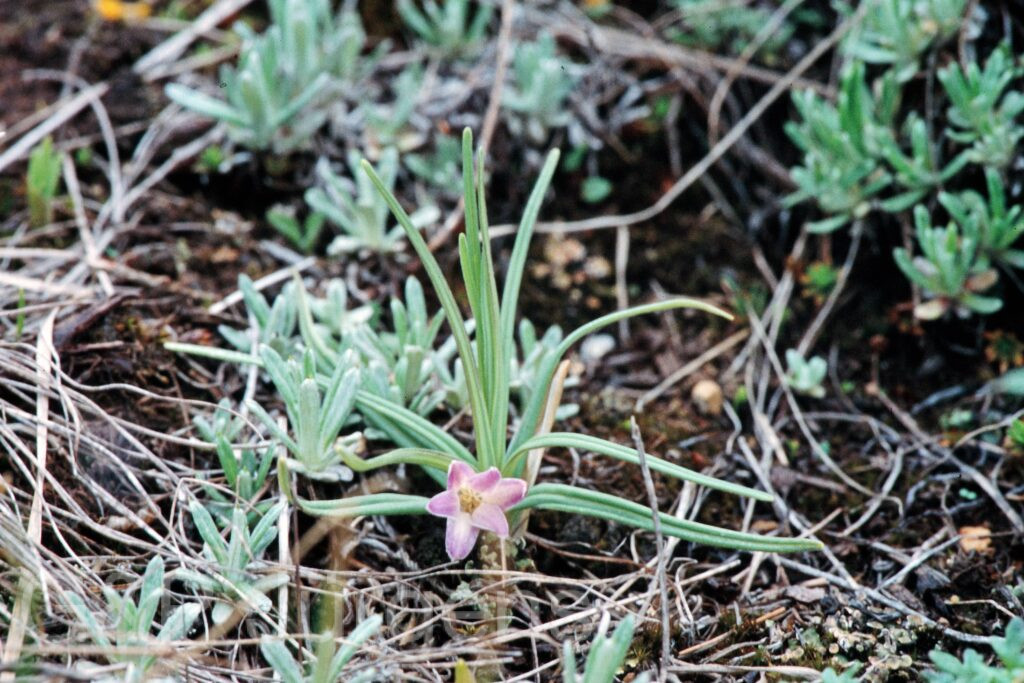
Polygonatum graminifolium is a high-alpine Solomon's seal restricted to the Himalaya, recorded from Pakistan, India, Nepal and Bhutan; GBIF documents only about 18 occurrences, indicating a narrow range and limited collecting. It inhabits open alpine and subalpine slopes, rocky meadows, grassy turf and the margins of dwarf shrubberies, generally on stony, well-drained soils above the forest line. The plant photographed south of Rara Lake in western Nepal at 3750 m in June is characteristic of its elevation, roughly 3000-4300 m, where the short season compels rapid flowering soon after snowmelt in early summer.

It is a small, slender perennial herb growing from a short, knotted, horizontal rhizome bearing the circular scars that give the genus its name. The wiry, erect to arching stem is unbranched and bears narrow, grass-like (graminoid) leaves that are linear to linear-lanceolate, sessile and parallel-veined, arranged alternately or sometimes subverticillately, their slenderness giving the species its epithet. The flowers are small, tubular-campanulate and pendulous, solitary or paired in the leaf axils, white to greenish-white and often green-tipped, on short pedicels. The perianth tube is cylindrical with six short recurved lobes enclosing six included stamens, and the ovary develops into a small globose berry ripening bluish-black to red.

The epithet graminifolium, grass-leaved, distinguishes it from broader-leaved Himalayan congeners. Polygonatum is a north-temperate genus formerly placed in Liliaceae or Convallariaceae and now treated within an expanded Asparagaceae. Its restricted distribution and modest occurrence record suggest specialisation to alpine turf, though no formal conservation assessment exists; like related species its rhizomes have potential use in the regional pharmacopoeia.

Author: Hook. · Sources: POWO (Kew), GBIF, Flora of China, Flora of Pakistan, Flora of Bhutan, Jeffrey revision of Polygonatum