
(Decne.) Miers
Description
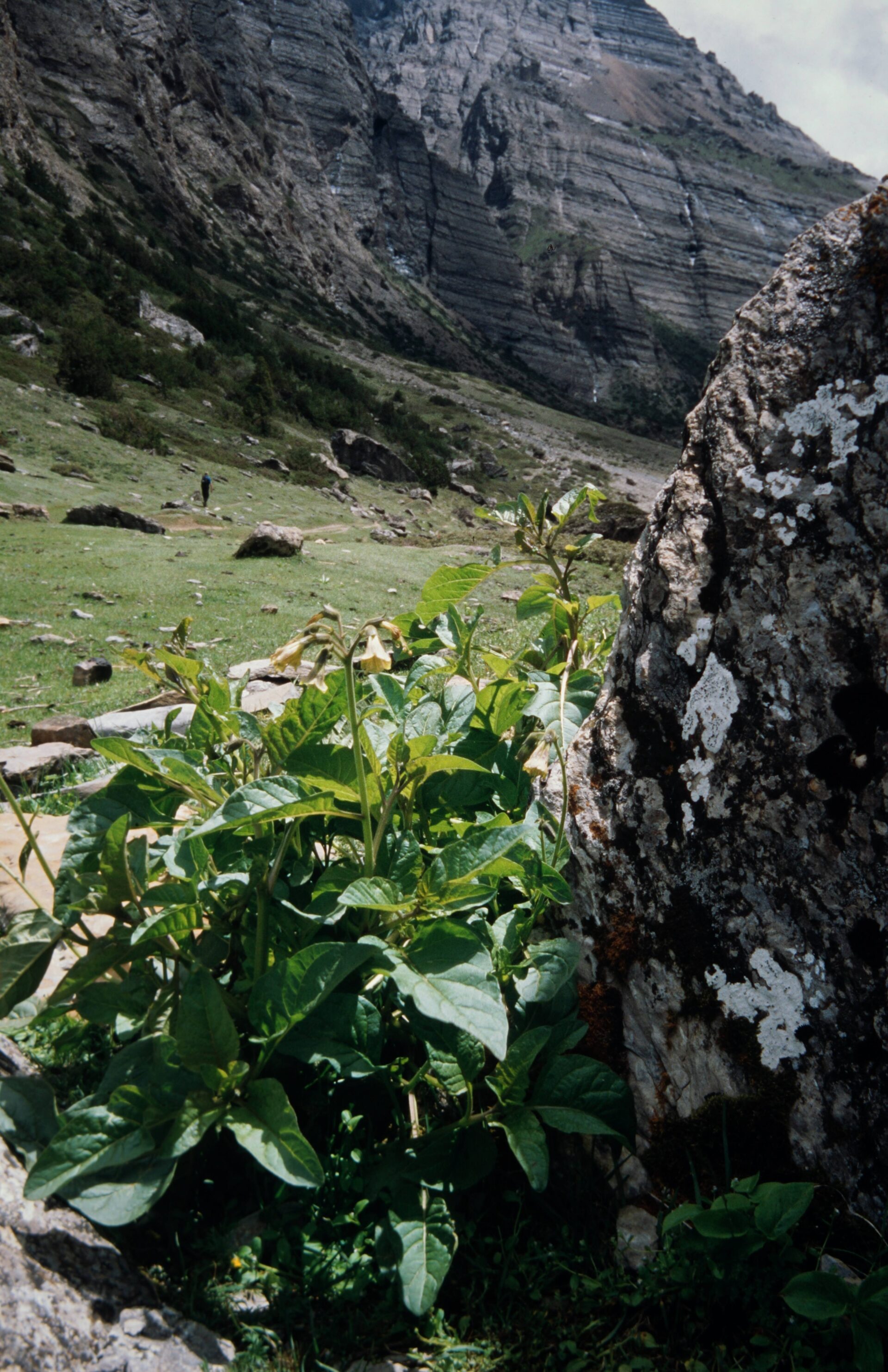
Physochlaina praealta (Decne.) Miers is a robust perennial herb of the high alpine and subalpine zones of the western and central Himalaya and the Tibetan borderlands. GBIF records it from India, China, Nepal and Pakistan (about 360 occurrences), a distribution centred on the cold, arid inner-Himalayan and trans-Himalayan ranges. It grows on open stony slopes, screes, grazed alpine pastures and around herders' camps where the soil is nitrogen-enriched, typically between roughly 3,000 and 4,500 m; the photographed plant is from West Nepal, Baga-La-Phedi, at 3,800 m in July, at the height of the brief alpine growing season.
The plant arises from a stout, perennial rootstock and forms an erect, branched, somewhat viscid-pubescent stem. The leaves are alternate, ovate to elliptic, entire to sinuate, narrowed to a winged petiole and soft in texture. The flowers are borne in terminal, somewhat scorpioid cymes; the corolla is campanulate to tubular, dull yellowish or greenish often tinged purple, with a five-lobed limb, and the calyx is accrescent. In fruit the calyx enlarges into an inflated, bladder-like, membranous structure (Physochlaina meaning swollen cloak) that encloses the circumscissile capsule (pyxidium), an adaptation aiding wind dispersal across open terrain.
Like many Hyoscyameae, the genus is rich in tropane alkaloids (hyoscyamine, scopolamine) and is poisonous yet medicinally used in Himalayan and Tibetan traditional systems. Physochlaina is a small Central Asian–Himalayan genus exemplifying the cold-desert Solanaceae element. The species is naturally localised but not currently regarded as threatened.
Author: (Decne.) Miers · Sources: POWO (Kew), GBIF, Flora of China Vol. 17, Flora of Pakistan, Flora of Nepal, Hunziker: The Genera of Solanaceae