Tag:

Bhutan

Flowers of Bhutan — 1326 plant species documented across the Bhutanese Himalaya, from dense broadleaf and conifer forests to alpine scrub and meadows. Bhutan’s largely intact wilderness shelters an exceptional diversity of orchids, rhododendrons, primulas and Himalayan poppies, many of them regional endemics. Each species page includes a botanical description, distribution, habitat and flowering time, with the original photograph and its recorded altitude and locality.

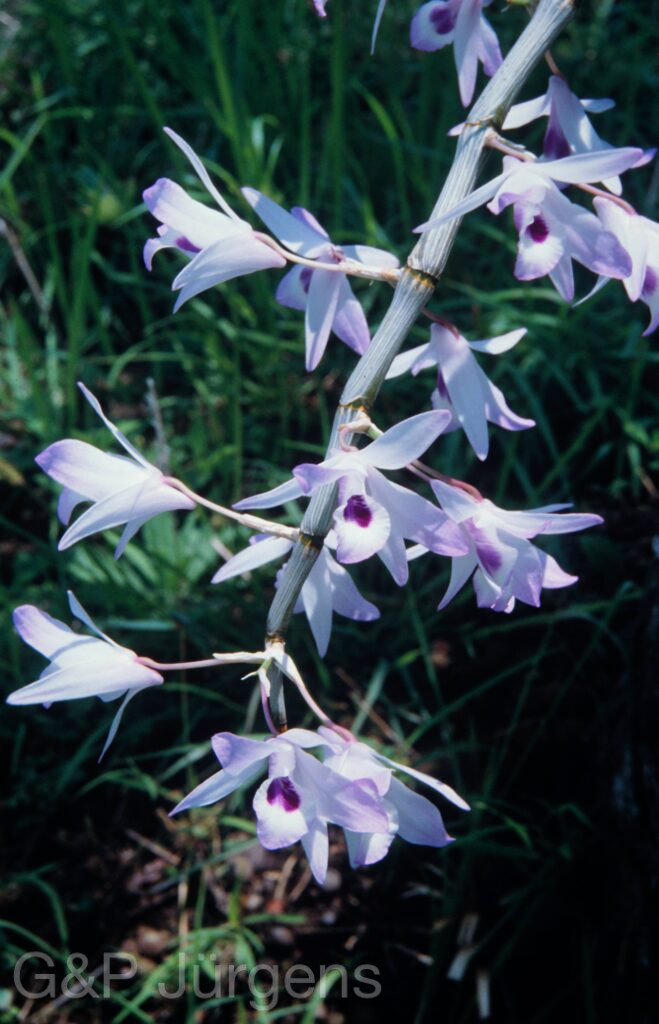
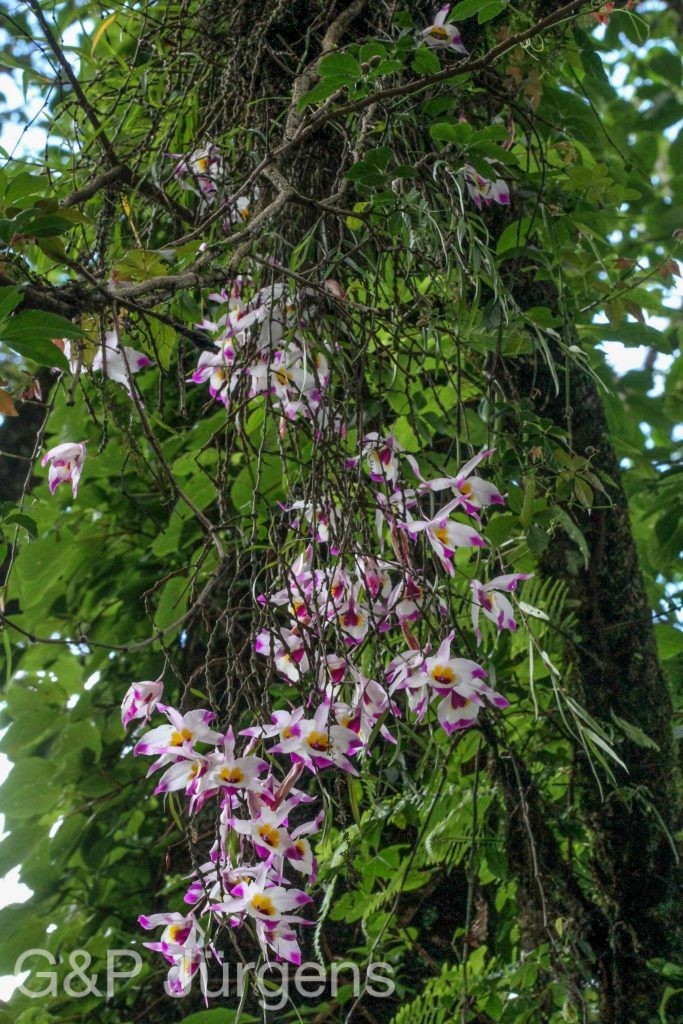
Hook.

BhutanPG2011 8
Bhutan Paro, 2400m June

Pendent epiphyte to 50 cm long and slender branched, bearing few linear-oblong leaves from bead-like.

Description

Dendrobium falconeri is a pendent epiphytic orchid native to the Himalayas, ranging from Nepal and northeast India through Bhutan to Myanmar, Thailand, and southwest China. It grows on mossy tree trunks and branches in humid montane forests at 800–2,000 m elevation.

The plant has slender, branching, wiry stems up to 50 cm long, bearing small, linear-oblong leaves at intervals along bead-like nodes. The flowers are among the most beautiful in the genus: 4–5 cm across, white to pale pink with bright purple tips on the petals and a large, trumpet-shaped lip marked with two conspicuous maroon-purple blotches and a yellow throat. Flowers appear singly or in pairs from leafless nodes, typically from March to May.

Dendrobium falconeri is prized in orchid cultivation for its striking colour pattern. In the wild, it is increasingly rare due to overcollection and deforestation. Listed under CITES Appendix II.

Author: Hook. · Sources: POWO (Kew), Flora of Bhutan, CITES Checklist, OrchidSpecies.com
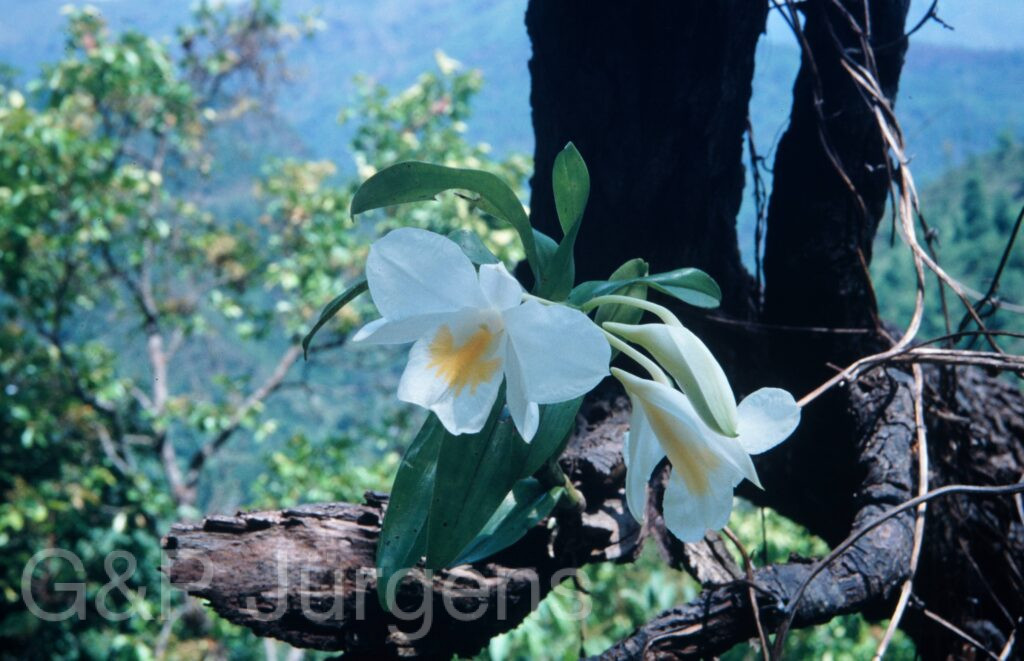
Roxb. ex Lindl.

Nepal 2001 507 ergebnis ergebnis
Nepal (Gorkha) Arkhet 720m, May
Nepal 2001 508 ergebnis ergebnis
Nepal (Gorkha) Arkhet 720m, May

Description

Dendrobium formosum is an epiphytic orchid of the eastern Himalaya and Indo-Burmese region, native to India, Nepal, Bhutan, Myanmar, Thailand and the Philippines; its roughly 88 georeferenced GBIF records also include cultivated material in Europe, the United States and Brazil, reflecting its horticultural popularity. In Nepal it occurs at low to mid elevations, as illustrated by the collection near Arkhet in Gorkha district at about 720 m in May, where it grows on trunks and branches in warm, humid subtropical broad-leaved forest, favouring shaded, mossy bark with high atmospheric humidity.

The species forms erect, cane-like pseudobulbous stems whose leaf sheaths, like the young growth, are clothed in conspicuous blackish-brown hairs, a feature of section Formosae. The leaves are distichous, oblong-lanceolate and leathery. Flowers are borne in short few-flowered racemes near the stem apex and are large and showy, with broad, pure white spreading sepals and petals and a trumpet-shaped labellum marked by a bright yellow or orange throat blotch. The fruit is a ribbed dehiscent capsule releasing dust-like seeds.

Within the vast genus Dendrobium, D. formosum anchors section Formosae, a group of black-haired species prized for their substantial white blooms. As a forest epiphyte dependent on intact canopies and mycorrhizal germination, it is vulnerable to deforestation and over-collection for the ornamental trade, and like all Orchidaceae is listed on CITES Appendix II regulating international commerce in wild-sourced plants.

Author: Roxb. ex Lindl. · Sources: POWO (Kew), GBIF, Flora of China Vol. 25, Flora of Bhutan Vol. 3, Flora of Nepal, The Genus Dendrobium (Lavarack, Harris & Stocker)

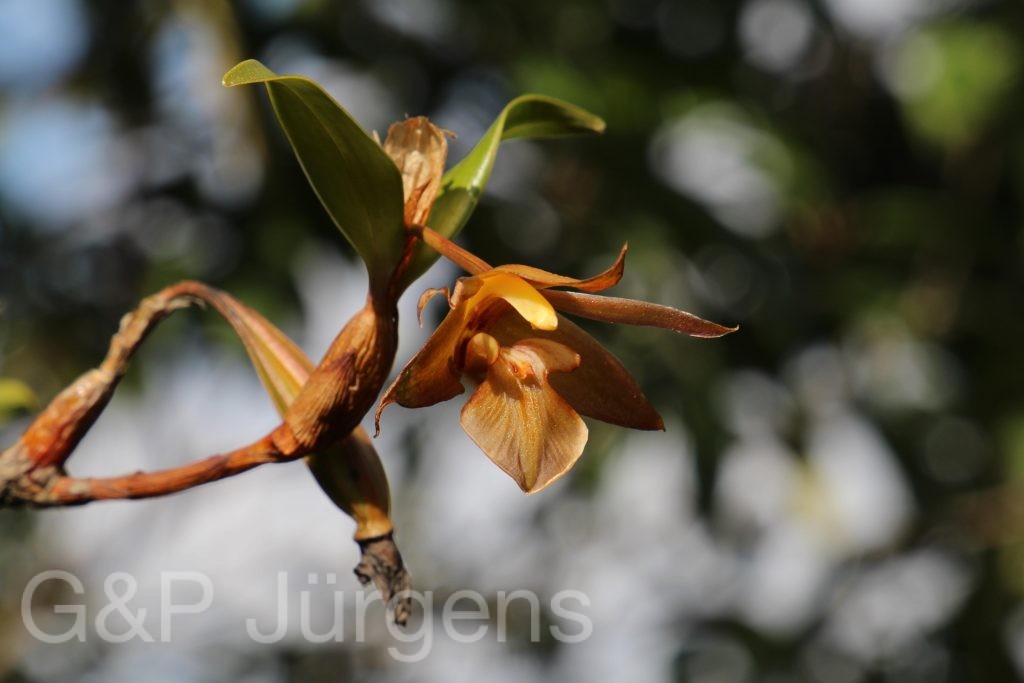
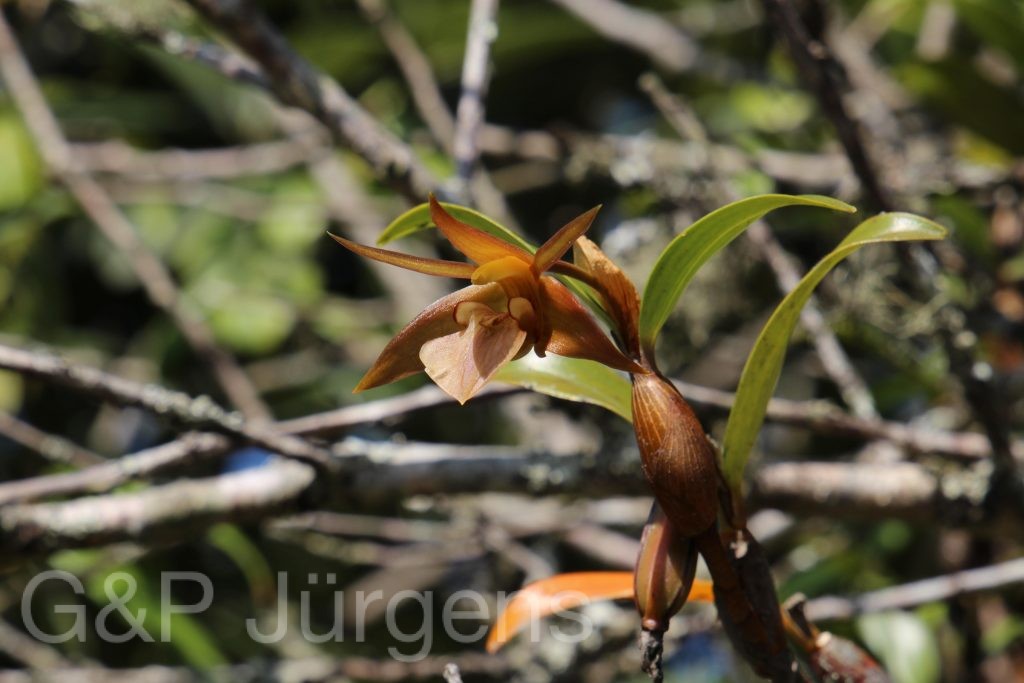
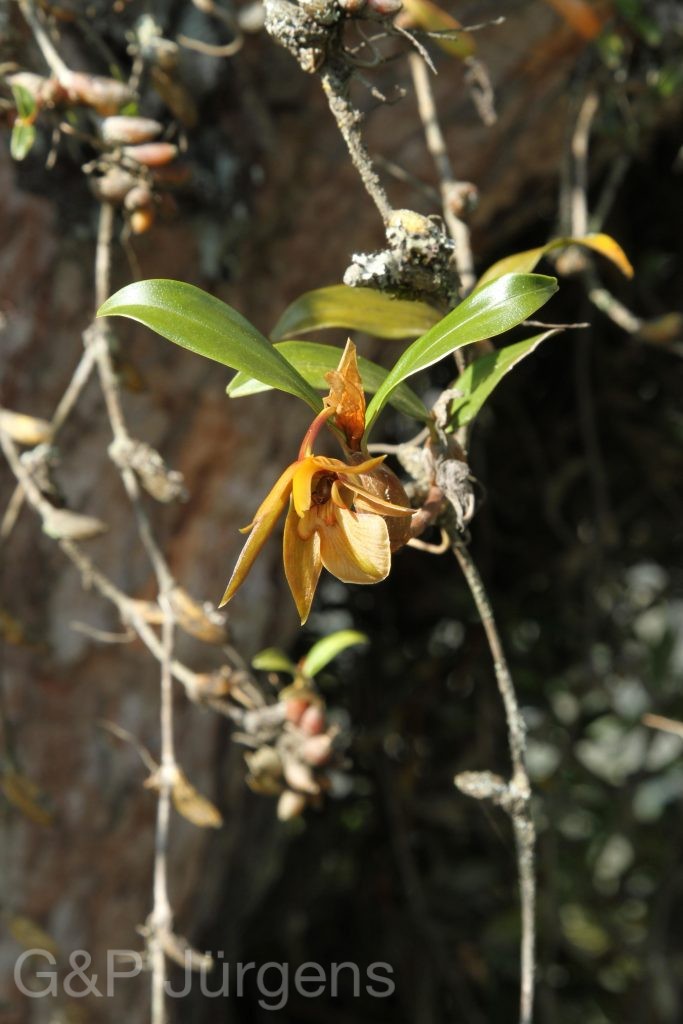
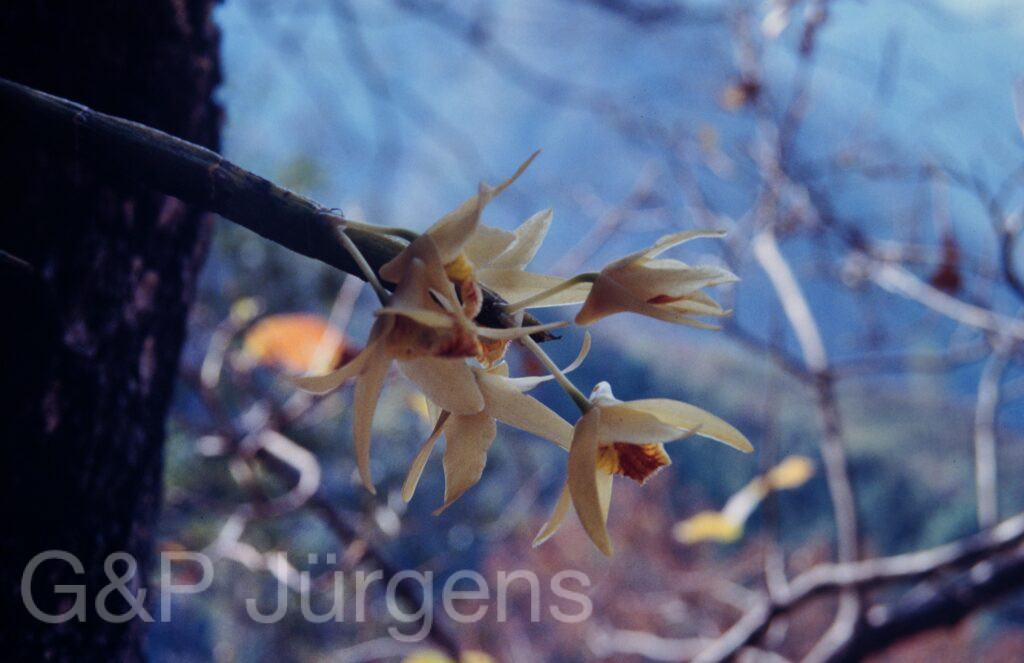
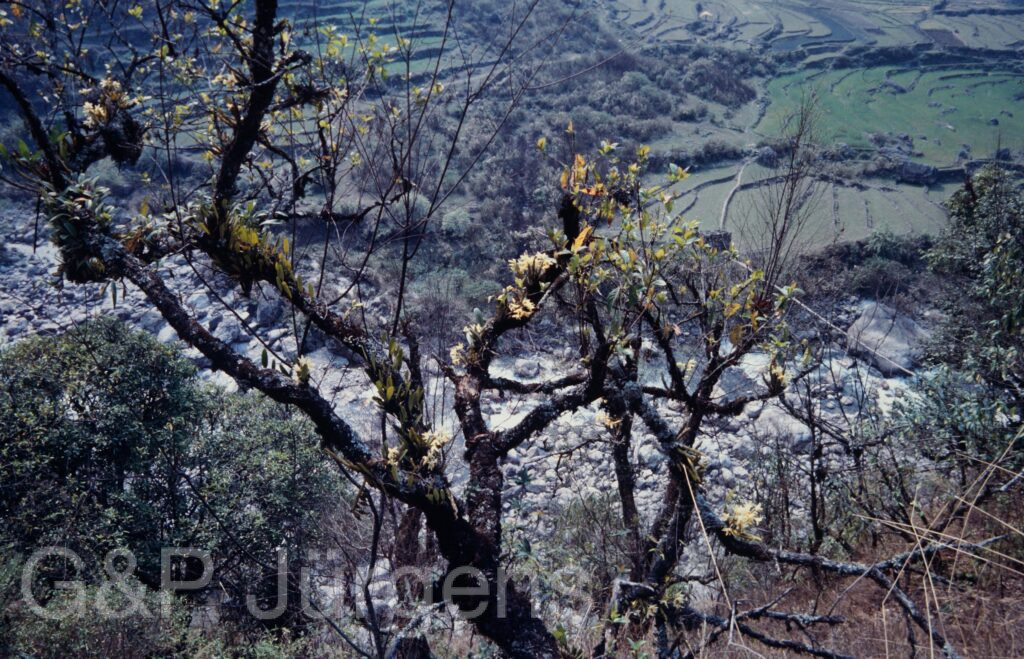
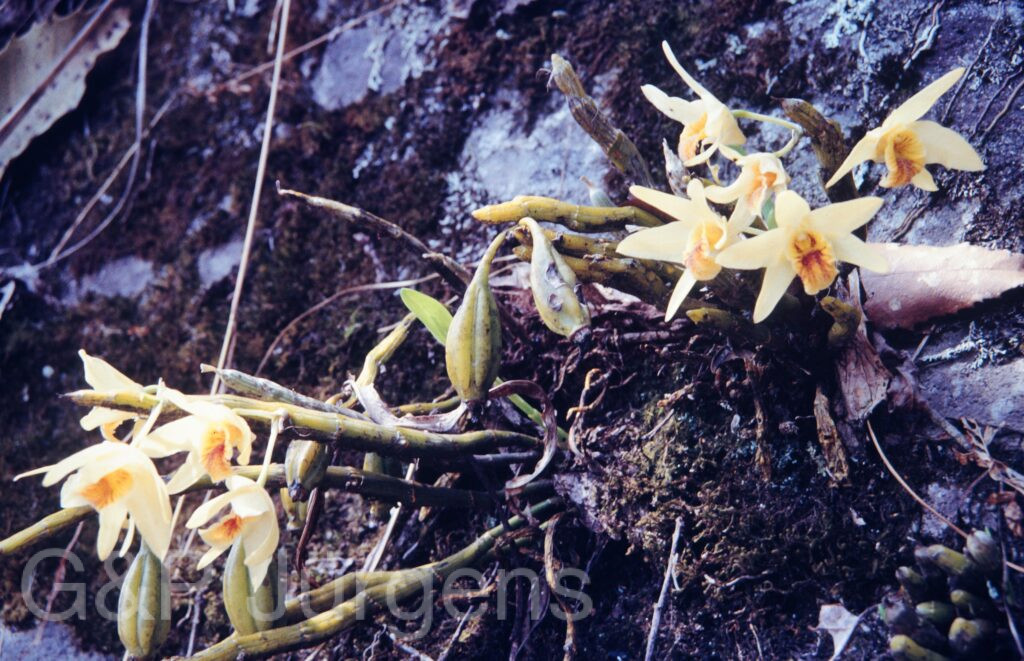
Griff.

Bhutan2015 449
  Bhutan Jakar 2500m, October
Bhutan2015 450
  Bhutan Jakar 2500m, October
Bhutan2015 451
  Bhutan Jakar 2500m, October
Bhutan2012 1129
Bhutan Koma-Chu-Valley 950m, October
Bhutan2012 1131
Bhutan Koma-Chu-Valley 950m, October
Bhutan2012 1358
Bhutan Sandrup 1500m, October

Description

Dendrobium fuscescens Griff. is an epiphytic orchid of the eastern Himalaya and adjacent Indo-Burmese region, recorded by GBIF from China, India, Myanmar, Nepal and Bhutan across some 69 occurrences. It grows on the trunks and branches of trees in humid broad-leaved and mixed forests, ranging over a broad altitudinal span as shown by the Bhutanese records at Jakar around 2500 m, in the Koma-Chu valley near 950 m, and at Sandrup about 1500 m, all in October. This spread from warm temperate valleys to cooler montane forest reflects a tolerance of moist, shaded, mossy bark substrates with good air movement.

The plant produces clustered, slender, elongate cane-like pseudobulbous stems that are somewhat flattened and grooved, becoming yellowish with age. The thin-textured, lanceolate to oblong leaves are distichously arranged along the stems and are usually deciduous in the dry season, leaving the canes bare. Short lateral racemes of a few small flowers arise from nodes on the older leafless stems; the flowers are pale, often tinged greenish or brownish-yellow (the epithet fuscescens alluding to the darkening tint), with spreading lanceolate sepals and petals and a labellum bearing a hairy or papillose disc and recurved lateral lobes, the lateral sepals forming a short mentum at the column foot.

Dendrobium is one of the largest orchid genera, and D. fuscescens belongs among the slender deciduous-caned Himalayan species. It is poorly documented, with few georeferenced records, and like most epiphytic orchids it is sensitive to deforestation and collection. No formal assessment singles it out as threatened, but its dependence on intact forest canopy makes habitat protection important, and all Dendrobium are listed on CITES Appendix II.

Author: Griff. · Sources: POWO (Kew), GBIF, Flora of Bhutan, Flora of China, World Checklist of Dendrobium, Seidenfaden monograph of Orchids of Indochina

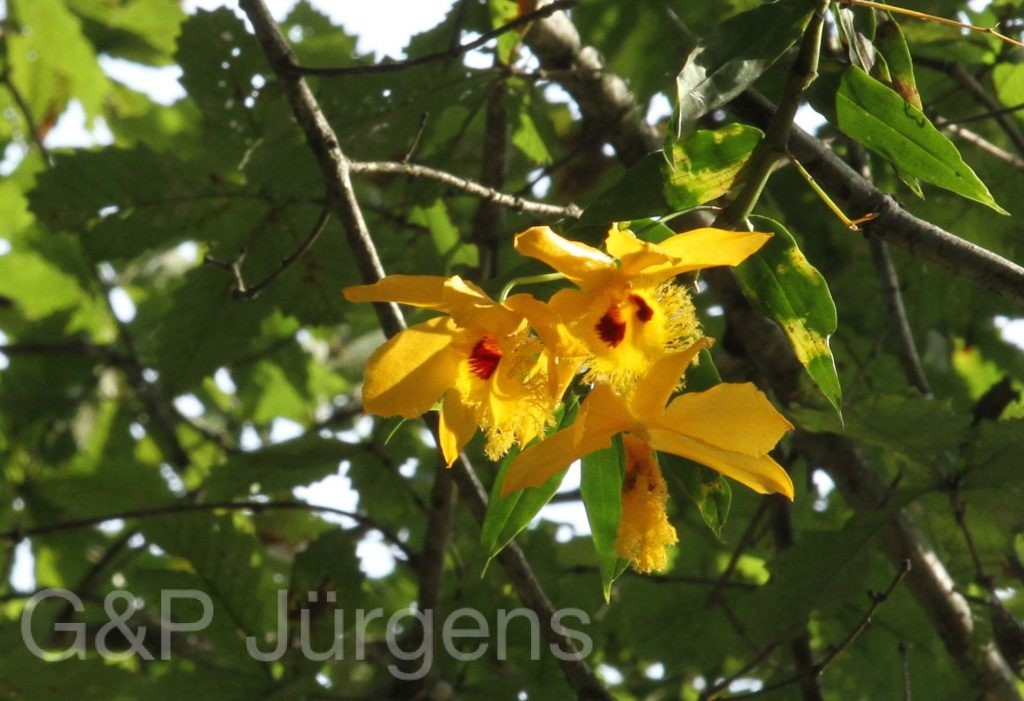
Paxton

Bhutan2012 755
Bhutan Galephu 1000m, October
Bhutan2012 756
Bhutan Galephu 1000m, October
Bhutan2012 754
Bhutan Galephu 1000m, October
Bhutan2012 455
Bhutan Wangdi 2500m, September
Bhutan2012 1007
Bhutan Trithangebe 900m, October

Description

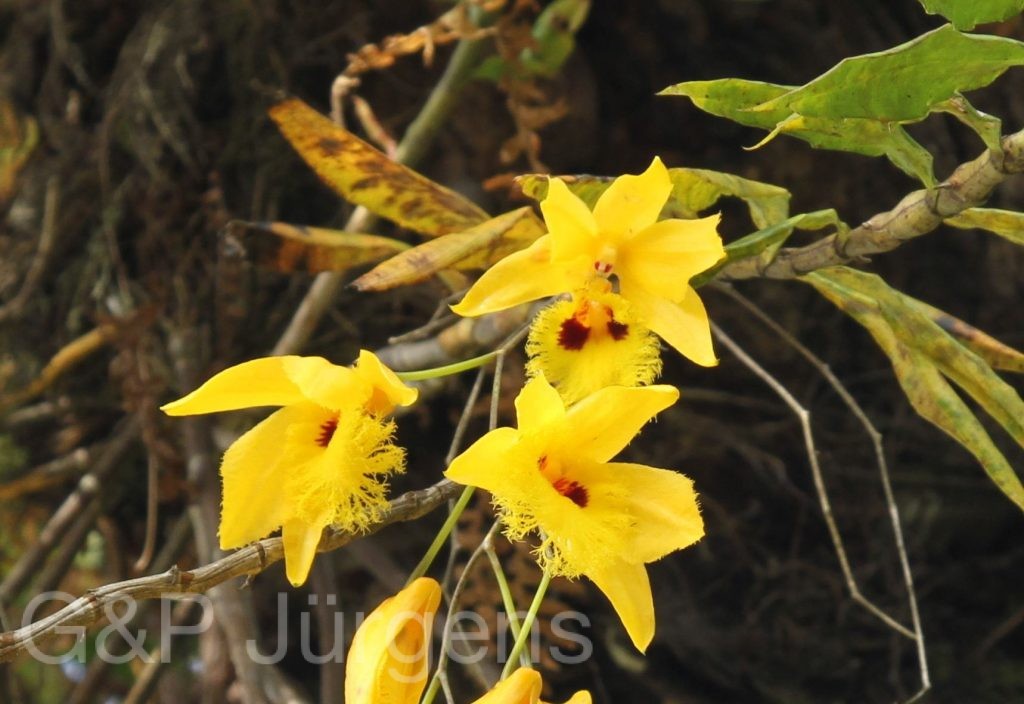
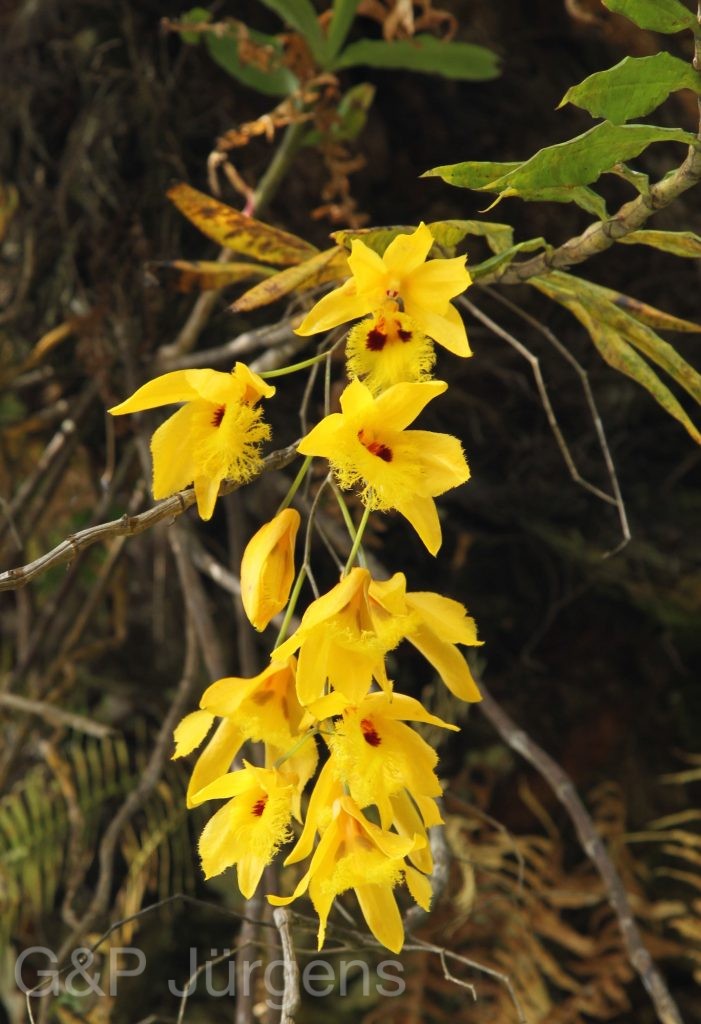
Dendrobium gibsonii is an epiphytic orchid widespread across the Sino-Himalayan and Indo-Chinese region, recorded from China, India, Thailand, Myanmar, Vietnam, Nepal, Bhutan, Laos and Malaysia, with 87 GBIF occurrences mapping a broad subtropical to lower-montane distribution. It is an epiphyte of warm, seasonally moist evergreen and semi-deciduous forest, favouring well-lit branches where it endures a pronounced dry season. In Bhutan it was photographed across a notable altitudinal spread, from Galephu and Trithangebe at around 900-1000 m in October to Wangdi at 2500 m in September, illustrating its tolerance of both the hot southern foothills and cooler inner valleys.

The plant produces long, pendulous to arching, slender canes that are somewhat swollen and channelled, bearing distichous, oblong-lanceolate, deciduous leaves. The inflorescences arise laterally on the older leafless canes as short, pendent racemes of several golden-yellow flowers. The sepals and petals are spreading and orange-yellow, while the broad, rounded lip is conspicuously fringed at the margin and marked with a pair of dark maroon or purple-brown blotches in the throat, a diagnostic feature. The fruit is a pendulous ribbed capsule.

The species belongs to Dendrobium section Dendrobium (the so-called nobile alliance), characterised by leafy canes that flower from the nodes after leaf fall. Its showy fringed, blotched lip makes it horticulturally desirable, and wild collection for the ornamental trade adds to pressure from habitat loss across the foothill forests. Although the wide range buffers it against immediate extinction risk, like many Asian Dendrobium it is listed under CITES Appendix II to regulate international trade.

Author: Paxton · Sources: POWO (Kew), GBIF, Flora of China, Flora of Bhutan, Dendrobium and its Allies (Lavarack, Harris & Stocker)

Wall. ex Lindl.

Nepal1992 94 P130 ergebnis
Nepal Amjilassa 2300m March 
Nepal1992 162 P239 2 ergebnis
Nepal Amjilassa 2300m March 
Nepal1992 163 P244 ergebnis
Nepal Amjilassa 2300m March 

Description

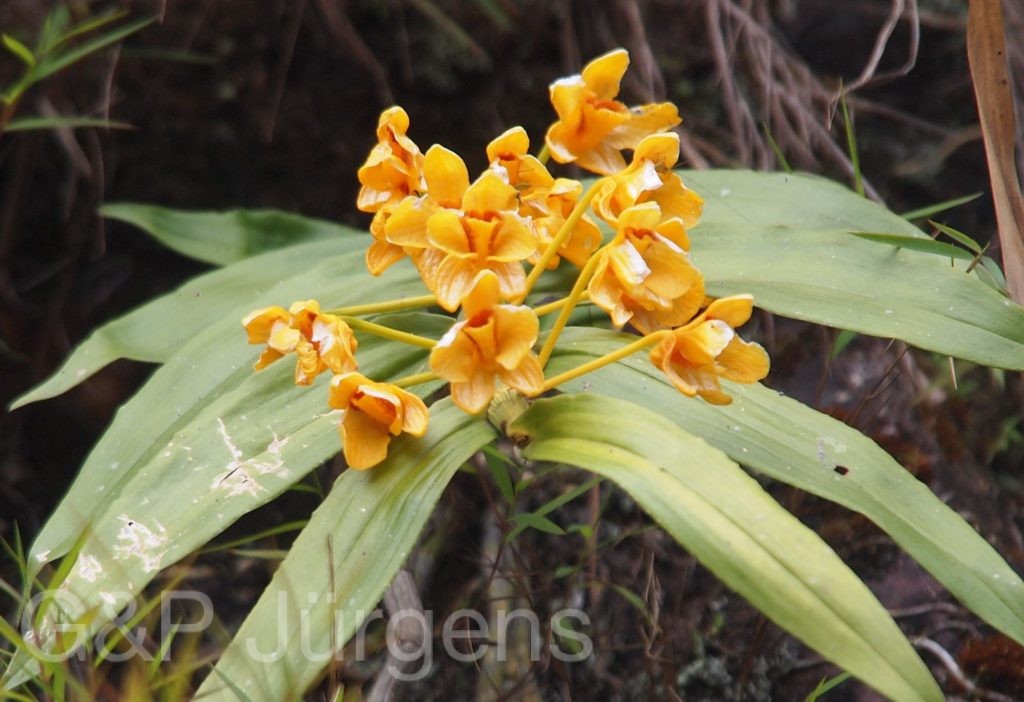
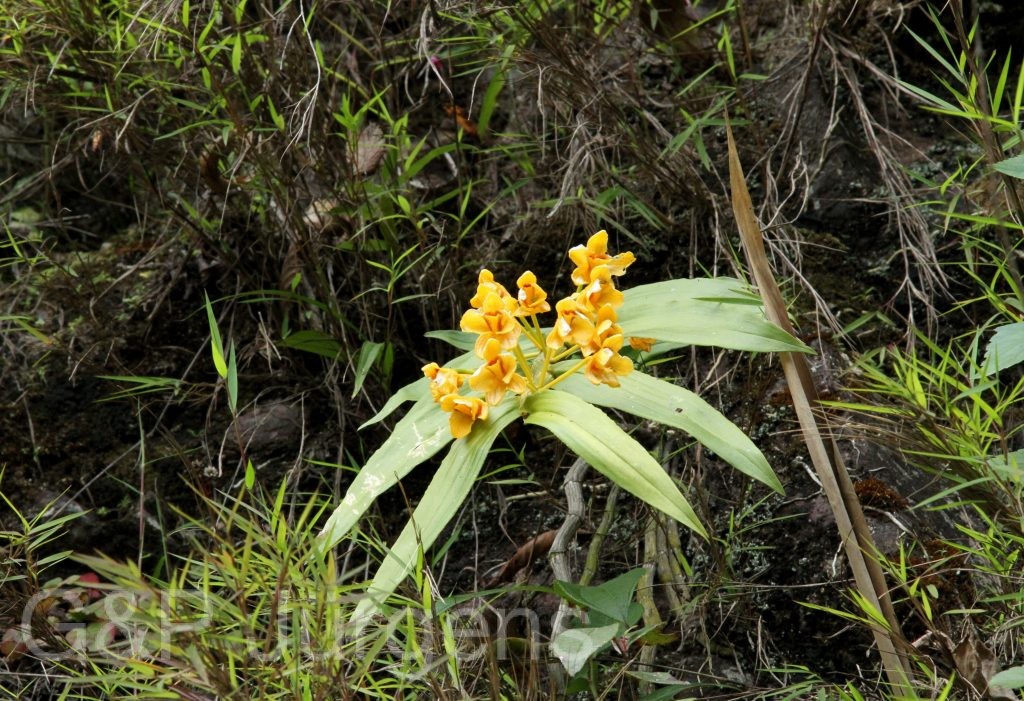
Dendrobium heterocarpum is a widespread epiphytic orchid of the tropical and subtropical forests of southern and southeastern Asia. GBIF data document its broad native range across the Philippines, Thailand, India, Nepal, Vietnam, China, Indonesia, Bhutan, Sri Lanka and Myanmar, with additional records from cultivation in the United States, Britain, Belgium and Germany, totalling around 261 occurrences. It grows as an epiphyte on the trunks and larger branches of trees in seasonally dry, well-lit montane and submontane forest, often in regions with a marked dry season that triggers flowering. The photographed plant from Amjilassa in eastern Nepal at 2300 m, flowering in March, illustrates its occurrence in the mid-elevation hill forests of the central Himalaya, where spring blooming follows the cool dry winter.

It is a sympodial epiphyte with clustered, erect to pendent, cane-like pseudobulbs that are somewhat fusiform and longitudinally furrowed when old, bearing several lanceolate, deciduous leaves along their length. The flowers, borne in small lateral clusters from nodes of leafless canes, are fragrant, with cream to pale yellow, often reflexed sepals and petals; the labellum is broad and recurved, golden-yellow with reddish-brown longitudinal veining and a pubescent disc. The fruit is a ribbed, ellipsoid capsule releasing dust-like seeds.

Dendrobium is among the largest orchid genera, and D. heterocarpum belongs to section Dendrobium, characterised by deciduous-leaved, nodally flowering canes. Long valued in horticulture for its sweetly scented, durable flowers, the species is collected from the wild across parts of its range, and like most epiphytic orchids it is listed under CITES Appendix II to regulate international trade. Its pollination depends on deceptive attraction of bees to the showy, nectarless labellum.

Author: Wall. ex Lindl. · Sources: POWO (Kew), GBIF, Flora of Nepal, Flora of China (Orchidaceae), The Genus Dendrobium (Lavarack, Harris & Stocker)

Lindl.

Bhutan2012 439
Bhutan Wangdi 2500m, September
Bhutan2012 1256
Bhutan Trashigang 2000m, October
Bhutan2012 1257
Bhutan Trashigang 2000m, October

Description

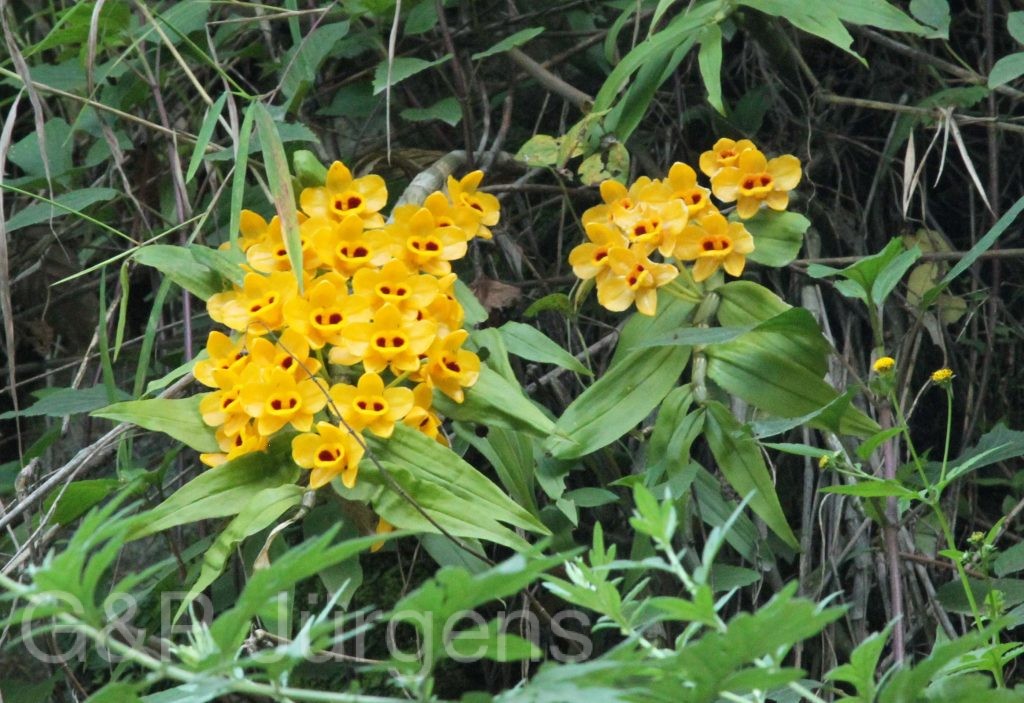
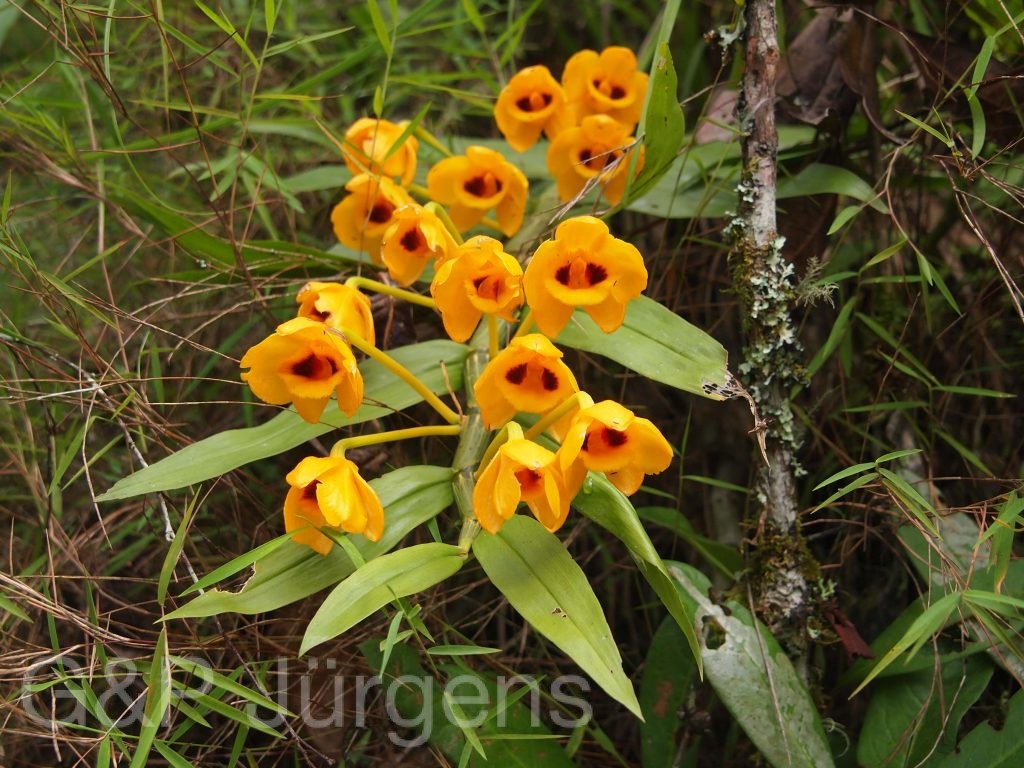
Dendrobium hookerianum, Hooker's dendrobium, is an eastern Himalayan epiphytic orchid known from China, India, Bhutan, Myanmar and Nepal, with 127 GBIF occurrences concentrated in the moist mid-montane forests of the region. It grows on tree trunks and branches in humid temperate broadleaved and conifer forest, broadly between about 1500 and 2500 m. The illustrated plants were recorded in Bhutan at Wangdi (Wangdue) at 2500 m in September and at Trashigang at 2000 m in October, autumn-flowering populations in mist-laden forest where cool nights and high humidity prevail.

The species forms long, pendent or arching, slender stems clothed in tubular sheaths and bearing many distichous, lanceolate, thin-textured leaves. From the upper nodes arise lateral racemes carrying several large, golden-yellow flowers. The spreading, elliptic sepals and broader petals are clear yellow, and the broad, suborbicular, fringed labellum is conspicuously marked with two deep maroon to blackish blotches on the disc and edged with a dense marginal fringe. The mentum is short, the column with a prominent foot, and the pollinia waxy.

Named in honour of Sir Joseph Dalton Hooker, the species belongs to Dendrobium section Dendrobium and is prized among Himalayan orchids for its showy fringed lip. Its restricted eastern Himalayan range, autumn flowering and ornamental appeal make it a target for collectors, and combined with ongoing forest clearance this renders wild populations vulnerable. International trade in the genus is regulated under CITES Appendix II.

Author: Lindl. · Sources: POWO (Kew), GBIF, Flora of Bhutan, Flora of China, Orchids of Bhutan, Dendrobium and its Relatives (Lavarack et al.)

Wall. ex Lindl.

Bhutan2014 716
Bhutan Wangdi Phodrang 2280m, June
Bh2008 454 P712
Bhutan Tsang-Chu, 1520m April

Description

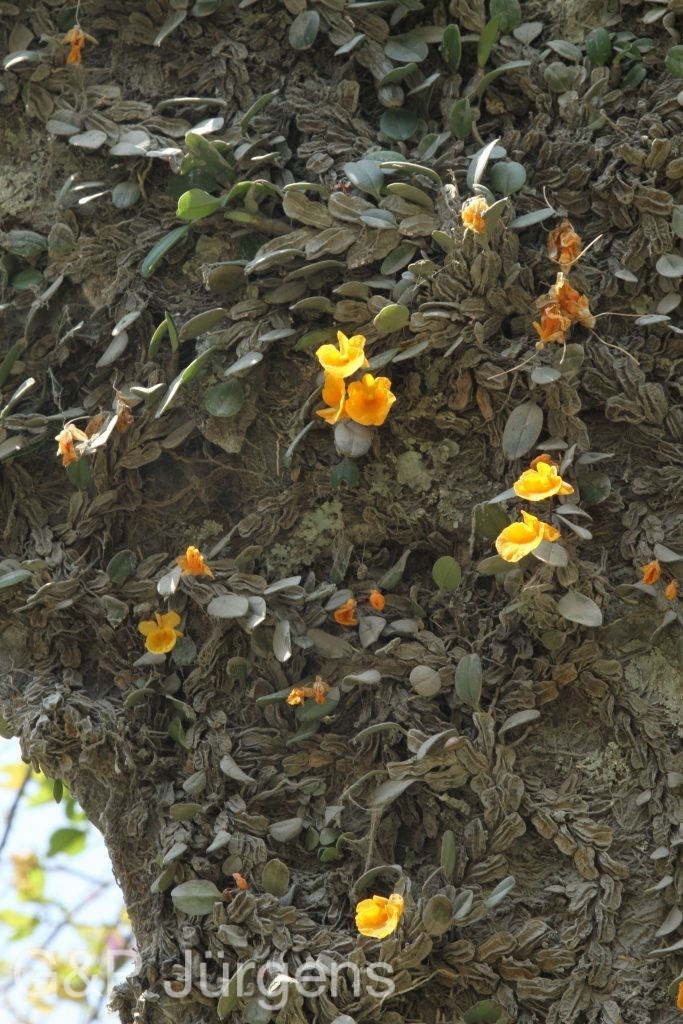
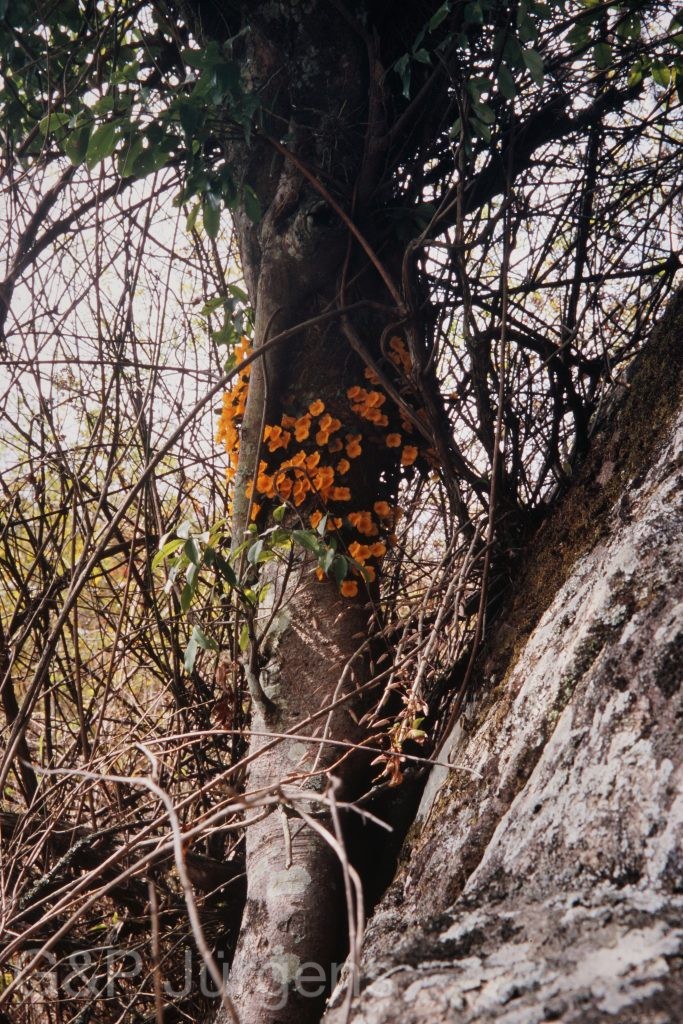
Dendrobium jenkinsii is a small epiphytic orchid distributed across the Eastern Himalaya, southern China and mainland Southeast Asia, with GBIF occurrences from China, Bhutan, India, Vietnam, Myanmar, Laos and Thailand among others. It grows as an epiphyte on tree trunks and large branches in open, well-lit montane and submontane forest, often on exposed boughs where it endures a marked seasonal alternation of monsoon moisture and a dry, cool resting period. It occurs at low to middle elevations; the Bhutanese records from Wangdue Phodrang at about 2280 m in June and from the Tsang-Chu valley at 1520 m in April bracket its altitudinal range and indicate spring to early-summer flowering.

The species forms small, clustered, ovoid to discoid pseudobulbs pressed against the substrate, each compressed, wrinkled when mature and bearing a single leathery apical leaf. The inflorescence is short and few-flowered, arising near the pseudobulb apex. The flowers are comparatively large for the plant's size and bright golden-yellow, with spreading, broadly elliptic sepals and petals. The labellum is the showiest part, broad, orbicular-reniform and conspicuously fringed or fimbriate at the margin, with a densely hairy or velvety disc; the short column bears a foot forming a mentum with the lateral sepals. The fruit is a small capsule.

D. jenkinsii belongs to Dendrobium section Densiflora and is closely allied to the larger D. lindleyi (D. aggregatum), from which it differs chiefly in its solitary or few-flowered inflorescences and smaller stature; the two have at times been confused or treated as conspecific. The species is much sought in horticulture, and wild collection compounds the pressures of forest loss across its range, making it a taxon of potential conservation concern despite a wide overall distribution.

Author: Wall. ex Lindl. · Sources: POWO (Kew), GBIF, Flora of China, The Orchids of Bhutan (Pearce & Cribb), Dendrobium and its Allies (Lavarack et al.)

Lindl.

Bhutan2015 453
Bhutan Trontsa 2300m, October
Bhutan2012 441
Bhutan Wangdi 2600m, September
Bhutan2012 1331
Bhutan Pemagatse 2600m, September

Description

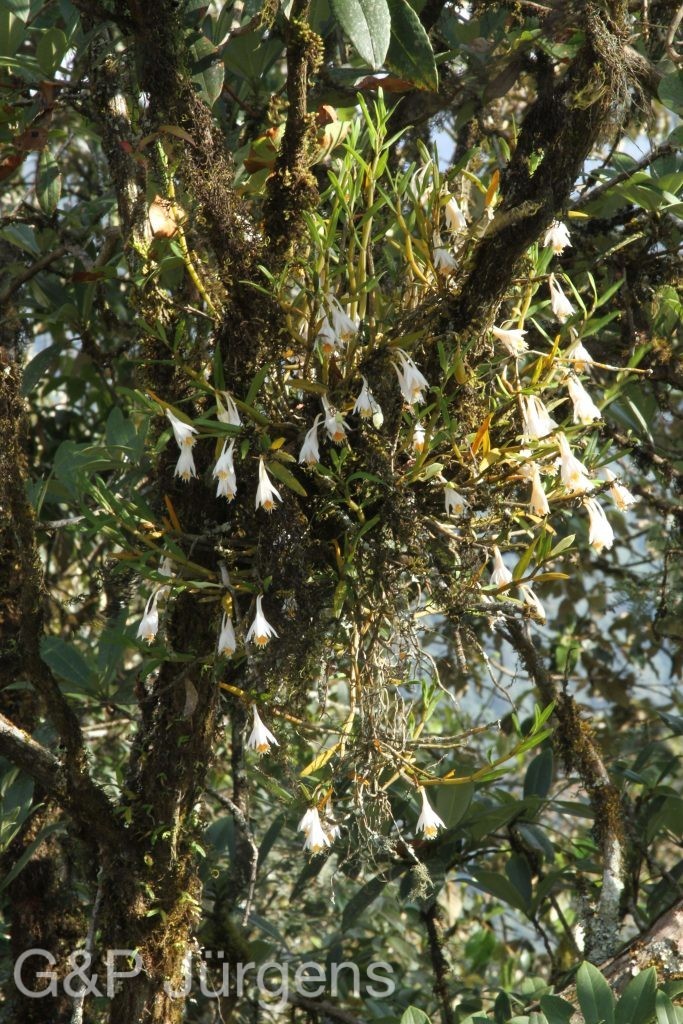
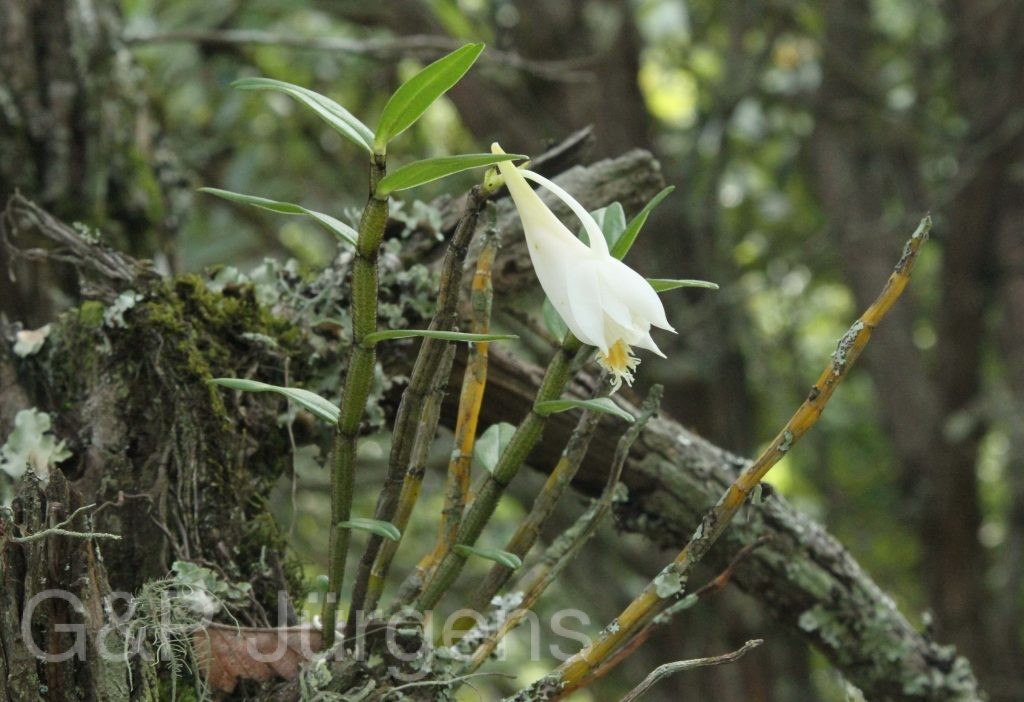
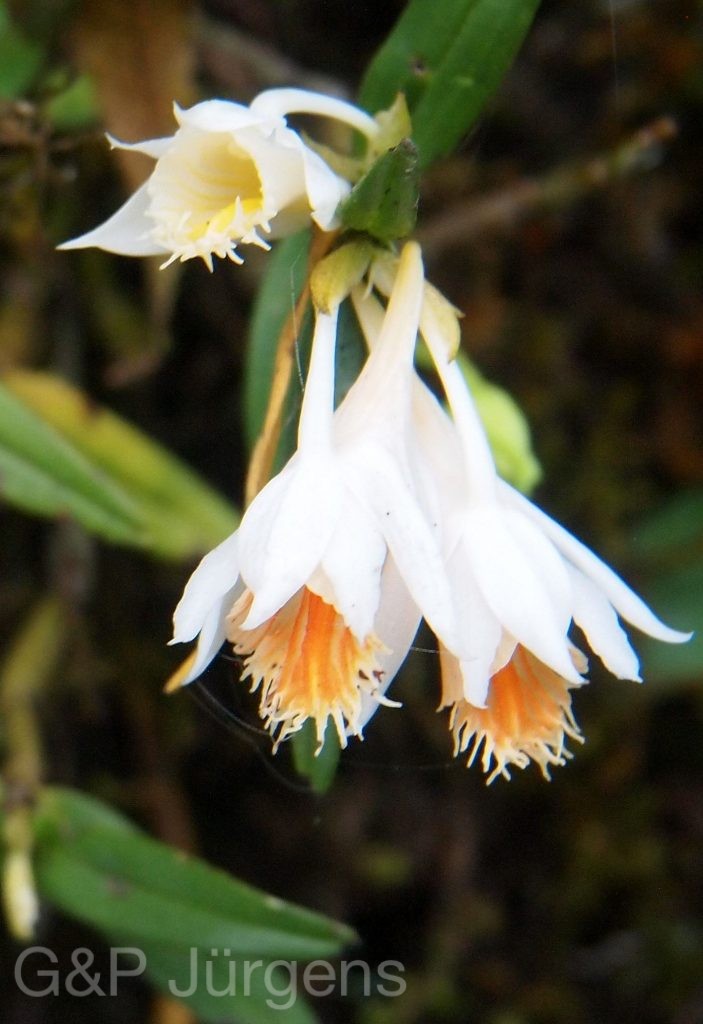
Dendrobium longicornu is an epiphytic orchid widespread across the eastern Himalaya and Indo-Burmese region, with GBIF recording over 300 occurrences and native range spanning India, China, Nepal, Bhutan, Vietnam, Myanmar, Bangladesh and Thailand, besides cultivated records in Europe. It grows as an epiphyte on mossy trunks and branches in humid, temperate to subtropical broad-leaved forest, typically between about 1500 and 2700 m. Bhutanese material was photographed at Trontsa (2300 m), Wangdi and Pemagatse (both 2600 m) in September and October, flowering on shaded, moss-laden trees in cool montane woodland.

The plant forms tufted, slender, erect to pendulous stems clothed in black-hairy leaf sheaths, bearing thin, lanceolate leaves toward the apex. The flowers, borne singly or few together near the stem tips, are showy and predominantly white with a fringed labellum marked by orange to greenish veining in the throat. The narrow tepals are spreading; the diagnostic feature is the long, slender, horn-like spur (mentum) formed by the lateral sepals and column foot, from which the epithet "longicornu" derives. The column is short, the anther cap bearing waxy pollinia, and the fruit a ribbed capsule.

Within the large genus Dendrobium, this species belongs to the white-flowered Formosae (nigrohirsute) section, distinguished by the dark hairs on stems and sheaths. Although widespread, it is sought by orchid collectors and is affected by habitat loss and overharvesting; like all Dendrobium it is listed on CITES Appendix II, regulating international trade.

Author: Lindl. · Sources: POWO (Kew), GBIF, Flora of Bhutan, Flora of China, The Orchids of Bhutan (Pearce & Cribb), CITES Appendix II listing

(L.) Sw.

Bhutan2014 808
Bhutan Mo-Chu 1880m, June
Bhutan2014 809
Bhutan Mo-Chu 1880m, June
Sikkim2011 173
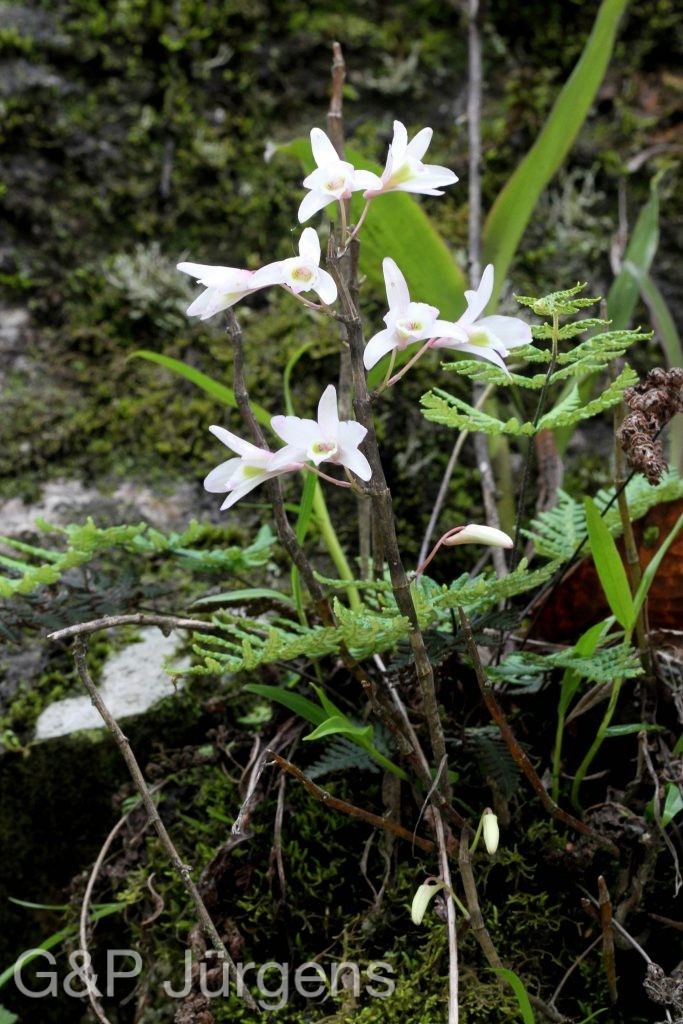
Sikkim Lachung 2660m, June

Description

Dendrobium moniliforme is one of the most widely distributed temperate dendrobiums, ranging from Japan, Korea, Taiwan and China westward through the Himalaya to Nepal, with GBIF documenting over a thousand occurrences across this broad East Asian and Himalayan span. It grows as an epiphyte on the trunks and branches of trees, and occasionally as a lithophyte on mossy rock, in cool, humid evergreen and mixed montane forest. The species experiences a pronounced cool, dry winter rest; the photographed material from the Mo-Chu valley in Bhutan at about 1880 m and from Lachung in Sikkim at 2660 m, both in June, illustrates its occupation of mid-elevation temperate forest and its early-summer flowering.

The plant produces tufted, slender, erect or arching cane-like stems that are conspicuously jointed and somewhat swollen at the nodes, giving the necklace-like appearance evoked by the epithet. The stems are leafy above, the leaves narrowly lanceolate, thin-textured and deciduous, leaving the older canes bare. The flowers are borne singly or in pairs from the nodes of leafless stems, fragrant, and variable in colour from white to pale pink, cream or yellowish. The sepals and petals are spreading; the trilobed labellum is often marked with reddish or greenish spots and bears a hairy or warty disc, while the short column has a foot forming a mentum. The fruit is a small ellipsoid capsule.

Highly polymorphic across its enormous range, D. moniliforme is placed in Dendrobium section Dendrobium and has accumulated extensive synonymy, with numerous regional forms and horticultural selections; the alternative name appearing on the source link reflects this nomenclatural complexity. Long cultivated in East Asia and esteemed for its fragrance and cold-hardiness, it remains widespread, but localised populations are reduced by collection and habitat loss.

Author: (L.) Sw. · Sources: POWO (Kew), GBIF, Flora of China, The Orchids of Bhutan (Pearce & Cribb), Dendrobium and its Allies (Lavarack et al.)

Lindl.

Bhutan2014 170
Bhutan Trashiyangtse 2120m, May
Sikkim2004 441 G769
Sikkim/India Tista-Valley 2400m May
Sikkim2004 442 P770
Sikkim/India Tista-Valley 2400m May

Description

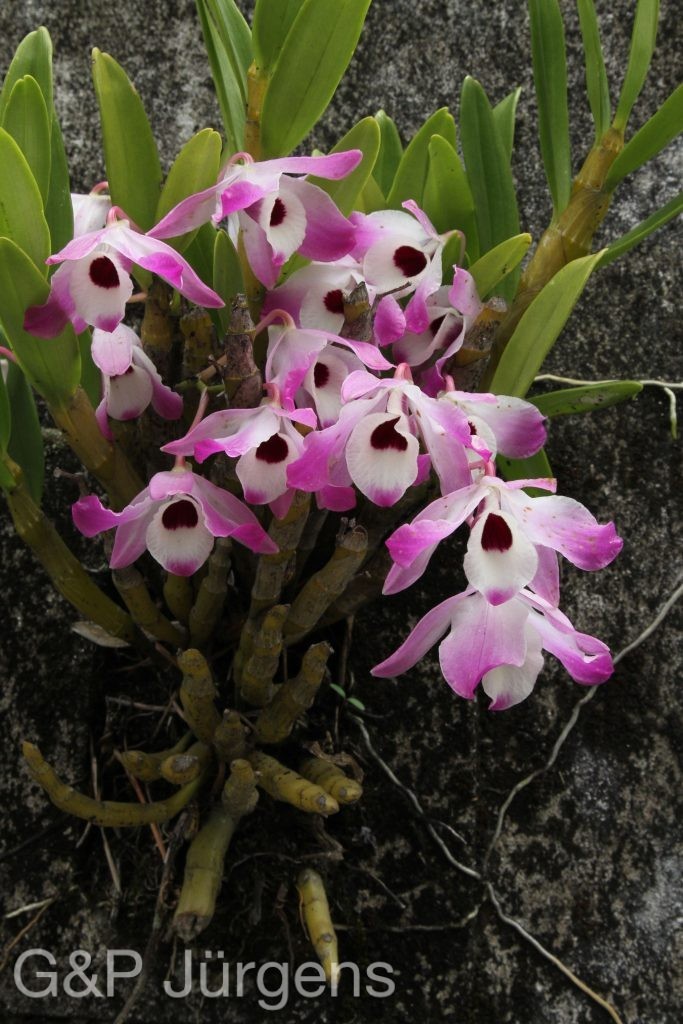
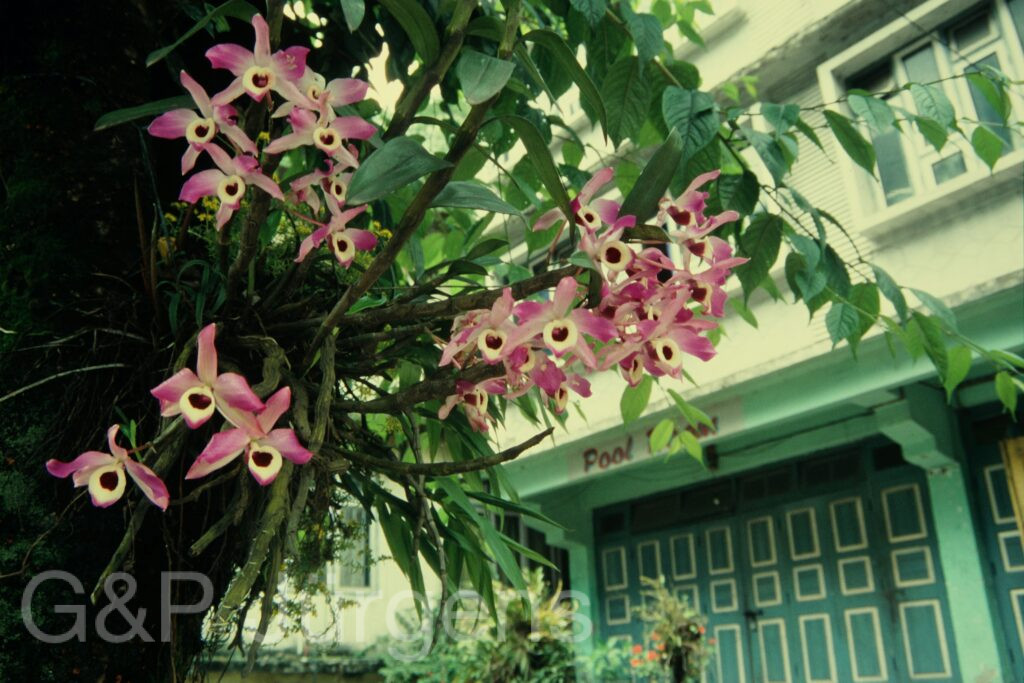
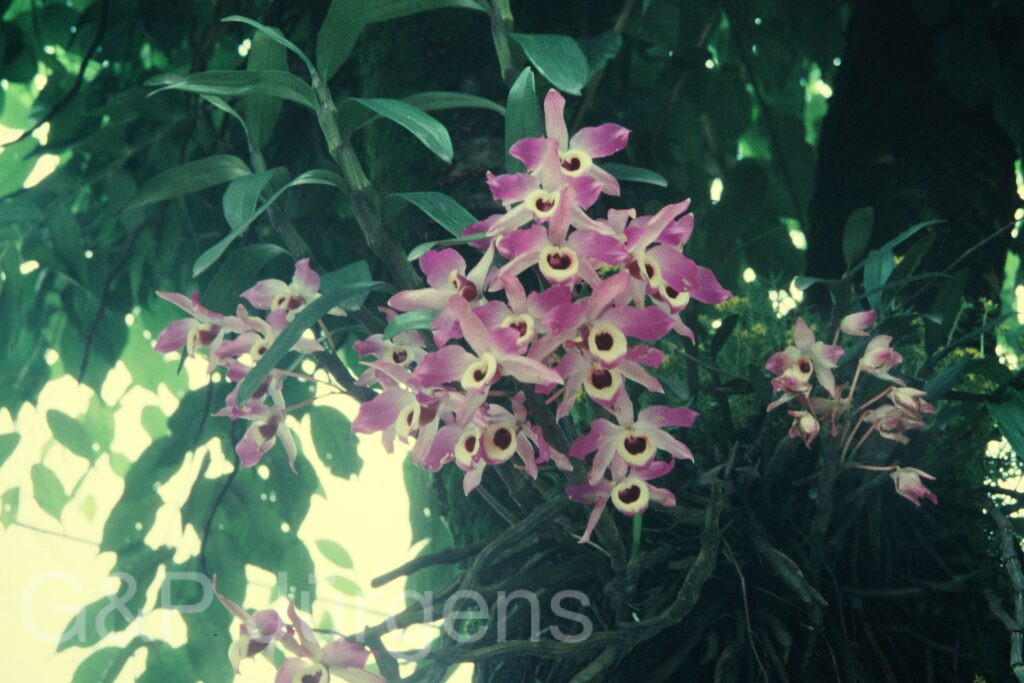
Dendrobium nobile is a widespread epiphytic orchid of the Himalaya and Indochina, native to China, India, Bhutan, Nepal, Myanmar, Vietnam and Laos, and now cultivated and naturalised far beyond, with records reported from many countries reflecting its enormous horticultural popularity. In the wild it grows as an epiphyte on mossy tree trunks and on shaded rocks in subtropical to warm-temperate broadleaved forest, chiefly between about 1000 and 2500 m. The plants documented here come from Trashiyangtse in eastern Bhutan at 2120 m and from the Tista Valley in Sikkim at 2400 m, both flowering in May at the close of the dry season.

The plant forms clustered, erect to pendulous, cane-like pseudobulbous stems that are fleshy, jointed and longitudinally grooved, bearing distichous, oblong-lanceolate leaves along their length; the leaves are usually deciduous before flowering. Inflorescences arise from the nodes of the leafless canes, each short raceme bearing one to three large, showy, fragrant flowers. The sepals and petals are white to rose-pink, deepening toward the tips, while the broad, rounded labellum is downy and conspicuously marked with a deep maroon-purple blotch in its throat ringed by paler margins. The column is short and the pollinia waxy; the fruit is an elongate dehiscent capsule releasing dust-like seeds.

As the nomenclatural type of section Dendrobium, this species is among the most important and intensively bred orchids in cultivation, with countless hybrids and named clones. Wild populations, however, have been heavily depleted by over-collection for horticulture and traditional medicine, and the species is listed on CITES Appendix II. Continued habitat loss across its native range makes in-situ conservation and sustainable trade regulation a significant concern.

Author: Lindl. · Sources: POWO (Kew), GBIF, Flora of China, The Orchids of Bhutan (Pearce & Cribb), Flora of Bhutan, CITES Appendices, Dendrobium monograph