Tag:

Bhutan

Flowers of Bhutan — 1326 plant species documented across the Bhutanese Himalaya, from dense broadleaf and conifer forests to alpine scrub and meadows. Bhutan’s largely intact wilderness shelters an exceptional diversity of orchids, rhododendrons, primulas and Himalayan poppies, many of them regional endemics. Each species page includes a botanical description, distribution, habitat and flowering time, with the original photograph and its recorded altitude and locality.

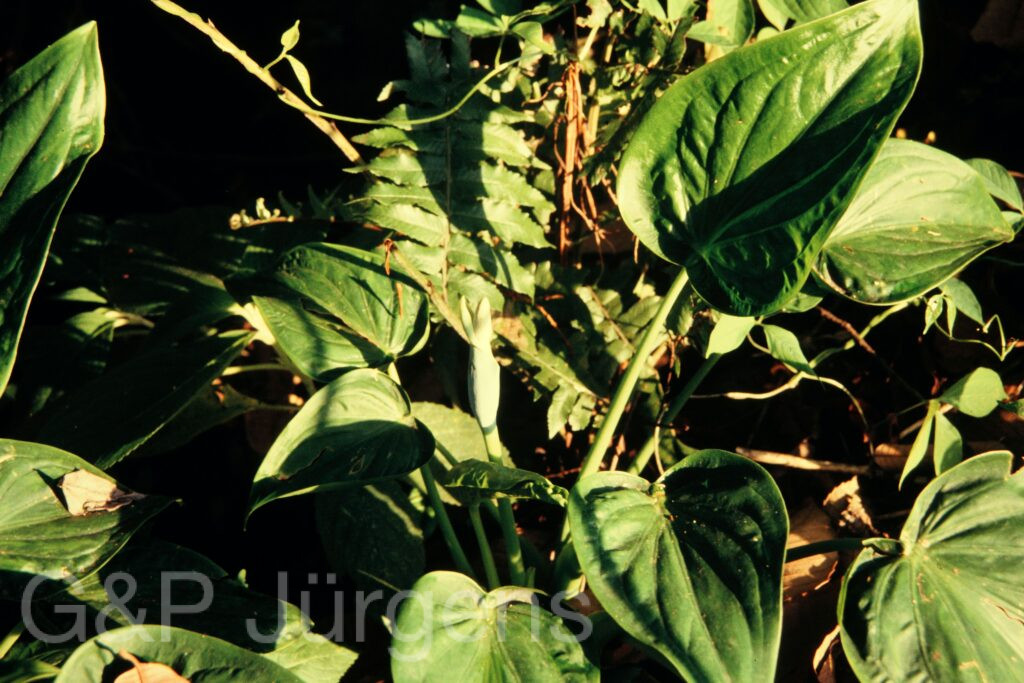
L.

Nepal 97 548 P1074
Nepal Sabha-Khola 530m May

Description

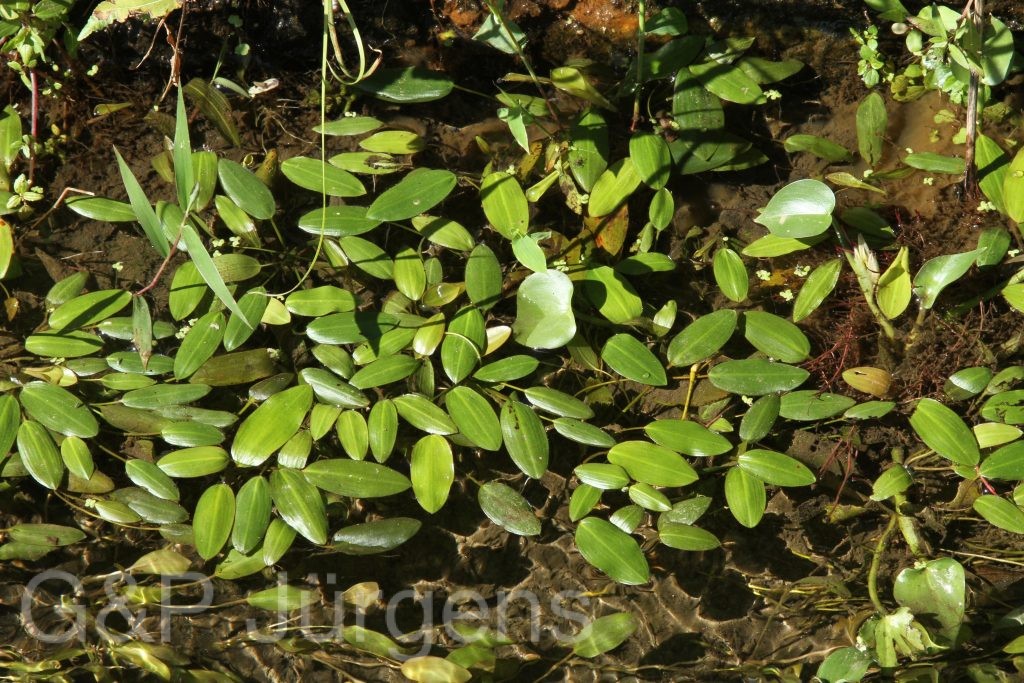
Pontederia hastata is an aquatic to semi-aquatic herb of tropical and subtropical Asia and Australasia, with 931 GBIF occurrences extending from India, Nepal, China and Sri Lanka through Southeast Asia to the Philippines, Papua New Guinea, Fiji and northern Australia. It grows in still and slow-moving fresh water, inhabiting ponds, ditches, marshes, paddy fields and the margins of streams and pools in the lowlands and low hills. The plant recorded along the Sabha-Khola in Nepal at 530 m in May exemplifies its lowland wetland habitat, where it grows rooted in shallow water or mud and flowers in the warm pre-monsoon period.

The species is a perennial, more or less emergent herb arising from a creeping rhizome and rooting at the nodes. The leaves are long-petiolate, the petioles sometimes slightly spongy and inflated, bearing sagittate to hastate blades with diverging basal lobes that give the plant its epithet. The flowers are borne in a dense spike or raceme subtended by a leaf-like spathe; each is bluish to pale violet, with six perianth segments fused below into a tube, six stamens often differing in length, and a tricarpellate ovary. The fruit is a capsule enclosing numerous small seeds dispersed by water.

The taxon has long been known as Monochoria hastata, reflected in the source link, but Monochoria is now subsumed within an enlarged Pontederia on phylogenetic grounds, making Pontederia hastata the accepted name. Like its relatives, the plant is an effective coloniser of disturbed aquatic and agricultural wetlands; it is widely used as a leaf vegetable and remains common, of no conservation concern across its broad range.

Author: L. · Sources: POWO (Kew), GBIF, Flora of China Vol. 24, Flora of Bhutan Vol. 3, Flora of Nepal, Flora of Pakistan, Pellegrini's revision of Pontederiaceae
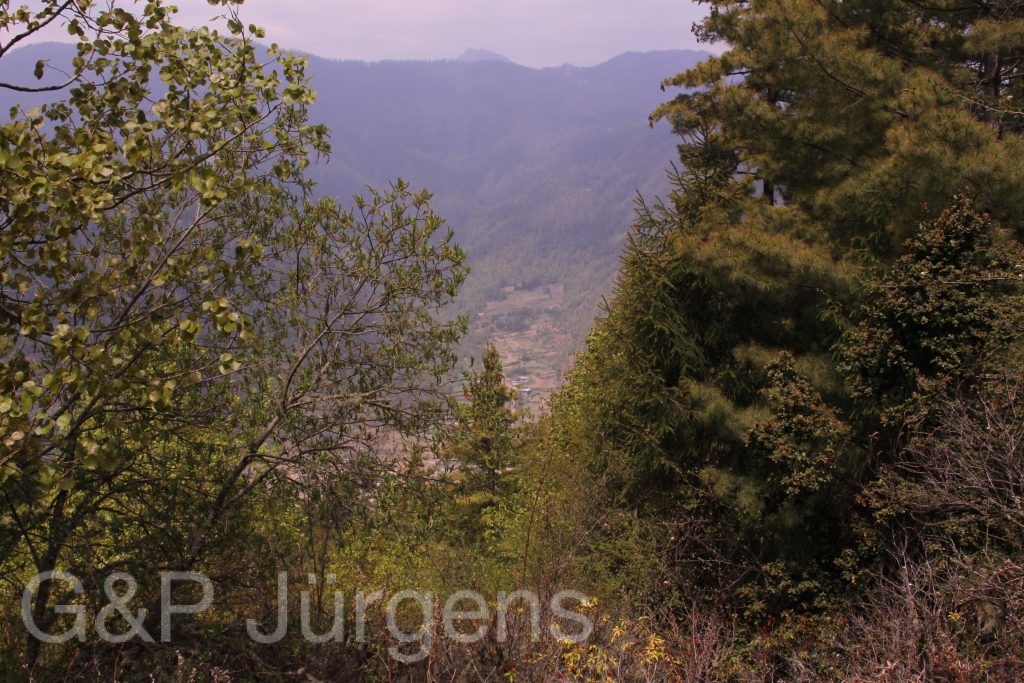
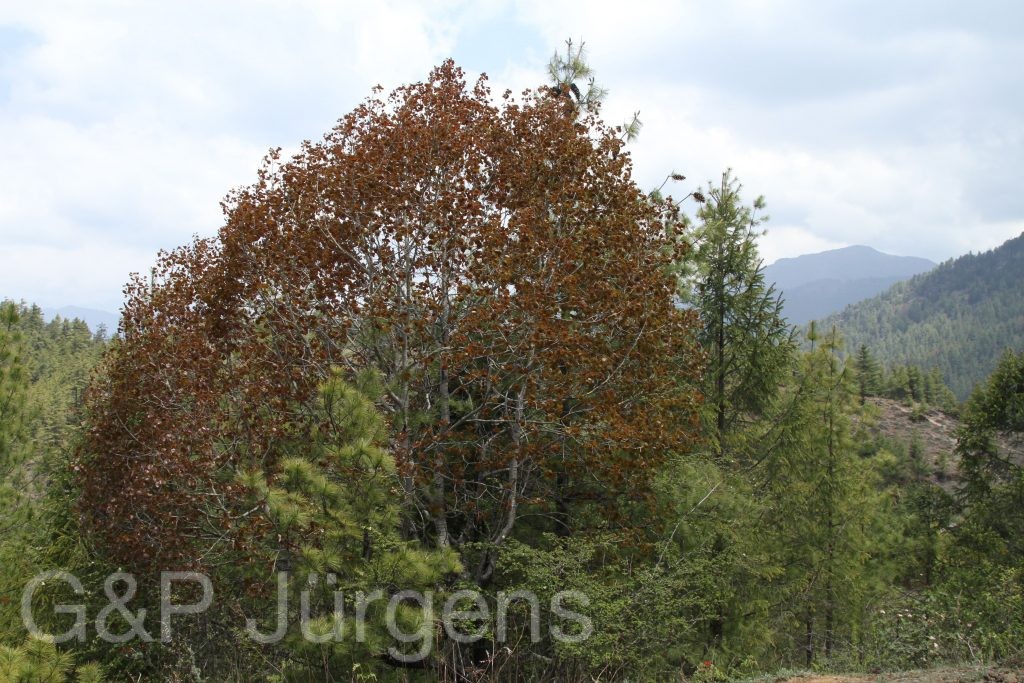
Populus tremula

by GP Jürgens

L.

Bhutan2014 957
Bhutan Chele-La 3400m, May
Bhutan2014 958
Bhutan Chele-La 3400m, May

Description

Populus tremula, the Eurasian aspen, is among the most widely distributed trees of the Northern Hemisphere, ranging across virtually all of Europe and temperate Asia, as the vast GBIF dataset of over 779,000 records from Sweden, France, Germany, Britain, Russia, China and beyond attests. In the Himalaya it reaches its southern Asian limit as a high-montane element, and the photographed tree from Bhutan's Chele-La at 3400 m in May represents this elevated outpost. It is a pioneer of disturbed ground, forest clearings, burnt areas, screes and woodland margins, tolerant of a wide range of soils and climates from boreal lowland to subalpine slopes, where it often forms clonal stands by root suckering.

It is a deciduous tree with smooth, greenish-grey bark, becoming furrowed at the base of old trunks. The alternate leaves are nearly orbicular to broadly ovate with a crenate to sinuate margin, borne on long, conspicuously laterally flattened petioles that allow the foliage to flutter in the slightest breeze, the trait giving the tree both its epithet tremula ("trembling") and its English name. Juvenile and sucker leaves are larger and more triangular. Like all poplars it is dioecious, the flowers borne in pendulous catkins that appear before the leaves; each flower subtended by a fringed bract, the males with numerous stamens, the females with a one-celled ovary. The fruit is a small capsule releasing cottony, plumed seeds dispersed by wind.

Aspen is a keystone pioneer species of immense ecological importance, supporting rich communities of insects, fungi and lichens and frequently forming genetically uniform clonal groves that can persist for centuries. Within Salicaceae it belongs to section Populus (the aspens and white poplars). Its presence in the eastern Himalaya illustrates the trans-Eurasian continuity of temperate forest floras; the species is of least conservation concern and is widely exploited for timber, pulp and matchwood.

Author: L. · Sources: POWO (Kew), GBIF, Flora of China Vol. 4, Flora of Bhutan Vol. 1, Flora of Pakistan, Eckenwalder's Conifers and Salicaceae Treatments

A.Benn.

Bhutan2015 560
Bhutan Mo-Chu 1500m, October

Description

Potamogeton distinctus is an aquatic herb widespread across temperate and subtropical Asia, recorded from Japan, Korea, China, Taiwan and the Russian Far East through the Himalaya (India, Nepal, Bhutan) into Southeast Asia and beyond. It is a plant of still and slow-moving fresh water — ponds, ditches, paddy fields, oxbows and the margins of slow rivers — from the lowlands to the lower montane belt. The individual photographed along the Mo Chu in Bhutan at 1,500 m in October illustrates its occurrence in a sluggish river backwater of the inner valleys, where it persists into autumn. It is well known as a weed of rice cultivation across its eastern range.

It is a perennial rooting in mud and spreading by slender, whitish, often tuber-bearing rhizomes. The plant is heterophyllous: submerged leaves are translucent, narrow and sessile or short-petioled, while the floating leaves are coriaceous, elliptic to oblong, long-petioled and with rounded to subcordate bases. Membranous stipules (ochreae) sheath the stem at the nodes. The inflorescence is a dense, cylindrical, emergent spike raised above the water on a stout peduncle; the small flowers each bear four clawed tepal-like segments and four stamens. The fruit is a small, obliquely obovoid drupelet with a short beak and a dorsal keel.

Potamogeton (Potamogetonaceae) is a cosmopolitan genus prone to hybridisation and to plastic, environmentally induced variation, which complicates identification; floating-leaved species such as P. distinctus are best separated on fruit, stipule and tuber characters. The species is widespread, often abundant, and of no conservation concern, though as a paddy weed it is locally controlled.

Author: A.Benn. · Sources: POWO (Kew), Flora of China Vol. 23, Flora of Bhutan Vol. 3, GBIF, Wiegleb & Kaplan: Account of Potamogeton (1998)

(C.E.C. Fisch.) T.T. Yu & C.L. Li

Sikkim2003 506 P706 ergebnis
Sikkim Yume Samdong 4400m, August

Description

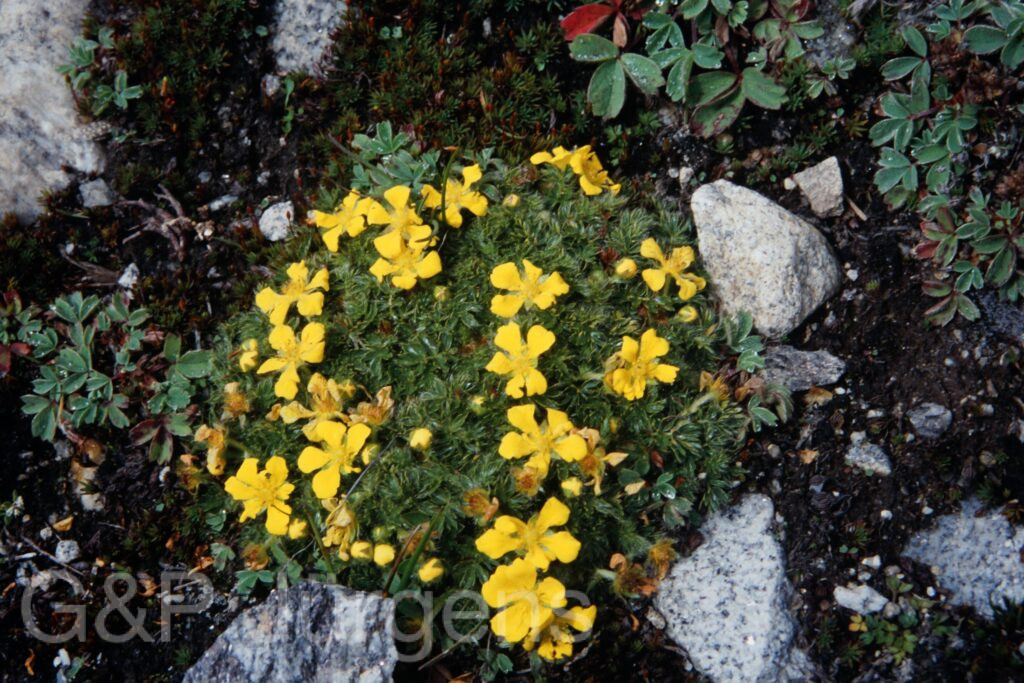
Potentilla articulata var. latipetiolata is a high-altitude perennial herb found in the eastern Himalayas and extending into the Sino-Himalayan region. It has been recorded from northeast India (Sikkim), Bhutan, and China (Xizang, Yunnan). The variety inhabits alpine scree, rocky moraine margins, and gravelly slopes at elevations of 3,800–5,000 m, favouring well-drained, mineral substrates with sparse vegetation cover. It has been collected from the Yume Samdong area in Sikkim at 4,400 m, flowering in August at the height of the eastern Himalayan monsoon.
The plant forms a compact, caespitose rosette from a stout, woody caudex covered with persistent, fibrous leaf-base remnants. The basal leaves are pinnately compound with 5–9 leaflets that are obovate to elliptic, 5–12 mm long, densely sericeous to villous on both surfaces, giving the foliage a silvery appearance. The petioles are broad and somewhat winged, a diagnostic character of var. latipetiolata distinguishing it from the typical variety. The flowering stems are short, 3–10 cm tall, bearing 1–3 flowers. The flowers are 10–15 mm in diameter, with five bright yellow, broadly obovate petals exceeding the sepals. The epicalyx segments are lanceolate, slightly shorter than the sepals. The achenes are smooth, ovoid, approximately 1.5 mm long.
This variety was originally described by C.E.C. Fischer and subsequently recombined by T.T. Yu and C.L. Li. It is distinguished from the typical Potentilla articulata primarily by its broader, more conspicuously winged petioles. With approximately 39 occurrence records in GBIF, it is a relatively uncommon taxon. The high-alpine habitats it occupies are among the most climate-sensitive ecosystems in the Himalayas, and long-term monitoring of such specialised alpine rosette plants is important for understanding biotic responses to warming temperatures and glacial retreat in the region.

Author: (C.E.C. Fisch.) T.T. Yu & C.L. Li · Sources: POWO (Kew), GBIF, Flora of China Vol. 9, Flora of Bhutan Vol. 1, Grierson & Long: Flora of Bhutan Vol. 1 (1987)

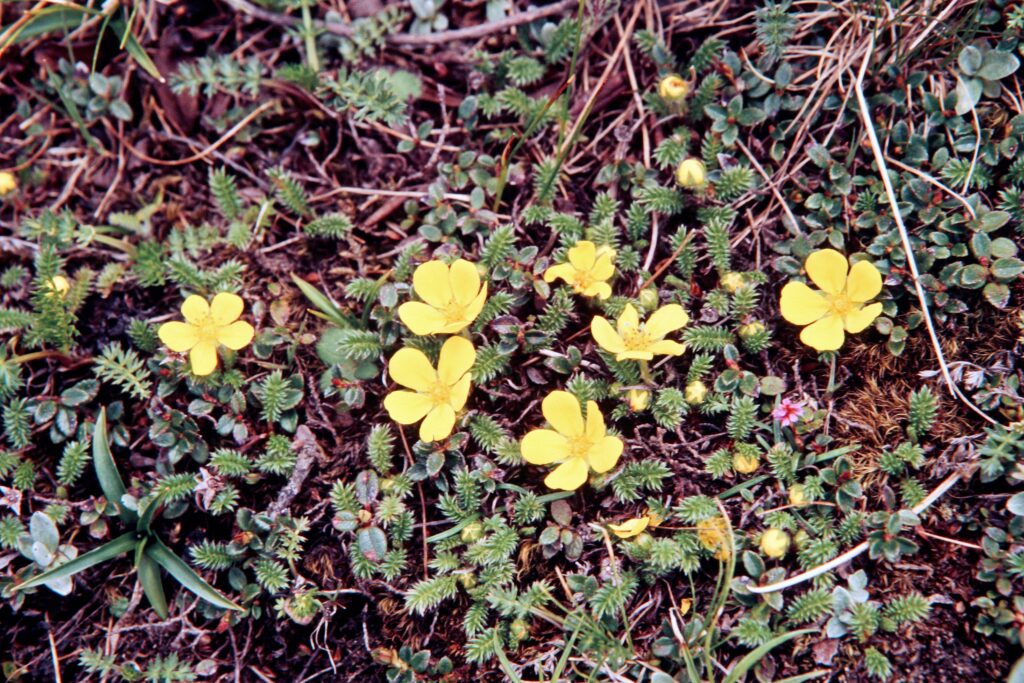
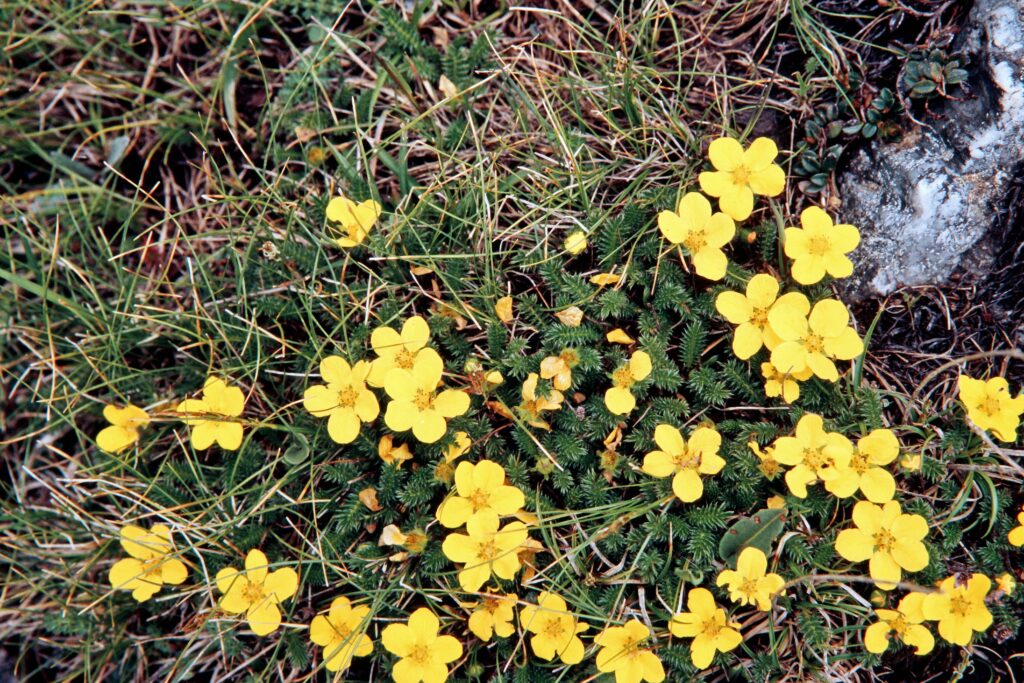
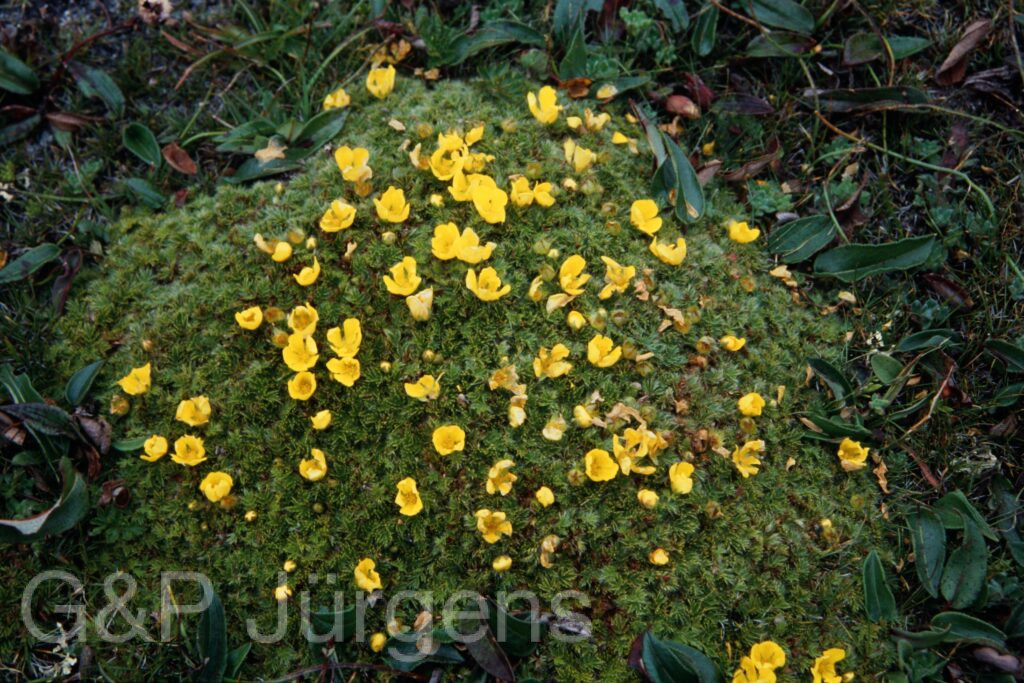
D.Don

Sikkim2003 132 G180
Sikkim Dzongri 3900m, August
Sikkim2003 133 W181
Sikkim Dzongri 3900m, August

Description

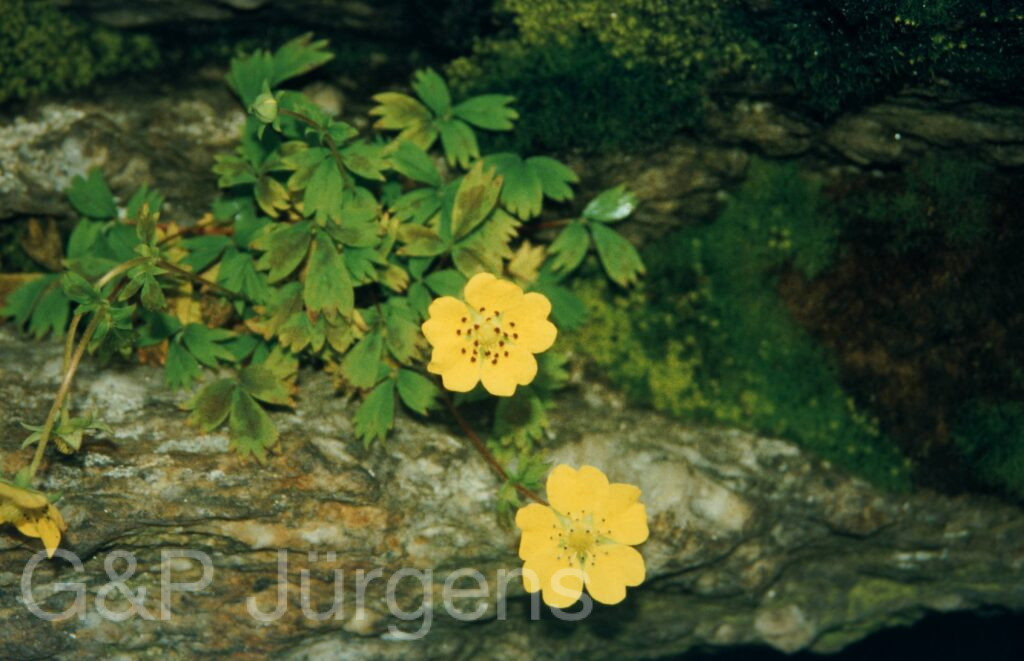
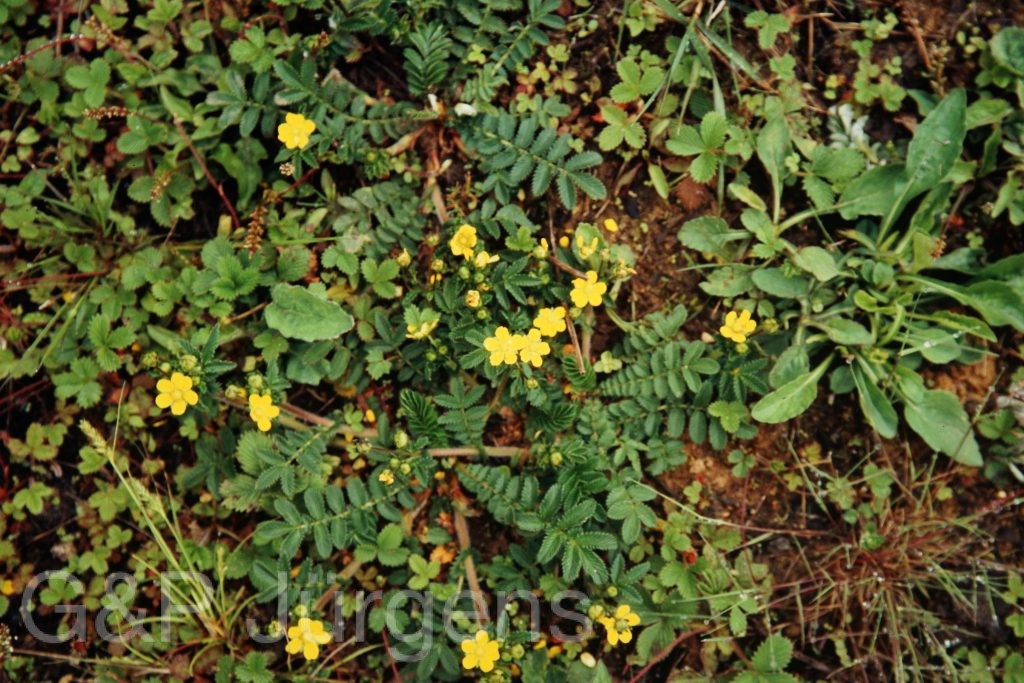
Potentilla coriandrifolia D.Don is a high-alpine perennial distributed across the eastern and central Himalaya and adjacent mountains, recorded from China, Nepal, India, Bhutan and Myanmar, with extralimital cultivated records elsewhere; some 542 georeferenced occurrences are documented in GBIF. It inhabits open turf, stony alpine meadows, gravelly slopes and the margins of moraines, typically between 3500 and 4800 m. The photographed plant grows at Dzongri in Sikkim at about 3900 m, flowering in August, a setting typical of the cool, well-drained alpine sward where this cushion-forming herb thrives among dwarf rhododendrons and graminoids.

The plant develops from a stout, woody, branched rootstock crowned by the persistent remains of old petioles, forming low tufts or loose mats. The leaves are radical, pinnate or pinnatisect with a coriander-like (coriandrifolium) dissection, the leaflets deeply incised into narrow oblong segments and often somewhat glaucous or silky beneath. Flowering stems are slender, ascending and few-flowered. The flowers are typically yellow, occasionally suffused with reddish or purplish tones at the base of the petals, with five obcordate petals exceeding the calyx, an epicalyx alternating with the sepals, and numerous stamens surrounding a central tuft of carpels. The fruit is an aggregate of dry achenes seated on a hairy receptacle.

A member of the large and taxonomically intricate genus Potentilla, this species belongs to the assemblage of dwarf Himalayan cinquefoils adapted to short growing seasons and intense insolation. Its distinctive finely cut foliage distinguishes it from related alpine taxa such as P. microphylla. Though not assessed as threatened, populations are restricted to fragile high-altitude habitats sensitive to grazing pressure and climate-driven upslope shifts, making the species a useful indicator of alpine ecosystem condition.

Author: D.Don · Sources: POWO (Kew), GBIF, Flora of China, Flora of Bhutan, Annotated Checklist of the Flowering Plants of Nepal, Soják monograph of Potentilla

Wall. & Lehm.

Nepal 99 481 ergebnis
West-Nepal Churta-Khola 3700m, June
Garw 2005 309 ergebnis
India Garhwal Patanathi 3600m, September

Description

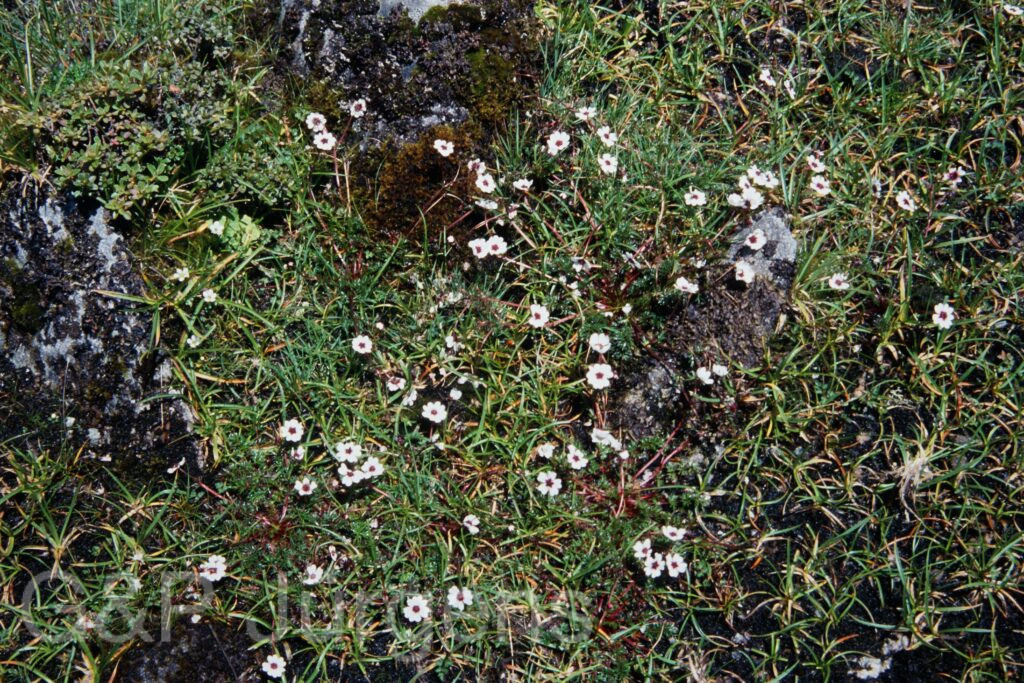
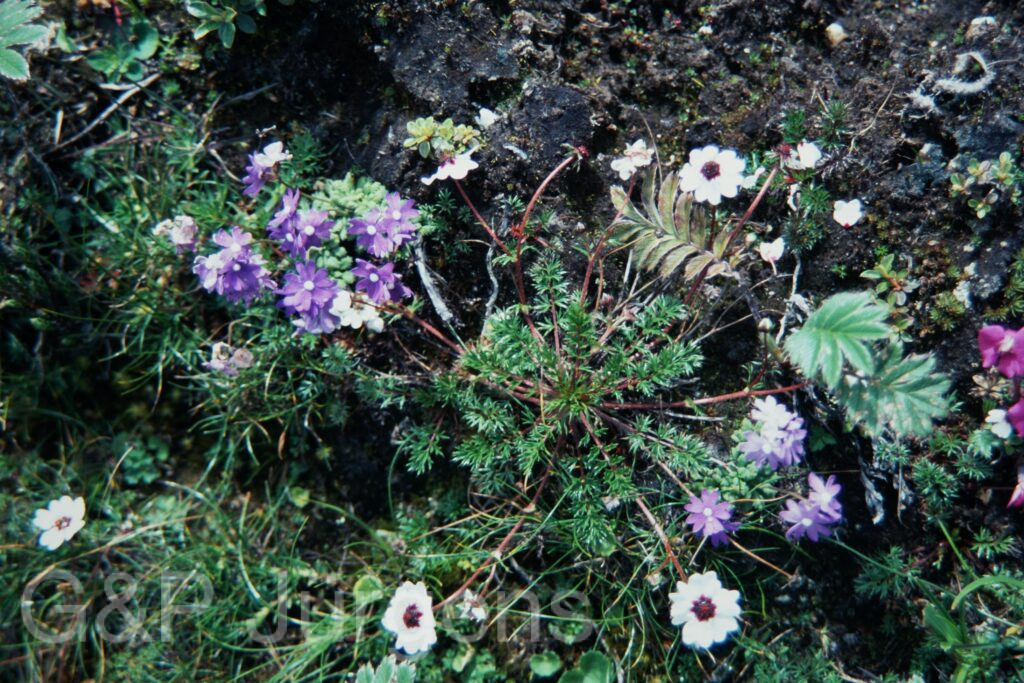
Potentilla eriocarpa is a mat-forming alpine cinquefoil distributed throughout the Himalaya and adjacent ranges, from Afghanistan and Pakistan eastward through India, Nepal and Bhutan into south-western China and Myanmar. GBIF records some 667 occurrences, densest in Nepal, the Indian Himalaya and the Chinese borderlands. It is a plant of the high alpine zone, colonising rock crevices, screes, stony meadows, moraines and exposed ridges, characteristically between about 3000 and 4800 m. The populations imaged in West-Nepal at Churta-Khola (3700 m, June) and in Indian Garhwal at Patanathi (3600 m, September) reflect its broad flowering season across the western Himalaya, from early summer into autumn near the upper limits of vascular plant growth.

The species forms low, dense cushions or tufts from a stout, woody, branched caudex clothed in the persistent remains of old stipules and leaf-bases. The leaves are ternate, the three obovate to cuneate leaflets coarsely toothed toward the apex, dark green and glabrescent above, paler and often silky beneath. The flowering stems are short, ascending to decumbent, bearing one to few flowers. Each flower has five sepals alternating with five epicalyx segments, five broadly obovate, often emarginate yellow petals, numerous stamens and many carpels on a hairy receptacle. The diagnostic feature, reflected in the epithet, is the densely woolly-hairy (eriocarpous) achenes forming the fruiting head.

Potentilla is a large and taxonomically intricate northern-temperate genus, and P. eriocarpa, described by Wallich and Lehmann, belongs to the predominantly Asian alpine cushion-forming group. Its ternate leaves and conspicuously hairy achenes separate it from the many associated Himalayan cinquefoils. As a widespread, abundant high-alpine perennial it is of no conservation concern, and is a significant component of cushion-plant and fellfield communities at extreme elevations.

Author: Wall. & Lehm. · Sources: POWO (Kew), GBIF, Flora of China, Flora of Pakistan, Flora of Bhutan, Annotated Checklist of the Flowering Plants of Nepal, monograph of the genus Potentilla (Wolf)

(D.Don) Maxim.

Sikkim2003 189 P260
Sikkim Dzongri 4100m, August

Description

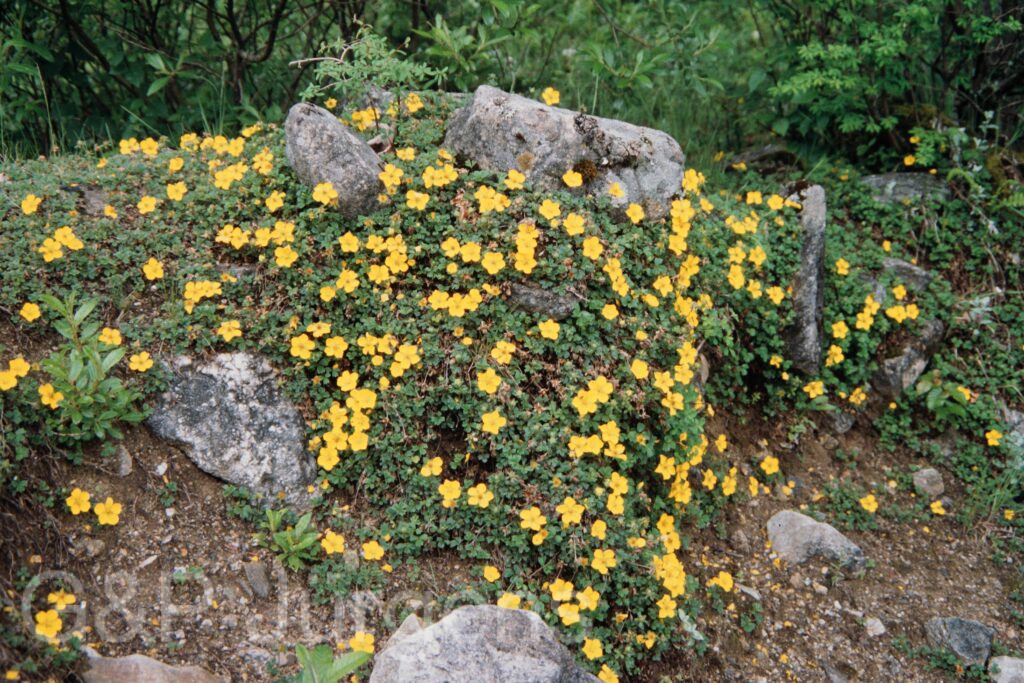
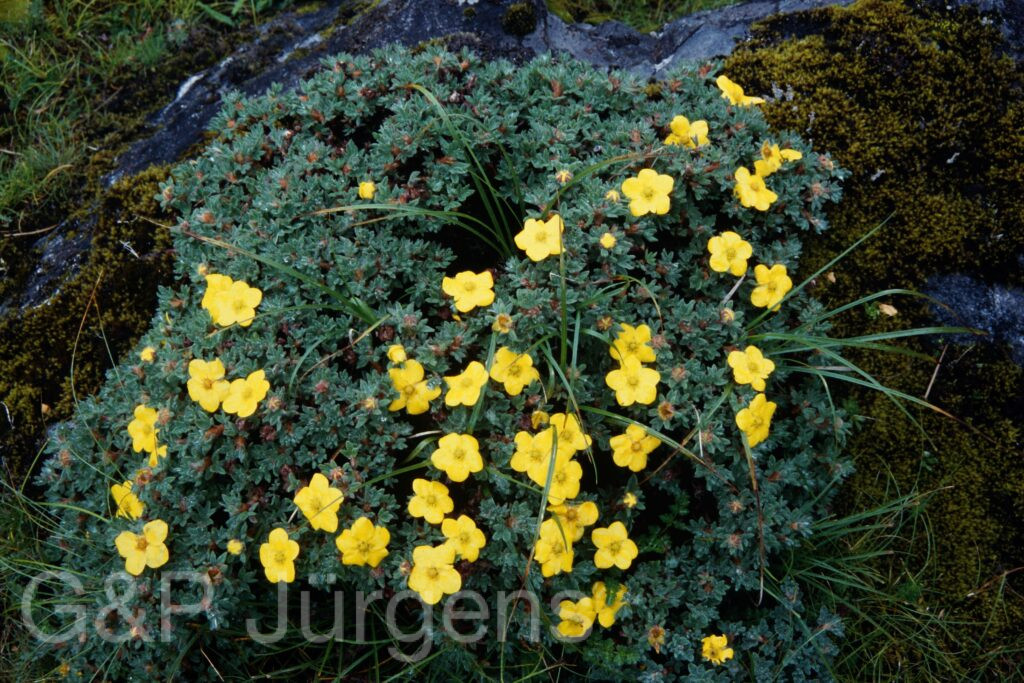
Potentilla fruticosa var. arbuscula is a shrubby cinquefoil of the high mountains of the Sino-Himalayan region, recorded from China, Nepal, Bhutan and Japan. GBIF treats the name as a synonym, with Potentilla fruticosa var. arbuscula (here cited following the source) regarded as the accepted designation for this entity; in modern treatments the shrubby cinquefoils are often placed in the segregate genus Dasiphora. It grows in alpine and subalpine scrub, open meadows, rocky slopes and stream-sides above and near the treeline, generally between about 3000 and 4500 m. The photographed plant comes from Dzongri in Sikkim at around 4100 m, flowering in August. With over 400 georeferenced records it is a well-documented high-montane shrub.

It forms a low, much-branched deciduous shrub, often spreading or cushion-like at the highest elevations, the bark shredding and the young shoots silky-hairy. The leaves are pinnate with usually five small, narrow, oblong leaflets that are green above and densely silvery-silky beneath, with revolute margins. The flowers are solitary or few in the leaf axils and at the branch tips; each has five green sepals alternating with epicalyx segments and five broad, rounded, golden-yellow petals exceeding the calyx. The numerous stamens surround a hairy receptacle bearing many free carpels, which ripen into a head of small hairy achenes.

The shrubby cinquefoil complex is taxonomically intricate and widely cultivated in horticulture; var. arbuscula is distinguished within it by its dense indumentum and Himalayan high-altitude form. Its abundant nectar-rich flowers attract a range of insect pollinators. As a common and broadly distributed alpine shrub it is of least conservation concern.

Author: (D.Don) Maxim. · Sources: POWO (Kew), GBIF, Flora of China, Flora of Bhutan, Soják's revisions of Potentilla and Dasiphora

Hook.f.

BhutanPG2011 530
Bhutan Ludlow-Sherriff-Trail Dem-Tso, 4000m June
Sikkim2003 290 P401
Sikkim Saniti-Lake, 4300m August

Description

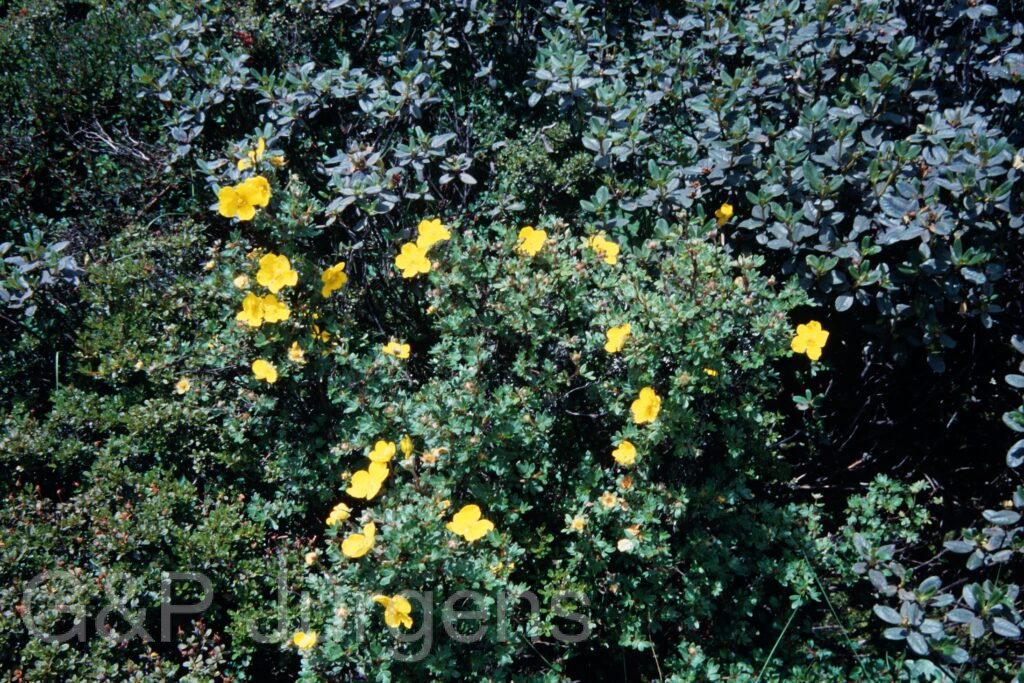
This dwarf shrubby cinquefoil belongs to the widespread circumboreal complex now placed by many authorities in the genus Dasiphora, the name GBIF treats as accepted; the very large occurrence total of over 83,000 reflects the broad species aggregate across North America, Europe and northern Asia, including China. The taxon is a true alpine, growing on stony pastures, lake shores, moraines and exposed rocky slopes near and above the treeline. The recorded high-Himalayan plants from Dem-Tso on the Ludlow-Sherriff Trail in Bhutan at 4000 m in June and from Saniti Lake in Sikkim at 4300 m in August represent prostrate dwarf forms of the cold, windswept upper alpine zone.

It is a low, much-branched deciduous shrub, in this variety dwarf and often mat-forming, with shredding brown bark on the older stems. The leaves are pinnate with usually five small, oblong to elliptic, entire leaflets that are silky-hairy and somewhat revolute at the margins, with conspicuous stipules. The flowers are solitary or few, with five rounded yellow petals, numerous stamens, and an epicalyx alternating with the green calyx lobes. The fruit is a head of small, hairy achenes typical of the genus.

The dwarf variety pumila is one of several poorly delimited high-elevation forms within a polymorphic, taxonomically contested group spanning Potentilla, Dasiphora and Pentaphylloides. Hardy and stress-tolerant, the shrub is a pioneer of skeletal alpine soils and a familiar component of treeline scrub across the Northern Hemisphere, of biogeographic interest as a connecting element between Himalayan and arctic floras.

Author: Hook.f. · Sources: POWO (Kew), GBIF, Flora of China, Flora of Bhutan, Soják's revisions of Dasiphora and Potentilla

Trevir.

Bh09 289 P475
Bhutan Tongsa, 2300m June
Garw 2005 284 ergebnis
India Garhwal Kunol 2650m, September

Description

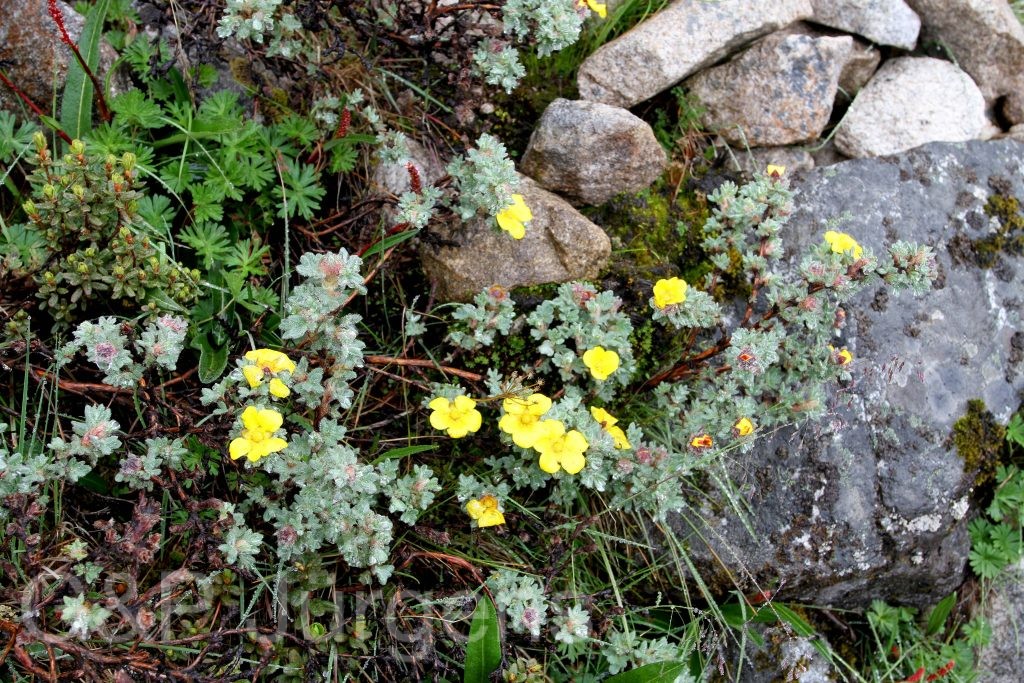
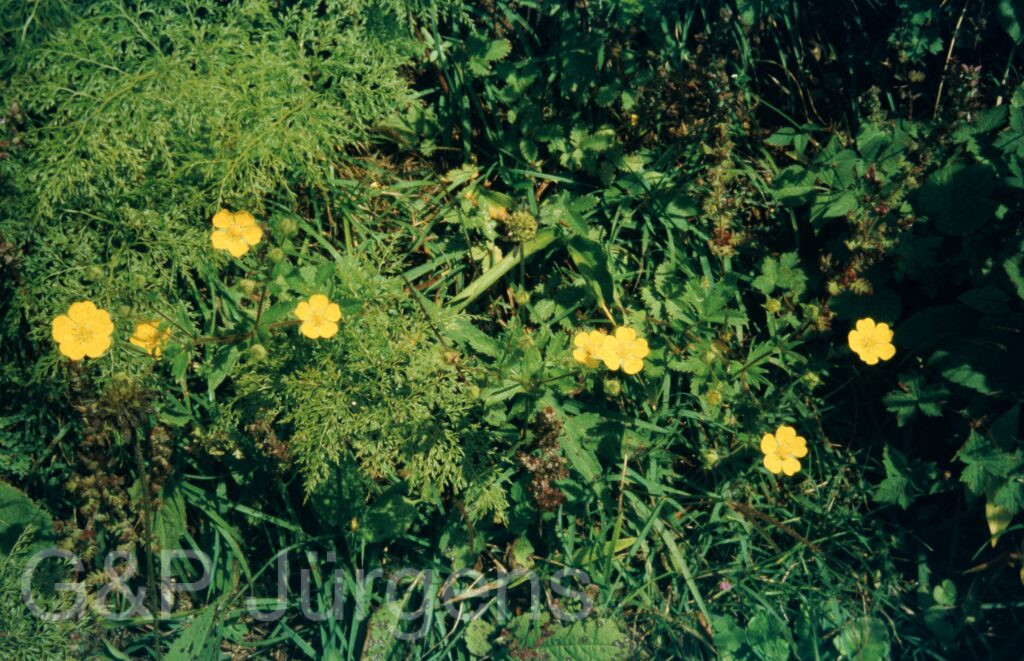
Potentilla lineata is a widespread Asian cinquefoil ranging across the Himalaya and into China, Myanmar and Vietnam, well represented in GBIF with around 519 records from China, Nepal, India, Bhutan, Pakistan and beyond. In GBIF the queried name is treated as a synonym, with Potentilla lineata itself given as the accepted name. It occupies open grassy slopes, forest clearings, banks, pastures and disturbed roadsides through the temperate and subalpine belts, roughly 1500 to 3500 m. The collections cited from Tongsa in Bhutan at 2300 m in June and from Kunol in the Garhwal Himalaya at 2650 m in September show its long flowering season across the monsoon.

It is a perennial herb with a woody rootstock producing erect to ascending, often silky-hairy stems. The leaves are pinnate or digitately compound with toothed, oblong to obovate leaflets that are typically green and appressed-hairy above and densely silvery- or white-tomentose beneath, the strongly impressed venation giving rise to the epithet lineata. The flowers are borne in lax terminal cymes; each has five yellow petals alternating with an epicalyx and five sepals, numerous stamens and many carpels seated on a hairy receptacle. The fruit is an aggregate of small dry achenes.

Potentilla is a large and taxonomically complex genus in which hybridisation and polyploidy blur species boundaries, and P. lineata has accordingly accumulated several synonyms. The silvery indumentum reduces water loss and reflects intense montane radiation. With its broad ecological tolerance and ready colonisation of disturbed ground, the species is common and of no conservation concern, functioning as a characteristic component of Himalayan grazing land and successional grassland.

Author: Trevir. · Sources: POWO (Kew), GBIF, Flora of China (Rosaceae), Flora of Bhutan, Annotated Checklist of the Flowering Plants of Nepal, Soják taxonomic studies of Potentilla

D.Don

Bh09 163 G288 1
Bhutan Labana, 4100m June
Sikkim2003 505 G705 ergebnis
Sikkim Yume Samdong 4400m, August

Description

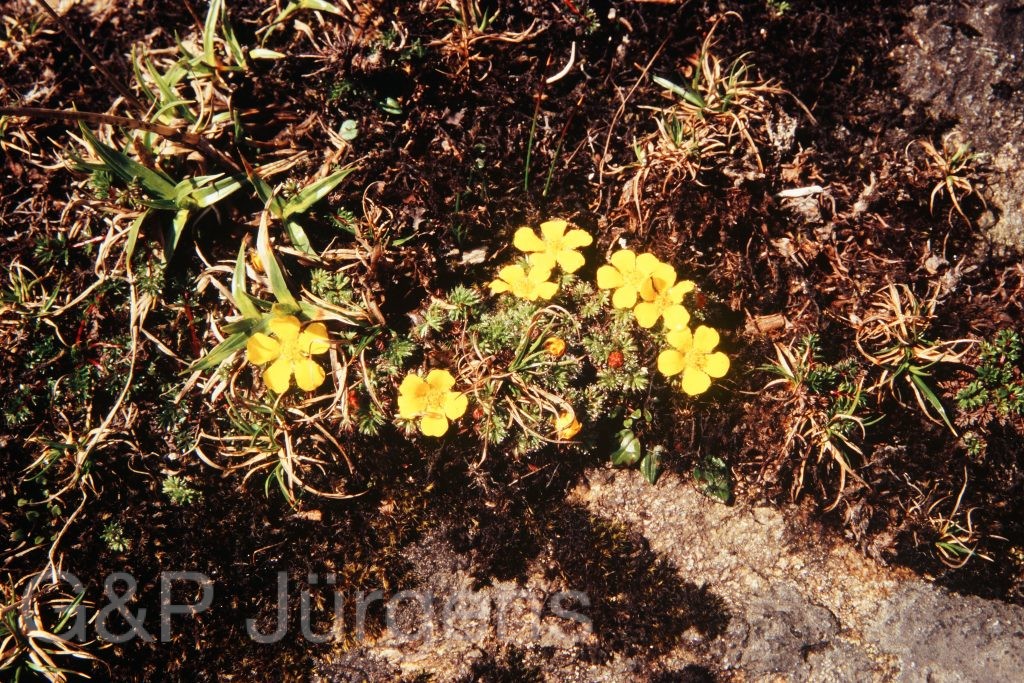
Potentilla microphylla D.Don is a dwarf, cushion-forming cinquefoil of the high Himalaya and Tibetan borderlands, occurring through China, India, Nepal and Bhutan. Reliable verbatim occurrence and country totals in the source record are unfortunately conflated with family-level aggregate figures, so the very large occurrence count and the European-dominated country list cited there pertain to the family Rosaceae rather than to this species, which is genuinely a high-alpine Himalayan endemic. It grows on exposed rocky ridges, screes, gravelly flats and crevices, typically between about 3500 and 5000 m. The illustrated plants come from Labana in Bhutan (4100 m, June), Khiar Kutti in Garhwal, India (3900 m, June), and Yume Samdong in Sikkim (4400 m, August), all severe high-alpine stations.

The plant forms dense, low cushions or mats from a woody, much-branched rootstock clothed in persistent old leaf bases. The leaves are crowded, small and pinnate with several pairs of tiny, closely set leaflets (the epithet microphylla, small-leaved), the leaflets often coriaceous, revolute-margined and silky or glabrescent. The flowers are usually solitary on short stalks barely exceeding the foliage, with five yellow, broadly obcordate petals longer than the sepals, an epicalyx, numerous stamens and a central cluster of carpels. The fruit is an aggregate of small dry achenes seated on a hairy receptacle.

Within Potentilla this species belongs to the dwarf, densely caespitose alpine cinquefoils, its compact cushion habit conserving warmth and moisture against wind and intense radiation. It is readily distinguished from the finely dissected P. coriandrifolia by its small, regularly pinnate, leathery leaflets. The species is widespread across its high-elevation belt and not of conservation concern, but is a characteristic component of fragile alpine cushion communities.

Author: D.Don · Sources: POWO (Kew), GBIF, Flora of China, Flora of Bhutan, Annotated Checklist of the Flowering Plants of Nepal, Soják monograph of Potentilla