
A.Benn.
Description
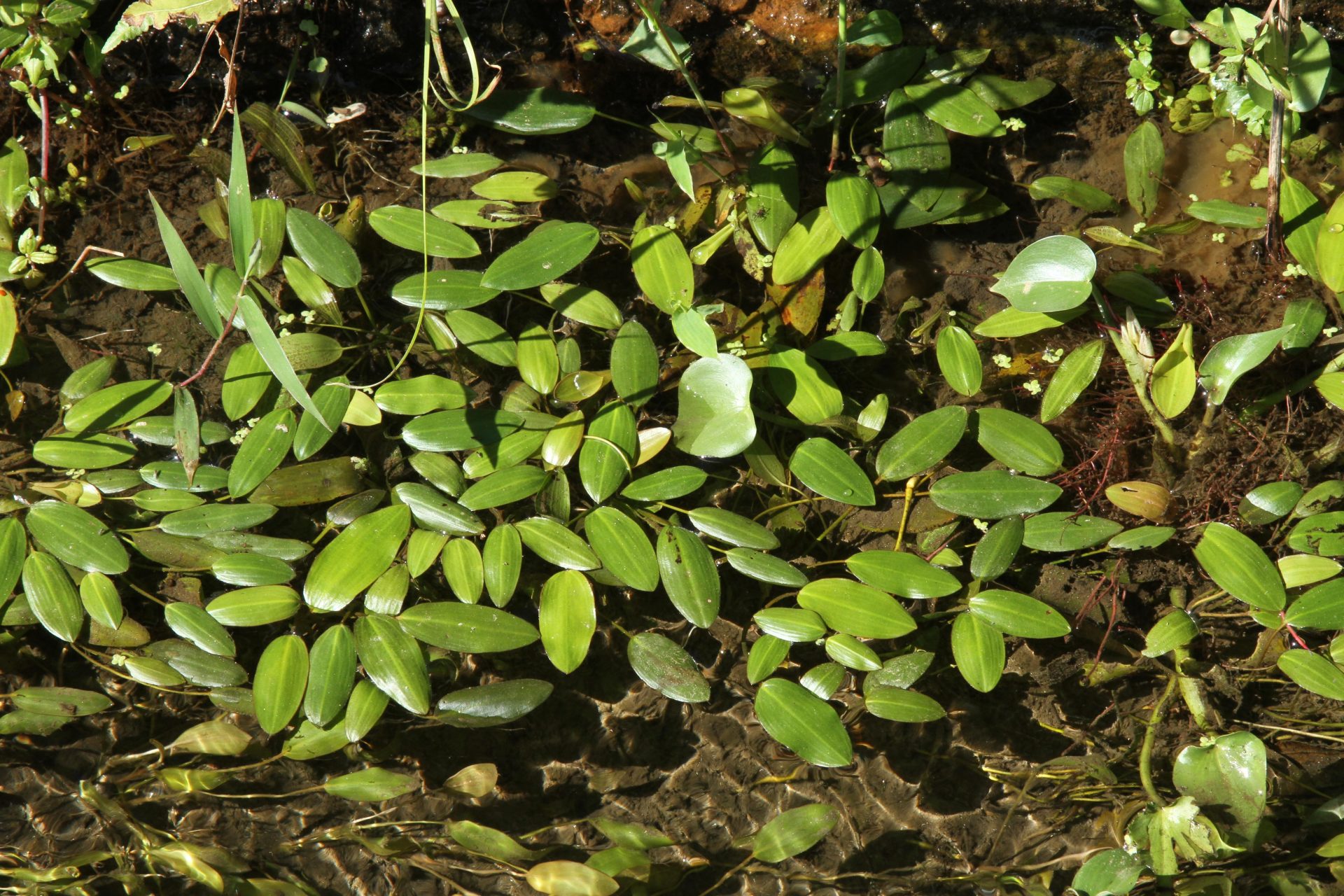
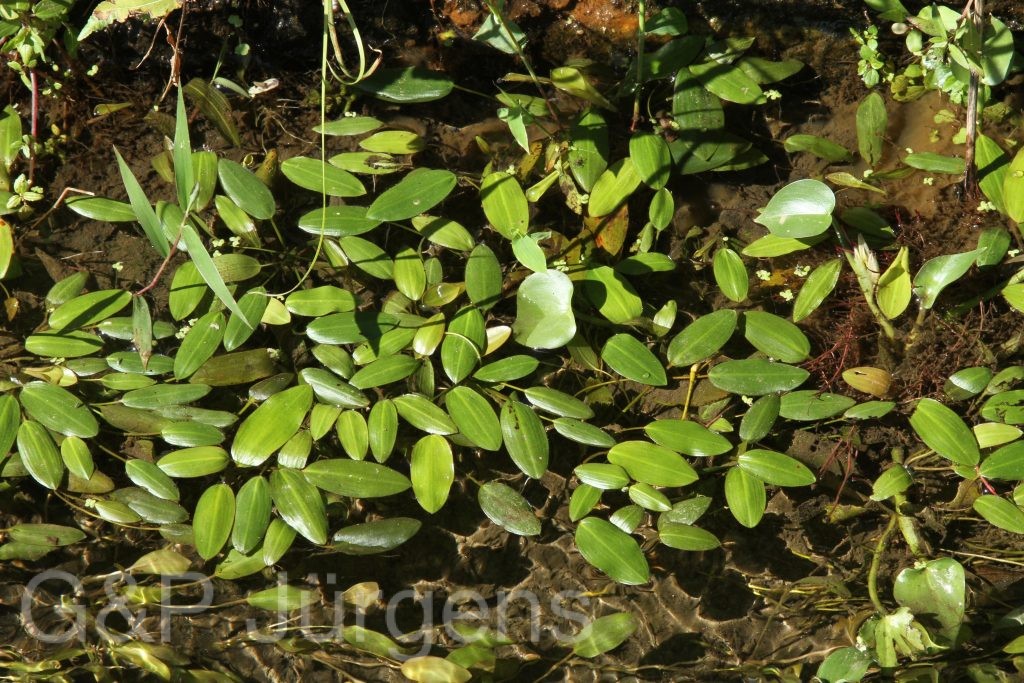
Potamogeton distinctus is an aquatic herb widespread across temperate and subtropical Asia, recorded from Japan, Korea, China, Taiwan and the Russian Far East through the Himalaya (India, Nepal, Bhutan) into Southeast Asia and beyond. It is a plant of still and slow-moving fresh water — ponds, ditches, paddy fields, oxbows and the margins of slow rivers — from the lowlands to the lower montane belt. The individual photographed along the Mo Chu in Bhutan at 1,500 m in October illustrates its occurrence in a sluggish river backwater of the inner valleys, where it persists into autumn. It is well known as a weed of rice cultivation across its eastern range.
It is a perennial rooting in mud and spreading by slender, whitish, often tuber-bearing rhizomes. The plant is heterophyllous: submerged leaves are translucent, narrow and sessile or short-petioled, while the floating leaves are coriaceous, elliptic to oblong, long-petioled and with rounded to subcordate bases. Membranous stipules (ochreae) sheath the stem at the nodes. The inflorescence is a dense, cylindrical, emergent spike raised above the water on a stout peduncle; the small flowers each bear four clawed tepal-like segments and four stamens. The fruit is a small, obliquely obovoid drupelet with a short beak and a dorsal keel.
Potamogeton (Potamogetonaceae) is a cosmopolitan genus prone to hybridisation and to plastic, environmentally induced variation, which complicates identification; floating-leaved species such as P. distinctus are best separated on fruit, stipule and tuber characters. The species is widespread, often abundant, and of no conservation concern, though as a paddy weed it is locally controlled.
Author: A.Benn. · Sources: POWO (Kew), Flora of China Vol. 23, Flora of Bhutan Vol. 3, GBIF, Wiegleb & Kaplan: Account of Potamogeton (1998)