Tag:

Myanmar

Flowers of the Myanmar Himalaya — 604 species recorded from northern Myanmar (Burma) and the eastern Himalayan borderlands, a biodiversity hotspot linking the Himalaya to the mountains of Yunnan and Southeast Asia. The region’s forests and alpine slopes hold a rich flora of rhododendrons, orchids, balsams and gentians. Every page gives a botanical description, distribution, habitat and flowering time with the original photograph.

Wight & Arn.

Bhutan2014 8
Bhutan Sandrup 750m, May
Bhutan2014 222
Bhutan Karu-Chu 1800m, May

Description

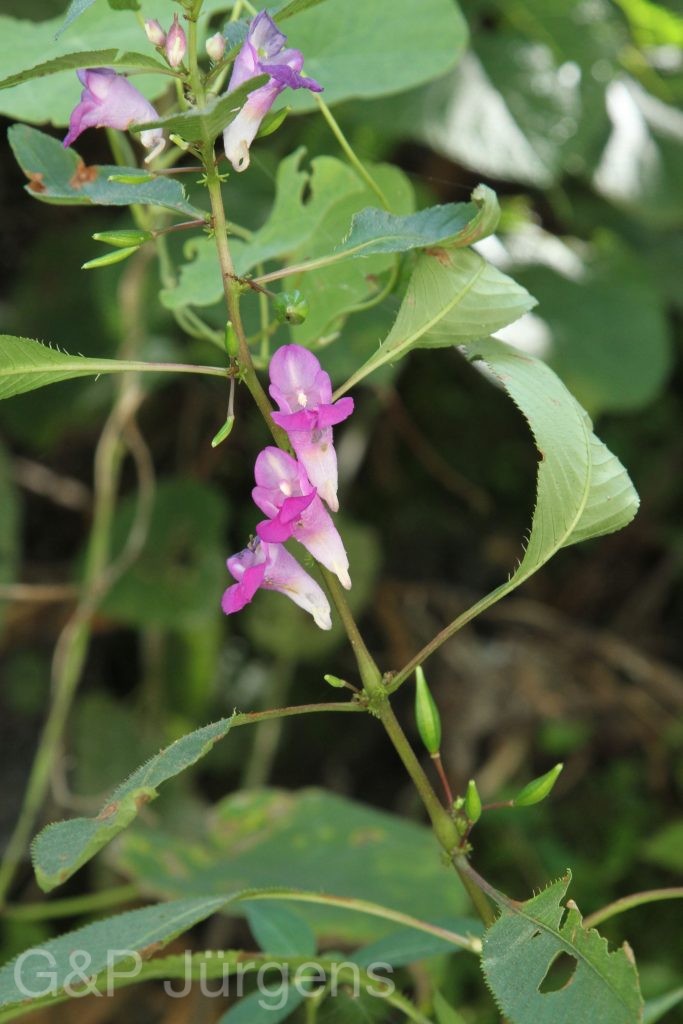
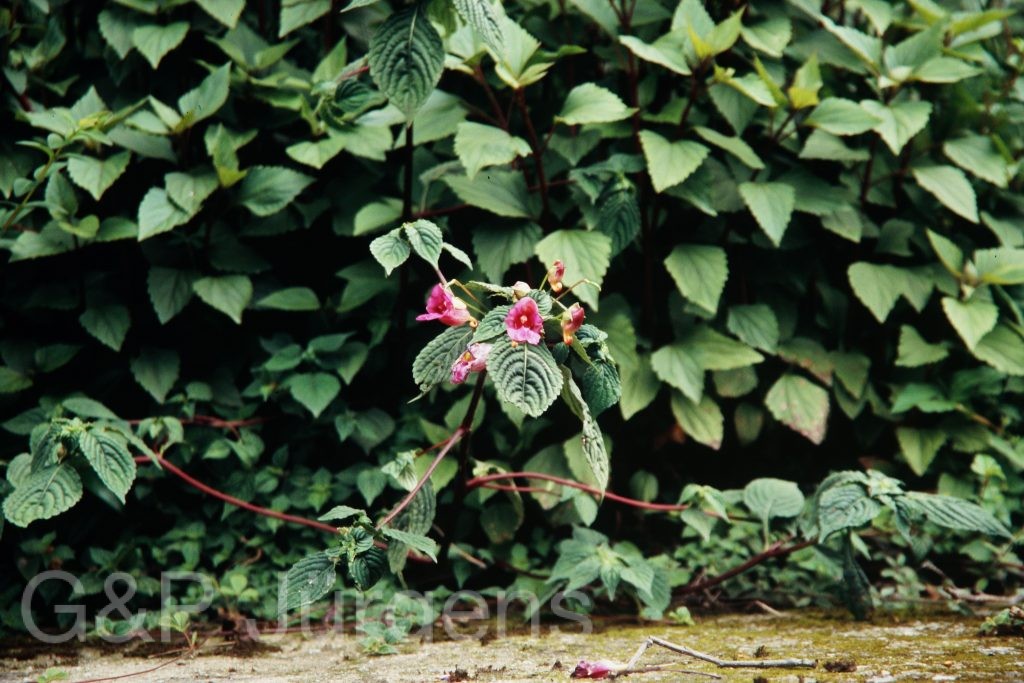
Hypericum hookerianum is a Himalayan and Sino-Himalayan shrubby St John's wort, native across China, NE India, Nepal, Bhutan and Myanmar, with GBIF recording some 638 occurrences including numerous cultivated and naturalised records from Europe, North America and Australasia. In the wild it grows in forest margins, clearings, scrub and on open rocky slopes. The photographed Bhutanese plants from Sandrup (750 m) and Karu-Chu (1,800 m), both in May, illustrate its wide altitudinal tolerance from the subtropical foothills to the warm temperate belt.

It is an evergreen or semi-evergreen shrub with terete, often reddish branches. The leaves are opposite, ovate to oblong or lanceolate, sessile or nearly so, frequently glaucous beneath and dotted with pale translucent glands. The flowers are large and showy, borne singly or in few-flowered cymes; they are cup-shaped to bowl-shaped, deep golden-yellow, with five broad concave petals and a dense central boss of numerous stamens grouped in five fascicles surrounding a stout ovary with several styles. The fruit is a many-seeded septicidal capsule.

Hypericum hookerianum is a parent of several widely grown ornamental cultivars and hybrids, valued for its robust habit and bold flowers, which accounts for its scattered occurrence well beyond its native range. The translucent and dark glands of the foliage, characteristic of the genus, contain hypericin and hyperforin and related bioactive compounds. Within the large and complex genus Hypericum, the species belongs to the woody section Ascyreia, distinguished by its shrubby habit, large bowl-shaped flowers and fascicled stamens; it is of no conservation concern given its breadth of range and cultivation.

Author: Wight & Arn. · Sources: POWO (Kew), Flora of Bhutan Vol. 1, GBIF, Flora of China Vol. 13, Robson: Studies in the Genus Hypericum (Bulletin of the Natural History Museum)
Hypoxis aurea

by GP Jürgens

Lour.

Nepal 97 491 P962
Nepal Num 1650m May
Nepal 99 198 ergebnis
West-Nepal Lara-Lake 2900m, June

Description

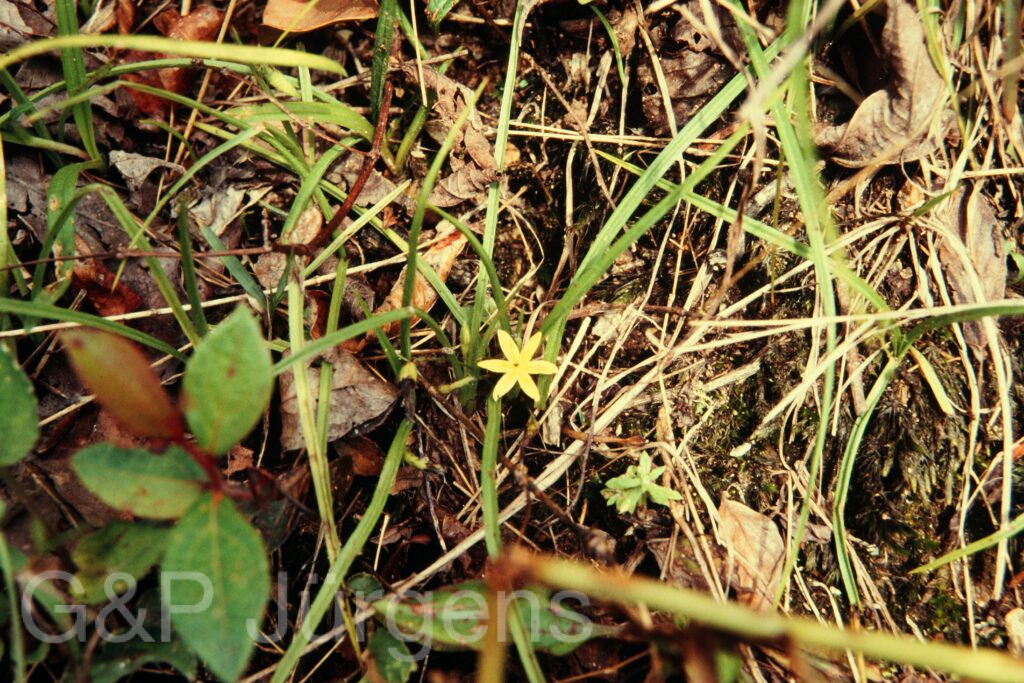
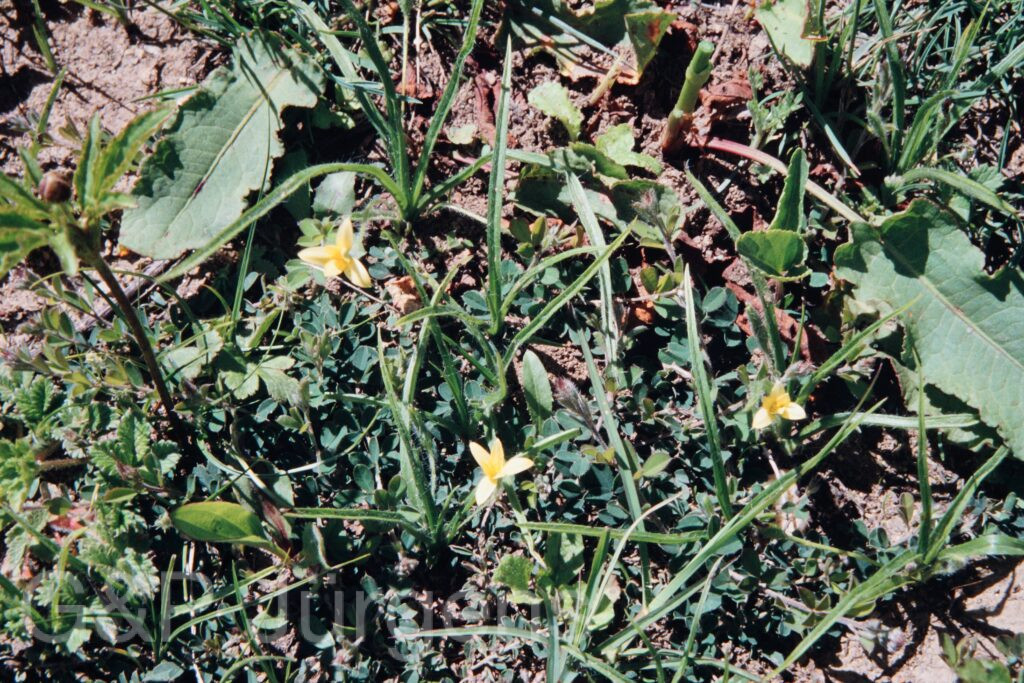
Hypoxis aurea Lour. is a small cormous geophyte of the Hypoxidaceae with a wide Asian and Pacific distribution, recorded from India, Nepal, Bhutan, Sri Lanka and China through Taiwan, Japan and Korea, across Southeast Asia (Myanmar, Thailand, Vietnam, Laos, Cambodia, Indonesia, the Philippines) to New Guinea, with around 1,240 georeferenced occurrences. It grows in open, well-lit grassy habitats: hill grassland, open pine and oak woodland, pasture, terrace banks and disturbed slopes, often in seasonally moist soils. The photographed plants from Num at about 1,650 m and from the Lara-Lake area of West Nepal at about 2,900 m, flowering in May and June, show its broad altitudinal span from subtropical foothills to the lower-temperate zone in the Himalaya.

It is a perennial herb arising from a small ovoid to tuberous corm. The leaves are all basal, several, narrowly linear and grass-like, often keeled and clothed (especially toward the base) in long soft hairs. The flowers are borne singly or few together on slender scapes shorter than or about equalling the leaves; each has six spreading yellow tepals, golden within and frequently greenish and hairy on the outer surface, with six stamens and an inferior, hairy ovary. The fruit is a small capsule opening to release numerous tiny black, often muricate seeds.

Hypoxis is a chiefly tropical and warm-temperate genus of grassland geophytes, and its members are well adapted to fire and seasonal drought through the perennating corm, which resprouts after burning or dry-season dormancy. The yellow, pollen-rich, nectarless flowers attract pollen-gathering insects. Widely distributed and frequently associated with grazed and disturbed grassland, H. aurea is common across its range and not considered threatened.

Author: Lour. · Sources: POWO (Kew), Flora of China Vol. 24, Flora of Bhutan Vol. 3, GBIF, Nordal: Hypoxidaceae (in Kubitzki, 1998)

Wall.

Bh2008 420 P656
Bhutan Phobjika, 3100m April

Description

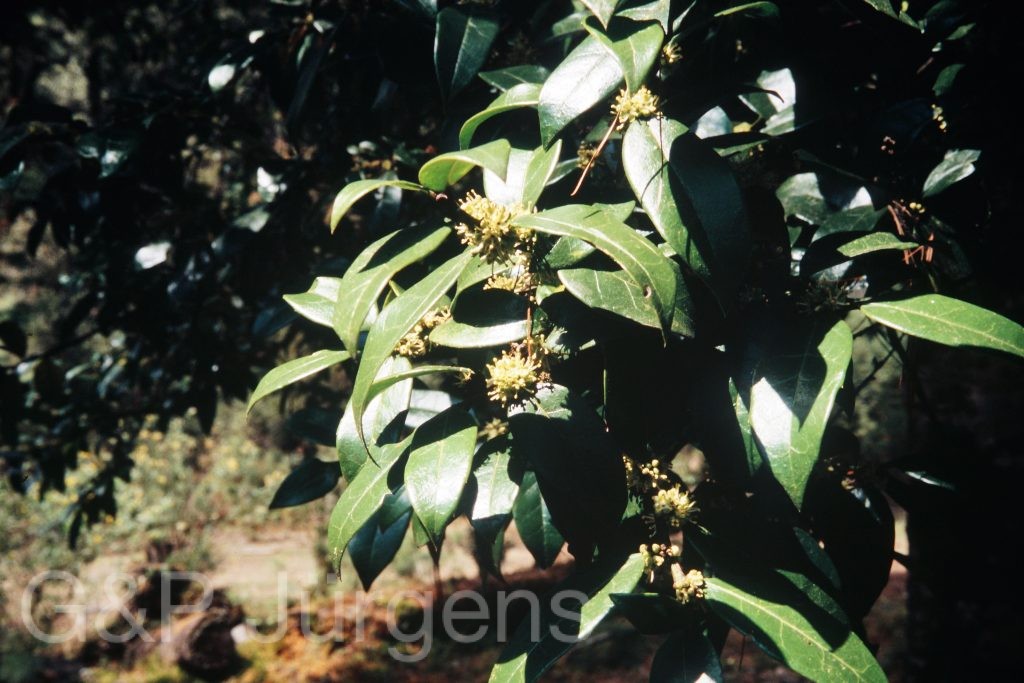
Ilex dipyrena, the Himalayan holly, is an evergreen tree or large shrub distributed along the Himalaya from Pakistan and northern India through Nepal, Sikkim and Bhutan into southern China (Yunnan, Xizang) and Myanmar. It is a characteristic constituent of cool temperate broad-leaved and mixed conifer forest, growing on shaded slopes, ridges and forest margins. It occurs mainly between about 1,800 and 3,300 m; the plant recorded in the Phobjikha valley of Bhutan at 3,100 m in April lies in the upper part of this band, within the moist temperate forest belt where it forms part of the evergreen understorey.

The plant is a small to medium-sized tree with greyish bark and glabrous twigs. The leaves are alternate, leathery and glossy dark green, elliptic to oblong-lanceolate, with a spinose-dentate margin bearing rigid marginal teeth on vigorous shoots, the teeth often reduced on older growth. The plant is dioecious, with small greenish-white, four-merous flowers clustered in the leaf axils. The fruit is a globose drupe ripening dull red, containing typically two pyrenes, a feature reflected in the epithet dipyrena, distinguishing it from the four- to five-seeded common holly.

Ilex is a large, near-cosmopolitan genus and the sole member of its family. Ilex dipyrena, described by Wallich, is the principal native holly of the Himalaya and a long-cultivated ornamental and parent of garden hybrids. Its evergreen, drupe-bearing habit provides food for birds, which disperse the seeds, and it contributes to the structure of temperate Himalayan forest. The species is widespread and common, and is not considered to be of conservation concern.

Author: Wall. · Sources: POWO (Kew), Flora of China Vol. 11, Flora of Bhutan Vol. 2, GBIF, Loizeau et al.: Ilex phylogeny

Hook.f. & Thomson

Bhutan2012 346
Bhutan Dochu-La 3000m, September

Description

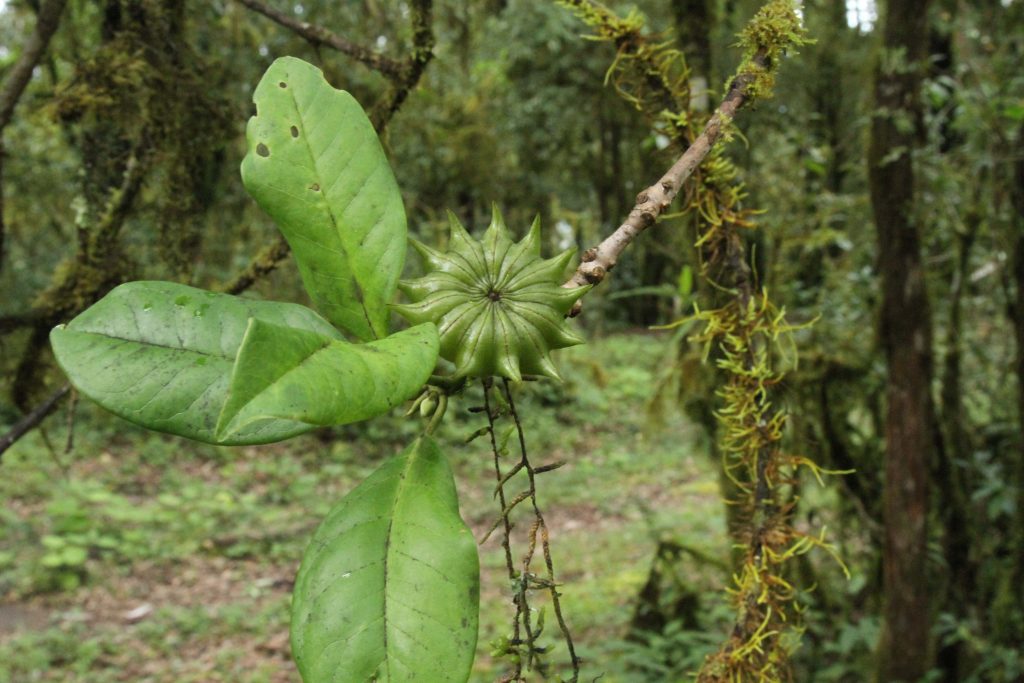
Illicium griffithii Hook.f. & Thomson is an aromatic evergreen tree or shrub of the eastern Himalaya and montane Southeast Asia. GBIF records it from Bhutan, NE India, China, Myanmar, Bangladesh, Vietnam, Cambodia and Malaysia (about 220 occurrences), a distribution centred on the wet temperate to subtropical forests of the eastern Sino-Himalaya. It grows in cool, humid, mossy broad-leaved and mixed conifer forest, often as an understorey component on damp slopes and ridges, typically between roughly 1,800 and 3,000 m; the illustrated plant is from Bhutan at Dochu-La, 3,000 m, in September, near the upper limit of its range.

The plant is a small to medium-sized tree with smooth bark and aromatic tissues. The leaves are alternate but crowded toward the branch tips in pseudowhorls, simple, entire, elliptic to oblanceolate, leathery, glabrous and gland-dotted, exuding an anise-like scent when crushed. The flowers are solitary and axillary, with numerous spirally arranged perianth segments grading from sepaloid to petaloid, pinkish to dark red, the stamens and free carpels also numerous in the manner of the basal angiosperms. The fruit is the characteristic star-shaped aggregate of (usually) 8–13 woody follicles arranged in a single whorl, each follicle opening to release a single glossy seed.

Illicium (Schisandraceae, formerly Illiciaceae) belongs to the basal angiosperm order Austrobaileyales. Like its relatives the seeds and fruit contain toxic sesquiterpene lactones (anisatin-type), and the star anise of this species is harvested locally for incense, flavouring and medicine, demanding care given its toxicity. The species is widespread within suitable montane forest and is not currently regarded as threatened.

Author: Hook.f. & Thomson · Sources: POWO (Kew), GBIF, Flora of China Vol. 7, Flora of Bhutan Vol. 1, Smith: A Taxonomic Review of Illicium (Sargentia)

Hook.f. & Thomson

Bhutan2012 329
Bhutan Dochu-La 3200m, September
Bhutan2012 330
Bhutan Dochu-La 3200m, September

Description

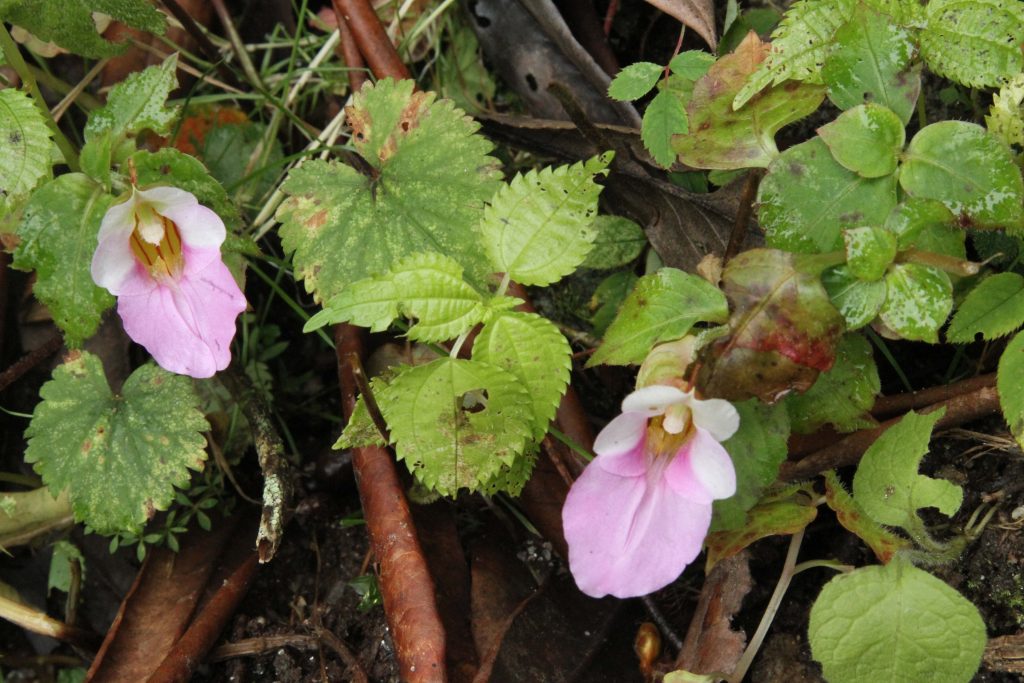
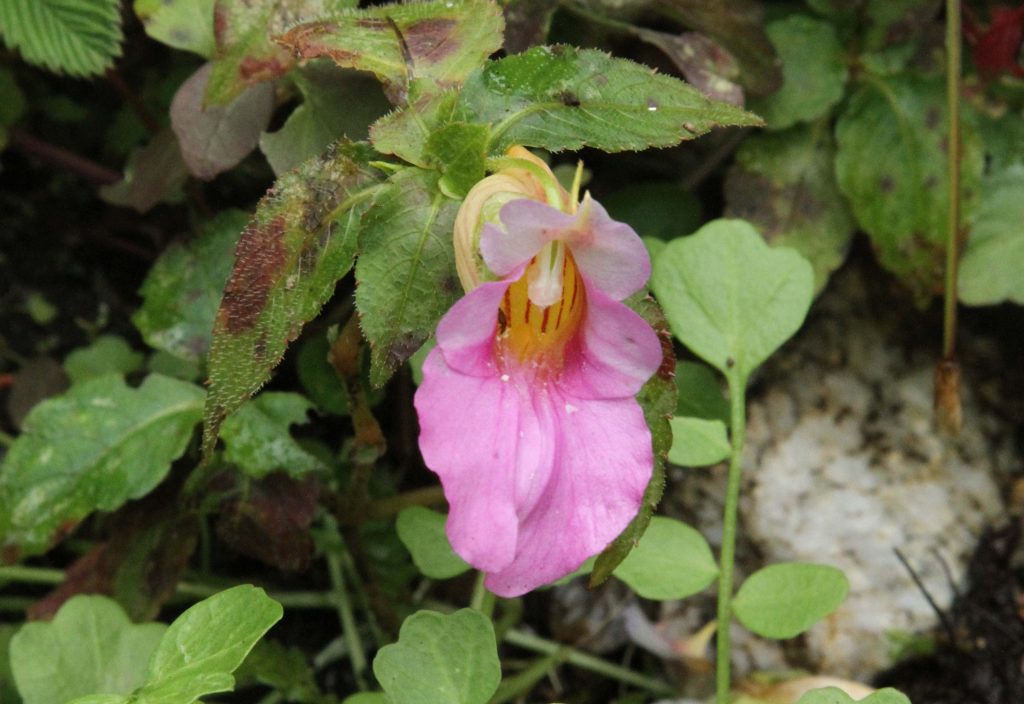
Impatiens arguta is a Sino-Himalayan balsam distributed from the central and eastern Himalaya through Myanmar into south-western China; GBIF records around 934 occurrences across China, India, Myanmar, Bhutan and Nepal. It is a plant of cool, humid temperate forest, growing on shaded moist banks, stream sides, forest margins and clearings, often in the broadleaved and mixed conifer belt. The image from Dochu-La in Bhutan at about 3200 m in September shows it flowering at a misty high pass late in the monsoon season, when temperate balsams reach their flowering peak in the abundant moisture and dappled shade of these slopes.

It is an erect, succulent perennial herb with stout, translucent, glabrous stems swollen at the nodes. The leaves are alternate or subopposite, ovate to lanceolate, with a sharply toothed (arguta, sharp-toothed) margin, an acuminate apex and a petiole sometimes bearing small glands. Flowers are borne singly or few together in the leaf axils on slender pedicels, zygomorphic and showy, typically purple to violet or pinkish; the lower sepal is boat-shaped and prolonged into a slender incurved spur, and the lateral united petals are two-lobed. The fruit is a fleshy, club-shaped capsule that dehisces explosively, scattering the seeds by elastic recoil of the valves.

The genus Impatiens is exceptionally species-rich and rapidly diversifying in the Himalaya, where many narrowly endemic taxa replace one another along altitudinal and longitudinal gradients. The explosive ballistic seed dispersal and nectar-spurred, insect-pollinated flowers of I. arguta are characteristic of the family. The species is widespread and not of conservation concern, but as a moisture-demanding forest herb it depends on the intact humid temperate woodlands of the eastern Himalaya.

Author: Hook.f. & Thomson · Sources: POWO (Kew), GBIF, Flora of Bhutan, Flora of China (Balsaminaceae), Grey-Wilson monograph of Impatiens

Hook.f.

Nepal 95 205 P344 ergebnis
Nepal Cluning-Khola 2900m October

Description

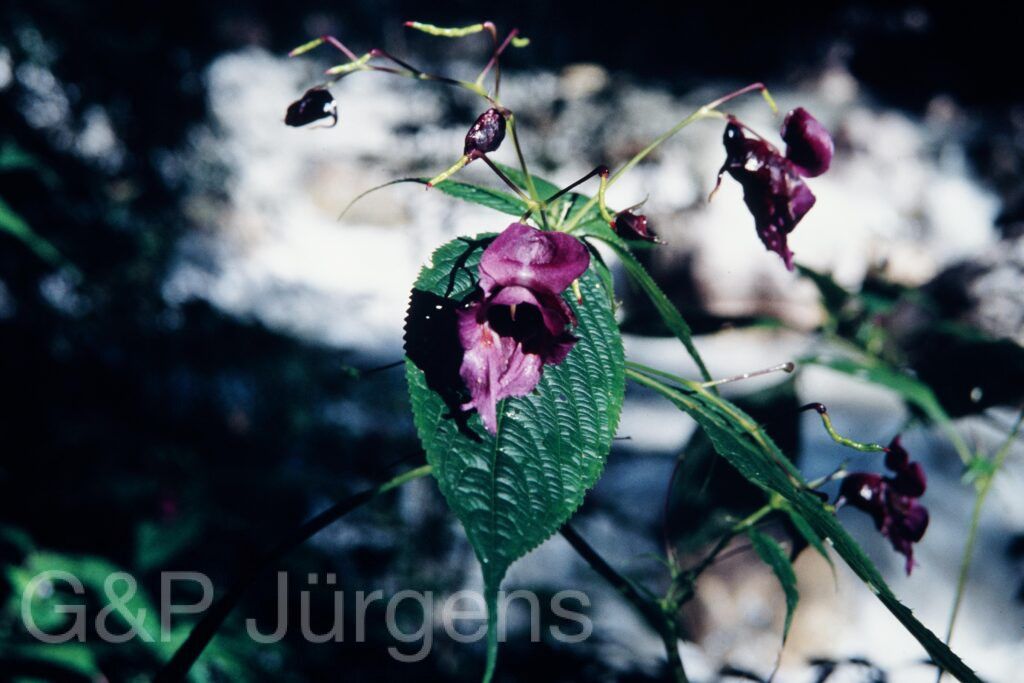
Impatiens cymbifera Hook.f. is a Sino-Himalayan balsam distributed across Nepal, China, India, Bhutan and Myanmar (NP, CN, IN, BT, MM), with GBIF recording about 103 occurrences. It is a plant of cool, humid montane forest, favouring shaded streamsides, seepage slopes, moist rock faces and path margins. The material photographed at the Cluning-Khola in Nepal at 2900 m in October reflects its autumn flowering in the temperate forest belt, where late-monsoon moisture sustains its succulent growth and prolongs anthesis into the post-monsoon season.

It is an erect, succulent annual with translucent, often reddish, watery stems swollen at the nodes and rooting below. The leaves are alternate, ovate to elliptic with a serrate margin bearing small stipitate glands at the base, and an acuminate apex. The flowers are borne singly or few in the leaf axils on slender pedicels, the corolla zygomorphic; the lower sepal is conspicuously enlarged into a boat-shaped (cymbiform, hence the epithet) saccate body abruptly contracted into an incurved spur, while the lateral united petals form two-lobed wings. The capsule is the characteristic clavate, explosively dehiscent fruit of the genus, scattering seeds by elastic recoil of the valves.

Within the large and intricate genus Impatiens, a centre of diversity in the Sino-Himalayan region, I. cymbifera belongs to the forest-dwelling annuals with strongly saccate lower sepals. Its flowers are pollinated by long-tongued insects, and explosive ballistic seed dispersal aids colonisation of moist disturbed ground. As a moisture-demanding annual it is tied to intact montane forest hydrology, and such balsams indicate undisturbed humid forest.

Author: Hook.f. · Sources: POWO (Kew), GBIF, Flora of Nepal, Flora of China Vol. 12, Flora of Bhutan Vol. 2, Grey-Wilson monograph and Sino-Himalayan Impatiens studies

Hook.f.

Bhutan2015 90
Bhutan Wangdi 1400m, October

Description

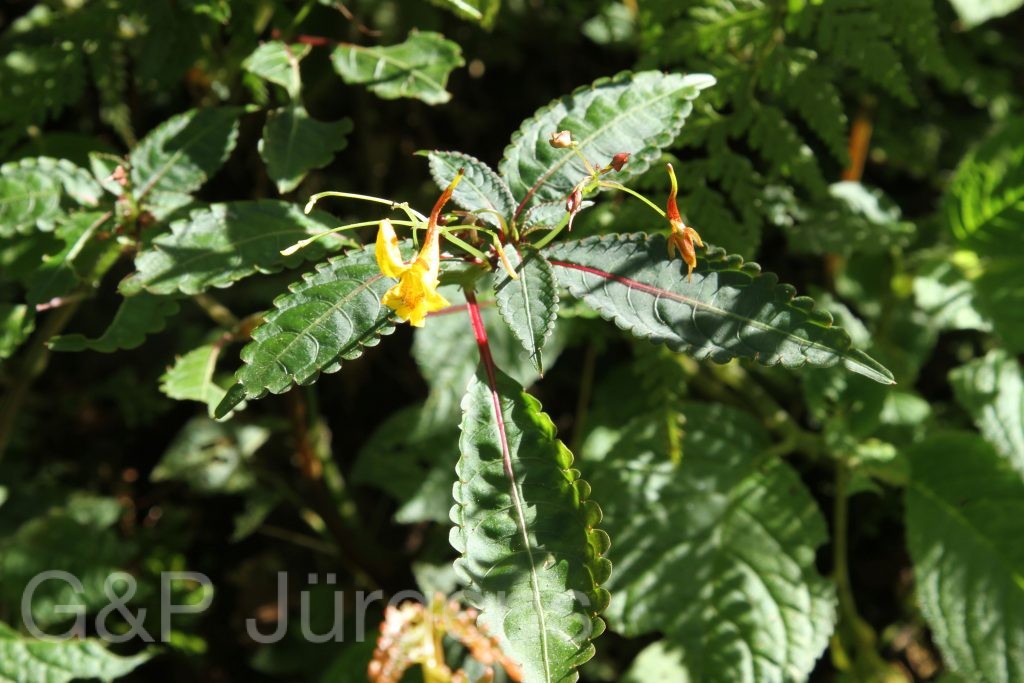
Impatiens drepanophora is a wide-ranging balsam of the eastern Himalaya and Indo-Burmese region, documented from Myanmar, China, India, Nepal, Bangladesh, Bhutan, Laos and Thailand, with around 126 recorded occurrences across this broad arc. It is a plant of warm-temperate to subtropical montane habitats, growing on moist shaded banks, along forest streams, in damp ravines and on disturbed roadside ground where seepage and high humidity prevail. The photographed plant from Wangdi in western Bhutan, at about 1400 m and flowering in October, reflects its mid-elevation preference and its characteristically late, post-monsoon flowering season.

It is a succulent annual with stout, translucent, often reddish-tinged stems that root at the lower nodes and branch freely. The leaves are alternate, ovate to elliptic-lanceolate with a long-acuminate apex and a crenate-serrate margin, the basal teeth or petiole base sometimes bearing stalked glands. The flowers are showy and zygomorphic, borne in axillary clusters, with a slender, conspicuously curved or sickle-shaped spur from which the epithet derives, the lower sepal forming the spurred sac; the lateral united petals and dorsal standard give the characteristic balsam form, the colouring pink to purplish. The fruit is the typical fleshy, explosively dehiscent capsule that scatters seeds when touched at maturity.

The genus Impatiens reaches exceptional richness in the eastern Himalaya, where wet forested slopes and a long monsoon foster numerous species distinguished largely by spur curvature, flower colour and leaf glands. The diagnostic falcate spur of I. drepanophora exemplifies the floral architecture that mediates pollination by long-tongued insects probing for spur-borne nectar. Being relatively widespread and tolerant of disturbed moist habitats, it is not of conservation concern, and like other balsams it can locally form abundant seasonal stands along watercourses and forest margins.

Author: Hook.f. · Sources: POWO (Kew), GBIF, Flora of Bhutan, Flora of China, Flora of British India, Grey-Wilson's Asian Impatiens revisions

DC.

Bhutan2012 940
Bhutan Jakar 1950m, October

Description

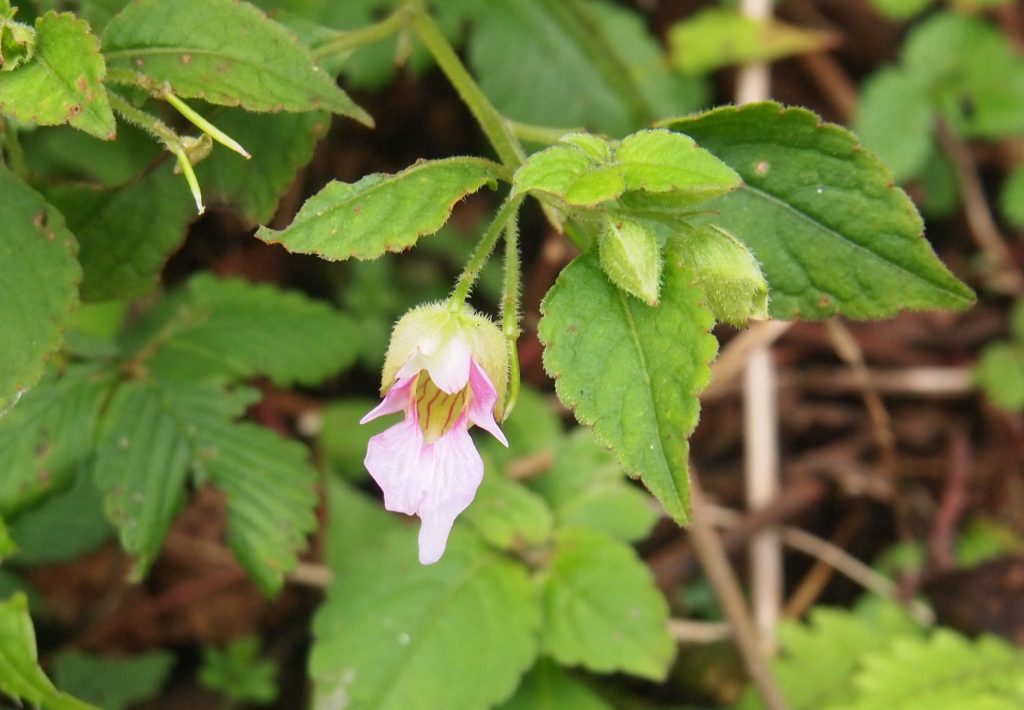
Impatiens puberula is a Himalayan balsam ranging through Nepal, India, China, Bhutan and Myanmar, with around 186 georeferenced records. It is a plant of cool, humid, shaded habitats, occurring on damp banks, stream-sides, seepage slopes and moist forest margins in the temperate zone. The individual photographed near Jakar in the Bumthang region of central Bhutan at about 1950 m in October illustrates its preference for shaded, moisture-retentive ground, where it flowers late into the monsoon season on rich, organic soils.

The species is a succulent annual with translucent, often reddish-tinged stems that are minutely puberulous, the indumentum giving rise to its epithet. The leaves are alternate, ovate to elliptic-lanceolate with a crenate-serrate margin, the teeth often gland-tipped, and taper to a petiole. The zygomorphic flowers are borne singly or in few-flowered axillary clusters; the showy lower sepal is prolonged into a slender, curved nectar spur, and the lateral united petals form broad wings, as is characteristic of the genus. The fruit is an explosively dehiscent fleshy capsule that, when ripe, coils its valves to fling out the seeds.

Impatiens is one of the largest angiosperm genera and is notably species-rich and taxonomically difficult across the Sino-Himalayan region, where rapid radiation has produced numerous narrowly defined and frequently endemic taxa separated by floral colour, spur curvature and seed sculpturing. Its explosive ballistic seed dispersal and dependence on perennially moist microhabitats make such balsams sensitive to drainage change and forest disturbance, though I. puberula remains widespread.

Author: DC. · Sources: POWO (Kew), GBIF, Flora of Bhutan, Flora of Nepal, Flora of China, Grey-Wilson's monograph of Impatiens

Wall.

Bh09 387 P613
Bhutan Mo-Chu, 1500m June

Description

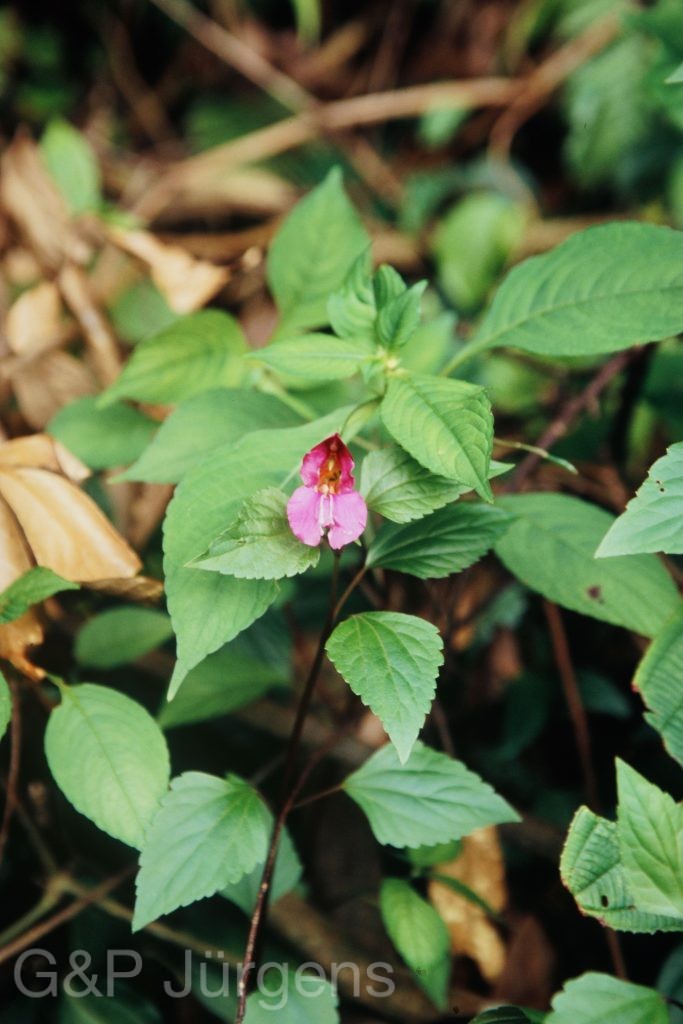
Impatiens sulcata is a tall, robust annual balsam of the Himalaya, recorded by GBIF (361 occurrences) from India, Nepal, Bhutan, Pakistan and adjacent China and Myanmar. It favours damp, nutrient-rich ground along streams, ditches, forest margins, roadside seepages and disturbed moist sites, principally from around 1500 to 3000 m in the warm-temperate and subtropical belts. The cited gathering from the Mo-Chu in Bhutan at 1500 m in June reflects its riparian preference, the plant typically forming dense, gregarious stands in the early monsoon along watercourses where the soil remains saturated.

The species is a succulent herb often exceeding a metre in height, with stout, conspicuously grooved (sulcate), reddish, hollow stems that root at the lower nodes. The leaves are large, ovate to ovate-lanceolate, serrate with crenate-glandular teeth, and arranged oppositely or in whorls toward the apex. Flowers are large and showy, pink to purplish, borne in axillary racemose clusters; the lower sepal forms a saccate spur, the standard is dorsally carinate, and the lateral united petals carry broad auricles. The fruit is a fleshy, club-shaped capsule that dehisces explosively, scattering the seeds by elastic recoil of the valves.

Belonging to the speciose, taxonomically complex genus Impatiens, the species sits among the tall Himalayan annual balsams and is allied to such forms as I. glandulifera, with which it shares vigorous growth and explosive seed dispersal. Its annual, fast-growing, ruderal habit makes it an effective colonist of disturbed riparian ground, while its open flowers are pollinated by bees and butterflies. It is widespread and not threatened.

Author: Wall. · Sources: POWO (Kew), GBIF, Flora of China Vol. 12, Flora of Bhutan Vol. 1, Flora of Nepal, Grey-Wilson Impatiens of Africa and the Himalaya

Roxb. ex DC.

Bhutan2015 120
Bhutan Galephug 600m, October
Bh09 288 G471
Bhutan Galephug 600m, October

Description

Impatiens tripetala is a succulent annual balsam of the warm, humid lowlands and foothills of the eastern Himalaya and Indo-Burma. GBIF lists 77 occurrences, centred on India, Myanmar, Bhutan and Nepal, with additional scattered or cultivated records reported under several country codes. It grows in moist shaded ground along forest streams, ditches and disturbed seepage sites in the subtropical belt, flowering late in and after the monsoon. The species was recorded at Galephug in southern Bhutan at about 600 m in October, a low foothill elevation reflecting its preference for warm, perhumid habitats.

It is an erect, glabrous herb with translucent, watery stems that are swollen at the nodes, rooting at the lower joints. The leaves are alternate, ovate to elliptic-lanceolate, crenate-serrate with the teeth often gland-tipped, and narrowed to a petiole. The zygomorphic flowers are borne on axillary peduncles; the lower sepal forms a spurred saccate pouch, and the corolla shows the reduced, apparently three-petalled appearance to which the epithet tripetala refers. The fruit is the characteristic fleshy, explosively dehiscent capsule of the genus, scattering its seeds by elastic recoil of the valves.

Impatiens (Balsaminaceae) is an enormous genus with a major centre of diversity in the Sino-Himalayan region, where many species are narrow endemics distinguished by flower colour, spur form and capsule shape. I. tripetala forms part of the rich lowland-to-submontane balsam flora of the eastern Himalaya. As an annual of moist, often disturbed ground it can be locally common, but the wider group is notable for high endemism and sensitivity to forest loss and hydrological change, themes relevant to its conservation context.

Author: Roxb. ex DC. · Sources: POWO (Kew), GBIF, Flora of Bhutan, Flora of British India, Annotated Checklist of the Flowering Plants of Nepal, Grey-Wilson monograph Impatiens of Africa and Asian revisions of Balsaminaceae