Tag:

Myanmar

Flowers of the Myanmar Himalaya — 604 species recorded from northern Myanmar (Burma) and the eastern Himalayan borderlands, a biodiversity hotspot linking the Himalaya to the mountains of Yunnan and Southeast Asia. The region’s forests and alpine slopes hold a rich flora of rhododendrons, orchids, balsams and gentians. Every page gives a botanical description, distribution, habitat and flowering time with the original photograph.

(Wall. ex DC.) B.Nord.
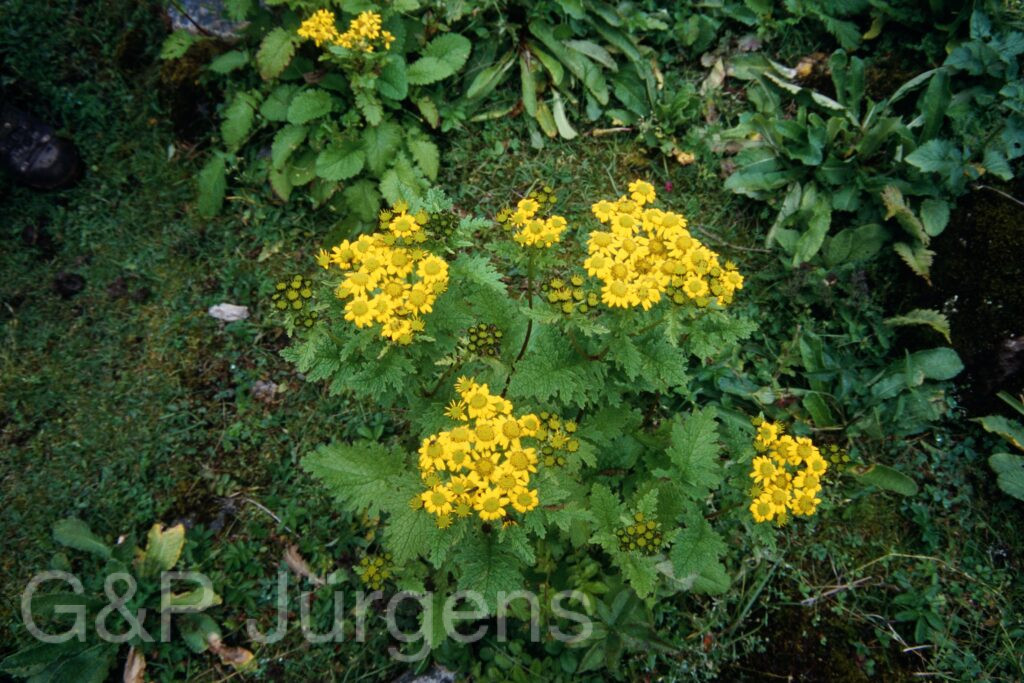
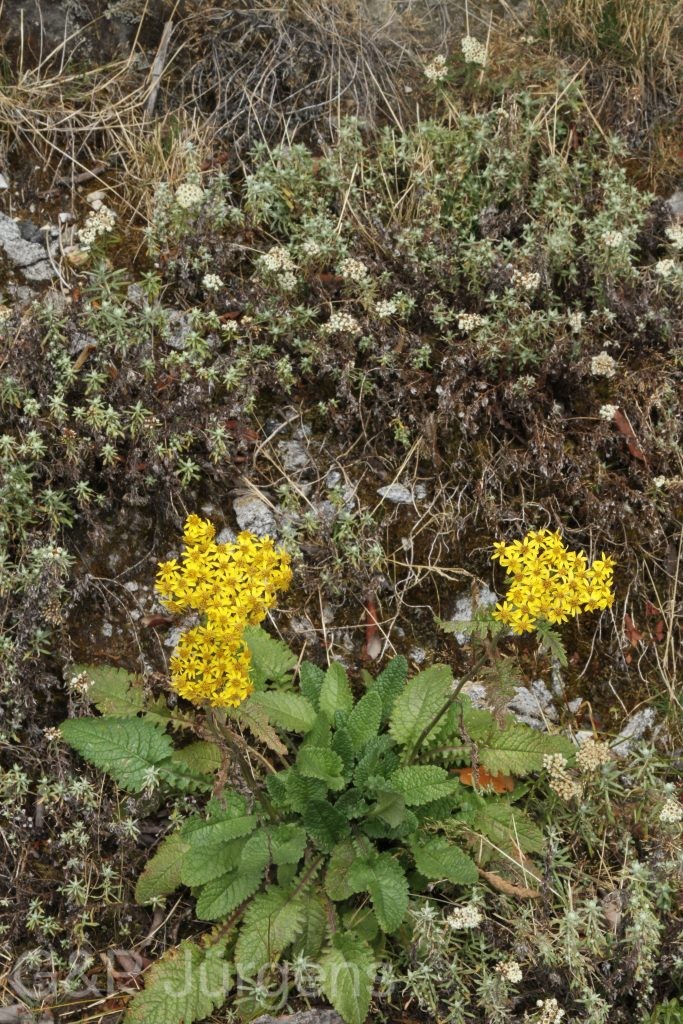
Sikkim2003 444 G617
Sikkim Chopta Valley 3900m August
Nepal 95 130 P222 ergebnis
Nepal south of Rupien La 3600m October
Bhutan2015 379
Bhutan Tumching-La 4000m, October

Description

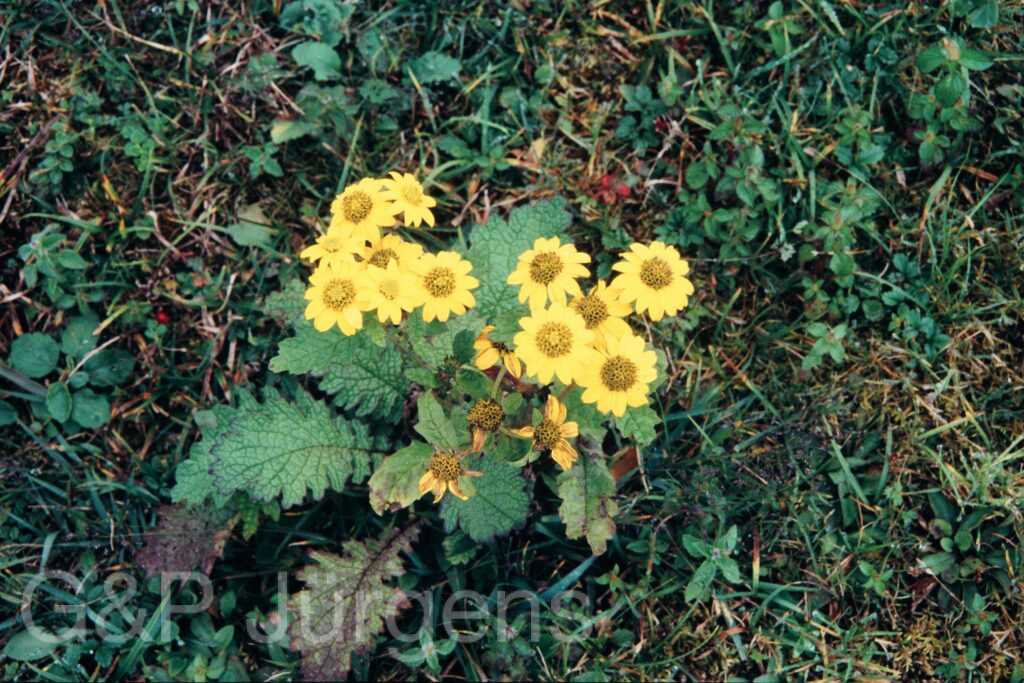
Jacobaea raphanifolia is a perennial herb of the high Himalaya and adjoining mountains of central Asia, recorded by GBIF (some 202 occurrences) from Nepal, India, China, Bhutan, Afghanistan, Pakistan and Myanmar, with scattered records reaching Kenya and South Africa that probably reflect cultivated or naturalised material. It is a plant of the upper subalpine and alpine zones, favouring moist meadows, streamsides, open scrub and damp rocky slopes. The species was photographed across a broad altitudinal band, in the Chopta Valley of Sikkim at about 3900 m in August, south of the Rupien La in Nepal at 3600 m in October, and on the Tumching La in Bhutan near 4000 m, a range centred between roughly 3500 and 4200 m.

It forms an erect, somewhat stout herb arising from a short, fibrous-rooted rhizome, with simple or branched leafy stems. The lower leaves are lyrate-pinnatifid to runcinate with a large terminal lobe, recalling a radish (raphanifolia), the margins toothed and the surfaces sparsely hairy; cauline leaves become smaller, sessile and often auriculate upwards. The capitula are radiate, several to many in a loose terminal corymb, subtended by a single row of narrow green phyllaries with a few short calyculate bracts. Ray florets are yellow, female and ligulate; the disc florets yellow, tubular and bisexual. The fruit is a ribbed, cylindrical cypsela crowned by a pappus of fine white capillary bristles.

The species belongs to a complex of montane ragworts segregated from Senecio into Jacobaea on molecular and morphological grounds. As a wide-ranging meadow herb of the alpine pastures it is locally common and of no conservation concern, though like many Senecioneae it contains pyrrolizidine alkaloids and is generally avoided by grazing stock, a trait that may favour its persistence in heavily pastured high valleys.

Author: (Wall. ex DC.) B.Nord. · Sources: POWO (Kew), GBIF, Flora of Bhutan, Flora of China, Annotated Checklist of the Flowering Plants of Nepal, Nordenstam's revision of Jacobaea and the Senecioneae
Wall.

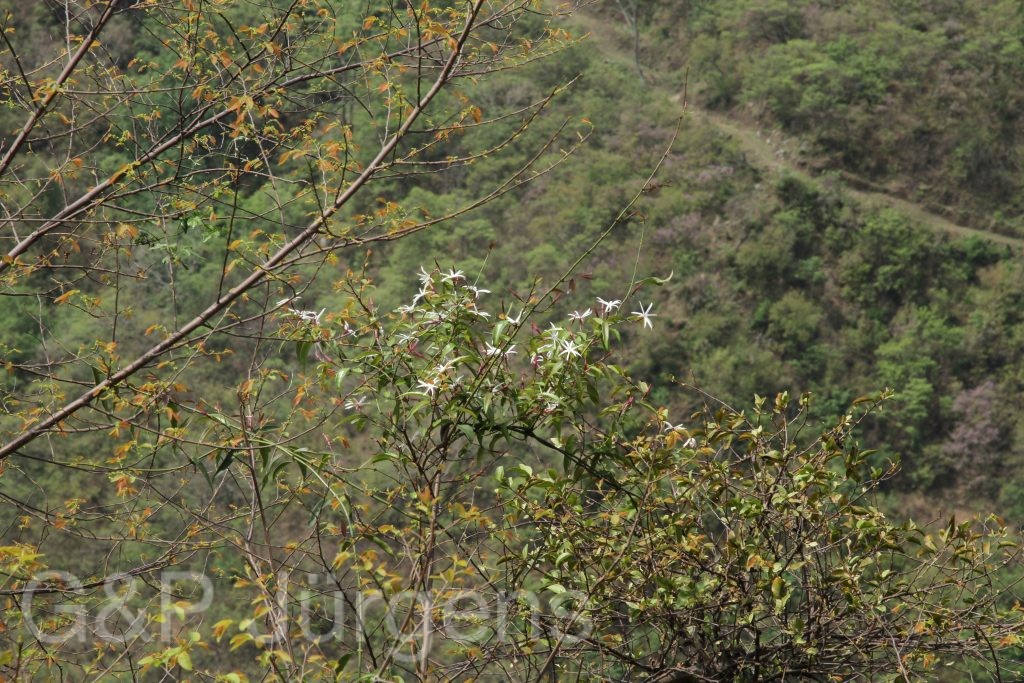
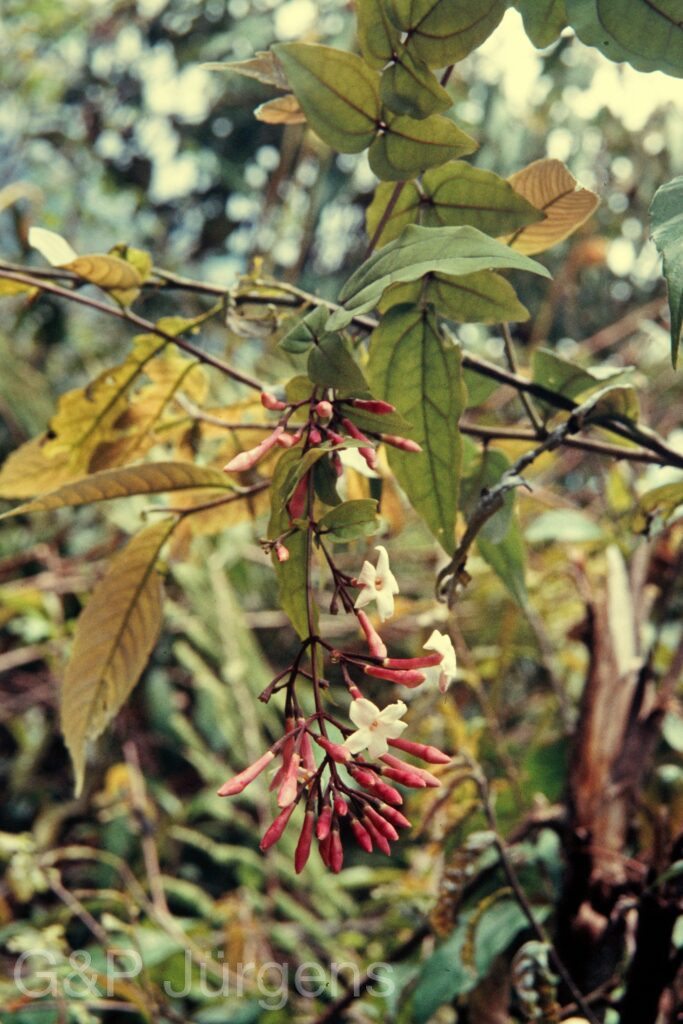
Nepal 97 92 P153
Nepal above Meta-Khola 2250m April
Nepal 97 312 P616
Nepal above Meta-Khola 2250m April

Description

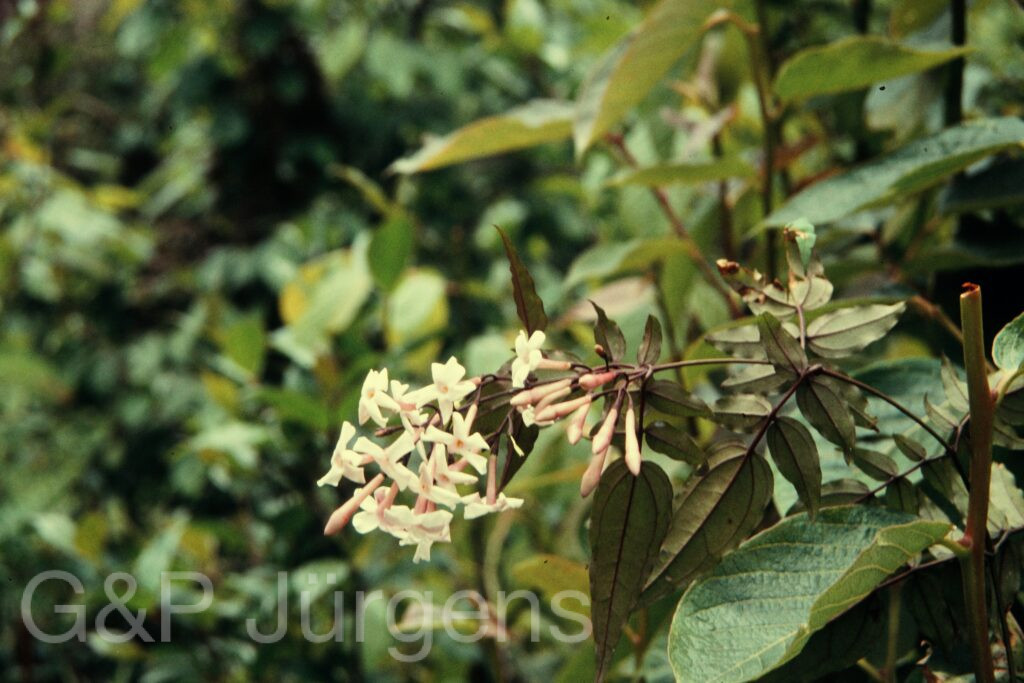
Jasminum dispermum is a scandent or climbing jasmine widely distributed across the Himalaya and montane south-east Asia, recorded from China, India, Nepal, Myanmar, Thailand and Bhutan, with outlying records (ID, KR, RU, ZZ) reflecting cultivation and herbarium material. Of more than 400 georeferenced collections, the core range lies along the subtropical-to-temperate forest belt of the Himalayan foothills. It grows in forest margins, scrub, ravines and along streams, scrambling over rocks and shrubs in the warm-temperate zone. The photographed plant from above the Meta-Khola in Nepal at 2250 m, flowering in April, is typical of its lower montane habitat and its spring flowering ahead of the monsoon.

It is a woody, twining shrub or liana with terete, often pubescent branchlets. The leaves are opposite and pinnately compound, usually with five to seven leaflets (sometimes reduced to three or trifoliolate uppermost ones), the leaflets ovate to lanceolate, acuminate and entire. The fragrant flowers are borne in terminal and axillary cymose panicles; each has a small, toothed calyx and a salverform corolla with a slender tube and spreading lobes, white within and frequently flushed pink or rose-purple on the outside in bud. Two stamens are inserted in the corolla tube. The fruit, reflected in the epithet dispermum, is a paired or two-seeded berry that ripens black.

Jasminum is a large Old World genus of the olive family centred on tropical and warm-temperate Asia and Africa, many species prized for their scent. J. dispermum is a vigorous, ornamentally attractive climber, occasionally cultivated, and remains common throughout its native range with no conservation concern. Its nocturnally fragrant, pale flowers suggest pollination by long-tongued moths and other nectar-seeking insects.

Author: Wall. · Sources: POWO (Kew), GBIF, Flora of China Vol. 15, Flora of Bhutan Vol. 2, Flora of Nepal, Green's Synopsis of the Oleaceae

Roxb. ex Hornem.

Bhutan2014 149
Bhutan Trashigang 2000m, May

Description

Jasminum laurifolium is a climbing jasmine native to the eastern Himalaya and South-East Asia, occurring in north-eastern India, Bhutan, Nepal, Myanmar, Thailand and southern China, and widely cultivated as an ornamental; its GBIF records (over 440) span this native range together with numerous cultivated occurrences in the Americas, the Pacific and the West Indies that account for the scattered records in Brazil, Colombia, Mexico, French Polynesia and the Caribbean. It grows in evergreen and mixed forest, on forest margins, thickets and shrubby slopes, generally up to about 2000 m. The photographed plant from Trashigang in eastern Bhutan at 2000 m in May reflects its occurrence in warm, humid mid-elevation forest.

It is an evergreen, woody twining shrub or liana with slender, glabrous, terete branchlets. The opposite, simple leaves are leathery and glossy, ovate-lanceolate to elliptic and laurel-like (whence laurifolium), with an entire margin, a long-acuminate apex and prominent pinnate venation. The fragrant flowers are borne in terminal and axillary cymes; each has a small, toothed calyx and a salverform white corolla with a slender tube and several narrow, spreading lobes. The fruit is a small, two-lobed black berry, often only one lobe maturing.

Jasminum is a large genus of the olive family Oleaceae, well represented in tropical Asia. J. laurifolium, sometimes treated with the variety brachylobum, is grown for its fragrant white flowers and is a familiar ornamental and source of perfume. Widespread in the wild and broadly cultivated, it is not of conservation concern, and its escape and naturalisation in warm regions outside its native range account for many of the extralimital records.

Author: Roxb. ex Hornem. · Sources: POWO (Kew), GBIF, Flora of China, Flora of Bhutan, Flora of Thailand, Jasminum (Oleaceae) revision (Green monograph)

Sam.

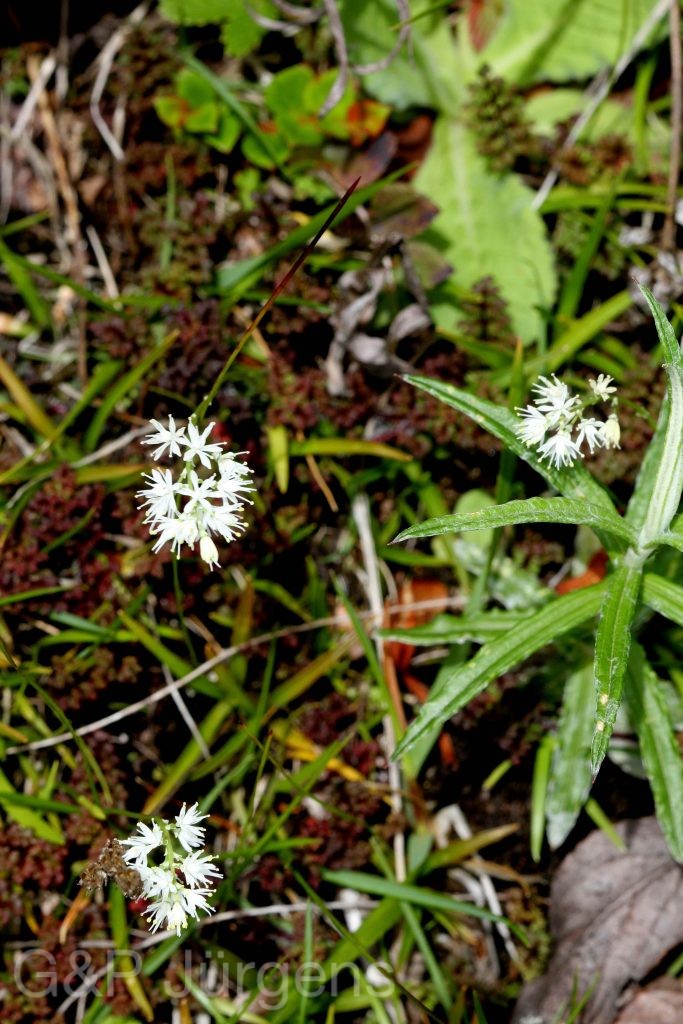
Sikkim2011 378
Sikkim Lada-La 3400, June

Description

Juncus cephalostigma is a Himalayan rush distributed from Nepal through Sikkim and adjacent India to Bhutan, northern Myanmar and south-western China, with about 139 GBIF records reflecting a restricted eastern Himalayan to Sino-Himalayan range. It is a plant of wet alpine and subalpine habitats: marshy meadows, streamsides, seepage slopes, springs and the margins of pools, generally between about 3,000 and 4,200 m. The plant photographed at Lada-La in Sikkim at 3,400 m, flowering in June, is typical of the cool, perennially moist high-montane grasslands and mires where rushes of this group thrive.

The plant is a tufted perennial herb growing from a short rhizome, with slender, erect, terete to compressed stems. The leaves are basal and cauline, grass-like, with the characteristic open or closed tubular sheaths of the genus. The inflorescence is a small terminal or pseudolateral cluster of few flowers, often condensed into a head (the epithet cephalostigma alluding to the head-like stigmatic arrangement); each flower has six small, scarious-margined, brownish to greenish tepals, six (or three) stamens, and a superior ovary crowned by a style with three stigmas. The fruit is a small loculicidal capsule containing numerous minute seeds.

Juncus is the largest genus of Juncaceae, a wind-pollinated family of cosmopolitan, mostly cool-climate and wetland graminoid herbs. The Himalayan rushes form a taxonomically demanding assemblage in which species are separated by fine characters of the inflorescence, capsule and seed. As an inhabitant of high-altitude wetlands, J. cephalostigma is sensitive to hydrological change and grazing, though it is not currently regarded as threatened.

Author: Sam. · Sources: POWO (Kew), Flora of China Vol. 24, Flora of Bhutan Vol. 3, GBIF, Kirschner: Juncaceae (Species Plantarum: Flora of the World)

D.Don

Sikkim2011 200
Sikkim Yumthang 3300m, June

Description

Juncus concinnus is a tufted, grass-like perennial rush of the Juncaceae, distributed through the Himalaya and the mountains of eastern Asia. GBIF data (nearly 1,000 occurrences) document a native range across China, Nepal, India, Bhutan, Pakistan, Japan, Myanmar and Thailand. The species is characteristic of moist alpine and subalpine habitats, including wet meadows, marshy ground, streamsides, seepage flushes and damp grassy slopes, generally between about 2,500 and 4,500 m. The collection from Yumthang in northern Sikkim at 3,300 m in June reflects its occurrence in the wet, snow-fed alpine meadows of the eastern Himalaya in early summer.

The plant forms dense tufts of slender, erect, terete to slightly compressed stems arising from a short rhizome, with narrow, channelled basal and cauline leaves. The inflorescence is a more or less compact, terminal cluster of several flower heads, each head comprising a few small, dark-coloured flowers. As in all Juncus, the perianth consists of six chaffy, lanceolate tepals (the inner and outer whorls similar), subtending three or six stamens and a superior ovary. The fruit is a small, three-valved loculicidal capsule containing numerous minute seeds, the chaffy perianth persisting around it.

Juncus is a large, cosmopolitan genus of the rush family, an assemblage of wind-pollinated, reduced-flowered monocots adapted predominantly to wet and seasonally inundated ground. As a component of alpine mire and wet-meadow vegetation, J. concinnus contributes to the structure of high-altitude wetland turf and stabilises moist soils. Widely distributed and secure across its range, it nonetheless depends on intact alpine hydrology, making it sensitive to wetland drainage and to changes in snowmelt regimes.

Author: D.Don · Sources: POWO (Kew), Flora of China Vol. 24, Flora of Bhutan Vol. 3, GBIF, Kirschner et al.: Juncaceae – Species Plantarum: Flora of the World

Buch.-Ham. ex D.Don

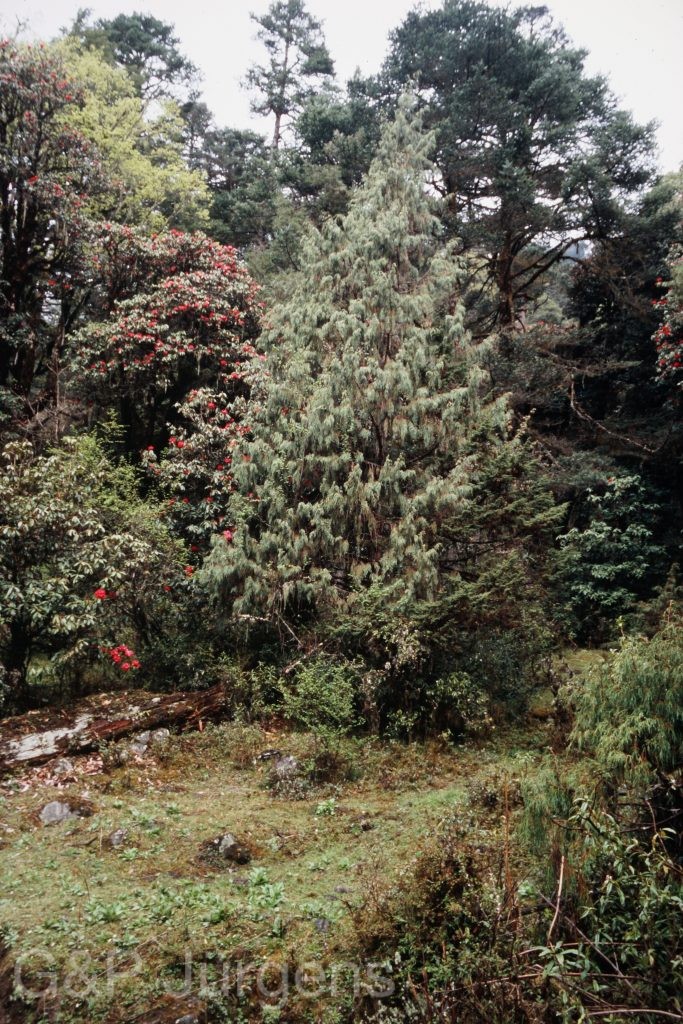
Bh2008 394 P610
Bhutan Gogona 3160m, May

Description

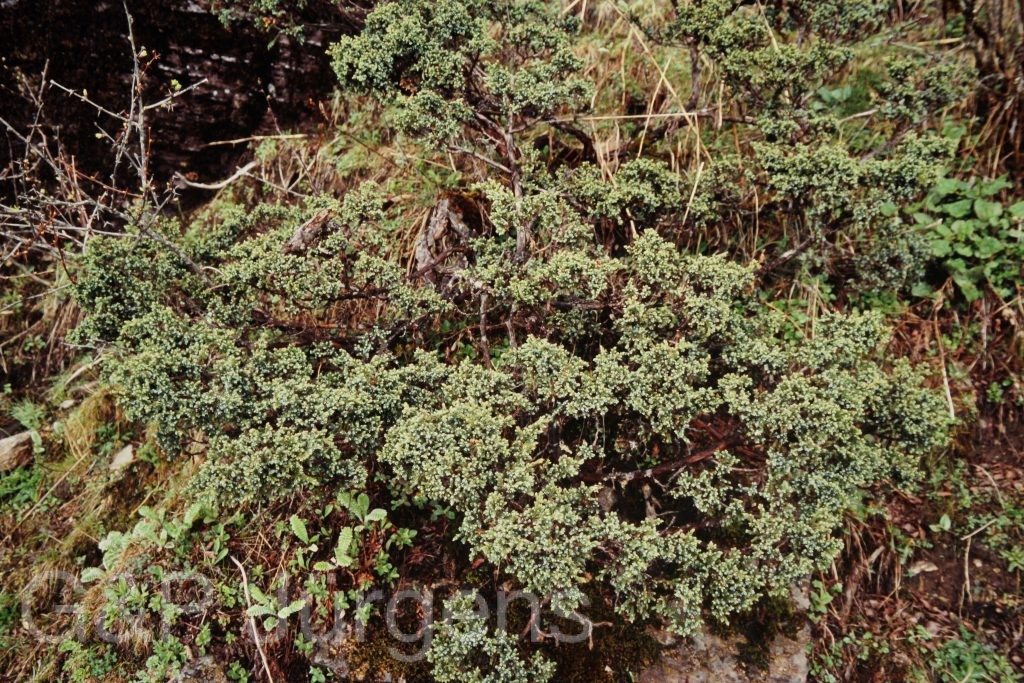
Juniperus recurva, the drooping or Himalayan weeping juniper, is a high-mountain conifer native across the Himalaya and adjacent China, with a core distribution in China, Nepal, India, Bhutan, Myanmar, Afghanistan and Pakistan; its very large GBIF tally of around 1185 records includes numerous cultivated occurrences in Great Britain, the United States, Spain, New Zealand, Japan and Germany, reflecting its long history in horticulture. In the wild it is a tree of the subalpine and alpine zones, forming open woodland, krummholz and scattered stands at and above the timberline on dry, rocky slopes. The tree photographed at Gogona in Bhutan at about 3160 m in May typifies its occurrence in the upper subalpine belt, where it often mingles with Abies, Rhododendron and Betula.

It is an evergreen tree or large shrub with characteristically pendulous, drooping branchlets and reddish-brown, fibrous bark that peels in long strips. The foliage consists of needle-like (acicular) juvenile-type leaves borne in whorls of three, incurved and sharply pointed, with a glaucous adaxial band; the leaves are retained as adults rather than reduced to scales. The species is typically dioecious, with small terminal pollen cones and ovulate cones that mature over two seasons into fleshy, berry-like galbuli that ripen blue-black to brownish and usually contain a single seed.

Juniperus recurva belongs to section Juniperus (the needle-leaved junipers) and includes the well-known coffin-juniper variant (var. coxii) with especially long pendulous shoots. Its fleshy cones are dispersed by birds and mammals, and the aromatic foliage is traditionally burned as incense across the Buddhist Himalaya. Although globally widespread and not classed as threatened, local populations near settlements are depleted by cutting for incense and fuel, and as a slow-growing timberline species it is potentially sensitive to warming-driven shifts in the upper forest limit.

Author: Buch.-Ham. ex D.Don · Sources: POWO (Kew), GBIF, Flora of China Vol. 4, Flora of Bhutan Vol. 1, Flora of Nepal, Adams Junipers of the World: The Genus Juniperus

Buch.-Ham. ex D.Don

Bh09 168 P297
Bhutan Labana 3600m May

Description

Juniperus squamata Buch.-Ham. ex D.Don is a variable, mostly prostrate to shrubby juniper of the Cupressaceae, native across the Himalaya and central and western China and recorded from Nepal, India, Bhutan, Pakistan, Afghanistan and Myanmar; with over 3,300 georeferenced records, many from cultivation in Europe, North America and Australasia, it is a widely grown ornamental as well as a wild montane species. In the wild it occupies high-altitude scrub, rocky alpine slopes, open conifer forest margins, ridges and exposed crests near and above the treeline. The photographed plant from Labana in Bhutan at about 3,600 m in May is typical of its subalpine to alpine station, where it often forms low spreading mats anchoring thin stony soils.

It is an evergreen shrub, frequently decumbent and mat-forming but sometimes erect and small-tree-like, with reddish-brown, flaking bark and ascending branchlet tips that are characteristically nodding. The foliage is entirely needle-like (acicular) and arranged in dense whorls of three, each leaf rigid, sharply pointed, concave and glaucous-white on the upper surface, giving the plant a frosted appearance. The species is usually dioecious; the seed cones are small, ovoid, ripening from green through reddish to glossy black, fleshy and berry-like, and contain a single seed.

Juniperus squamata belongs to section Juniperus, the needle-leaved junipers, and is morphologically variable across its range, having given rise to numerous horticultural cultivars selected for habit and foliage colour. As a slow-growing pioneer of harsh exposed sites it contributes to soil stabilisation at high elevation. The species is widespread and assessed as Least Concern, though local stands are affected by grazing and fuelwood collection.

Author: Buch.-Ham. ex D.Don · Sources: POWO (Kew), Flora of China Vol. 4, Flora of Bhutan Vol. 1, GBIF, Adams: Junipers of the World (2014)

L.

Nepal 97 410 P792
Nepal Tashigaon 3000m May
Nepal 2001 173 ergebnis ergebnis
East-Nepal Sabha-Khola 2100m, April

Description

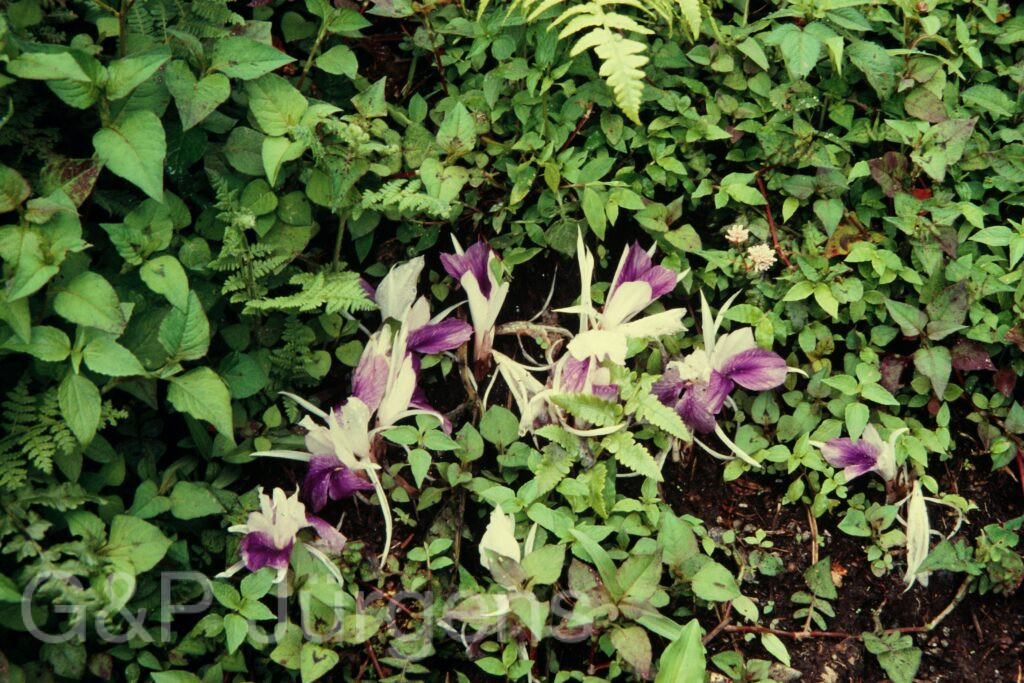
Kaempferia rotunda L. is a tuberous, rhizomatous herb of the ginger family native to tropical and subtropical Asia and very widely cultivated, so that its GBIF record (586 occurrences) spans India, Myanmar, China, Thailand, Bangladesh, Cambodia, Laos, Vietnam, Indonesia and the Philippines alongside many introduced localities in the Neotropics, North America and the Pacific. In the Himalayan foothills it grows in warm, shaded forest, scrub and disturbed ground; it was recorded in eastern Nepal at Sabha-Khola near 2100 m in April and at Tashigaon around 3000 m in May, the latter elevation being unusually high and probably reflecting sheltered, low-frost microsites or local cultivation.

The plant arises from a clustered, aromatic rhizome bearing fleshy tuberous roots. The leaves, two to four per shoot, are oblong-lanceolate, often handsomely variegated with dark and silvery-green zones above and purplish beneath, and appear after or with flowering. The inflorescence is hysteranthous, emerging directly from the rhizome at ground level before the leaves expand: a cluster of short-lived flowers with white, narrowly oblong corolla lobes, two petaloid white staminodes, and a conspicuous, deeply bilobed lilac to violet labellum. The fruit is a three-valved capsule, though propagation is largely vegetative.

Kaempferia rotunda is the type species of its genus and is grown ornamentally as 'peacock ginger' and used in traditional medicine across South and Southeast Asia, its rhizomes valued for fragrant essential oils. Its enormous naturalised range testifies to long human movement of the species. Pollination of the showy ephemeral flowers is by bees and other insects attracted to the labellar nectar guides, while persistence in cultivation buffers it against any wild conservation concern.

Author: L. · Sources: POWO (Kew), GBIF, Flora of China, Flora of Bhutan, Flora of British India, Zingiberaceae monograph (Larsen & Larsen; K. Schumann Zingiberaceae)

Kuntze

Bhutan2014 260
Bhutan Karu-Chu 1800m, May

Description

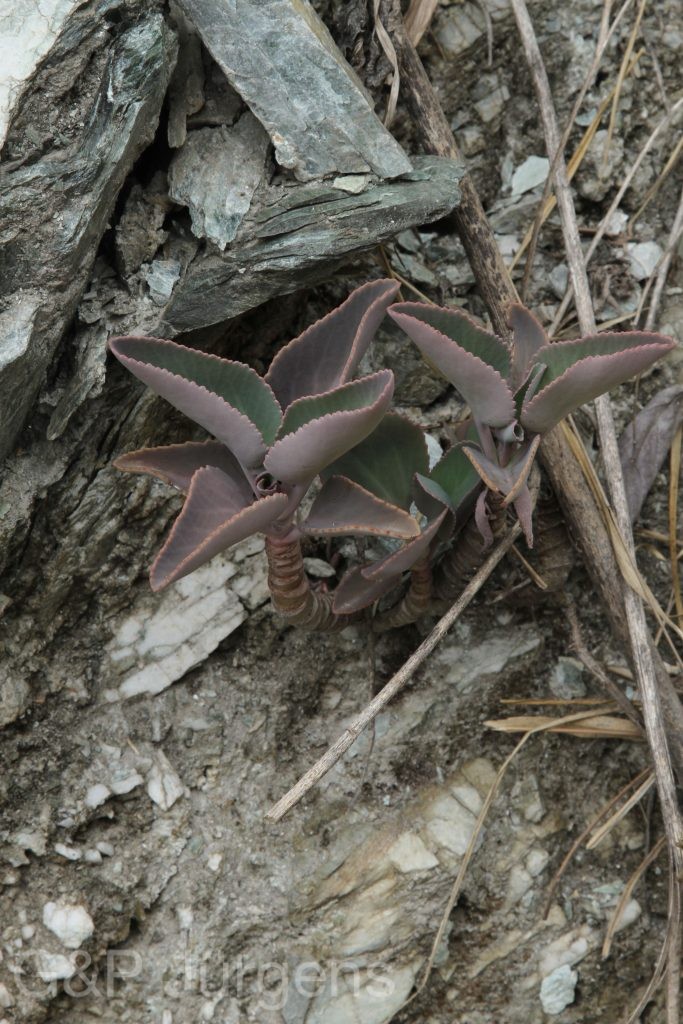
Kalanchoe integra is a succulent herb of broad palaeotropical and introduced distribution, recorded by GBIF (around 902 occurrences) across tropical and subtropical Asia and beyond, including Taiwan, Indonesia, the Philippines, India, Thailand, China, Japan, Nepal, Myanmar and Bhutan, as well as introduced or cultivated populations in the Americas and Europe. It grows on warm, dry, rocky slopes, open hillsides, walls, ledges and disturbed ground, favouring sunny, well-drained sites in the foothill and lower montane zones. The collection from Karu-Chu in Bhutan at about 1800 m in May marks a Himalayan foothill occurrence and reflects its preference for relatively low, warm elevations and its spring flowering at the onset of the growing season.

The plant is an erect, glabrous, fleshy perennial or biennial herb with a stout, often simple stem. The succulent leaves are opposite and decussate, the lower ones petiolate and obovate to oblong with a crenate or shallowly toothed margin, the upper leaves becoming sessile and sometimes pinnately lobed. The inflorescence is a large, terminal, much-branched corymbose cyme of numerous pendent, tubular flowers. Each flower has a fused, somewhat inflated tubular calyx and a longer tubular corolla in shades of yellow to orange or reddish, with four spreading lobes. There are eight stamens inserted on the corolla tube, and the four free carpels mature into many-seeded follicles.

Described under the combination by Kuntze, Kalanchoe integra belongs to a large Old World genus of the Crassulaceae noted for crassulacean acid metabolism (CAM), an adaptation enabling water conservation in seasonally dry habitats. The genus is taxonomically intricate, many names being confused within the K. integra-K. laciniata-K. spathulata complex. The species is used in traditional medicine in parts of its range and is sometimes cultivated. Being widespread, weedy and tolerant of disturbance, it is not of conservation concern.

Author: Kuntze · Sources: POWO (Kew), GBIF, Flora of China, Flora of Bhutan, Flora of British India, Raymond-Hamet revision of Kalanchoe

Mast.

Bhutan2012 1294
Bhutan Trashigang 1720m, October
Bhutan2012 1295
Bhutan Trashigang 1720m, October

Description

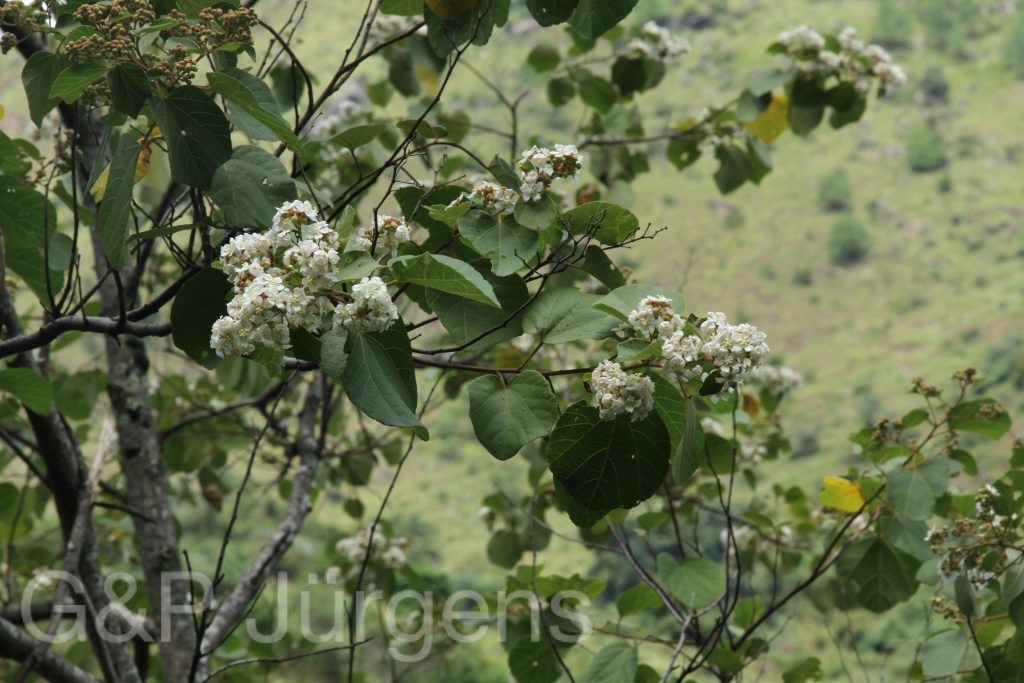
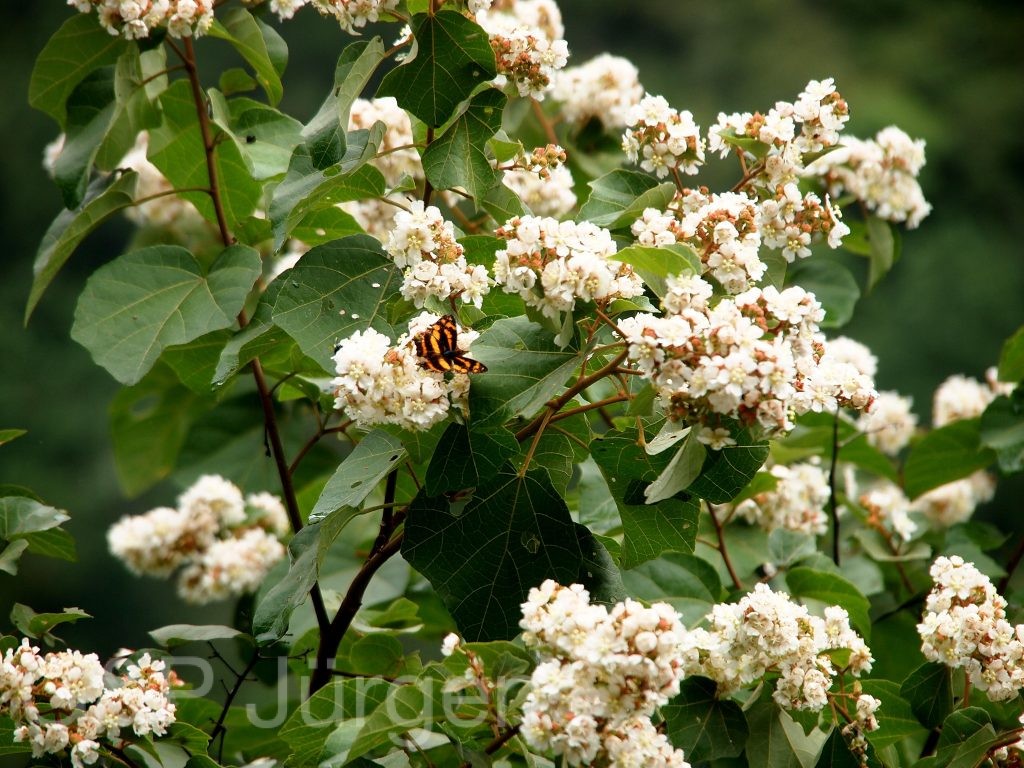
Kydia glabrescens is a small tree of the eastern Himalayan and Indo-Chinese region, recorded from China, Thailand, Nepal, Vietnam, Bhutan, India and Myanmar, with about 140 georeferenced occurrences. It occurs in subtropical and warm-temperate broadleaved forest, secondary woodland and forest margins at low to moderate elevations. The individual documented near Trashigang in eastern Bhutan at about 1720 m in October illustrates its mid-elevation habitat, flowering and fruiting in autumn on well-drained slopes within and at the edges of mixed hill forest.

The plant is a deciduous tree with grey bark whose young parts are stellate-tomentose but become more glabrescent with age, a feature underlying its epithet. The leaves are alternate, broadly ovate to suborbicular, palmately three- to five-veined and often shallowly lobed, with crenate-dentate margins. The flowers are borne in terminal and axillary panicles and are subtended by conspicuous epicalyx bracts that enlarge and become wing-like in fruit, a diagnostic feature of the genus; the small five-petalled corolla is white to pale pink, the stamens united into a staminal column typical of the Malvaceae. The fruit is a small capsule subtended by the accrescent, persistent bracts that aid wind dispersal.

Kydia is a small Asian genus traditionally placed in the Malvaceae (subfamily Grewioideae or related tribes in the broadly circumscribed family), distinguished by its enlarged fruiting epicalyx and dioecious or polygamous breeding system. The timber is used locally and the mucilaginous bark has minor traditional uses. Reasonably widespread through the eastern Himalaya and Southeast Asia, K. glabrescens is not considered threatened.

Author: Mast. · Sources: POWO (Kew), GBIF, Flora of Bhutan, Flora of China, Flora of British India, Tang, Gilbert & Dorr's account of Malvaceae