
Kuntze
Description
Kalanchoe integra is a succulent herb of broad palaeotropical and introduced distribution, recorded by GBIF (around 902 occurrences) across tropical and subtropical Asia and beyond, including Taiwan, Indonesia, the Philippines, India, Thailand, China, Japan, Nepal, Myanmar and Bhutan, as well as introduced or cultivated populations in the Americas and Europe. It grows on warm, dry, rocky slopes, open hillsides, walls, ledges and disturbed ground, favouring sunny, well-drained sites in the foothill and lower montane zones. The collection from Karu-Chu in Bhutan at about 1800 m in May marks a Himalayan foothill occurrence and reflects its preference for relatively low, warm elevations and its spring flowering at the onset of the growing season.
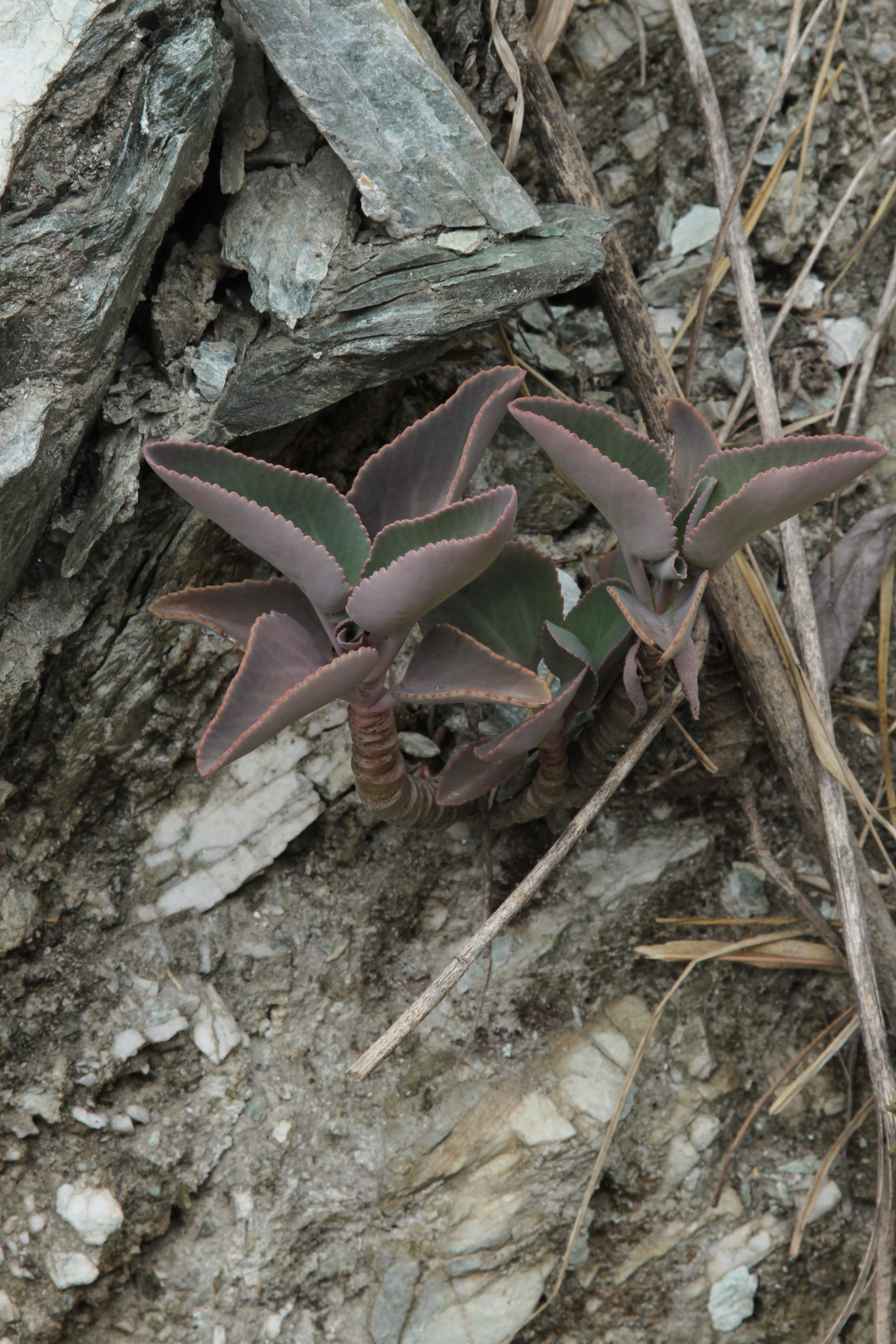
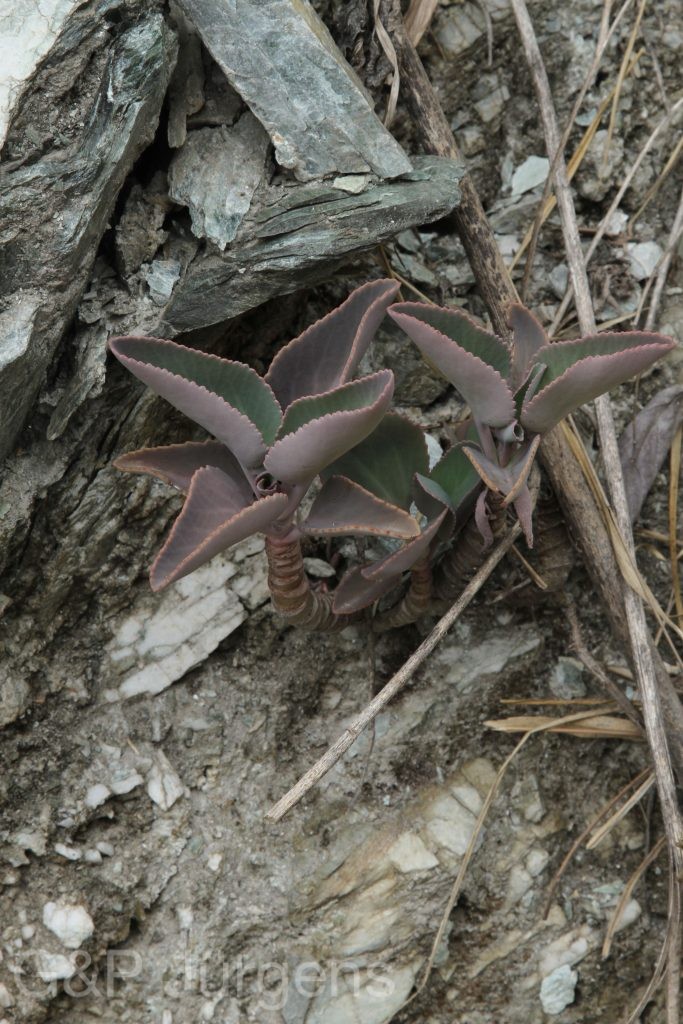
The plant is an erect, glabrous, fleshy perennial or biennial herb with a stout, often simple stem. The succulent leaves are opposite and decussate, the lower ones petiolate and obovate to oblong with a crenate or shallowly toothed margin, the upper leaves becoming sessile and sometimes pinnately lobed. The inflorescence is a large, terminal, much-branched corymbose cyme of numerous pendent, tubular flowers. Each flower has a fused, somewhat inflated tubular calyx and a longer tubular corolla in shades of yellow to orange or reddish, with four spreading lobes. There are eight stamens inserted on the corolla tube, and the four free carpels mature into many-seeded follicles.
Described under the combination by Kuntze, Kalanchoe integra belongs to a large Old World genus of the Crassulaceae noted for crassulacean acid metabolism (CAM), an adaptation enabling water conservation in seasonally dry habitats. The genus is taxonomically intricate, many names being confused within the K. integra-K. laciniata-K. spathulata complex. The species is used in traditional medicine in parts of its range and is sometimes cultivated. Being widespread, weedy and tolerant of disturbance, it is not of conservation concern.
Author: Kuntze · Sources: POWO (Kew), GBIF, Flora of China, Flora of Bhutan, Flora of British India, Raymond-Hamet revision of Kalanchoe