
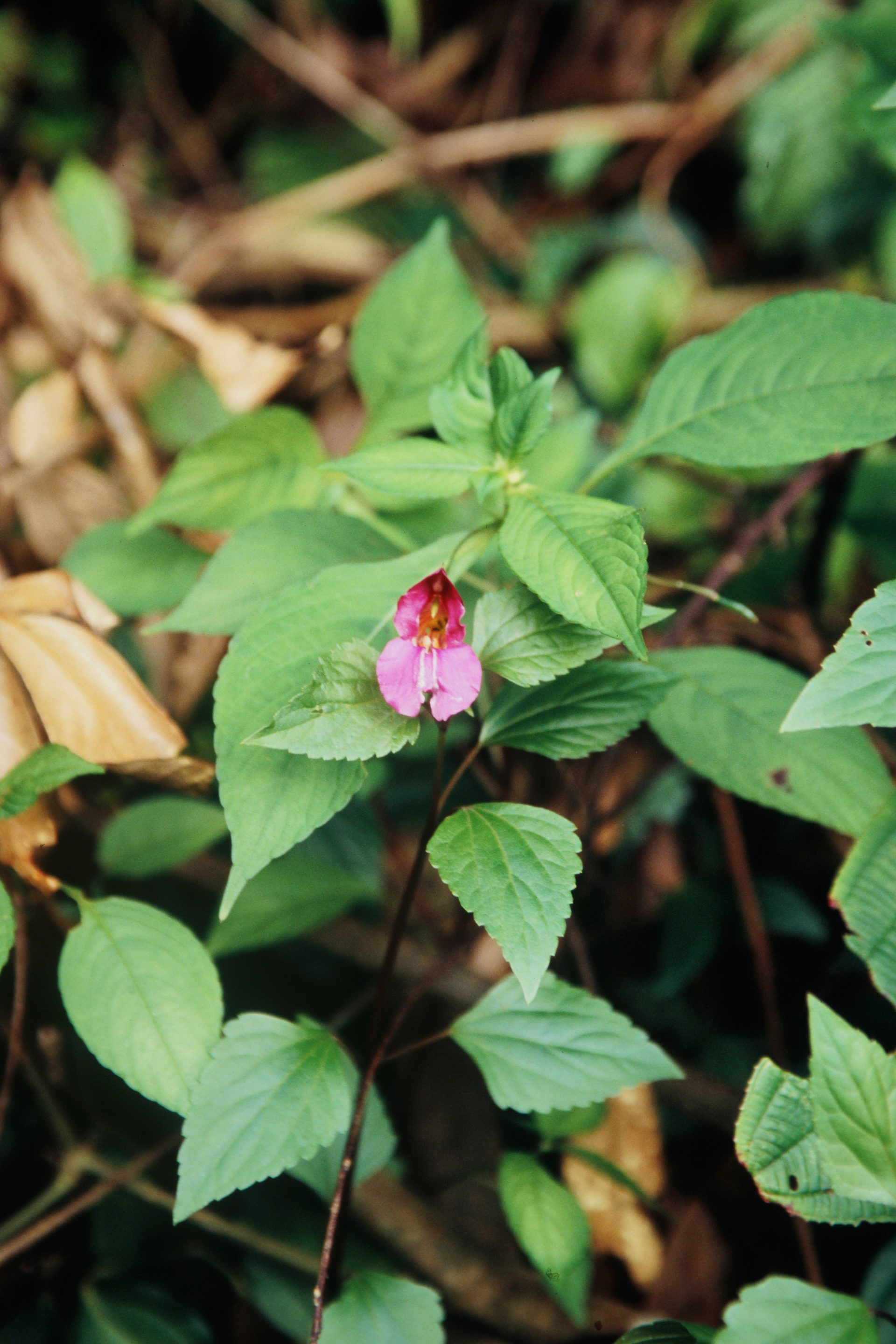
Wall.
Description
Impatiens sulcata is a tall, robust annual balsam of the Himalaya, recorded by GBIF (361 occurrences) from India, Nepal, Bhutan, Pakistan and adjacent China and Myanmar. It favours damp, nutrient-rich ground along streams, ditches, forest margins, roadside seepages and disturbed moist sites, principally from around 1500 to 3000 m in the warm-temperate and subtropical belts. The cited gathering from the Mo-Chu in Bhutan at 1500 m in June reflects its riparian preference, the plant typically forming dense, gregarious stands in the early monsoon along watercourses where the soil remains saturated.
The species is a succulent herb often exceeding a metre in height, with stout, conspicuously grooved (sulcate), reddish, hollow stems that root at the lower nodes. The leaves are large, ovate to ovate-lanceolate, serrate with crenate-glandular teeth, and arranged oppositely or in whorls toward the apex. Flowers are large and showy, pink to purplish, borne in axillary racemose clusters; the lower sepal forms a saccate spur, the standard is dorsally carinate, and the lateral united petals carry broad auricles. The fruit is a fleshy, club-shaped capsule that dehisces explosively, scattering the seeds by elastic recoil of the valves.
Belonging to the speciose, taxonomically complex genus Impatiens, the species sits among the tall Himalayan annual balsams and is allied to such forms as I. glandulifera, with which it shares vigorous growth and explosive seed dispersal. Its annual, fast-growing, ruderal habit makes it an effective colonist of disturbed riparian ground, while its open flowers are pollinated by bees and butterflies. It is widespread and not threatened.
Author: Wall. · Sources: POWO (Kew), GBIF, Flora of China Vol. 12, Flora of Bhutan Vol. 1, Flora of Nepal, Grey-Wilson Impatiens of Africa and the Himalaya