
DC.
Description
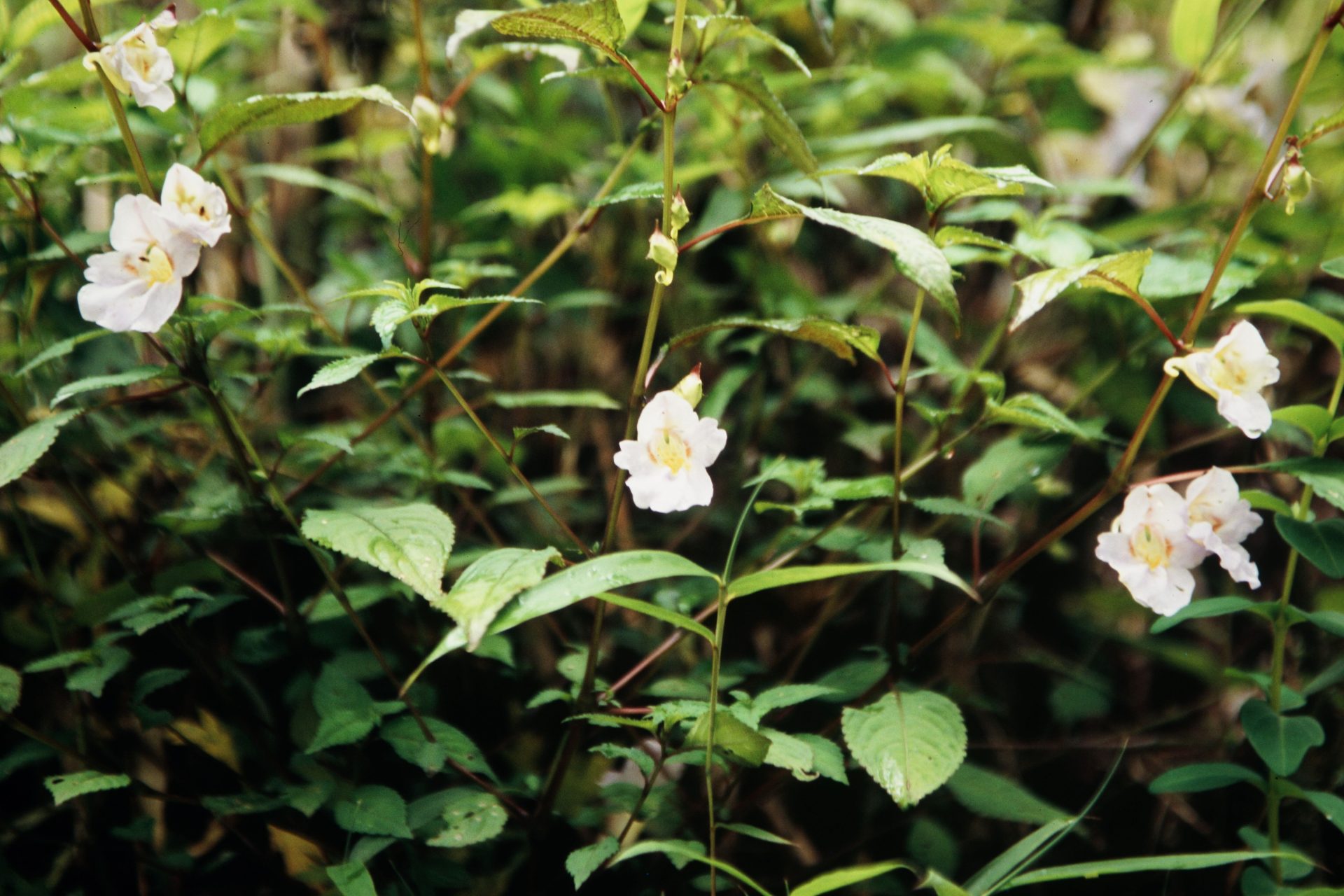
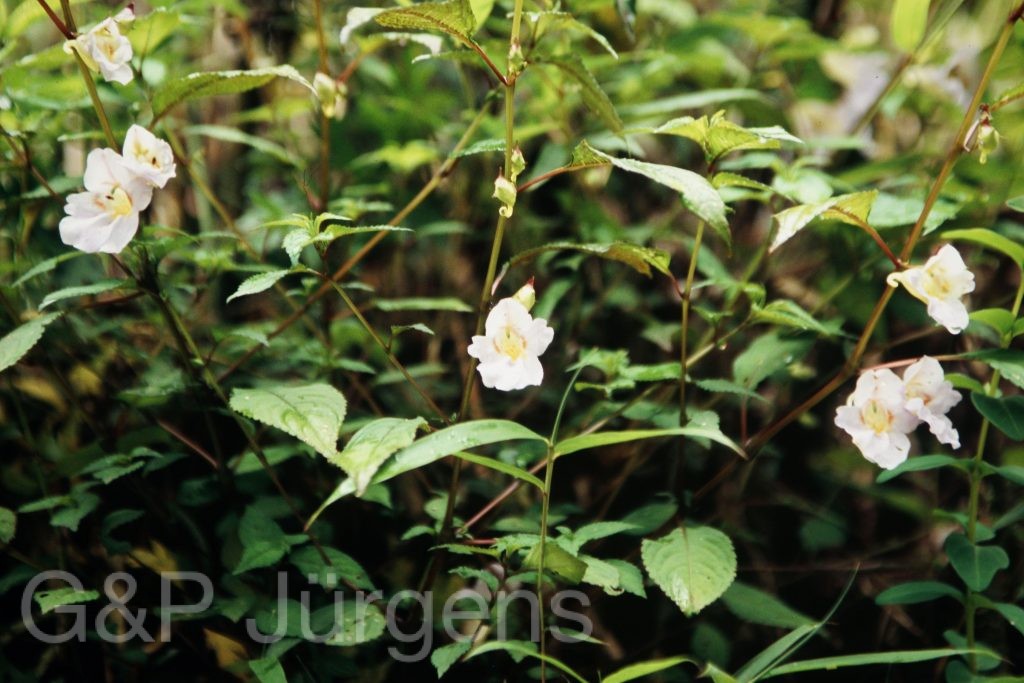
Impatiens discolor is an annual herb of the eastern Himalaya and adjoining ranges, documented by GBIF from Nepal, India, Bhutan, China, Thailand and Papua New Guinea across roughly 78 occurrences, several records being indeterminate as to country. It favours shaded, humid montane forest, growing along stream banks, in moist gullies and on seepage-fed roadside banks within evergreen and mixed broad-leaved woodland, typically at middle elevations. The photographed plant from Tongsa (Trongsa) in central Bhutan at about 2100 m, flowering in June with the onset of the monsoon, is typical of the warm, wet conditions that the genus exploits during the rainy season.
The plant has a succulent, translucent, often reddish stem that is erect or ascending and watery in texture, with swollen nodes. The leaves are alternate, ovate to elliptic, with a serrate or crenate-serrate margin and an acuminate apex, frequently glaucous or paler beneath, giving the discolorous appearance referenced by the epithet. The zygomorphic flowers are borne singly or in few-flowered axillary clusters; the lower sepal forms a saccate spur, and the showy yellow corolla (sometimes spotted) is built from a standard and two lateral united petals. The fruit is a fleshy, club-shaped capsule that dehisces explosively, the valves coiling abruptly to fling the seeds well away from the parent.
Balsaminaceae are notoriously taxonomically difficult, with Impatiens hyper-diverse and richly speciose in the Sino-Himalaya, where rapid radiation has produced many narrowly distributed, ecologically specialised taxa. Explosive seed dispersal and dependence on insect pollinators, together with a strictly annual life cycle, tie the species closely to seasonal monsoon moisture. While not formally assessed as threatened, the group's fine-scale habitat specificity makes individual populations sensitive to forest disturbance and altered rainfall regimes.
Author: DC. · Sources: POWO (Kew), GBIF, Flora of China, Flora of Bhutan, Annotated Checklist of the Flowering Plants of Nepal, Grey-Wilson "Impatiens of Africa" and Sino-Himalayan Impatiens monographic studies