Tag:

Nepal

Flowers of Nepal — 1313 wild plant species documented from the Nepalese Himalaya, from subtropical foothills to high alpine meadows above 4,000 m. Nepal’s dramatic elevation gradient makes it one of the richest botanical regions on Earth, home to rhododendrons, primulas, gentians and the famed blue poppies (Meconopsis). Every entry gives a botanical description, native distribution, habitat and flowering season, alongside the original field photograph and the location where it was taken.

Balf.f. & W.W.Sm.

Description

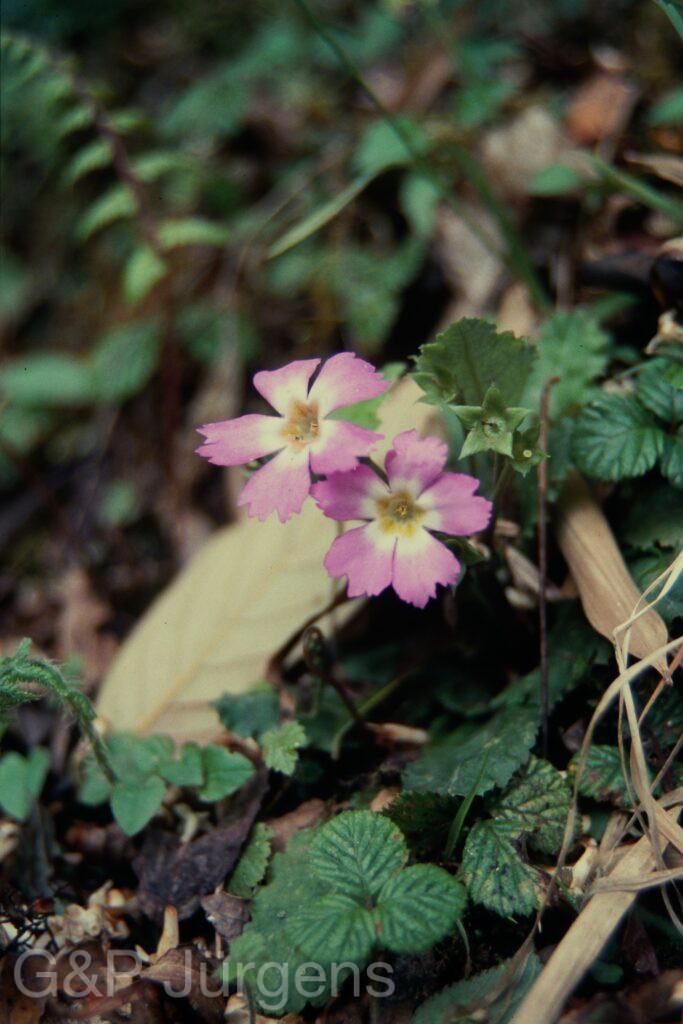
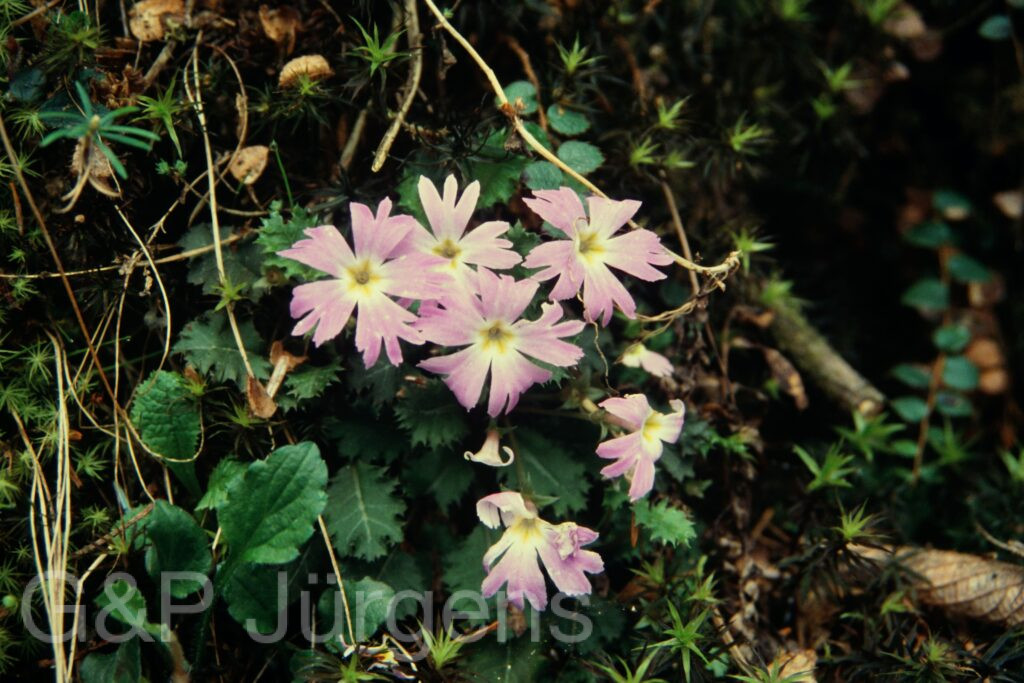
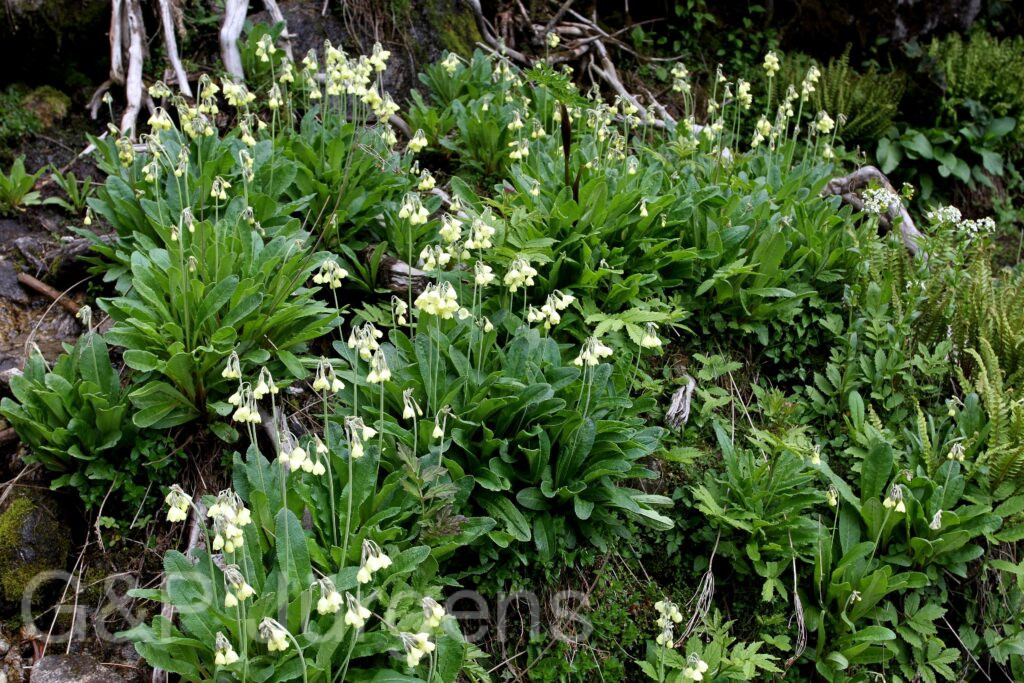
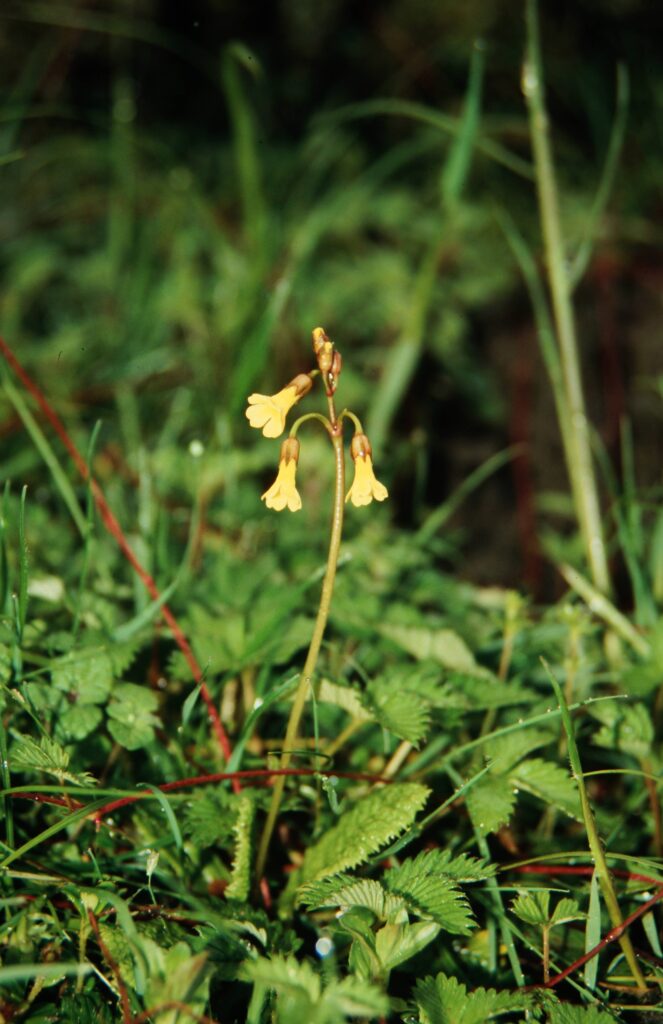
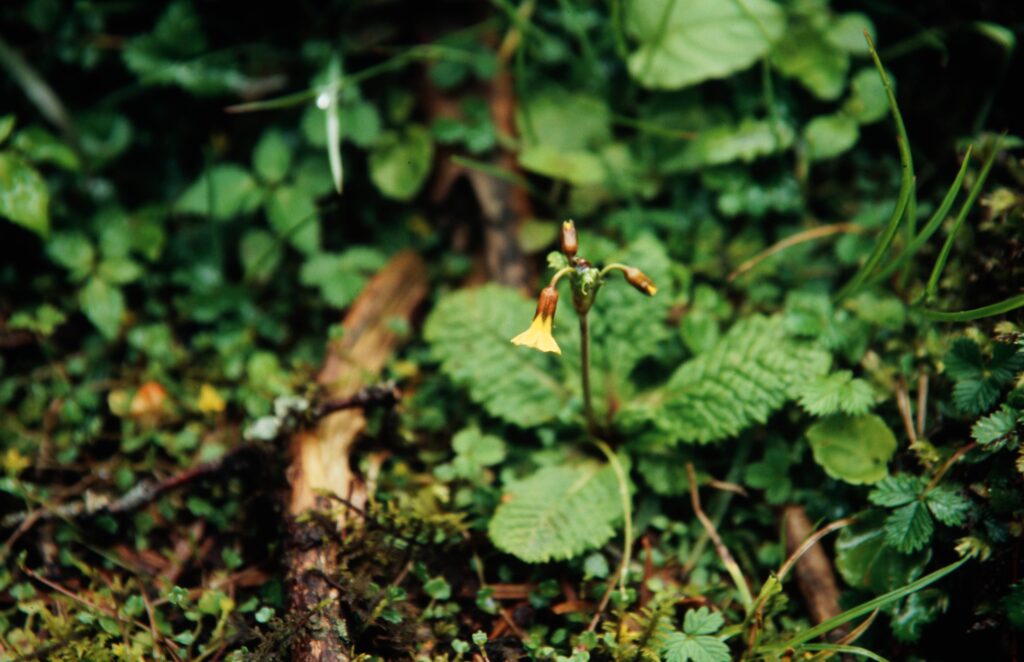
Primula prenantha is a small perennial herb distributed across the eastern Himalaya and adjacent mountains, with GBIF recording it from China, India, Myanmar, Nepal and Bhutan across some 93 georeferenced occurrences. It is a plant of moist, cool montane habitats, favouring stream margins, seepage slopes, wet meadows and the edges of evergreen and mixed broad-leaved forest, typically between about 2400 and 3600 m. The photographed population at Tamrong in West Bengal, at roughly 2750 m, flowering in May, is characteristic of this damp temperate belt where snowmelt keeps the ground saturated through the early growing season.

The plant forms a small basal rosette arising from a short rhizome with fibrous roots. The leaves are obovate to oblong-spathulate, narrowing gradually into a winged petiole, with a crenate to denticulate margin and an obtuse apex; the lamina is thin, glabrous and not farinose. From the rosette rises a slender erect scape bearing a terminal umbel of few to several nodding flowers subtended by small linear bracts. The flowers are heterostylous; the calyx is tubular-campanulate and lobed, and the corolla is yellow with a narrow tube and spreading, often emarginate lobes forming a flat or slightly cupped limb. The fruit is a small cylindrical capsule that dehisces by apical valves to release numerous minute seeds.

The species belongs to Primula section Sikkimensis (in the broad sense, allied to the yellow-flowered Petiolares-Sikkimensis assemblage), a group centred on the Sino-Himalayan region whose diversification tracks the uplift of the Himalaya and the associated humid monsoon gradients. Its dependence on cool, perennially moist microhabitats makes it sensitive to changes in snowpack and montane hydrology, and like many Sino-Himalayan primulas it is locally rather than broadly distributed. It is not currently regarded as globally threatened, but its narrow ecological tolerance warrants attention under warming and drying climatic scenarios.

Author: Balf.f. & W.W.Sm. · Sources: POWO (Kew), GBIF, Flora of China, Flora of Bhutan, Annotated Checklist of the Flowering Plants of Nepal, John Richards "Primula" (monograph)
(Spreng.) Hara

BhutanPG2011 625 01
Bhutan Ludlow-Sherriff-Trail Shashuna-Dem-Tso, 3900m June
Sikkim2003 327 P464
Sikkim Saniti-Lake 4200m August

Description

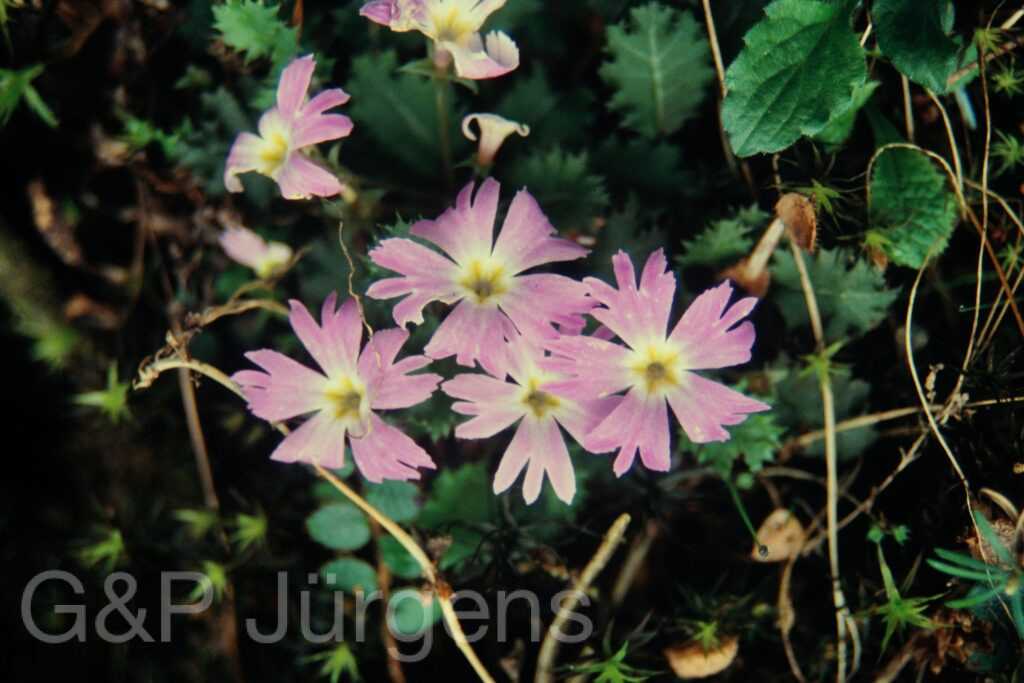
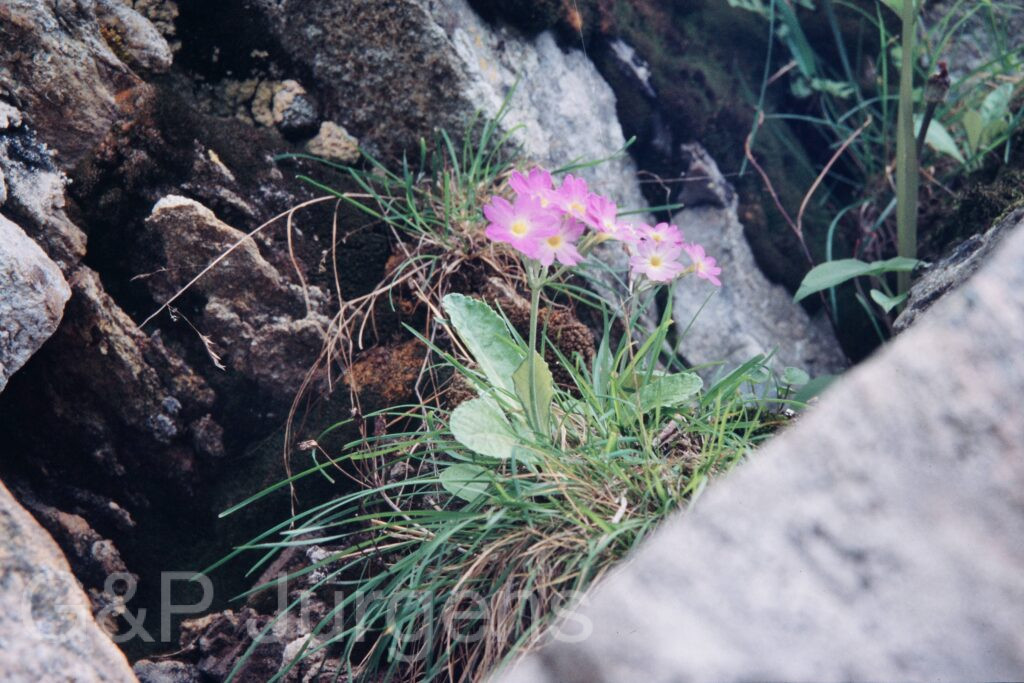
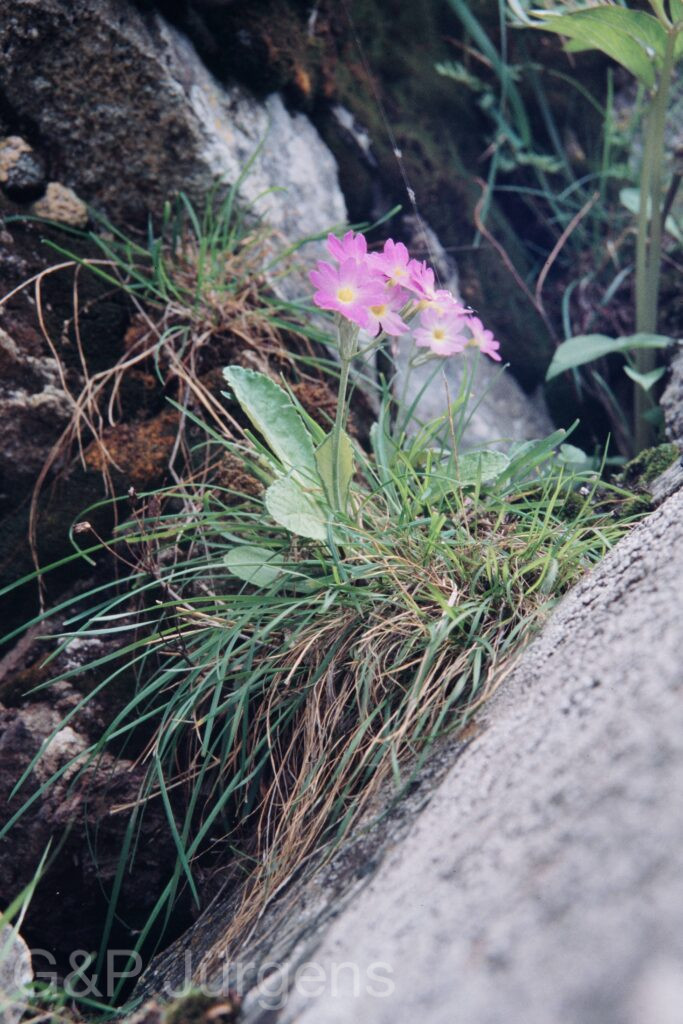
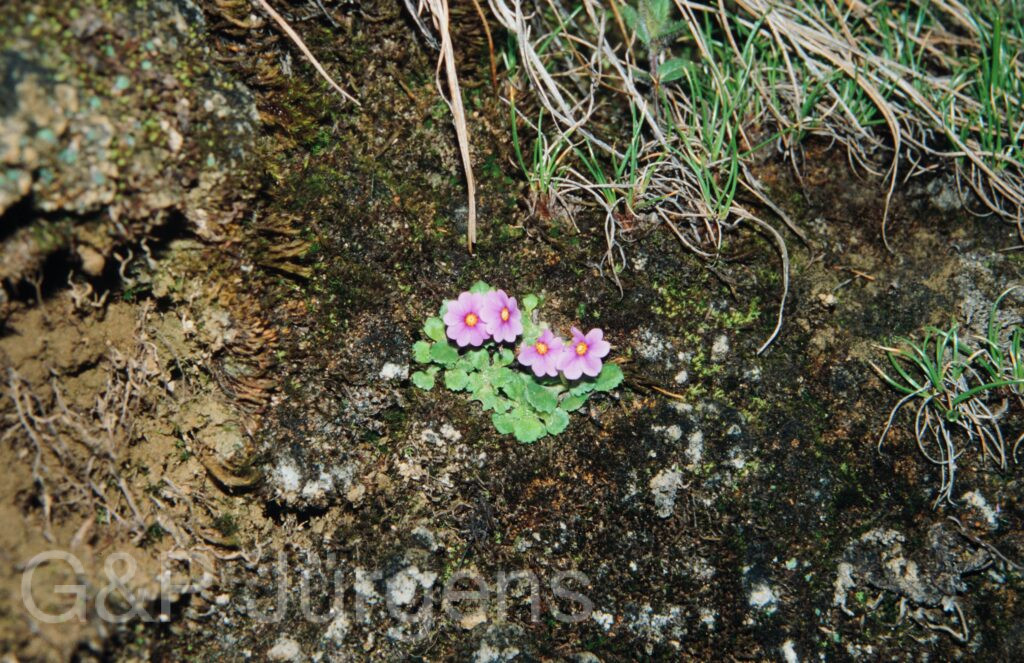
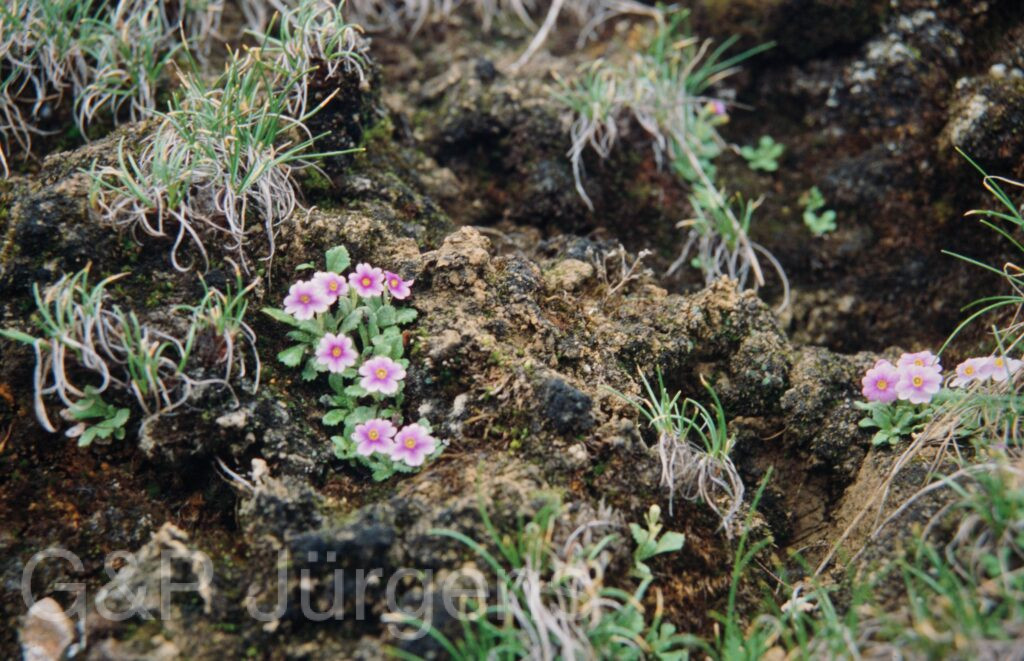
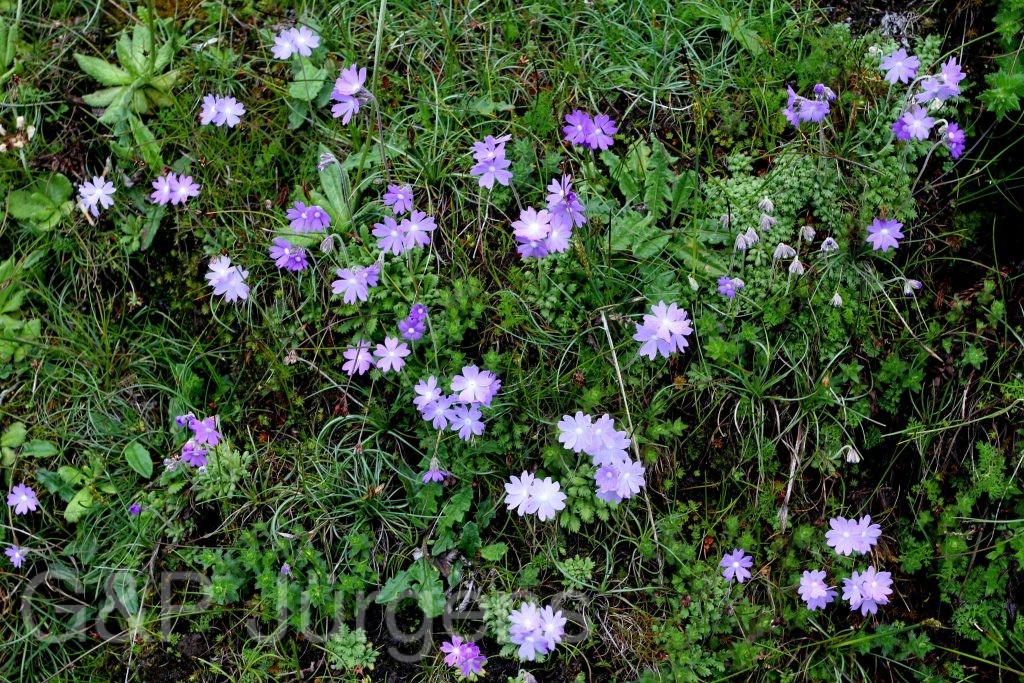
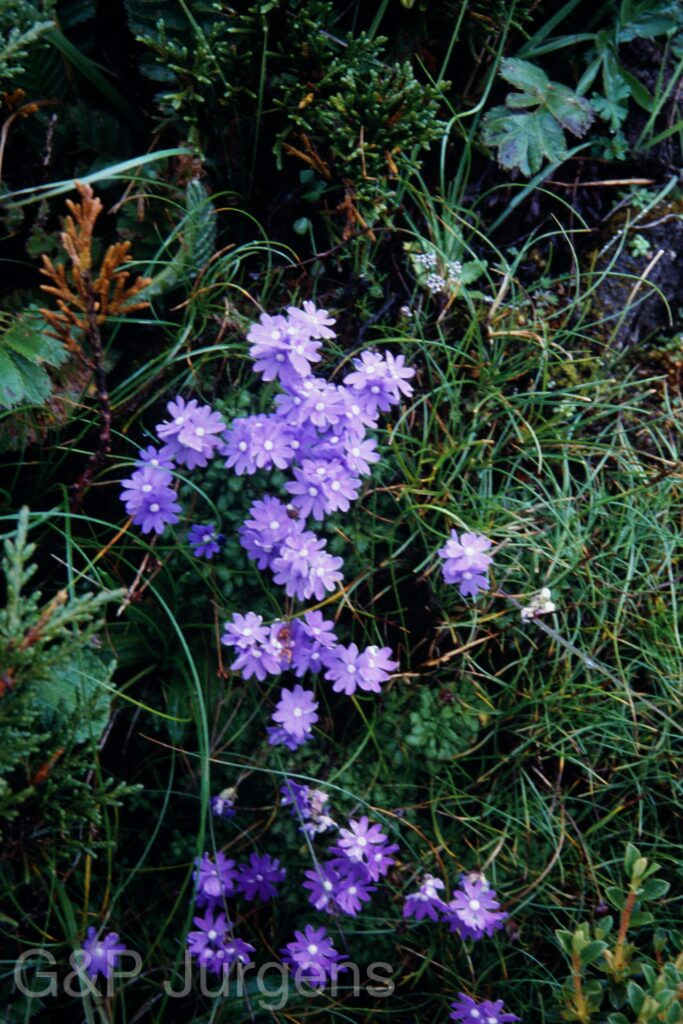
Primula primulina is a dwarf alpine primrose of the Himalayan high country, distributed through Nepal, northern India, Bhutan and southern China, with several hundred georeferenced occurrences recorded in GBIF. It is a cushion- or mat-forming species of the upper alpine and nival zones, growing on open stony slopes, moist alpine turf, rock ledges and the margins of high-elevation tarns kept moist by late snowmelt. The material from the Ludlow-Sherriff Trail at Shashuna-Dem-Tso in Bhutan (about 3900 m, June) and from Saniti Lake in Sikkim (4200 m, August) reflects its association with glacial lake basins and its summer flowering across the monsoon months.

P. primulina is a diminutive, densely tufted perennial forming low rosettes or compact cushions from a slender branching rootstock. The leaves are small, oblanceolate to spathulate, often densely crowded, with an entire or finely toothed margin and frequently bearing farina, the rosettes sometimes marcescent at the base. The flowers are borne singly or few together on very short scapes scarcely exceeding the foliage, giving an almost sessile appearance. The corolla is salverform with a slender tube and spreading, notched lobes, typically rose-purple to pink with a paler or yellowish eye; the calyx is tubular and lobed. The fruit is a small capsule enclosed by or barely exceeding the persistent calyx.

The species is placed in Primula section Minutissimae, the group of minute, cushion-forming Sino-Himalayan primroses to which P. primulina lends its name as a characteristic member. Long-established synonymy reflects its complex nomenclatural history under several earlier basionyms. As a specialist of high-altitude snowbed and lakeshore microhabitats, it is closely tied to persistent snow cover and is therefore among the alpine taxa most likely to be affected by warming-driven contraction of suitable habitat, though it currently carries no formal conservation assessment.

Author: (Spreng.) Hara · Sources: POWO (Kew), GBIF, Flora of Bhutan, Flora of China, The Genus Primula (Richards)

G.Watt

Sikkim2004 142 G244
Sikkim/India Singalila 3800m April

Description

Primula pulchra is an eastern Himalayan species distributed across Nepal, India, Bhutan, southern China (Xizang, Yunnan) and northern Myanmar, with GBIF documenting some 39 georeferenced occurrences across this comparatively narrow range. It is a plant of the upper temperate and subalpine zones, typically growing between about 3000 and 4300 m on moist, humus-rich slopes, in open Rhododendron scrub, along stream margins and on grazed alpine meadows that remain snow-covered for much of the winter. The photographed material from the Singalila Ridge on the Sikkim–West Bengal border at roughly 3800 m, flowering in April, is characteristic: the species is among the earliest primulas to bloom as the snowmelt recedes.

It is a small, rosette-forming perennial arising from a short rhizome with fibrous roots. The leaves are obovate to oblong-spathulate, narrowed to a winged petiole, the margin crenate-dentate, and the lower surface typically clad in a pale to yellowish farina. The scape carries a one- to few-flowered umbel subtended by short bracts. Flowers are heterostylous and showy, the corolla rose-purple to violet with a pale or yellow eye, the lobes obcordate and emarginate; the calyx is campanulate and often farinose. The fruit is a small capsule about equalling the persistent calyx, releasing numerous angular seeds.

Primula pulchra belongs to section Petiolares, a large, taxonomically intricate group of Sino-Himalayan primulas characterised by early flowering and resting-bud overwintering. Within it the species is allied to P. calderiana and P. boothii, from which it is separated by leaf shape, farina distribution and corolla detail; intergradation has complicated its delimitation. As a snow-bed and meadow specialist it is sensitive to grazing and to shifts in snow-lie driven by climate warming, though its presence in several protected high-altitude areas affords some security.

Author: G.Watt · Sources: POWO (Kew), GBIF, Flora of China, Flora of Bhutan, Smith & Fletcher monograph of the genus Primula, Richards 'Primula' (2003)

Duthie

Nepal 99 515 ergebnis
West-Nepal Churta-Khola 3800m, June
Nepal 99 804 ergebnis
West-Nepal Baga-La-Phedi 4350m, July
Nepal 99 461 ergebnis
West-Nepal Naphukana 2830m, June

Description

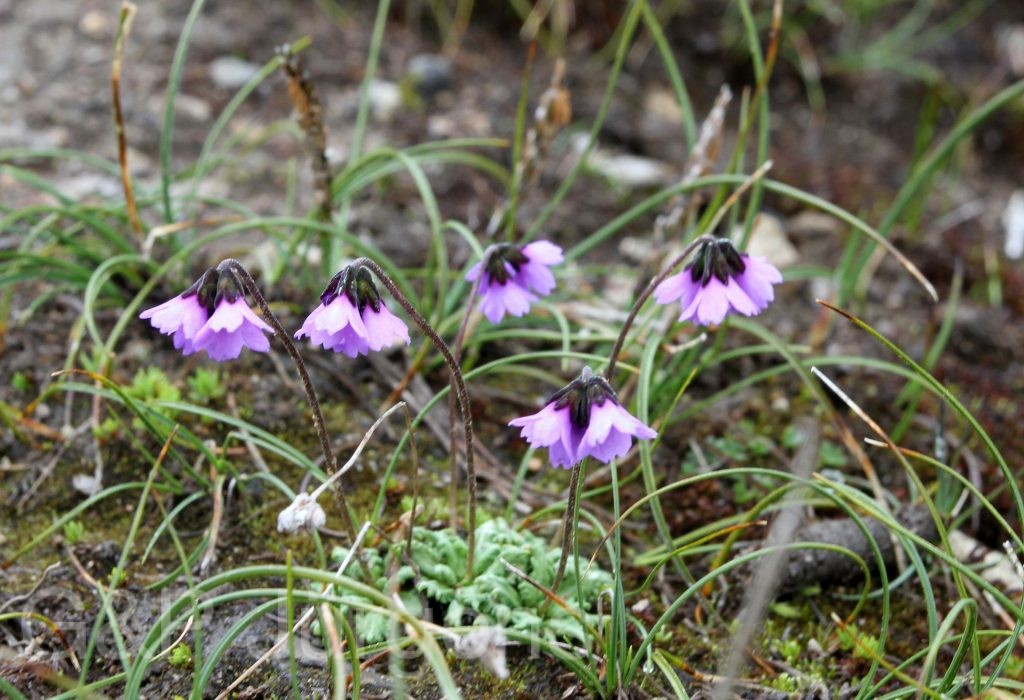
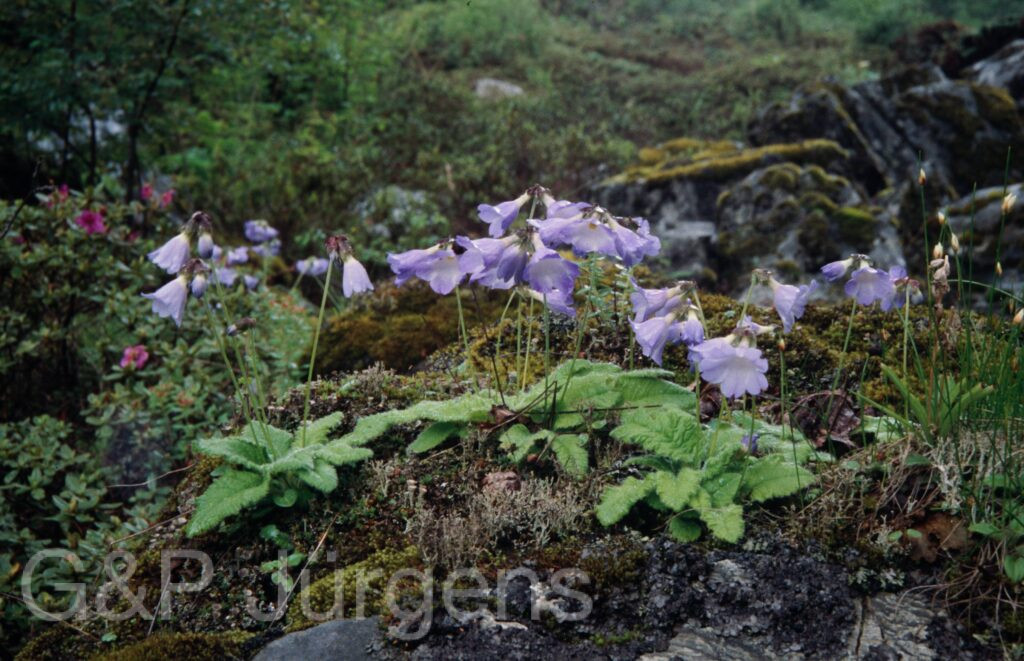
Primula reidii is a celebrated alpine primrose of the western and central Himalaya, with about 80 GBIF occurrences recorded from Nepal, India and Pakistan. It is a plant of cool, humid high-elevation habitats, growing among moist rocks, on shaded ledges, in crevices and on steep banks where seepage and snowmelt maintain constant moisture. The documented localities span a wide altitudinal range, from Naphukana in West Nepal at about 2830 m and Churta-Khola at 3800 m in June to Baga-La-Phedi at around 4350 m in July, confirming its occurrence from the upper temperate well into the alpine zone during the early monsoon flowering season.

It is a perennial rosette herb, the leaves clustered at the base into a rosette, oblong to oblanceolate, soft-textured, crenate to toothed, and frequently bearing a white or yellowish farinose (mealy) coating on the scape, calyx and leaf undersides. The flowers are borne in a terminal umbel or short head on a leafless scape, subtended by an involucre; each has a tubular, farinose, five-lobed calyx and a bell-shaped (campanulate), nodding corolla. The famously fragrant flowers are white to pale blue with five rounded, often notched lobes. The species is typically homostylous, and the fruit is a small capsule releasing numerous fine seeds.

The genus Primula reaches its greatest diversity in the Sino-Himalayan mountains, and P. reidii, described by Duthie, belongs to the bell-flowered alpine assemblage traditionally placed in section Soldanelloides, esteemed by horticulturists for its scented, nodding bells. It is a much-admired but somewhat localised alpine restricted to specific moist rock habitats; while not formally assessed as threatened, such niche-restricted alpines are sensitive to collection pressure, grazing and the warming-driven desiccation of high-altitude seeps.

Author: Duthie · Sources: POWO (Kew), GBIF, Flora of Nepal, Annotated Checklist of the Flowering Plants of Nepal, Richards Primula, Smith & Fletcher revision of Primula

Hook.f. & Thomson ex. G.Watt

BhutanPG2011 299
Bhutan Jule-Tso, 4000m June
Nepal 99 688 1 ergebnis
West-Nepal, Pungmo-Khola, July

Description

Primula sapphirina is a diminutive alpine primrose of the high Eastern Himalaya, recorded from India, Bhutan, Nepal and south-western China, with GBIF documenting around 80 occurrences from this restricted high-altitude range. It is confined to the alpine zone, growing on moist turf, mossy banks, seepage slopes and the edges of melting snow patches where the ground stays cool and damp through the brief growing season. The cited localities underline its elevation: Jule-Tso in Bhutan at about 4000 m flowering in June and the Pungmo-Khola in West Nepal in July, both well above treeline, where it flowers as the snow recedes and the short subnival summer begins.

It is a small, delicate perennial herb forming a slender, few-leaved tuft from a short rootstock, often farinose. The leaves are basal, small, spathulate to oblong, narrowed into a winged petiole, with finely toothed or crenate margins. The slender scape bears few small flowers, sometimes solitary, nodding on capillary pedicels; the calyx is tubular-campanulate and the corolla is a clear sapphire-blue to violet, the limb shallowly lobed with a narrow tube, giving the plant its epithet. The species is typically heterostylous with pin and thrum forms. The fruit is a small membranous capsule containing numerous minute seeds.

Primula sapphirina, attributed to Hooker f. & Thomson ex G. Watt, belongs to section Minutissimae (the so-called "bird's-eye" alpine primulas), a group of tiny high-elevation species characterised by farinose, cushion-like habit and small blue flowers. As an obligate alpine, it depends on snowmelt moisture and stable turf, and its pollination by small flies and bees occurs within a narrow window. Its restricted distribution and specialised habitat make it sensitive to climate-driven upslope shifts, though no formal conservation assessment has yet been published.

Author: Hook.f. & Thomson ex. G.Watt · Sources: POWO (Kew), GBIF, Flora of Bhutan, Flora of China, Annotated Checklist of the Flowering Plants of Nepal, Richards' monograph Primula

Craib

Sikkim2004 75 P131
Sikkim West-Bengal, Bersay 2600m April
Sikkim2004 313 G563
Sikkim/India Kokchurong 3600m May
Sikkim2004 314 G564
Sikkim/India Kokchurong 3600m May

Description

Primula scapigera is an eastern Himalayan primrose recorded from northern India (Sikkim, West Bengal), Nepal, Bhutan and adjacent China, with 67 GBIF occurrences also reflecting cultivated material reaching Japan. It grows in cool, humid montane and subalpine habitats, on mossy banks, in open Rhododendron and conifer forest and along streamsides, generally between 2500 and 3800 m. The illustrated plants were collected at Bersay in the Sikkim/West Bengal borderland at 2600 m in April and at Kokchurong in Sikkim at 3600 m in May, spanning the species' spring to early-summer flowering across its altitudinal range.

It is a small perennial herb forming neat rosettes of obovate to spathulate leaves that are crenate to denticulate at the margin, narrowed to a winged petiole and often coated beneath, like the scape and calyx, with pale farina. The slender erect scape bears a terminal umbel of a few to several flowers. The corolla is rose-pink to purplish with a contrasting yellow or whitish eye, the limb divided into five obcordate, notched lobes; the plants are heterostylous, producing pin and thrum morphs. The fruit is a small capsule shorter than or equalling the persistent calyx.

The species is placed in Primula section Petiolares, a largely Sino-Himalayan group of farinose, rosette-forming primroses centred on the eastern Himalaya and Hengduan ranges. Within the section it is allied to P. petiolaris and P. gracilipes, from which it is separated by its scapose inflorescence and leaf characters. Like its congeners it depends on insect pollination facilitated by its distyly, and its restricted high-rainfall habitat makes it sensitive to disturbance and warming. Though not formally assessed, it remains a localised eastern Himalayan endemic of conservation interest.

Author: Craib · Sources: POWO (Kew), GBIF, Flora of Bhutan, Flora of China, Richards: Primula

H.R.Fletcher

Nepal 99 575 ergebnis
West-Nepal Bheri-Khola 2850m, July
Nepal 99 574 ergebnis
West-Nepal Bheri-Khola 2850m, July

Description

Primula sharmae is a narrowly distributed primrose apparently endemic to Nepal, where it is the sole region documented in GBIF among its roughly 72 occurrence records. It is a plant of cool, humid montane environments, occupying moist rocky slopes, shaded banks, ledges and the margins of streams and forest in the temperate Himalayan zone. The population photographed along the Bheri-Khola in West Nepal at about 2850 m in July was recorded during the monsoon, the principal flowering and growth period when persistent cloud and rainfall keep these slopes saturated and favour the moisture-demanding primulas.

It is a perennial rosette herb, the leaves crowded at the base into a basal rosette, oblong to oblanceolate or spathulate, with toothed or crenate margins and gradually tapering into a winged petiole; the foliage and scape may bear a fine farinose (mealy) covering characteristic of many Himalayan primulas. The flowers are borne in a terminal umbel atop a leafless scape, subtended by an involucre of bracts; each flower has a tubular, five-lobed calyx and a salverform corolla with a slender tube and five spreading, often notched (emarginate) lobes. The species is heterostylous, presenting pin and thrum floral morphs, and the fruit is a small dehiscent capsule releasing numerous seeds.

The genus Primula is exceptionally diverse in the Himalaya, where many species are narrow endemics confined to particular valley systems, and P. sharmae, described by H.R.Fletcher, is one such restricted-range taxon. Endemic primulas with limited known distributions are of inherent conservation interest, as small populations tied to specific moist microhabitats are vulnerable to disturbance, grazing and climatic drying. Continued field documentation across western Nepal would help clarify its true range and population status.

Author: H.R.Fletcher · Sources: POWO (Kew), GBIF, Flora of Nepal, Annotated Checklist of the Flowering Plants of Nepal, Richards Primula, Smith & Fletcher revision of Primula

Hook.

Sikkim2011 246
Sikkim Yumthang 3700m, June
Sikkim2011 65
Sikkim Yumthang 3700m, June
BhutanPG2011 810 01 01 scaled
Bhutan / also included: Ligularia fischeri
Bh09 34 P64
Bhutan
Sikkim2003 231 P320
Sikkim Dzongri 4100m 08.2003

Description

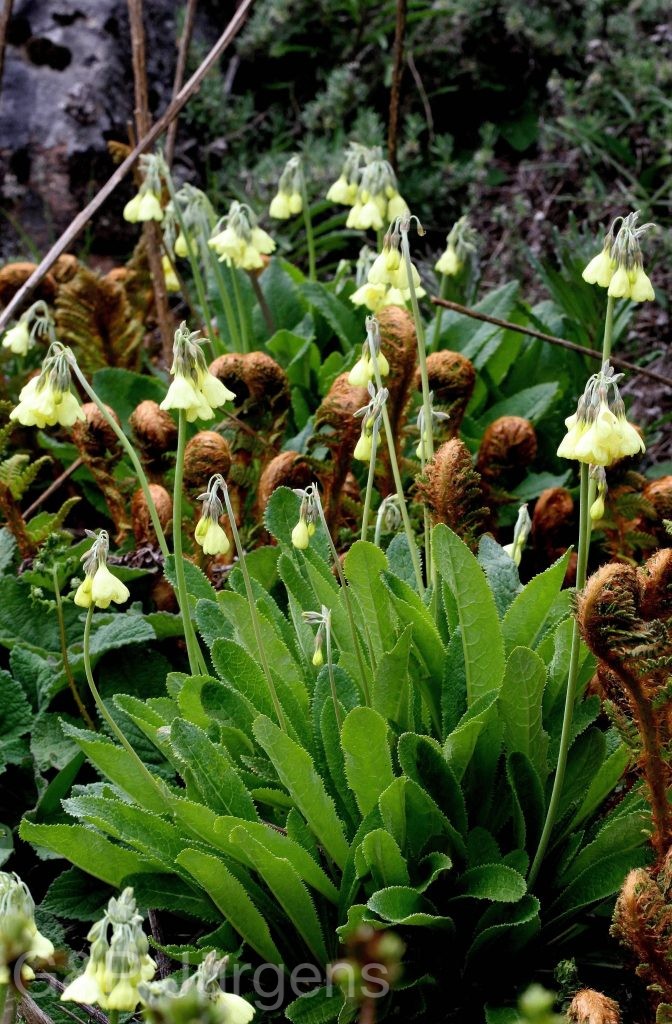
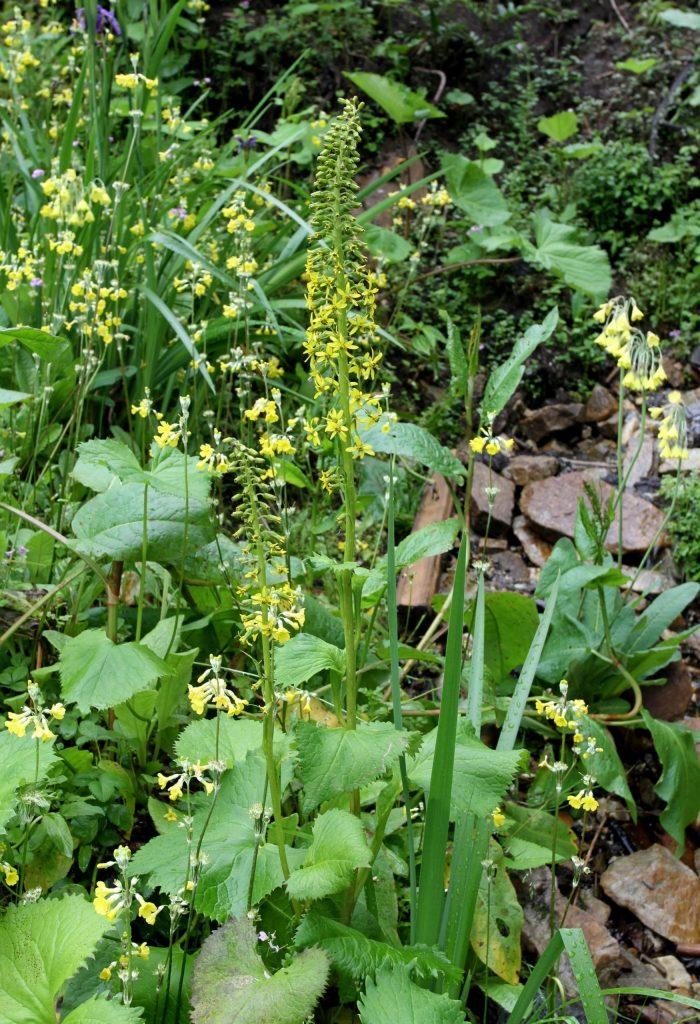
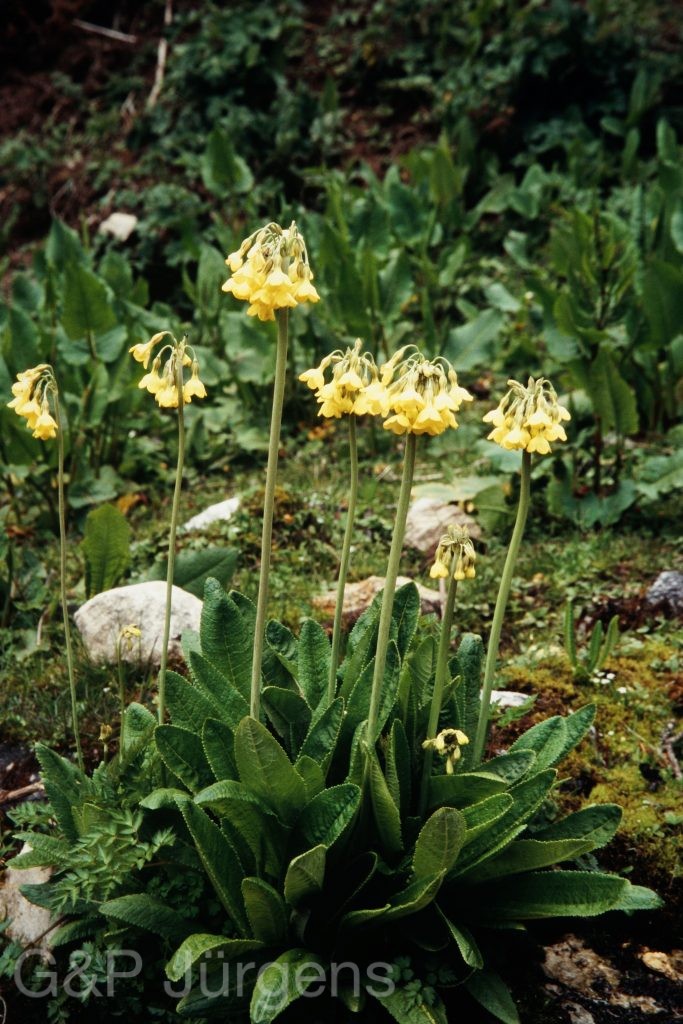
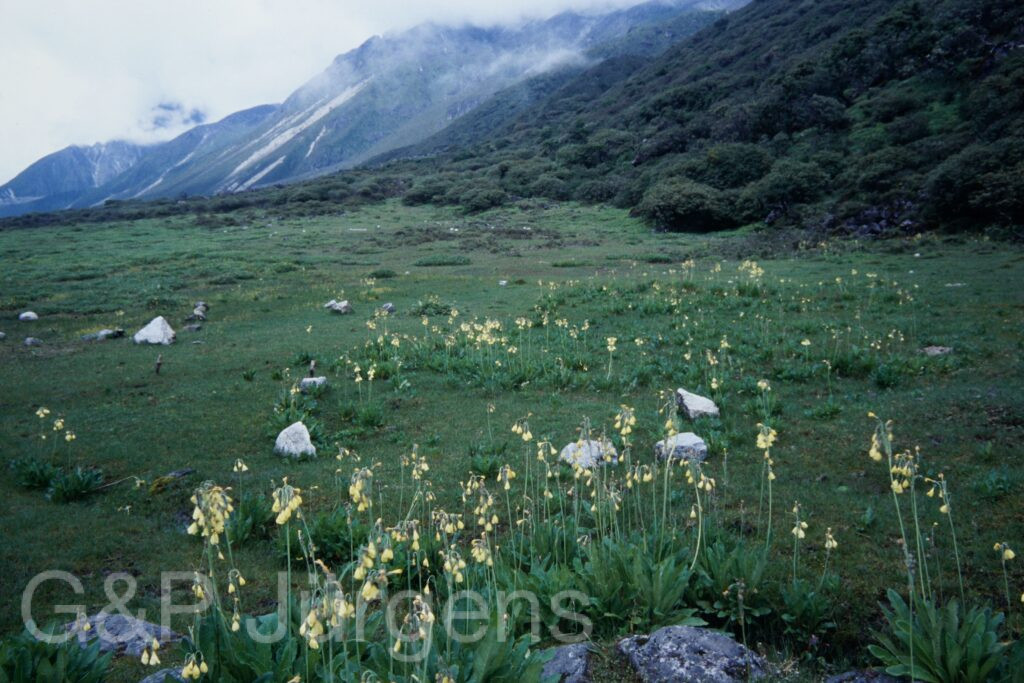
Primula sikkimensis, the Sikkim cowslip, is a robust perennial of the Himalaya and the eastern Tibetan plateau, recorded from China, Nepal, Bhutan, India and Myanmar, with 1820 occurrences in GBIF making it one of the better-documented Himalayan primulas. It is a plant of wet alpine habitats: marshy meadows, stream sides, bog margins and damp turf, typically between 3000 and 4500 m, often forming extensive colonies in seepage zones. The Sikkim collections illustrated, from Yumthang at 3700 m in June and Dzongri at 4100 m in August, exemplify its association with permanently moist, cold ground; the caption also notes Ligularia fischeri co-occurring in the same habitat.

The plant arises from a stout rhizome and produces a basal rosette of oblong to oblanceolate leaves, the blades crenate-toothed and tapering to a winged petiole, mealy-farinose at least beneath when young. The stout, erect scape, often 30-90 cm tall, bears a terminal umbel of several to many nodding, fragrant flowers. The corolla is funnelform with a slender tube and spreading limb, pale to sulphur-yellow, the throat dusted with farina; the species is heterostylous, with distinct pin and thrum morphs. The fruit is a cylindrical capsule, somewhat longer than the persistent calyx, releasing numerous small seeds.

Primula (Primulaceae) reaches its greatest diversity in the Sino-Himalaya; P. sikkimensis is the type of section Sikkimensis, a group of moisture-loving, yellow- to whitish-flowered primulas. Its heterostyly enforces outcrossing, and its scent and form suit pollination by long-tongued insects. Widespread and locally abundant, it is not of conservation concern, but as a wetland specialist it is sensitive to drainage, grazing pressure and the desiccation of alpine mires under a warming climate.

Author: Hook. · Sources: POWO (Kew), GBIF, Flora of China, Flora of Bhutan, The Genus Primula (A Monograph)

Craib

Nepal 99 601 ergebnis
Nepal Kagmara-La4800m, July

Description

Primula spathulifolia Craib is a high-alpine herb of the central and eastern Himalaya, recorded from India, Nepal and Bhutan (IN, NP, BT), with GBIF documenting some 25 occurrences across this restricted range. It grows in the upper alpine and subnival belt, typically between about 4000 and 5000 m on damp gravelly slopes and snow-melt flushes. The material from the Kagmara-La in Nepal at 4800 m in July shows its flowering shortly after snow-melt, when the brief alpine summer permits rapid growth and anthesis.

The species forms a small, neat rosette arising from a short rootstock, the leaves spathulate to narrowly oblanceolate as the epithet indicates, with a tapering base, an entire to obscurely toothed margin and an efarinose to lightly farinose surface. The scape is short, bearing one to several flowers in a terminal umbel. The corolla is rose-purple to violet with a paler or yellowish eye, the limb divided into obcordate, emarginate lobes spreading from a slender tube; the calyx is campanulate and the flowers heterostylous in the typical primuloid manner. The fruit is a small capsule releasing numerous minute seeds dispersed by wind and water.

Within Primula, P. spathulifolia belongs among the small-statured rosette-forming alpines, part of a complex of dwarf Sino-Himalayan species adapted to extreme altitudes. Its narrow distribution makes it of biogeographic interest as a Himalayan endemic of high passes, and although no formal threat assessment is widely cited, its dependence on stable snow-melt habitats renders it potentially sensitive to shifts in snowpack and grazing. Pollination is presumed to involve small bees and flies active in the brief alpine window.

Author: Craib · Sources: POWO (Kew), GBIF, Flora of Nepal, Flora of Bhutan Vol. 2, Flora of China Vol. 15, Smith & Fletcher monograph of the genus Primula

G.Watt

Nepal 99 815 ergebnis
West-Nepal Baga-La-Phedi 4300m, July
Nepal 99 814 ergebnis
West-Nepal Baga-La-Phedi 4300m, July

Description

Primula stirtoniana is a high-altitude perennial herb distributed across the Himalayas from western Nepal through northeast India (Sikkim, Uttarakhand) to Bhutan and southern China (Xizang). The species inhabits alpine meadows, moist rocky ledges, and scree slopes at elevations of 3,600–4,800 m, where it grows in association with other alpine cushion plants and rosette-forming herbs. It has been recorded from Baga-La-Phedi in western Nepal at 4,300 m, flowering in July during the peak monsoon period when moisture availability is highest.
The plant forms compact rosettes arising from a short, stout rootstock. The leaves are spatulate to obovate, 2–6 cm long, with a crenate to dentate margin, more or less farinose beneath with a whitish or yellowish farina. The scape is erect, 5–15 cm tall, bearing a terminal umbel of 3–10 flowers. The calyx is campanulate, often farinose, with lanceolate lobes. The corolla is purple to violet-blue, with a flat, spreading limb 10–15 mm in diameter; the tube is cylindrical, exceeding the calyx. The species is heterostylous, producing both pin and thrum flowers. The capsule is globose to ovoid, slightly exceeding the calyx at maturity.
Primula stirtoniana belongs to section Crystallophlomis, a group characterised by prominent leaf farina, and is allied to P. macrophylla and related species. It was described by George Watt in the late nineteenth century and has been relatively infrequently collected. With approximately 26 occurrence records in GBIF, it remains a poorly documented species whose population status across its range is unclear. Alpine Primula species are considered sensitive indicators of climate change, and upward range shifts or phenological mismatches with pollinators may pose long-term threats to such narrowly adapted high-altitude taxa.

Author: G.Watt · Sources: POWO (Kew), GBIF, Flora of Nepal, Richards: Primula (2003), Grierson & Long: Flora of Bhutan Vol. 2 (2001)