Tag:

Nepal

Flowers of Nepal — 1313 wild plant species documented from the Nepalese Himalaya, from subtropical foothills to high alpine meadows above 4,000 m. Nepal’s dramatic elevation gradient makes it one of the richest botanical regions on Earth, home to rhododendrons, primulas, gentians and the famed blue poppies (Meconopsis). Every entry gives a botanical description, native distribution, habitat and flowering season, alongside the original field photograph and the location where it was taken.

Punica granatum

by GP Jürgens

L.

Bhutan2014 69
Bhutan Kadi 1600m, May

Description

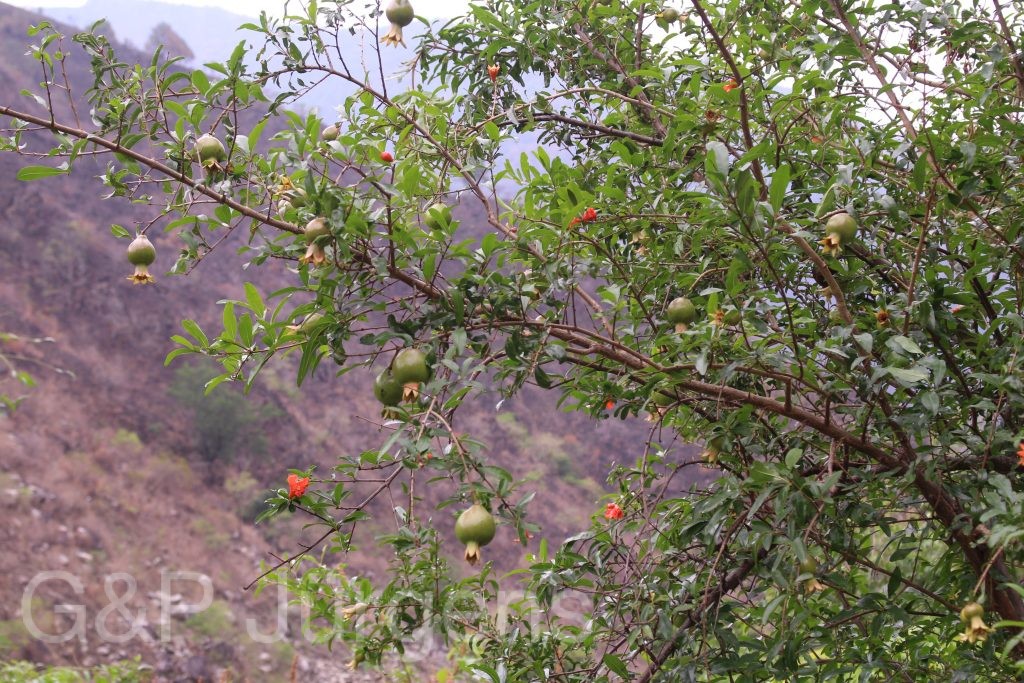
Punica granatum, the pomegranate, is a deciduous shrub or small tree native to the region from Iran and the Transcaucasus through Central Asia, now cultivated and naturalised worldwide; its 51453 GBIF occurrences span Mediterranean Europe, the Middle East, India, China, the Americas, Africa and Australia. It thrives in warm, semi-arid to subtropical climates on a wide range of soils, favouring sunny, well-drained sites, and tolerates drought and seasonal heat. The plant recorded at Kadi in Bhutan at 1600 m in May represents a cultivated or naturalised occurrence in the warm Himalayan valleys, flowering in late spring as temperatures rise.

The species is a much-branched shrub or small tree, often spinescent, with smooth grey bark and frequently angular young shoots. The leaves are opposite or subopposite, simple, entire, oblong to obovate, glossy and glabrous, often coppery when young. The showy flowers are solitary or clustered, with a thick, leathery, persistent campanulate hypanthium bearing 5-8 fleshy lobes and crumpled, bright scarlet to orange-red petals enclosing numerous stamens and an inferior ovary. The fruit is the distinctive balausta, a large, leathery-rinded berry crowned by the persistent calyx and partitioned internally into chambers packed with seeds enveloped in juicy, translucent, edible arils.

Long placed in its own family Punicaceae, Punica is now embedded within Lythraceae on molecular evidence, with the genus comprising only P. granatum and the Socotran P. protopunica. The pomegranate is among the most anciently cultivated fruit crops, valued for its edible arils, ornamental flowers and medicinal uses, and is widely grown across the warmer Himalayan foothills and adjacent plains.

Author: L. · Sources: POWO (Kew), GBIF, Flora of China Vol. 13, Flora of Bhutan Vol. 2, Flora of Nepal, Flora of Pakistan, Graham's revision of Lythraceae
Jafri 

BhutanPG2011 253
Bhutan Jule-Tso, 4000m June

Description

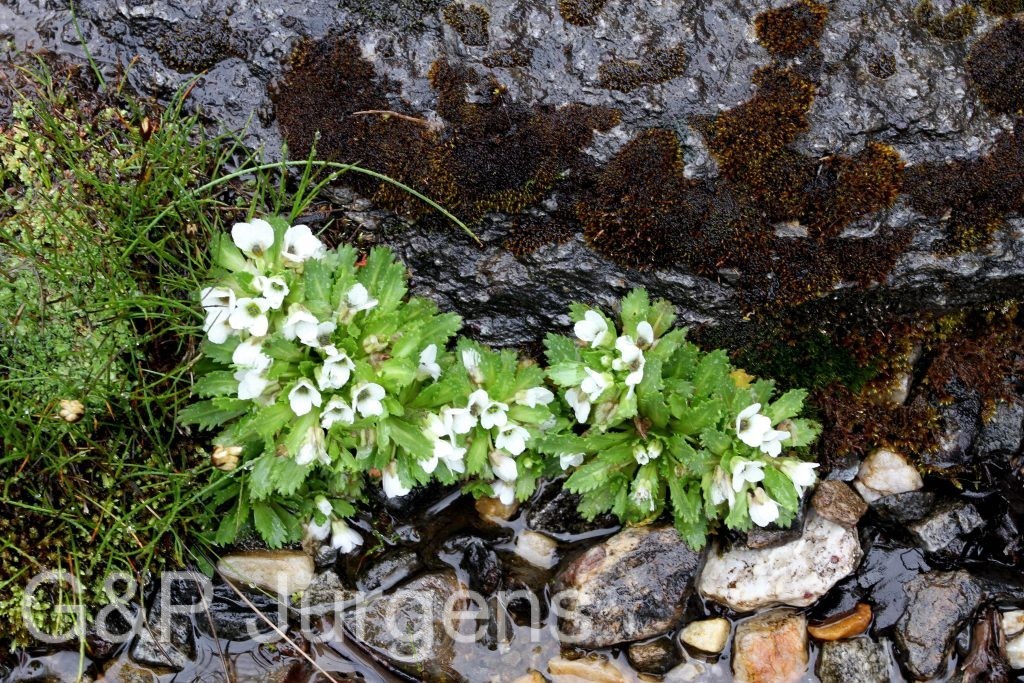
Pycnoplinthopsis bhutanica is a high-alpine crucifer endemic to the eastern Himalaya, recorded from Bhutan, Nepal and India, and one of the rarer plants in this group with only about 33 GBIF occurrences. It is confined to open alpine habitats — stony turf, screes, moraines and rock crevices — at very high elevations, generally around and above 4000 m. The plant photographed at Jule-Tso in Bhutan at about 4000 m in June represents its characteristic setting in cold, well-drained alpine ground near glacial lakes, flowering in early summer as the snow retreats.

The species is a small, cushion- or rosette-forming perennial herb with a stout, often woody taproot crowned by a dense tuft of leaves. The leaves are entire to slightly toothed, somewhat fleshy and crowded, frequently appressed to the ground. The flowers are borne close to the rosette on very short pedicels, with four white to pale lilac or pinkish petals arranged in the cruciform pattern typical of the family and six tetradynamous stamens. The fruit is a short silicula characteristic of the genus, retaining a persistent style and dehiscing to release the seeds.

Pycnoplinthopsis is a small Himalayan genus closely allied to Pycnoplinthus, both being dwarf, cushion-forming high-alpine Brassicaceae adapted to the harsh conditions of the upper alpine and subnival zone. The compact rosette habit, woody rootstock and reduced inflorescence are adaptations to cold, wind exposure and a brief growing season. As a narrow eastern Himalayan endemic of restricted, fragile high-elevation habitats, it is of biogeographic and conservation interest and potentially vulnerable to climate-driven contraction of the alpine zone, although it has not been formally assessed.

Author: Jafri · Sources: POWO (Kew), GBIF, Flora of China, Flora of Bhutan, Annotated Checklist of the Flowering Plants of Nepal, Al-Shehbaz systematics of Brassicaceae

Pyrus pashia

by GP Jürgens

Buch.-Ham. ex D.Don

Bhutan2012 1264
Bhutan Trashigang 1720m, October

Description

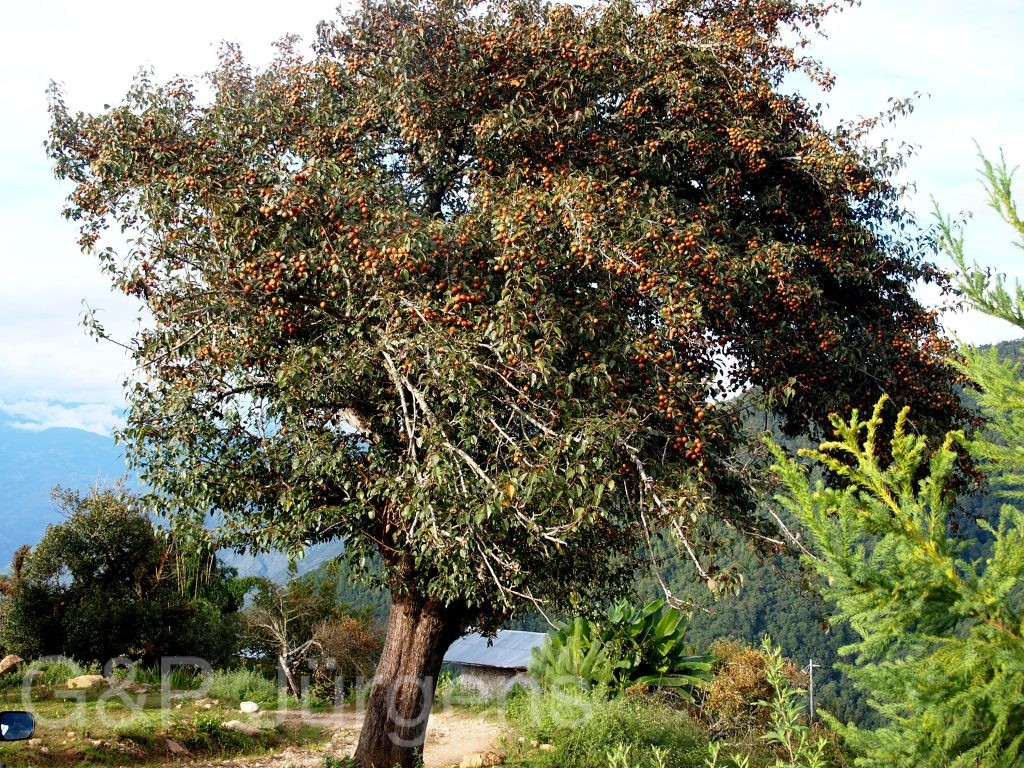
Pyrus pashia Buch.-Ham. ex D.Don, the wild Himalayan pear, is a widespread tree of the temperate Himalaya and adjacent ranges, distributed from Pakistan and Afghanistan through northern India, Nepal, Bhutan and south-west China into mainland Southeast Asia, with scattered introductions elsewhere. It grows in open broad-leaved forest, on forest margins, hillsides and around cultivation in the warm- to cool-temperate belt, generally between about 1000 and 2500 m. The photographed tree from Trashigang in eastern Bhutan at 1720 m, recorded in October when the fruit is ripening, typifies its occurrence in lower-montane forest and the agricultural landscapes where it is often retained or semi-cultivated.

The plant is a small to medium-sized deciduous tree with a rounded crown, the branches sometimes bearing short, stiff spines. The alternate leaves are ovate to elliptic, with finely toothed margins, an acuminate apex and a slender petiole, often hairy when young and turning colour before leaf-fall. In spring, before or with the new leaves, it bears showy corymbs of white, five-petalled flowers with numerous stamens bearing reddish to purple anthers. The fruit is a small, rounded to subglobose brown pome, dotted with conspicuous pale lenticels and gritty with stone cells, becoming sweet and edible only when bletted (over-ripened).

Within the genus Pyrus (Rosaceae, subfamily Amygdaloideae) P. pashia is a key Asian wild pear, valued as a rootstock for cultivated pears and a source of edible fruit and timber. Its blossom attracts bees and other insects, and the fruit is dispersed by birds, mammals and people. The species is widespread, common and of least concern, and is of interest to plant breeders as a reservoir of genetic diversity and disease resistance.

Author: Buch.-Ham. ex D.Don · Sources: POWO (Kew), GBIF, Flora of China (Rosaceae), Flora of Pakistan, Flora of Bhutan, Pears: Botany, Production and Uses

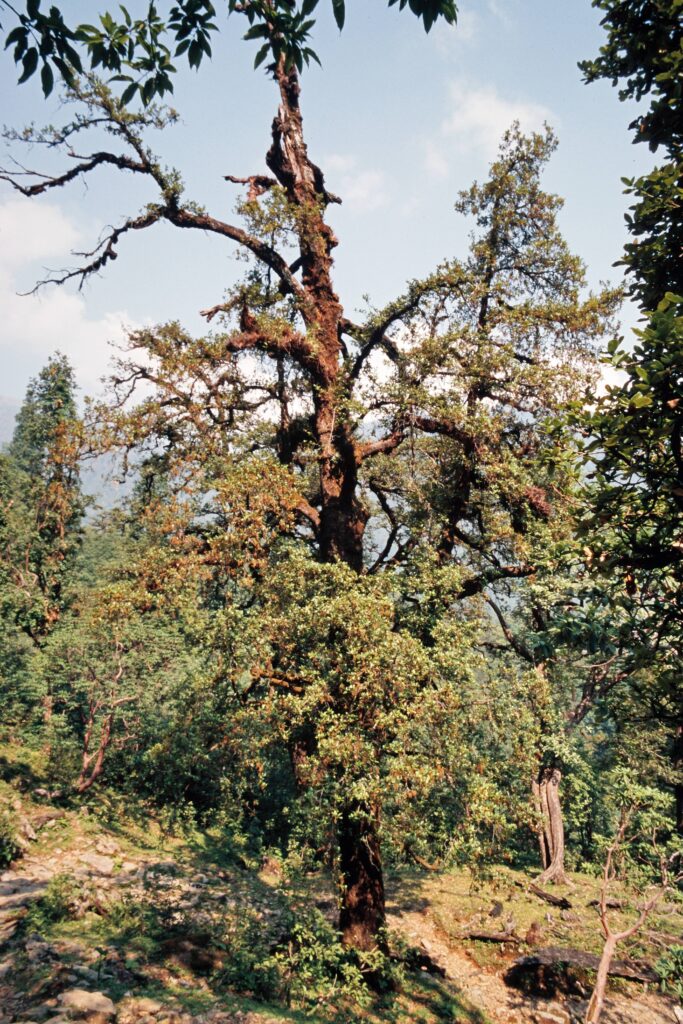
Lindl. ex A.Camus

Garh 07 97 ergebnis
India Garhwal Trijugi Narayan 2250m, June
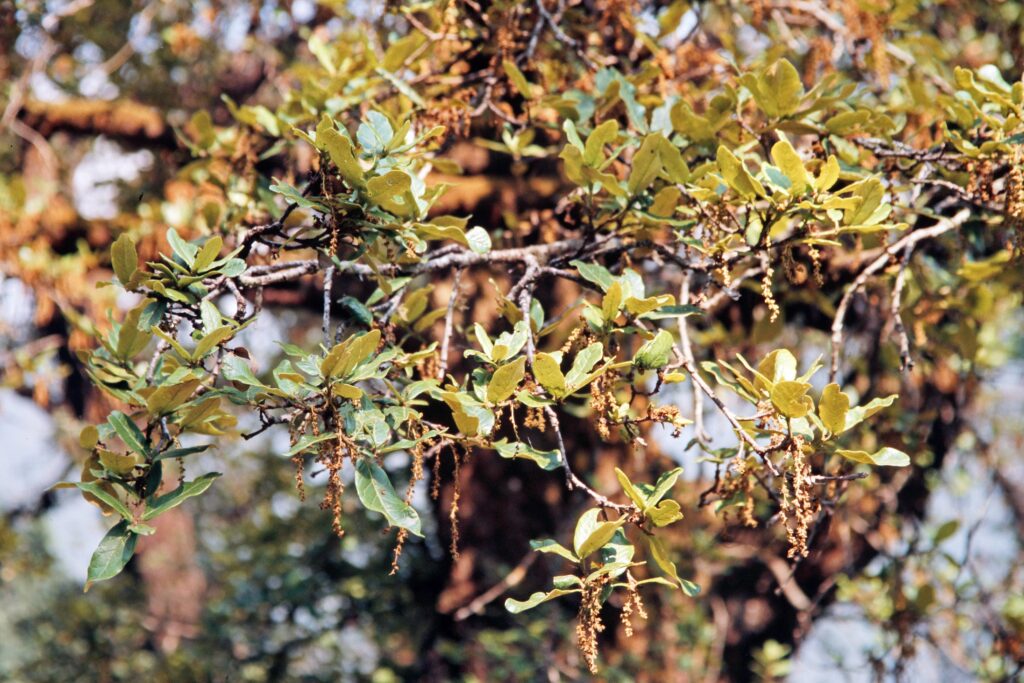
Garh 07 98 ergebnis
India Garhwal Trijugi Narayan 2250m, June

Description

Quercus floribunda Lindl. ex A.Camus, the moru or green oak, is an evergreen tree of the Fagaceae forming a major element of the temperate forests of the western and central Himalaya. GBIF records, totalling 278 occurrences, span India, Nepal, China, Pakistan and Afghanistan, with peripheral reports. The species dominates moist, cool-temperate slopes typically between 2,000 and 2,700 m, often in association with Quercus leucotrichophora, Rhododendron arboreum and Lyonia. The photographed tree from Trijugi Narayan in Garhwal at 2,250 m, in June, is representative of these mid-altitude oak forests that are climatically and hydrologically critical to the Himalayan watershed.

The plant is a large evergreen tree reaching 25–30 m, with a rounded crown and greyish, fissured bark. The leaves are coriaceous, oblong-lanceolate to elliptic, glossy dark green above and glaucous-pubescent or glabrescent beneath, the margins entire to spinulose-serrate especially on young foliage. The species is monoecious: the staminate flowers are borne in slender pendulous catkins, while the pistillate flowers are few and inconspicuous. As the name suggests, flowering is profuse. The fruit is an ovoid acorn seated in a shallow, scaly cupule, maturing in the second year.

Quercus floribunda has long been confused with Q. dilatata and other Himalayan oaks, and its nomenclature reflects a tangled taxonomic history within the ring-cupped oak group (subgenus Cerris / section Ilex). Ecologically these oak forests are keystone communities, regulating spring discharge and supporting rich epiphyte and lichen assemblages, yet they are heavily exploited for fuelwood, fodder and leaf-litter, making mature stands increasingly fragmented and locally threatened.

Author: Lindl. ex A.Camus · Sources: POWO (Kew), GBIF, Flora of China Vol. 4, Flora of Pakistan (Fagaceae), Flora of British India Vol. 5, Menitsky: Oaks of Asia

Quercus glauca

by GP Jürgens

Thunb.

Bhutan2015 571
Bhutan Mo-Chu 1550m, October
Bhutan2015 572
Bhutan Mo-Chu 1550m, October

Description

Quercus glauca, the ring-cupped or Japanese blue oak, is one of the most widespread evergreen oaks of East and South Asia. GBIF documents nearly 14,910 occurrences spanning Japan, China, Taiwan, Korea, Nepal, India, Bhutan, Myanmar, Laos and Pakistan, with numerous introduced records in Europe and North America. It is a dominant or co-dominant of subtropical and warm-temperate broadleaved evergreen forest, frequently on hill slopes, ravines and along watercourses at low to mid elevations. The photographed tree grew in Bhutan along the Mo-Chu at 1550 m in October, a typical mid-montane riparian situation within the species' Himalayan range.

It is an evergreen tree with smooth greyish bark and alternate, coriaceous, oblong-lanceolate leaves whose upper half is conspicuously serrate while the lower margin is entire; the lamina is glossy dark green above and glaucous, often whitish-waxy and pubescent beneath, giving the species its epithet. Young shoots are silky-villous. As a member of subgenus Cerris, section Cyclobalanopsis, it bears its acorns in a distinctive cupule formed of concentric, ring-like fused bracts rather than separate scales; the ovoid nut ripens in a single season. Flowers are unisexual, the staminate in slender pendent catkins, the pistillate few in short spikes.

GBIF accepts the name. Its placement in section Cyclobalanopsis, sometimes treated as a separate genus, unites the Asian ring-cupped oaks. Quercus glauca is an important timber and afforestation tree, widely planted and naturalised, and ecologically central to evergreen oak forests. It is abundant and assessed as of least conservation concern.

Author: Thunb. · Sources: POWO (Kew), GBIF, Flora of China, Flora of Bhutan, monograph of Asian Quercus (Cyclobalanopsis)

Quercus lanata

by GP Jürgens

Sm.

Nepal 97 83 P138
Nepal Tankhu 2100m April
Nepal 97 84 P141
Nepal Tankhu 2100m April

Description

Quercus lanata is an evergreen oak of the Himalaya and adjacent uplands, documented in 317 GBIF occurrences across Nepal, Bhutan, India, Pakistan, China, Myanmar, Thailand and Vietnam. It is a characteristic tree of subtropical to lower temperate broad-leaved forest, occurring on hill slopes and ridges, often in association with other evergreen oaks, rhododendrons and laurels, generally between about 1000 and 2400 m. The tree photographed at Tankhu in Nepal at 2100 m in April occupies the mid-montane oak belt, flowering in spring before or with the flush of new foliage on warm, well-drained slopes.

The species forms a small to medium-sized evergreen tree with a rounded crown and bark that is grey and fissured. The leaves are alternate, simple, coriaceous, ovate-lanceolate to elliptic, with serrate or crenate-dentate margins, the lower surface densely covered in a persistent greyish to tawny wool from which the epithet lanata derives. The flowers are unisexual and monoecious, the staminate borne in slender pendulous catkins and the pistillate few, in short spikes. The fruit is an acorn, ovoid, seated in a shallow, scaly cupule, maturing over one season.

Quercus lanata belongs to subgenus Cerris, section Cyclobalanopsis or the ring-cupped oak alliance recognised in older treatments, and has historically been confused with Q. leucotrichophora and other woolly-leaved Himalayan oaks. It is an important component of mid-elevation watershed forests, providing fuelwood, fodder and leaf litter, and is locally subject to pressure from lopping and forest clearance, though it remains widespread and not globally threatened.

Author: Sm. · Sources: POWO (Kew), GBIF, Flora of China Vol. 4, Flora of Bhutan Vol. 1, Flora of Nepal, Flora of Pakistan, Menitsky's Oaks of Asia

A.Camus

Garh 07 580 ergebnis
India Garhwal Seena 3350m, June

Description

Quercus leucotrichophora, commonly known as banj oak, is a dominant broadleaved tree of the western and central Himalaya, distributed from northern Pakistan through India (Jammu & Kashmir, Himachal Pradesh, Uttarakhand) to Nepal, Bhutan, and adjacent parts of Myanmar. It forms extensive forests on north-facing slopes and mesic sites at elevations of 1,500–3,500 m, constituting one of the most ecologically important tree species in the Himalayan mid-montane zone. The species has been documented at Seena in the Garhwal Himalaya of Uttarakhand at 3,350 m in June, representing the upper elevational margin of its range where it transitions into subalpine communities.
Quercus leucotrichophora is an evergreen tree, typically 15–25 m tall, with a stout trunk and spreading, dense crown. The bark is dark grey to blackish, deeply furrowed on mature trees. Leaves are elliptic to lanceolate, 6–15 cm long and 2–5 cm wide, with a sharply serrate margin bearing spine-tipped teeth, coriaceous in texture, dark green and glabrous above, and distinctly white-tomentose beneath — the specific epithet referring to these white (leuco-) hairs (tricho-) on the leaf (phora). Flowers are unisexual and monoecious; male catkins are pendulous, 5–10 cm long, while female flowers are borne in short, erect spikes. The acorn is ovoid, 1–1.5 cm long, seated in a shallow, scaly cupule with appressed, imbricate scales.
Quercus leucotrichophora belongs to the subgenus Cerris, section Ilex, a group of evergreen oaks centred in East and South Asia. It is a keystone species in western Himalayan forests, supporting a rich community of epiphytes, mycorrhizal fungi, and avifauna. The leaf litter is a critical source of organic matter and nutrient cycling in montane soils. Banj oak forests are widely exploited for fuelwood and fodder — the leaves being an essential winter fodder resource for livestock — and ongoing lopping pressure has led to degradation of many stands, prompting conservation and restoration efforts across Uttarakhand and Himachal Pradesh.

Author: A.Camus · Sources: POWO (Kew), GBIF, Flora of China Vol. 4, Singh & Rawat: Flora of the Great Himalayan National Park (2000), Troup: Silviculture of Indian Trees Vol. 3

Sm.

Bhutan2014 857
Bhutan Chele-La 3000m, May
Bhutan2014 1039
Bhutan Chele-La 3000m, May
Nepal 99 374 ergebnis
West-Nepal Linji-Khola 3300m, June

Description

Quercus semecarpifolia, the kharsu oak, is an evergreen oak forming the highest-altitude oak forests of the Himalaya, native across China, Nepal, India, Bhutan, Pakistan and Afghanistan and extending into Myanmar and Thailand. It dominates upper montane and subalpine slopes, often at the treeline, generally between about 2400 and 3800 m, on cool, moist exposures. The trees photographed at Chele-La in Bhutan at 3000 m in May and along the Linji-Khola in West Nepal at 3300 m in June illustrate its role as the uppermost broad-leaved forest belt, frequently mixed with rhododendron, fir and birch near the limit of arborescent growth.

It is a large evergreen tree, gnarled and spreading at high elevations, with thick, fissured bark. The leaves are leathery and elliptic to oblong, dark glossy green above and golden- to rusty-tomentose beneath when young, the margin entire or with a few spiny teeth, especially on younger and coppice growth. It is monoecious, the male flowers in slender pendulous catkins and the female flowers solitary or few. The fruit is a large, hemispherical acorn seated in a shallow cup of appressed scales, maturing over a second season and providing important mast.

Quercus semecarpifolia belongs to subgenus Cerris (section Ilex, the ring-cupped oaks), the predominant oak lineage of the Sino-Himalayan mountains. As a treeline keystone it stabilises soils, supports rich epiphyte and understorey communities and yields hard timber, fuelwood and fodder, which makes it heavily exploited and in places poorly regenerating. Its acorns are dispersed by birds and rodents, and the species is regarded as ecologically critical yet locally threatened by overcutting and grazing across the Himalaya.

Author: Sm. · Sources: POWO (Kew), GBIF, Flora of China, Annotated Checklist of the Flowering Plants of Nepal, Flora of Bhutan, Menitsky's Oaks of Asia

Hand.-Mazz.

Nepal 2001 305 ergebnis ergebnis
Nepal (Gorkha) Kharka 3140m, May

Description

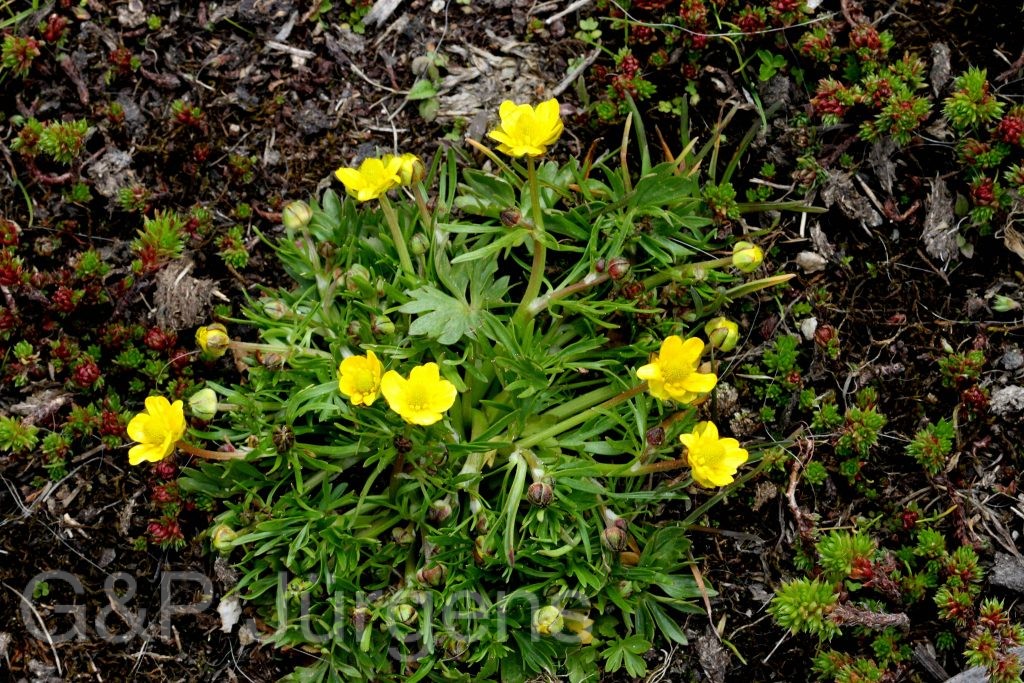
Ranunculus adoxifolius is a small buttercup of the Sino-Himalayan region, recorded from Nepal, India and Bhutan, with GBIF listing about 76 occurrences (the French record reflecting herbarium or cultivated provenance). It occupies moist subalpine to alpine habitats, including shaded forest margins, damp meadows, mossy banks and seepage slopes, generally between roughly 3000 and 4000 m. The photographed plant was found in the Gorkha district of Nepal at a kharka (high pasture) at 3140 m in May, flowering early in the season as snowmelt moistens the ground beneath open forest and on grassy slopes.

It is a delicate, low perennial herb with a short rhizome and fibrous roots. The basal leaves are long-petiolate with rounded, three-lobed to ternately divided blades whose segments are crenate-lobed, recalling the foliage of Adoxa, hence the epithet. The slender, few-leaved stems bear one to a few small flowers. Each flower has five (sometimes more) spreading, glossy yellow petals each with a basal nectary scale, numerous yellow stamens, and a domed receptacle of many free carpels. The fruiting head is a globose to ovoid cluster of small, glabrous, beaked achenes.

The species belongs to the cosmopolitan genus Ranunculus (Ranunculaceae), within the assemblage of small-flowered Asian alpine buttercups. Like its relatives it contains the acrid glycoside ranunculin, rendering the fresh plant unpalatable to grazing stock. With a restricted Himalayan range tied to undisturbed moist montane habitat, it is a useful indicator of intact subalpine vegetation; it has not been formally assessed, but its specialised habitat warrants attention where disturbance and grazing intensify.

Author: Hand.-Mazz. · Sources: POWO (Kew), GBIF, Flora of Nepal, Flora of China, Annotated Checklist of the Flowering Plants of Nepal, Ranunculus monographs (Tamura)

Freyn

Sikkim2011 55
Sikkim Vista-valley 3800m, June
Sikkim2003 300 P429
Sikkim Saniti-Lake 4300m August

Description

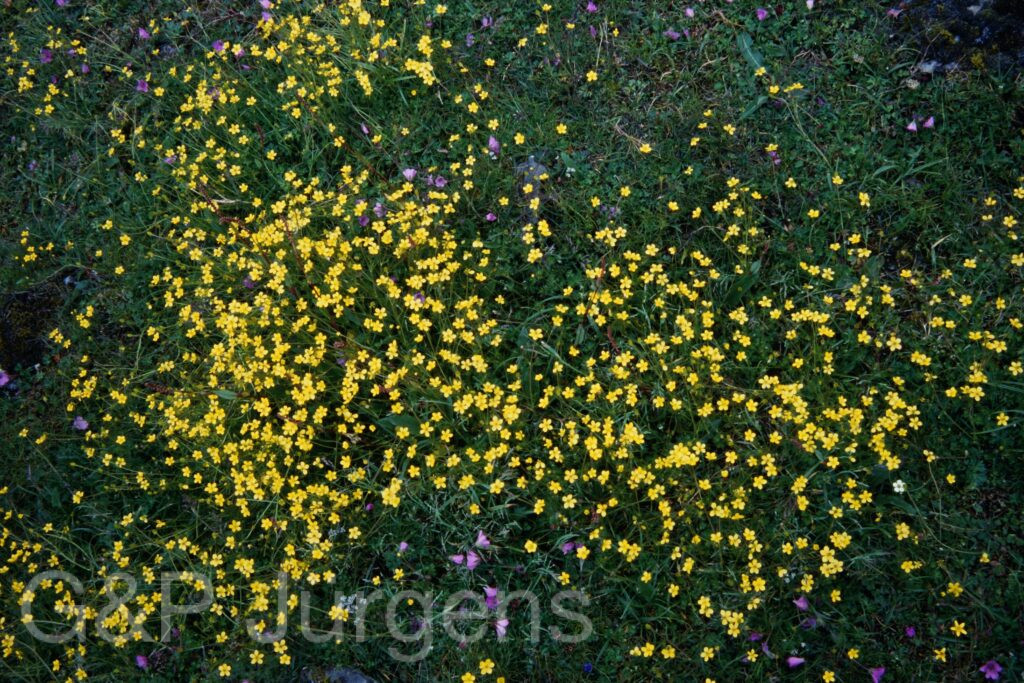
Ranunculus brotherusii is a widespread alpine buttercup of Central Asia and the Himalaya, recorded from China, Nepal, India, Bhutan, Pakistan, Mongolia, Russia and Kyrgyzstan, with additional collections in European herbaria. Its roughly 1756 georeferenced records reflect a common and broadly distributed high-mountain species. It grows in damp alpine meadows, marshy ground, streamsides and snow-flush hollows, typically at about 3000-5000 m. The Sikkim gatherings cited above, from the Vista valley at 3800 m in June and from Saniti Lake at 4300 m in August, are characteristic, the species flowering through the short alpine summer on moist, well-watered turf.

It is a small, tufted perennial herb arising from a fibrous root system, the stems erect to ascending and sparsely appressed-hairy. The basal leaves are long-petiolate with reniform to orbicular blades that are three-lobed or further divided into crenate segments, while the cauline leaves are smaller and more deeply cut, becoming sessile above. The flowers are solitary or few, with five greenish, often pubescent sepals and five glossy yellow obovate petals each bearing a small nectary scale. The numerous stamens surround a globose to ovoid head of carpels, the fruit an aggregate of small glabrous achenes with a short curved or hooked beak.

Ranunculus is a large, cosmopolitan genus particularly diverse in cold temperate and alpine regions, and R. brotherusii belongs to its assemblage of small-flowered Asian alpine buttercups. Like its relatives it contains acrid protoanemonin compounds rendering it unpalatable and toxic to livestock, which favours its persistence on grazed pasture. Pollination is by generalist alpine flies and bees. Its extensive transboundary range and ecological tolerance place it well outside any conservation concern.

Author: Freyn · Sources: POWO (Kew), GBIF, Flora of China, Flora of Pakistan, Ranunculus of Central Asia monograph