Tag:

Summer

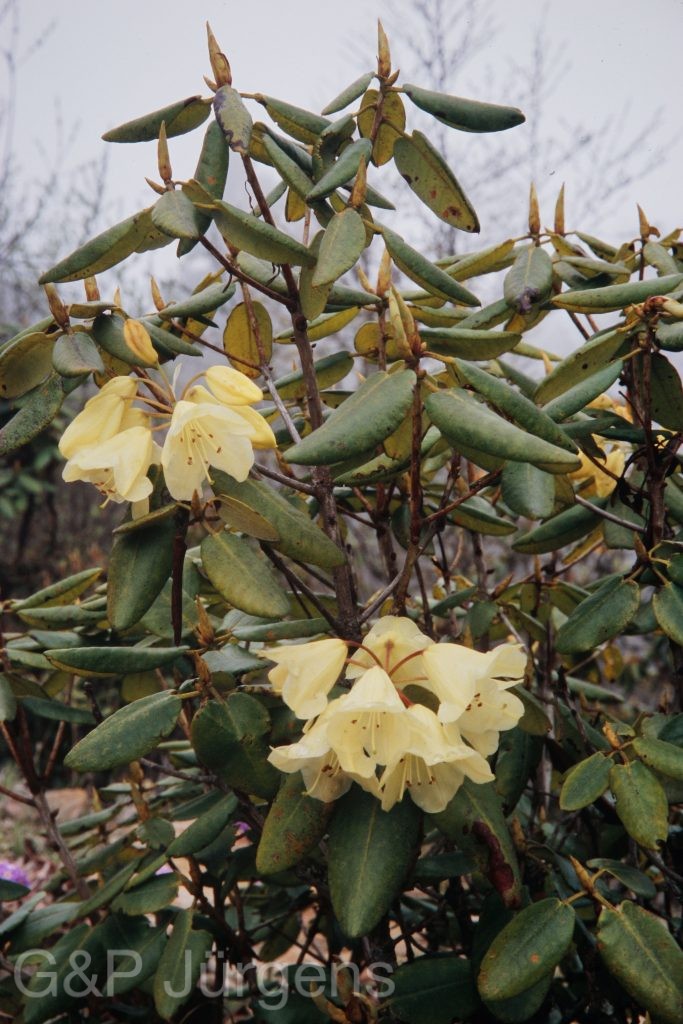
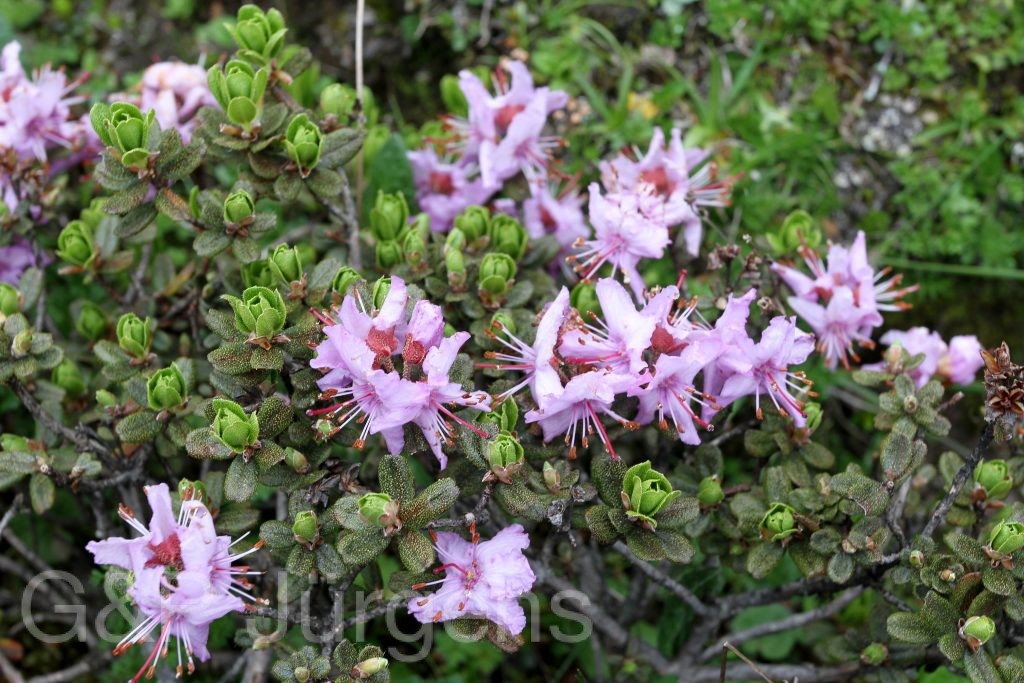
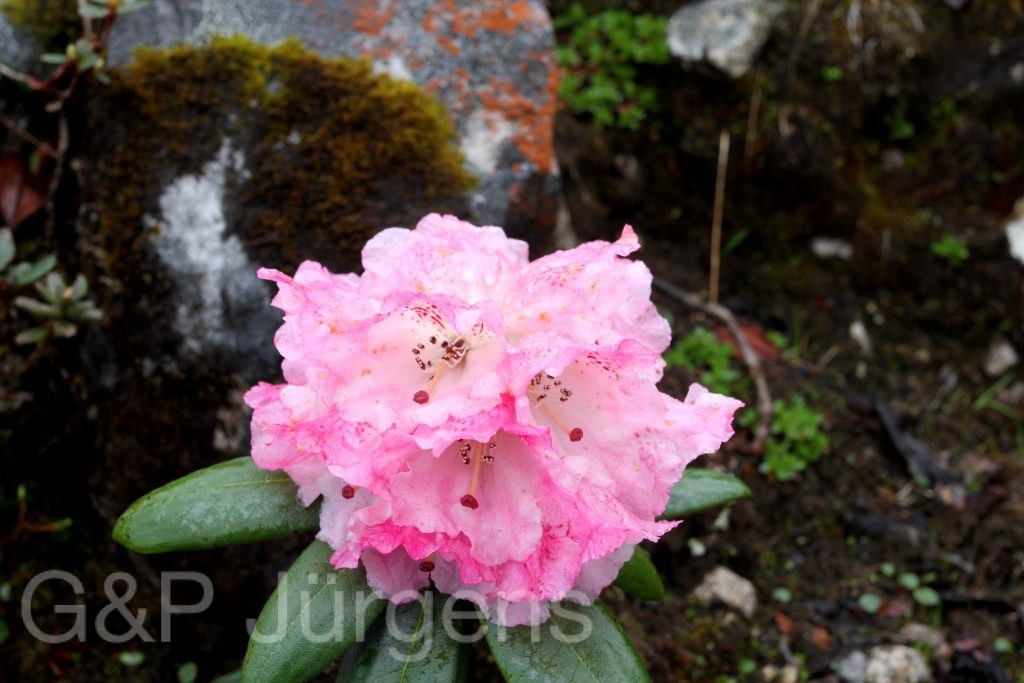
D.G.Long & S.Bowes-Lyon
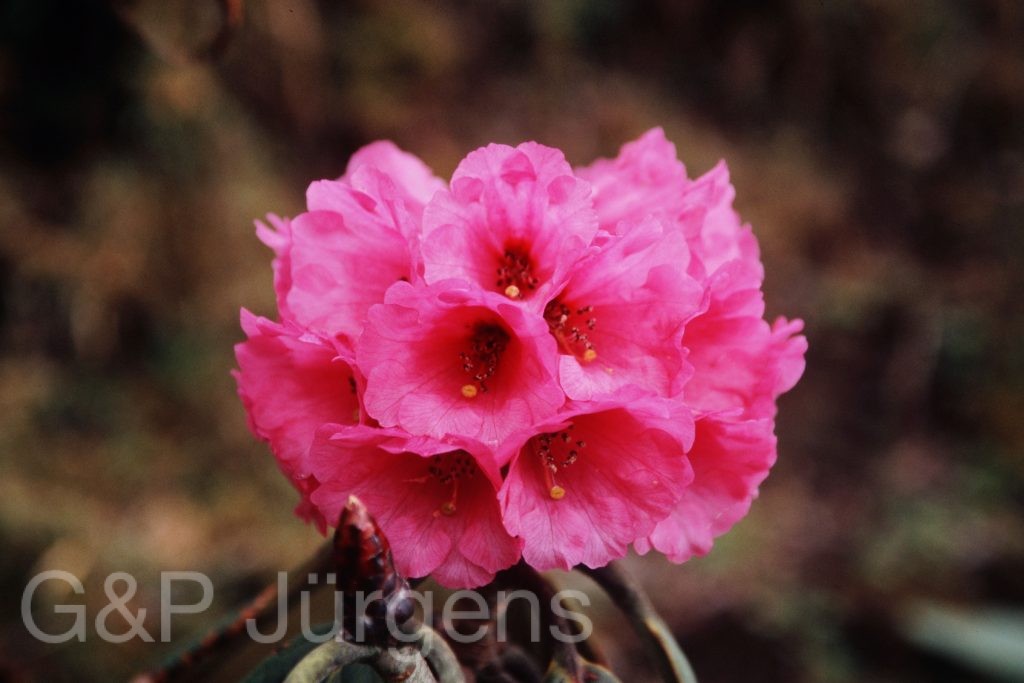
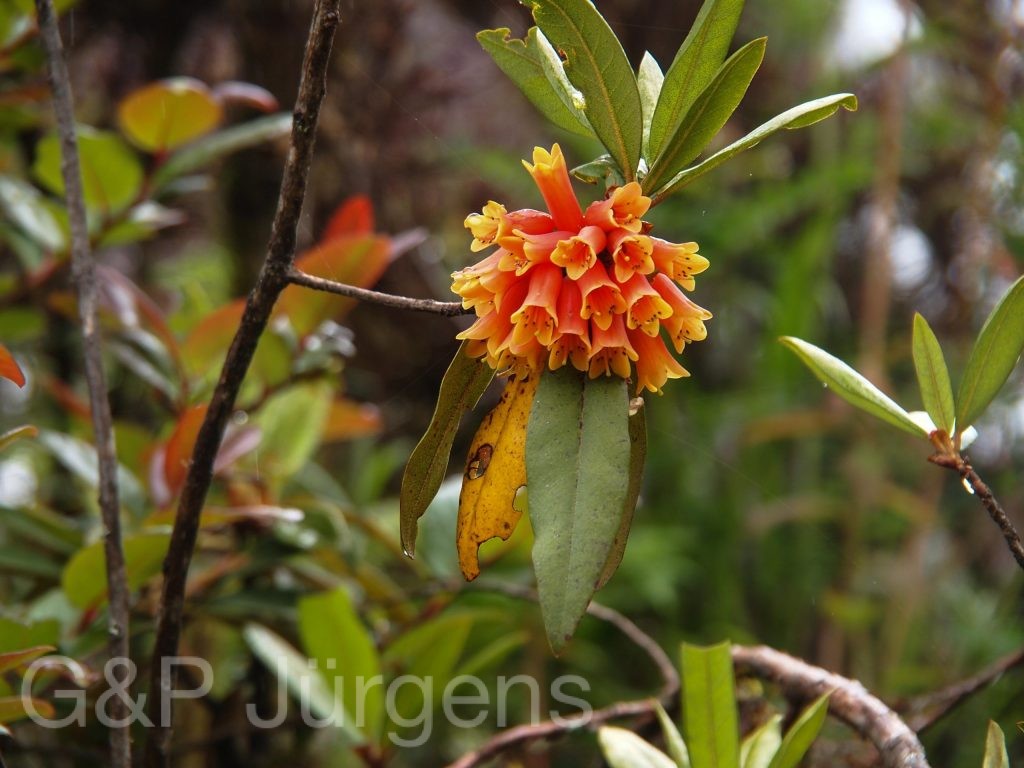
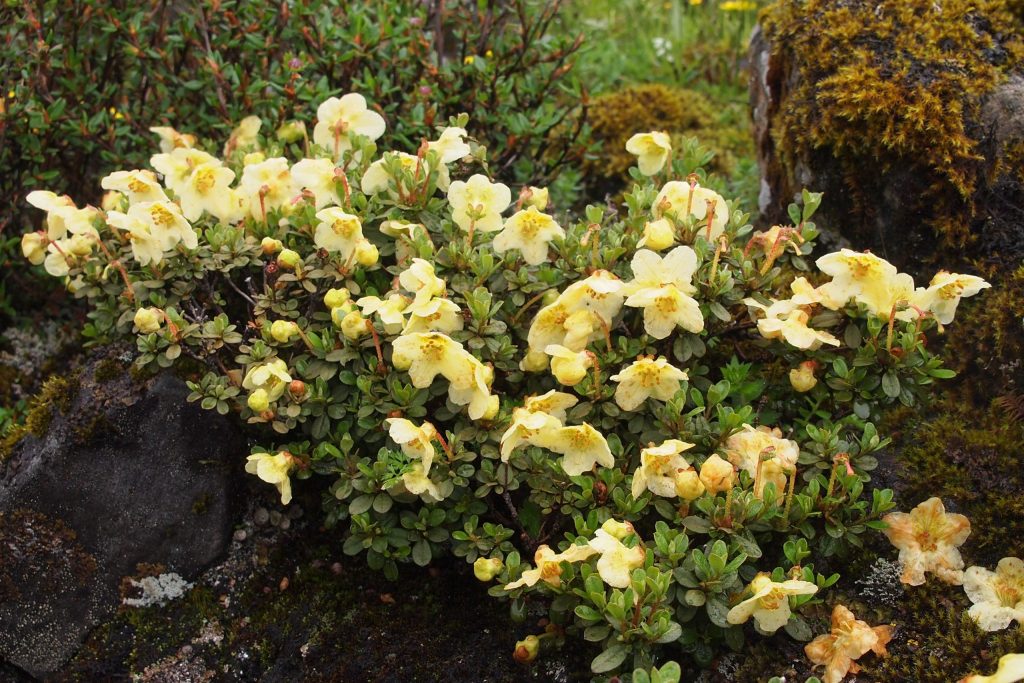
BhutanPG2011 510
Bhutan Ludlow-Sherriff-Trail Warrtlang-La, 4500m June
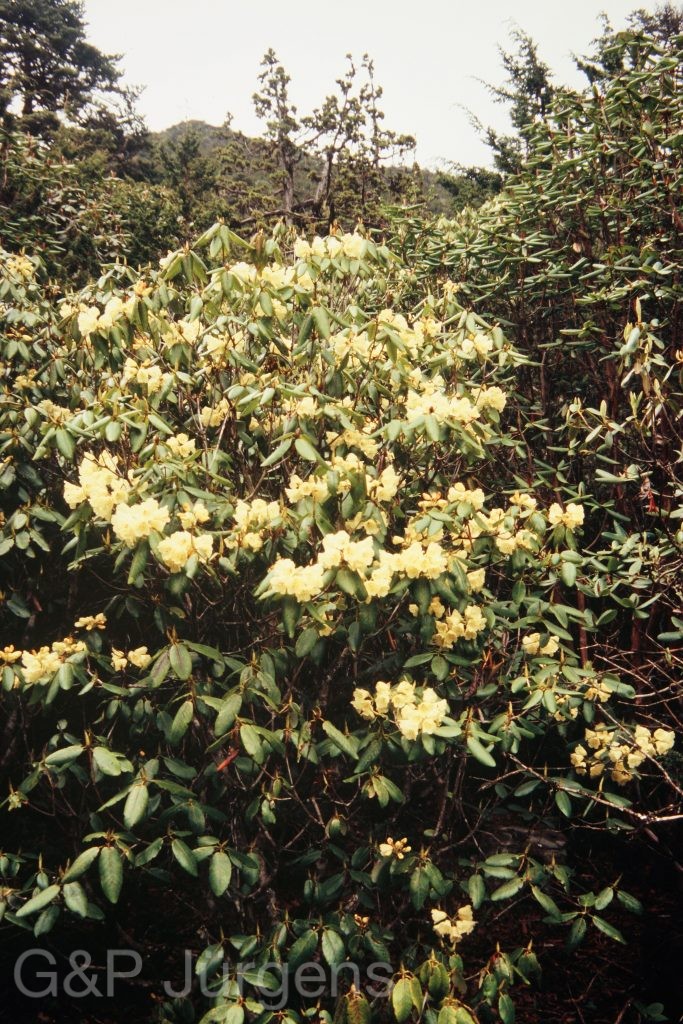
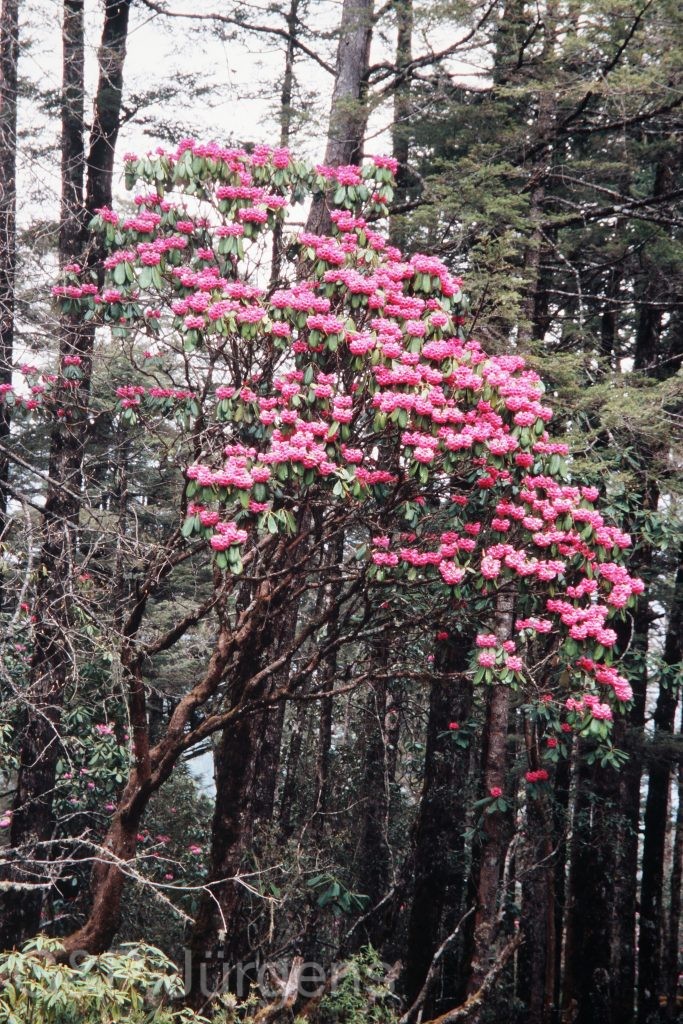
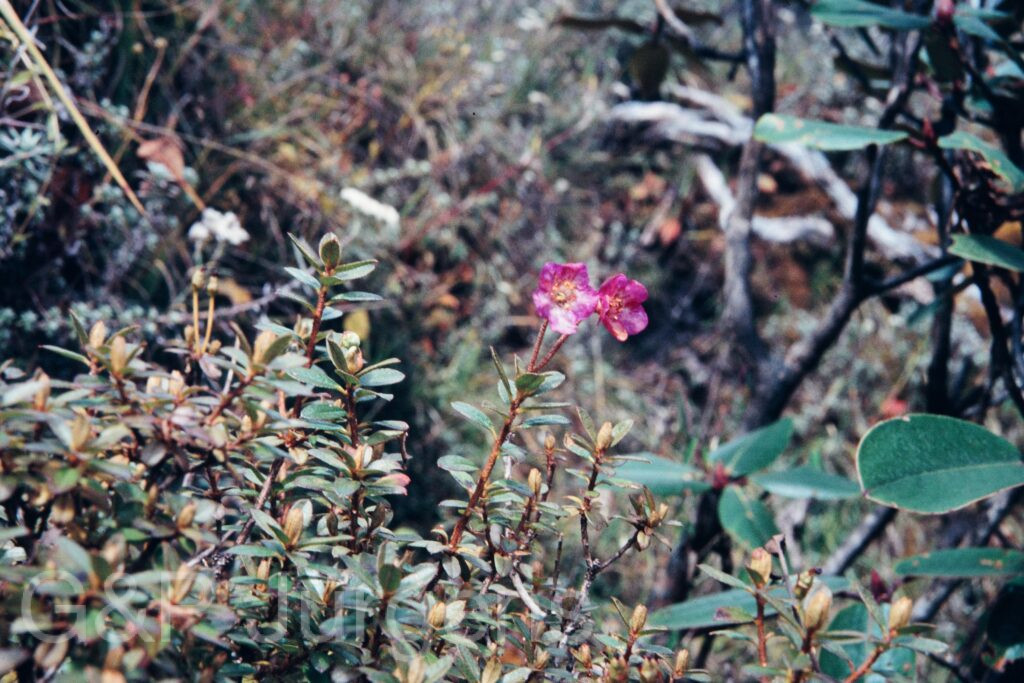
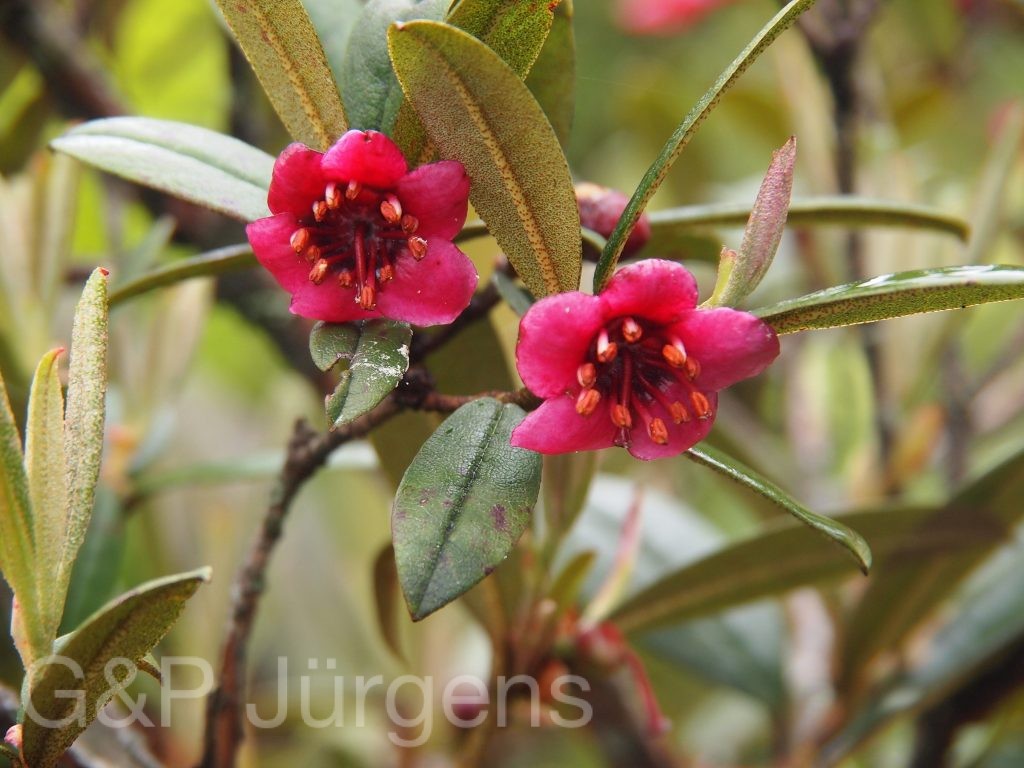
BhutanPG2011 412
Bhutan Ludlow-Sherriff-Trail Warrtlang-La, 4500m June
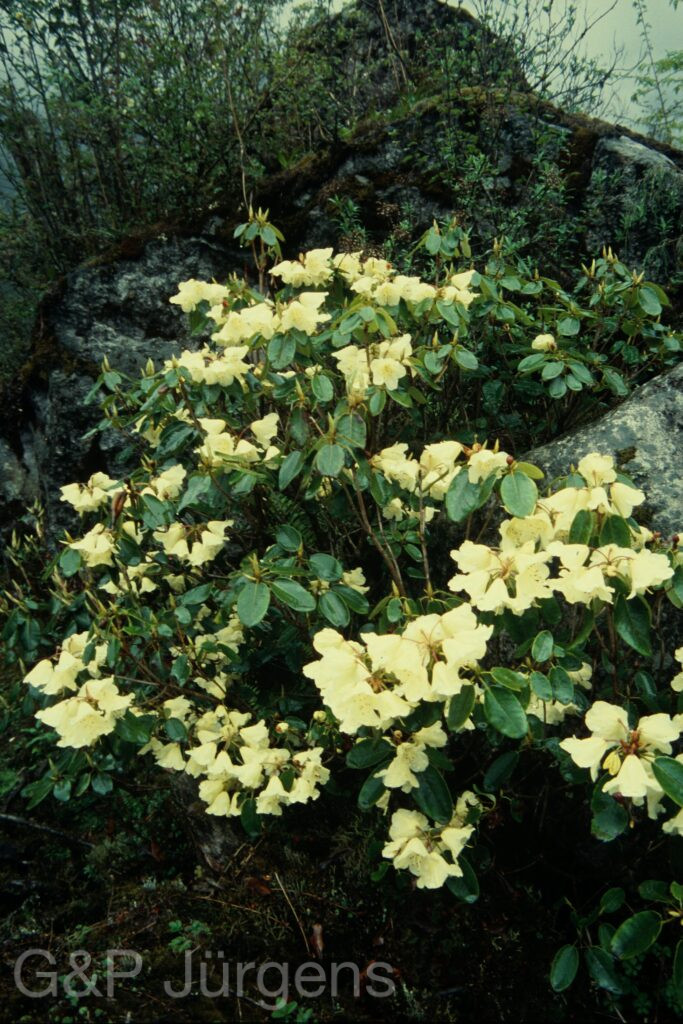
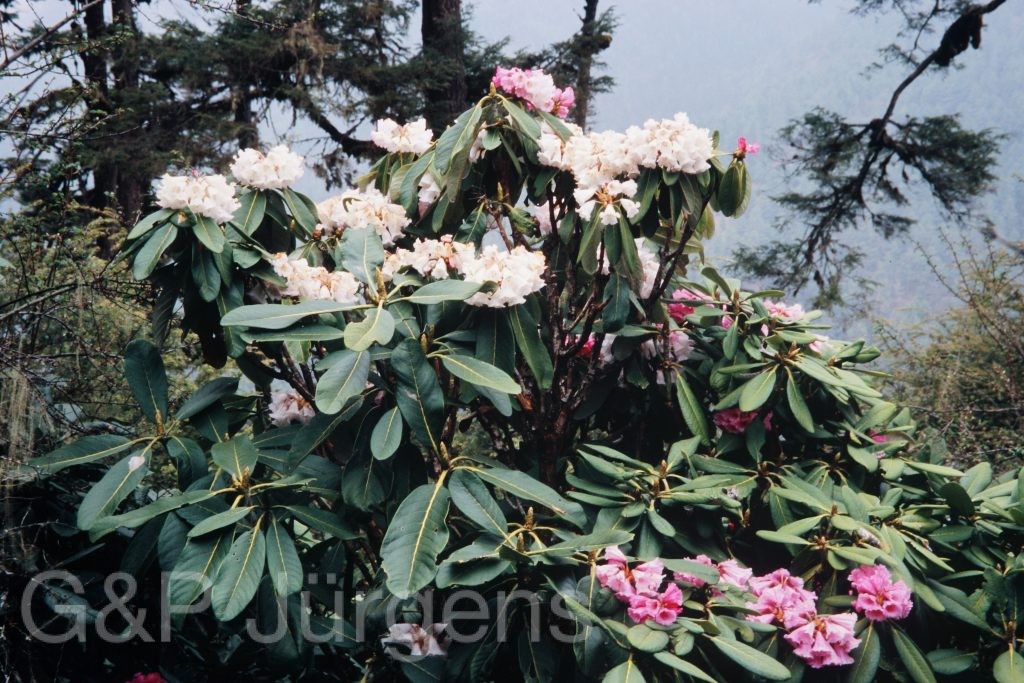
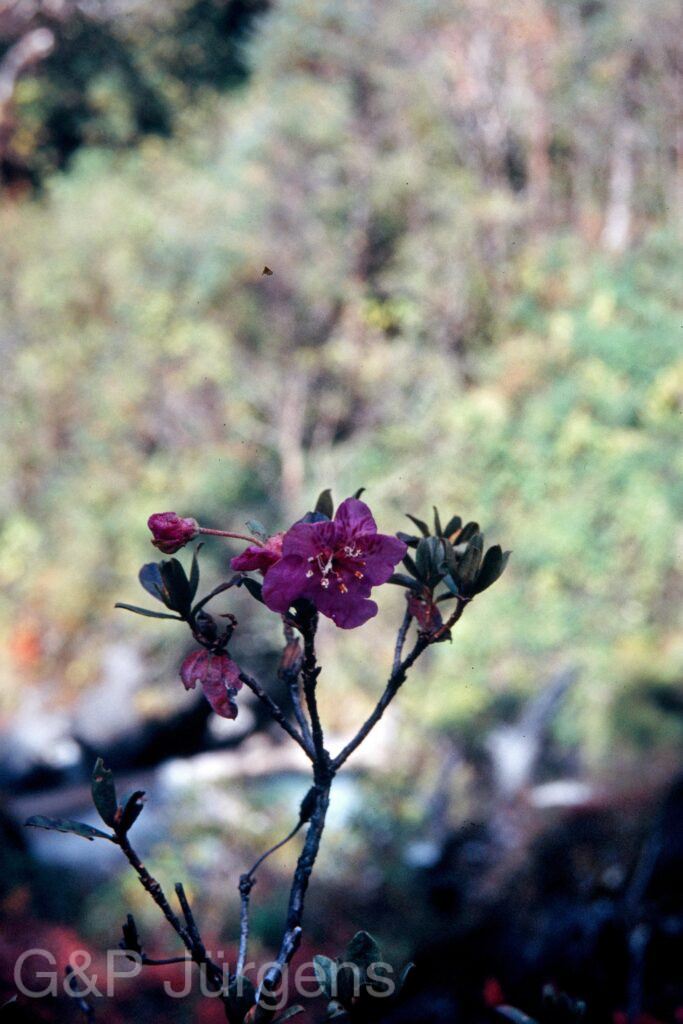
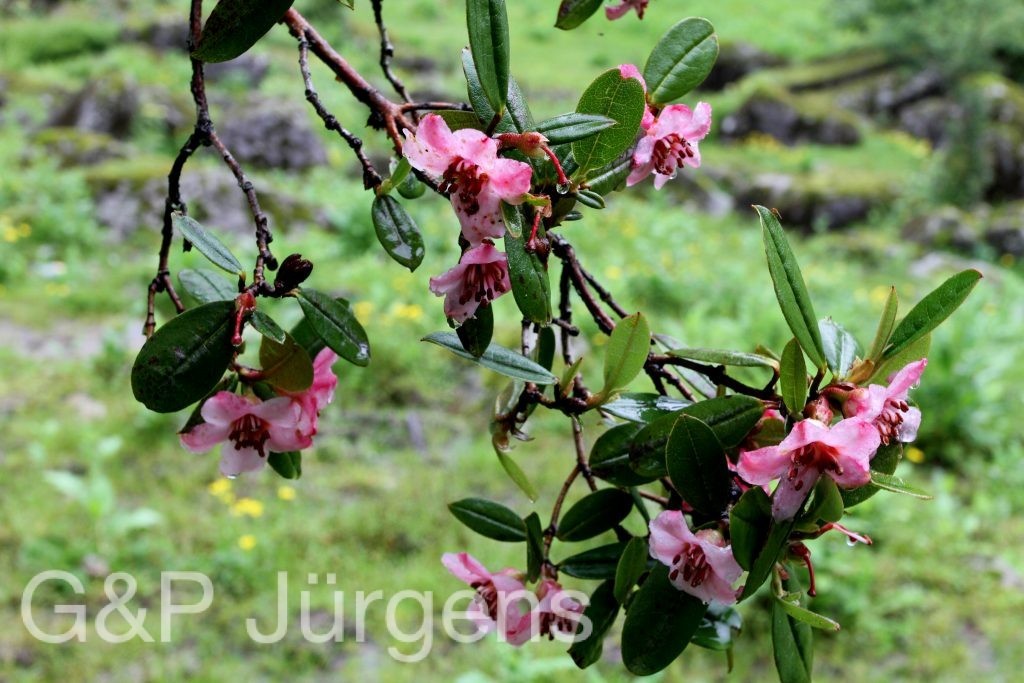
BhutanPG2011 511
Bhutan Ludlow-Sherriff-Trail Warrtlang-La, 4500m June

Description

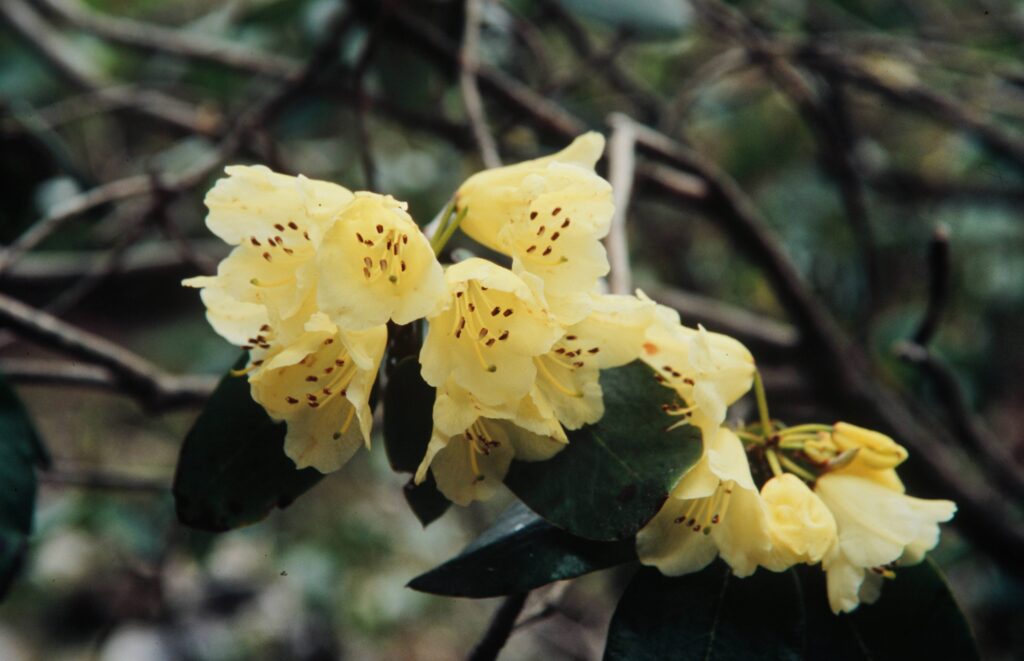
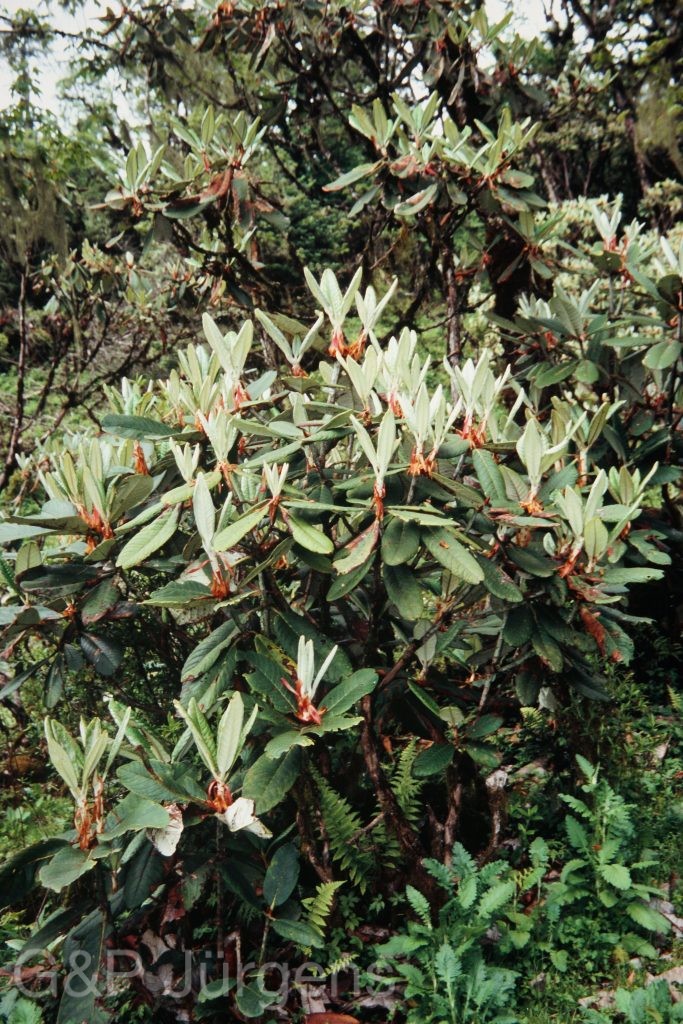
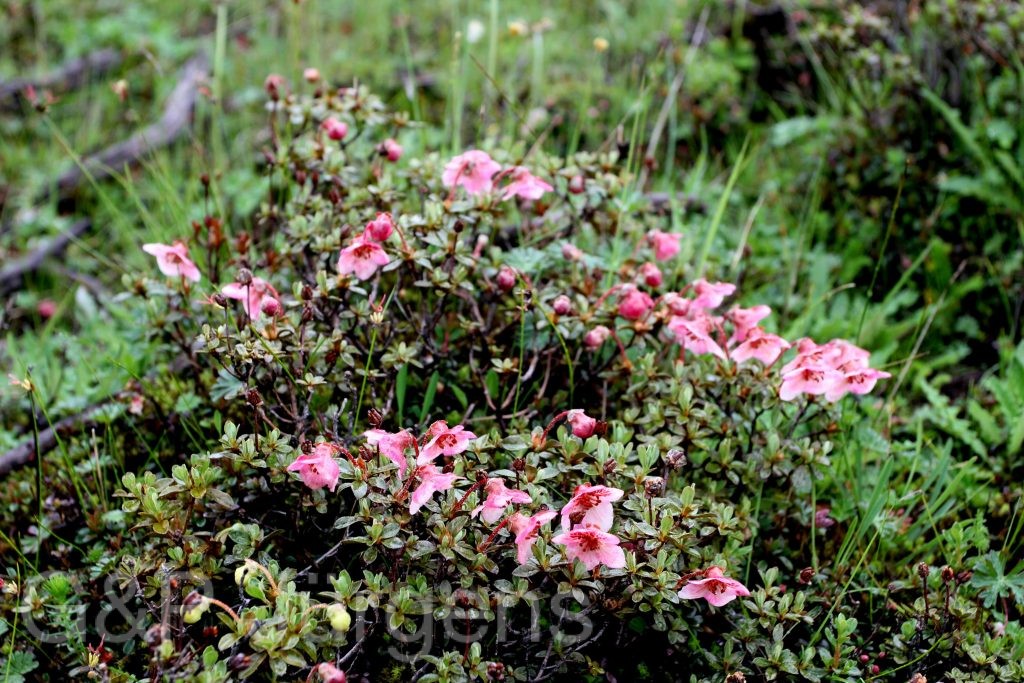
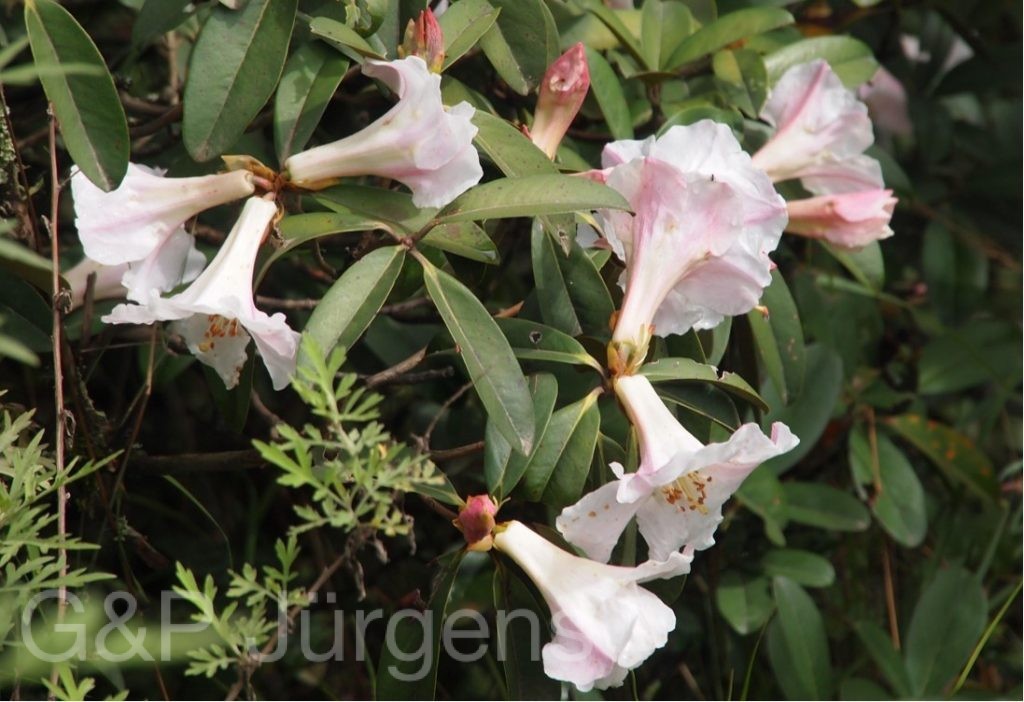
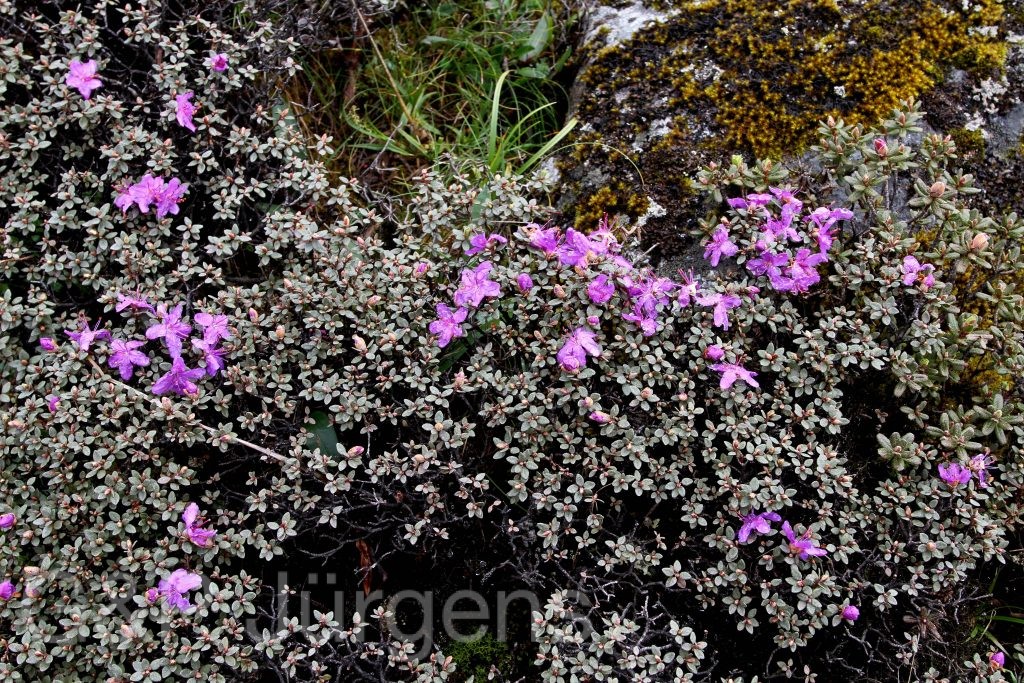
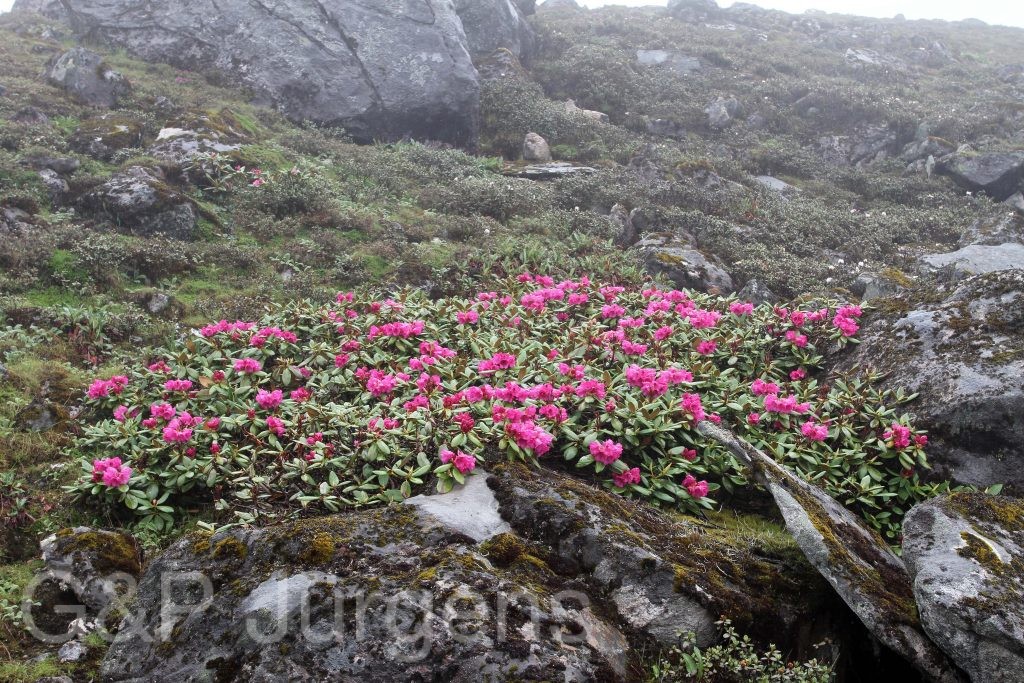
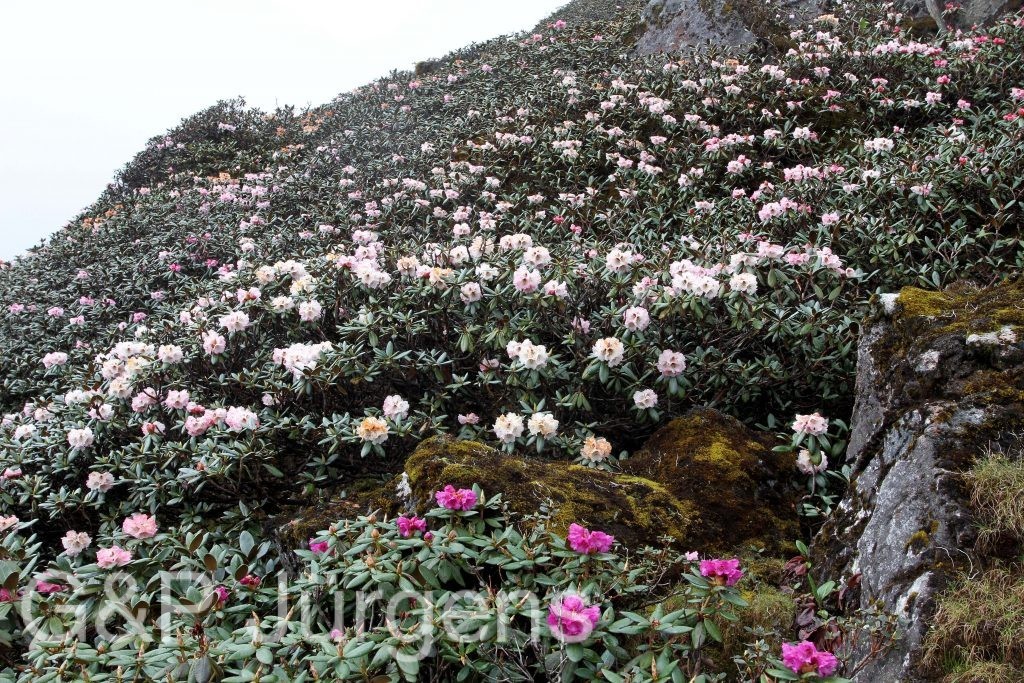
Rhododendron bhutanense is a high-alpine shrub endemic to the eastern Himalaya, centred on Bhutan and adjacent India, with only about 59 GBIF records reflecting its restricted range. It is a component of the dwarf rhododendron heath and open alpine scrub that clothes exposed slopes near and above the treeline, typically between about 3500 and 4500 m. The photographed plant on the historic Ludlow–Sherriff trail at the Warrtlang La pass at 4500 m, flowering in June, exemplifies its occupancy of the highest shrub zone, where it endures intense irradiation, wind and frost on thin, acidic, peaty soils in the early summer flowering season.

The species is a low to medium evergreen shrub with stout branchlets. Its leaves are coriaceous, oblong to elliptic, with the lower surface bearing a dense indumentum (a felted tomentum) characteristic of the section to which it belongs, an adaptation reducing water loss and radiation damage at altitude. The flowers are borne in compact terminal trusses; the corolla is campanulate to funnel-campanulate, pink to pale rose or purplish, often with darker spotting within. Stamens are typically ten, and the ovary is densely hairy, maturing into a woody, septicidal capsule that releases numerous small seeds.

Rhododendron bhutanense was described by D.G.Long and S.Bowes-Lyon and is placed in subgenus Hymenanthes, allied to the indumented R. campanulatum group, its tomentose leaf undersides being a key diagnostic. As a narrow eastern-Himalayan endemic confined to a thin alpine band, it is of particular biogeographic and conservation interest: such high-altitude endemics are especially exposed to upslope habitat loss under climate warming, making monitoring of its limited Bhutanese populations worthwhile.

Author: D.G.Long & S.Bowes-Lyon · Sources: POWO (Kew), GBIF, Flora of Bhutan, Rhododendrons of Bhutan, Cullen & Chamberlain Revision of Rhododendron
Hook.f.

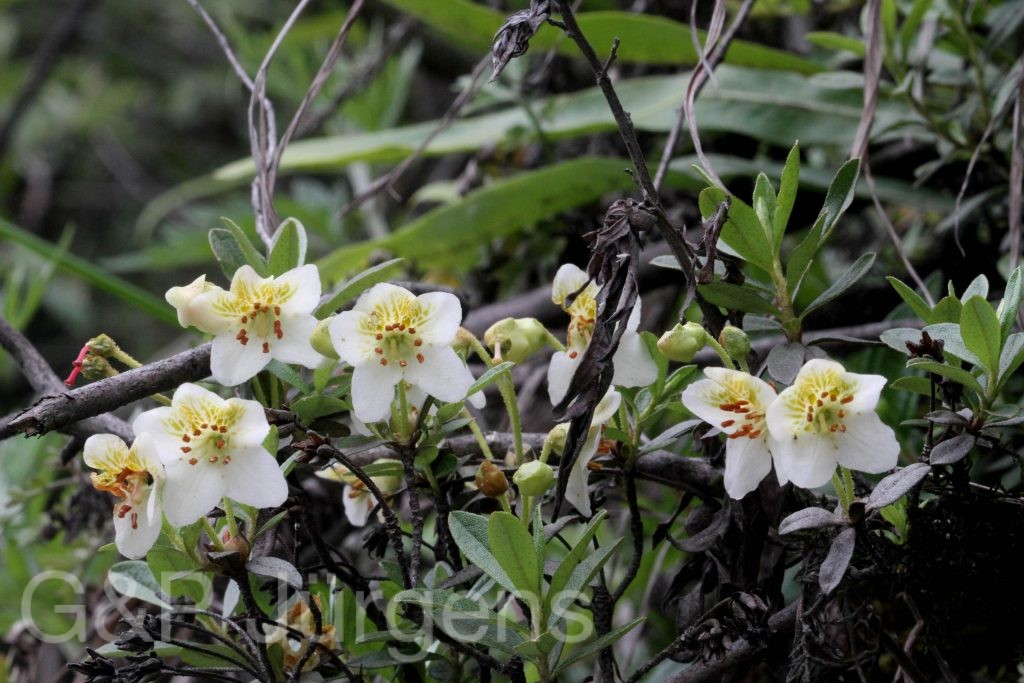
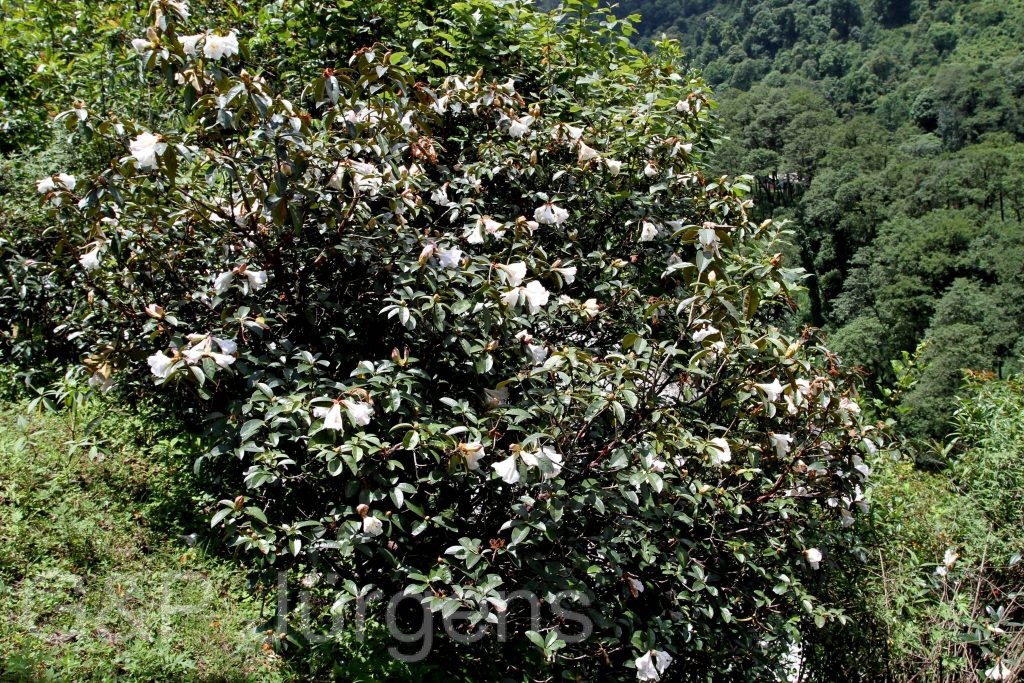
BhutanPG2011 31
Bhutan Pele-La, 2800m June
BhutanPG2011 693 1
Bhutan Luksor, 2900m July

Description

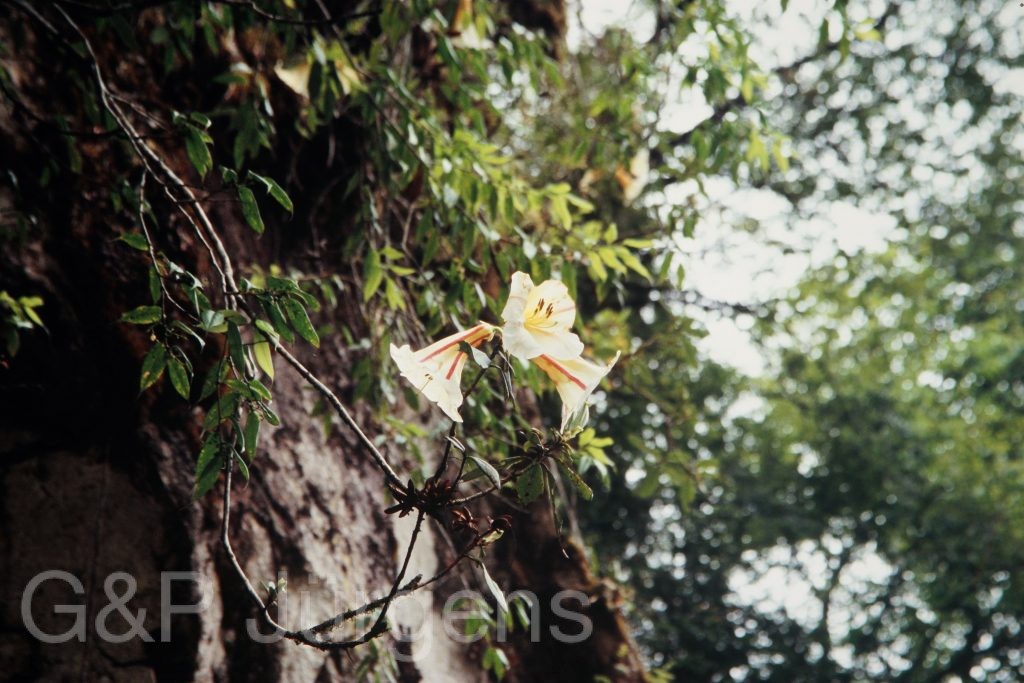
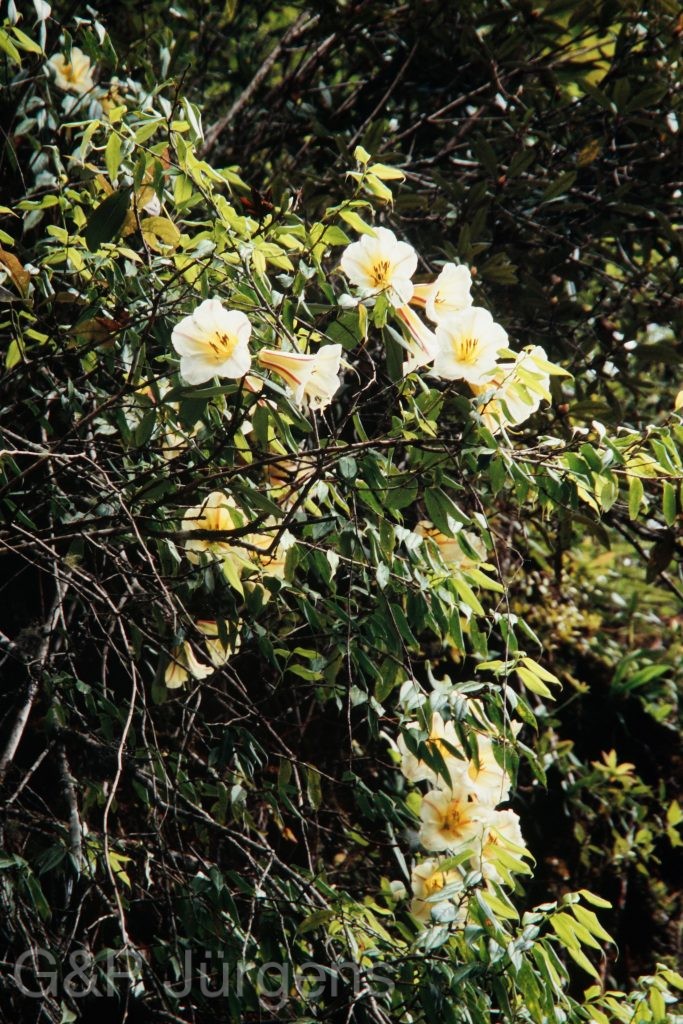
Rhododendron camelliiflorum is a Himalayan endemic shrub restricted to the moist temperate belt of Nepal, India, Bhutan and adjacent China (Xizang), with 165 GBIF occurrences. It is characteristically epiphytic or lithophytic, growing on mossy tree trunks, rocks and banks within humid Abies, Tsuga and broadleaved forest, typically between about 2500 and 3500 m. The photographs were taken in Bhutan at Pele-La at 2800 m in June and at Luksor at 2900 m in July, cool cloud-forest sites where persistent mist and abundant epiphytic moss create the damp microhabitats this species favours.

It is a small, straggling evergreen shrub with scaly young shoots and coriaceous, elliptic to oblanceolate leaves that are dark green and lepidote (densely scaly) beneath, with revolute margins and an acute, mucronate apex. The flowers are borne singly or in small terminal clusters and are notably fleshy; the campanulate to broadly tubular, five-lobed corolla is waxy white, often flushed with pink or rose, recalling a small camellia, whence the epithet. The stamens are typically ten, with the ovary and style densely scaly. The fruit is a dry, scaly, septicidal capsule releasing numerous minute seeds.

The species belongs to subgenus Rhododendron, section Rhododendron (the lepidote rhododendrons), and its thick-textured flowers and epiphytic tendency distinguish it within the Himalayan assemblage. Its summer flowering and inaccessible epiphytic habit have kept it scarce in cultivation. Though confined to a narrow elevational band, it remains locally frequent in intact forest and is not currently considered globally threatened, but it is vulnerable to forest degradation across the eastern Himalaya.

Author: Hook.f. · Sources: POWO (Kew), GBIF, Flora of Bhutan, Flora of China, The Genus Rhododendron (Royal Botanic Garden Edinburgh), Rhododendrons of the Himalaya

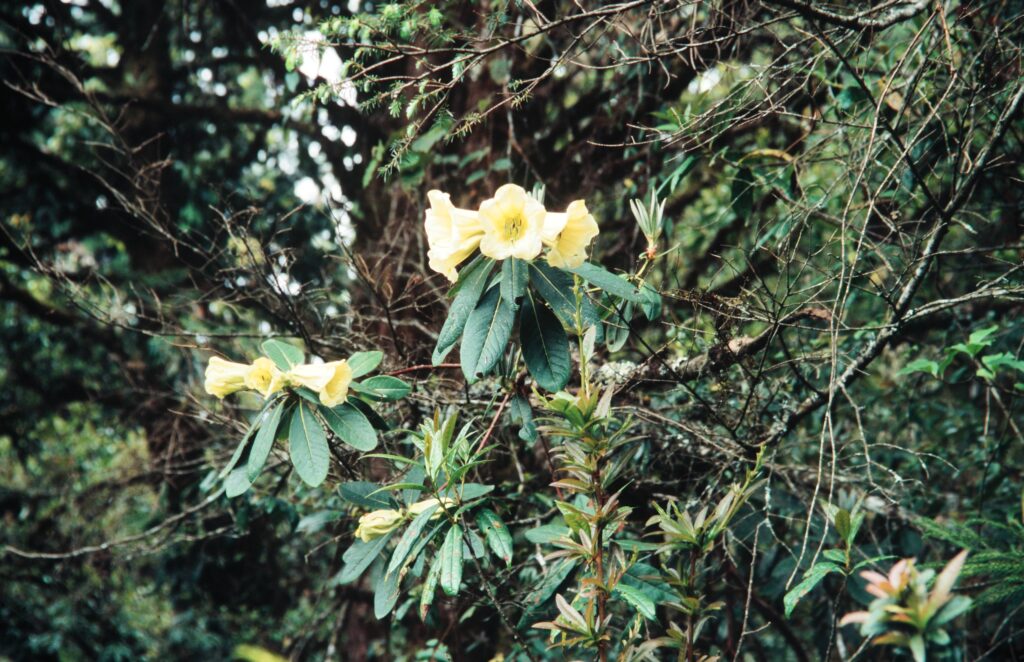
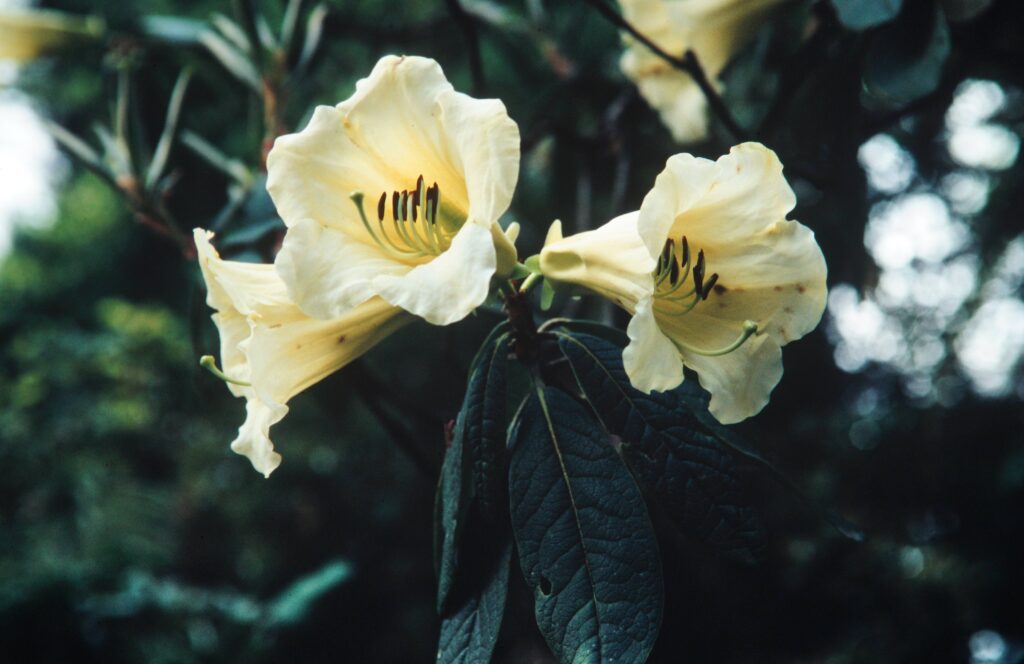
Hook. f.

Bh2008 237 P374
Bhutan Tumching-La, 3600m April
Bh09 83 G141
Bhutan Langchlakha, 3700m June
Sikkim2004 403 G687
Sikkim/India Lachung 3300m May
Sikkim 2006 372 ergebnis
India West-Bengal, Tamrong 2850m, May

Description

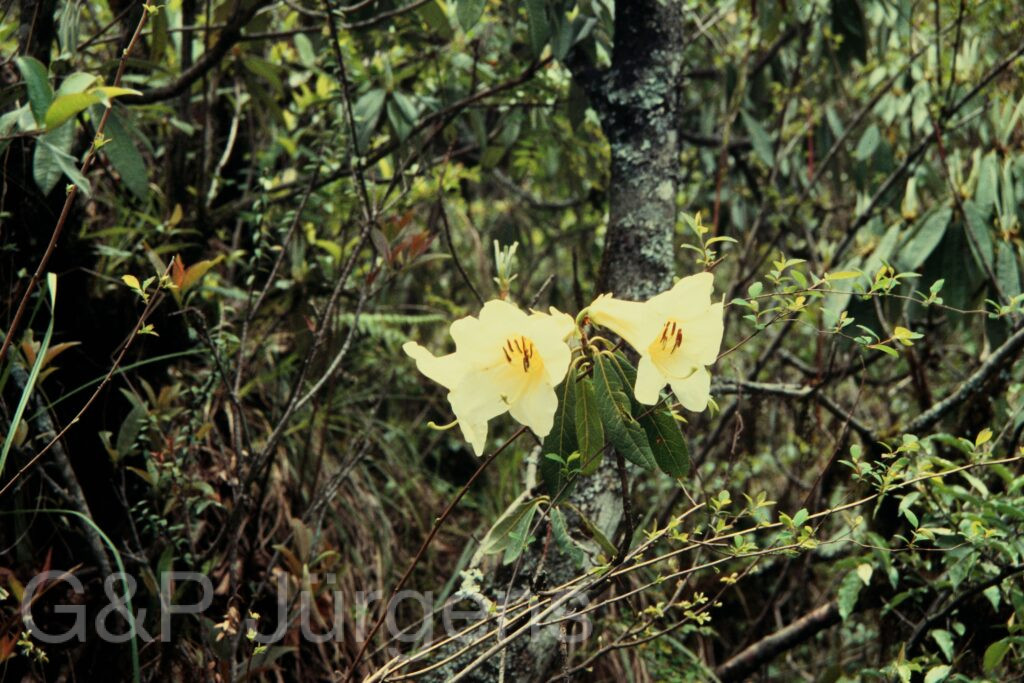
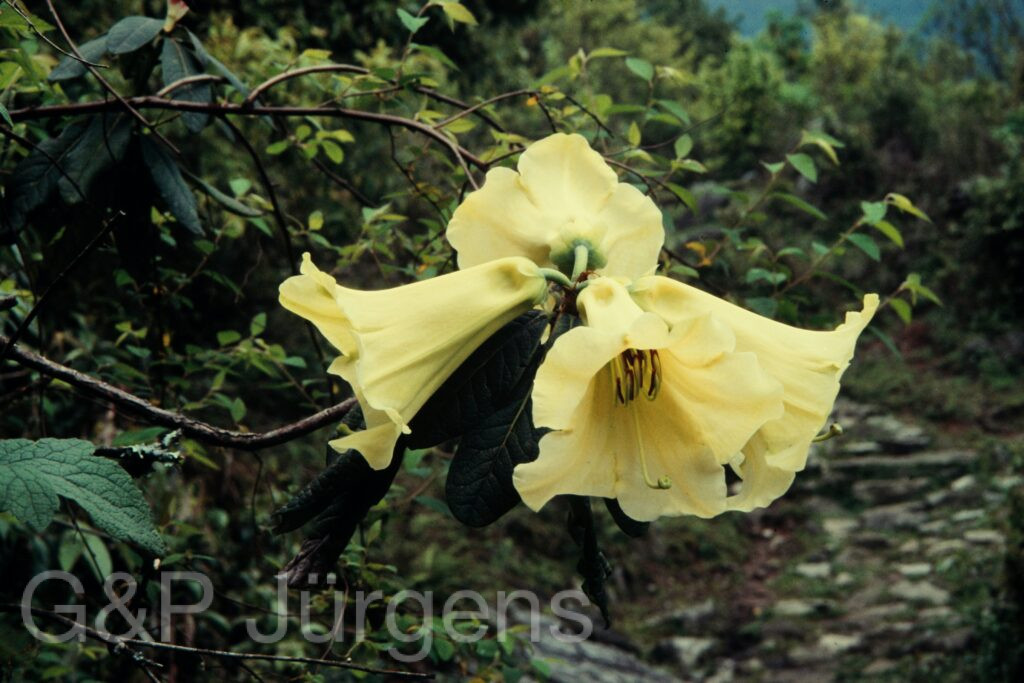
Rhododendron campylocarpum is an East Himalayan species distributed through the higher ranges of Nepal, Sikkim and Darjeeling in India, Bhutan, southern Tibet (China) and northern Myanmar, with abundant horticultural records (GB, US, NZ, etc.) reflecting long cultivation in temperate gardens; GBIF holds some 676 occurrences. It grows in the upper temperate and subalpine zone, typically between about 2850 and 3700 m, as documented at Tumching-La (3600 m) and Langchlakha (3700 m) in Bhutan, at Lachung (3300 m) in Sikkim and at Tamrong (2850 m) in West Bengal, inhabiting conifer and Abies forest margins, rhododendron thickets and moist rocky slopes near the treeline. It flowers in late spring and early summer (April-June).

It is an evergreen, much-branched shrub or small tree reaching 1-4 m, with smooth, peeling bark. The leaves are alternate, clustered toward the branch tips, broadly ovate to elliptic-oblong, 4-10 cm long, rounded to cordate at the base, glabrous and dark green above and conspicuously glaucous beneath. The inflorescence is a lax, terminal truss of 5-12 flowers; the corolla is campanulate, 3-4 cm across, clear sulphur- to canary-yellow, frequently with a crimson basal blotch within. Stamens are 10, included; the ovary and slender style are usually glandular. The fruit is a curved, cylindrical capsule, the epithet ("campylocarpum", bent fruit) referring to this curvature.

The species belongs to subgenus Hymenanthes, subsection Campylocarpa, a small group of yellow-flowered Himalayan rhododendrons including R. wardii and R. callimorphum, and it hybridises freely in the wild and in cultivation. Introduced by J. D. Hooker in the 1850s, it became an important parent of many garden hybrids and is an early-summer nectar source for bumblebees and other high-altitude pollinators. Though locally common and not globally threatened, individual populations are subject to grazing, fuelwood collection and the upward shift of the treeline.

Author: Hook. f. · Sources: POWO (Kew), GBIF, Flora of Bhutan, Flora of China, The Genus Rhododendron (Cullen & Chamberlain monograph)

Hook. f.

Bh09 237 P397
Bhutan Wangdi 1950m, June
Bh09 238 G399
Bhutan Wangdi 1950m, June
Nepal 97 314 P620
Nepal Honggaon 2360m May
Nepal 97 418 P807
Nepal Taskigaon 3000m May

Description

Rhododendron dalhousieae is an epiphytic or terrestrial shrub of the eastern Himalaya, distributed across India, Nepal, Bhutan and adjacent China; its c. 149 georeferenced records track the wet temperate forest belt (records from Britain and New Zealand reflect its long history in cultivation). It grows in humid broadleaf and Rhododendron-rich forest, often perched on mossy trunks and rocks or on steep banks, chiefly between 1800 and 3000 m. The image documents populations across its range, from Wangdi in Bhutan at 1950 m to Nepal's Honggaon and Taskigaon (2360-3000 m) and Samadan in West Bengal at 2400 m, flowering from May into June in the cloud-forest zone.

It is a straggling, sparsely branched shrub 1-3 m tall, frequently epiphytic, with peeling bark and large, obovate to elliptic leaves clustered toward the branch tips, glaucous beneath and bearing scattered scales. The flowers are among the most spectacular of Himalayan rhododendrons: borne in lax trusses of two to six, each broadly funnel-campanulate, 7-12 cm long, fragrant, white often flushed with pale yellow or pink, with a long tube. The ten stamens and slender style are enclosed within the corolla, and the scaly ovary matures into an elongate capsule splitting to release numerous minute winged seeds.

Described by Hooker f. (Hook. f.) from his Sikkim explorations, R. dalhousieae belongs to Rhododendron subgenus Rhododendron, section Rhododendron (the lepidote or scaly-leaved rhododendrons), and is named for Lady Dalhousie. Its large, fragrant, pale flowers suggest pollination by moths and large bees. Long prized in horticulture, it is widespread but locally uncommon and dependent on intact humid forest; habitat loss makes some populations vulnerable, though it is not formally threatened.

Author: Hook. f. · Sources: POWO (Kew), GBIF, Flora of Bhutan, Flora of China, Flora of Bhutan and Sikkim, The Genus Rhododendron monograph (Edinburgh, Ericaceae)

Kingdon-Ward

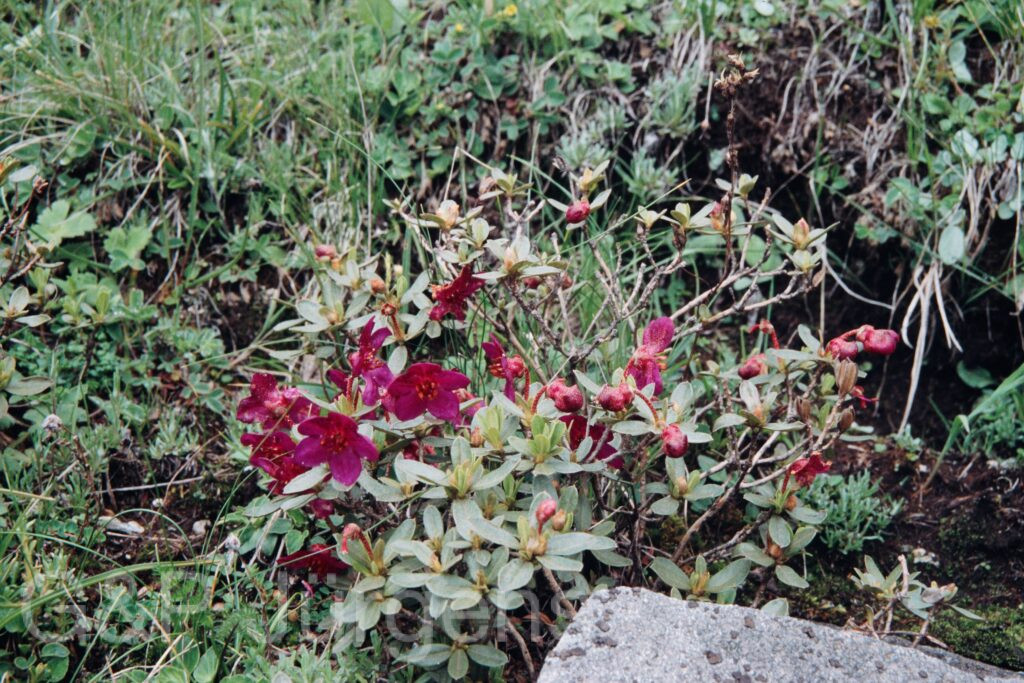
BhutanPG2011 241
Bhutan Tsochenchen, 3800m June

Description

Rhododendron fragariiflorum (correctly orthographed as R. fragariflorum) is a dwarf, cushion-forming shrub endemic to the high eastern Himalaya and adjacent southeastern Tibet. Its distribution, documented by GBIF across China (Xizang), India (Sikkim, Arunachal Pradesh) and Bhutan, is restricted to the alpine zone, where it grows on open, peaty slopes, in moist meadows and among rocks at elevations of roughly 3,800–5,000 m. The photographed population near Tsochenchen in Bhutan at 3,800 m in June illustrates its typical habitat above the treeline, where it forms low mats in the company of alpine sedges, primulas and other prostrate rhododendrons subjected to strong insolation, frost and a brief summer growing season.

The plant is a low, much-branched, semi-prostrate shrublet seldom exceeding 10–20 cm in height, with slender, often decumbent stems clad in persistent leaf scales. The small, elliptic to obovate leaves are coriaceous, scaly (lepidote) beneath, and dark green above, frequently with revolute margins. Distinctively, the flowers are solitary or borne in pairs and are a deep purplish-crimson to magenta, often described as strawberry-coloured, hence the epithet fragariflorum. The corolla is broadly campanulate to rotate, five-lobed and lepidote on the outer surface, with ten exserted stamens; the fruit is a small, scaly, dehiscent capsule.

The species belongs to subgenus Rhododendron, section Pogonanthum-related lepidote groups, and is taxonomically notable for its unusually open, non-tubular corolla among scaly rhododendrons. As a strict high-alpine specialist with a narrow range and modest occurrence record, it is of biogeographic interest as an indicator of intact Sino-Himalayan alpine habitats. Climate-driven upward shifts of the treeline pose the principal long-term threat to such cushion communities.

Author: Kingdon-Ward · Sources: POWO (Kew), GBIF, Flora of Bhutan Vol. 2, Flora of China Vol. 14, Cullen: Revision of Rhododendron subgenus Rhododendron (Notes RBG Edinburgh)

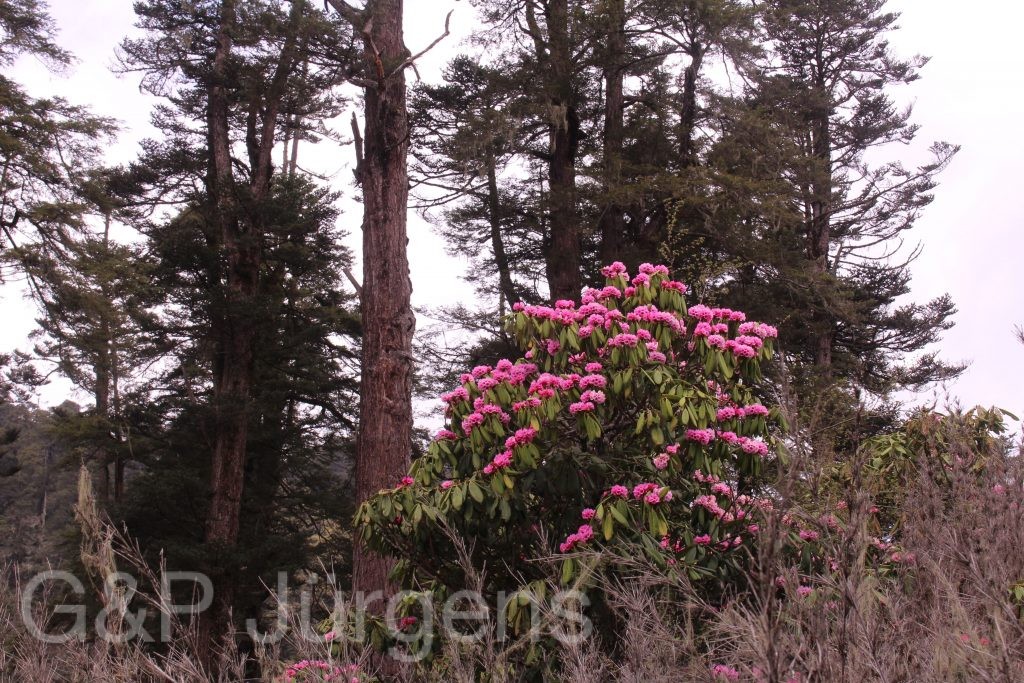
D.G.Long & Rushforth

Bhutan2014 426
Bhutan Yatong-La 2900m, May
Bhutan2014 431
Bhutan Yatong-La 2900m, May
Bh2008 104 P168
Bhutan Nobding, 2700m April
Bh2008 370 P573
Bhutan Nobding, 2700m April
Bh2008 227 P359
Bhutan Nobding, 2700m April
Bh09 280 G462
Bhutan Pele-La, 3000m June

Description

Rhododendron kesangiae is a large-leaved rhododendron effectively endemic to Bhutan, where it is a conspicuous component of the temperate forest belt; GBIF records around 169 occurrences, the points from Canada, Sweden and Great Britain reflecting plants grown in specialist gardens and arboreta. It forms forests and thickets on cool, humid mountain slopes, typically between about 2700 and 3500 m, often in association with other big-leaved rhododendrons, magnolias and conifers. The illustrated collections from Yatong-La (2900 m, May), Nobding (2700 m, April) and Pele-La (3000 m, June) span its core range in central and western Bhutan and its spring-to-early-summer flowering.

It is a small tree or large shrub with stout branches and a rough, flaking bark. The large, elliptic to obovate leaves are leathery, dark green and somewhat rugose above, with the lower surface covered in a thin, silvery to pale fawn indumentum. The flowers are borne in dense, dome-shaped terminal trusses; the corolla is broadly campanulate, pale to deep pink or rose-purple, usually marked with a darker basal blotch, and contains numerous stamens around a stout ovary. The fruit is a woody, curved, dehiscent capsule releasing many small seeds.

Described only in 1991 by D.G. Long and Rushforth and named for Queen Kesang of Bhutan, R. kesangiae belongs to subsection Grandia (the large-leaved Himalayan rhododendrons), distinguished by leaf size, indumentum and flower colour. Its narrow, essentially Bhutanese distribution makes it a notable endemic of conservation interest, dependent on the continued integrity of mid-montane forest.

Author: D.G.Long & Rushforth · Sources: POWO (Kew), GBIF, Flora of Bhutan, The Genus Rhododendron (Cullen & Chamberlain), Rhododendrons of Bhutan

Nutt.

Bhutan2014 529
Bhutan Pele-La 2900m, May
Bhutan2014 643
Bhutan Pele-La 2900m, May
BhutanPG2011 262011 Bhutan Rhod. keysii scaled
Bhutan Pele-La, 2800m June

Description

Rhododendron keysii is an eastern Himalayan shrub native to Bhutan, India (Arunachal Pradesh, Sikkim) and southern Tibet (China), with 202 georeferenced occurrences; further records from Canada, Great Britain and New Zealand reflect its cultivation as a curiosity in temperate gardens rather than a natural range. It grows in cool, humid montane and temperate forest, in scrub, forest margins and as an epiphyte or terrestrial shrub among conifers and broad-leaved trees, generally between about 2400 and 3300 m. It was photographed at the Pele-La pass in Bhutan at 2800 to 2900 m in May and June, within the moist mid-montane belt where mist and high rainfall favour its growth.

It is an erect, sparsely branched evergreen shrub 1 to 3 m tall, with scaly young shoots and rather thin, elliptic-lanceolate leaves that are lepidote beneath. The flowers are highly distinctive among rhododendrons: borne in small axillary clusters along the upper stems, they are narrowly tubular to cylindrical, only slightly flared at the mouth, and bicoloured, with an orange-red to brick-red tube and contrasting yellow-green lobes. The corolla shape recalls a Correa or a small Cestrum rather than a typical rhododendron. The fruit is a slender scaly capsule.

The species belongs to Rhododendron subgenus Rhododendron, section Rhododendron (subsection Cinnabarina, the keysii alliance), and its tubular axillary flowers make it instantly recognisable. The narrow tube and exserted style point to pollination by sunbirds. Ecologically it is a component of mossy montane forest undergrowth. It is not regarded as threatened, though uncommon and locally distributed, and is valued horticulturally for its unusual floral form.

Author: Nutt. · Sources: POWO (Kew), GBIF, Flora of Bhutan, Flora of China, The Genus Rhododendron (Cullen & Chamberlain monograph)

Hook.f.

Nepal 95 386 P685 ergebnis
Nepal Bahanjyang 3800m October
Nepal 95 424 P738 ergebnis
Nepal Bahanjyang 3800m October
BhutanPG2011 629 01
Bhutan Ludlow-Sherriff-Trail Ken-La, 4300m July
BhutanPG2011 620 scaled
Bhutan Ludlow-Sherriff-Trail Ken-La, 4300m July
Nepal 99 548 ergebnis
West-Nepal Churta-Khola, 3800m June
Sikkim2011 183
Sikkim Lachung 2650m, June

Hook. f.

Sikkim2011 171
Sikkim Lachen 2760m, June
61F33B91D6814425A5DC452DD80DA368
Bhutan Paro, 2400m June

Description

Rhododendron maddenii is a temperate Himalayan and Indo-Burmese species native from India and Bhutan through China to Myanmar and Vietnam; GBIF's 432 records also reflect its wide cultivation, with occurrences logged from New Zealand, Australia, Britain, Japan, Korea, Malaysia and the United States. In the wild it grows on steep, often rocky and humus-rich slopes, cliff ledges and the margins of temperate broadleaf and conifer forest, frequently as an epiphyte or lithophyte. The figured plants from Lachen in Sikkim at 2760 m and Paro in western Bhutan at 2400 m, both flowering in June, place it firmly within the cool temperate forest belt where summer monsoon moisture and high atmospheric humidity prevail.

It is an evergreen shrub or small tree, the bark smooth and peeling in papery flakes. The leaves are leathery, elliptic to oblong-lanceolate, dark green and glabrous above, the undersurface densely covered with brown lepidote scales characteristic of the subgenus. The flowers, borne in terminal trusses of few blooms, are large, funnel-form to tubular-campanular and strongly fragrant, white often flushed with pink and scaly on the outside of the corolla tube. There are typically numerous stamens and a long style, the ovary lepidote. The fruit is an elongate, scaly, dehiscent capsule releasing many small seeds adapted to wind and epiphytic establishment.

Within Rhododendron subgenus Rhododendron, R. maddenii belongs to the large, taxonomically complex subsection Maddenia, distinguished by lepidote foliage and showy scented corollas, and it shows considerable variation in size and indumentum across its range. The fragrant, pale flowers attract long-tongued moths and other nocturnal pollinators. Long prized in horticulture, it is the source of many hybrids; in the wild it remains generally secure, though habitat loss and over-collection threaten some local populations.

Author: Hook. f. · Sources: POWO (Kew), GBIF, Flora of Bhutan, Flora of China, The Genus Rhododendron (Royal Horticultural Society), Cullen's revision of lepidote Rhododendron

Hook. f.

BhutanPG2011 525
Bhutan Ludlow-Sherriff-Trail Dem-Tso, 4650m June

Description

Rhododendron nivale is a dwarf, high-alpine rhododendron of the eastern Himalaya and Tibetan ranges, occurring in southern China (notably Xizang), Nepal, northern India, Bhutan and northern Myanmar, with around 1285 GBIF records. As its epithet ("of the snows") implies, it is one of the highest-ascending woody plants in the world, forming low, wind-pruned cushions and mats on open alpine slopes, moraine, rocky turf and near the snowline. The Bhutanese population imaged on the Ludlow-Sherriff Trail at Dem-Tso at 4650 m in June exemplifies its extreme elevational habitat and its early-summer flowering as the snow recedes.

It is a much-branched, prostrate to low-growing evergreen shrublet with twigs densely set with overlapping scales (lepidote). The leaves are very small, elliptic to obovate, leathery, and conspicuously scaly on both surfaces, the lower side often rusty with dense scales. The flowers are borne singly or few together at the branch tips; the corolla is small, broadly funnelform to rotate, and pink, rose-purple to bluish-purple, with the tube hairy within and exserted stamens. The fruit is a small, scaly, dehiscent capsule releasing minute seeds adapted to wind dispersal in the open high mountains.

Rhododendron nivale belongs to subsect. Lapponica (sect. Rhododendron), the lepidote alpine "dwarf" rhododendrons that dominate vast areas of Sino-Himalayan alpine scrub, and several subspecies have been recognised across its range. Its cushion habit, dense leaf scaling and reduced stature are classic adaptations to cold, desiccating, high-irradiation subnival conditions. The species is abundant within its zone and not of conservation concern, but as a snowline specialist it is a sensitive indicator of alpine climatic change.

Author: Hook. f. · Sources: POWO (Kew), GBIF, Flora of China, Flora of Bhutan, The Plant Hunters' Rhododendrons of the Himalaya, Cullen's revision of Rhododendron subsect. Lapponica (monograph)