Author

GP Jürgens

Hook.f. & Thomson

BhutanPG2011 814 01 01
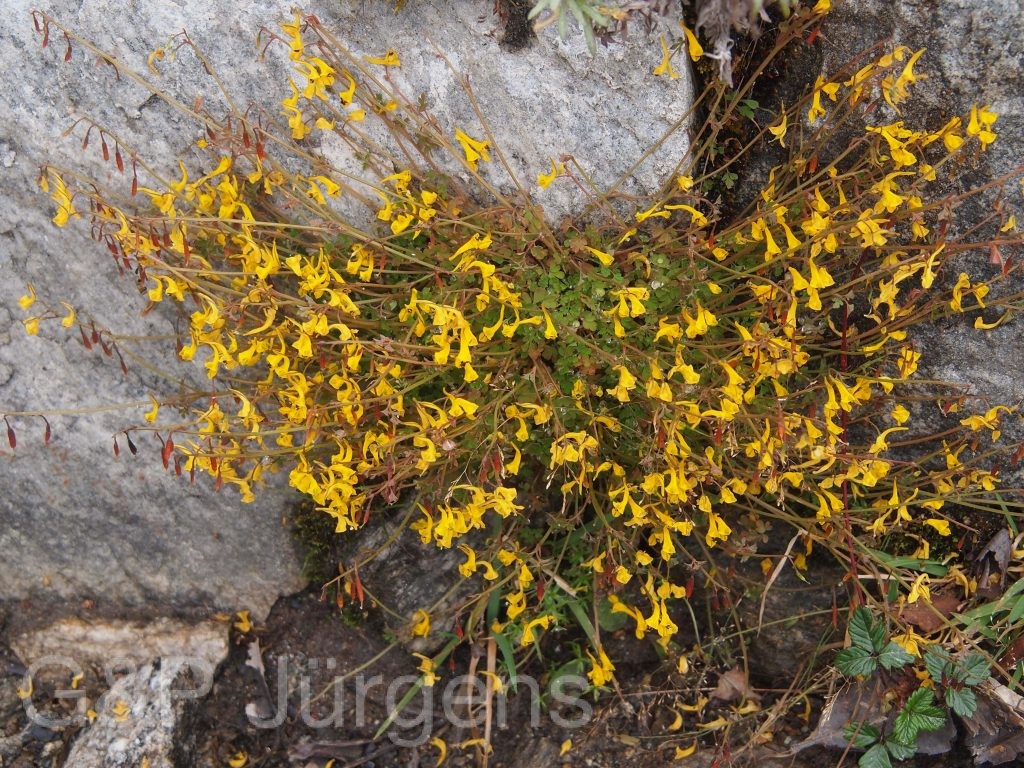
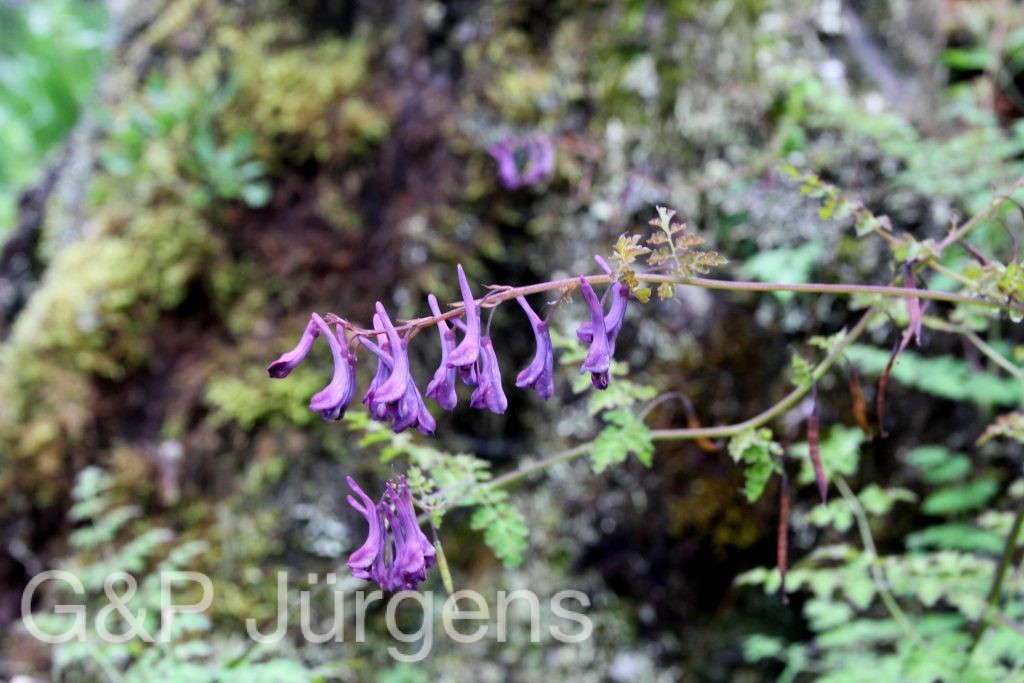
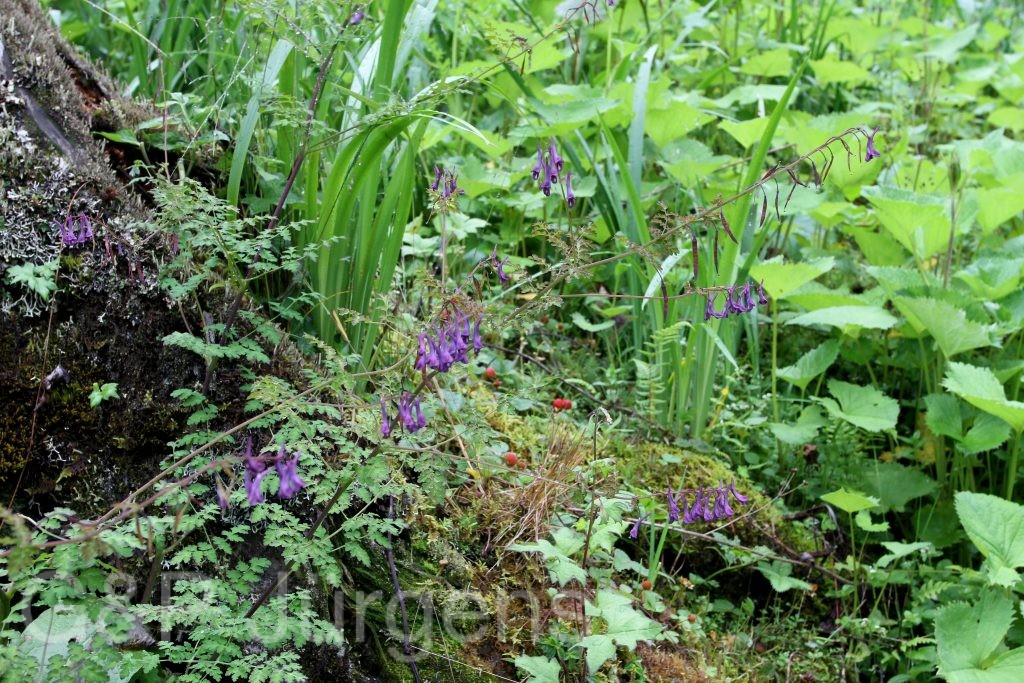
Bhutan Chele-La, 3700m July
BhutanPG2011 813
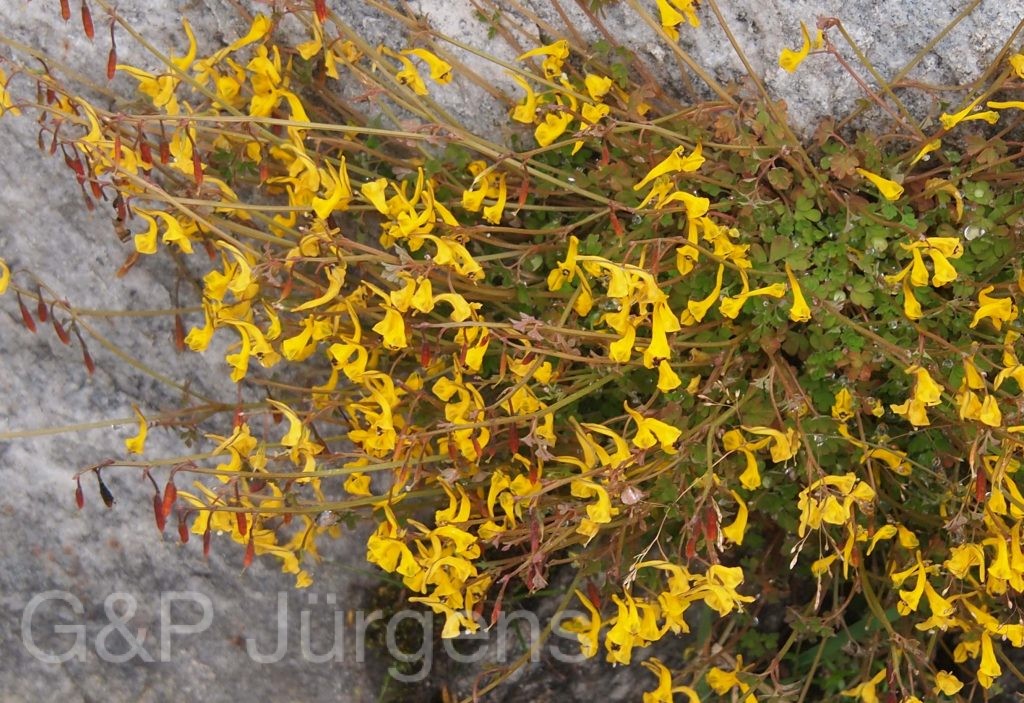
Bhutan Chele-La, 3700m July

Description

Corydalis flaccida is a Himalayan herb distributed through China, Nepal, India and Bhutan, with GBIF documenting 138 occurrences across this Sino-Himalayan arc. It grows in cool, moist montane to sub-alpine habitats, including forest margins, shrubberies, shaded banks, rocky slopes and stream-sides, broadly between 2700 and 4000 m. The photographed plant from the Chele-La pass in western Bhutan at about 3700 m, flowering in July, illustrates its monsoon-season blooming in humid high-pass environments where it grows among rocks and moist alpine scrub.

The species is an erect, somewhat lax, glabrous annual or short-lived perennial herb with brittle, often somewhat flaccid stems, as the epithet suggests. The leaves are alternate and two- to three-pinnately divided into small ovate to oblong segments, frequently glaucous beneath. Flowers are borne in elongating racemes subtended by leafy or dissected bracts; each zygomorphic flower has four petals in two whorls, the upper petal prolonged backward into a slender spur. The corolla is typically blue to purplish-blue, sometimes with darker tips, and the inner petals are apically connate over the stigma. The fruit is a slender, linear, dehiscent capsule containing several shiny black seeds, each usually bearing an oily elaiosome.

Described by Hooker and Thomson, the species belongs to the large, taxonomically complex genus Corydalis (Fumarioideae), notable in the Himalaya for its diversity of blue-flowered species. The elaiosome-bearing seeds promote myrmecochorous (ant-mediated) dispersal, while the spurred flowers are adapted for pollination by long-tongued bees. Like many Himalayan Corydalis it contains isoquinoline alkaloids of pharmacological interest. With a broad regional distribution it is not considered threatened, though its specialised high-elevation habitats are sensitive to land-use and climatic change.

Author: Hook.f. & Thomson · Sources: POWO (Kew), GBIF, Flora of China, Flora of Bhutan, Revision of the genus Corydalis (Lidén & Zetterlund)
Wall.

Nepal 95 122 P210 ergebnis
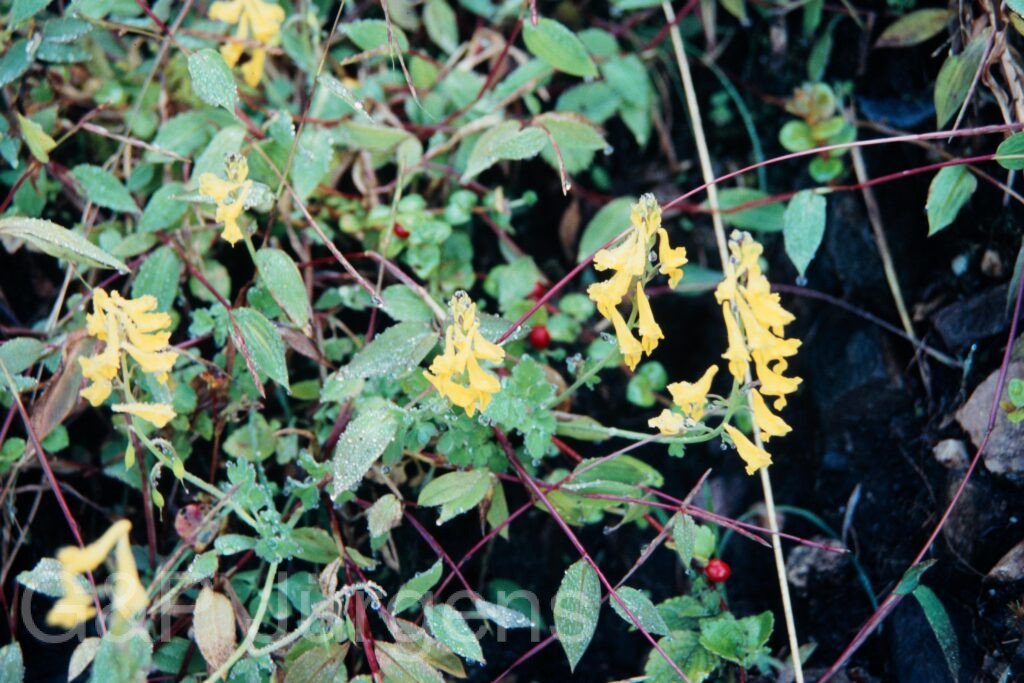
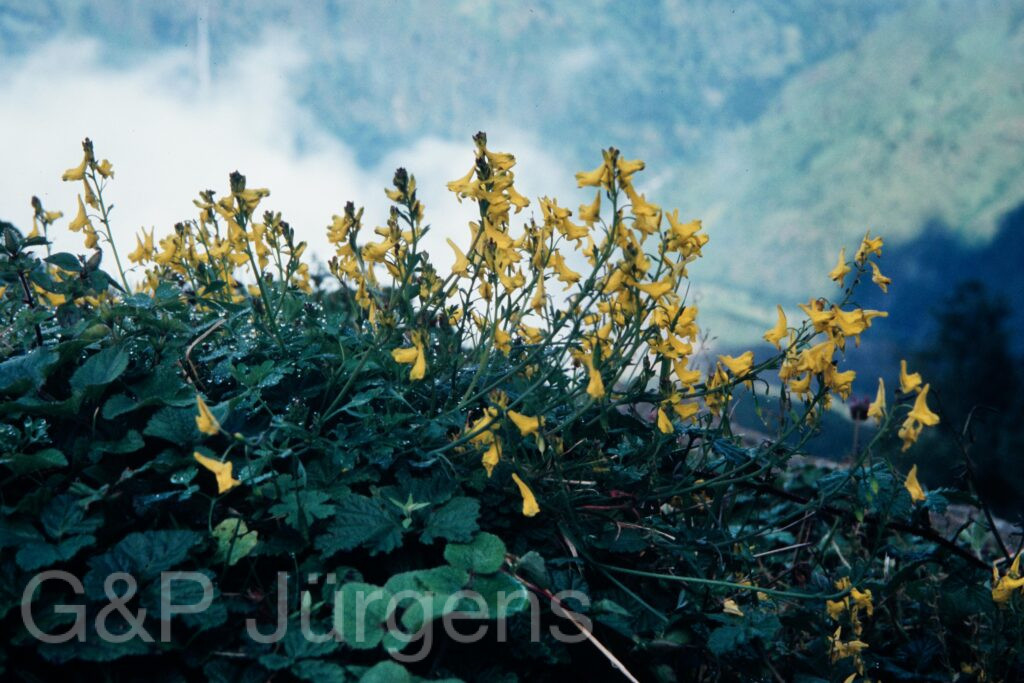
Nepal south of Rupien La 3500m October
Nepal 95 123 P211 ergebnis
Nepal south of Rupien La 3500m October

Description

Corydalis juncea is a slender alpine herb of the central and eastern Himalaya. GBIF records place it in Nepal, India, China and Bhutan, with around 148 occurrences reflecting its distribution through the high mountains of the region. It grows on open, dry to moist alpine slopes, gravelly ground, screes and rocky banks at high elevation, where it tolerates the harsh, exposed conditions of the upper montane and alpine belt. The photographed plant from south of the Rupien La in Nepal at 3500 m, recorded in October, illustrates its occurrence in the late-season alpine zone, where it can flower into the autumn before the onset of winter dormancy.

It is an erect, glaucous perennial herb with slender, rush-like, sparingly leafy stems, the epithet juncea alluding to this reed-like habit. The leaves are few, glaucous and divided into narrow, linear segments, the upper ones reduced. The inflorescence is a lax, few-flowered terminal raceme; each flower is markedly zygomorphic, with four petals, the outer upper petal extended backwards into a slender spur, the corolla yellow, often tinged or tipped with purplish-brown. The fruit is a narrow, linear-oblong capsule that splits to release small, shining seeds furnished with an elaiosome.

Corydalis is a large genus of the Fumarioideae, treated within the Papaveraceae, with a marked centre of diversity in the Sino-Himalayan high mountains. C. juncea belongs to the assemblage of yellow-flowered, narrow-leaved Himalayan species adapted to dry, open, high-altitude habitats. As in its relatives, the oil-bearing seed appendage promotes dispersal by ants, while the spurred flowers are pollinated by nectar-seeking bees, and the deep-seated rootstock allows the plant to survive the severe alpine winter.

Author: Wall. · Sources: POWO (Kew), GBIF, Flora of Nepal, Flora of China (Papaveraceae, Fumarioideae), The Genus Corydalis (Lidén & Zetterlund)
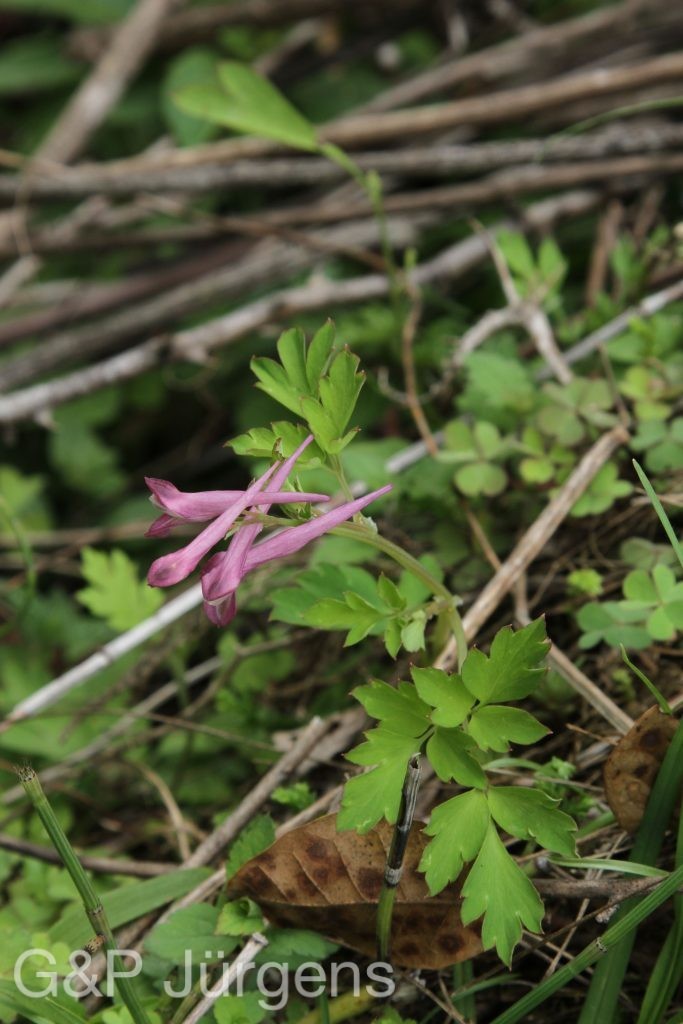
Prain

Bhutan2012 925
Bhutan Tumching-La 3800m, October
Bhutan2012 926

Description

Corydalis lathyroides Prain is an Eastern Himalayan species known from Nepal, Bhutan and northeastern India (gbif_countries: NP, BT, IN), represented by only 28 occurrences in GBIF, indicative of a narrow range and limited collection. It is a plant of high subalpine to alpine habitats, occurring on open slopes, scree margins, scrub and rocky meadows, with a documented occurrence at Tumching-La in Bhutan at 3800 m, where it was photographed in October. This late-autumn record reflects an extended flowering season at the upper forest-to-alpine transition of the monsoonal eastern ranges.

It is a glabrous, glaucous herb with brittle, somewhat fleshy stems and a deep root or tuberous rootstock. The leaves are alternate, pinnately or ternately divided into oblong to obovate segments, the epithet lathyroides alluding to a vetch-like (Lathyrus) aspect of the foliage. The flowers are borne in terminal racemes; each is strongly zygomorphic with four petals, the upper petal prolonged backward into a conspicuous nectar spur, the colour typically yellow to purplish. The fruit is a slender dehiscent capsule (siliquiform) containing several shining seeds, often with an oil-rich elaiosome.

Corydalis, placed in subfamily Fumarioideae of an expanded Papaveraceae, is an exceptionally large and taxonomically complex genus richly developed in the Sino-Himalaya. The spurred flowers are adapted to long-tongued bees, while elaiosome-bearing seeds promote ant dispersal (myrmecochory). Given its restricted distribution and sparse records, the species merits monitoring, though no formal conservation assessment has been published.

Author: Prain · Sources: POWO (Kew), GBIF, Flora of Bhutan, Annotated checklist of the flowering plants of Nepal, Lidén & Zetterlund monograph of Corydalis

Hook.f. & Thomson

Bhutan2014 185
Bhutan Trachyangtse 2300m, May

Description

Corydalis leptocarpa is a Sino-Himalayan to East Asian fumitory recorded from China, Bhutan, India, Myanmar, Japan, Nepal, Thailand and Korea, with around 163 GBIF occurrences spanning this broad temperate range. It is a plant of shaded, humid forest, woodland margins, mossy banks and damp ravines, typically at montane elevations from roughly 1500 to 3000 m. The individual photographed near Trashiyangtse (Trachyangtse, eastern Bhutan) at about 2300 m in May illustrates its association with moist broad-leaved forest in spring, when the slender stems and pale flowers appear in the dappled understorey.

The species is a slender, erect to ascending annual or short-lived perennial herb with brittle, somewhat glaucous foliage. The leaves are bi- to triternately compound, the ultimate segments ovate and lobed, borne on delicate petioles. The inflorescence is a lax raceme of pale yellow, zygomorphic flowers; each has four petals, the upper outer one prolonged backward into a slender spur, enclosing two stamen bundles and an elongate ovary. The fruit, as the epithet leptocarpa ('slender-fruited') indicates, is a narrow, linear, pendulous capsule that dehisces elastically to scatter the shining black seeds, which often bear an oily elaiosome.

Corydalis is one of the largest genera of the Papaveraceae (subfamily Fumarioideae), exceptionally diverse in the Sino-Himalaya, where hundreds of species occupy habitats from forest floor to alpine scree. C. leptocarpa belongs to the yellow-flowered woodland element of the genus. Many Corydalis species rely on ant-mediated seed dispersal of their elaiosome-bearing seeds. With its wide East Asian range and tolerance of forest-edge habitats it is not considered threatened, though it remains tied to intact montane forest cover.

Author: Hook.f. & Thomson · Sources: POWO (Kew), GBIF, Flora of China, Flora of Bhutan, Annotated Checklist of the Flowering Plants of Nepal, Lidén & Zetterlund monograph of Corydalis

Ludlow & Stearn

Bh2008 36 P59
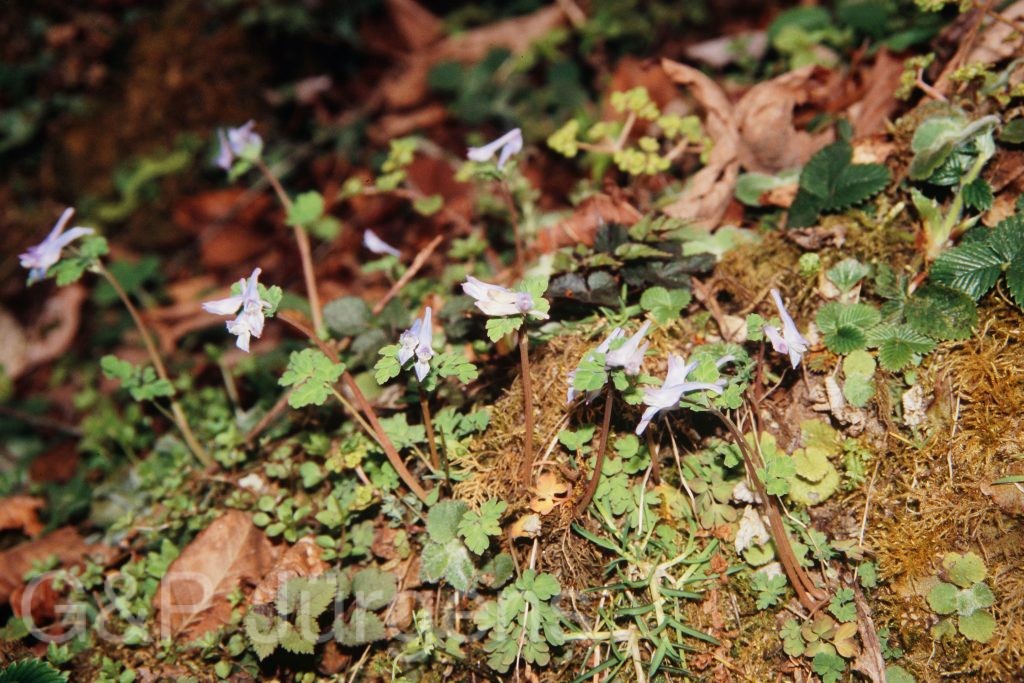
Bhutan Dochu-La 2850m, April

Description

Corydalis oligantha is an apparently Bhutanese endemic, the only GBIF records (about 6) deriving from Bhutan and described from there by Ludlow and Stearn. It is a plant of moist, shaded temperate habitats, growing on humus-rich banks, forest floors, mossy rock crevices and damp clearings, around 2800 to 3000 m. The specimen illustrated from Dochu-La in western Bhutan at 2850 m in April, flowering early in spring as the snow recedes, exemplifies its preference for cool, moisture-retentive woodland margins and its brief vernal growing season.

It is a slender, often glaucous herb with watery sap and a fleshy rootstock or small tuber. The leaves are alternate and finely dissected, ternately or pinnately compound into narrow segments, giving the delicate, fern-like aspect typical of the genus. The flowers, comparatively few in the lax raceme as the epithet oligantha (few-flowered) implies, are strongly zygomorphic: each has four petals, the upper one prolonged backwards into a conspicuous nectar spur, the inner pair coherent over the stamens and stigma, the colour generally yellow to purplish. The fruit is a slender, two-valved dehiscent capsule releasing several shining seeds, often bearing an elaiosome.

Corydalis is an exceptionally large and taxonomically difficult genus that radiates spectacularly across the Sino-Himalaya, and narrow endemics such as C. oligantha contribute to Bhutan's distinctive alpine and temperate flora. The spurred, bilabiate flowers reflect specialised pollination by long-tongued bees, while seed elaiosomes promote ant dispersal. With an extremely restricted range and very few documented occurrences, this species is potentially of high conservation concern and would benefit from targeted survey and assessment.

Author: Ludlow & Stearn · Sources: POWO (Kew), GBIF, Flora of Bhutan, Ludlow & Stearn studies of Bhutan plants, Flora of China (Papaveraceae), Lidén & Zetterlund monograph of Corydalis

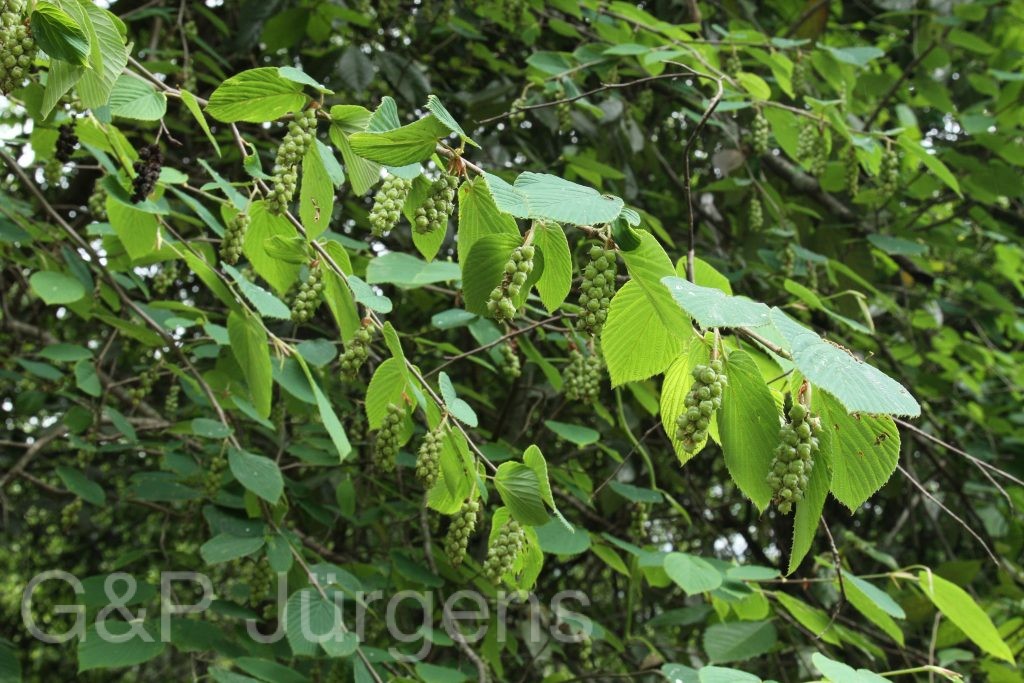
Griff.

Bhutan2014 160
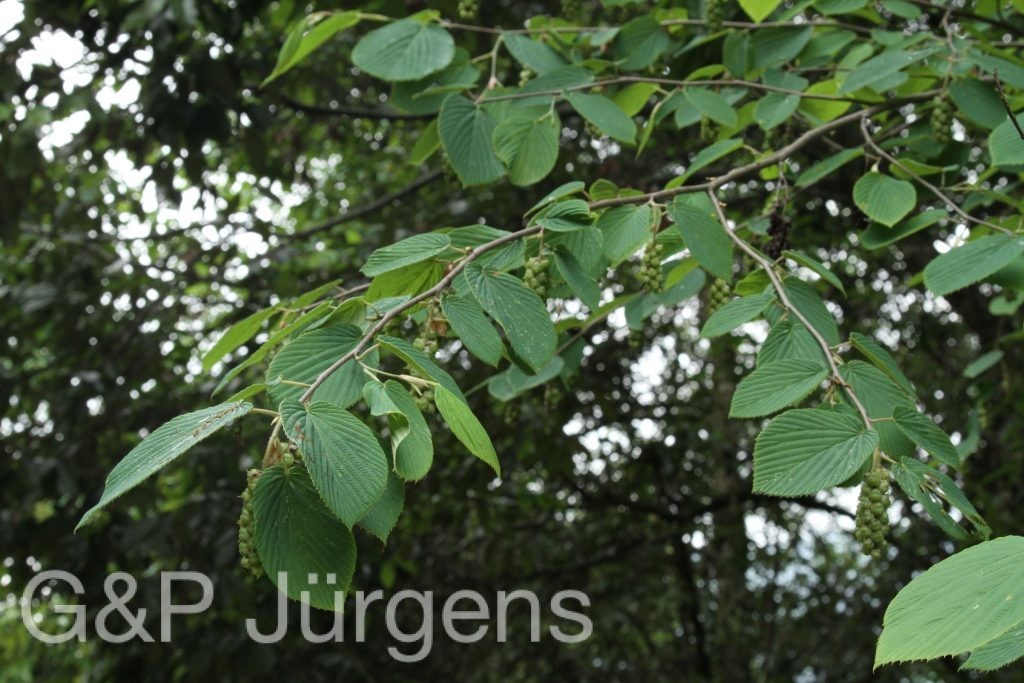
Bhutan Trashigang 1570m, May
Bhutan2014 161
Bhutan Trashigang 1570m, May

Description

Corylopsis himalayana is an eastern Himalayan winter-hazel distributed through NE India, Bhutan and adjacent SW China, GBIF recording around 181 occurrences (together with scattered cultivated records elsewhere). It is a shrub or small tree of temperate broadleaved forest, forest margins and thickets, typically on moist, well-drained slopes. The photographed plant from Trashigang in eastern Bhutan at 1,570 m (May) is characteristic of its mid-elevation habitat in the warm temperate forest zone, where it occurs among other deciduous understorey and edge species.

It is a deciduous shrub or small tree with alternate, ovate to obovate leaves that are obliquely cordate at the base, with a serrate margin, prominent straight lateral veins and stellate or simple hairs beneath, the foliage often expanding after or with the flowers. The flowers are borne in pendent, catkin-like racemes; each is small, with five yellow, spathulate petals, five stamens and a half-inferior ovary, and the inflorescences are subtended by conspicuous bracts. The fruit is a woody, two-beaked capsule splitting to release shining black seeds.

Corylopsis belongs to the witch-hazel family Hamamelidaceae, a lineage of considerable phylogenetic interest as an early-diverging element of the eudicots, and the genus is prized horticulturally for its early-spring display of fragrant yellow racemes. C. himalayana represents the western, Himalayan outpost of a genus otherwise centred on East Asia, a distribution pattern echoing the well-known Sino-Himalayan to Japanese floristic links. Restricted to montane forest, it benefits from the conservation of intact temperate woodland across its limited range.

Author: Griff. · Sources: POWO (Kew), Flora of Bhutan Vol. 1, GBIF, Flora of China Vol. 9, Endress: Hamamelidaceae (in Families and Genera of Vascular Plants)

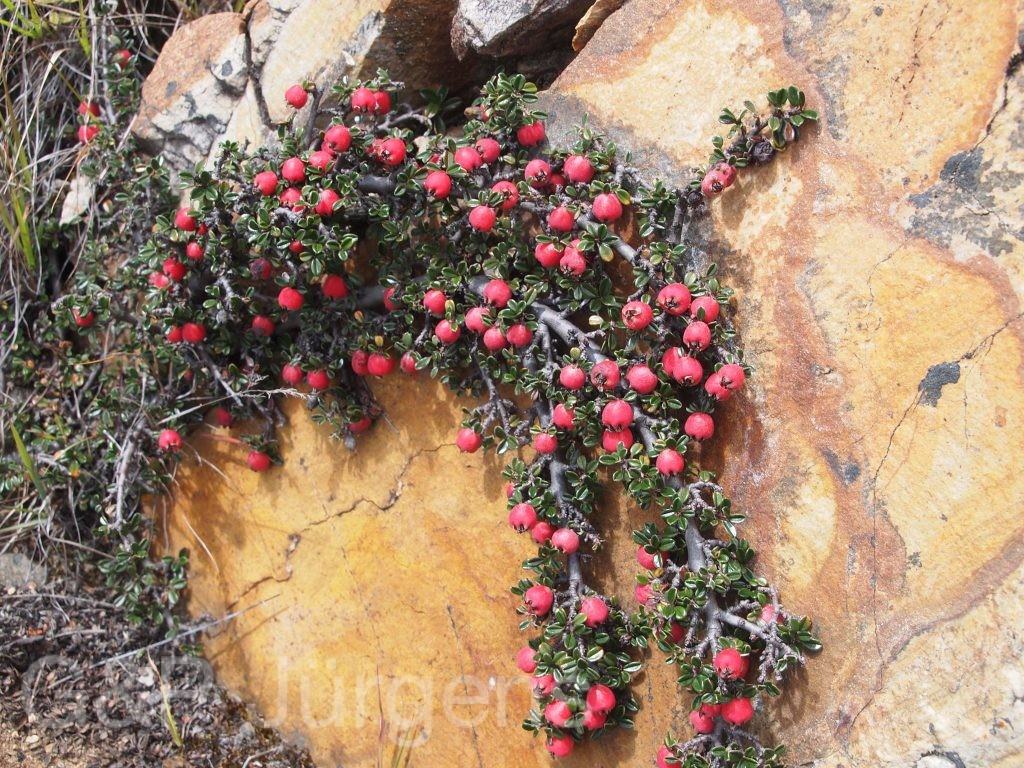
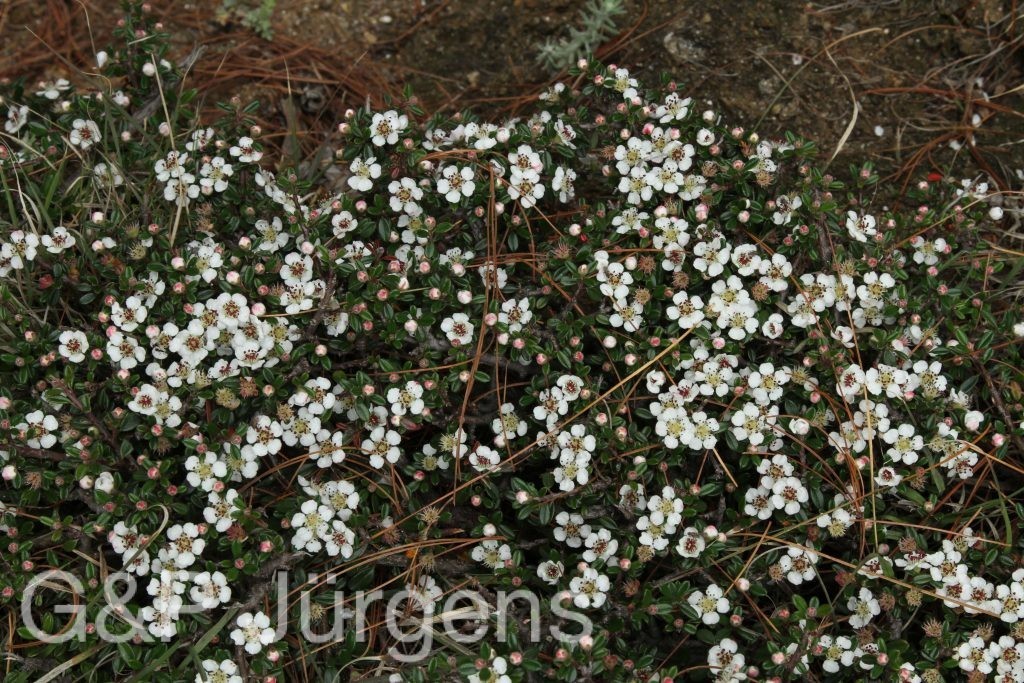
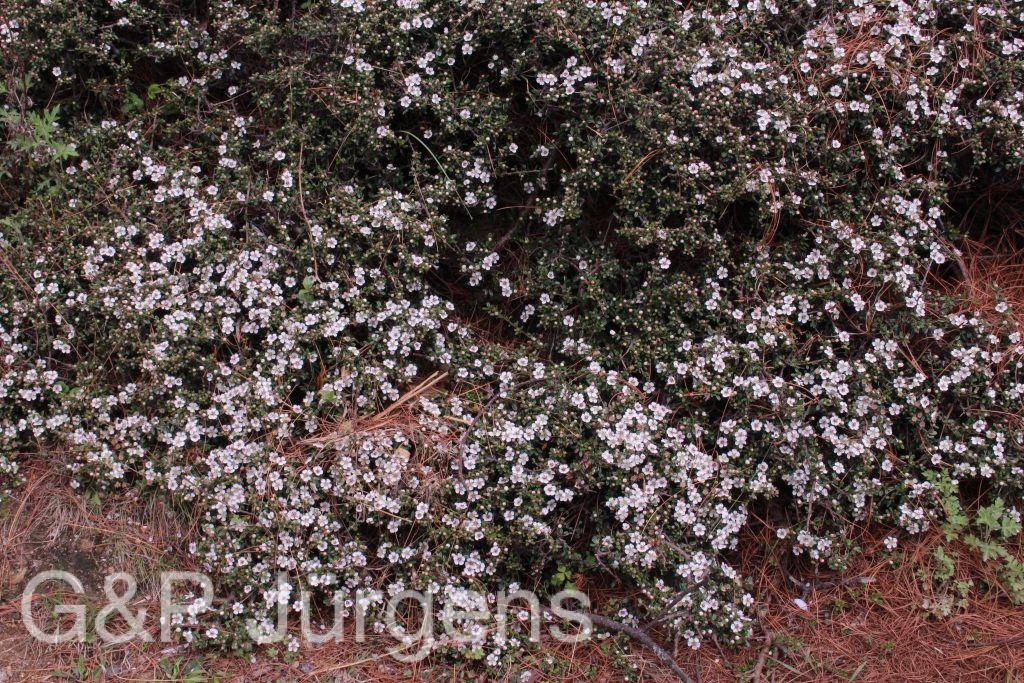
Wall. ex Lindl.

Bhutan2012 894
Bhutan Tumching-La 3850m, October
Bhutan2014 410
Bhutan Yatong-La 2900m, May
Bhutan2014 409
Bhutan Yatong-La 2900m, May

Description

Cotoneaster microphyllus is a small-leaved, prostrate to spreading shrub native to the Himalaya and western China, recorded from Pakistan, Nepal, India, Bhutan and China; extensively grown as a groundcover and rock-garden plant, it has naturalised widely, giving GBIF records from Great Britain, Ireland, France, Germany, the United States, Australia and New Zealand among some 2800 occurrences. In its native range it grows on rocky slopes, cliff ledges, open hillsides and amid alpine scrub from the temperate to subalpine zone. The images document it in Bhutan at Tumching-La near 3850 m in October, when the fruit is ripe, and at Yatong-La around 2900 m in May at flowering.

It is an evergreen, much-branched shrub with rigid, spreading to procumbent branches, the young shoots strigose. The leaves are small, 4-10 mm, obovate to elliptic, dark glossy green and glabrescent above, grey-tomentose beneath, with revolute margins. The flowers are solitary or in pairs, with white, spreading petals, numerous stamens with reddish anthers, and two carpels. The fruit is a globose pome 5-8 mm in diameter, bright crimson to scarlet, crowned by the persistent calyx, conspicuous against the dark foliage and persisting into winter.

Cotoneaster microphyllus belongs to a taxonomically intricate, largely apomictic complex within the genus, in which many microspecies have been segregated and circumscriptions remain contentious; much horticultural material formerly under this name belongs to related taxa. Apomixis fixes minor variants as discrete lineages. The bird-dispersed fruit accounts for its frequent escape and naturalisation, and in some regions it is regarded as a minor invasive. The wild species is common and of least conservation concern.

Author: Wall. ex Lindl. · Sources: POWO (Kew), GBIF, Flora of China, Flora of Bhutan, Flora of British India, Fryer & Hylmö Cotoneasters: A Comprehensive Guide

Wall. & Griff. ex C.B.Clarke

Bhutan2012 1153
Bhutan Tashiyangtse 1850m, October
Bhutan2012 1155
Bhutan Tashiyangtse 1850m, October

Description

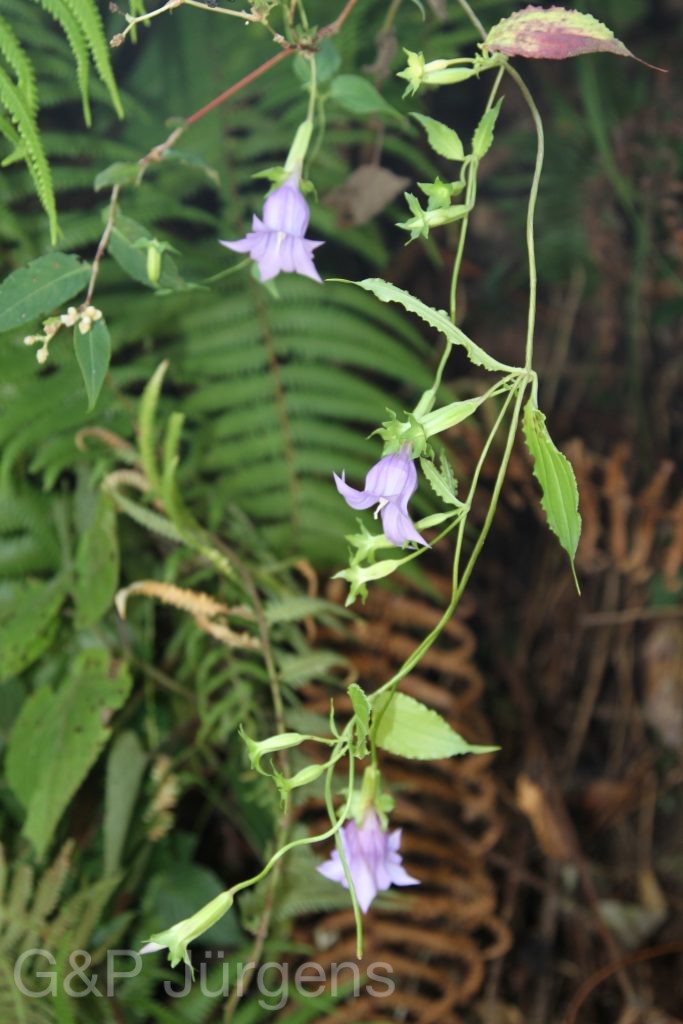
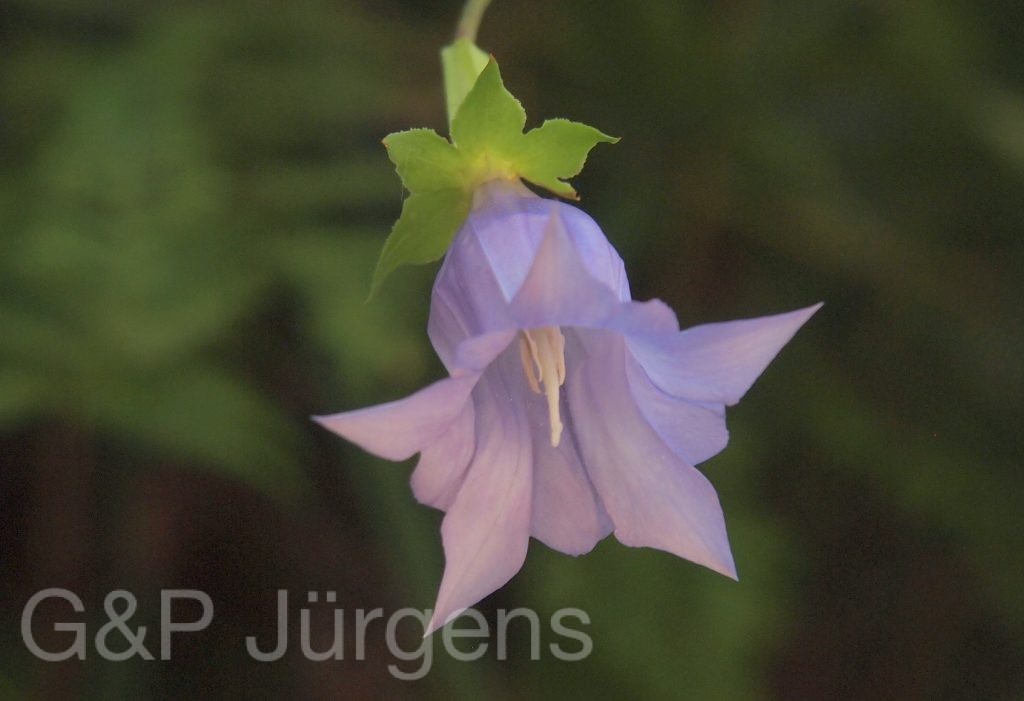
Crawfurdia campanulacea is a twining gentian of the eastern Himalaya and adjacent China, distributed from north-eastern India through Bhutan and Bangladesh into Myanmar, Vietnam and south-western China; its roughly 220 georeferenced occurrences (CN, IN, MM, BD, BT, VN) mark it as a regional element of the moist subtropical-to-temperate forest belt. It is a climbing herb of forest margins, thickets, shaded slopes and stream banks, generally between about 1500 and 2800 m, flowering in the autumn. The plant photographed at Tashiyangtse in eastern Bhutan at 1850 m in October illustrates this late-season blooming within humid broad-leaved forest.

It is a perennial herbaceous climber with slender, twining stems scrambling over surrounding vegetation. The leaves are opposite, ovate to ovate-lanceolate, acuminate, three- to five-nerved and short-petiolate, with entire margins. The conspicuous flowers are solitary or few in the upper axils, the corolla broadly campanulate (bell-shaped, as the epithet records), bluish-purple to violet, with five lobes and small plicate folds in the sinuses typical of the gentian alliance; there are five epipetalous stamens and a superior, stalked (stipitate) ovary. The fruit is a stipitate, ellipsoid capsule containing numerous small, flattened and often winged seeds.

Crawfurdia is a small Asian genus closely allied to Gentiana and Tripterospermum, distinguished by its twining habit and stipitate, winged-seeded capsules; some authors have submerged it within those genera, and its limits remain debated. Adapted to scrambling through forest understorey, C. campanulacea depends on intact woodland and is not regarded as threatened, though it is restricted to undisturbed montane forest across its range.

Author: Wall. & Griff. ex C.B.Clarke · Sources: POWO (Kew), GBIF, Flora of China, Flora of Bhutan, Flora of India, Ho & Pringle's treatment of Gentianaceae

(Hook.f.) Kitam.

Nepal 95 164 P266 ergebnis
Nepal Rupien La 3900m October

Description

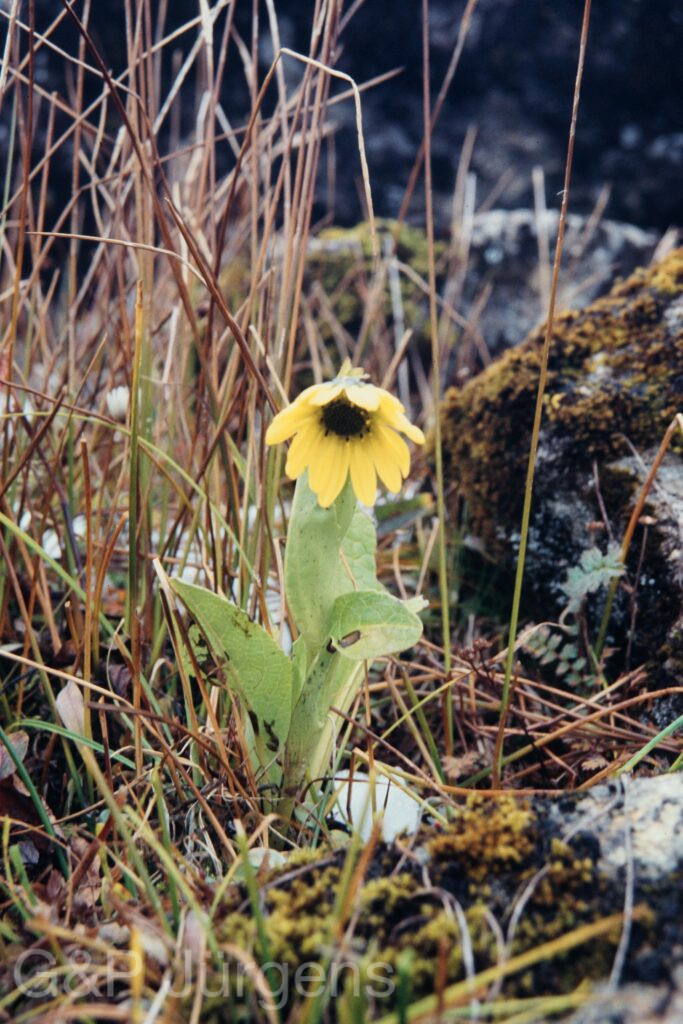
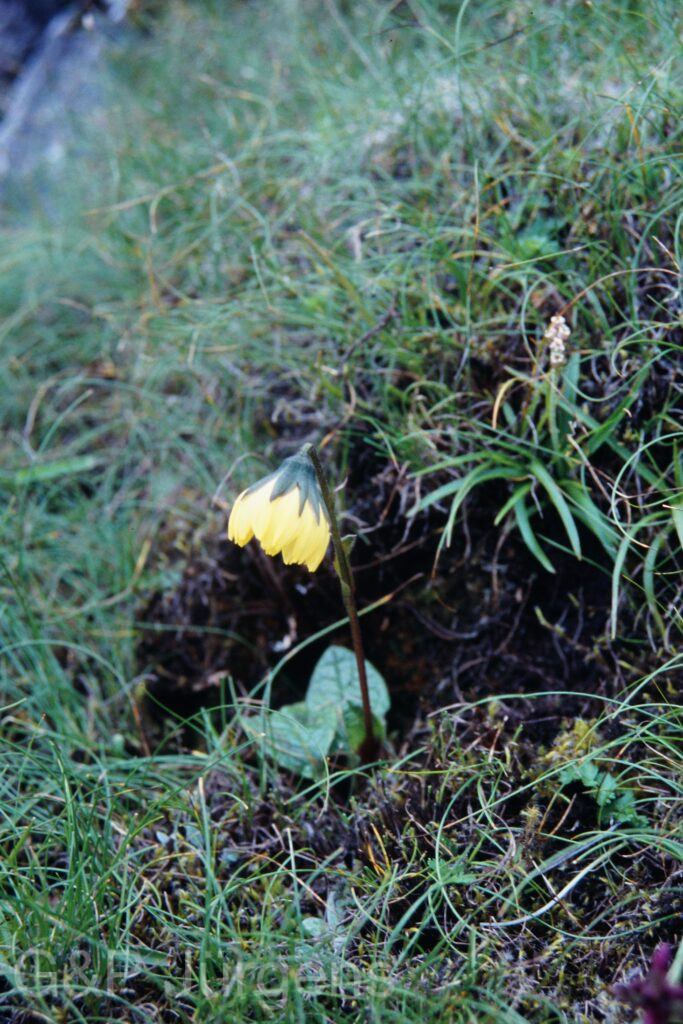
Cremanthodium ellisii is an alpine perennial of the Himalaya and the eastern Tibetan plateau, recorded from China, India, Nepal, Pakistan and Bhutan, with 754 occurrences in GBIF. It is a plant of high, open habitats: alpine meadows, scree, moraine, rocky slopes and stream margins, characteristically between 3500 and 5600 m, ranking among the highest-ascending composites of the region. The Nepalese collection figured, from Rupien La at 3900 m in October, reflects its occupancy of cold, exposed pass environments and its persistence into late autumn at the lower edge of its altitudinal span, on stony, well-drained alpine soils.

It forms a stout perennial rootstock from which arise erect, often woolly or purplish flowering stems 10-40 cm tall. The basal leaves are petiolate with ovate to reniform, dentate to lobed blades, while the stem leaves become smaller and amplexicaul upward. The stems are crowned by one to several large, nodding (cernuous) capitula, the nodding habit characteristic of the genus; the involucral bracts are densely covered with dark or pale hairs. Ray florets are golden-yellow, ligulate and female, surrounding numerous tubular yellow disc florets. The fruit is a glabrous cylindrical achene bearing a pappus of soft white bristles.

Cremanthodium (Asteraceae, tribe Senecioneae) is a Sino-Himalayan genus of roughly seventy species, closely allied to Ligularia and Senecio and distinguished by its nodding heads, an adaptation protecting florets from rain and intense alpine irradiance. C. ellisii is a variable, widespread species, broadly distributed and not threatened, though as a true alpine specialist it is potentially vulnerable to upward habitat compression under climate warming.

Author: (Hook.f.) Kitam. · Sources: POWO (Kew), GBIF, Flora of China, Flora of Bhutan, Monograph of Cremanthodium (Compositae, Senecioneae)

C.B.Clarke

Sikkim2003 312 P442
Sikkim Saniti-Lake 4300m August

Description

Cremanthodium oblongatum is an alpine herb of the eastern Himalaya and southern Tibetan Plateau, recorded from Nepal, China (Xizang), India and Bhutan, with 214 occurrences in GBIF (the German points reflecting cultivated or herbarium material). It grows on open alpine meadows, screes, rocky slopes and moist turf at high elevation, generally between 3600 and 5000 m. The plant photographed near Saniti Lake in Sikkim at about 4300 m in August is typical of the cold, humid, well-irrigated alpine grassland it occupies during the brief monsoon-driven flowering period high above the treeline.

The species is a perennial herb arising from a short rhizome with fibrous roots. The mostly basal leaves are long-petiolate with oblong to elliptic, entire or shallowly toothed blades, somewhat fleshy and often with a whitish or purplish cast. The flowering stem is erect, simple and bears one or few solitary, nodding (pendent) capitula, the nodding habit being a defining genus character. Each head has a hemispherical involucre of subequal, often dark purple-haired phyllaries, an outer ray of yellow ligulate female florets and a central disc of yellow tubular bisexual florets. The fruit is a glabrous cylindrical achene crowned by a pappus of fine whitish bristles.

Cremanthodium (tribe Senecioneae) is a Sino-Himalayan alpine genus closely allied to Ligularia and Parasenecio, distinguished by its characteristically nodding heads, an adaptation thought to shelter the florets from rain, cold and ultraviolet exposure at high altitude. Pollination is by alpine bumblebees and flies, and the plumed achenes are wind-dispersed. The species is locally frequent within its narrow alpine band and is not formally assessed as threatened, but its restriction to cold high-elevation habitats makes it potentially vulnerable to climate-driven warming and the upslope compression of the alpine zone.

Author: C.B.Clarke · Sources: POWO (Kew), GBIF, Flora of China, Flora of Bhutan, Good Revision of the Genus Cremanthodium