Author

GP Jürgens

Wall.

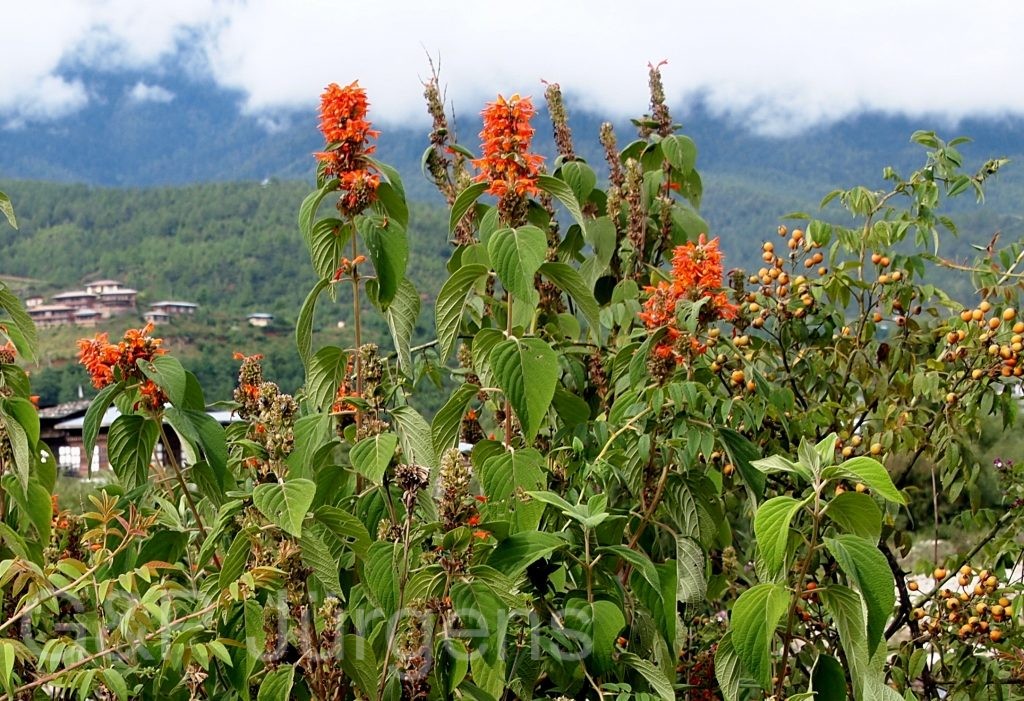
Bhutan2012 13
Bhutan Paro, 2300m September
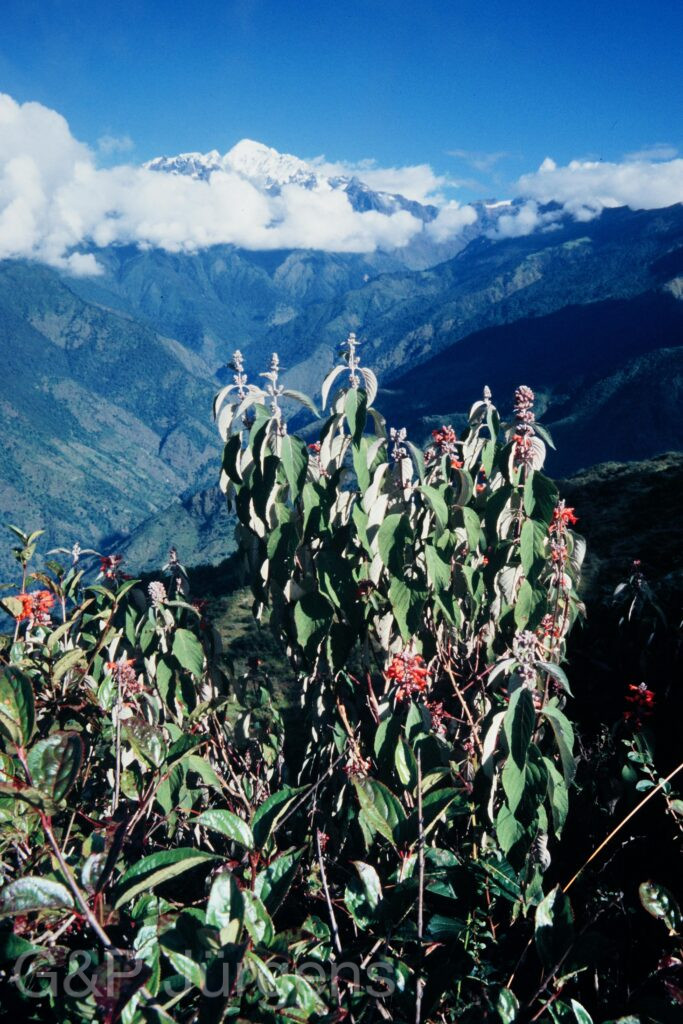
Nepal 95 95 P164 ergebnis
Nepal Barphak 2000m October
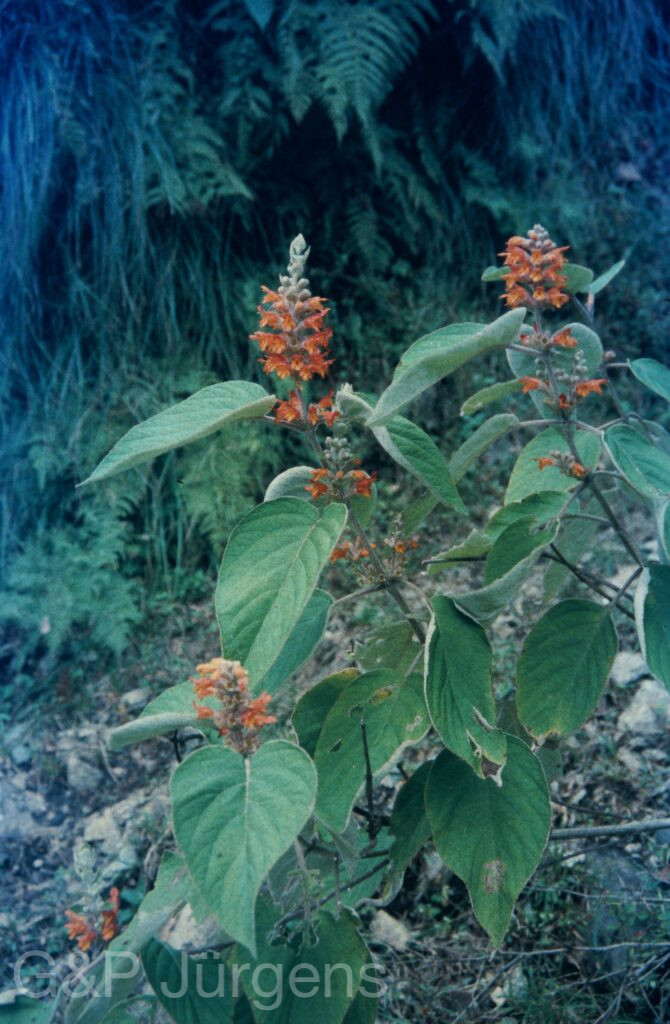
Garw 2005 209 ergebnis ergebnis
India Garhwal Pana 2800m, September

Description

Colquhounia coccinea is a showy shrubby mint of the Himalaya and southwestern China. GBIF records it from China, Nepal, India, Bhutan, Thailand and Myanmar, with cultivated and introduced occurrences in Australia, Europe and North America, totalling around 670 records. It grows in open forest, scrub, thickets and along hill slopes and roadsides in the warm temperate zone, generally between 1500 and 3000 m. The populations illustrated were photographed at Paro in Bhutan (2300 m), Barphak in Nepal (2000 m) and Pana in Garhwal, India (2800 m), flowering in September and October, its characteristic autumn flowering season in the Himalayan foothills.

It is a robust, sprawling or semi-scandent shrub up to 2-3 m, the stems and foliage clothed in stellate or felted indumentum. The opposite leaves are ovate to lanceolate, acuminate, crenate-serrate and rugose, greyish-tomentose beneath. The flowers are borne in dense axillary cymose clusters; the curved, tubular, two-lipped corolla is brilliant scarlet to orange-red, well exserted from the calyx, with four didynamous stamens. The fruit is unusual among Lamiaceae in that the nutlets are winged, an adaptation favouring wind dispersal from the often steep slopes the plant occupies.

Colquhounia is a small Sino-Himalayan genus of subfamily Lamioideae, and the winged nutlets and tubular red corollas distinguish it within the family. The vivid scarlet, nectar-rich tubular flowers are adapted to bird pollination, notably by sunbirds, an uncommon strategy in the predominantly bee-pollinated mints. Long valued as an ornamental and frost-tender garden shrub, the species is widespread and locally common, and is not of conservation concern.

Author: Wall. · Sources: POWO (Kew), GBIF, Flora of China, Flora of Bhutan, Annotated Checklist of the Flowering Plants of Nepal, Phylogeny and classification of subfamily Lamioideae (Lamiaceae)

(L.) DeFilipps

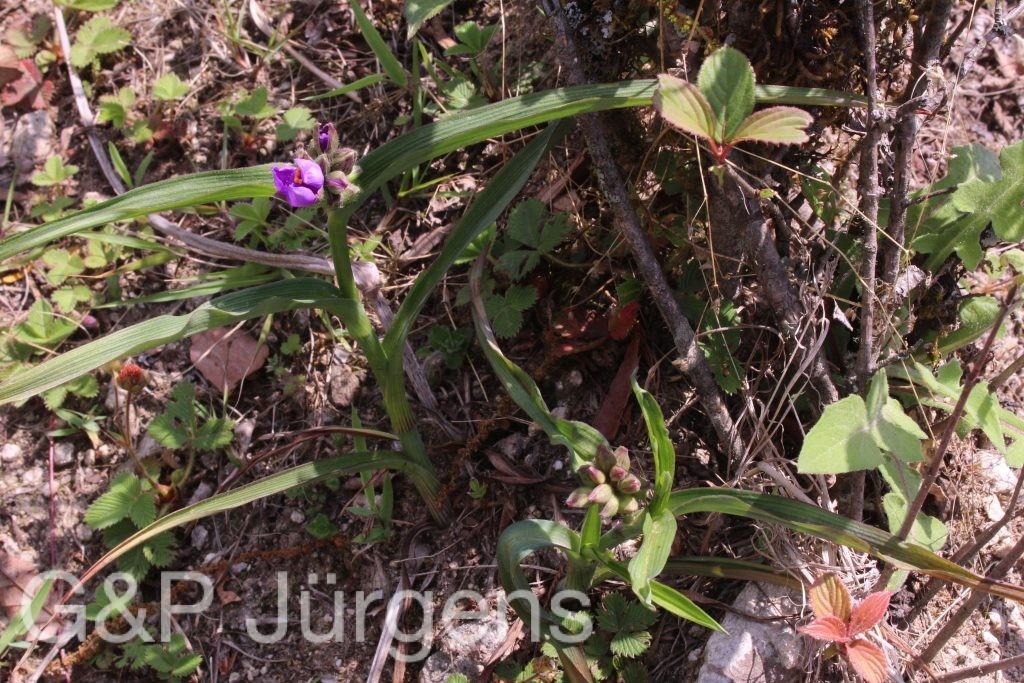
Nepal 97 543 P1063
Nepal Sabha-Khola 1000m May

Description

Combretum indicum (L.) DeFilipps, the Rangoon creeper, is a vigorous woody climber of the Combretaceae native to tropical Asia and now pantropically cultivated and naturalised. Its native and introduced records span India, Nepal, Myanmar, Thailand, Indochina, southern China, Malaysia, Indonesia and the Philippines, with widespread escapes in tropical Africa, the Americas, Australia and the Pacific. It is a plant of warm lowland and foothill environments: forest margins, riverbanks, thickets and hedgerows, often in secondary and disturbed vegetation. The plant photographed along the Sabha-Khola in Nepal at 1,000 m in May reflects its occurrence in the warm sub-Himalayan zone, where it flowers in the pre-monsoon season.

The plant is a large scandent shrub or liana, climbing by means of persistent woody petiole bases that function as hooks. The leaves are opposite, elliptic to oblong, entire and shortly petiolate, with the petiole base hardening and remaining as a spinescent peg. The flowers are borne in terminal and axillary spike-like racemes and are famously colour-changing: each long-tubed, five-petalled flower opens white and turns through pink to deep red over successive days, fragrant especially at night, indicating moth pollination. The fruit is an ellipsoid, five-winged or five-angled, leathery pseudo-drupe.

Formerly placed in the genus Quisqualis, the species is universally grown as an ornamental for its showy, sweetly scented, colour-shifting inflorescences, and its seeds and leaves have a long history of use in traditional medicine, notably as an anthelmintic. This horticultural ubiquity accounts for its extensive naturalisation, and in some warm regions it behaves as an invasive, smothering native vegetation, so that its spread beyond cultivation warrants management attention.

Author: (L.) DeFilipps · Sources: POWO (Kew), GBIF, Flora of China Vol. 13, Flora of Nepal, Exell: Combretaceae (Flora Malesiana)

Edgew.

Bhutan2014 817
Bhutan Punaka 1310m, May
Bhutan2014 818
Bhutan Punaka 1310m, May

Description

Commelina maculata is a perennial herb of the Himalaya and adjacent Asian mountains, recorded by GBIF from China, Nepal, India, Thailand, Bhutan, Myanmar, Vietnam and Sri Lanka across about 310 occurrences. It grows in moist, often shaded places, along forest margins, on grassy and rocky banks, beside paths and watercourses, and in disturbed ground, generally at low to middle elevations. The plant photographed at Punakha in western Bhutan at about 1310 m, flowering in May, occupies the warm temperate valley habitat where this species is common in the early monsoon season.

The plant has ascending to decumbent, somewhat fleshy stems that root at the lower nodes, with sheathing leaf bases typical of the family. The leaves are alternate, lanceolate to ovate-lanceolate, with entire margins and a closed basal sheath, often with a fringe of hairs at the sheath mouth. The flowers emerge from a folded, boat-shaped spathe and are zygomorphic, with three sepals and three petals of which the two upper petals are larger and conspicuously blue, the lower one reduced and paler; there are six stamens, several modified as staminodes with cruciform antherodes. Each flower is ephemeral, opening for part of a single day. The fruit is a small loculicidal capsule containing few rugose seeds.

Commelina is a large pantropical genus whose Asian montane species, including C. maculata, are distinguished by spathe form, seed sculpturing and indumentum. The fleeting, nectarless flowers rely on pollen-foraging insects, and the staminodes function as a visual lure. As a plant of disturbed and marginal habitats the species is weedy, resilient and widely distributed, and it is of no conservation concern. Its broad Indo-Malayan to Himalayan range reflects the success of the genus in seasonally moist, sunny situations.

Author: Edgew. · Sources: POWO (Kew), GBIF, Flora of China, Flora of Bhutan, Faden Commelinaceae studies, Annotated Checklist of the Flowering Plants of Nepal

(Craib) B.L.Burtt

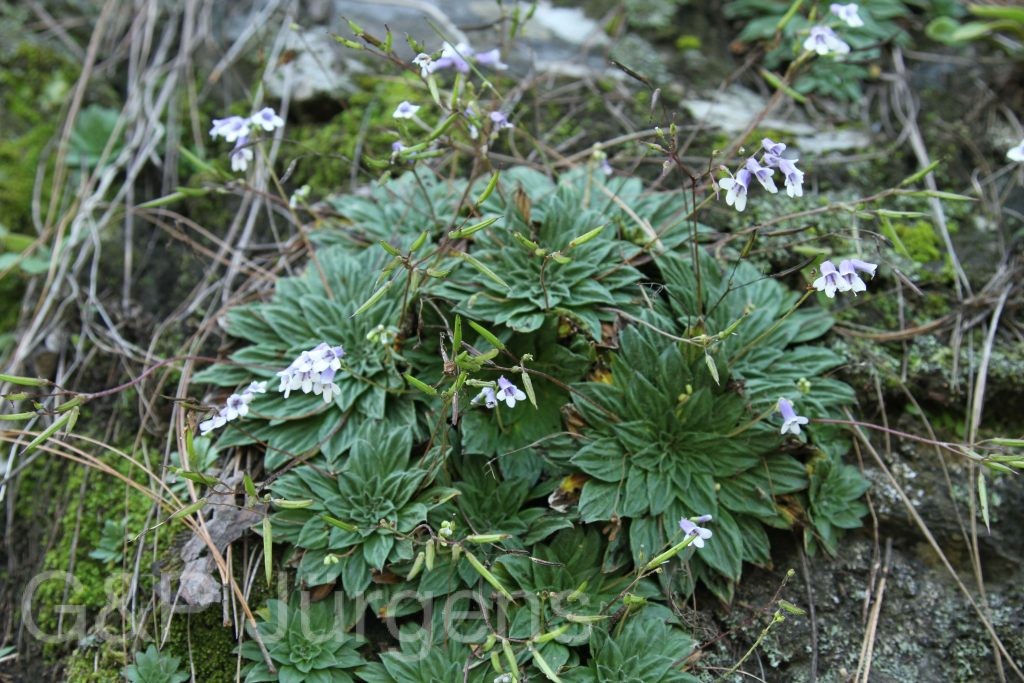
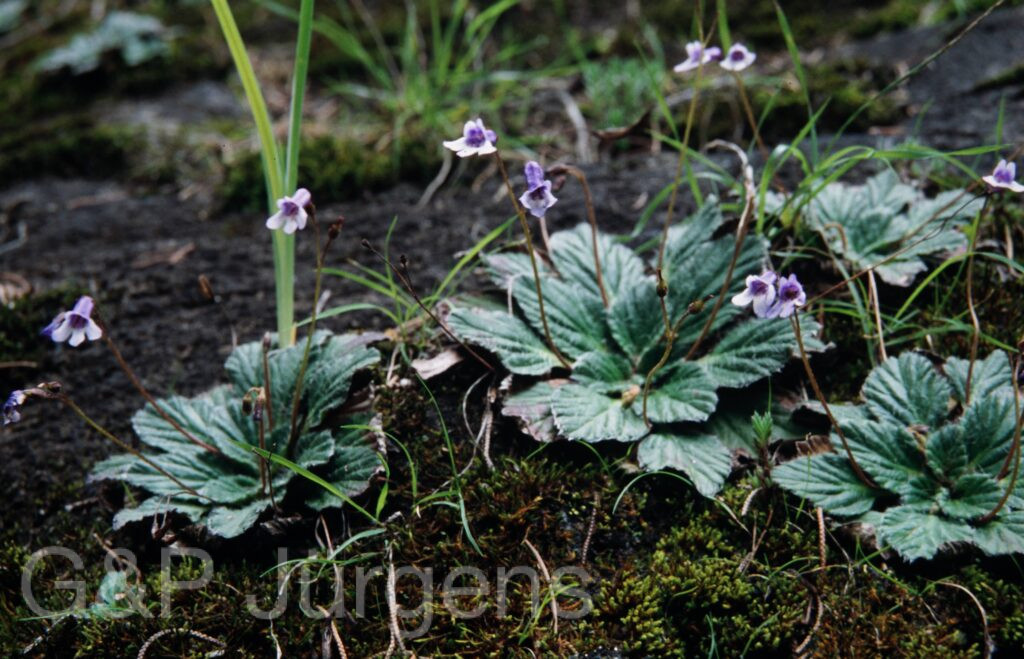
Bhutan2012 1027
Bhutan Trithangebe 900m, October
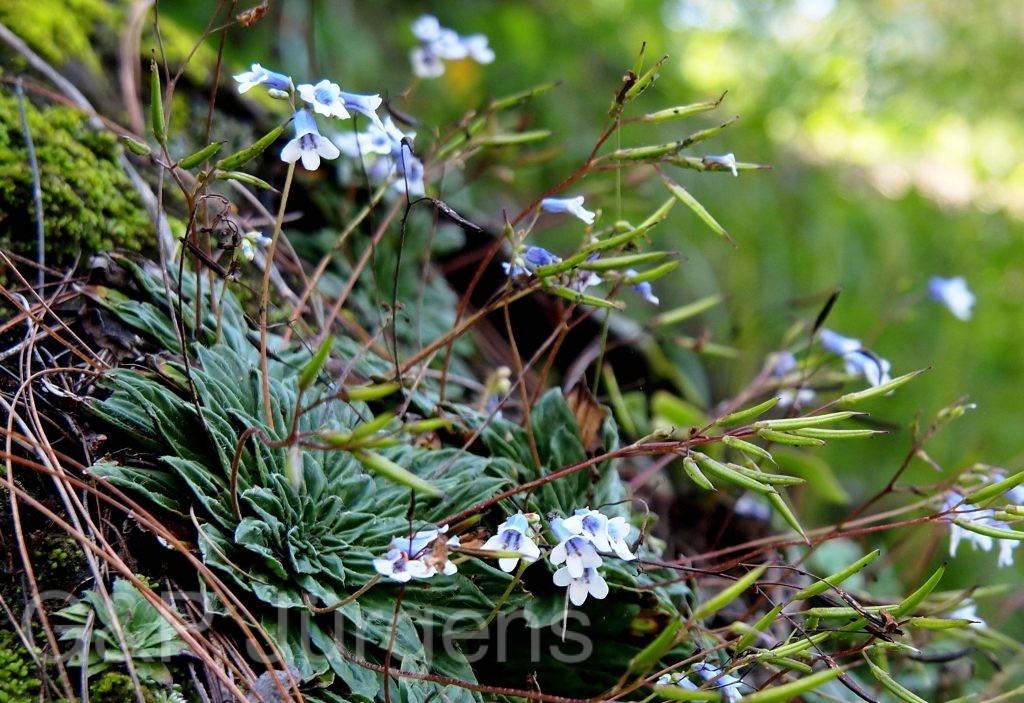
Bhutan2012 1028
Bhutan Trithangebe 900m, October

Description

Corallodiscus cooperi is a narrowly distributed rosette herb of the eastern Himalaya, so far reliably known only from Bhutan, where the few catalogued occurrences point to a restricted, possibly endemic or near-endemic range. As with other members of the genus it is a lithophyte, growing on shaded, mossy rock faces, cliff ledges and boulders, often in the spray zone of streams or on damp, well-drained crags. The plant photographed at Trithangebe in Bhutan at 900 m in October occupies the warm subtropical foothill belt, lower than the montane elevations favoured by several congeners, flowering or fruiting into the autumn on its rocky substrate.

It is a small, perennial, acaulescent herb forming a dense, appressed basal rosette of leaves. The leaves are obovate to spathulate, thick-textured, with a green, often rugose and sparsely hairy upper surface and a densely brown- or rusty-tomentose lower surface, the margins crenate to entire. From the rosette arise slender, leafless scapes bearing few-flowered cymes; the flowers are small and weakly zygomorphic, with a tubular to campanulate, five-lobed corolla of blue to violet or purplish hue, and four didynamous stamens. The fruit is a slender, elongate capsule containing numerous minute seeds.

The placement here under "Corallodiscinae" reflects the subtribal rank of Corallodiscus within Gesneriaceae (subfamily Didymocarpoideae); the genus is a small Sino-Himalayan group of rosette-forming rock plants allied to Didymocarpus and Oreocharis. Its members are characteristically tolerant of seasonal desiccation. Given its apparently very limited known range, C. cooperi warrants attention as a potential narrow endemic of conservation interest, dependent on undisturbed rocky habitats.

Author: (Craib) B.L.Burtt · Sources: POWO (Kew), Flora of China Vol. 18, Flora of Bhutan Vol. 2, GBIF, Weber: Gesneriaceae in The Families and Genera of Vascular Plants

(Wall. ex R.Br.) B.L.Burtt

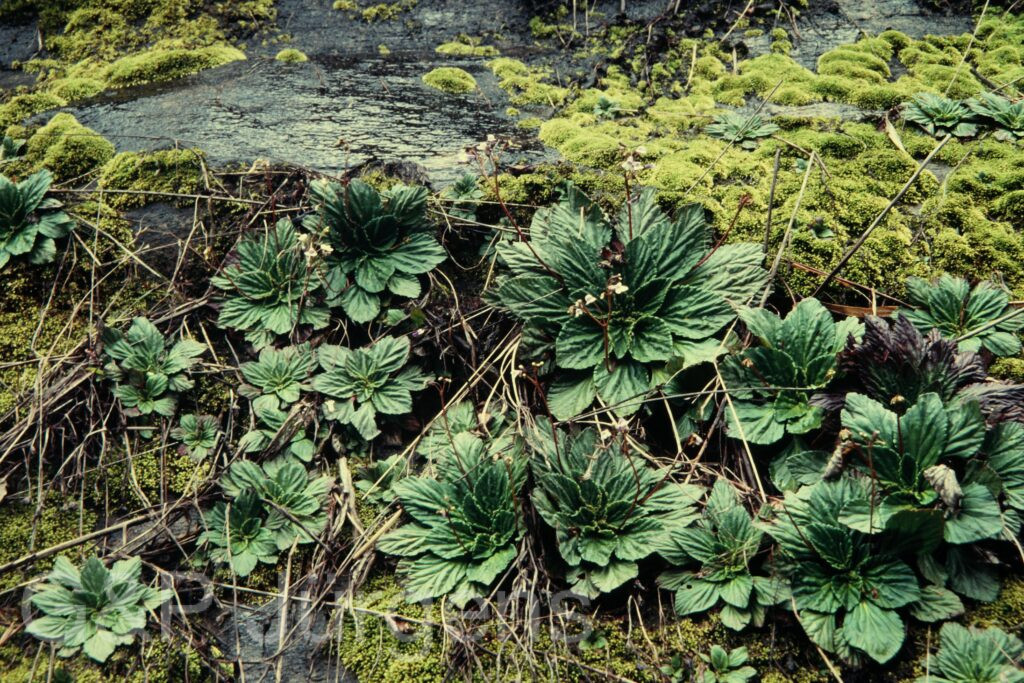
Nepal 97 369 P725
Nepal Arun-Valley 1750m May
Nepal 99 927 ergebnis
West-Nepal Roha 2750m, July

Description

Corallodiscus lanuginosus (Wall. ex R.Br.) B.L.Burtt is a rosette-forming, rupicolous perennial of the Gesneriaceae, distributed across the Himalaya and southwest China. GBIF data (over 2,000 occurrences) record it from China, Nepal, India, Bhutan, Pakistan, Myanmar, and Thailand, indicating a broad Sino-Himalayan range. It was photographed in Nepal in the Arun Valley (1,750 m, May) and at Roha in west Nepal (2,750 m, July), reflecting its occurrence on shaded, mossy cliff faces, rock crevices, and boulders in montane forest, generally between about 1,500 and 3,500 m where humidity is high.

The plant forms a compact basal rosette of leaves pressed against the rock surface. The leaves are obovate to elliptic, with a crenate margin, the upper surface dark green and rugose, the lower surface densely clothed in woolly, rusty to whitish hairs (hence "lanuginosus"). Slender, leafless scapes bear cymose clusters of flowers; the corolla is tubular-campanulate and bluish-violet to purple with a paler throat, with the slightly oblique limb and reduced fertile stamens typical of the genus. The fruit is a slender capsule.

Corallodiscus belongs to the Old World Gesneriaceae (subfamily Didymocarpoideae) and is closely allied to the lithophytic Himalayan radiation that includes Didymocarpus and allies; the input subtribe name reflects this placement. Many populations exhibit poikilohydric, resurrection-like desiccation tolerance, surviving dry periods on exposed rock and reviving with the monsoon. Widespread and locally common on cliffs, the species is not considered threatened.

Author: (Wall. ex R.Br.) B.L.Burtt · Sources: POWO (Kew), Flora of China Vol. 18, Flora of Bhutan Vol. 2, GBIF, Burtt: Studies in the Gesneriaceae of the Old World

Wall.

Nepal 97 354 P693
Nepal Arun-Valley 1650m May

Description

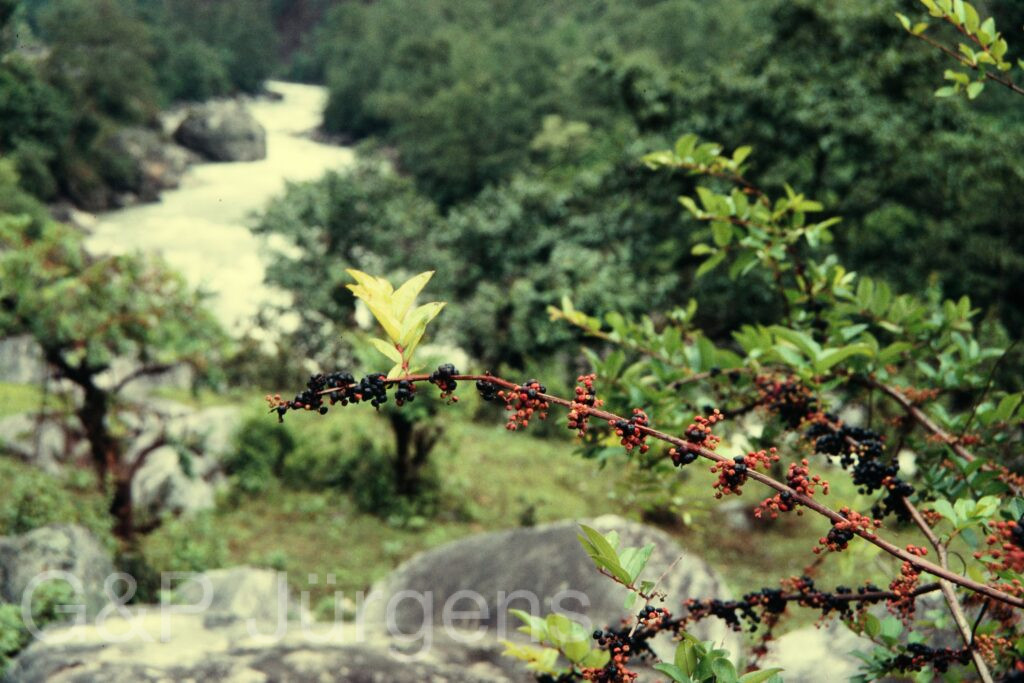
Coriaria nepalensis is a shrub of the Himalaya and adjacent mountains of western China, ranging from Pakistan through the Indian Himalaya, Nepal and Bhutan to south-western China and Myanmar. GBIF aggregates around 1880 occurrences, including scattered introductions in Europe and Japan where it is grown as a curiosity. It is a vigorous colonist of open hillsides, landslips, riverbanks, terrace edges and disturbed ground, often forming thickets on poor soils between about 1000 and 3000 m. The plant from the Arun Valley of eastern Nepal at 1650 m in May is characteristic of its role as a pioneer of the subtropical to warm-temperate hill zone.

It is a much-branched deciduous shrub with arching, reddish, four-angled young branchlets. The leaves are opposite or whorled, sessile or subsessile, ovate to ovate-lanceolate, entire and conspicuously three- to five-veined from the base. The small flowers are borne in slender axillary or terminal racemes, with five sepals and five small petals; after flowering the petals enlarge, becoming fleshy and dark purple-black, closely investing the cluster of achene-like fruitlets to form a juicy, mulberry-like pseudo-fruit. These succulent infructescences are bird-dispersed but, like the whole plant, are highly poisonous, containing the convulsant sesquiterpene coriamyrtin.

Coriariaceae is a small, isolated family of the single genus Coriaria, with a remarkable disjunct distribution across the Mediterranean, eastern Asia, the Himalaya, New Zealand and the Americas, a textbook case of relictual biogeography. C. nepalensis fixes atmospheric nitrogen through root nodules harbouring the actinomycete Frankia, underpinning its success on impoverished, eroded substrates. Widespread and weedy in its native range, it is of no conservation concern, though its toxicity is locally significant to livestock.

Author: Wall. · Sources: POWO (Kew), GBIF, Flora of China Vol. 11, Flora of Bhutan Vol. 1, Flora of Pakistan, Annotated Checklist of the Flowering Plants of Nepal, Skog revision of Coriaria

Cortiella hookeri

by GP Jürgens

(C.B.Clarke) C.Norman

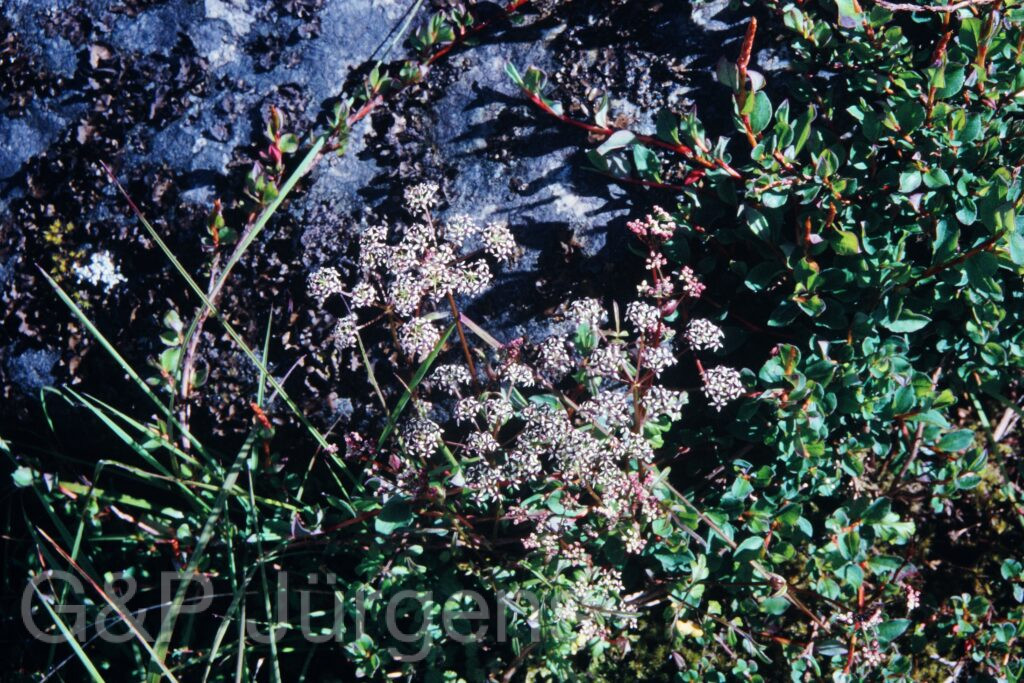
Sikkim2003 243 P334
Sikkim Dzongri 4100m, August

Description

Cortiella hookeri is a cushion-forming umbellifer of the high Himalaya and Tibetan Plateau, distributed through Nepal, China, India and Bhutan; GBIF records 115 occurrences, concentrated in the alpine zone of this region. It grows on open stony slopes, gravelly alpine turf, screes and exposed ridges, typically above 4000 m where few flowering plants persist. The illustrated material was gathered in Sikkim at Dzongri at about 4100 m in August, a classic high-alpine station where the species flowers late in the short growing season among rock and short turf swept by monsoon cloud.

The plant is a low, compact perennial herb forming a flattened rosette or cushion from a stout, often woody taproot crowned by the fibrous remains of old leaf bases. Leaves are crowded, petiolate and pinnately to ternately dissected into small, firm, often crowded segments adapted to cold and wind. The inflorescence is a condensed, sessile or short-stalked compound umbel held close to the rosette, subtended by conspicuous bracts and bracteoles; the small flowers are white to pinkish, five-merous, with inflexed petals and an inferior ovary. The fruit is a dorsally somewhat compressed schizocarp splitting into two ribbed mericarps, the ribs and vittae providing key diagnostic characters.

Cortiella is a small genus of the Sino-Himalayan alpine flora, segregated within the carrot family on fruit anatomy and habit, with C. hookeri commemorating J. D. Hooker. POWO and GBIF accept the name. Its cushion habit and high-elevation niche exemplify the convergent growth forms that allow Apiaceae to colonise the harshest Tibetan alpine ground.

Author: (C.B.Clarke) C.Norman · Sources: POWO (Kew), GBIF, Flora of China, Flora of Bhutan, Annotated Checklist of the Flowering Plants of Nepal, Umbelliferae of the Sino-Himalaya (Apiaceae monograph)

D.G. Long.

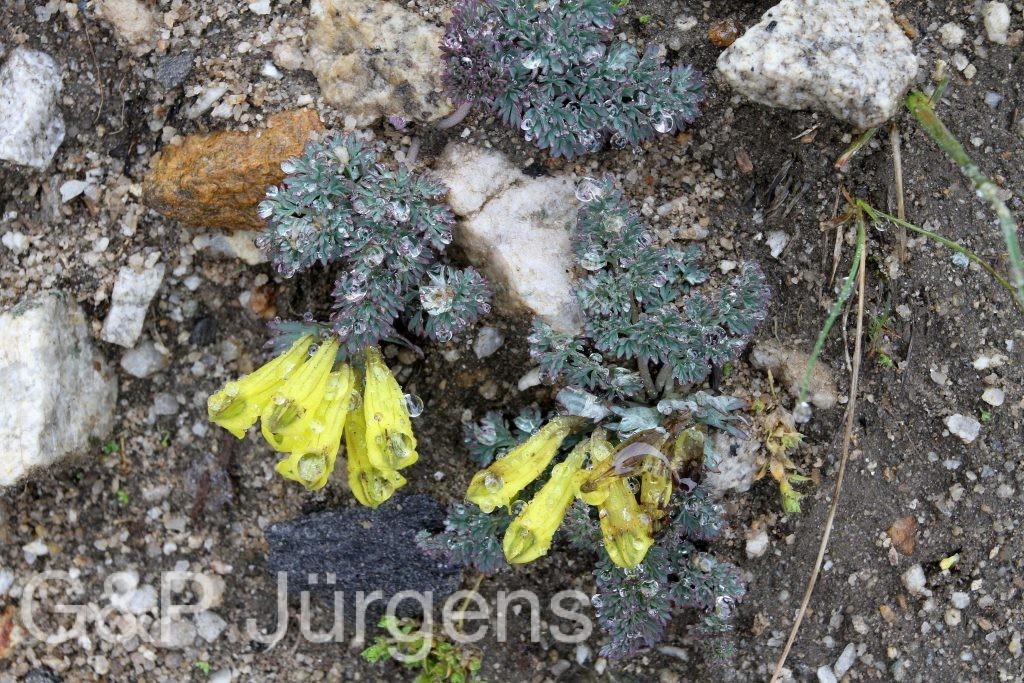
BhutanPG2011 568 01
Bhutan Ludlow-Sherriff-Trail Dem-Tso, 4600m July

Description

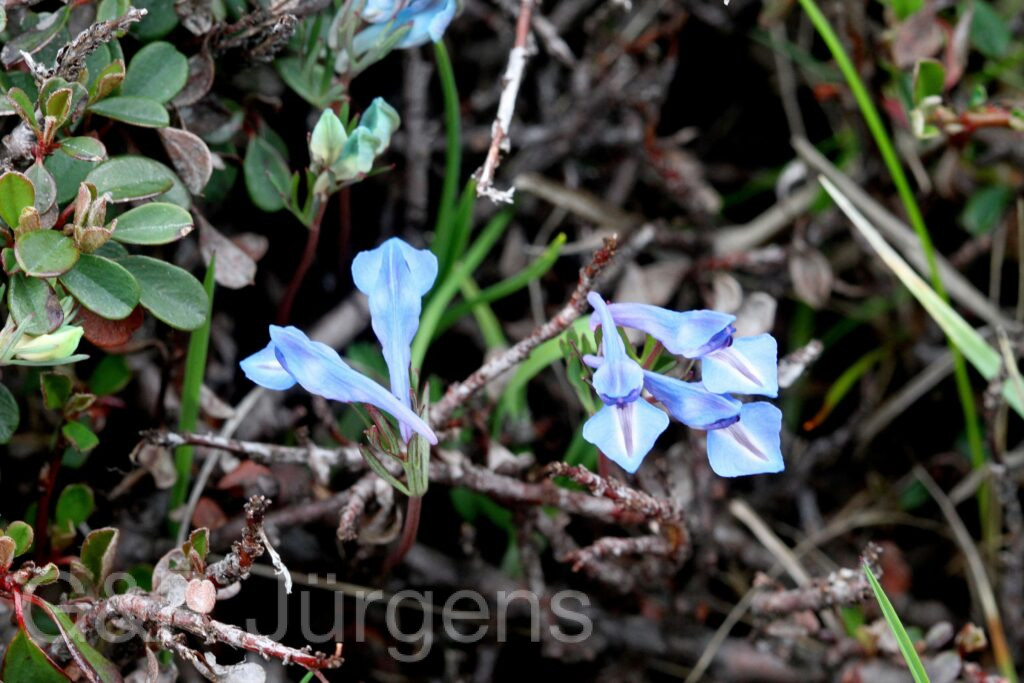
Corydalis calliantha is a high-alpine herb of the Eastern Himalaya, narrowly endemic to Bhutan, where it is the only territory from which it is documented (GBIF records derive exclusively from BT, with very few verified occurrences). It occupies the upper alpine and subnival belt, growing among moist screes, moraine debris and damp turf at the margins of glacial tarns. The collection illustrated here, gathered along the Ludlow-Sherriff Trail near Dem-Tso at about 4600 m in July, typifies its preference for cool, well-drained but seasonally irrigated substrates exposed only briefly during the short alpine summer.

It is a low, tufted, glabrous and somewhat glaucous perennial arising from a slender fleshy rootstock. The leaves are mostly basal, petiolate and several times finely divided into small obovate to oblong segments, giving a delicate, almost ferny appearance. Flowers are borne in short, few-flowered racemes; each zygomorphic flower has four petals, the outer upper petal produced backward into a slender, gently curved nectar spur, and is typically clear sky-blue to violet-blue, the colour to which the epithet calliantha ("beautiful-flowered") alludes. The fruit is a slender dehiscent capsule containing several small, shining black seeds, each often bearing a small elaiosome.

Within the large and taxonomically intricate genus Corydalis, this species belongs to the blue-flowered alpine assemblage centred on the Sino-Himalayan region, a group much studied by D.G. Long and collaborators in the Flora of Bhutan. Its restricted range and specialised subnival habitat make it of biogeographic interest and potentially vulnerable to climatic shifts affecting high-altitude snowmelt, although its remote terrain affords protection from direct disturbance.

Author: D.G. Long. · Sources: POWO (Kew), GBIF, Flora of Bhutan, Annotated Checklist of the Flowering Plants of Nepal, Liden & Zetterlund monograph of Corydalis

Prain

Bhutan2012 307
Bhutan Shale-La, 4100m September

Description

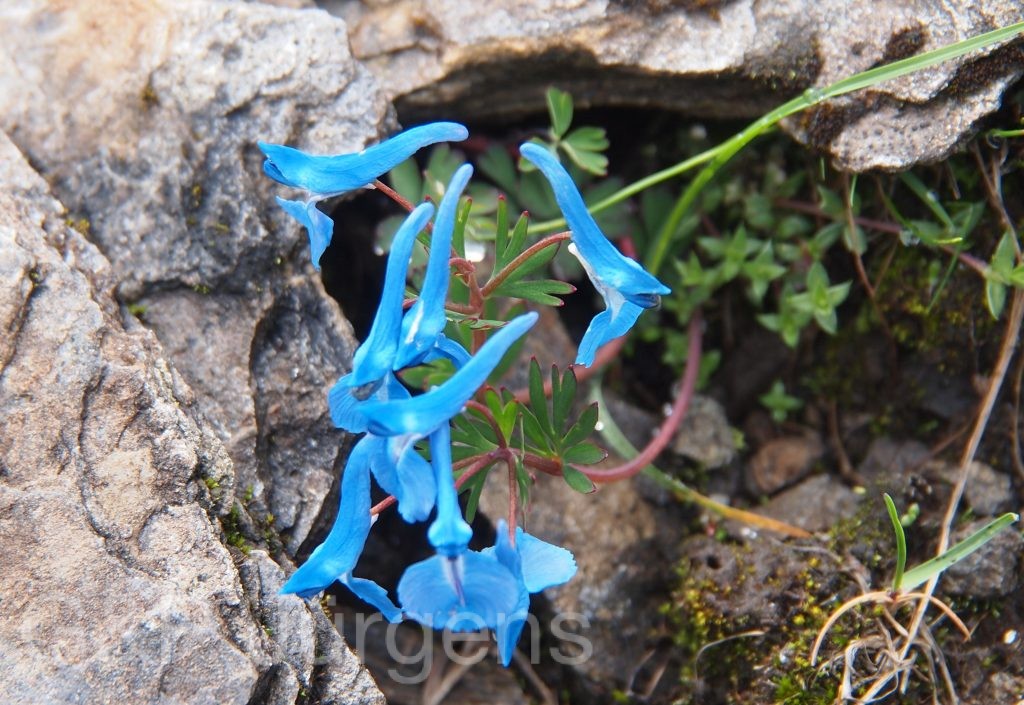
Corydalis crispa is an eastern Himalayan fumitory restricted to China, Bhutan and India, with around 129 GBIF records. It is a high-altitude species of the alpine zone, growing on open stony slopes, screes, rock crevices and the gravelly margins of meadows. The cited material from Shele-La in Bhutan at about 4100 m, flowering in September, is representative of its occurrence near the upper limit of vascular plant growth, where it occupies well-drained, sunny but moist mineral soils and flowers late in the brief alpine summer as the monsoon eases.

The plant is a glabrous, somewhat glaucous herb arising from a slender rootstock, with erect to ascending, branched and often slightly flexuose stems. The leaves are alternate, two- to three-times divided into small, narrow, often crisped or finely dissected ultimate segments, giving rise to the epithet. The flowers are borne in lax terminal racemes; each is strongly zygomorphic with four petals in two whorls, the outer upper petal prolonged backward into a spur, and are typically blue to purplish-blue. The fruit is a slender, dehiscent capsule that opens to disperse small black seeds, frequently bearing an oil-rich elaiosome attractive to ants.

Described by Prain, C. crispa is one of many alpine blue-flowered Corydalis that diversified across the Sino-Himalayan high mountains, a centre of exceptional richness for the genus. Such species are closely tied to specialised scree and crevice microhabitats. The web link references a synonymous name, C. bowes-lyonii, reflecting nomenclatural realignment. As a narrow high-altitude endemic, its populations merit monitoring against climatic change affecting alpine habitats.

Author: Prain · Sources: POWO (Kew), GBIF, Flora of China, Flora of Bhutan, Liden & Zetterlund's monograph of Corydalis

(Prain) D.G. Long

Sikkim2011 347
Sikkim Lada-La 4000m, June
BhutanPG2011 653
Bhutan Thitha-Tso, 4300m June
BhutanPG2011 652 1
Bhutan Thitha-Tso, 4300m June

Description

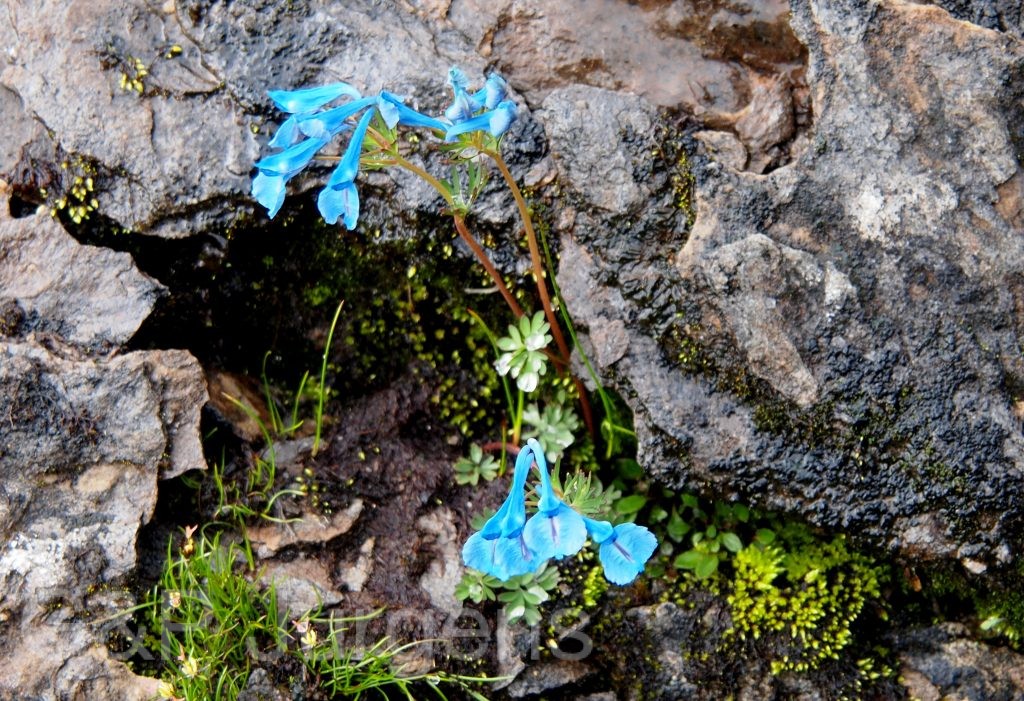
Corydalis ecristata is a small alpine herb of the higher Himalaya, distributed through Nepal, India, China and Bhutan (NP, IN, CN, BT), with about 58 recorded occurrences. It grows on open stony slopes, in screes, alpine turf, moraine and damp gravelly ground near snowmelt, characteristically in the high alpine to subnival zone, broadly between about 3800 and 4800 m. The gatherings cited come from Lada-La in Sikkim at 4000 m and from Thitha-Tso in Bhutan at 4300 m, both flowering in June, an elevation and early-summer season typical of the species, which colonises freshly exposed, well-drained debris in the brief window following the retreat of snow.

The plant is a small, glabrous, somewhat glaucous perennial herb arising from a slender tuber or rootstock. The leaves are mostly basal and finely divided, ternately to pinnately dissected into narrow ultimate segments, with long petioles. The flowers are few, borne in a short terminal raceme; each is strongly zygomorphic with four petals in two whorls, the outer upper petal prolonged backward into a nectar spur, the inner petals cohering over the stigma. As the epithet 'ecristata' indicates, the petals are crestless (lacking the dorsal wing or crest found in many congeners), the corolla blue to sky-blue, sometimes with darker markings. The fruit is a slender, dehiscent, few-seeded capsule.

Corydalis (subfamily Fumarioideae of the Papaveraceae, sometimes treated in Fumariaceae) attains exceptional diversity in the Sino-Himalayan alpine flora, where blue-flowered, tuberous species like C. ecristata are a conspicuous element of the high screes. The spurred, bilaterally symmetric flowers are pollinated chiefly by bumblebees seeking the nectar held in the spur. As a specialist of high-altitude scree and moraine with a fairly restricted range, it is dependent on stable alpine conditions, though it is not at present regarded as threatened.

Author: (Prain) D.G. Long · Sources: POWO (Kew), GBIF, Flora of Bhutan, Flora of China, The Genus Corydalis (Liden & Zetterlund monograph)