Author

GP Jürgens

H.L.Li

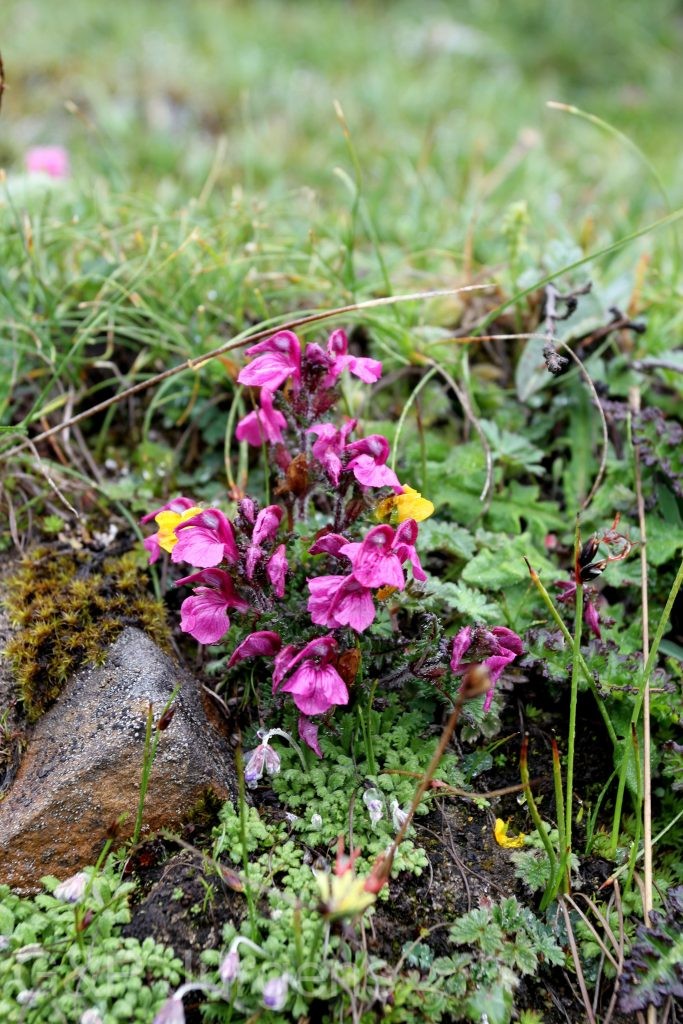
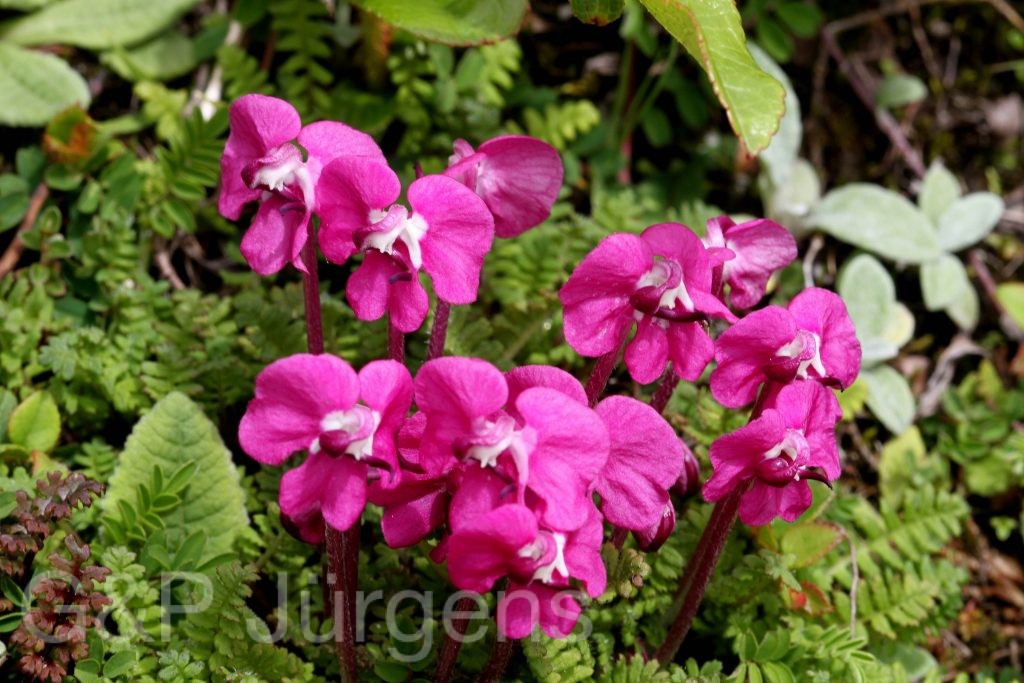
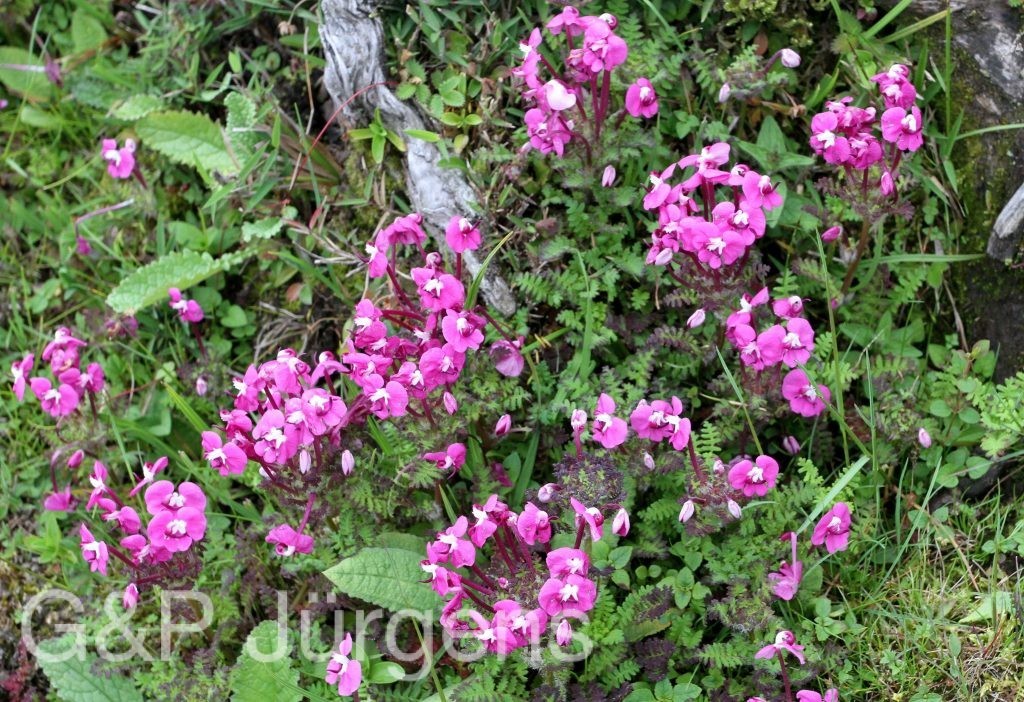
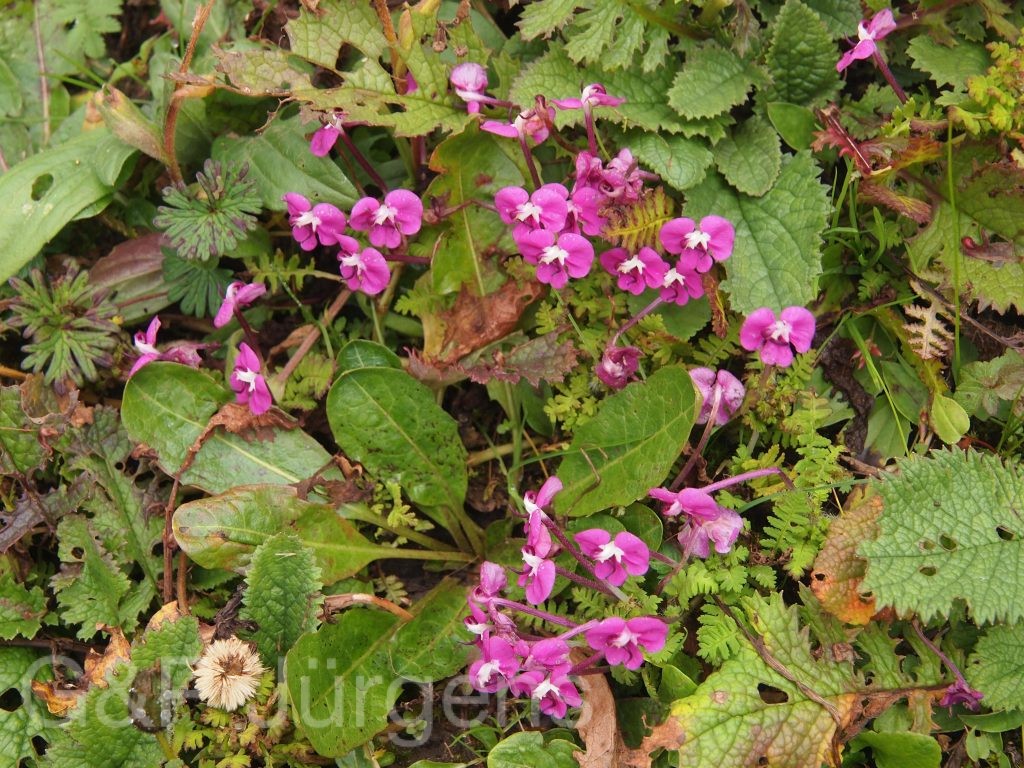
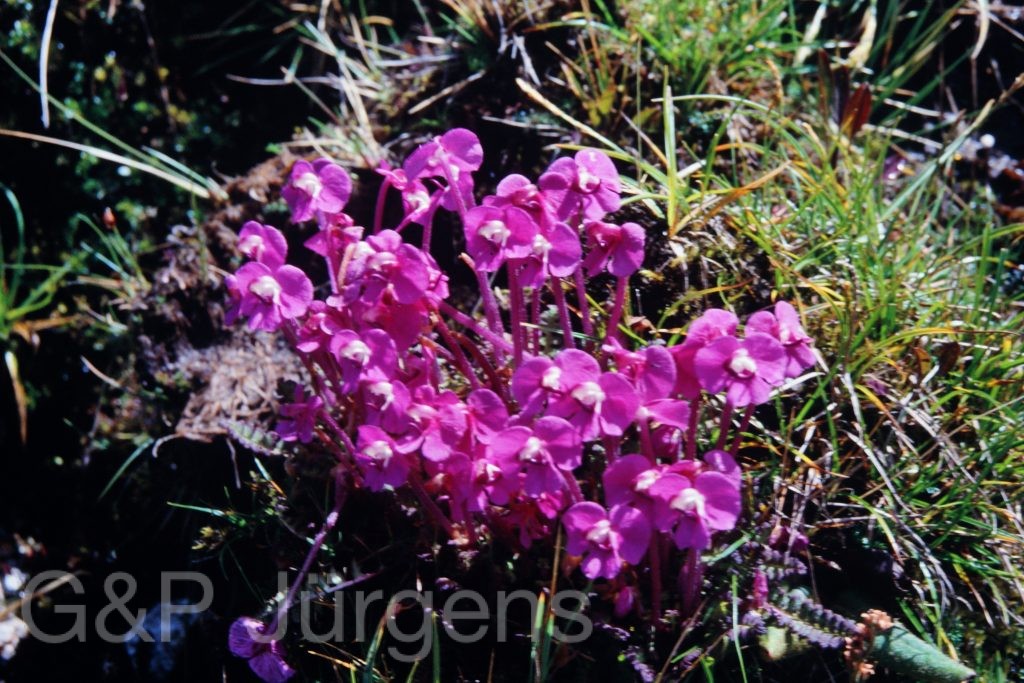
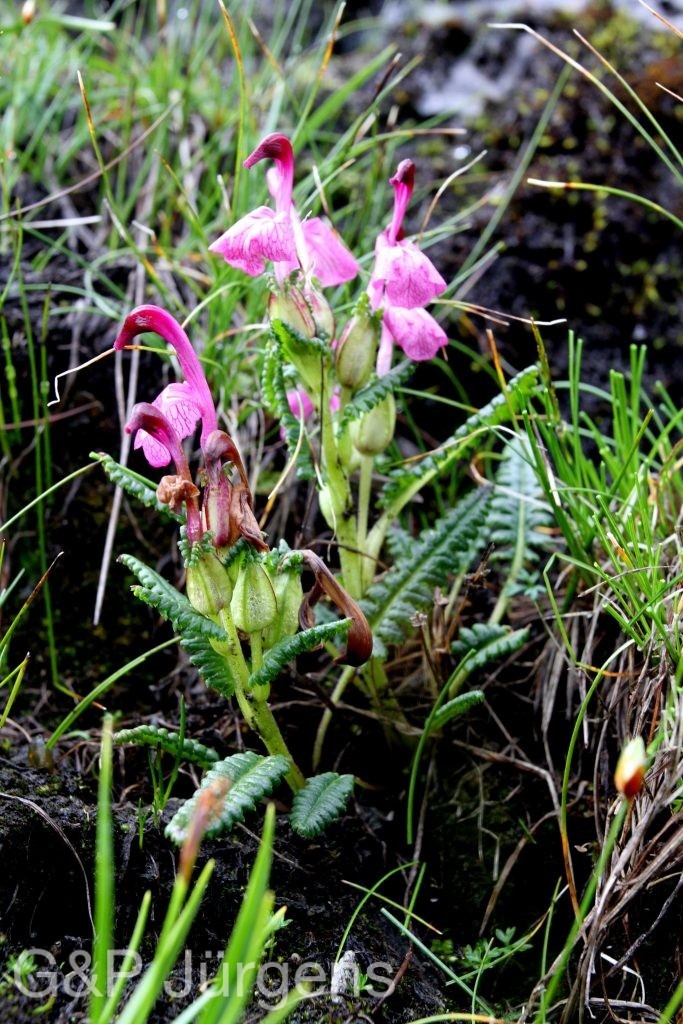
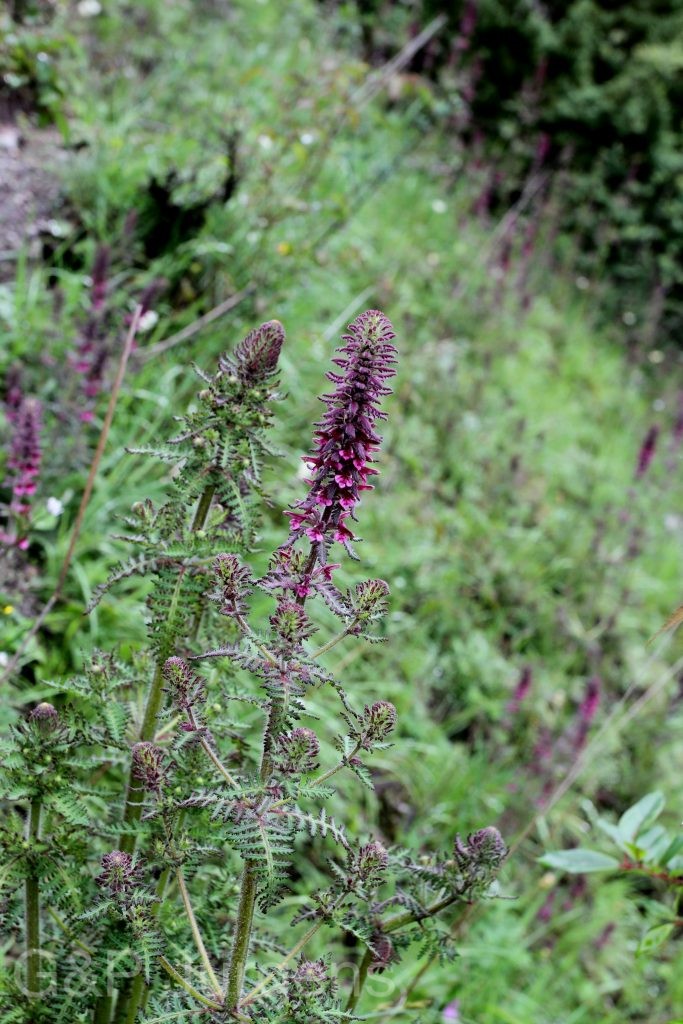
BhutanPG2011 534
Bhutan Ludlow-Sherriff-Trail Dem-Tso, 4650m June

Description

Pedicularis megalochila is a high-alpine lousewort of the Eastern Himalaya, distributed across Bhutan, Sikkim and adjacent India, eastern Nepal and southern Tibet (Xizang) in China, with GBIF logging 62 occurrences over CN, BT, NP and IN. It inhabits open alpine turf, moist meadows, seepage slopes and the margins of glacial tarns at considerable altitude, typically between about 4000 and 4800 m. The photographed plant was recorded in Bhutan along the Ludlow-Sherriff Trail near Dem-Tso at 4650 m, flowering in June, consistent with the brief summer flowering window of high-elevation Pedicularis.

The species is a low perennial herb with a stout rootstock and short, ascending stems. The leaves are largely basal and rosulate, pinnatisect into closely set, toothed segments, with reduced cauline leaves. The flowers are aggregated into a dense terminal head or short spike, each subtended by a leafy bract. As the epithet megalochila implies, the zygomorphic corolla bears a notably large lower lip; the corolla is two-lipped, the upper lip forming a hooded, often beaked galea enclosing the four didynamous stamens, the colour ranging from rose-purple to pink. The calyx is tubular and toothed, and the fruit is an oblique, laterally compressed capsule containing few seeds.

Like all members of Pedicularis (now placed in Orobanchaceae), it is a hemiparasite, attaching by haustoria to the roots of neighbouring alpine plants while retaining green, photosynthetic foliage. The genus is exceptionally diverse and rapidly radiating in the Sino-Himalayan alpine zone, where bumblebee pollination and corolla architecture drive species differentiation. Its remote high-altitude habitat affords natural protection, and no specific conservation threat is currently documented.

Author: H.L.Li · Sources: POWO (Kew), GBIF, Flora of Bhutan, Flora of China (Scrophulariaceae/Orobanchaceae), H.L.Li and Tsoong revisions of Himalayan Pedicularis
Hook.f.

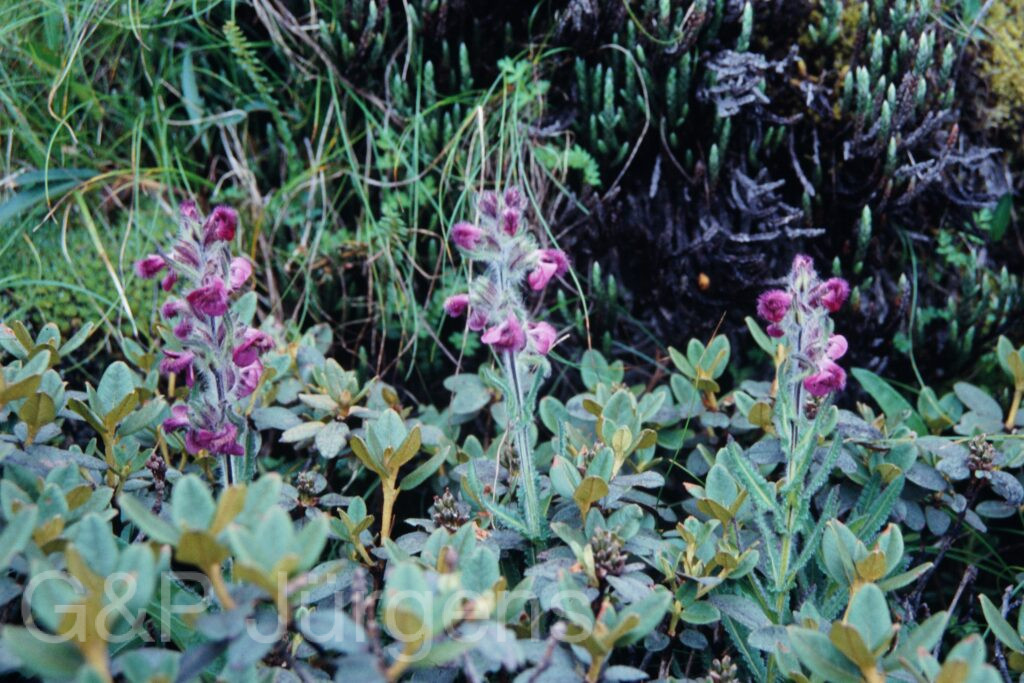
BhutanPG2011 657 01
Bhutan Ludlow-Sherriff-Trail Thitha-Tso, 4350m July

Description

Pedicularis microcalyx is a hemiparasitic alpine lousewort of the central and eastern Himalaya. GBIF records it from India, Nepal, Bhutan and China, with around 50 occurrences, reflecting a comparatively narrow Himalayan distribution. It occupies wet alpine meadows, marshy turf, lake margins and seepage slopes at high elevation, generally between 3800 and 4800 m. The individual illustrated was found along the historic Ludlow-Sherriff trail near Thitha-Tso in Bhutan at 4350 m in July, blooming amid the saturated alpine sward during the monsoon, the season when these moisture-loving species flower.

Like other louseworts it is a root-hemiparasite drawing water and nutrients from neighbouring graminoids and herbs via haustorial connections. It is a low perennial with pinnatisect, fern-like leaves whose segments are toothed. The flowers are borne in a leafy spike or terminal cluster; as the epithet microcalyx indicates, the calyx is small. The bilabiate corolla is pink to purplish, the galea (upper lip, hood) often beaked or curved over the lower three-lobed lip, an arrangement adapted to pollination by long-tongued bumblebees. The fruit is an asymmetrical, beaked capsule splitting to release the seeds.

Pedicularis is one of the largest Himalayan genera, with extraordinary diversification of corolla form linked to bumblebee pollinator specialisation, the region being a global centre of richness. Its hemiparasitic habit lets it draw on community resources while contributing little. With a restricted high-altitude range and dependence on intact wet alpine habitats, P. microcalyx is potentially vulnerable to grazing and climate-driven drying, though not formally assessed.

Author: Hook.f. · Sources: POWO (Kew), GBIF, Flora of China, Flora of Bhutan, Annotated Checklist of the Flowering Plants of Nepal, A revision of the Himalayan species of Pedicularis

Wall. ex Benth

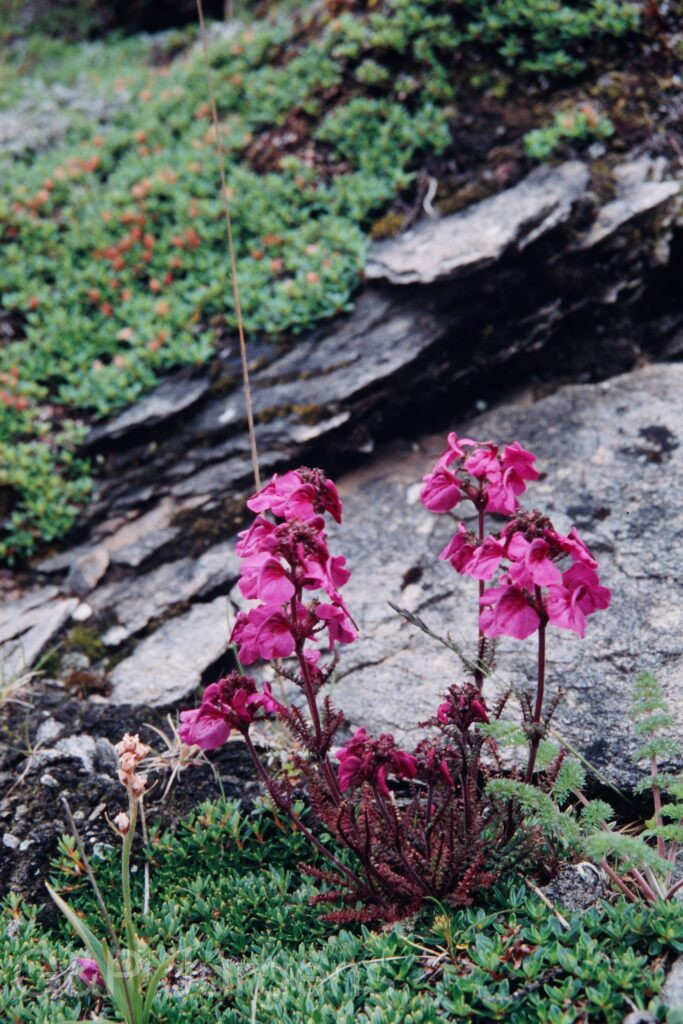
BhutanPG2011 386
Bhutan Dur-Tso, 3450m June

Description

Pedicularis mollis is a widespread Himalayan lousewort ranging through Nepal, China (Xizang, Yunnan), India and Bhutan, and is comparatively well collected, with GBIF holding nearly 392 occurrences. It grows in the subalpine and lower alpine zones, typically between about 3000 and 4200 m, in open coniferous and Rhododendron forest, on grassy slopes, in damp meadows and along the margins of streams and tarns. The photographed plant from Dur-Tso in Bhutan at 3450 m, flowering in June, exemplifies its preference for moist, well-watered montane ground where it associates with sedges and other meadow forbs. Like all louseworts it is a hemiparasite, drawing water and minerals from the roots of neighbouring plants.

It is a robust perennial with erect, softly pubescent stems arising from a stout rootstock. The leaves are oblong-lanceolate in outline and pinnately to pinnatipartite divided, the segments themselves toothed and clothed in soft hairs that give the species its epithet. The inflorescence is a dense, elongating terminal spike subtended by leafy bracts. Each flower has a tubular, toothed calyx and a strongly two-lipped corolla, typically pink to purplish, the hooded upper lip (galea) curved into a beak enclosing the anthers, the lower lip three-lobed and spreading. Pollination is chiefly by long-tongued bumblebees, and the fruit is an oblique capsule with several seeds.

Pedicularis is one of the largest genera of the northern hemisphere, reaching its greatest diversity in the Sino-Himalaya, where dozens of species partition habitat and pollinator. P. mollis is distinguished by its soft pubescence, leaf dissection and galea form. The genus's hemiparasitic habit makes its members important to meadow community structure, while specialised bumblebee pollination links reproductive success to montane pollinator populations now under pressure from land-use and climatic change.

Author: Wall. ex Benth · Sources: POWO (Kew), GBIF, Flora of China, Flora of Bhutan, Pennell 'The Scrophulariaceae of the Western Himalayas', Yamazaki monograph of Pedicularis

(Maxim.) Hurus.

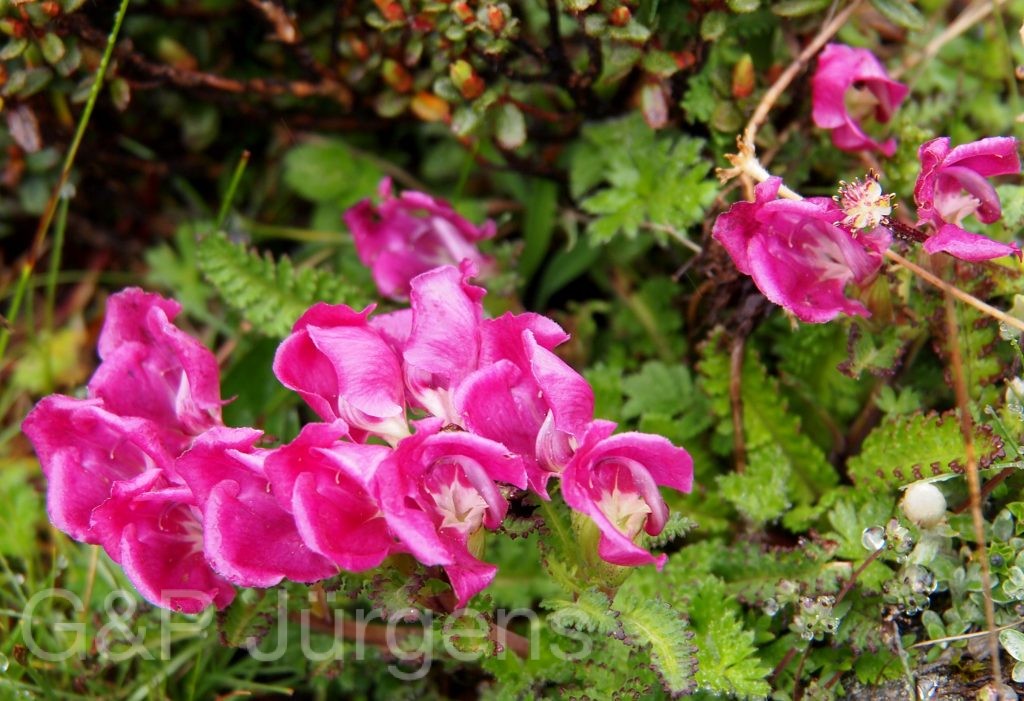
BhutanPG2011 588
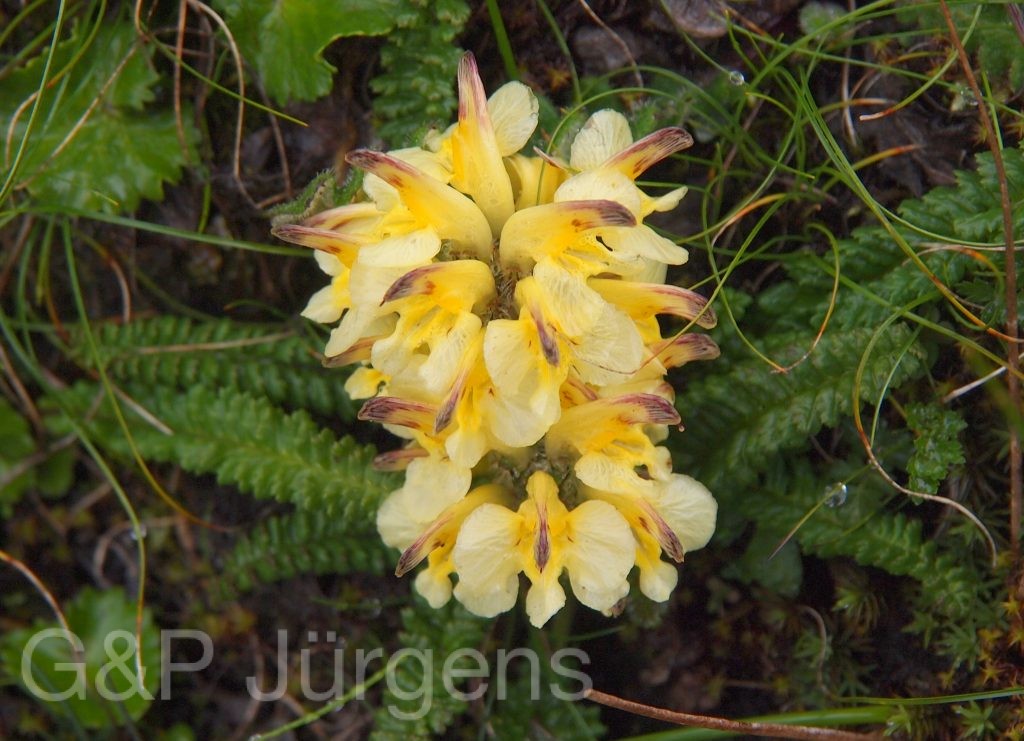
Bhutan Ludlow-Sherriff-Trail Miluthang, 4500m July

Description

Pedicularis oederi var. sinensis is a hemiparasitic perennial of the high eastern Himalaya and Sino-Himalayan ranges, distributed across China, Bhutan and India (CN, BT, IN), with some 195 documented occurrences. It is a plant of open alpine turf, stony slopes, moist meadows and the margins of snowbeds in the subalpine to alpine and subnival belts, typically between about 3500 and 5000 m. The collection illustrated here was made along the Ludlow-Sherriff Trail at Miluthang in Bhutan at 4500 m in July, an elevation and timing characteristic of its summer flowering in the wake of melting snow, where it derives part of its nutrition by parasitising the roots of neighbouring graminoids and herbs.

The plant forms a low, tufted rosette arising from a stout, fleshy taproot and a short caudex, with one to several erect or ascending, sparingly leafy flowering stems. The leaves are mostly basal, oblong-lanceolate in outline and pinnatisect, the segments oblong and serrate-crenate, the rachis often woolly. The inflorescence is a dense, oblong to capitate terminal spike subtended by leafy bracts. The corolla is two-lipped and yellow, the galea usually marked with red-brown or purple at the apex and beakless, hooded over the four didynamous stamens, while the lower lip is three-lobed and spreading. The calyx is tubular and lobed; the fruit is an obliquely ovoid, compressed capsule containing several seeds.

The genus Pedicularis (lousewort) reaches its greatest diversity in the Sino-Himalayan alpine flora, and P. oederi is a circumpolar-alpine species whose Himalayan populations are treated as var. sinensis. Its beakless galea places it among the non-rostrate louseworts, and like its congeners it relies on long-tongued bumblebees for pollination. As a facultative root hemiparasite it can influence the composition of alpine plant communities. Though locally common across its range, it is sensitive to grazing pressure and to climatic shifts affecting the duration of snow cover.

Author: (Maxim.) Hurus. · Sources: POWO (Kew), GBIF, Flora of Bhutan, Flora of China, Pedicularis of the Sino-Himalaya (Yamazaki monograph)

Prain

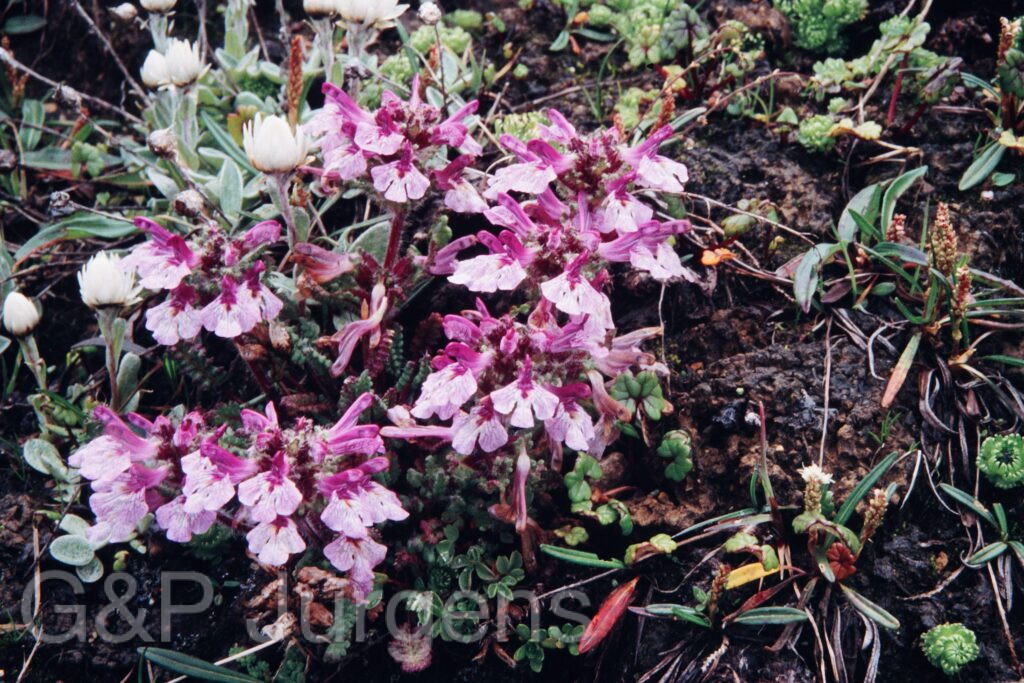
BhutanPG2011 521
Bhutan Ludlow-Sherriff-Trail Dem-Tso, 4500m June

Description

Pedicularis regeliana is a high-alpine lousewort of the Himalaya, recorded from Nepal, India, Bhutan and China, with about 72 GBIF occurrences reflecting a restricted high-elevation range. It grows in alpine meadows, moist grassy slopes, marshy turf and streamsides near the upper limit of vegetation, generally around 4000 to 4800 m. The plant photographed along the Ludlow-Sherriff Trail near Dem-Tso in Bhutan at about 4500 m in June illustrates its occurrence in damp alpine grassland and lake margins, flowering in early summer when the high pastures green after snowmelt.

The species is a perennial herb arising from a short rootstock, with erect or ascending stems and leaves that are pinnatisect to pinnatipartite, the segments narrow and toothed, in basal and cauline arrangements. The flowers are borne in a terminal spike or raceme, each subtended by a leafy bract; the strongly zygomorphic corolla is two-lipped, with the upper lip (galea) hooded and often beaked and the lower lip three-lobed and spreading. The four didynamous stamens lie within the galea, and the fruit is a flattened capsule releasing several seeds.

Pedicularis is an exceptionally species-rich genus that, like other former Scrophulariaceae now placed in Orobanchaceae, comprises hemiparasites drawing water and nutrients from the roots of neighbouring plants while retaining green, photosynthetic foliage. The genus reaches extraordinary diversity in the Sino-Himalaya, where the varied galea shapes are tied to specialisation for bumblebee pollination. As a high-altitude endemic of limited range, P. regeliana is an alpine specialist sensitive to disturbance of montane meadows, though it has not been formally evaluated for threat status.

Author: Prain · Sources: POWO (Kew), GBIF, Flora of China, Flora of Bhutan, Annotated Checklist of the Flowering Plants of Nepal, Prain's account of Indian Pedicularis

Maxim

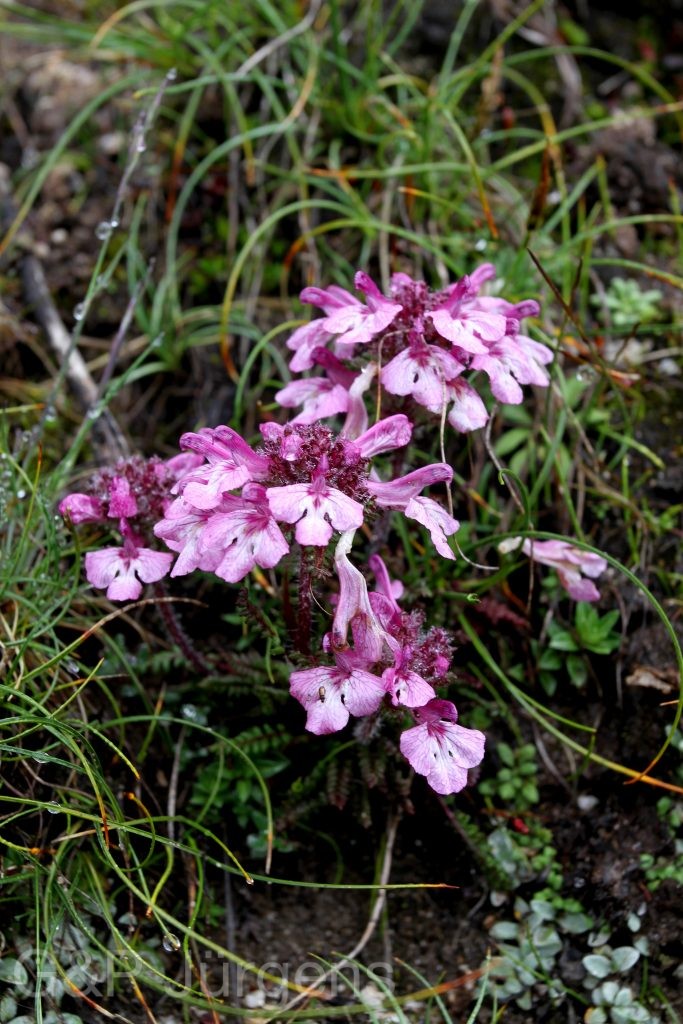
BhutanPG2011 543
Bhutan Ludlow-Sherriff-Trail Dem-Tso, 4600m June
Nepal 99 663 ergebnis
Nepal

Description

Pedicularis roylei is a Himalayan lousewort distributed from China and Pakistan eastward through Nepal, India and Bhutan, with more than 570 GBIF occurrences. It is a plant of moist alpine meadow, marshy turf and the margins of glacial pools and streamlets, characteristically growing at high elevation between about 3800 and 4800 m. The population photographed near Dem-Tso on the Ludlow-Sherriff Trail in Bhutan at 4600 m, flowering in June, with additional records in Nepal, illustrates its affinity for damp, short alpine swards near the snow line.

Like other Pedicularis it is a hemiparasitic perennial herb that attaches to the roots of neighbouring plants. It forms low tufts with a short rootstock, the stems few and ascending. The leaves are mostly basal and clustered, pinnatipartite to pinnatisect with toothed lobes, the cauline leaves fewer. The flowers are borne in a dense terminal head or short spike; the bilabiate corolla is pink to reddish-purple, with a galeate upper lip (galea) that is beakless or shortly hooded and a spreading, three-lobed lower lip. The fruit is an oblique, laterally compressed capsule containing few seeds.

Pedicularis reaches extraordinary diversity in the Sino-Himalaya, where root hemiparasitism and specialised pollination by long-tongued bumblebees have driven rapid speciation and floral diversification. P. roylei, described by Maximowicz, is widespread and not threatened, but as a parasite tied to particular alpine meadow hosts and pollinators it is a sensitive component of high-altitude grassland ecosystems.

Author: Maxim · Sources: POWO (Kew), GBIF, Flora of Bhutan, Flora of China, Prain account of Indo-Himalayan Pedicularis

Prain

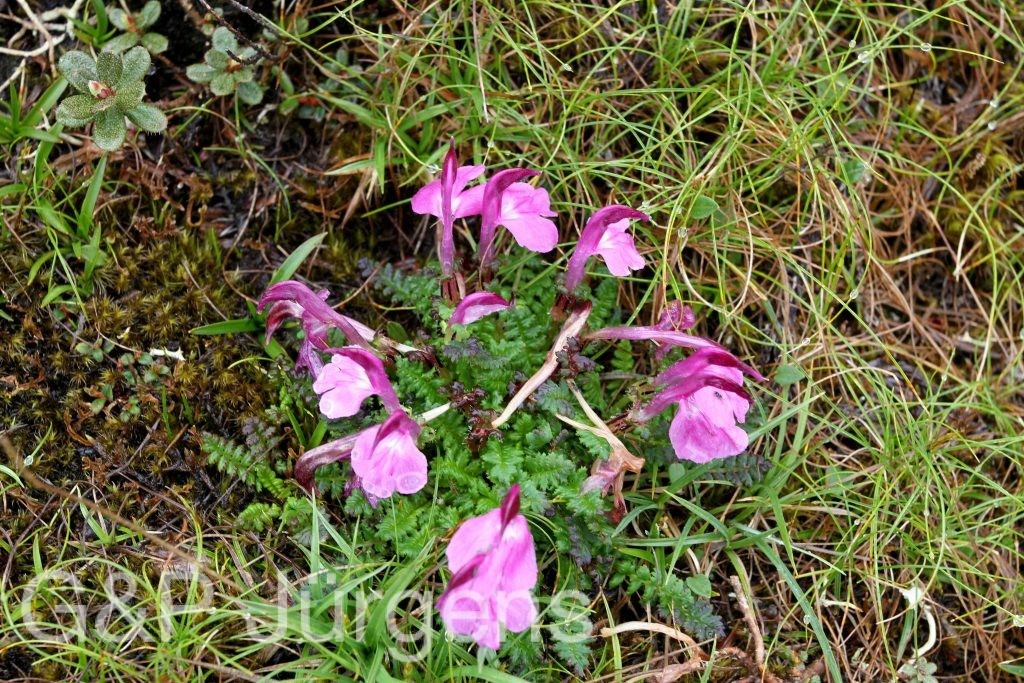
BhutanPG2011 532
Bhutan Ludlow-Sherriff-Trail Dem-Tso, 4650m June

Description

Pedicularis schizorrhyncha Prain is a high-alpine lousewort restricted to the eastern Himalaya, recorded from Nepal, Bhutan and India, with only some 41 GBIF occurrences underscoring its narrow distribution and elevated habitat. It occupies moist alpine meadows, turf, seepage margins and the edges of glacial tarns, typically between about 4000 and 4800 m. The illustrated plant from the Ludlow-Sherriff Trail at Dem-Tso in Bhutan, at roughly 4650 m in June, is representative of its strict confinement to the cool, short-summer subnival belt near the upper limit of vascular plant growth.

The species is a low perennial hemiparasitic herb arising from a slender rootstock, with few erect or ascending stems bearing pinnately divided to pinnatisect leaves whose lobes are toothed and crisped. The flowers are borne in a short terminal spike, each subtended by a leaf-like bract; the calyx is tubular and toothed, and the strongly zygomorphic corolla has an upper lip or galea prolonged into a slender, downcurved, conspicuously bifid or cleft beak, the feature recalled by the epithet schizorrhyncha. The fruit is an oblique, laterally compressed capsule.

Pedicularis (Orobanchaceae) is an enormous Sino-Himalayan radiation, and the long-beaked species form a coherent group adapted to specialised long-tongued bumblebee pollination. As a root hemiparasite, P. schizorrhyncha draws supplementary nutrients from neighbouring alpine plants. Its restricted range and sensitivity to alpine habitat change make it a species warranting monitoring, though it remains formally unassessed.

Author: Prain · Sources: POWO (Kew), GBIF, Flora of Bhutan, Flora of China, Flora of Nepal, Prain and Tsoong monographic treatments of Pedicularis

D.Don

Sikkim2011 202
Sikkim Lachung 3000m, June
BhutanPG2011 735 01 01
Bhutan Haa-Valley, 2750m June
Bhutan2012 77
Bhutan Shele-La, 4000m September
Sikkim2003 115 P155
Sikkim below Dzongri 4000m August

Description

Pedicularis siphonantha is a Himalayan lousewort distributed through southern China, Nepal, northern India, Sikkim, Bhutan, Myanmar and Pakistan, well represented in GBIF with 810 occurrences. It is a plant of moist alpine and subalpine meadows, open hillsides, Rhododendron scrub and streamside turf, mostly between 2700 and 4500 m. The accompanying records span its range and season: Lachung in Sikkim at 3000 m and the Haa Valley in Bhutan at 2750 m in June, and the higher Shele-La (4000 m) and slopes below Dzongri (4000 m) flowering on into August and September, reflecting a long summer-to-autumn anthesis across an altitudinal gradient.

It is a perennial herb with erect or ascending stems arising from a stout rootstock, bearing leaves that are pinnatisect into oblong, doubly toothed segments. The rose-pink to purplish-red flowers are crowded in terminal racemes; the corolla is strongly two-lipped, its most distinctive feature a long, slender, often curved or twisted tubular galea drawn out into a beak (the siphon-like form giving the epithet), with a spreading three-lobed lower lip. The four stamens lie under the galea, and the fruit is an obliquely ovoid capsule containing several seeds.

Like all Pedicularis, it is a hemiparasite, drawing water and nutrients from the roots of neighbouring meadow plants through haustoria while retaining green photosynthetic foliage. The elongate corolla tube indicates pollination by long-tongued bumblebees. Pedicularis is exceptionally species-rich and difficult in the Sino-Himalaya, with corolla architecture central to species delimitation. Widespread and locally abundant, P. siphonantha is not regarded as threatened, though louseworts as a group are sensitive to changes in their host-rich alpine grassland communities.

Author: D.Don · Sources: POWO (Kew), GBIF, Flora of China, Flora of Bhutan, Yamazaki: Pedicularis monograph

Hook. f.

Sikkim2003 317 P451
Sikkim Saniti-Lake 4300m August

Description

Pedicularis trichoglossa is a striking alpine lousewort of the Himalaya and Sino-Himalayan mountains, with 547 georeferenced records from China (CN), Nepal (NP), Bhutan (BT), India (IN) and Myanmar (MM). It is a plant of high alpine meadows, moist grassy slopes, streamsides and the margins of glacial lakes, typically between about 3500 and 4800 m. The population recorded at Saniti Lake in Sikkim at 4300 m in August is characteristic of its occurrence in damp, late-season alpine turf, where it flowers in the post-monsoon weeks alongside other high-elevation herbs. Its broad east-Himalayan distribution makes it a conspicuous element of the upper alpine flora.

It is an erect perennial herb with one to several simple or sparingly branched stems arising from a short rootstock. The leaves are alternate to subopposite, pinnatisect into many small, toothed segments, in the typical fern-like fashion of the genus. The flowers are crowded into a dense, elongate terminal spike, deep reddish-purple to wine-red, conspicuous against the foliage. Each strongly two-lipped corolla has a hooded, beaked galea formed by the upper lip, the beak conspicuously fringed with long purple hairs, a feature reflected in the epithet trichoglossa (hairy-tongued). The fruit is an oblique, beaked capsule containing several seeds.

Pedicularis (Orobanchaceae) is one of the largest and most diverse genera of the Himalayan alpine zone, where it has undergone remarkable radiation in floral form linked to bumblebee pollination; the hairy, beaked galea of P. trichoglossa is one such specialised adaptation. Like all members of the genus it is a hemiparasite, drawing water and nutrients from the roots of neighbouring plants via haustoria while retaining green, photosynthetic foliage. The species is widespread and frequent, of no conservation concern, but it is a valuable indicator of intact high-alpine meadow communities.

Author: Hook. f. · Sources: POWO (Kew), GBIF, Flora of China, Flora of Bhutan, Annotated Checklist of the Flowering Plants of Nepal, Prain and Tsoong monographic studies of Asian Pedicularis

?

Nepal 99 597 ergebnis
West-Nepal Churta-Khola 3800m, June

Description

Pedicularis X denotes a Himalayan lousewort of uncertain or hybrid identity (the GBIF return resolves only to Plantae, with the global occurrence figure of over 634 million reflecting that kingdom-level match rather than the taxon itself, so distributional data here are uninformative). On evidence of the genus and the locality, it is a montane to alpine plant of moist meadows, scrub margins and tall-herb communities in the Western Himalaya. The image record from Churta-Khola in West Nepal at 3800 m, in June, places it in the early-summer subalpine-to-alpine zone where Pedicularis is most diverse and conspicuous.

Louseworts are perennial (sometimes annual) herbs with leaves that are typically alternate to whorled and pinnately divided into toothed segments, often fern-like in aspect. The flowers are borne in terminal spikes or racemes and are strongly zygomorphic: the calyx is tubular and toothed, and the bilabiate corolla has an upper lip (galea) frequently produced into a beak or rostrum enclosing the anthers, while the three-lobed lower lip forms a landing platform. Corolla colour ranges from pink and purple to yellow and white. The fruit is a flattened, often asymmetric capsule containing several seeds. Such floral architecture is adapted to pollination by long-tongued bumblebees.

Pedicularis (Orobanchaceae, formerly Scrophulariaceae) is a hemiparasitic genus of extraordinary richness in the Sino-Himalaya, where rapid radiation and frequent hybridisation produce taxonomically difficult complexes, consistent with the provisional designation here. As root hemiparasites the plants form haustorial connections to host roots, influencing meadow community composition. Firm identification requires examining galea form, leaf division and corolla details against regional monographs.

Author: ? · Sources: POWO (Kew), GBIF, Flora of Bhutan, Annotated checklist of the flowering plants of Nepal, Yamazaki revision of Asian Pedicularis