
Hook.f.
Description
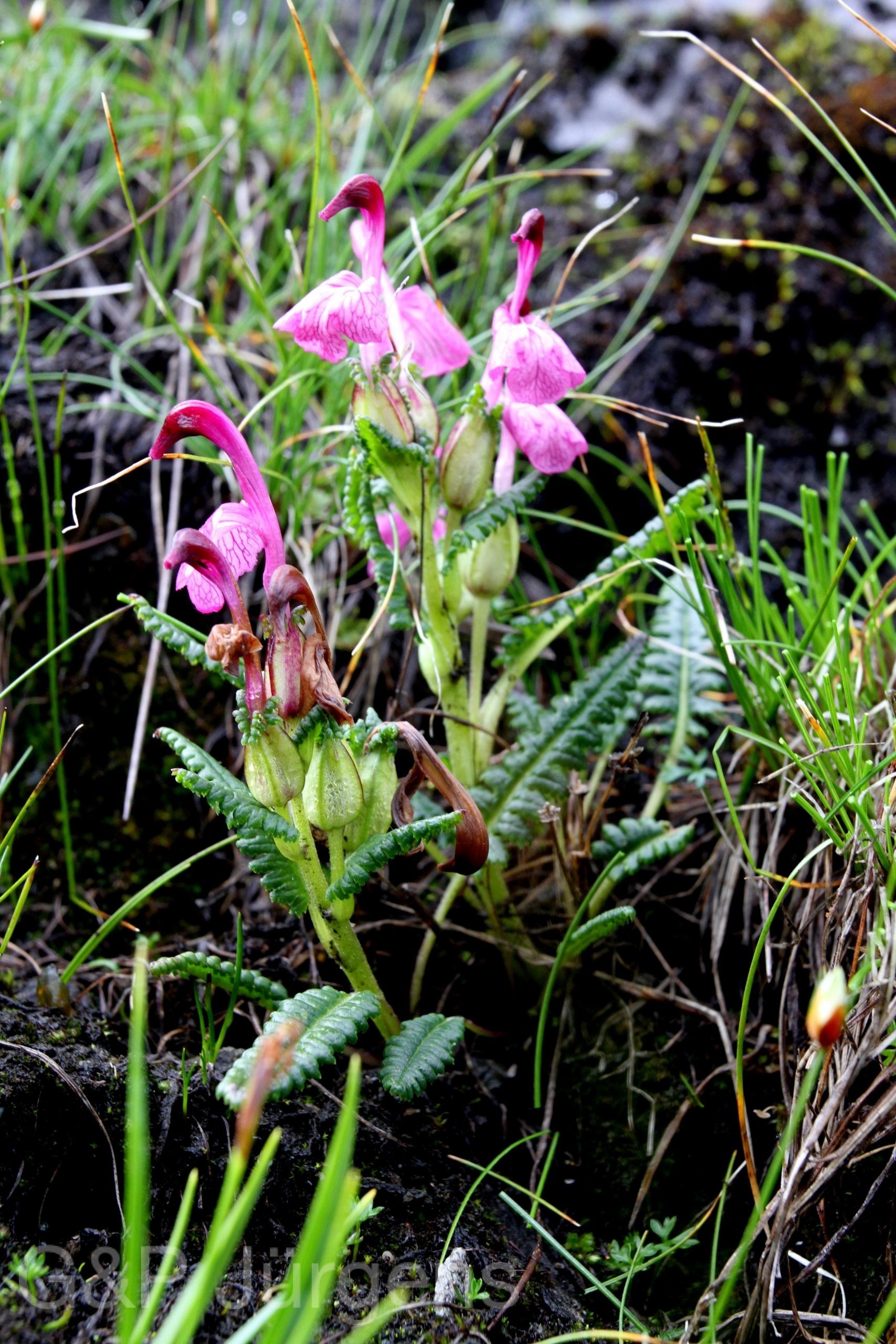
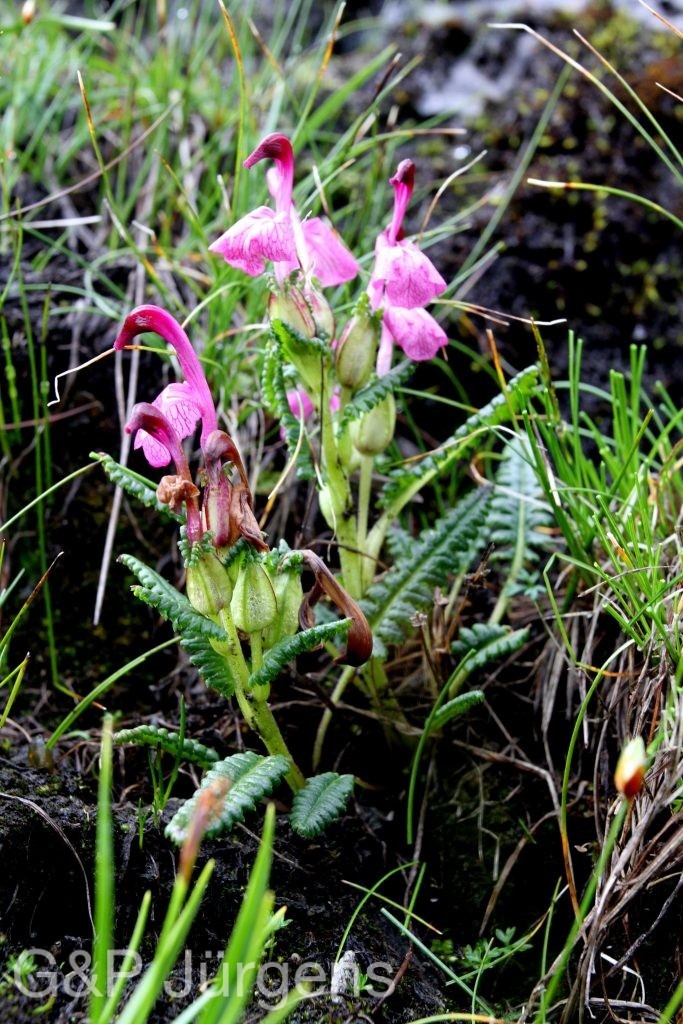
Pedicularis microcalyx is a hemiparasitic alpine lousewort of the central and eastern Himalaya. GBIF records it from India, Nepal, Bhutan and China, with around 50 occurrences, reflecting a comparatively narrow Himalayan distribution. It occupies wet alpine meadows, marshy turf, lake margins and seepage slopes at high elevation, generally between 3800 and 4800 m. The individual illustrated was found along the historic Ludlow-Sherriff trail near Thitha-Tso in Bhutan at 4350 m in July, blooming amid the saturated alpine sward during the monsoon, the season when these moisture-loving species flower.
Like other louseworts it is a root-hemiparasite drawing water and nutrients from neighbouring graminoids and herbs via haustorial connections. It is a low perennial with pinnatisect, fern-like leaves whose segments are toothed. The flowers are borne in a leafy spike or terminal cluster; as the epithet microcalyx indicates, the calyx is small. The bilabiate corolla is pink to purplish, the galea (upper lip, hood) often beaked or curved over the lower three-lobed lip, an arrangement adapted to pollination by long-tongued bumblebees. The fruit is an asymmetrical, beaked capsule splitting to release the seeds.
Pedicularis is one of the largest Himalayan genera, with extraordinary diversification of corolla form linked to bumblebee pollinator specialisation, the region being a global centre of richness. Its hemiparasitic habit lets it draw on community resources while contributing little. With a restricted high-altitude range and dependence on intact wet alpine habitats, P. microcalyx is potentially vulnerable to grazing and climate-driven drying, though not formally assessed.
Author: Hook.f. · Sources: POWO (Kew), GBIF, Flora of China, Flora of Bhutan, Annotated Checklist of the Flowering Plants of Nepal, A revision of the Himalayan species of Pedicularis