Author

GP Jürgens

(Franch.) E.Pritz.

Bh2008 298 P457
Bhutan Ura, 3400m April

Description

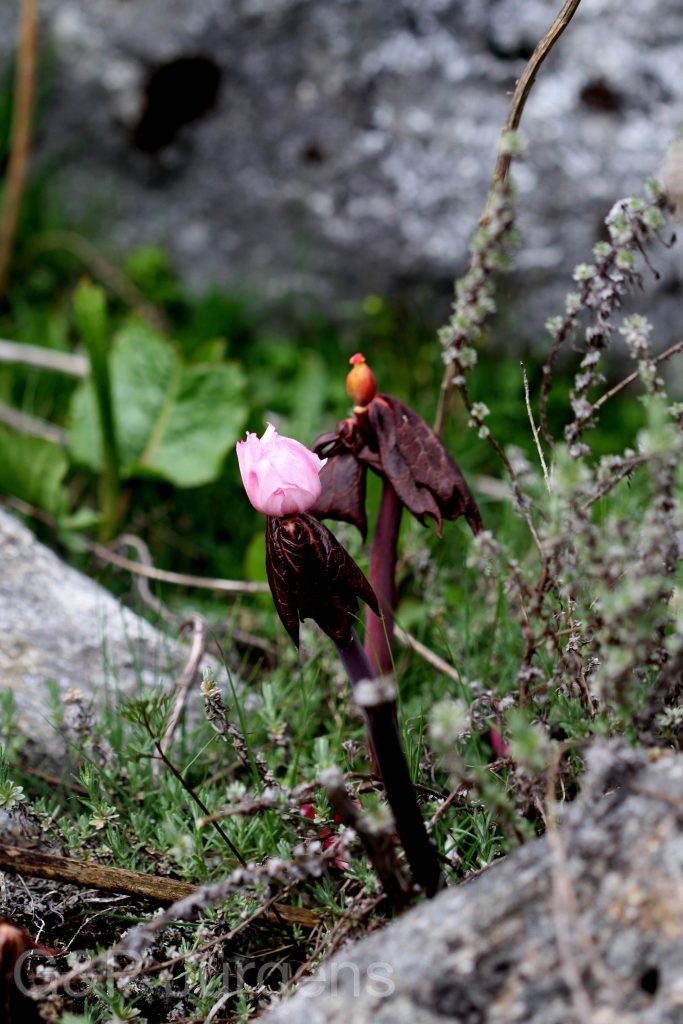
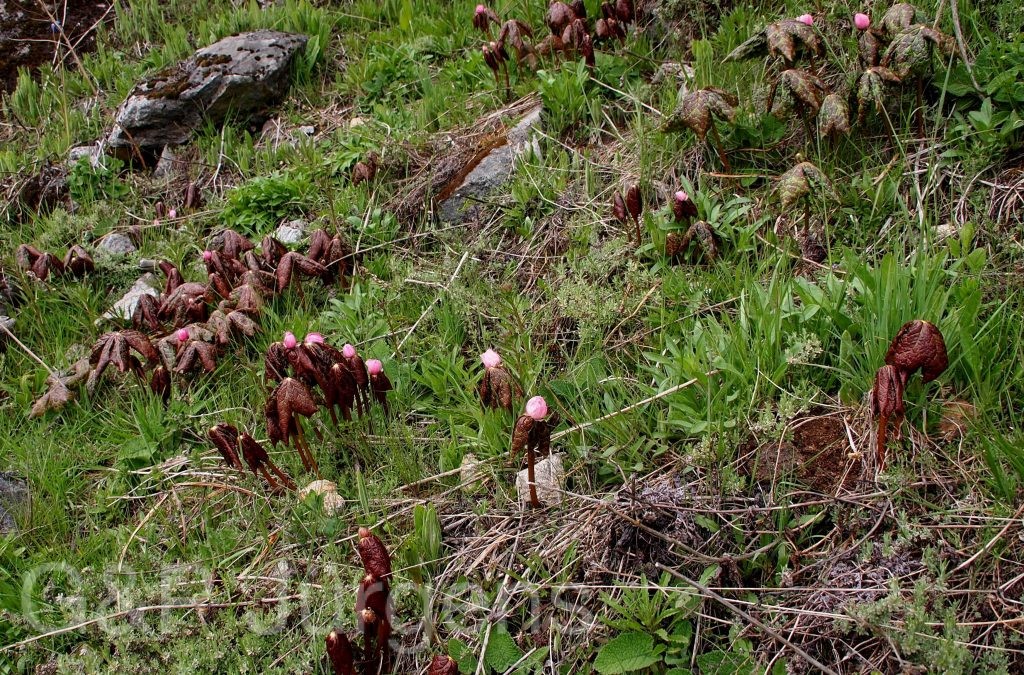
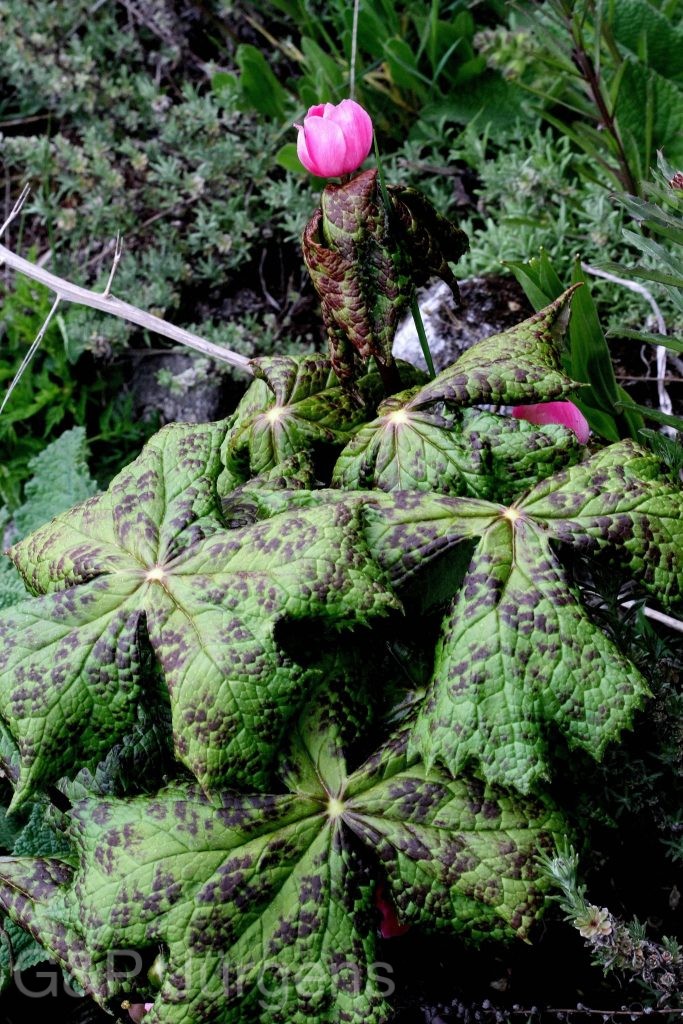
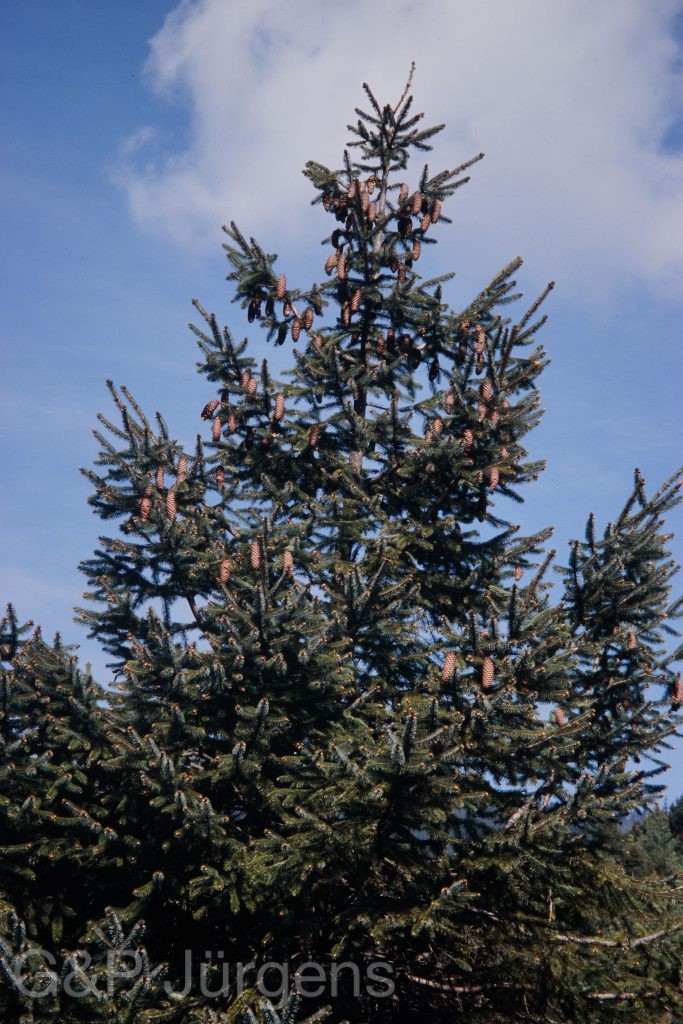
Picea brachytyla, the Sargent spruce, is a montane to subalpine conifer of the eastern Himalaya and southwest to central China, with GBIF documenting some 1,700 occurrences concentrated in China and Bhutan alongside many cultivated records in Europe, North America and elsewhere reflecting its value as an ornamental and forestry tree. In its native range it forms part of the cool-temperate conifer forests between roughly 2600 and 3800 m, often in mixed stands with fir, hemlock, larch and rhododendron on humid, well-drained mountain slopes fed by the summer monsoon. The photographed tree from Ura in central Bhutan at 3400 m, in April, sits within this upper-montane belt, where the species occupies sheltered valleys and north-facing slopes that retain moisture and snow into spring.

It is an evergreen tree to 20-30 m or more, with a conical to columnar crown and grey-brown, scaly bark, the branchlets pale and often slightly pubescent in the grooves between the pulvini. The needles are linear and flattened in cross-section rather than quadrangular, distinctly two-ranked or pectinate, dark green above and conspicuously marked beneath with two whitish stomatal bands that give the foliage a silvery cast. The pendulous seed cones are cylindrical-oblong, green ripening to brown, with thin, rounded to obtuse, entire-margined scales; the small winged seeds are wind-dispersed.

Picea brachytyla belongs to the flat-needled group of spruces (subgenus Casicta) and is morphologically close to P. spinulosa of the same region, from which it is separated by needle and cone characters; several varieties have been recognised across its longitudinal range, notably the western var. complanata. The species is assessed by the IUCN as Vulnerable, its populations reduced by logging and forest clearance across China, while the Himalayan stands in Bhutan and adjacent areas remain comparatively intact within protected high-mountain forest.

Author: (Franch.) E.Pritz. · Sources: POWO (Kew), GBIF, Flora of China Vol. 4, Flora of Bhutan Vol. 1, Farjon's A Handbook of the World's Conifers
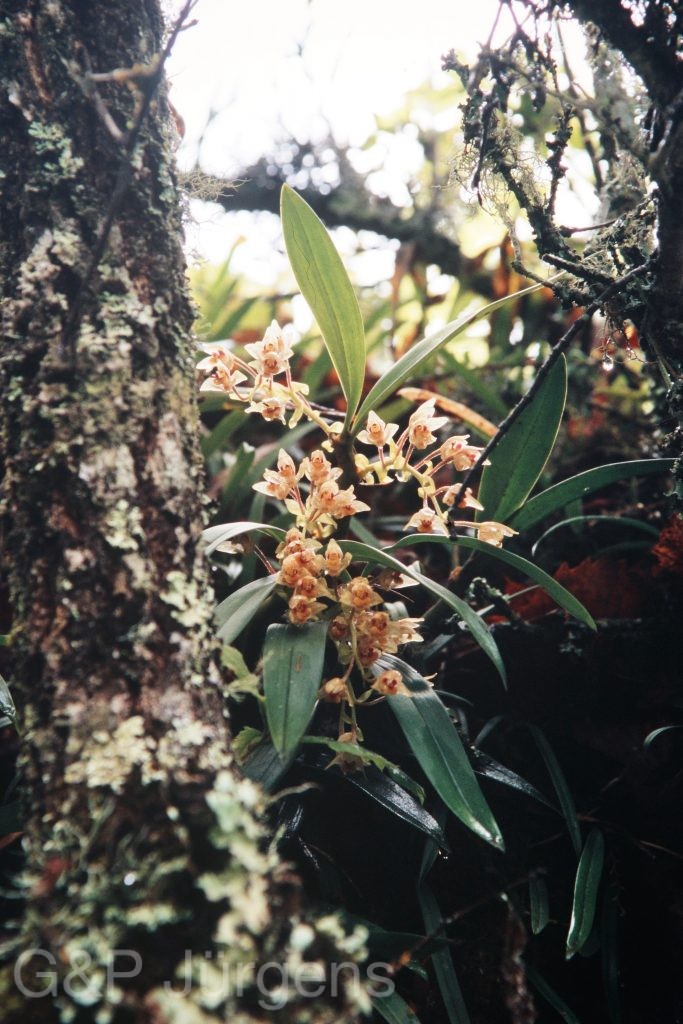
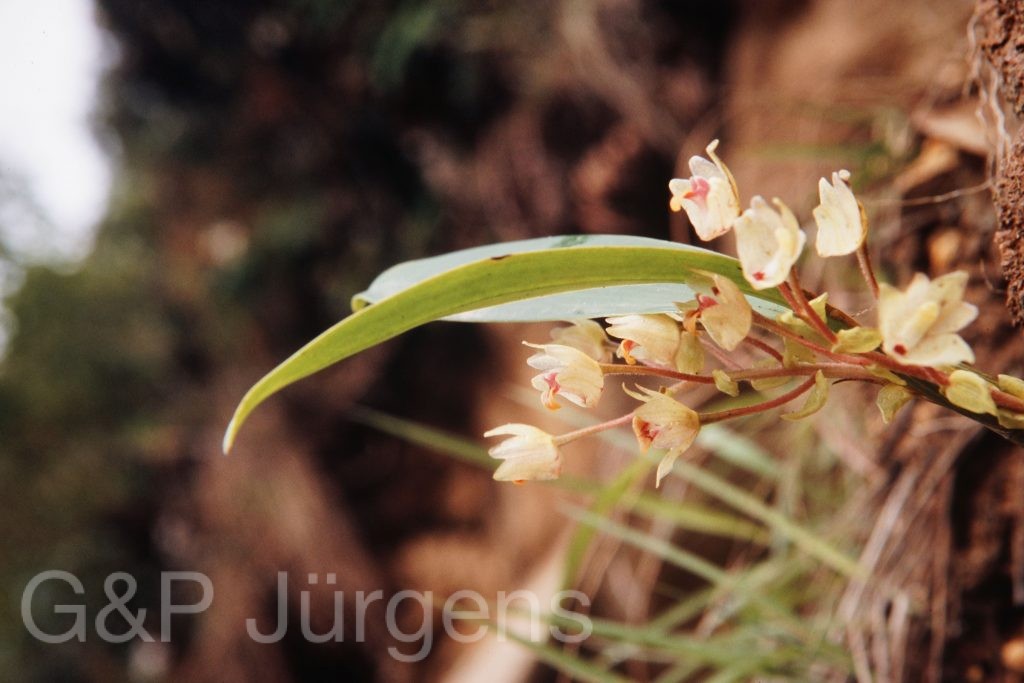
(Lindl.) Kuntze

Bhutan2012 1144
Bhutan, Trashiyangtse 1780m, October
Bhutan2012 1143
Bhutan, Trashiyangtse 1780m, October

Description

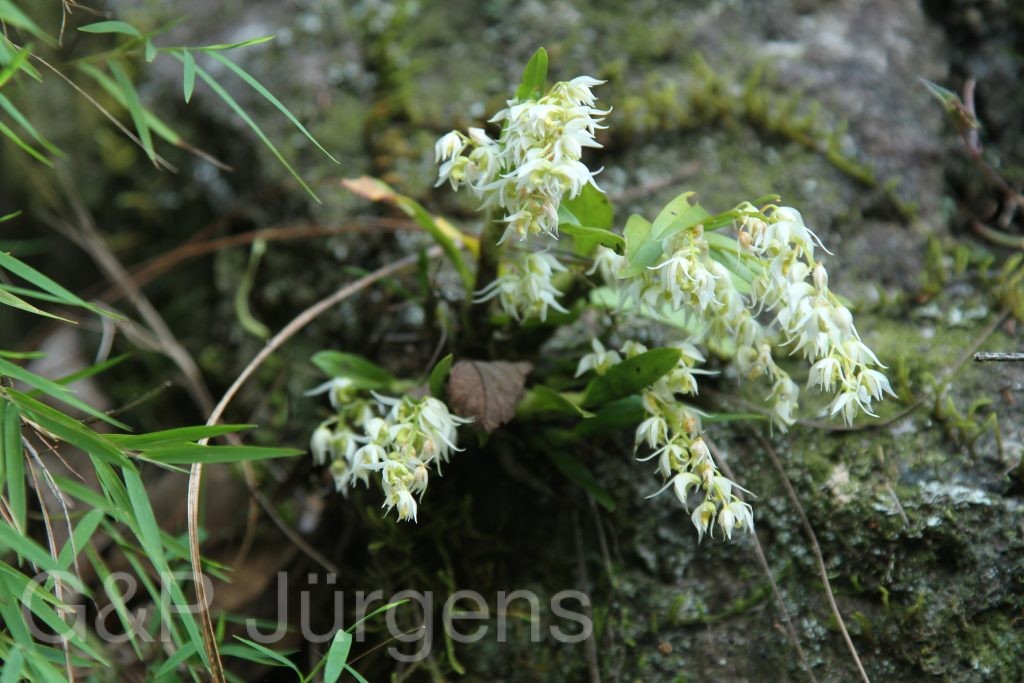
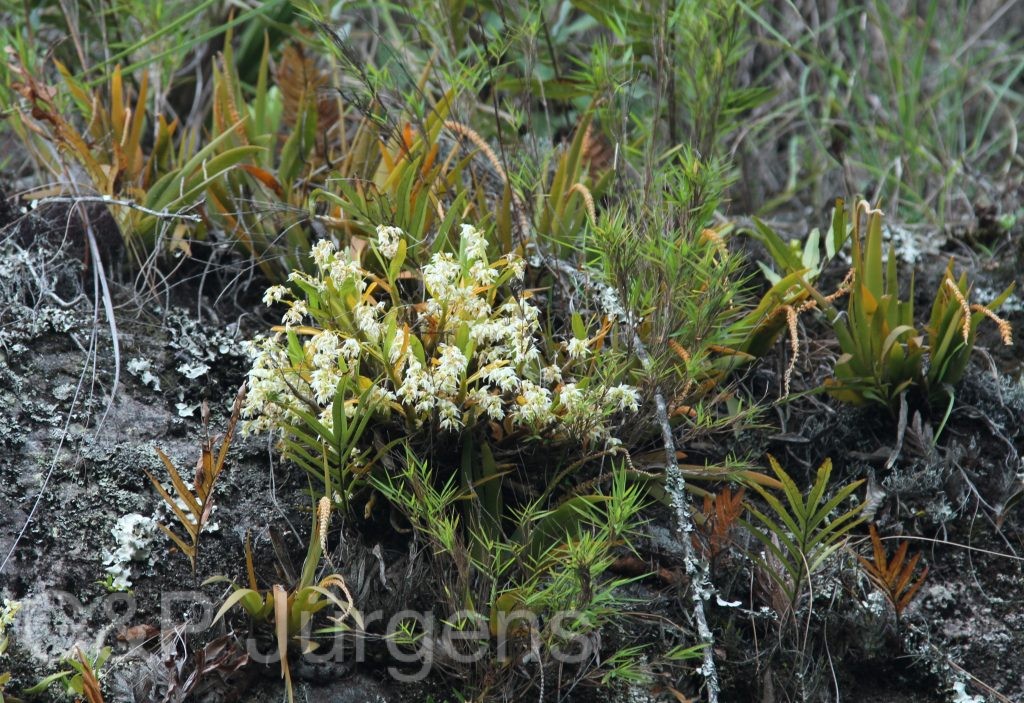
Pinalia acervata is an epiphytic orchid of the warm-temperate and subtropical forests of tropical Asia, ranging widely from China and India through Myanmar, Thailand, Vietnam, Cambodia, Malaysia and Singapore to Bhutan and Nepal, with 114 GBIF records reflecting this broad Indo-Burmese and Sino-Himalayan span. It grows as a humidity-loving epiphyte on mossy trunks and branches in evergreen broadleaved forest, generally at low to moderate elevations. The illustrated plant was found at Trashiyangtse in eastern Bhutan at about 1780 m in October, in the warm, monsoon-fed valleys where epiphytic orchid communities are particularly rich.

The species forms clustered, cylindrical to fusiform pseudobulbs that are densely tufted, each bearing several distichous, lanceolate to oblong leaves toward the apex. The inflorescences are lateral racemes, frequently densely many-flowered and clothed, like the ovaries and outer floral parts, in the rusty or whitish woolly indumentum characteristic of the segregate genus. The small flowers are whitish to pale yellow, with a saccate mentum formed by the lateral sepals against the column foot, and a small three-lobed lip; the fruit is a small ribbed capsule.

The taxon was long placed in the large pantropical genus Eria, as Eria acervata, and the basionym (Lindl.) Kuntze reflects this history; modern phylogenetic work has resolved many former Eria species into smaller, better-circumscribed genera, with this species now treated under Pinalia in tribe Podochileae. As a widespread, adaptable epiphyte it is not considered threatened, though local populations depend on the persistence of humid forest canopy and are diminished by deforestation.

Author: (Lindl.) Kuntze · Sources: POWO (Kew), GBIF, Flora of China, Flora of Bhutan, Genera Orchidacearum (Pridgeon et al.)

(Rchb.f.) Kuntze

Bh2008 320 P495
Bhutan Jakar, 2950m April
Bh2008 321 G496
Bhutan Jakar, 2950m April

Description

Pinalia amica (Rchb.f.) Kuntze, long known under Eria amica, is an epiphytic orchid widely distributed through tropical and subtropical Asia. GBIF records (about 203 occurrences) extend from Nepal, northern India and Bhutan eastward through Myanmar, southern China, Taiwan, Thailand, Laos, Cambodia, Vietnam and Malaysia. It grows as an epiphyte, occasionally a lithophyte, on mossy trunks and branches in humid broad-leaved and mixed forest, from the foothills up to about 2000-3000 m. The plant photographed at Jakar in Bhutan at 2950 m in April, flowering in spring, occurs near the upper part of its altitudinal range in cool, moist montane forest where high humidity and shaded, well-aerated bark provide its rooting substrate.

It is a sympodial epiphyte with cylindric to fusiform pseudobulbs or stems clustered on a creeping rhizome, each bearing a few apical leaves. The leaves are oblong-lanceolate, leathery and several-nerved. The inflorescence is a lateral raceme of several to many flowers, the rachis and ovaries usually finely hairy. The flowers are small, cream to pale yellow, often marked with reddish-brown striations; the sepals form a short mentum at the base with the column foot, and the lip is three-lobed and bears longitudinal keels or calli. The pollinarium carries eight waxy pollinia, and the fruit is a ribbed dehiscent capsule releasing dust-like seeds.

The broadly circumscribed genus Eria has been dismembered on molecular evidence, and species of the Eria amica group are now placed in Pinalia within tribe Podochileae; Pinalia amica is the currently accepted name. Like most epiphytic orchids it depends on mycorrhizal fungi for seed germination and produces enormous numbers of minute wind-dispersed seeds. Widespread across Asia, it is not regarded as threatened overall, though, as with all orchids, it is listed on CITES Appendix II, and local populations are sensitive to deforestation and collection.

Author: (Rchb.f.) Kuntze · Sources: POWO (Kew), GBIF, Flora of China, The Orchids of Bhutan, Annotated Checklist of the Flowering Plants of Nepal, Ng et al. molecular phylogeny of Eria and allied genera

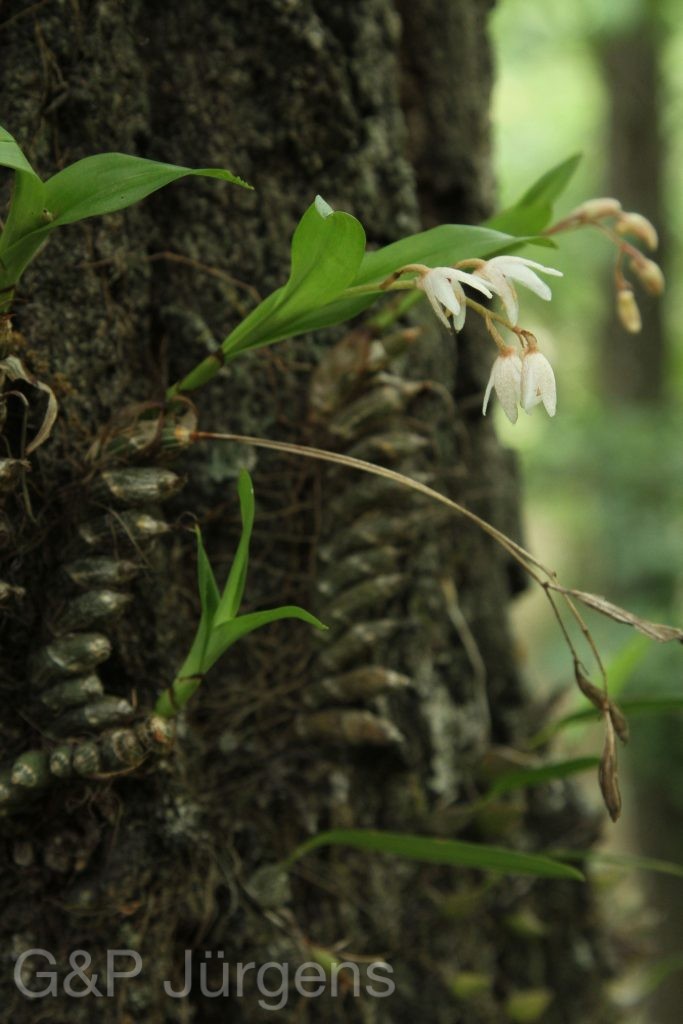
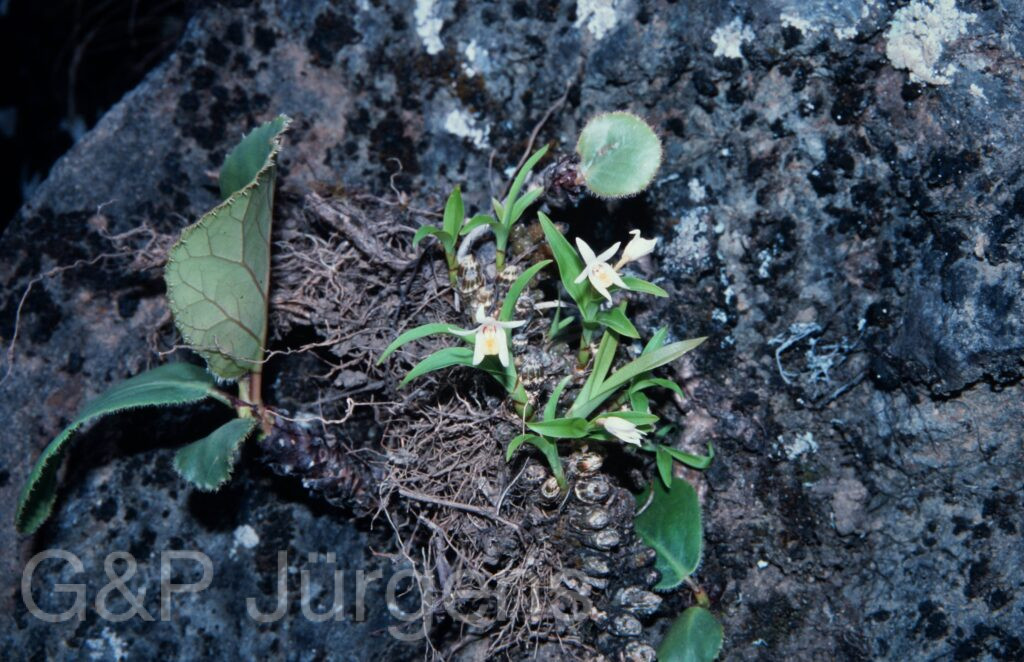
(Lindl.) Kuntze

Bhutan2014 177
Bhutan Trashigang 2100m, May

Description

Pinalia excavata is an epiphytic orchid of the Eastern Himalaya and adjacent southern China and Indochina, with GBIF records from China, India, Nepal, Bhutan and Myanmar and a modest tally of documented occurrences. It grows as an epiphyte on tree trunks and mossy branches in humid broad-leaved and evergreen montane forest, favouring shaded, well-ventilated situations in the warm-temperate to lower montane belt. The species occupies low to middle elevations; the photographed plant from Trashigang in eastern Bhutan at about 2100 m in May represents a typical station within its altitudinal range, flowering in late spring as the pre-monsoon humidity rises.

The plant produces clustered, fusiform to cylindrical pseudobulbs arising from a creeping rhizome, each bearing several apical leaves. The leaves are lanceolate to elliptic, thin-textured to somewhat leathery and prominently veined. The inflorescence is a lateral or subterminal raceme bearing numerous small flowers, the rachis and ovaries usually clothed in fine hairs as is characteristic of the genus. The flowers are pale, whitish to cream or yellowish, with spreading sepals and petals; the lateral sepals are adnate to the column foot to form a short mentum, and the trilobed labellum bears raised keels or ridges along its disc. The column is short and footed, and the fruit is a small ribbed capsule.

Pinalia comprises species formerly placed in the broadly circumscribed Eria, segregated on the basis of molecular and morphological evidence; P. excavata was originally described under Eria and is treated by current authorities under Pinalia. As a forest epiphyte dependent on intact humid canopy, it is vulnerable to deforestation and habitat degradation across its range, although it is not presently the subject of a formal threat assessment.

Author: (Lindl.) Kuntze · Sources: POWO (Kew), GBIF, Flora of China, Flora of Bhutan, The Orchids of Bhutan (Pearce & Cribb)

Kuntze

Nepal 2001 462 ergebnis ergebnis
Nepal (Gorkha) Gunda 1700m, May

Description

Pinalia leucantha is an epiphytic orchid of the central and eastern Himalaya, recorded from northern India, Nepal, Bhutan and adjacent southern China, with georeferenced collections (c. 59 in GBIF) along the moist subtropical to lower temperate belt of the range. It typically grows on mossy trunks and major branches of broad-leaved forest trees, occasionally on shaded rocks, between roughly 1000 and 2000 m. The photographed plant from Gorkha district, Gunda (1700 m, flowering in May), is characteristic of this monsoon-influenced habitat, where high humidity and a marked dry winter govern the growth cycle.

The species is a tufted, sympodial epiphyte forming clustered, fusiform to cylindrical pseudobulbs that are several-noded and clothed when young in papery sheaths. Each pseudobulb bears a few apical, oblong-lanceolate to elliptic, coriaceous leaves with acute tips. The inflorescence is a lateral to subterminal raceme carrying numerous small, whitish to cream flowers, the floral parts frequently invested with fine ferruginous hairs typical of the genus. Sepals and petals are spreading, the lateral sepals adnate to the column foot to form a short mentum; the lip is three-lobed with a fleshy, often keeled disc, and the pollinia are eight, waxy and clavate.

The genus Pinalia comprises species formerly placed in a broadly circumscribed Eria, segregated within tribe Podochileae (subtribe Eriinae) on vegetative and column characters supported by molecular data, and many Himalayan epiphytes have been recombined into it. As a widespread forest epiphyte, P. leucantha is not currently regarded as threatened, though like most epiphytic orchids it is sensitive to deforestation and collection; CITES Appendix II listing applies to all Orchidaceae in trade.

Author: Kuntze · Sources: POWO (Kew), GBIF, Flora of Nepal, Flora of Bhutan, Flora of China (Orchidaceae), The Orchids of Bhutan

(Hook.f.) Soó

Sikkim2003 96 P133
Sikkim above Chora 3600m 08.2003
Sikkim2003 97 P134
Sikkim above Chora 3600m 08.2003

Description

Platanthera leptocaulon is a terrestrial orchid of the eastern Himalaya and adjacent mountains of south-western China, recorded from Sikkim and the rest of northern India, Nepal, Bhutan, Myanmar and Yunnan and Sichuan in China. The roughly 67 georeferenced collections concentrate in the high subalpine to alpine belt, where the species occupies moist open turf, the margins of dwarf-shrub thickets and grassy hollows kept damp by snowmelt. The plant photographed above Chora in Sikkim at 3600 m in August typifies its habitat, flowering during the late-summer monsoon at elevations of roughly 3000-4200 m on humus-rich, well-drained slopes.

It is a slender, glabrous herb arising from ovoid to fusiform root-tubers, the erect stem comparatively thin and wiry (the epithet leptocaulon meaning "slender-stemmed"). The few cauline leaves are oblong-lanceolate to linear, sheathing at the base and grading upwards into bracts. The lax terminal raceme bears small greenish to greenish-white flowers; the dorsal sepal and petals are connivent to form a hood over the column, the lateral sepals spreading, and the entire, narrowly oblong labellum extends backwards into a slender cylindrical spur. The viscidia are naked and the pollinia are attached by slender caudicles, with fruit a small erect dehiscent capsule releasing dust-like seed.

The genus Platanthera is a large Holarctic and Asian assemblage centred on temperate and montane regions, and P. leptocaulon belongs to the species-rich Sino-Himalayan radiation, the basionym having been transferred by Soo from Habenaria. Like most members of the genus it depends on mycorrhizal fungi for germination and probably on long-tongued nocturnal pollinators attracted to the spurred flowers. Though not formally assessed, its broad transboundary range and tolerance of grazed alpine pasture suggest reasonable security, but populations remain vulnerable to overgrazing and the warming-driven upslope contraction of alpine grassland.

Author: (Hook.f.) Soó · Sources: POWO (Kew), GBIF, Flora of China, Flora of Bhutan, The Genus Platanthera (Orchidaceae) monograph

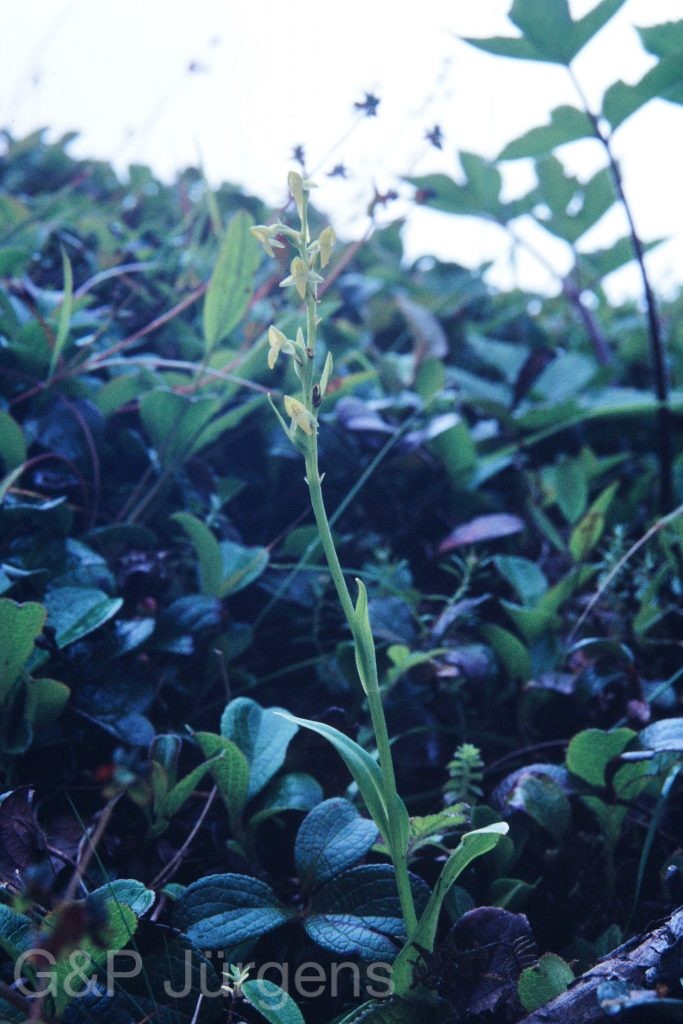
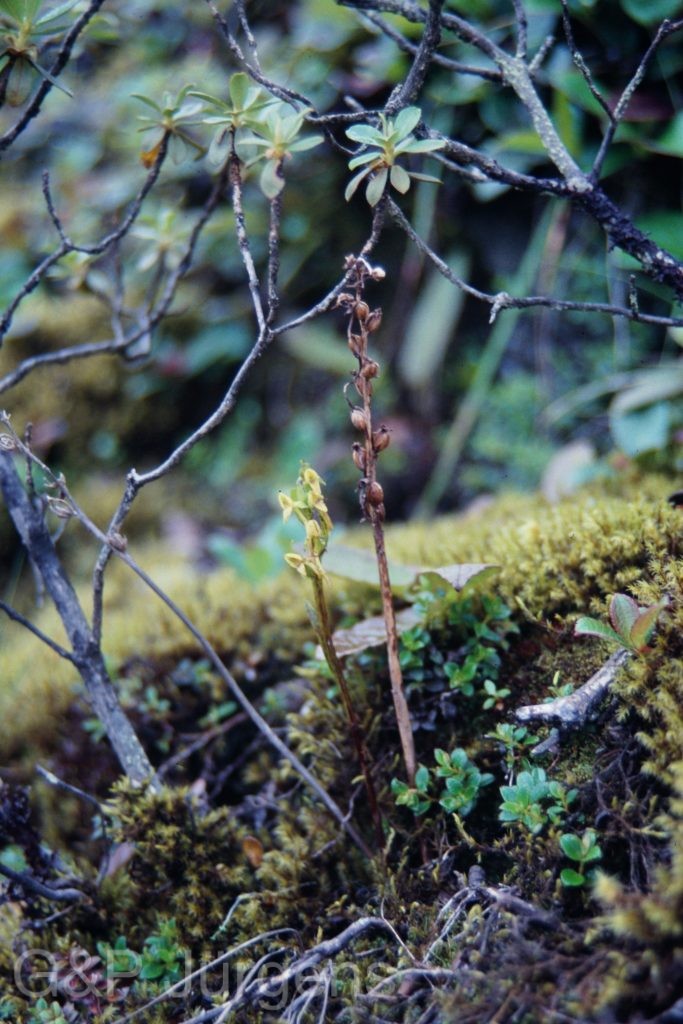
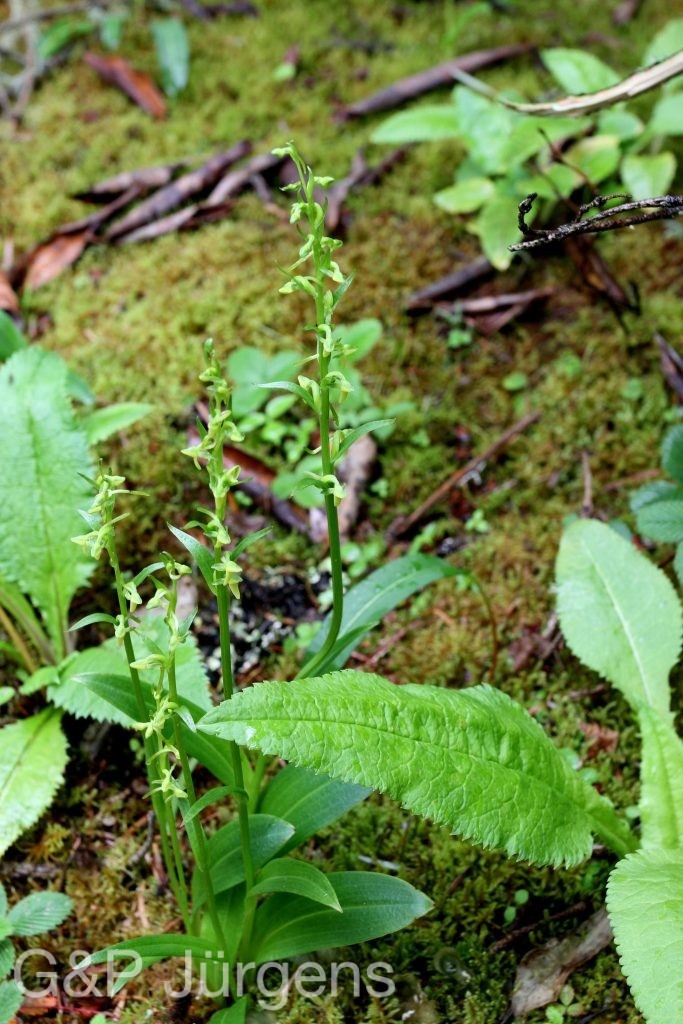
(Hook.f.) Soó

BhutanPG2011 818 01 01
Bhutan Chele-La 3500m, July

Description

Platanthera stenantha (Hook.f.) Soó is a terrestrial orchid of the Himalaya and western China, recorded by GBIF from China, Nepal, India, Myanmar and Bhutan across some 138 occurrences. It inhabits open subalpine and alpine slopes, grassy meadows, and the edges of Rhododendron and birch scrub, typically between about 3000 and 4000 m. The plant photographed on the Chele-La pass in Bhutan at around 3500 m in July, at the height of the monsoon flowering season, exemplifies its association with cool, moist, well-lit high-montane grassland.

The species grows from elongate, fleshy root-tubers and produces an erect leafy stem bearing several oblong to lanceolate cauline leaves that grade upwards into bracts. The inflorescence is a slender, fairly dense terminal raceme of small greenish to yellowish-green flowers, the specific epithet stenantha referring to their narrow form. The dorsal sepal and petals form a loose hood over the column, the lateral sepals spread, and the narrow, tongue-shaped labellum hangs downward and is prolonged at its base into a slender spur, usually about equalling or exceeding the ovary, that holds nectar for moth or butterfly pollinators.

Platanthera is a large genus of tribe Orchideae characterised by its spurred labellum and widely separated, often divergent pollinia-bearing anther cells. Platanthera stenantha belongs among the green-flowered Sino-Himalayan species and is distinguished from its relatives by floral proportions and spur length. With a moderately wide distribution it is not regarded as globally threatened, but its high-grassland habitat is subject to grazing and climatic pressures, and like all orchids it falls under CITES Appendix II.

Author: (Hook.f.) Soó · Sources: POWO (Kew), GBIF, Flora of Bhutan, Flora of China, Pearce and Cribb Orchids of Bhutan, World Checklist of Orchidaceae

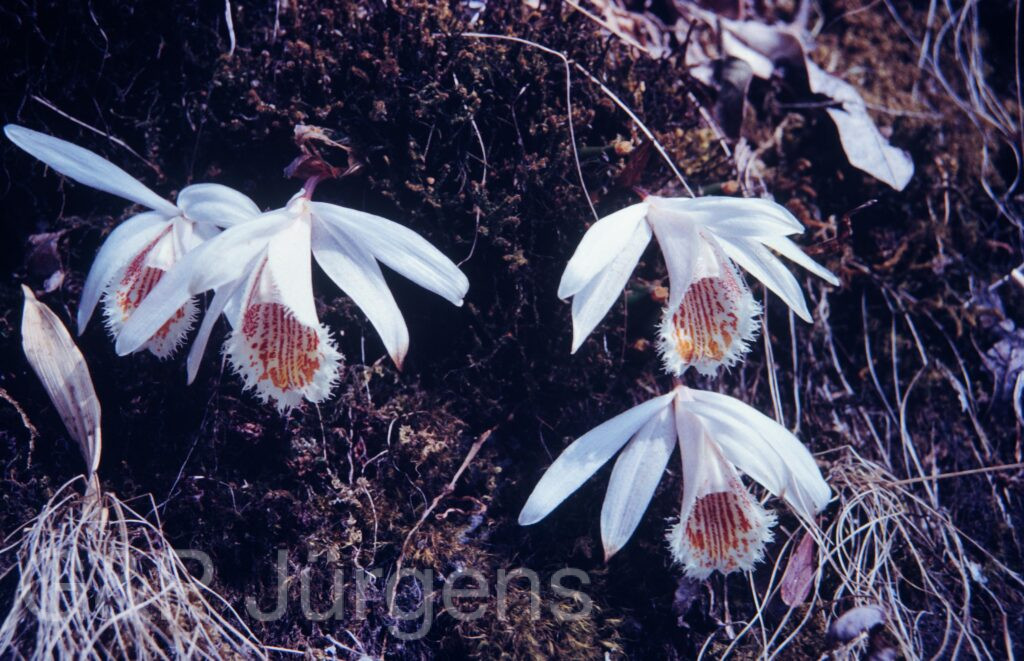
(Sm.) D.Don

Nepal1992 42 P60 ergebnis
Nepal Nundhaki 1500m March 
Nepal1992 56 P81 ergebnis
Nepal Nundhaki 1500m March 
Nepal1992 242 P359 ergebnis
Nepal Nundhaki 1500m March 

Description

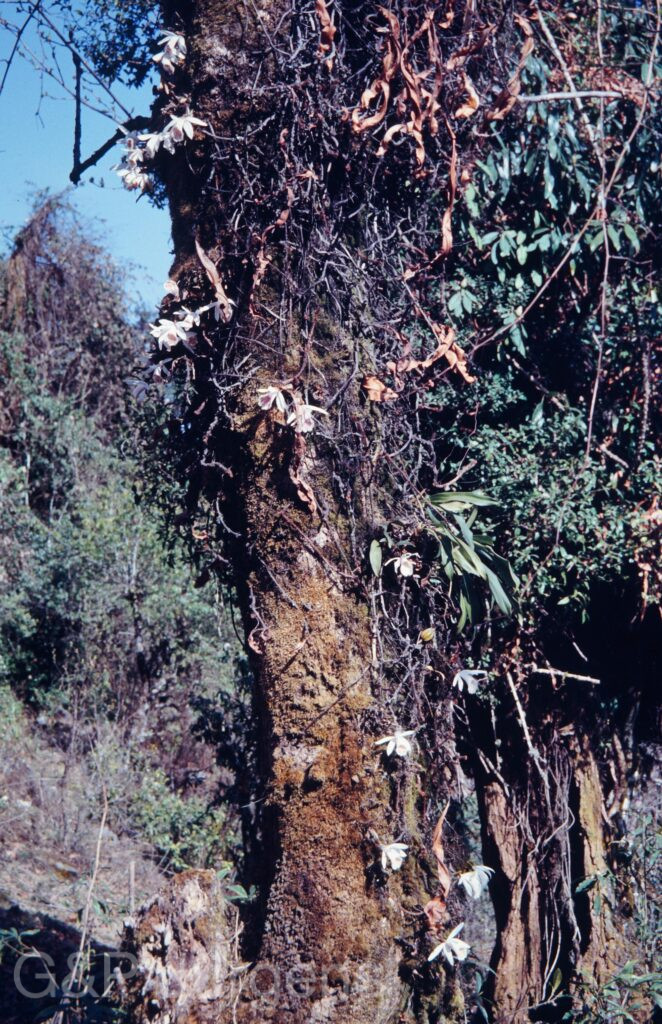
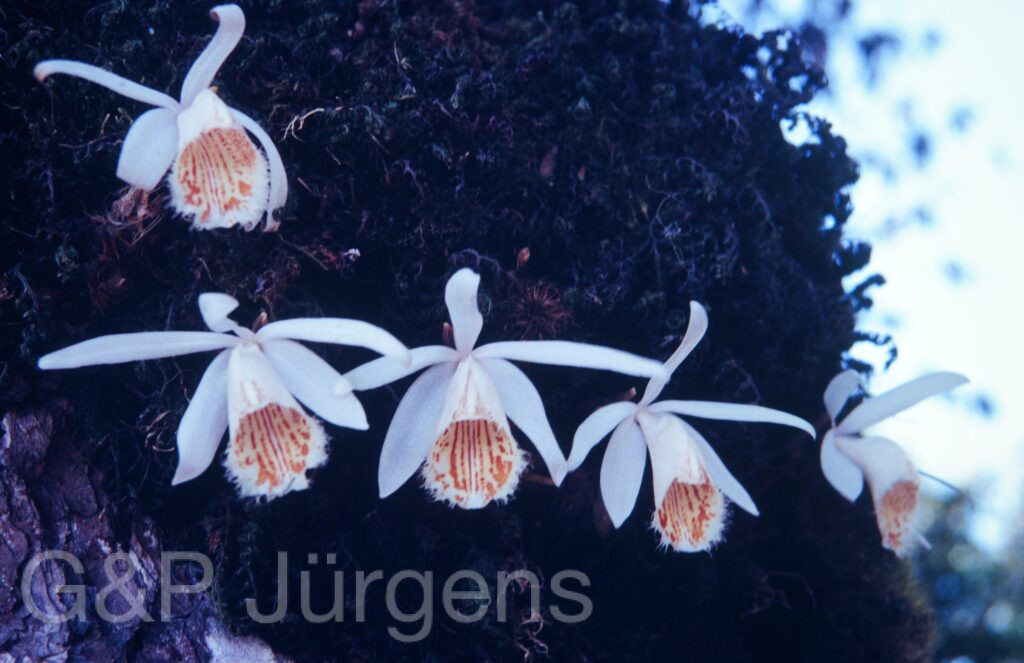
Pleione humilis is a dwarf orchid of the Himalaya and adjoining mountains, native to Nepal, India, Bhutan, Myanmar and Thailand, with around 136 georeferenced occurrences across this eastern arc. It grows chiefly as an epiphyte on mossy tree trunks and branches, and occasionally as a lithophyte on shaded, humus-covered rocks, in cool, humid temperate forest. The illustrated plant from Nundhaki in Nepal, at about 1500 m and flowering in March, exemplifies the species' habit of blooming in late winter to early spring, characteristically before or as the new leaves expand at relatively low montane elevations.

The plant grows from small, flask- to top-shaped, often warty pseudobulbs, each producing a single (occasionally paired) plicate, deciduous leaf. The flowers, usually borne singly on a short scape from the base of the pseudobulb, are large for the plant's size and showy, with spreading, narrow, white to pale pink sepals and petals. The conspicuous trumpet-shaped labellum is broadly funnel-form and frilled at the margin, white marked within by yellow to brown and red blotches and bearing several toothed or fringed keels (lamellae) along the disc. The slender, winged column lies enclosed within the lip, and the fruit is a ribbed dehiscent capsule shedding dust-like seeds.

Pleione is a small genus of about two dozen Sino-Himalayan and Southeast Asian orchids, much admired and cultivated, of which P. humilis is one of the winter-flowering, single-leaved species. As with all orchids it is protected under CITES Appendix II, and wild populations are threatened by collection for horticulture and by clearance of the moist forest on which the epiphytic plants depend; conservation therefore hinges on protecting both the species and its montane forest habitat.

Author: (Sm.) D.Don · Sources: POWO (Kew), GBIF, Flora of Bhutan (Orchidaceae), Flora of China (Orchidaceae), Cribb & Butterfield: The Genus Pleione (monograph)

Plumeria rubra

by GP Jürgens

L.

Nepal 97 575 P1112
Nepal Sabha-Khola 550m May
Nepal 1994 36 ergebnis
Ost-Nepal Simbhuwa Kola 
1000m April

Description

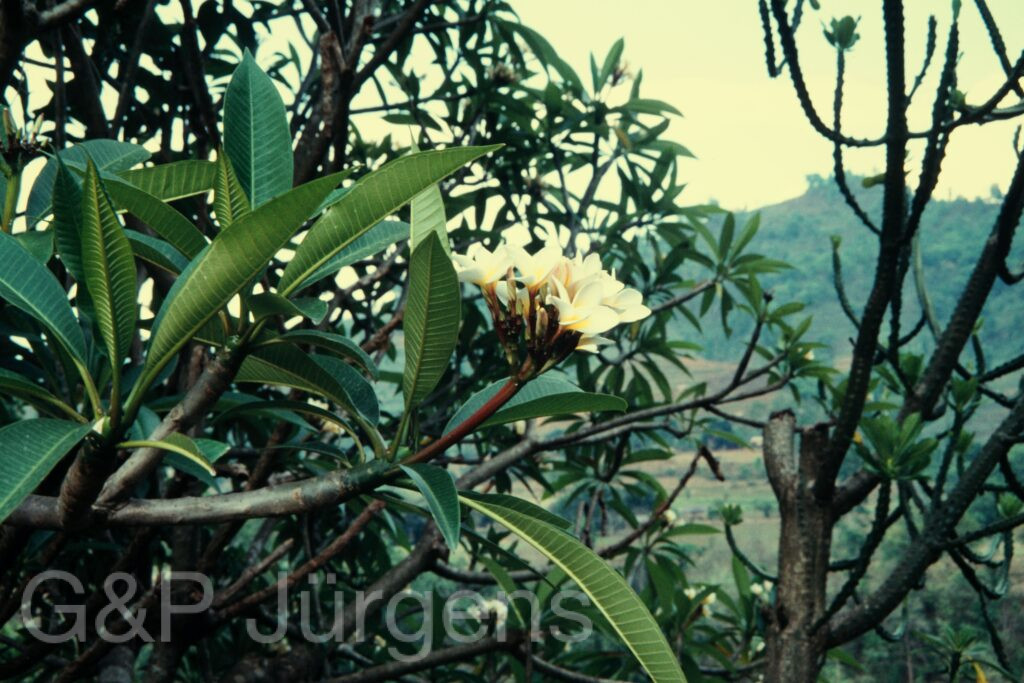
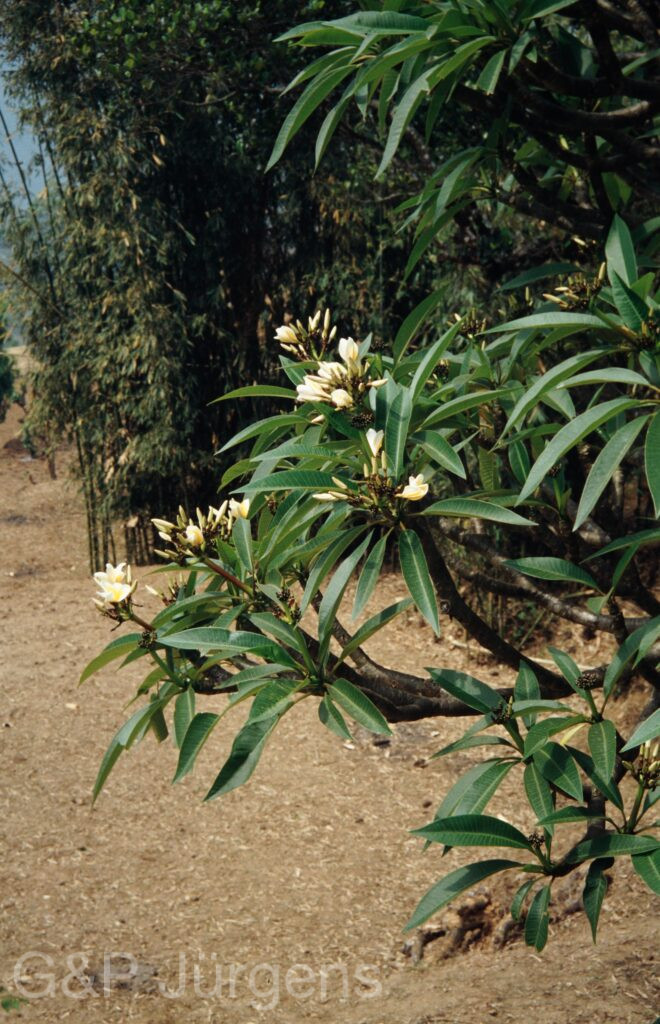
Plumeria rubra, the red frangipani, is a small tree native to Mexico and Central America but now pantropical through cultivation, a spread vividly reflected in its GBIF record of over 11,600 occurrences spanning Mexico, Guatemala, Costa Rica, Panama, Brazil, Colombia, Ecuador, Peru, the United States, India, South Africa, Indonesia, China, French Polynesia and many more. In the Himalayan foothills it is an introduced ornamental and temple tree rather than a wild element; the images from the Sabha-Khola valley (550 m, May) and the Simbhuwa Kola in eastern Nepal (1000 m, April) document it in the warm, frost-free lowland and lower hill zone where it is widely planted around dwellings, gardens and shrines. It tolerates seasonal drought, thriving in open, sunny, well-drained sites and flowering through the warm pre-monsoon and monsoon months.

It is a deciduous tree to about 5-8 m with a spreading crown of stout, blunt, sparingly branched stems exuding copious milky latex when cut. The large, alternate leaves are clustered toward the branch tips, oblong to elliptic-lanceolate, leathery, with prominent pinnate lateral veins joined by a marginal collecting vein. The strongly fragrant flowers are borne in terminal cymes; each has a salverform corolla with five overlapping, asymmetric lobes, typically white to yellow with a yellow eye in many forms but ranging to pink and deep red in the species and its cultivars. The fruit is a pair of divergent, cylindrical follicles releasing numerous winged seeds.

Plumeria belongs to the Apocynaceae subfamily Rauvolfioideae and comprises several New World species, of which P. rubra is the most variable and most widely grown, hybridising freely in cultivation. Its latex contains the iridoid glycoside plumieride and related compounds, and the plant carries deep cultural significance across South and Southeast Asia for use in offerings and garlands. Though of conservation concern nowhere because of its vast cultivated range, in the Himalaya it persists entirely as a human-introduced ornamental and has not naturalised into native forest.

Author: L. · Sources: POWO (Kew), GBIF, Flora of China Vol. 16, Flora of Nepal, Woodson's revision of Plumeria (Apocynaceae of the New World)

Royle

Sikkim2011 57
Sikkim Tanghu 3900m, June
Sikkim2011 70
Sikkim Tanghu 3900m, June
Sikkim2011 72
Sikkim Tanghu 3900m, June

Description

Podophyllum hexandrum, the Himalayan mayapple, is a perennial herb of the high temperate and subalpine Himalaya, occurring through China, India, Pakistan, Nepal, Bhutan and Afghanistan, with around 860 occurrences in GBIF. It grows in moist alpine meadows, open fir and birch forest, shaded scrub and along the margins of melting snowfields, typically between about 2500 and 4500 m. The plant photographed at Tanghu in northern Sikkim at 3900 m in June, emerging and flowering as the snow recedes, is characteristic of its high-elevation niche, where the rich, moist humus of the upper forest and meadow ecotone supports dense local stands.

The species arises from a stout, creeping, knotty rhizome and produces a single erect aerial stem 15–50 cm tall bearing usually two large, long-petiolate leaves that are deeply palmately three- to five-lobed, the lobes themselves further cut and toothed, often bronze-mottled when young. A solitary, nodding to erect flower is borne at the fork of the leaves; it is cup-shaped with white to pale pink petals and (as the epithet indicates) commonly six stamens. The fruit is a large, fleshy, ovoid berry ripening to bright red and containing numerous seeds embedded in pulp.

GBIF flags the name as a synonym, the species being widely treated under the accepted name Podophyllum hexandrum, with the genus Sinopodophyllum (S. hexandrum) recognised by some authors to accommodate the Asian taxon apart from the North American Podophyllum peltatum; the source page links to that segregate name. The plant is the principal natural source of podophyllotoxin, a lignan of major pharmaceutical importance as a precursor of anticancer agents. Heavy harvesting of the rhizomes for this trade, together with habitat disturbance, has caused marked local declines, and the species is regarded as threatened and is subject to conservation and CITES-related concern across much of its range.

Author: Royle · Sources: POWO (Kew), GBIF, Flora of China Vol. 19, Flora of Bhutan Vol. 1, Flora of Pakistan, Medicinal Plants of the Himalaya: A Monograph of Podophyllum