
(Lindl.) Kuntze
Description
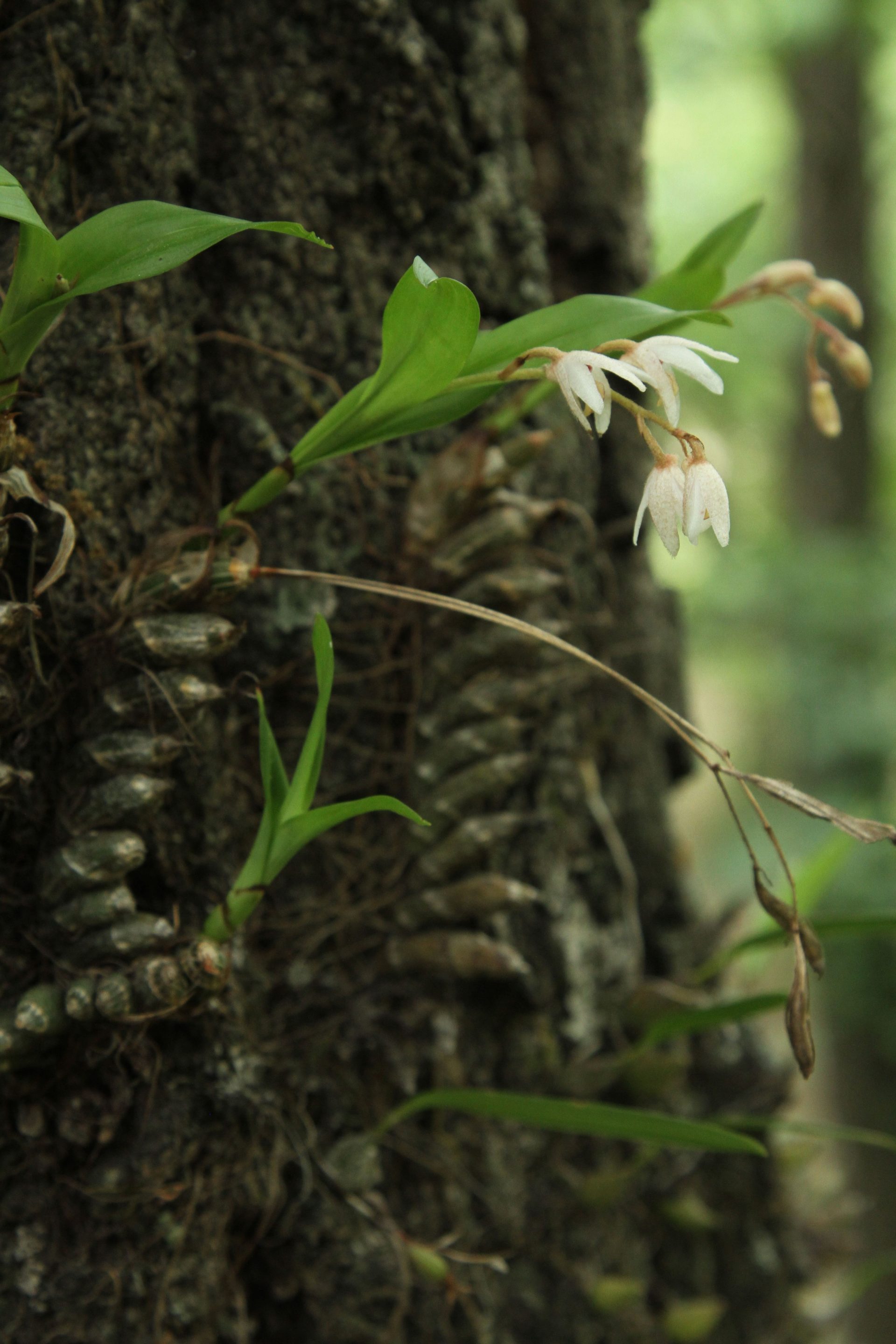
Pinalia excavata is an epiphytic orchid of the Eastern Himalaya and adjacent southern China and Indochina, with GBIF records from China, India, Nepal, Bhutan and Myanmar and a modest tally of documented occurrences. It grows as an epiphyte on tree trunks and mossy branches in humid broad-leaved and evergreen montane forest, favouring shaded, well-ventilated situations in the warm-temperate to lower montane belt. The species occupies low to middle elevations; the photographed plant from Trashigang in eastern Bhutan at about 2100 m in May represents a typical station within its altitudinal range, flowering in late spring as the pre-monsoon humidity rises.
The plant produces clustered, fusiform to cylindrical pseudobulbs arising from a creeping rhizome, each bearing several apical leaves. The leaves are lanceolate to elliptic, thin-textured to somewhat leathery and prominently veined. The inflorescence is a lateral or subterminal raceme bearing numerous small flowers, the rachis and ovaries usually clothed in fine hairs as is characteristic of the genus. The flowers are pale, whitish to cream or yellowish, with spreading sepals and petals; the lateral sepals are adnate to the column foot to form a short mentum, and the trilobed labellum bears raised keels or ridges along its disc. The column is short and footed, and the fruit is a small ribbed capsule.
Pinalia comprises species formerly placed in the broadly circumscribed Eria, segregated on the basis of molecular and morphological evidence; P. excavata was originally described under Eria and is treated by current authorities under Pinalia. As a forest epiphyte dependent on intact humid canopy, it is vulnerable to deforestation and habitat degradation across its range, although it is not presently the subject of a formal threat assessment.
Author: (Lindl.) Kuntze · Sources: POWO (Kew), GBIF, Flora of China, Flora of Bhutan, The Orchids of Bhutan (Pearce & Cribb)