
Lindl.

Description
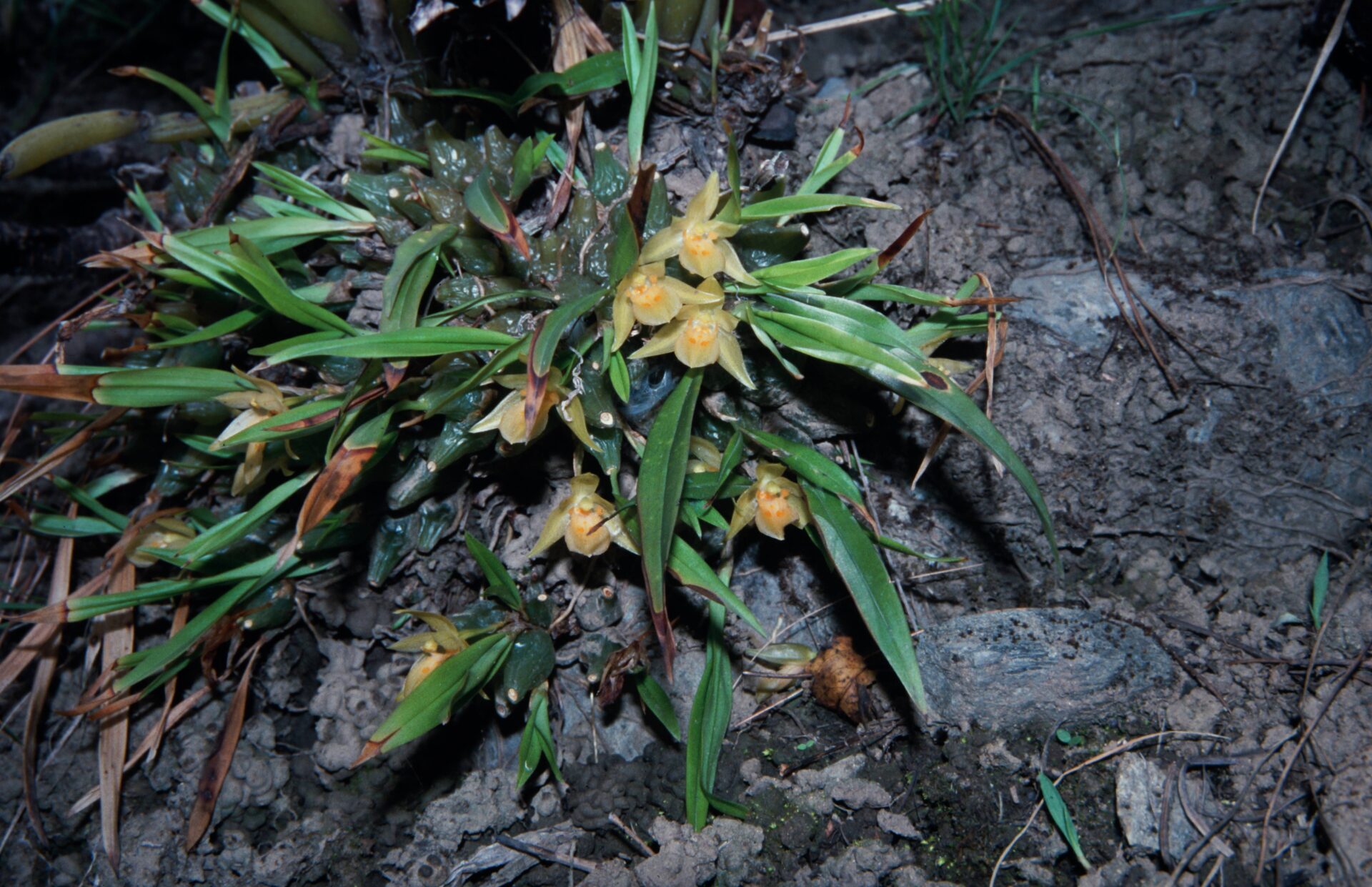
Coelogyne uniflora (long known as Panisea uniflora) is an epiphytic orchid distributed across the eastern Himalaya and Indochina, ranging from Nepal, Sikkim and Bhutan through northeast India to southern China, Myanmar, Thailand, Laos, Cambodia and Malaysia; GBIF records 90 occurrences across this range. It grows as an epiphyte on mossy trunks and branches, and occasionally as a lithophyte on shaded rocks, in humid subtropical to lower temperate broad-leaved and evergreen forest, generally between about 1000 and 2200 m. The photographed plant from Gunda in the Gorkha district of Nepal at 1700 m in May illustrates its flowering at the onset of the monsoon, when atmospheric humidity in these mid-montane forests is high.
It is a small, tufted, sympodial epiphyte with closely spaced, ovoid to cylindrical pseudobulbs borne on a creeping rhizome, each pseudobulb bearing one or two narrowly lanceolate, plicate leaves. The inflorescence is short and few-flowered, usually carrying a single relatively large flower (whence uniflora) at or near the base of the new growth. The flower has spreading, pale creamy-white to yellowish sepals and petals; the lip (labellum) is three-lobed, often marked with reddish-brown to orange and bearing low keels on the disc, the lateral lobes erect. The column is slender and the fruit a ribbed dehiscent capsule releasing dust-like seeds.
The species exemplifies recent generic realignments within the Coelogyninae (Orchidaceae): the genus Panisea has been subsumed into a broadly circumscribed Coelogyne on molecular phylogenetic grounds, so the wp_link "panisea-uniflora" reflects the former placement while Coelogyne uniflora is the currently accepted name. Like other coelogynes it produces minute wind-dispersed seeds dependent on mycorrhizal fungi for germination. Though wide-ranging, epiphytic orchids are sensitive to deforestation and collection and are afforded CITES Appendix II protection.
Author: Lindl. · Sources: POWO (Kew), GBIF, Flora of China Vol. 25, Flora of Bhutan Vol. 3, Flora of Nepal, The Genus Coelogyne: A Synopsis (Clayton & Pradhan)