
(Maxim.) Hurus.
Description
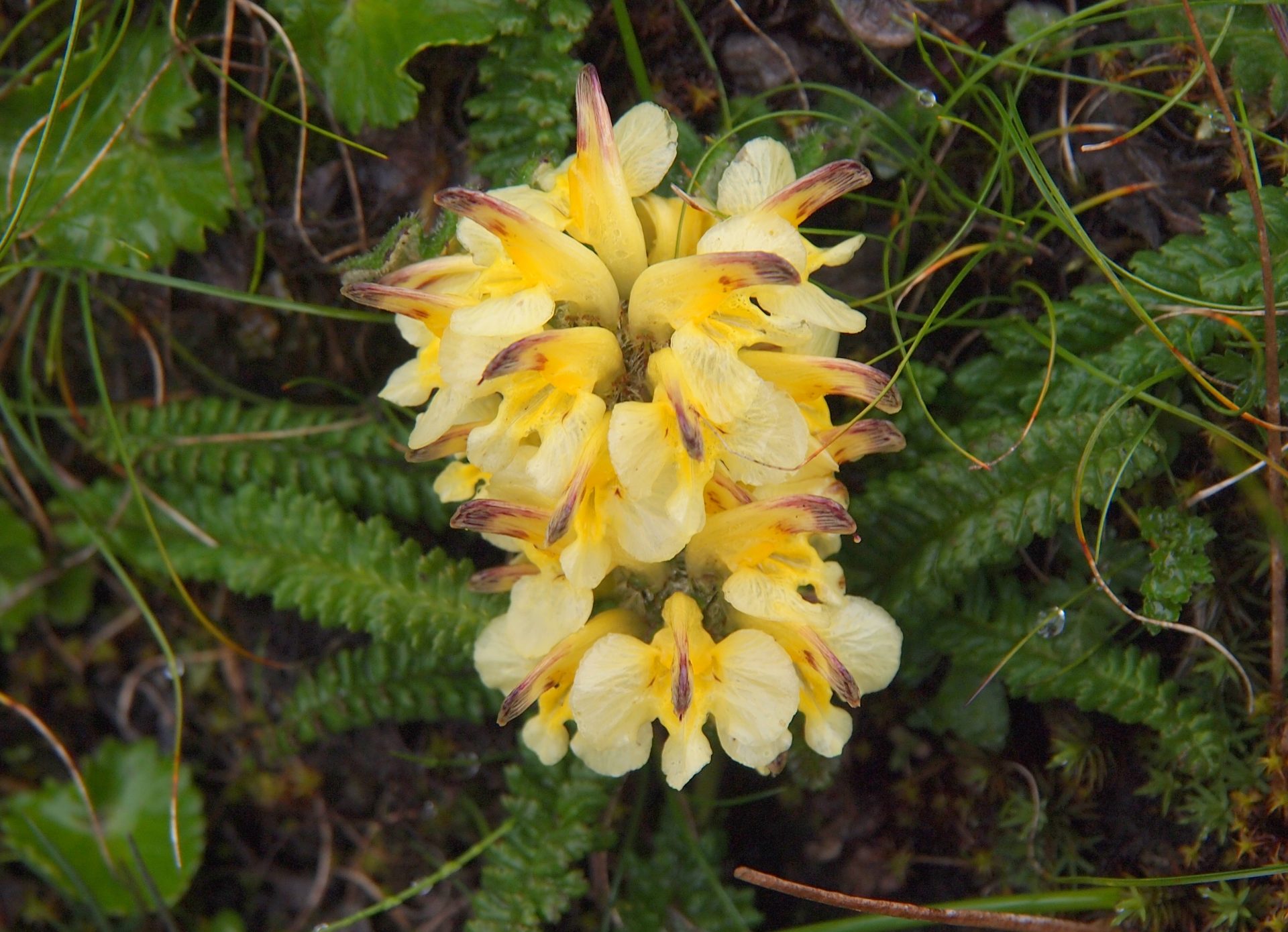
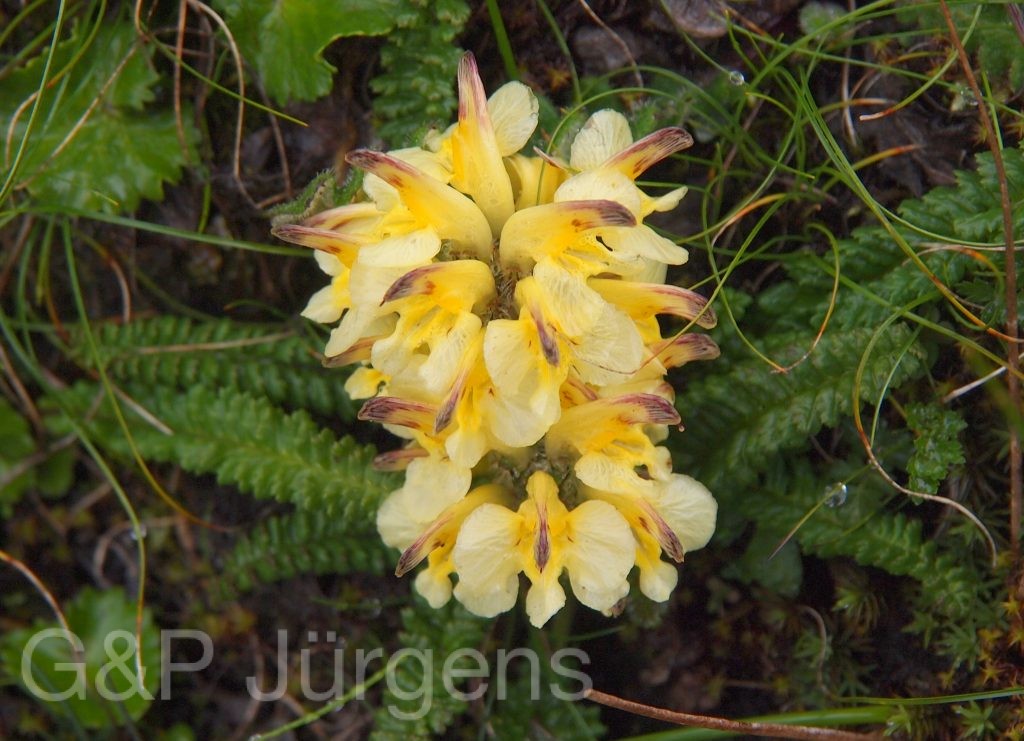
Pedicularis oederi var. sinensis is a hemiparasitic perennial of the high eastern Himalaya and Sino-Himalayan ranges, distributed across China, Bhutan and India (CN, BT, IN), with some 195 documented occurrences. It is a plant of open alpine turf, stony slopes, moist meadows and the margins of snowbeds in the subalpine to alpine and subnival belts, typically between about 3500 and 5000 m. The collection illustrated here was made along the Ludlow-Sherriff Trail at Miluthang in Bhutan at 4500 m in July, an elevation and timing characteristic of its summer flowering in the wake of melting snow, where it derives part of its nutrition by parasitising the roots of neighbouring graminoids and herbs.
The plant forms a low, tufted rosette arising from a stout, fleshy taproot and a short caudex, with one to several erect or ascending, sparingly leafy flowering stems. The leaves are mostly basal, oblong-lanceolate in outline and pinnatisect, the segments oblong and serrate-crenate, the rachis often woolly. The inflorescence is a dense, oblong to capitate terminal spike subtended by leafy bracts. The corolla is two-lipped and yellow, the galea usually marked with red-brown or purple at the apex and beakless, hooded over the four didynamous stamens, while the lower lip is three-lobed and spreading. The calyx is tubular and lobed; the fruit is an obliquely ovoid, compressed capsule containing several seeds.
The genus Pedicularis (lousewort) reaches its greatest diversity in the Sino-Himalayan alpine flora, and P. oederi is a circumpolar-alpine species whose Himalayan populations are treated as var. sinensis. Its beakless galea places it among the non-rostrate louseworts, and like its congeners it relies on long-tongued bumblebees for pollination. As a facultative root hemiparasite it can influence the composition of alpine plant communities. Though locally common across its range, it is sensitive to grazing pressure and to climatic shifts affecting the duration of snow cover.
Author: (Maxim.) Hurus. · Sources: POWO (Kew), GBIF, Flora of Bhutan, Flora of China, Pedicularis of the Sino-Himalaya (Yamazaki monograph)