Author

GP Jürgens

Hand.-Mazz.

Nepal 2001 305 ergebnis ergebnis
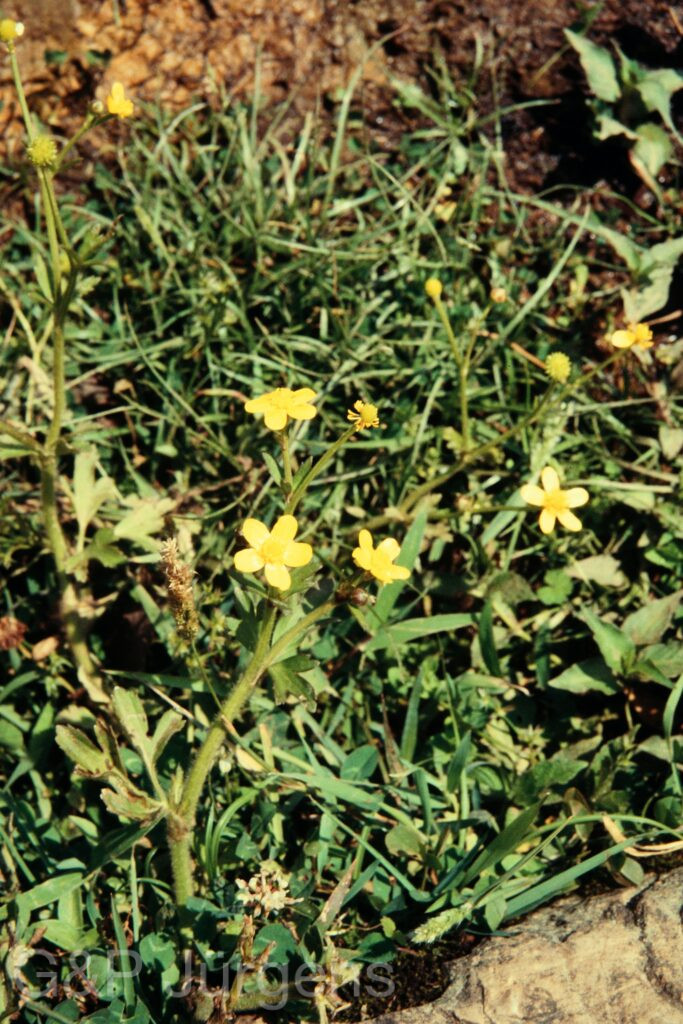
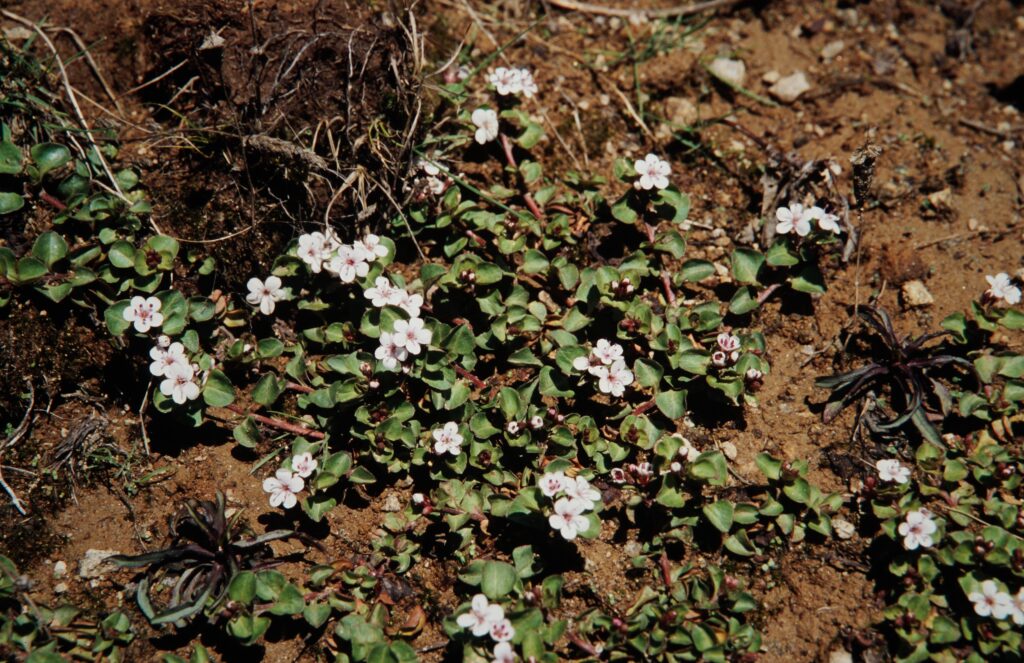
Nepal (Gorkha) Kharka 3140m, May

Description

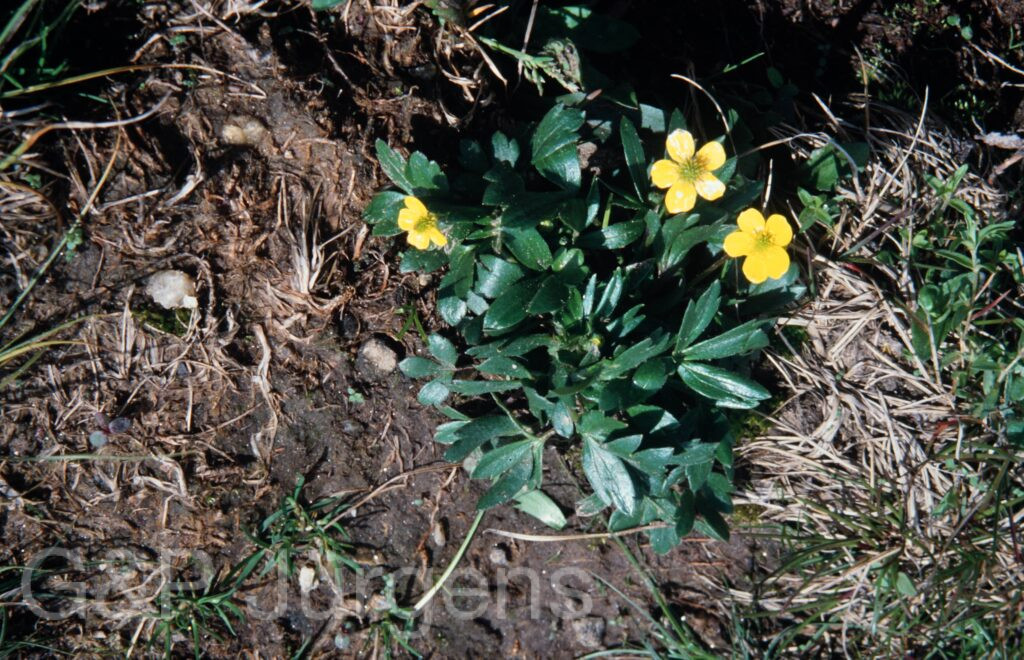
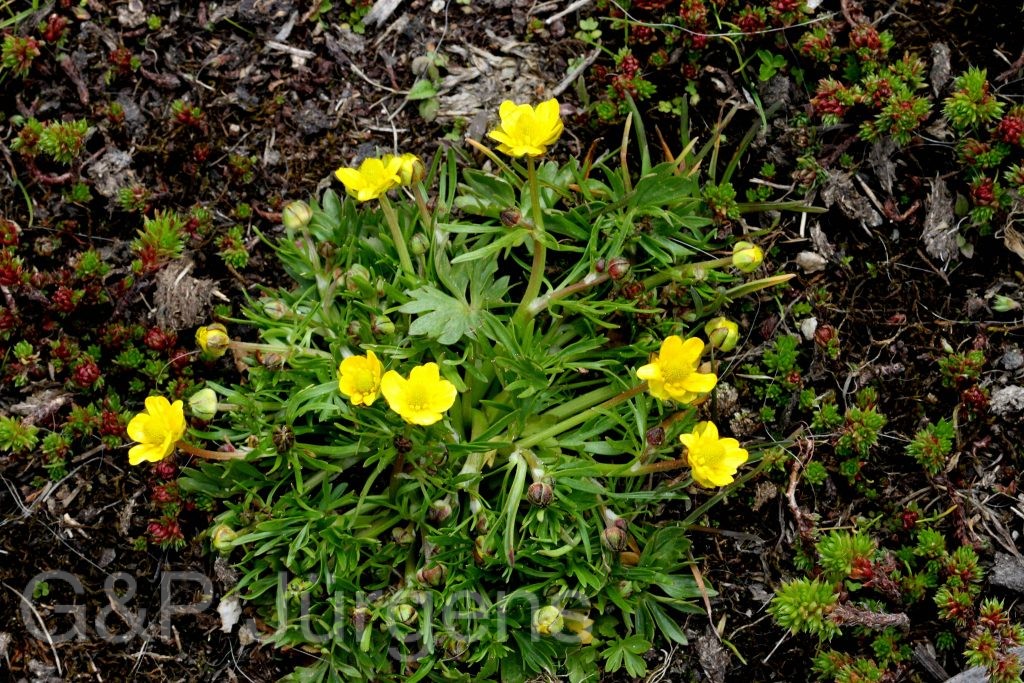
Ranunculus adoxifolius is a small buttercup of the Sino-Himalayan region, recorded from Nepal, India and Bhutan, with GBIF listing about 76 occurrences (the French record reflecting herbarium or cultivated provenance). It occupies moist subalpine to alpine habitats, including shaded forest margins, damp meadows, mossy banks and seepage slopes, generally between roughly 3000 and 4000 m. The photographed plant was found in the Gorkha district of Nepal at a kharka (high pasture) at 3140 m in May, flowering early in the season as snowmelt moistens the ground beneath open forest and on grassy slopes.

It is a delicate, low perennial herb with a short rhizome and fibrous roots. The basal leaves are long-petiolate with rounded, three-lobed to ternately divided blades whose segments are crenate-lobed, recalling the foliage of Adoxa, hence the epithet. The slender, few-leaved stems bear one to a few small flowers. Each flower has five (sometimes more) spreading, glossy yellow petals each with a basal nectary scale, numerous yellow stamens, and a domed receptacle of many free carpels. The fruiting head is a globose to ovoid cluster of small, glabrous, beaked achenes.

The species belongs to the cosmopolitan genus Ranunculus (Ranunculaceae), within the assemblage of small-flowered Asian alpine buttercups. Like its relatives it contains the acrid glycoside ranunculin, rendering the fresh plant unpalatable to grazing stock. With a restricted Himalayan range tied to undisturbed moist montane habitat, it is a useful indicator of intact subalpine vegetation; it has not been formally assessed, but its specialised habitat warrants attention where disturbance and grazing intensify.

Author: Hand.-Mazz. · Sources: POWO (Kew), GBIF, Flora of Nepal, Flora of China, Annotated Checklist of the Flowering Plants of Nepal, Ranunculus monographs (Tamura)
Freyn

Sikkim2011 55
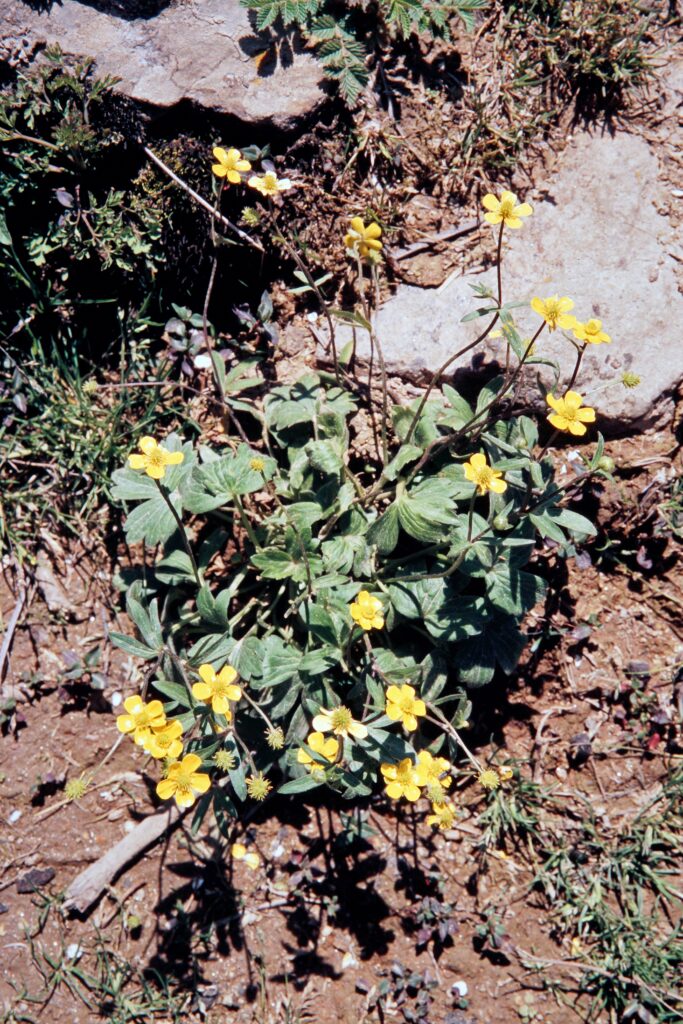
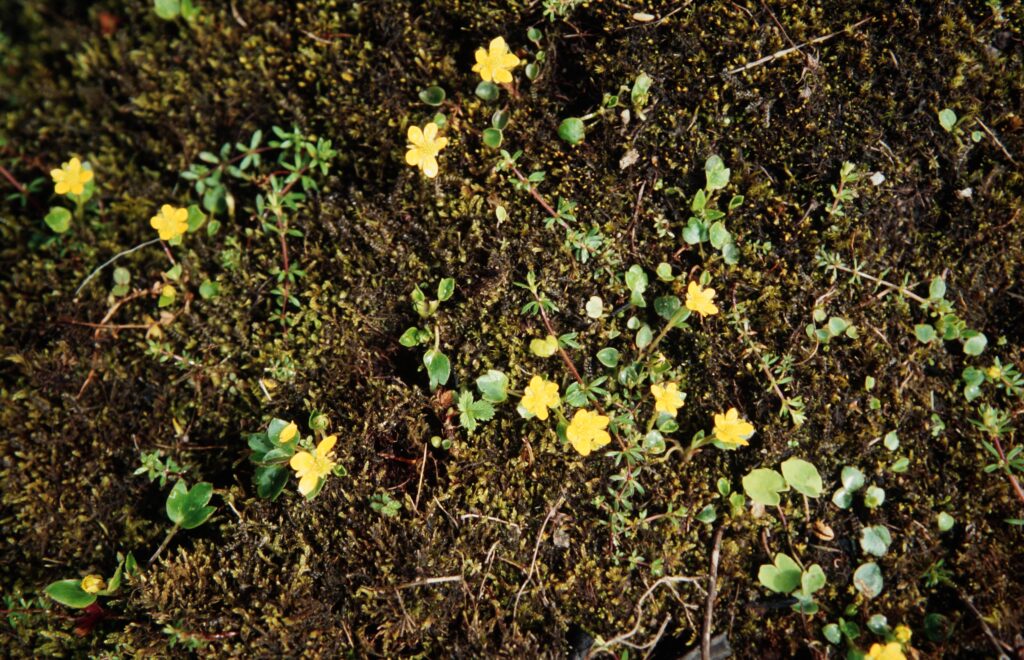
Sikkim Vista-valley 3800m, June
Sikkim2003 300 P429
Sikkim Saniti-Lake 4300m August

Description

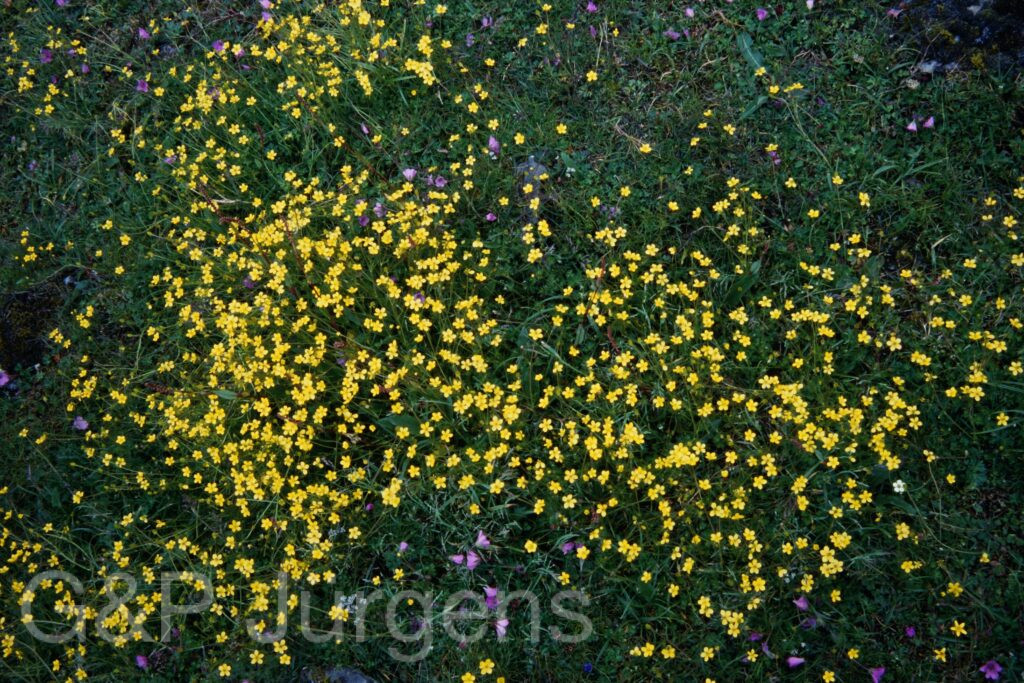
Ranunculus brotherusii is a widespread alpine buttercup of Central Asia and the Himalaya, recorded from China, Nepal, India, Bhutan, Pakistan, Mongolia, Russia and Kyrgyzstan, with additional collections in European herbaria. Its roughly 1756 georeferenced records reflect a common and broadly distributed high-mountain species. It grows in damp alpine meadows, marshy ground, streamsides and snow-flush hollows, typically at about 3000-5000 m. The Sikkim gatherings cited above, from the Vista valley at 3800 m in June and from Saniti Lake at 4300 m in August, are characteristic, the species flowering through the short alpine summer on moist, well-watered turf.

It is a small, tufted perennial herb arising from a fibrous root system, the stems erect to ascending and sparsely appressed-hairy. The basal leaves are long-petiolate with reniform to orbicular blades that are three-lobed or further divided into crenate segments, while the cauline leaves are smaller and more deeply cut, becoming sessile above. The flowers are solitary or few, with five greenish, often pubescent sepals and five glossy yellow obovate petals each bearing a small nectary scale. The numerous stamens surround a globose to ovoid head of carpels, the fruit an aggregate of small glabrous achenes with a short curved or hooked beak.

Ranunculus is a large, cosmopolitan genus particularly diverse in cold temperate and alpine regions, and R. brotherusii belongs to its assemblage of small-flowered Asian alpine buttercups. Like its relatives it contains acrid protoanemonin compounds rendering it unpalatable and toxic to livestock, which favours its persistence on grazed pasture. Pollination is by generalist alpine flies and bees. Its extensive transboundary range and ecological tolerance place it well outside any conservation concern.

Author: Freyn · Sources: POWO (Kew), GBIF, Flora of China, Flora of Pakistan, Ranunculus of Central Asia monograph

DC.

Nepal 97 611 P1182
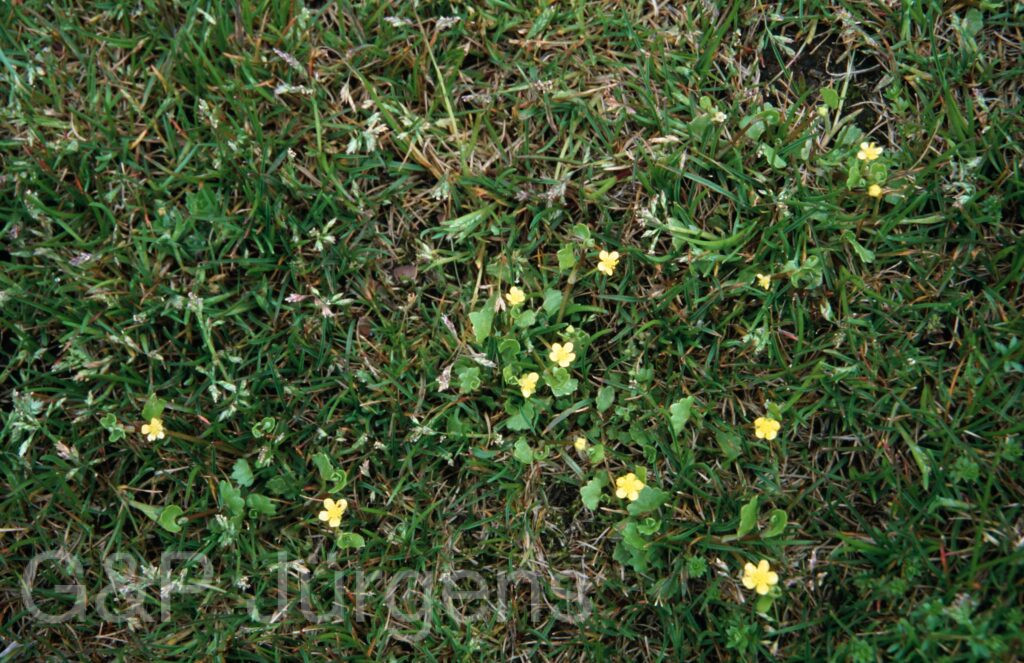
Nepal Godawari 1350m May
Garh 07 47 ergebnis
India Garhwal Mandakini 2360m, June

Description

Ranunculus diffusus is a widely distributed buttercup of the Himalaya and montane Asia, recorded from India, Nepal, China, Pakistan, Bhutan, Myanmar, Vietnam, Malaysia, Indonesia, Sri Lanka and Taiwan, with some 618 occurrences in GBIF. It favours moist, shaded habitats such as forest floors, streamsides, damp banks and the margins of cultivation, ranging widely from the subtropical foothills into the temperate zone, roughly between 1000 and 3000 m. The photographs from Godawari in Nepal at about 1350 m in May and from the Mandakini valley in Garhwal at about 2360 m in June illustrate its broad ecological and altitudinal tolerance across the spring and early-monsoon flowering period.

The plant is a perennial herb with slender, diffusely spreading and often decumbent or rooting stems, the habit that gives the species its name. The basal and lower leaves are long-petioled and ternately divided into three lobed and toothed segments, more or less hairy. The flowers are small, solitary or few on slender pedicels, with usually five spreading, reflexed sepals and five glossy yellow petals each bearing a nectary scale at the base, surrounding numerous stamens and carpels. The fruiting head is a globose to ovoid cluster of small, compressed achenes tipped by a short curved or hooked beak.

Within the cosmopolitan genus Ranunculus, R. diffusus is a member of the diverse Asian assemblage of small-flowered, woodland and streamside buttercups and shows considerable variation in leaf division and pubescence across its wide range. Like most buttercups it contains the acrid glycoside ranunculin, rendering it unpalatable and somewhat toxic to livestock. Common and ecologically plastic, it is not of conservation concern and frequently behaves as a weed of moist disturbed ground.

Author: DC. · Sources: POWO (Kew), GBIF, Flora of China, Flora of Bhutan, Annotated Checklist of the Flowering Plants of Nepal, Tamura's treatment of Ranunculaceae

Hand.-Mazz.

Sikkim2011 233
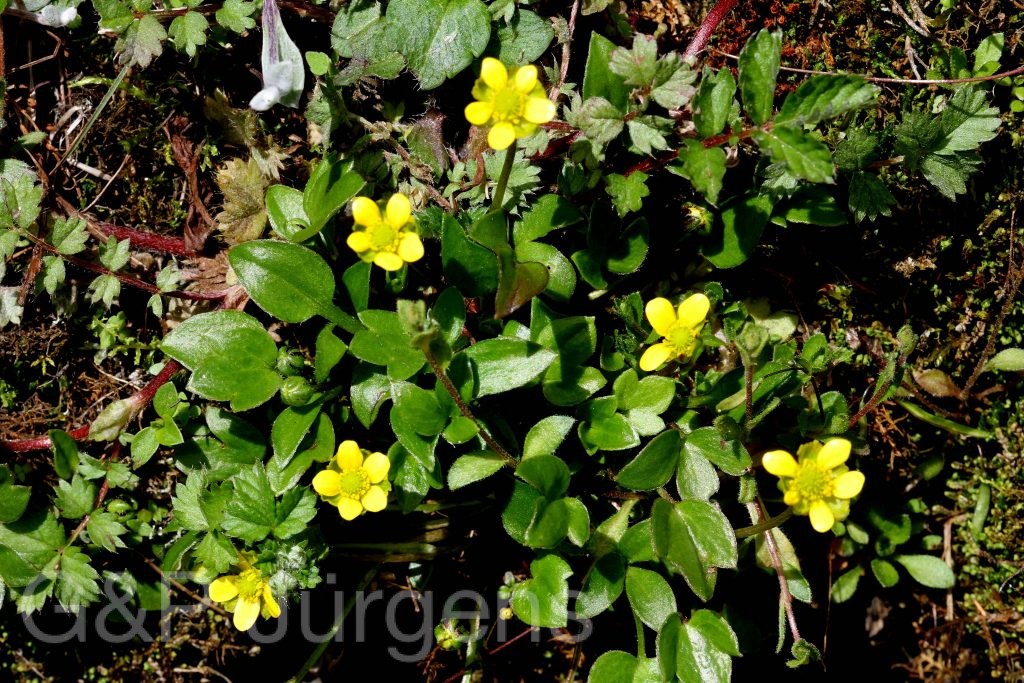
Sikkim Yumthang 3700m, June
Nepal 2001 304 ergebnis ergebnis
Nepal (Gorkha) Lambra Kharka 3200m, May

Description

Ranunculus microphyllus is a Sino-Himalayan alpine buttercup whose core GBIF range (c. 399 occurrences) lies in China, Nepal, India and Bhutan, with scattered records elsewhere reflecting cultivated or misdetermined material. It grows in open alpine turf, moist meadows, snowmelt flushes, damp rock ledges and stream banks, typically between about 3000 and 4200 m. The cited localities—Yumthang in Sikkim at 3700 m in June, Lambra Kharka in the Nepalese Gorkha at 3200 m, and Sandakphu in West Bengal at 3200 m, both in May—illustrate its spring-to-early-summer flowering across moist, cool, high-elevation grasslands and seepage of the central and eastern Himalaya.

It is a small, tufted perennial herb, the stems low and ascending, often somewhat hairy, arising from a fibrous-rooted base. As the epithet implies the leaves are small; the basal leaves are petiolate and shallowly to deeply three-lobed or crenate, while the stem leaves are reduced and more dissected. The flowers are solitary or few, with the typical buttercup plan: five green sepals, five glossy bright-yellow petals each with a basal nectary, and numerous spirally arranged stamens and free carpels. The fruit is a globose head of small, slightly beaked achenes.

Described by Handel-Mazzetti, R. microphyllus belongs to the large, taxonomically intricate genus Ranunculus, in which the small-leaved Himalayan alpines form a closely related and often confused complex. It is locally common and not of conservation concern, though confined to moist high-altitude habitats sensitive to warming. Ecologically it is characteristic of snowmelt-fed alpine meadows, its open flowers offering accessible nectar and pollen to flies and other high-altitude insects.

Author: Hand.-Mazz. · Sources: POWO (Kew), GBIF, Flora of China, Annotated Checklist of the Flowering Plants of Nepal, Tamura monograph of Ranunculaceae

Dumort.

Nepal 2001 457 ergebnis ergebnis
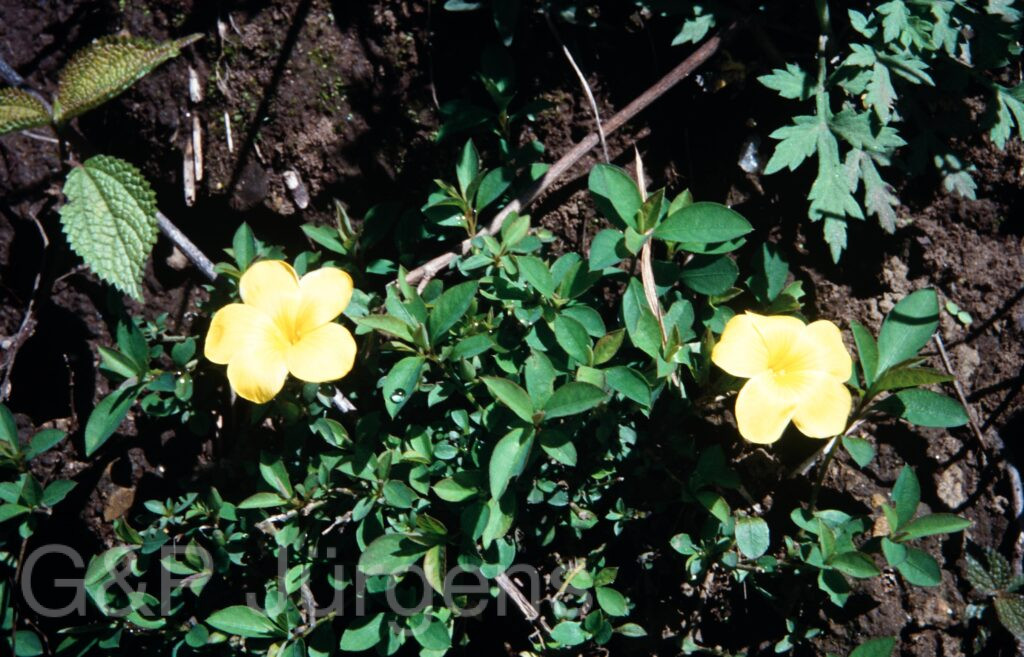
Nepal (Gorkha) Gunda 1700m, May

Description

Reinwardtia indica Dumort., the yellow flax, is a subshrub of the flax family widely distributed through the Himalaya and the mountains of southern China and Southeast Asia. GBIF documents it in India, Nepal, Bhutan, Pakistan, China, Myanmar and Thailand, with numerous extralimital records reflecting its frequent cultivation as an ornamental. It grows on shaded banks, forest margins, hillside scrub and roadside slopes in the subtropical to lower temperate zone, generally between about 800 and 2,300 m. The plant from Gunda in the Gorkha district of Nepal at 1,700 m, flowering in May, is typical of its hill-forest habitat, though it also flowers conspicuously in the cooler months.

The species is a low, much-branched perennial subshrub to about 1 m tall with slender, glabrous green stems. The leaves are alternate, elliptic to obovate, entire or minutely toothed, with small caducous stipules. The bright golden-yellow flowers are borne singly or in few-flowered axillary and terminal clusters; each has five sepals, five large obovate petals that are fugacious (lasting only a day), and stamens united below into a tube with alternating staminodes. The fruit is a septicidal capsule splitting into several one-seeded segments.

Reinwardtia is a small genus of one or two species closely allied to Linum, distinguished by its woody habit and persistent yellow flowers. R. indica is much grown in gardens and is used in folk medicine and as a dye source. It is widespread, frequently semi-naturalised through cultivation, and of no conservation concern.

Author: Dumort. · Sources: POWO (Kew), GBIF, Flora of China Vol. 11, Flora of Pakistan, Mildbraed: Linaceae in Das Pflanzenreich

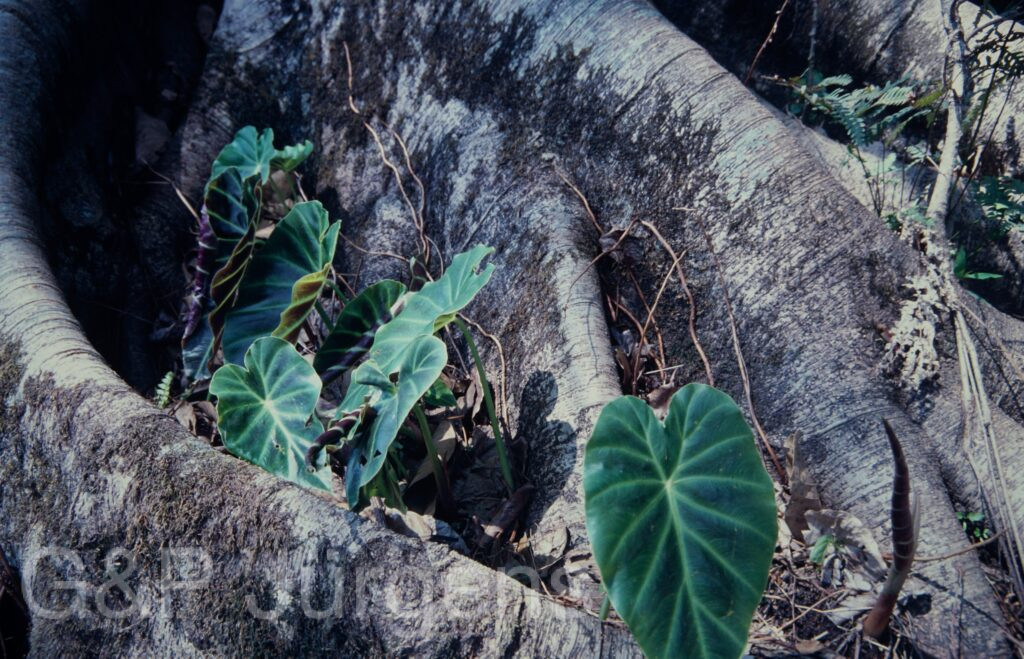
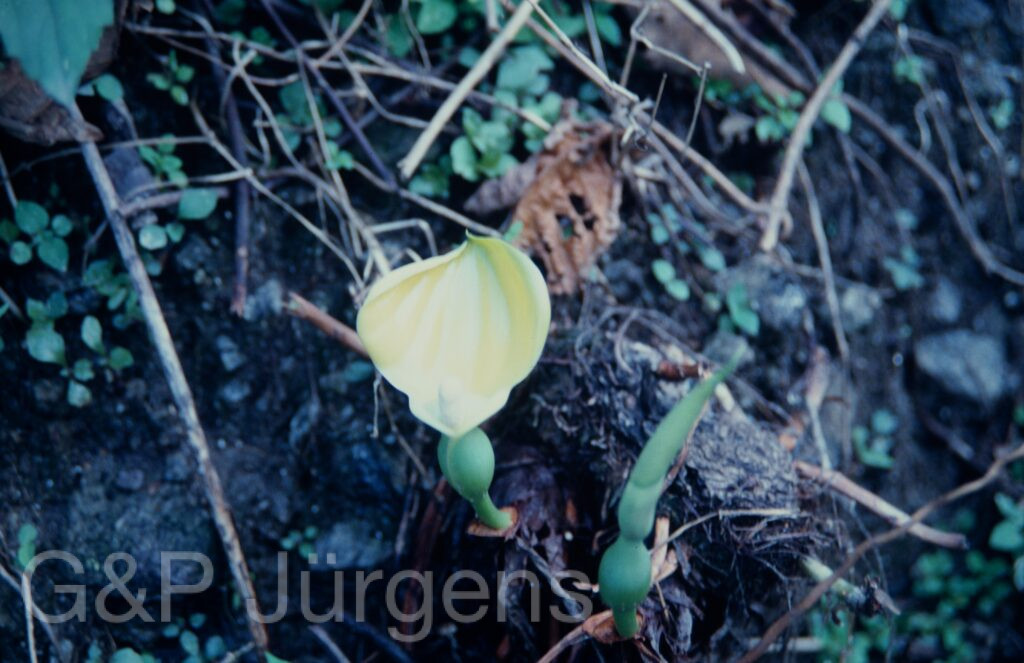
Remusatia pumila

by GP Jürgens

(D.Don) H.Li & A.Hay

Bhutan2012 715
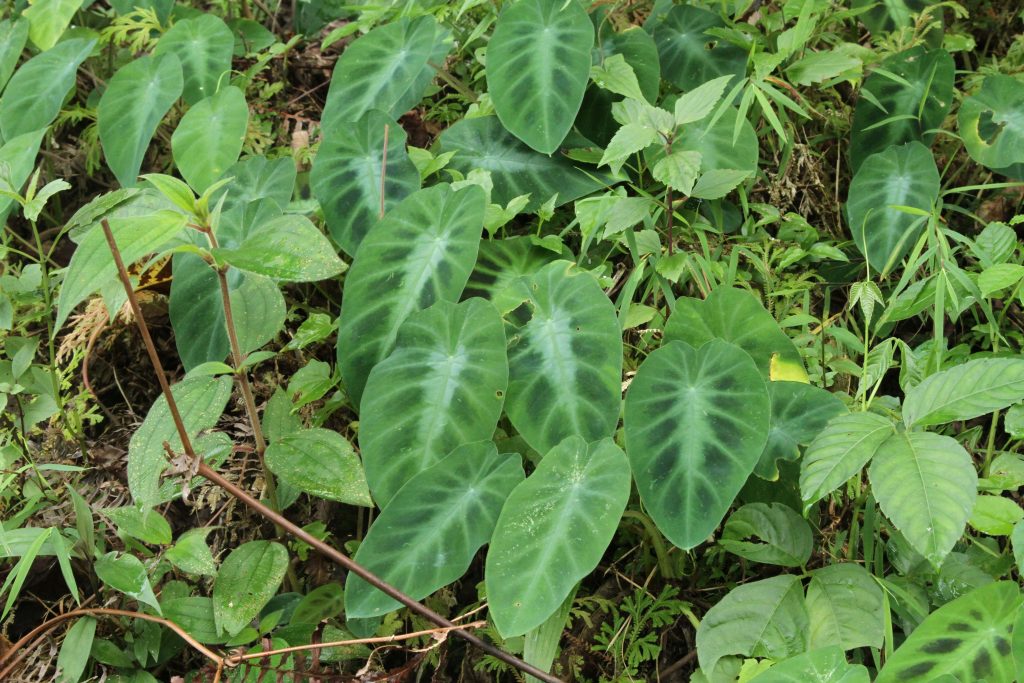
Bhutan Galephu 850m, October
Nepal 1994 228 ergebnis
Ost-Nepal Mewa-Khola 1900m April 

Description

Remusatia pumila (D.Don) H.Li & A.Hay is a small tuberous aroid of the eastern Himalaya and Indo-Burmese region, documented by about 269 records spanning India, Nepal, Bhutan, China, Myanmar, Thailand, Malaysia, Indonesia and Vietnam, with naturalised reports elsewhere. It grows as a lithophyte and epiphyte on mossy rocks, boulders and tree trunks in humid broad-leaved and subtropical forest, favouring shaded, seepage-moistened microsites. The cited gatherings from Galephu in southern Bhutan at 850 m in October and the Mewa Khola of East Nepal at 1900 m in April reflect its span across the warm-temperate to subtropical foothill belt.

The plant is a diminutive geophyte arising from a small subglobose tuber that produces clusters of bulbil-bearing structures. The leaves are few, with slender petioles and ovate to ovate-cordate, peltate or sagittate blades. As in all Remusatia, vegetative reproduction is conspicuous: erect to spreading bulbiliferous shoots bear numerous hooked, scale-covered bulbils that detach and disperse epizoochorously. The inflorescence is a spathe enclosing a spadix with basal female and upper male flower zones separated by sterile flowers; flowering is comparatively infrequent relative to the prolific bulbil production.

The species was long placed in Gonatanthus, a genus now subsumed within Remusatia, the combination reflecting molecular and morphological reassessment of the tribe Colocasieae. Reliance on hooked bulbils for dispersal by passing animals is a key adaptation to its epilithic and epiphytic, often ephemerally exposed habitats. Widespread and locally frequent, it is not considered threatened, though its dependence on undisturbed humid forest links its persistence to lowland and submontane habitat integrity.

Author: (D.Don) H.Li & A.Hay · Sources: POWO (Kew), GBIF, Flora of China, Flora of Bhutan, Flora of Nepal, Araceae of the Indian subcontinent / monograph of Remusatia and Colocasieae

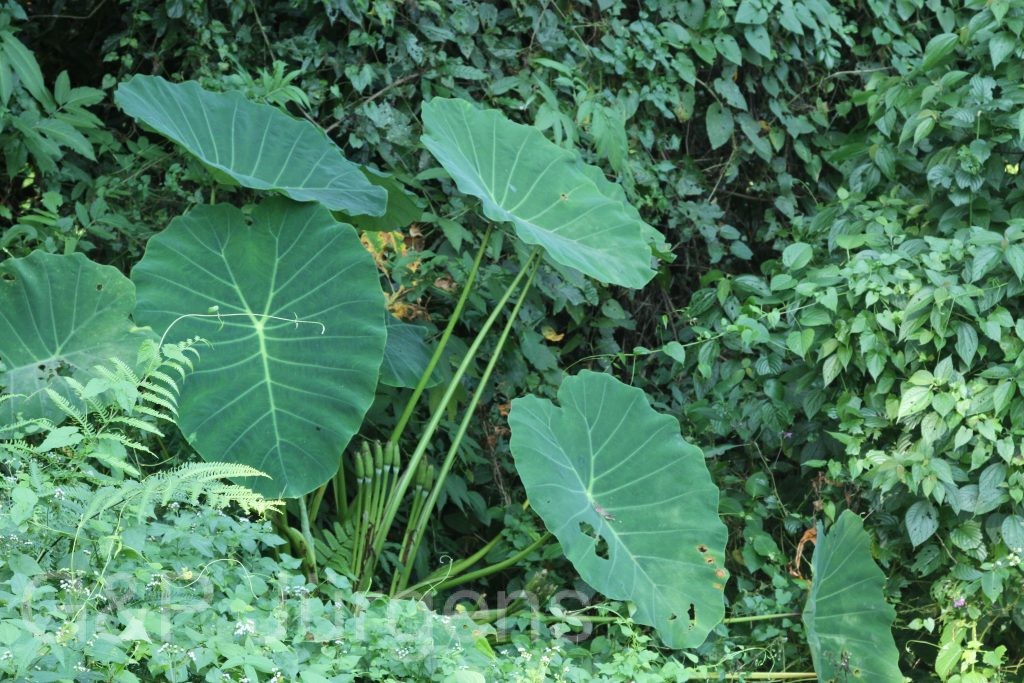
Remusatia vivipara

by GP Jürgens

(Roxb.) Schott

Bhutan2015 106 1
Bhutan Galephug 600m, October
Nepal 1994 223 ergebnis
Ost-Nepal Mewa-Khola 1900m April 

Description

Remusatia vivipara (Roxb.) Schott is a widespread tuberous aroid of the Old World tropics, the most broadly distributed member of its genus, with nearly 790 records spanning the Himalaya and India, China and Taiwan, Southeast Asia, Indonesia and Australia, tropical Africa and Madagascar, and Arabia, plus naturalised occurrences elsewhere. It is chiefly an epiphyte and lithophyte on mossy tree trunks, cliffs and boulders in humid forest, descending into shaded ravines and persisting in disturbed semi-shade. The cited gatherings from Galephug in southern Bhutan at 600 m in October and the Mewa Khola of East Nepal at 1900 m in April span its lowland-to-submontane range.

The plant grows from a small depressed-globose tuber that gives rise annually to one or few leaves and to the conspicuous bulbiliferous shoots characteristic of the genus. The leaf blade is ovate to ovate-cordate and peltate, on a long sheathing petiole. Dispersal is dominated by erect, spike-like bulbil-bearing axes densely set with small, scale-covered bulbils armed with recurved hooks that catch on the fur and feathers of passing animals. Flowering, where it occurs, produces a spathe with a basal convolute tube and expanded limb, subtending a spadix with separate female and male zones; sexual reproduction is much less frequent than vegetative propagation.

The extraordinary pantropical range of R. vivipara is largely attributable to this epizoochorous bulbil dispersal, supplemented by human movement of ornamental and tuber stock. Its placement in Colocasieae, near Colocasia and Gonatanthus, has been confirmed by molecular work. The species is common, ecologically plastic and locally weedy, and is of no conservation concern; in cultivation it is valued as a curious bulbil-producing aroid.

Author: (Roxb.) Schott · Sources: POWO (Kew), GBIF, Flora of China, Flora of Bhutan, Flora of Nepal, monograph of Remusatia and tribe Colocasieae

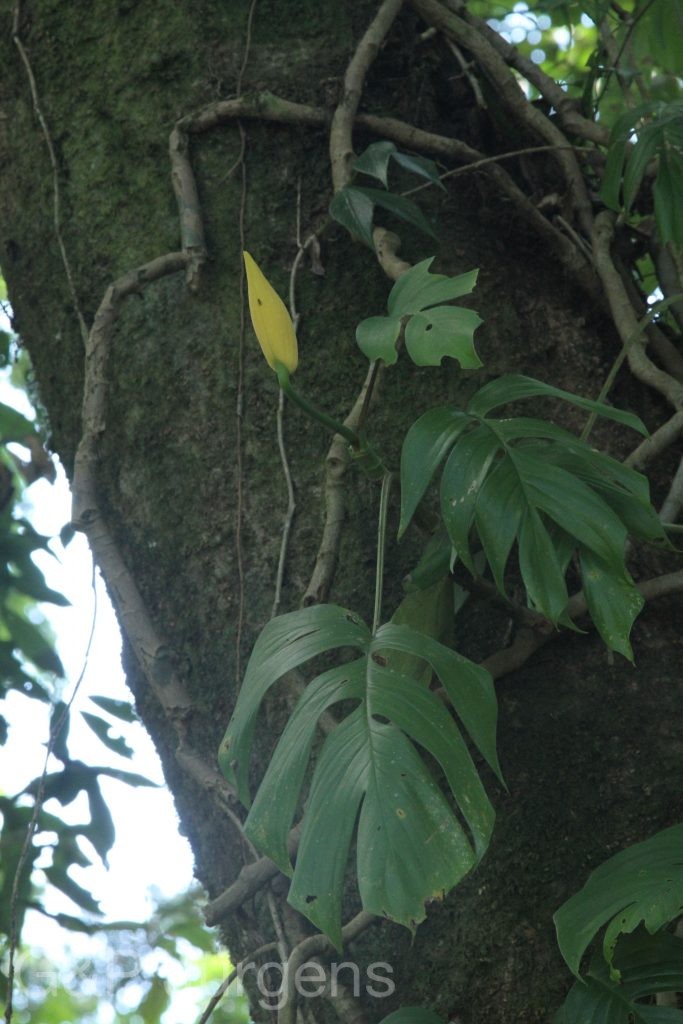
(Wall.) Schott

Bhutan2015 214
Bhutan Zhemgang 1000m, October

Description

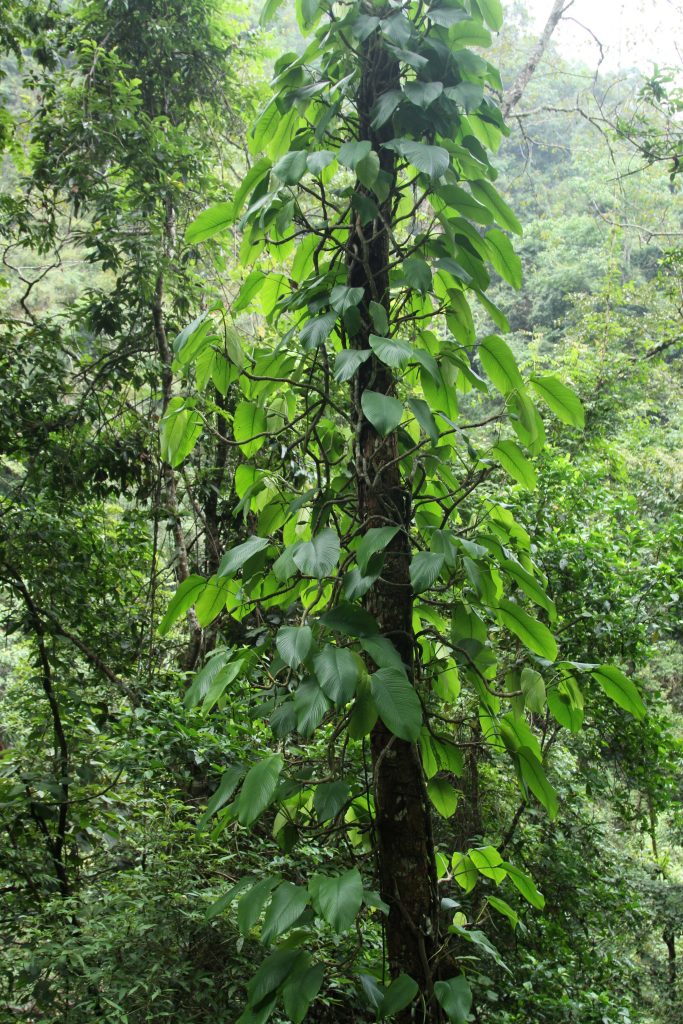
Rhaphidophora glauca (Wall.) Schott is a root-climbing aroid of the eastern Himalaya and Indo-Burmese region, recorded from India, Nepal, Bhutan, China, Myanmar, Thailand, Indonesia and Bangladesh; the GBIF total of about 195 occurrences reflects its frequent presence in humid subtropical and lower montane forest. It grows as a hemiepiphytic liana ascending tree trunks and rock faces in moist broad-leaved evergreen forest, broadly between 600 and 1800 m. The photographed plant from Zhemgang in central Bhutan at about 1000 m, in October, typifies its occurrence in the shaded, humid foothill forest of southern Bhutan, clinging by adventitious roots to mossy bark.

The species is a robust, evergreen, root-climbing hemiepiphyte with stout, terete, green to glaucous stems bearing clasping adventitious roots at the nodes. The leaves are alternate, large, ovate to oblong with an obliquely cordate to unequal base, often glaucous beneath as the epithet implies, the petiole sheathing and geniculate near the apex. The inflorescence is a solitary, axillary spadix subtended by a thick, boat-shaped, caducous spathe; the flowers are small, bisexual and naked, densely covering the cylindrical spadix in the manner of the Monstereae. The fruit is a fleshy, many-seeded berry crowded along the infructescence, the seeds bearing the curved raphide-laden tissue characteristic of the genus.

Rhaphidophora (Araceae, tribe Monstereae) is a palaeotropical genus of root-climbing aroids closely allied to Epipremnum and Monstera and distinguished by its raphide-bearing seeds and shuttlecock-like spathe. R. glauca is the principal Himalayan representative, recognised by its glaucous, oblique-based leaves. As a widespread, tolerant forest liana it is of no conservation concern, though as a hemiepiphyte it depends on intact forest structure; it is occasionally grown as a foliage ornamental and used locally in folk medicine.

Author: (Wall.) Schott · Sources: POWO (Kew), GBIF, Flora of China, Flora of Bhutan, Flora of British India, Boyce & Croat — The Überlist of Araceae and Monstereae studies

Schott

Bhutan2012 769
Bhutan Zemgang 1500m, October

Description

Rhaphidophora hookeri is a robust root-climbing aroid of the warm-temperate and subtropical broad-leaved forests of the eastern Himalaya and northern Indochina. GBIF occurrences place it across China, Thailand, India, Vietnam, Bhutan, Laos, Bangladesh, Myanmar and Nepal, with around 253 records reflecting its sparse but wide montane distribution. It is a hemiepiphyte of humid, shaded forest, ascending tree trunks and rock faces by adventitious clasping roots in evergreen ravines and along stream margins. The photographed plant from Zemgang in central Bhutan at 1500 m, recorded in October, is typical of the mid-elevation foothill forests where the species favours high atmospheric humidity, deep shade and moss-covered substrates.

It is a perennial climber with thick, fleshy stems that adhere closely to the support, the internodes marked by prominent scars and bearing dense feeding roots. The leaves are large, glossy and entire to obliquely ovate-elliptic, the petioles geniculate and sheathing at the base. The inflorescence is a cylindrical spadix subtended by a thick, deciduous, boat-shaped spathe; the flowers are bisexual and naked, lacking a perianth, densely packed over the spadix. The fruit is a fleshy syncarp of berries, releasing numerous small seeds at maturity.

The genus Rhaphidophora comprises some hundred species of palaeotropical climbing aroids, distinguished within the Monstereae by their bisexual flowers and the absence of a perianth. R. hookeri, named in honour of J. D. Hooker, is one of the few representatives reaching the Himalayan region. Like related climbing aroids it shows marked heteroblastic development, juvenile shingle-leaved shoots differing strongly from the adult climbing stems, an adaptation to the vertical microhabitats of dense forest interiors.

Author: Schott · Sources: POWO (Kew), GBIF, Flora of Bhutan, Flora of China (Araceae), Revision of Rhaphidophora (Boyce, Araceae monographs)

Hook. f. & Thomson

BhutanPG2011 778 01 01
Bhutan Chele-La, 3900m July
Sikkim2003 485 P673
Sikkim Lachung Valley 3500m August

Description

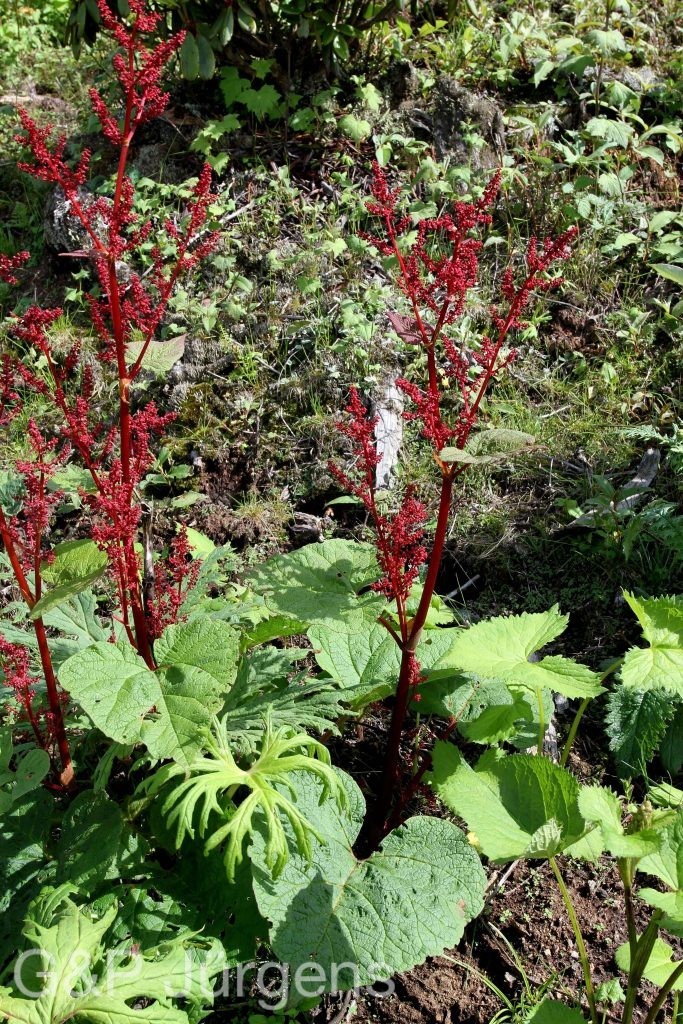
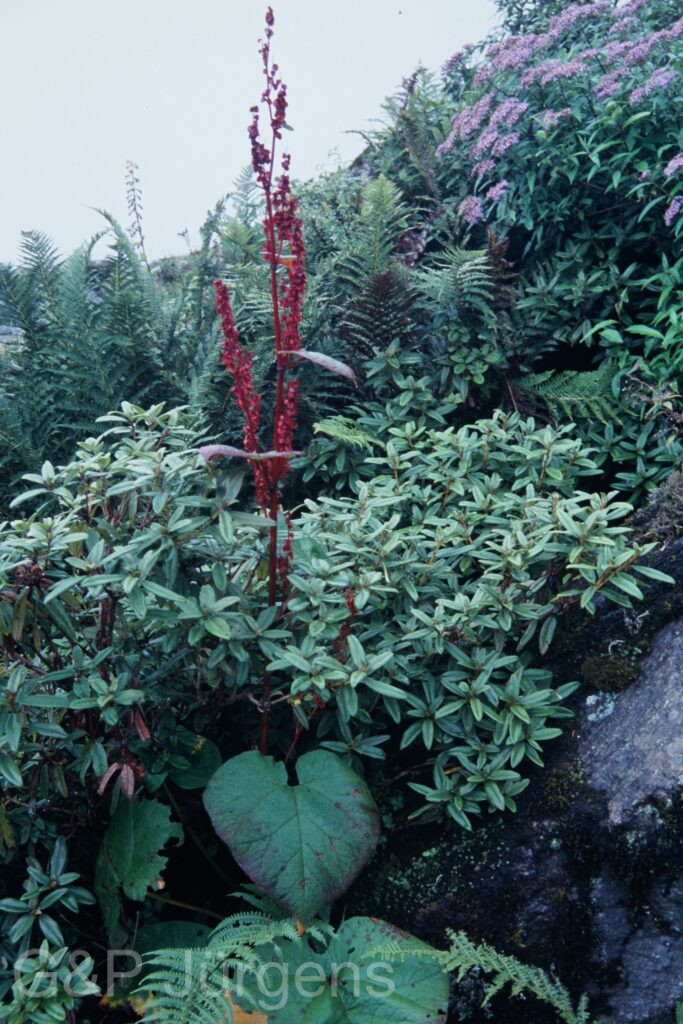
Rheum acuminatum is a stout perennial wild rhubarb of the eastern and central Himalaya, distributed through China, Nepal, India, Bhutan and Myanmar, with some 370 documented records. It is a plant of subalpine and alpine slopes, rocky meadows, open shrubberies and stream margins, generally growing between 3000 and 4300 m. The illustrated plants come from Chele-La in Bhutan at 3900 m in July and the Lachung Valley in Sikkim at 3500 m in August, spanning the high-summer flowering and fruiting period characteristic of the species at these elevations.

The plant arises from a thick woody rhizome and produces erect, often reddish, hollow stems up to a metre or more tall. The basal leaves are large, long-petiolate and broadly ovate-cordate with an acuminate apex giving the epithet, the blade more or less glabrous above and with prominent venation; an ochrea sheaths the stem at each node. The inflorescence is a tall, branched panicle bearing numerous small flowers with a coloured perianth of six segments, white to greenish or reddish. The fruit is a broadly winged triangular achene (a three-angled, three-winged nutlet) adapted to wind and water dispersal.

The genus Rheum reaches its richest diversity in the Himalaya and the Qinghai-Tibetan plateau, where high-altitude rhubarbs show striking adaptations to cold, exposed habitats. R. acuminatum lacks the inflated bracts of the alpine glasshouse rhubarbs but shares the family's ochreate, trigonous-fruited architecture. The rhizomes have a history of local medicinal use, and although the species is widespread and not threatened, related wild rhubarbs are subject to harvesting pressure across the region.

Author: Hook. f. & Thomson · Sources: POWO (Kew), GBIF, Flora of China, Flora of Bhutan, Annotated Checklist of the Flowering Plants of Nepal, Losina-Losinskaja revision of Rheum