
(Wall.) Schott
Description
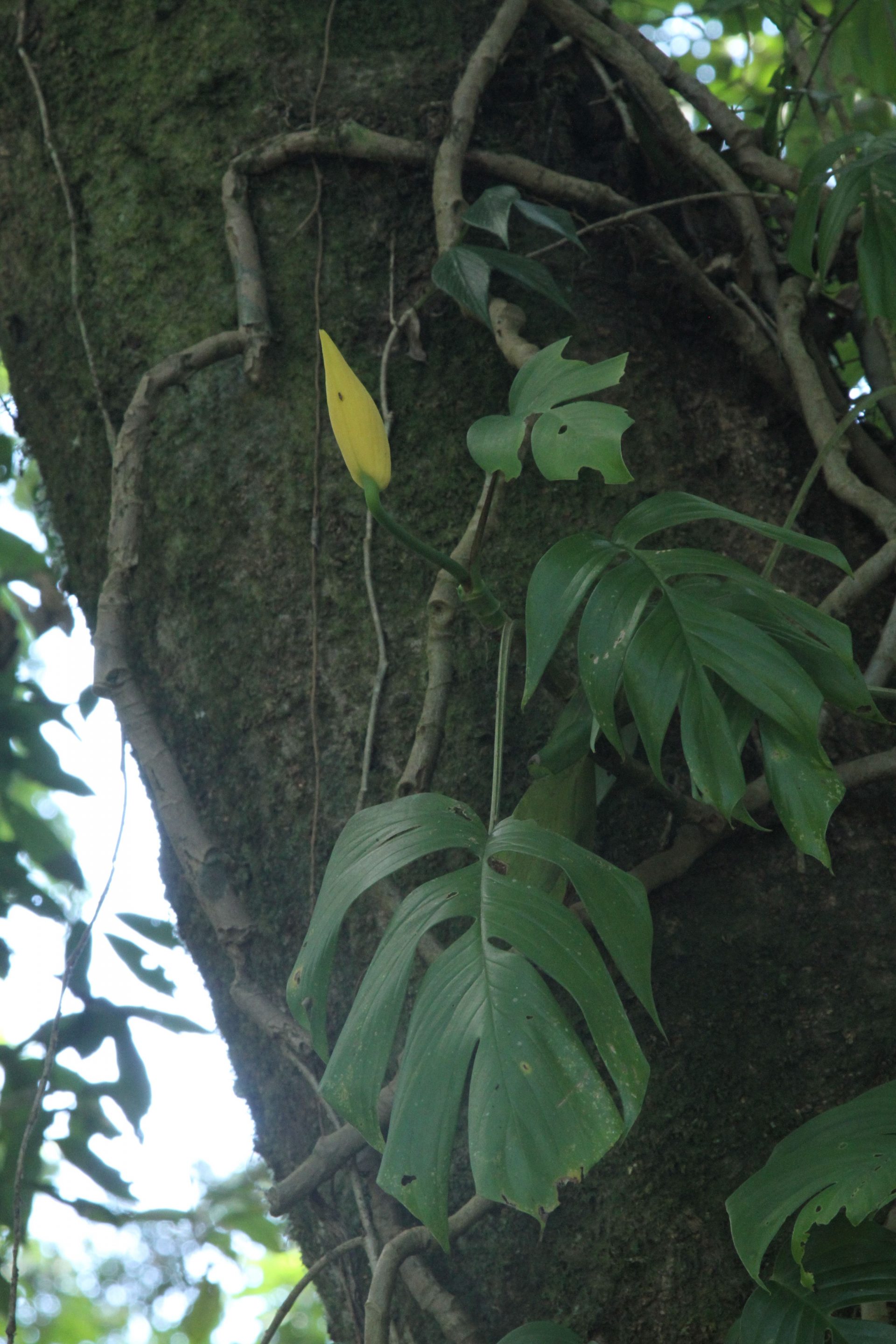
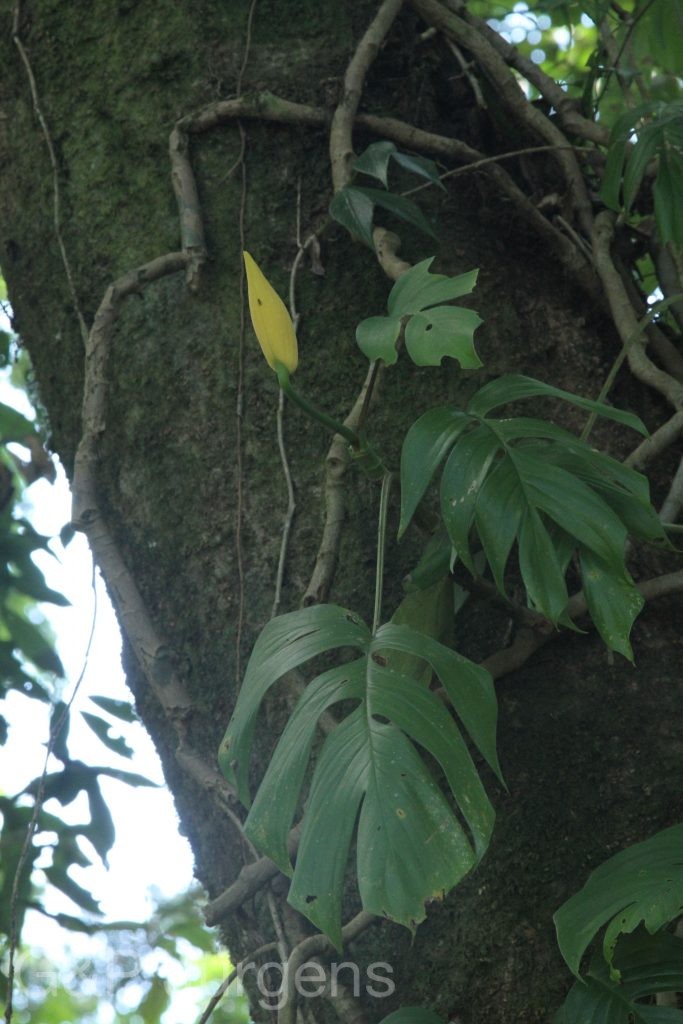
Rhaphidophora glauca (Wall.) Schott is a root-climbing aroid of the eastern Himalaya and Indo-Burmese region, recorded from India, Nepal, Bhutan, China, Myanmar, Thailand, Indonesia and Bangladesh; the GBIF total of about 195 occurrences reflects its frequent presence in humid subtropical and lower montane forest. It grows as a hemiepiphytic liana ascending tree trunks and rock faces in moist broad-leaved evergreen forest, broadly between 600 and 1800 m. The photographed plant from Zhemgang in central Bhutan at about 1000 m, in October, typifies its occurrence in the shaded, humid foothill forest of southern Bhutan, clinging by adventitious roots to mossy bark.
The species is a robust, evergreen, root-climbing hemiepiphyte with stout, terete, green to glaucous stems bearing clasping adventitious roots at the nodes. The leaves are alternate, large, ovate to oblong with an obliquely cordate to unequal base, often glaucous beneath as the epithet implies, the petiole sheathing and geniculate near the apex. The inflorescence is a solitary, axillary spadix subtended by a thick, boat-shaped, caducous spathe; the flowers are small, bisexual and naked, densely covering the cylindrical spadix in the manner of the Monstereae. The fruit is a fleshy, many-seeded berry crowded along the infructescence, the seeds bearing the curved raphide-laden tissue characteristic of the genus.
Rhaphidophora (Araceae, tribe Monstereae) is a palaeotropical genus of root-climbing aroids closely allied to Epipremnum and Monstera and distinguished by its raphide-bearing seeds and shuttlecock-like spathe. R. glauca is the principal Himalayan representative, recognised by its glaucous, oblique-based leaves. As a widespread, tolerant forest liana it is of no conservation concern, though as a hemiepiphyte it depends on intact forest structure; it is occasionally grown as a foliage ornamental and used locally in folk medicine.
Author: (Wall.) Schott · Sources: POWO (Kew), GBIF, Flora of China, Flora of Bhutan, Flora of British India, Boyce & Croat — The Überlist of Araceae and Monstereae studies