
(Wall.) Mart.
Description
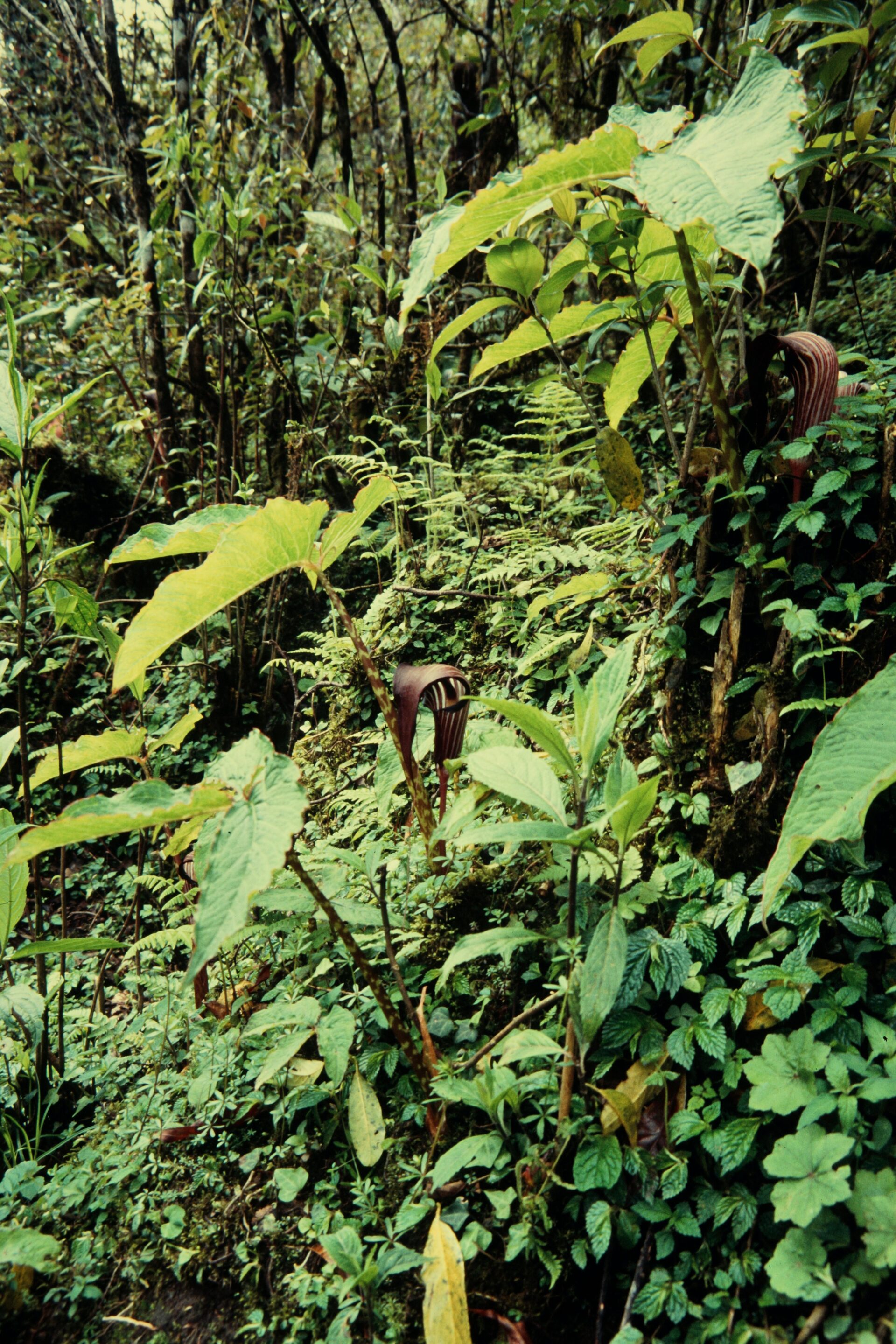
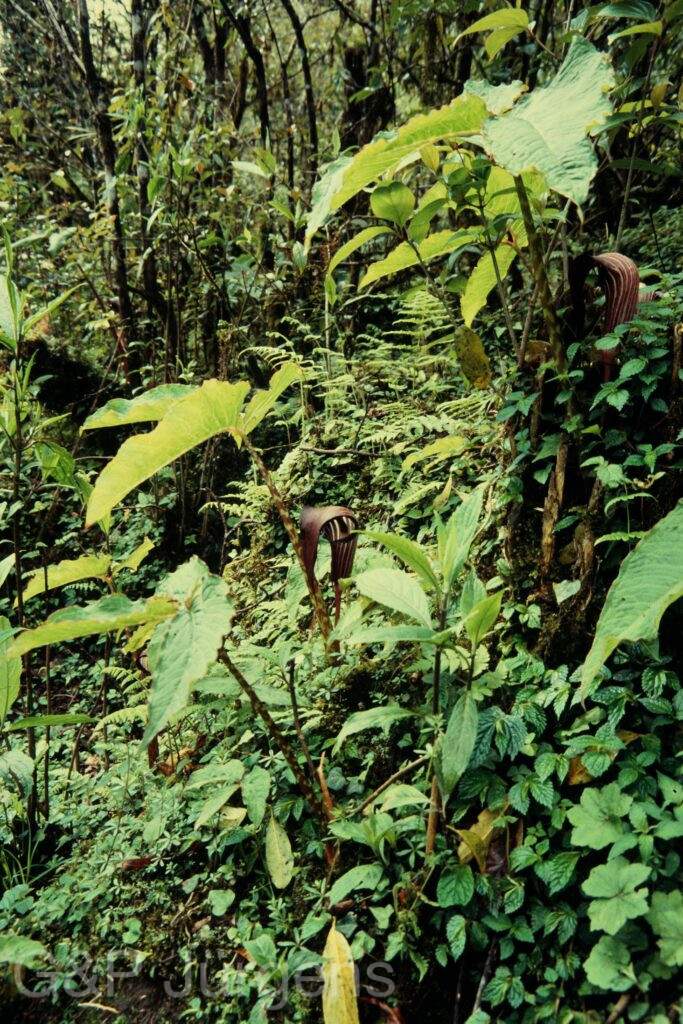
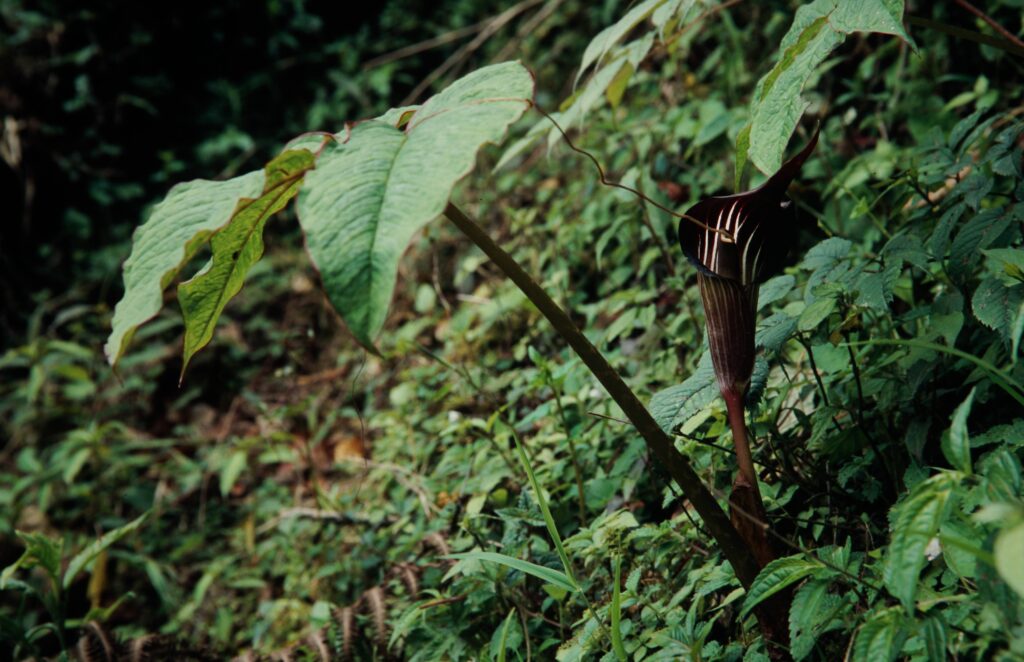
Arisaema speciosum is an eastern Himalayan cobra lily distributed from Nepal through Sikkim and West Bengal in India, Bhutan and into south-central China, with peripheral records in Myanmar and Thailand; GBIF holds nearly 200 occurrences. It grows in cool, humid temperate forest, in the shade of broadleaved and mixed conifer woodland, on rich, moist, humus-laden soils along stream banks, ravines and shaded slopes. The collections illustrated, from Tashigaon in eastern Nepal at about 3100 m and from Maneybhajang in West Bengal at around 2000 m, both in May, reflect its montane belt of roughly 2000-3300 m, where it emerges and flowers as the pre-monsoon rains advance.
The plant arises from a depressed, tuberous corm and produces a single trifoliolate leaf on a stout, mottled petiole; the three leaflets are broadly ovate, acuminate and often suffused dark purplish-red along the margins and central rib. The inflorescence is a spathe with a deep maroon, white-striped tube and an arching, dark purple-brown limb. Most striking is the spadix, whose appendage is prolonged into a very long, pendent, whip-like filiform tail hanging well below the spathe. The plant is typically dioecious, sex expression varying with tuber size, and female spadices ripen into a dense club of bright red berries.
The epithet speciosum, meaning showy, refers to the dramatic spathe and trailing appendage. Within the large Asian genus Arisaema it belongs to a group with trifoliolate leaves and long-tailed spadices. Like its congeners it is protogynous and paradioecious, with pollination effected by fungus gnats lured into the spathe chamber. The species is grown by specialist cultivators, and habitat disturbance and over-collection are potential local conservation concerns.
Author: (Wall.) Mart. · Sources: POWO (Kew), GBIF, Flora of China, Flora of Bhutan, Gusman The Genus Arisaema, Murata monograph of Arisaema