
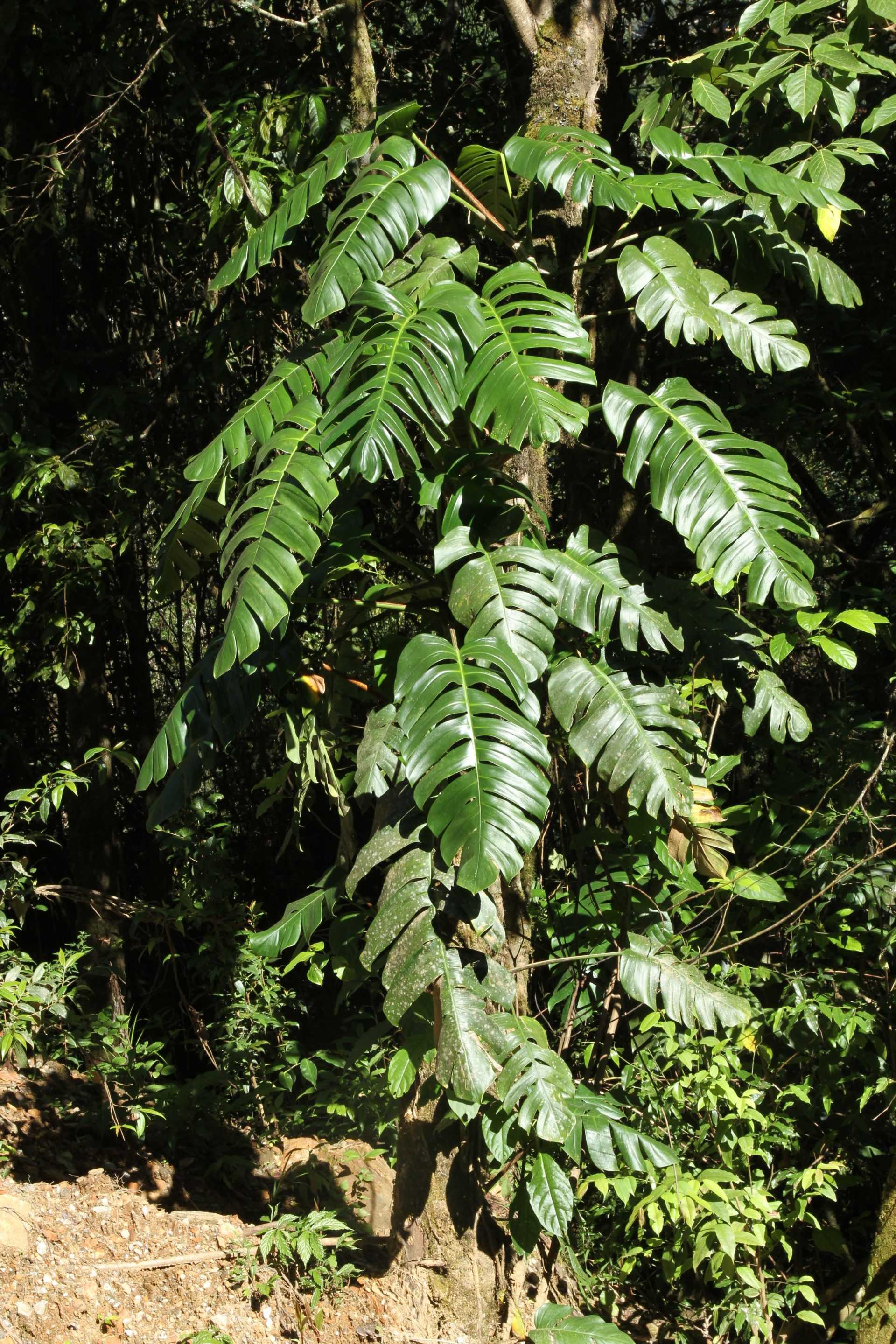
(Roxb.) Schott
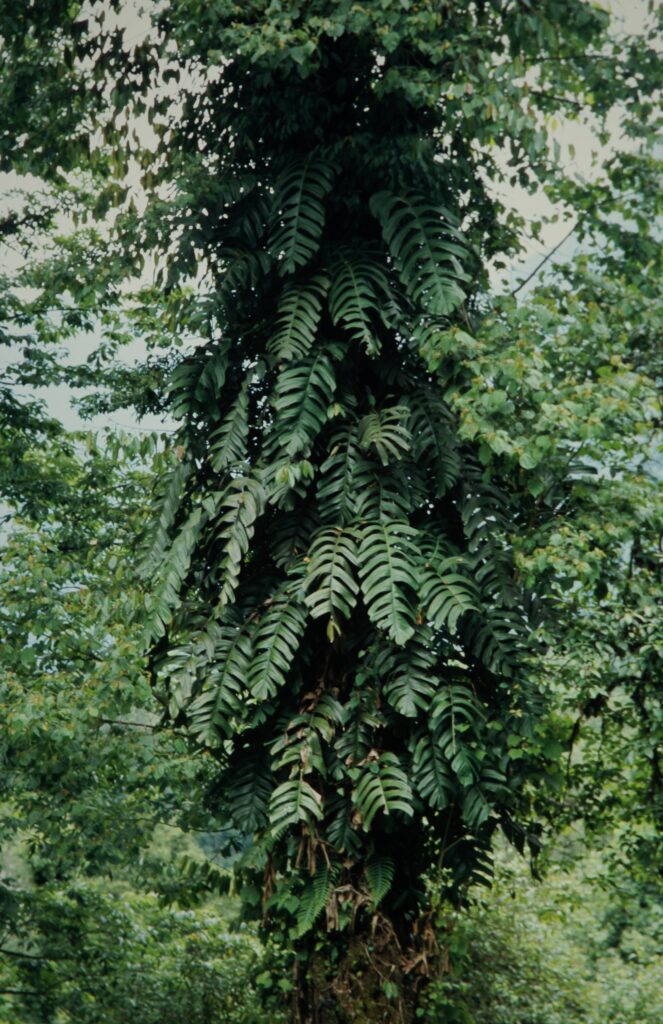
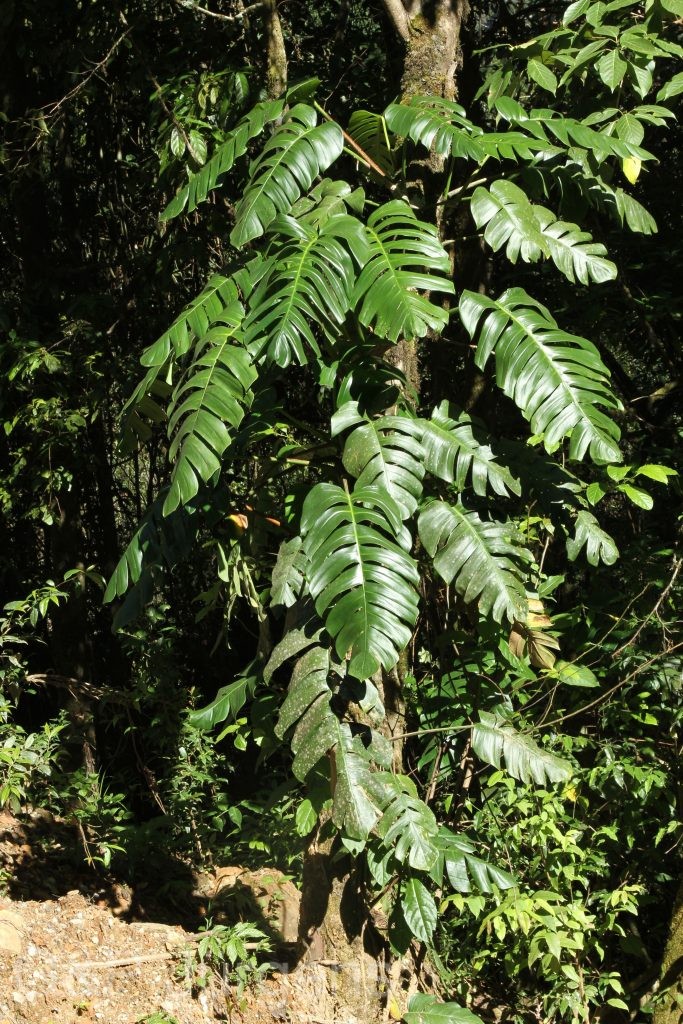
Description
Rhaphidophora decursiva ((Roxb.) Schott) is a robust root-climbing aroid widely distributed across tropical and subtropical Asia, ranging from the eastern Himalaya and northeast India through Bangladesh, Myanmar, Thailand, Laos, Vietnam and southern China to Sri Lanka and the Malay region. The roughly 700 GBIF records confirm a strong concentration in the Indo-Burmese hill forests. It is a hemiepiphyte of humid evergreen and semi-evergreen broad-leaved forest, climbing tree trunks and clambering over rocks in shaded, moist ravines from near sea level to about 2,000 m. The cited material from Ruigi-Chu in West Bengal at 1,800 m in May and from Galephug, Bhutan, at 800 m in October illustrates its wide altitudinal amplitude across the Himalayan foothills.
The plant produces stout, scandent stems that cling by abundant clasping adventitious roots, the internodes green to brownish and somewhat flattened against the support. The leaves are large and long-petiolate, the lamina ovate-oblong in juveniles but becoming deeply pinnatifid in adults, divided almost to the midrib into numerous decurrent segments that give the species its epithet. The inflorescence is a cylindrical spadix subtended by a thick, boat-shaped, yellowish to greenish spathe; the flowers are bisexual and naked, lacking a perianth, and the infructescence ripens into a dense cluster of berries.
The genus Rhaphidophora belongs to the tribe Monstereae and is distinguished from the Neotropical Monstera by its Old World distribution and bisexual flowers. R. decursiva is among the most widespread members of the genus and shows considerable leaf heteroblasty between juvenile shingling and mature pinnatifid stages. Locally the plant is used in traditional medicine and is occasionally grown as a foliage ornamental. It is common and not regarded as threatened.
Author: (Roxb.) Schott · Sources: POWO (Kew), Flora of Bhutan Vol. 3, GBIF, Flora of China Vol. 23, Boyce & Croat: The Überlist of Araceae (Monstereae)