Author

G & P Jürgens

D.Don

Garw 2005 166 ergebnis ergebnis
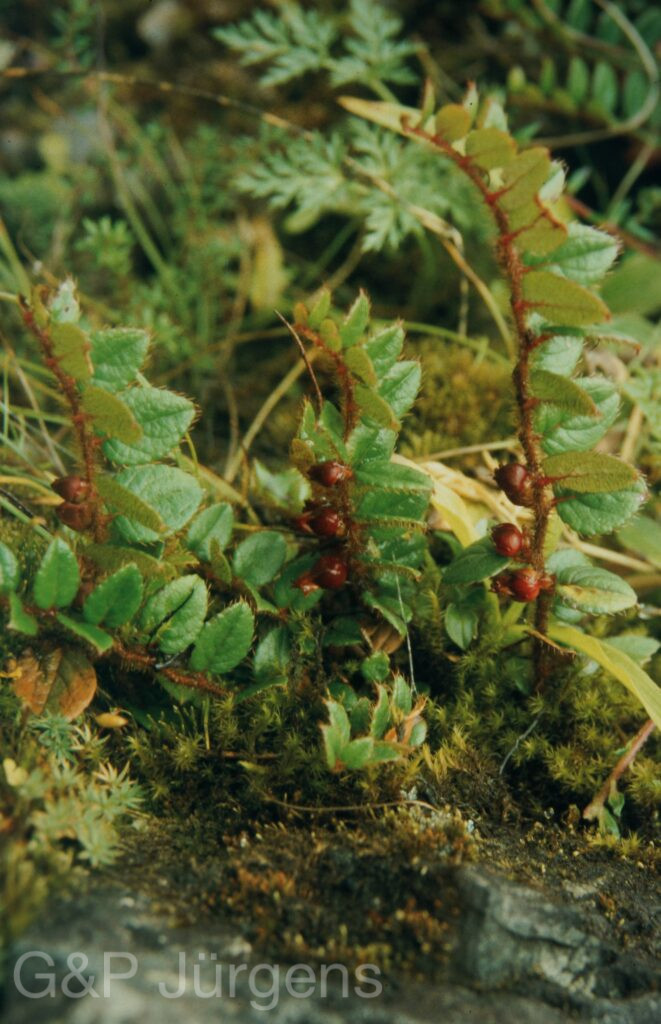
India Garhwal Shertoli 3200m, September

Description

Gaultheria nummularioides D.Don is a prostrate, creeping dwarf shrub of the temperate and subalpine Himalaya and adjacent mountains of East and Southeast Asia. Its range extends through Nepal, NE and NW India, Bhutan, Myanmar and SW China, with outlying records in Malesia (Indonesia, Malaysia) and cultivated occurrences in Japan, Great Britain and the United States; GBIF documents over 1,200 collections across this wide span. It typically grows between 2,000 and 4,000 m in mossy forest margins, on damp rocks, banks and epiphytically on tree trunks, as recorded for the photographed plant from Garhwal at Shertoli, 3,200 m, in September. It favours humid, shaded, acidic substrates and is a characteristic component of Rhododendron–oak understorey and bryophyte-rich rock communities.

The plant forms wiry, much-branched, reddish-brown procumbent stems clothed in stiff brown bristles, rooting at the nodes to form dense mats. Leaves are small, distichous, ovate to rounded (nummularioides referring to the coin-like blade), 5–12 mm long, coriaceous, dark green and glossy above, the margins finely toothed and ciliate. Flowers are solitary and axillary, pendent on short pedicels, the corolla campanulate to urceolate, white tinged pink, 4–5 mm long with five short recurved lobes; the calyx is often reddish. The fruit is a fleshy blue-black berry-like capsule enclosed by the accrescent succulent calyx.

The genus Gaultheria (subfamily Vaccinioideae) is notable for aromatic foliage rich in methyl salicylate; G. nummularioides is locally used as a fragrant and medicinal plant. Its broad Himalayan-to-Malesian distribution illustrates the floristic continuity of the Sino-Himalayan ericaceous element. The species is common and not of conservation concern across most of its range.

Author: D.Don · Sources: POWO (Kew), GBIF, Flora of China Vol. 14, Flora of Bhutan Vol. 2, Flora of Nepal, Airy Shaw: The Gaultheria-Pernettya complex (Kew Bulletin)
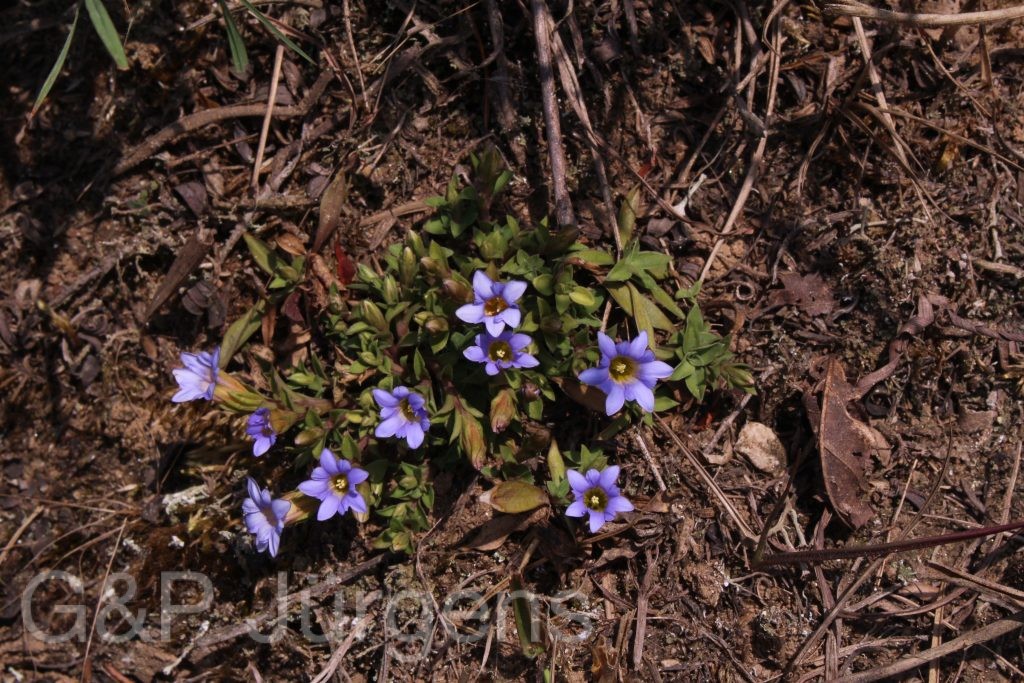
Royle

Nepal 95 380 P673 ergebnis
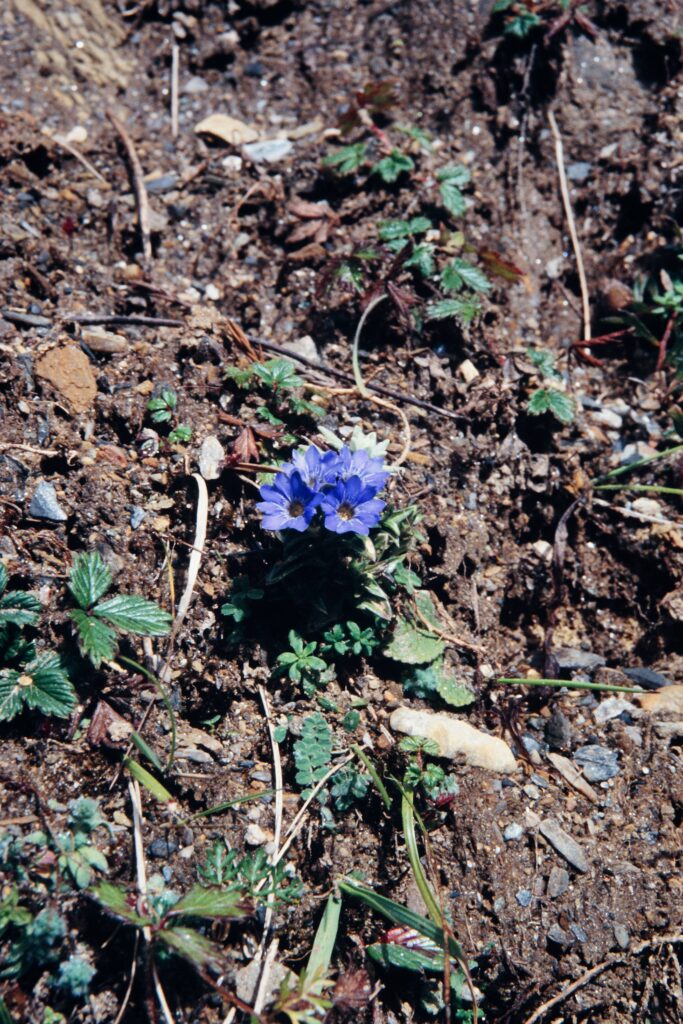
Nepal Jaisuli Kund 4200m, October

Description

Gentiana coronata is a Himalayan alpine gentian distributed across the western and central Himalaya, from Pakistan through northern India (Kashmir, Himachal Pradesh, Uttarakhand) to Nepal. GBIF records 52 occurrences from India, Pakistan, and adjacent regions. The species typically grows in alpine meadows, moist grassy slopes, and along stream margins at elevations of 3,500–4,800 m. The photograph from Jaisuli Kund in Nepal at 4,200 m, taken in October, captures the species in its characteristically late flowering season when most alpine herbs have already set seed.
The plant is an annual or biennial herb, 5–15 cm tall, with erect or ascending stems that are simple or sparingly branched from the base. Basal leaves are ovate to elliptic, forming a loose rosette; cauline leaves are opposite, sessile, ovate-lanceolate, 8–20 mm long, with acute apices. Flowers are solitary and terminal or few in upper leaf axils, sessile or subsessile. The calyx is tubular, 10–15 mm long, with five lanceolate lobes. The corolla is tubular-campanulate, 20–30 mm long, pale blue to deep azure, with conspicuous plicae (inter-lobe folds) that are fringed or laciniate, forming the corona-like structure alluded to in the specific epithet. Stamens five, inserted at the middle of the corolla tube. The capsule is stipitate, ellipsoid.
Gentiana coronata belongs to section Chondrophyllae and is part of a complex of small annual gentians that diversified extensively in the high-altitude environments of the Himalaya and Tibetan Plateau. Its late-season phenology is ecologically significant, as it provides nectar resources for pollinators at a time when floral availability is minimal. The species is considered locally common in suitable habitats but faces potential long-term threats from climate-induced shifts in alpine vegetation zones.

Sources: POWO (Kew), GBIF, Flora of Pakistan Vol. 197, Ho & Pringle: Gentianaceae in Flora of China Vol. 16

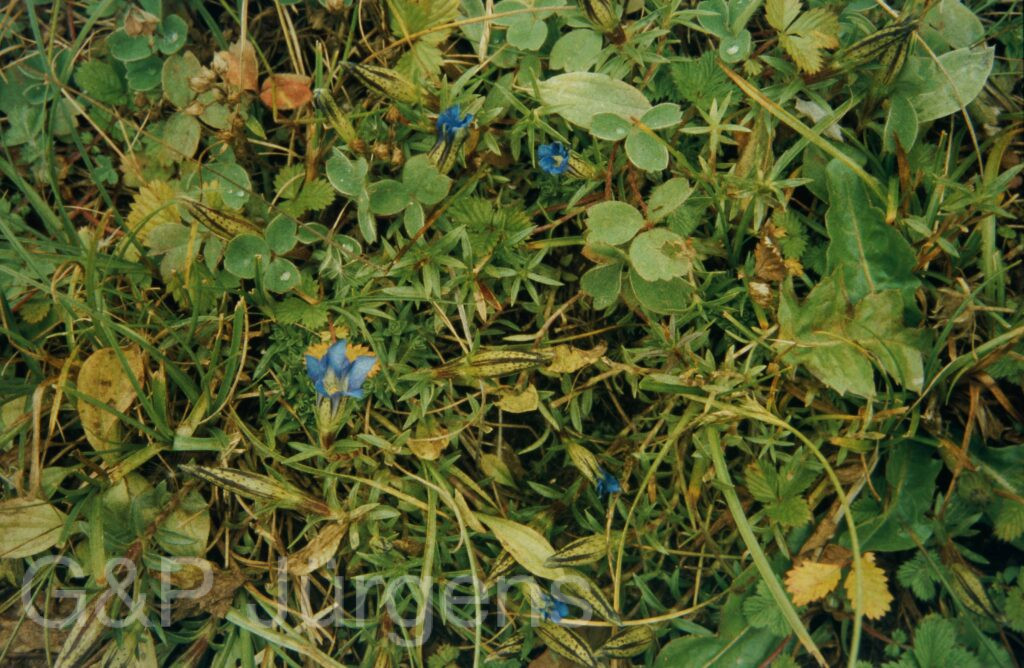
(G.Don) Griseb.

Bhutan2014 670
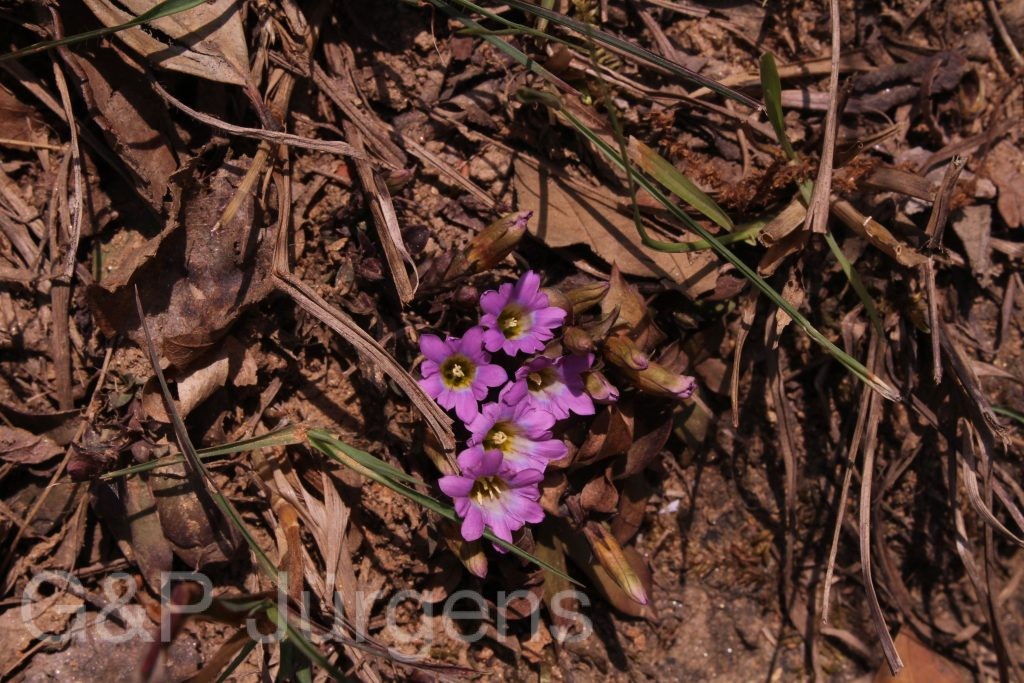
Bhutan Phobjika 2900m, May
Bhutan2014 671
Bhutan Phobjika 2900m, May

Description

Gentiana loureiroi is a small Asian gentian distributed from China and Hong Kong through Thailand, Laos, Vietnam and Myanmar to India and Bhutan, with more than 500 GBIF records making it one of the better-documented species in this account. It is a plant of open grassy places, pasture, roadside banks and moist montane meadows, generally in the lower and middle montane belt. The collection from Phobjika in central Bhutan at about 2900 m, flowering in May, typifies its occurrence in damp, short-turf glacial-valley grasslands where it appears early in the season among grazed sward.

The plant is a low, slender annual or short-lived perennial with prostrate to ascending, often branched stems forming small mats or tufts. The leaves are small, opposite, ovate to elliptic, sessile, with cartilaginous margins, the basal ones frequently forming a loose rosette. The flowers are solitary and terminal on the branchlets, with a tubular calyx of five lobes and a funnelform to salverform corolla that is typically blue to violet-blue, the five spreading lobes alternating with smaller plicate folds in the sinuses. The fruit is a stipitate capsule projecting from the withered corolla and releasing numerous minute seeds.

Described by G. Don and combined in Gentiana by Grisebach, G. loureiroi belongs to the largely small-flowered annual section of the genus characteristic of disturbed and grazed montane grassland. Its wide geographic and elevational range, tolerance of human-modified habitats and prolific seed production make it ecologically resilient and of least conservation concern across its extensive distribution.

Author: (G.Don) Griseb. · Sources: POWO (Kew), GBIF, Flora of China, Flora of Bhutan, Ho & Pringle's account of Gentiana

C.B.Clarke

Sikkim2003 526 P734
Sikkim Yume Samdong 4600m August

Description

Gentiana micans is an alpine gentian of the eastern and central Himalaya, with GBIF occurrences spanning southwest China, Bhutan, India and Nepal. It is a characteristic component of moist alpine meadow, seepage slopes and short turf above the treeline, generally between 3,500 and 4,800 m. The illustrated plant was recorded at Yume Samdong in northern Sikkim at about 4,600 m in August, coinciding with the late-monsoon flowering peak when these gentians carpet the high pastures alongside Primula, Pedicularis and Saxifraga.

The species is a small annual or short-lived herb with slender, ascending to erect stems often branching from the base and frequently tinged purple. The leaves are small, sessile, ovate to lanceolate and arranged in opposite pairs. The flowers are solitary and terminal on the branchlets, with a tubular to narrowly campanulate corolla that is brilliant deep blue, the five lobes spreading and separated by small plicate folds; the calyx is tubular with narrow teeth. The fruit is a stalked, two-valved capsule containing numerous minute seeds adapted to wind dispersal.

Gentiana micans belongs to the species-rich Himalayan assemblage of small annual gentians (section Chondrophyllae and allies), a group whose delicate taxonomy rests on corolla, calyx and seed characters. Though individually inconspicuous, these annuals are ecologically important early colonisers of disturbed and grazed alpine ground. The taxon is widespread and not considered threatened, but its meadow habitats are sensitive to overgrazing and to the shifting precipitation regimes of the monsoonal high Himalaya.

Author: C.B.Clarke · Sources: POWO (Kew), GBIF, Flora of China Vol. 16 (Gentianaceae), Grierson & Long: Flora of Bhutan Vol. 2, Ho & Liu: A Worldwide Monograph of Gentiana

Burkill

Sikkim2011 105
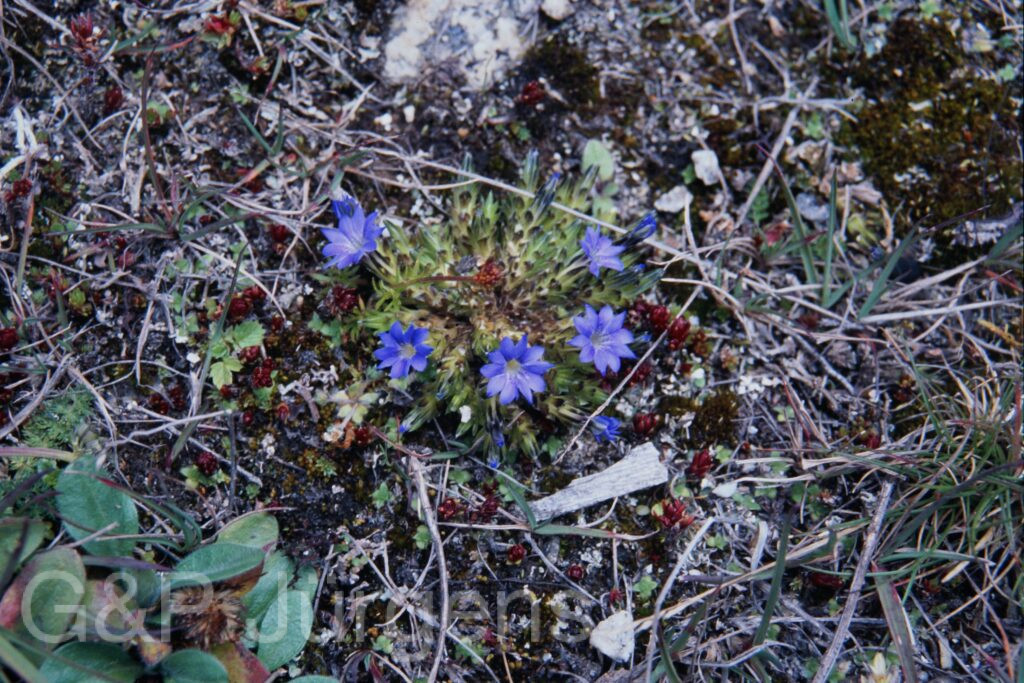
Sikkim Chopta-valley 4200m, June
Bhutan2014 908
Bhutan Chele-La 3700m, May

Description

Gentiana micantiformis Burkill is a diminutive alpine gentian of the high Sino-Himalaya, recorded from China, Nepal, Bhutan, India and Japan (gbif_countries: CN, NP, BT, IN, JP) with a modest 59 occurrences in GBIF, reflecting both its small stature and restricted high-elevation range. It inhabits short alpine turf, open stony slopes, moist meadows and the margins of snow-melt flushes, generally between about 3500 and 4500 m. The image data, from the Chopta valley in Sikkim at 4200 m in June and Chele-La in western Bhutan at 3700 m in May, place it firmly in the early-season alpine zone where it flowers as the snow recedes.

It is a small annual or short-lived herb forming low tufts, with slender, often branched stems. The leaves are small, opposite, ovate to oblong and crowded toward the base, frequently with cartilaginous mucronate tips and white membranous margins. The flowers are solitary or few at the stem apices, with a tubular-campanulate, lobed calyx and a tubular-funnelform corolla that is blue to pale blue-violet, the lobes alternating with smaller plicate folds (plicae) characteristic of section Chondrophyllae. The capsule is stipitate and many-seeded, dehiscing to release minute seeds.

Gentiana section Chondrophyllae comprises numerous small annual Asian gentians whose delimitation is notoriously difficult, and the epithet signals close affinity with G. micans. Flowers open in bright sun and close in cold or cloud, a heliotropic adaptation typical of high-alpine gentians and aiding warmth-dependent insect pollination. Although nowhere abundant, the species is widely scattered across the high ranges and is not regarded as threatened.

Author: Burkill · Sources: POWO (Kew), GBIF, Flora of China (Gentianaceae), Flora of Bhutan, Ho & Liu monograph A Worldwide Monograph of Gentiana

Harry Sm.

Bhutan2015 660
Bhutan Chele-La 4000m, October
Bhutan2015 662
Bhutan Chele-La 4000m, October
Bhutan2012 280
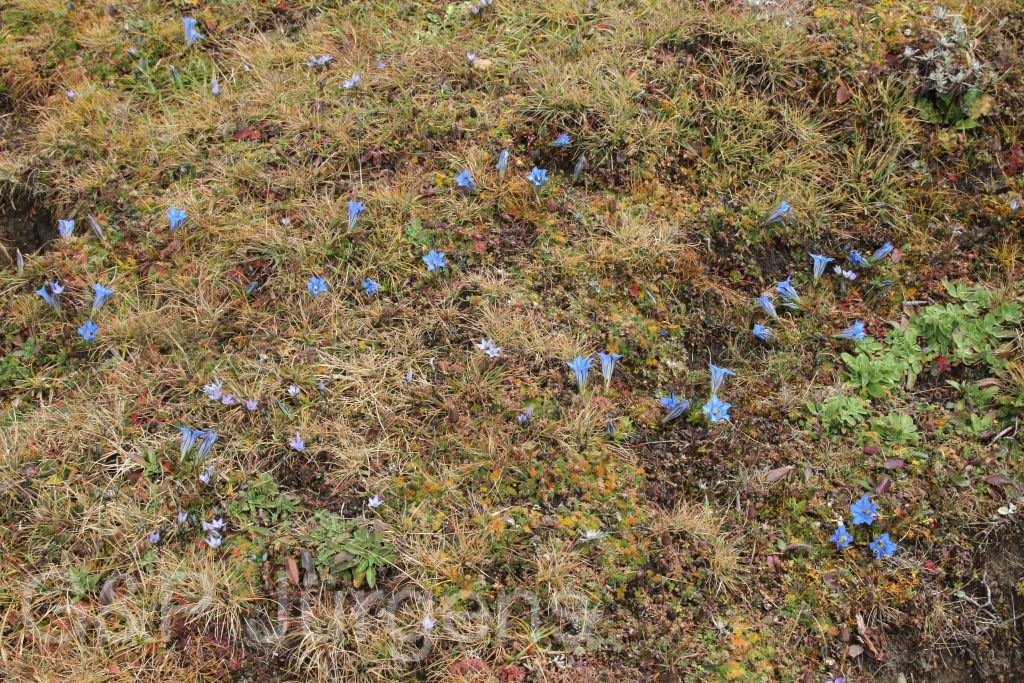
Bhutan Shele-La, 4100m September

Description

Gentiana oreodoxa is an eastern Himalayan and southwest Chinese alpine gentian recorded from China, Myanmar, Bhutan and India, a comparatively narrow distribution reflected in its modest GBIF tally of about 81 occurrences. It grows in alpine turf, open grassy slopes and rocky meadows of the high mountains, characteristically at and above 4000 m. The plants photographed at Chele-La (about 4000 m, October) and Shele-La (about 4100 m, September) in Bhutan exemplify its preference for short alpine grassland near the upper passes, where it flowers late in the season as autumn approaches.

The species is a small tufted perennial with a short rootstock giving rise to clustered, prostrate to ascending flowering stems and basal rosettes. The leaves are small, narrowly elliptic to oblanceolate, leathery and densely imbricate below, with cartilaginous-thickened margins. The flowers are solitary or few at the stem tips, the campanulate to narrowly funnel-shaped corolla deep blue with plicate folds (plicae) between the lobes, the calyx tubular with short teeth. The fruit is a stalked, bivalved capsule releasing numerous small seeds.

Gentiana oreodoxa belongs to the large autumn-flowering assemblage of dwarf alpine gentians (section Frigida and allies) that dominate the high turf of the Sino-Himalaya. These plants are well adapted to short growing seasons and intense radiation, opening their corollas in sunshine and closing in cold or cloud. With a restricted eastern Himalayan range it is a regional specialist; though not formally assessed as threatened, its confinement to high alpine habitats makes it a useful indicator of montane ecosystem integrity under a warming climate.

Author: Harry Sm. · Sources: POWO (Kew), GBIF, Flora of China, Flora of Bhutan, Annotated Checklist of the Flowering Plants of Nepal, Ho & Liu monograph of Gentiana

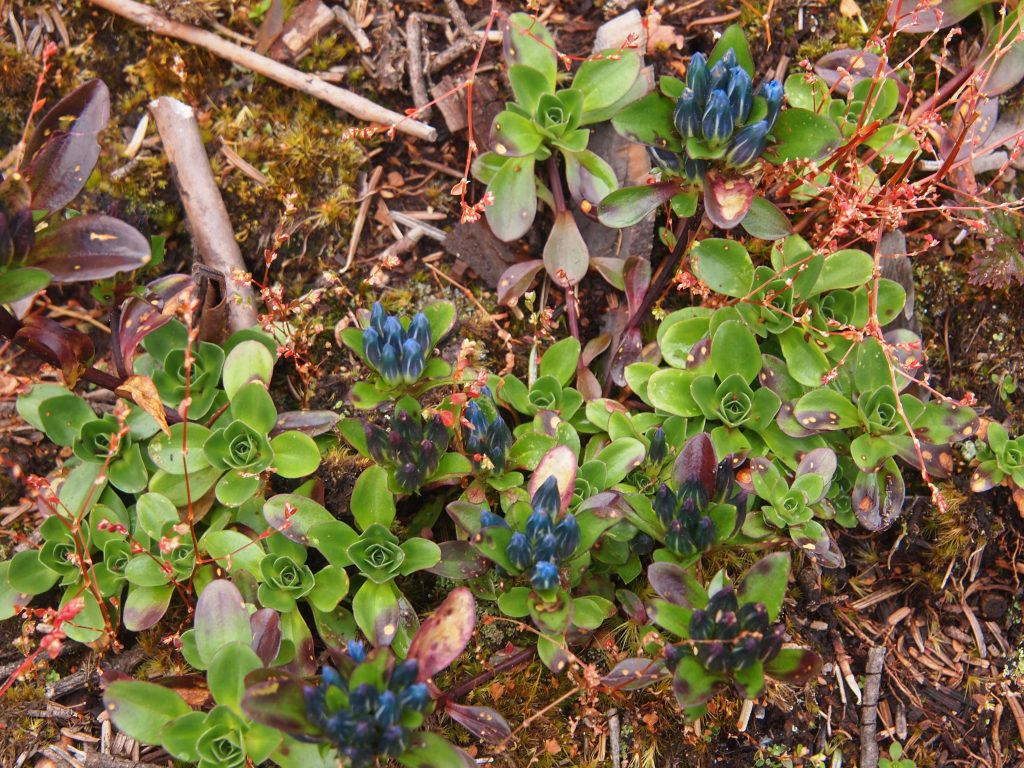
C.B.Clarke

Bhutan2012 913
Bhutan Tumching-La 4100m, October

Description

Gentiana sikkimensis is an eastern Himalayan and Sino-Himalayan gentian recorded from China, India, Nepal and Bhutan, with nearly 200 georeferenced occurrences in GBIF. It is a characteristic plant of alpine turf, open moist meadows and the margins of dwarf-shrub heath in the high mountains, generally between about 3500 and 4500 m. The illustrated plant from Tumching-La in Bhutan at 4100 m, flowering in October, reflects the genus's late autumnal flowering, when these small gentians colour the alpine sward after the main summer bloom has passed.

It is a small tufted perennial herb with a short caudex and slender, ascending to decumbent flowering stems. The basal leaves form a rosette and are narrowly oblong to spathulate, while the cauline leaves are smaller, opposite and sessile, with cartilaginous margins. The flowers are solitary or few in terminal clusters, the campanulate to narrowly funnelform corolla deep blue with paler longitudinal bands and bearing well-developed plicae (folds) between the lobes. The calyx is tubular with unequal lobes, and the fruit is a stipitate, two-valved capsule releasing numerous small seeds.

The species belongs to Gentiana section Frigida (or allied sections of the autumn-flowering Asian gentians), a group much diversified across the Qinghai-Tibetan Plateau and its margins. It is widespread and not regarded as threatened, although alpine gentians of this kind are sensitive to overgrazing and to the upward shift of vegetation belts under a warming climate, making long-term monitoring of high-elevation populations worthwhile.

Author: C.B.Clarke · Sources: POWO (Kew), GBIF, Flora of Bhutan, Flora of China, Ho & Pringle monograph of Gentiana

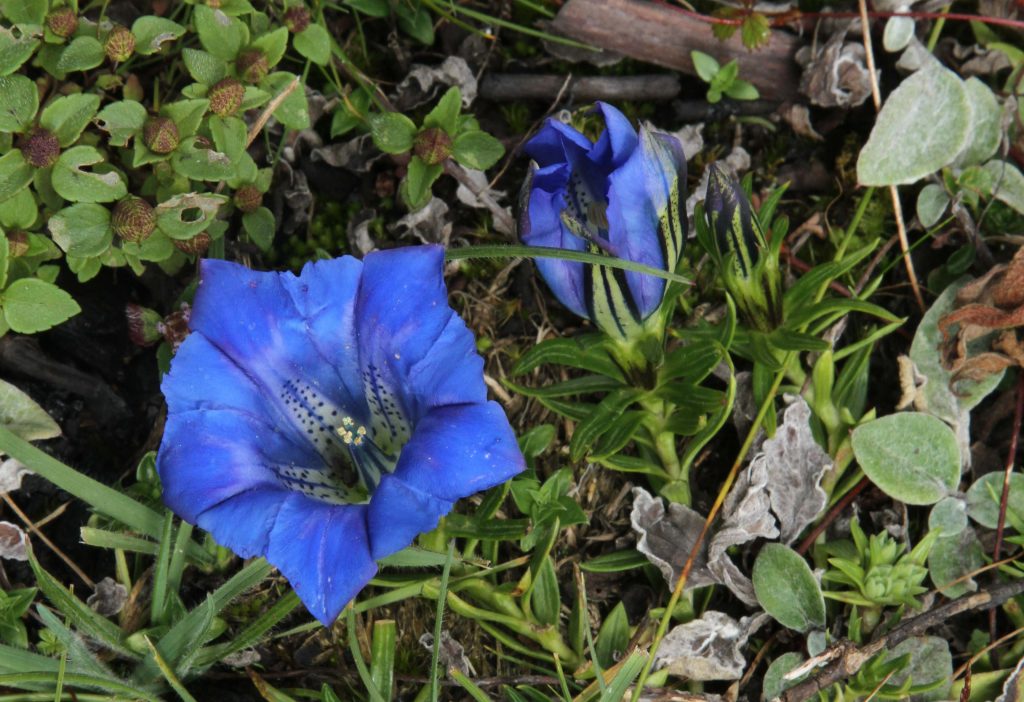
Edgew.

Garw 2005 356 ergebnis
India Garhwal Baganathi 3900m, September

Description

Gentiana stipitata Edgew. is a small alpine gentian endemic to the Sino-Himalayan region. GBIF data (some 239 occurrences) place it across the high mountains of China, India, Nepal, Bhutan and Taiwan, where it inhabits alpine and subalpine meadows, open turf, moist grassy slopes and the margins of seasonal snow-melt flushes. It is a plant of high elevations, typically between 3,000 and 4,500 m. The individual photographed at Baganathi in Garhwal (NW India) at 3,900 m in September captures it in late-season flower, when many high-altitude gentians provide a final burst of colour before the onset of winter.

The species is a low, tufted perennial herb with a slender rootstock and basal rosettes of narrowly lanceolate to spathulate leaves. The flowering stems are short and often several, each bearing a solitary, erect, narrowly funnel-shaped to campanulate corolla. The corolla is blue to purplish-blue, frequently with greenish or pale spotting in the throat, the five lobes alternating with smaller plicate folds (plicae) characteristic of section Frigida-allied gentians. The calyx is tubular with linear lobes, and the fruit is a stipitate capsule, the elongate gynophore (the stipe) giving the species its epithet and a useful diagnostic feature; seeds are numerous and small.

Gentiana stipitata belongs to the species-rich autumn-flowering Himalayan gentians and is distinguished from related taxa by its conspicuously stipitate capsule and floral proportions. Like many high-alpine gentians it is closely tied to short cool growing seasons and snow-influenced microhabitats. Though not assessed as threatened, its restricted high-elevation habitat makes it sensitive to alpine warming and grazing pressure across its range.

Author: Edgew. · Sources: POWO (Kew), Flora of China Vol. 16, Flora of Bhutan Vol. 2, GBIF, Ho & Liu: A Worldwide Monograph of Gentiana (2001)

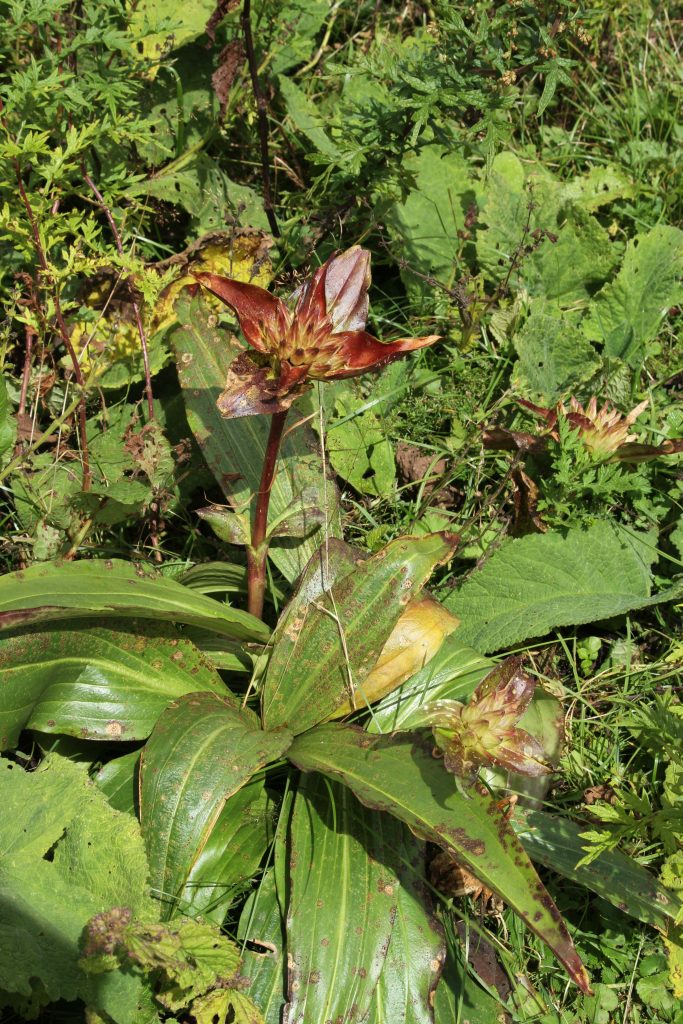
King ex Hook.f.

Bhutan2012 261
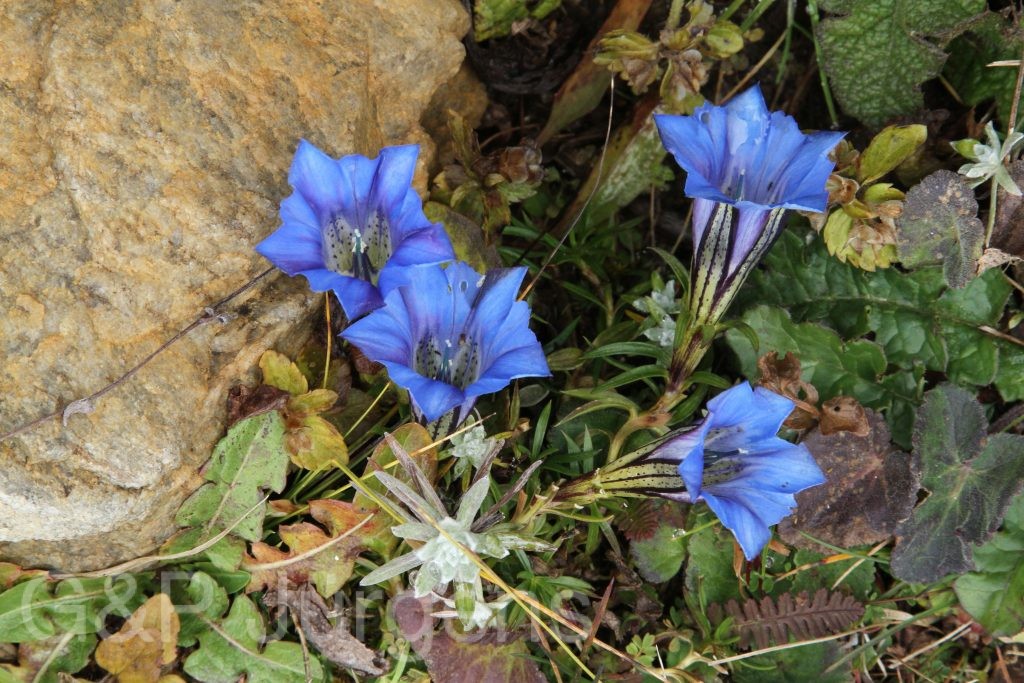
Bhutan Shele-La, 4100m September

Description

Gentiana tibetica is a robust perennial gentian of the high Himalaya and Tibetan Plateau, native to China (notably Xizang and Qinghai), Bhutan and Nepal; the scattered European, Korean and Japanese GBIF records derive from cultivation and herbaria rather than wild populations. It occupies the alpine and upper subalpine zone, growing in moist meadows, grassy hillsides, scrub margins and open stony slopes. The cited collection from Shele-La in Bhutan at about 4100 m in September places it among the late-flowering high-altitude flora of the eastern Himalaya, where it endures cold nights and a short growing season.

The plant is a stout, erect perennial herb forming a basal rosette from a thick rootstock. The basal and lower stem leaves are large, broadly elliptic to oblong-lanceolate, prominently several-veined and narrowed to a sheathing base, the cauline leaves becoming smaller and bract-like upward. The flowers are numerous and sessile, crowded into dense terminal and axillary clusters subtended by leafy bracts. Each flower has a membranous calyx and a tubular to narrowly funnelform corolla that is pale yellowish-white to greenish, often spotted, with short erect lobes and small plicate folds (plicae) between them. The fruit is a stipitate bivalved capsule releasing numerous small winged seeds.

Gentiana tibetica belongs to section Cruciata of the genus, the cluster-flowered gentians, and was described by King from Hooker's material. The pale tubular flowers are pollinated chiefly by bumblebees adapted to the cold montane climate. Like several large-rooted gentians it has a history of medicinal use of its bitter roots. Widespread and locally common on the plateau and its Himalayan rim, it is not considered threatened.

Author: King ex Hook.f. · Sources: POWO (Kew), GBIF, Flora of China, Flora of Bhutan, Ho & Liu's monograph of the Gentians of China (Gentiana)

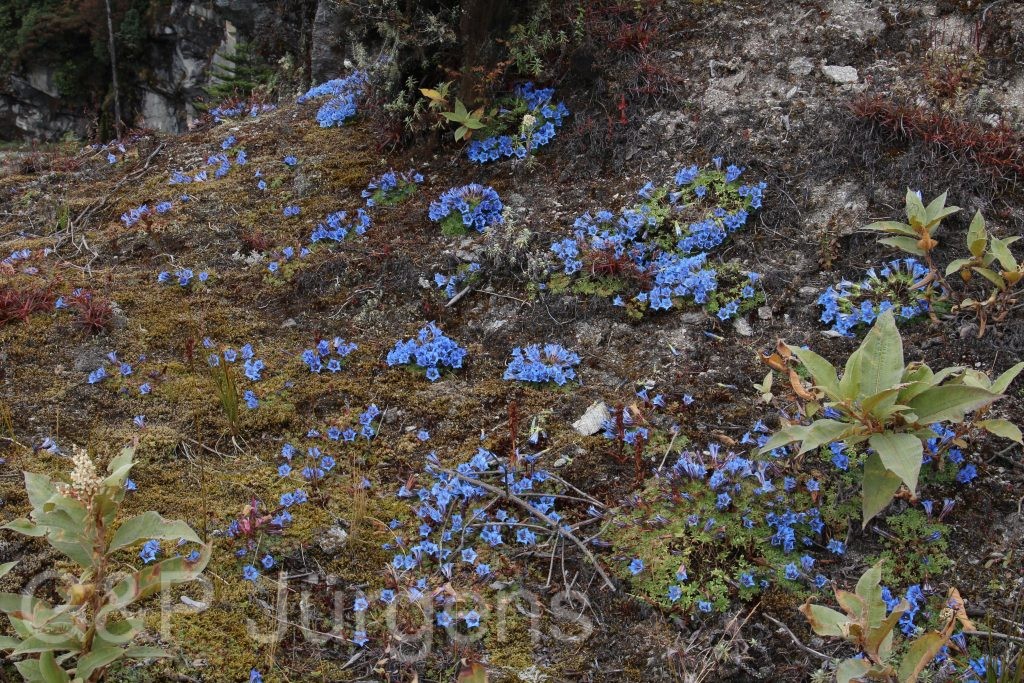
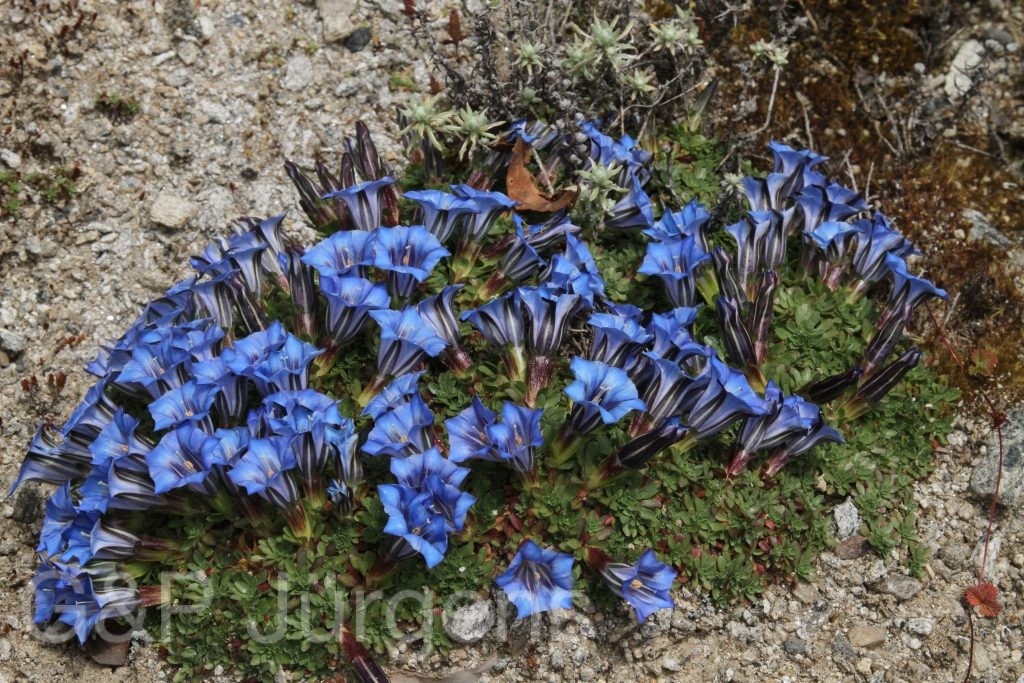
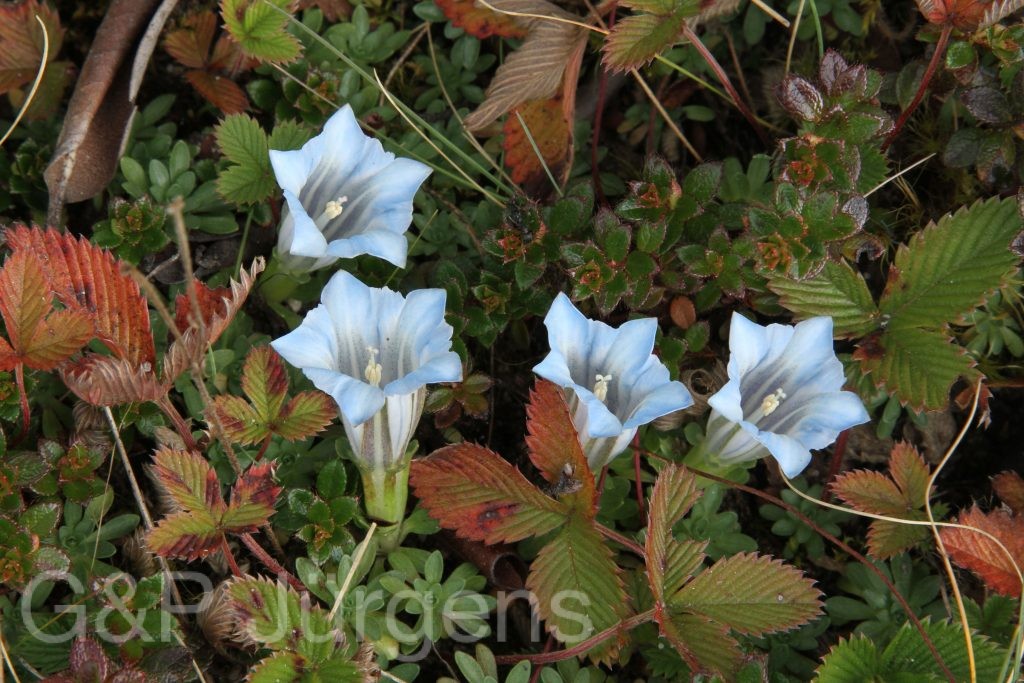
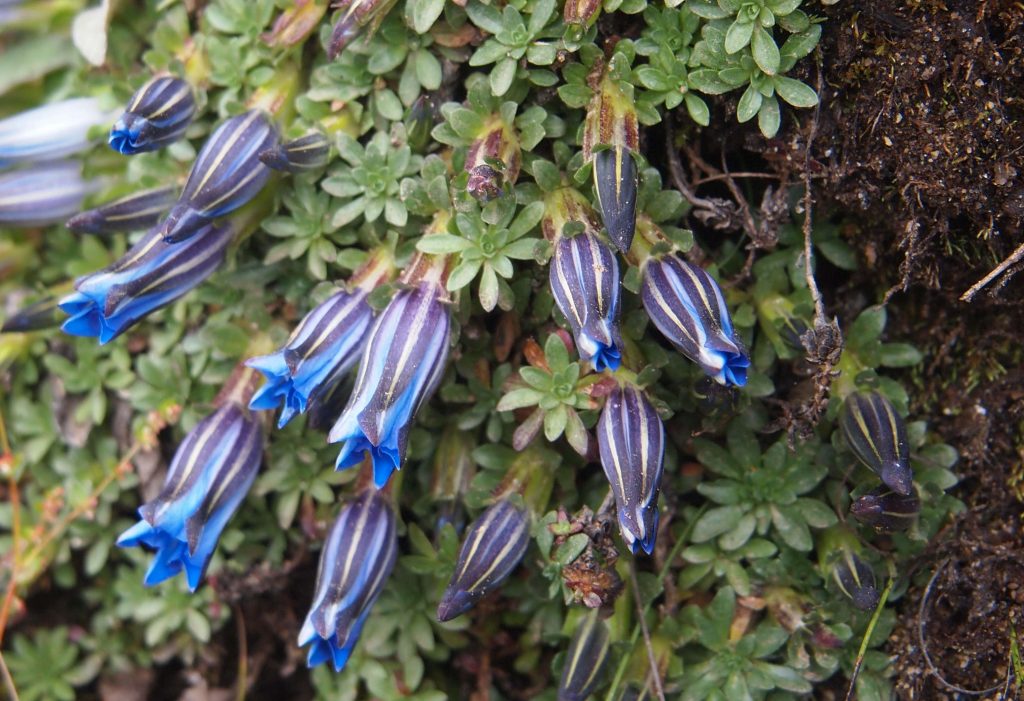
(G.Don) Griseb.

Bhutan2015 374
Bhutan Tumching-La 4000m, October
Bhutan2015 376
Bhutan Tumching-La 4000m, October
Bhutan2015 381
Bhutan Tumching-La 4000m, October
Bhutan2012 921
Bhutan Tumching-La 4000m, October

Description

Gentiana tubiflora is a dwarf alpine gentian of the Himalaya and the Tibetan plateau, recorded by GBIF from Nepal, India, Bhutan and China (a Malaysian datum is likely erroneous) across some 124 occurrences. It is a plant of high open ground: alpine turf, short grazed pastures, damp meadows, gravelly flushes and moist slopes near the upper limit of vegetation, typically between about 3500 and 4500 m. The specimen photographed at Tumching-La in Bhutan at 4000 m in October, flowering very late in the season, illustrates its tolerance of cold and its occupation of exposed, well-watered high-alpine grassland.

It is a small, tufted perennial herb forming low cushions or mats from a slender rootstock, with short, often prostrate to ascending leafy shoots. The leaves are small, opposite, linear to narrowly oblong, crowded and somewhat rigid, with cartilaginous margins. The flowers are solitary and terminal, the corolla narrowly tubular as the epithet indicates, with five short erect lobes alternating with small plicate folds, and coloured deep to pale blue. The calyx is tubular with narrow lobes, the stamens are inserted within the corolla tube, and the fruit is a stalked capsule that releases numerous minute seeds.

Gentiana is a large genus whose section of small-flowered, tube-corolla'd alpine species is especially diverse across the Sino-Himalaya, and G. tubiflora is a characteristic member of that high-elevation assemblage. The narrow tubular corolla and folds between the lobes channel access to specialised pollinators and protect the nectar, while the compact mat habit buffers the plant against wind and cold. The species is widespread and not regarded as threatened, forming a familiar element of late-flowering Himalayan alpine meadows.

Author: (G.Don) Griseb. · Sources: POWO (Kew), GBIF, Flora of China (Gentianaceae), Flora of Bhutan, Annotated Checklist of the Flowering Plants of Nepal, Ho & Liu monograph of Gentiana