Author

G & P Jürgens

(G.Don) Wall. ex Griseb.
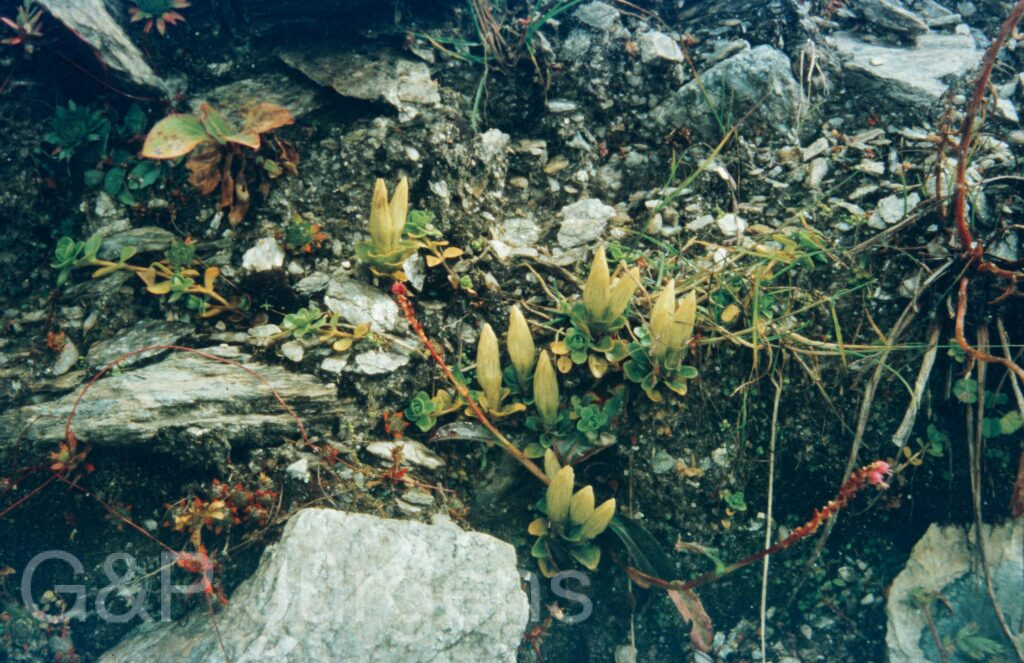
Garw 2005 330 ergebnis
India Garhwal Bagubasa 4100m, September

Description

Gentiana venusta is a Himalayan alpine gentian ranging through India, Nepal, Pakistan and Bhutan, with about 103 documented occurrences tracing a broad arc along the high Himalaya from the western to the eastern ranges. It is a strict alpine, growing on open grassy slopes, alpine meadows, moist turf and stony pastures above the treeline, generally between roughly 3500 and 4500 m. The illustrated plant from Bagubasa in Garhwal at 4100 m, flowering in September, exemplifies its late-monsoon to early-autumn flowering, when these dwarf gentians colour the short alpine sward after the snow-fed turf has been grazed and the meadows begin to dry.

It is a small tufted annual or short-lived perennial forming low rosettes from which arise several decumbent to ascending, few-flowered stems. The leaves are small, sessile, obovate to spathulate and crowded basally, the cauline pairs more distant and lanceolate, with a narrow cartilaginous margin. The flowers are solitary or few, terminal, with a tubular calyx whose lobes are unequal, and a narrowly funnelform to club-shaped corolla that is pale blue, whitish or yellowish, often spotted within, with short erect lobes and conspicuous plicate, fimbriate to bifid intervening folds (plicae). The fruit is a stipitate, bivalved capsule containing numerous minute, smooth seeds.

The species belongs to Gentiana sect. Chondrophyllae, the large group of small-flowered annual Himalayan and Sino-Himalayan gentians, a notoriously difficult complex in which G. venusta is distinguished by floral and plical characters. The name G. venusta (G.Don) Wall. ex Griseb. is accepted. Flowering is closely tied to snowmelt and monsoon timing, and pollination is by small insects; the diminutive seeds are dispersed by wind and water. It is widespread and of least conservation concern.

Author: (G.Don) Wall. ex Griseb. · Sources: POWO (Kew), GBIF, Flora of Bhutan Vol. 2, Flora of Pakistan, Flora of Nepal, Ho & Liu A Worldwide Monograph of Gentiana
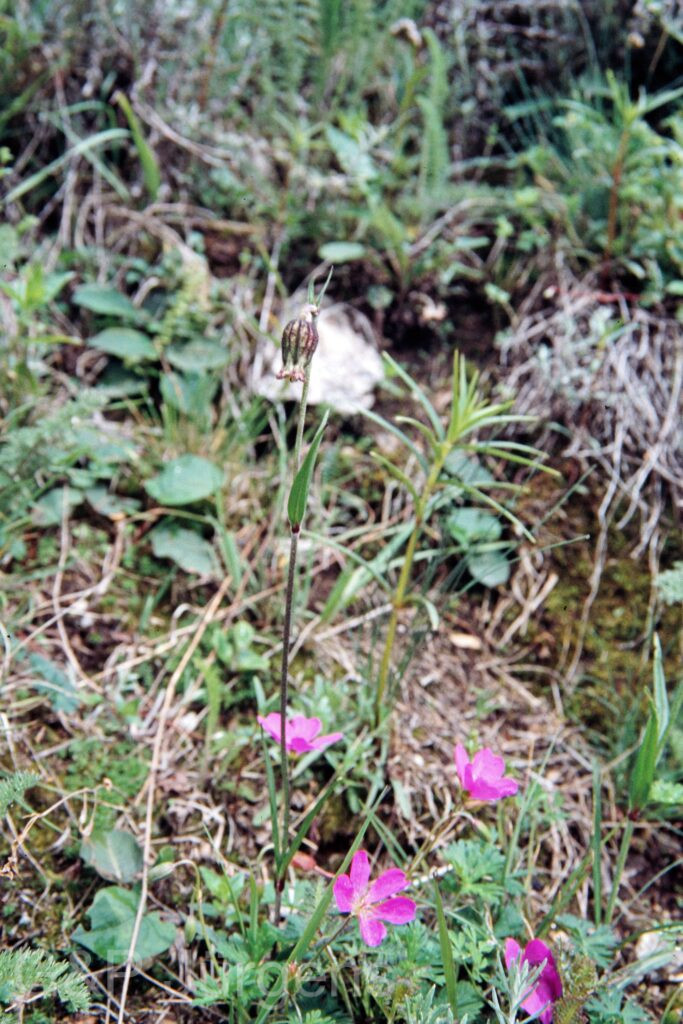
(Lam.) Schltr.

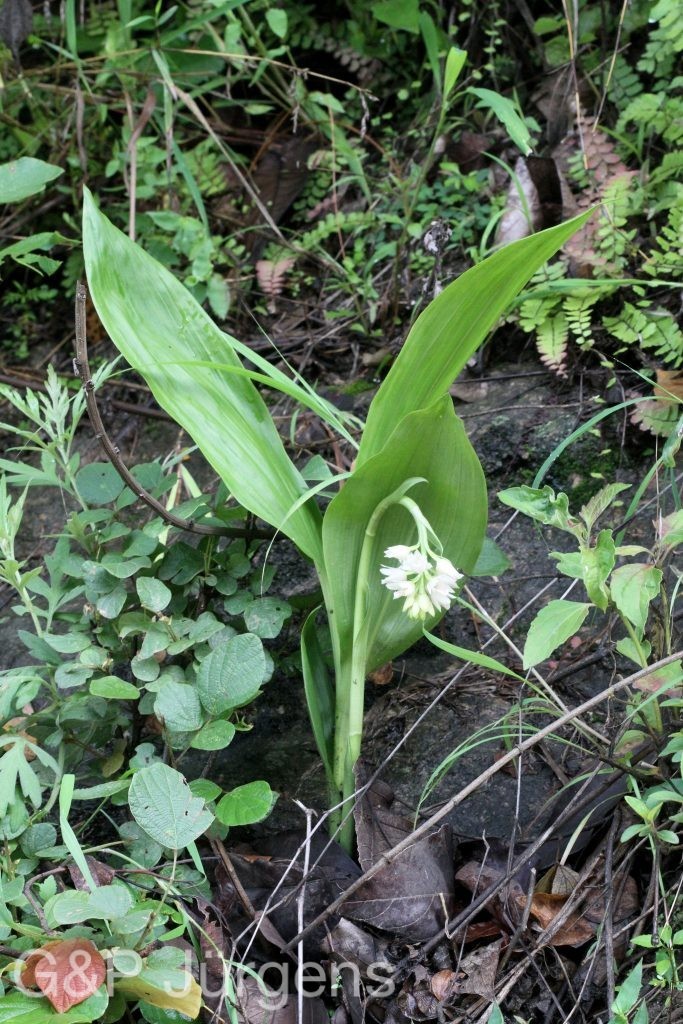
Geodorum densiflorum ergebnis
Bhutan Paro, 2400m June

Description

Geodorum densiflorum is a widespread terrestrial orchid ranging across tropical and subtropical Asia and into the Pacific, recorded from India, Nepal, Bhutan, Sri Lanka, China, Japan, Taiwan, Thailand, Vietnam, Malaysia, Indonesia, the Philippines, New Guinea, Australia and numerous islands, with well over a thousand documented occurrences. It grows in open deciduous and bamboo forest, grassy slopes, scrub and roadside banks, usually in seasonally dry, well-drained ground from the lowlands to mid-elevations. The plant photographed near Paro in Bhutan at 2400 m in June represents the upper part of its altitudinal range, flowering with the onset of the monsoon.

The species arises from underground, corm-like pseudobulbs that store water and reserves through the dry season. The leaves are few, large, broadly elliptic-lanceolate and plicate, with prominent parallel venation, narrowed to a petiole-like base and often appearing with or after the flowers. The inflorescence is unmistakable: a stout scape terminating in a dense, sharply nodding or recurved raceme so that the flowers face downward, the apex curving over before erecting in fruit. The flowers are pink to white with a pouched, whitish labellum marked yellow or purple within. The column is short and the fruit a pendent capsule.

In GBIF the name appears as a synonym, with Geodorum densiflorum treated as the accepted name; the species is the type of the small palaeotropical genus Geodorum within tribe Cymbidieae, distinguished by its characteristic nodding inflorescence. Its wide range, ecological tolerance and frequent occurrence in disturbed habitats make it relatively secure, though, like all orchids, it is listed on CITES Appendix II.

Author: (Lam.) Schltr. · Sources: POWO (Kew), GBIF, Flora of China, The Orchids of Bhutan (Pearce & Cribb), Flora of British India, CITES Appendices

Stephan ex Willd.

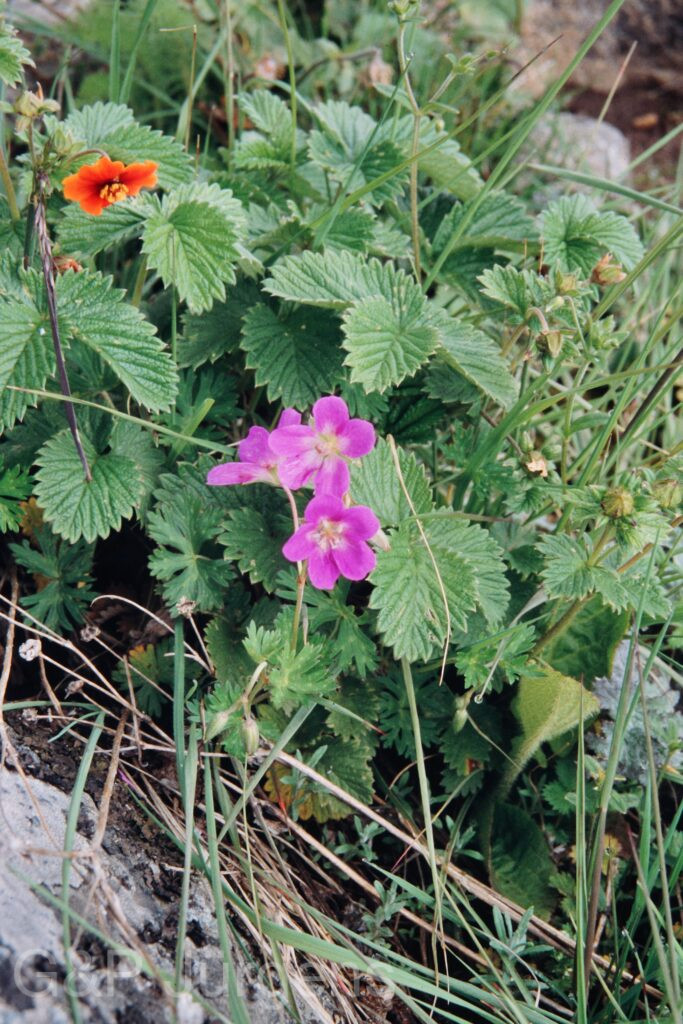
Nepal 99 259 ergebnis
West-Nepal Loccu 3400m, June
Nepal 99 342 ergebnis
West-Nepal Kalmura 3800m, June

Description

Geranium collinum (Stephan ex Willd.) is a perennial cranesbill of wide continental distribution, ranging from eastern Europe and the Caucasus through Russia, Turkey, Iran and Central Asia (Kazakhstan, Kyrgyzstan, Tajikistan, Uzbekistan) into Afghanistan, Pakistan, the western Himalaya and western China and Mongolia. The roughly 3,200 GBIF records trace a steppe-and-mountain belt across temperate Asia. It is characteristic of moist alpine meadows, damp grassland, streamsides and open subalpine slopes, typically between 2,500 and 4,000 m, as shown by the West Nepal collections from Loccu at 3,400 m and Kalmura at 3,800 m, both in June at the height of the monsoon-flush flowering season.

The plant grows from a stout, woody, branched rootstock and produces ascending to decumbent, much-branched stems clothed in spreading, often retrorse hairs. The leaves are long-petiolate and palmately divided into five to seven deeply incised, oblong-cuneate lobes, the upper cauline leaves becoming shortly stalked and smaller. The flowers are borne in lax, paired cymes; the five petals are pale pink to lilac-purple, obovate and slightly notched, conspicuously veined with darker lines. The fruit is the characteristic geraniaceous schizocarp with a long beak (rostrum), splitting at maturity into five awned mericarps that disperse the seeds by an explosive ballistic mechanism.

Geranium collinum belongs to a taxonomically complex group of pink-flowered perennial cranesbills and is somewhat variable in leaf dissection and indumentum across its vast range, having given rise to numerous infraspecific names. Its presence in alpine pastures makes it a component of high-altitude grazing communities, and the tannin-rich rootstock has been used in folk medicine. The species is widespread and not of conservation concern.

Author: Stephan ex Willd. · Sources: POWO (Kew), Flora of Pakistan, GBIF, Flora of China Vol. 11, Yeo: Hardy Geraniums (2002)

Sweet

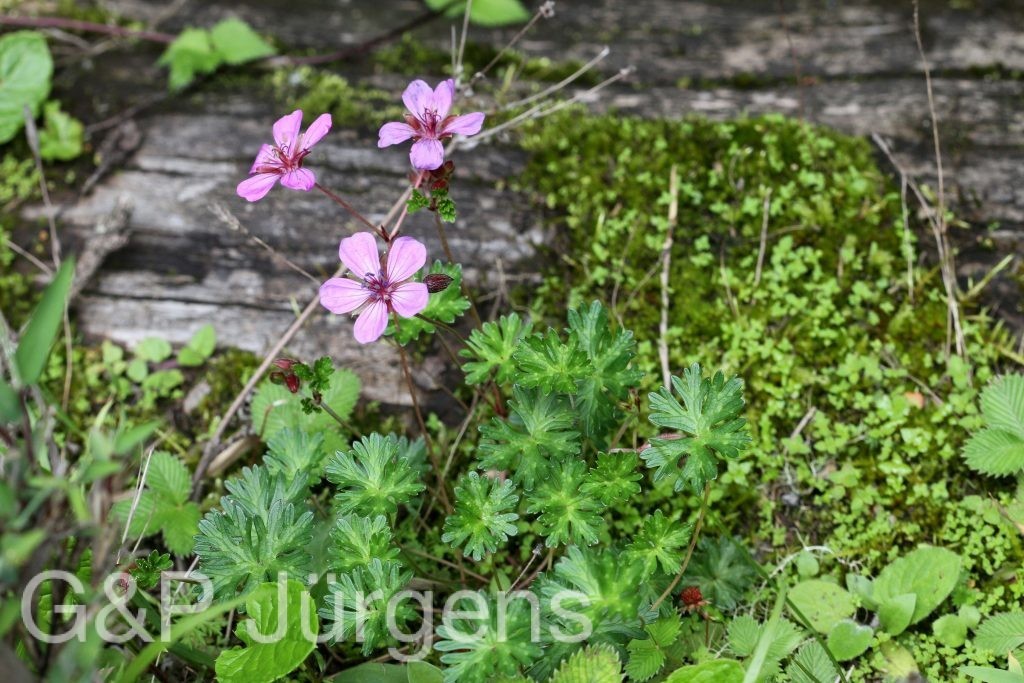
BhutanPG2011 106
Bhutan Tsochenchen, 3450m June
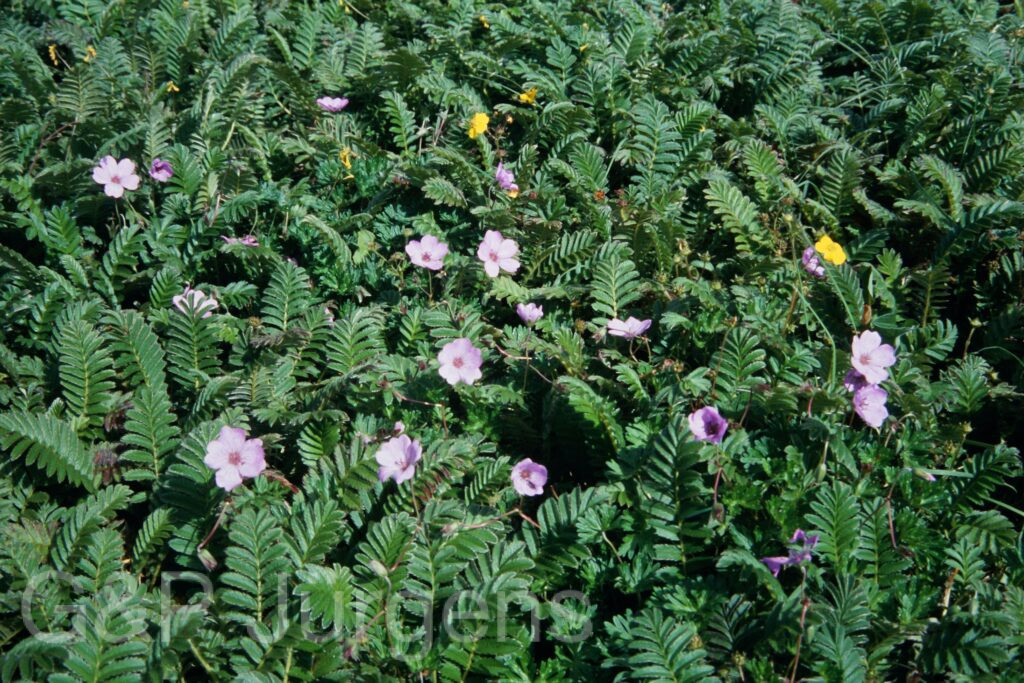
Sikkim2003 181 G247
Sikkim Dzongri 4100m 08.2003

Description

Geranium donianum is an alpine cranesbill of the Himalaya and southwestern China, recorded by GBIF from China, Nepal, India, Bhutan and Myanmar across roughly 795 occurrences. It grows in alpine and subalpine meadows, open grassy slopes, scrub margins and stony turf, generally at high elevations where it forms part of the herb-rich alpine sward. The photographed plants were found in Bhutan at Tsochenchen at 3450 m in June and in Sikkim at Dzongri at 4100 m in August, situations typical of its preference for sunny, well-drained montane grassland through the brief alpine summer.

It is a low, tufted perennial arising from a stout, often woody rootstock, with somewhat spreading, hairy stems. The leaves are orbicular to reniform in outline and palmately divided nearly to the base into several wedge-shaped, deeply lobed segments, the lobes again toothed; basal leaves are long-petiolate. The flowers are relatively large and showy, with five free, obovate petals that are typically deep pink to purplish-red and conspicuously darker-veined, sometimes notched at the apex. There are ten stamens and a five-lobed superior ovary; the fruit is the characteristic beaked schizocarp of the genus, whose mericarps separate elastically at maturity to fling out the seeds.

GBIF accepts the name. Within Geranium it belongs among the Himalayan alpine cranesbills allied to G. orientali-tibeticum and related taxa, a group well represented across the high ranges. The vivid dark-veined petals serve as nectar guides for bee and fly pollinators. Widespread and locally common in alpine pastures, G. donianum is assessed as of least conservation concern.

Author: Sweet · Sources: POWO (Kew), GBIF, Flora of Nepal, Flora of China, Yeo monograph of Geranium

L.

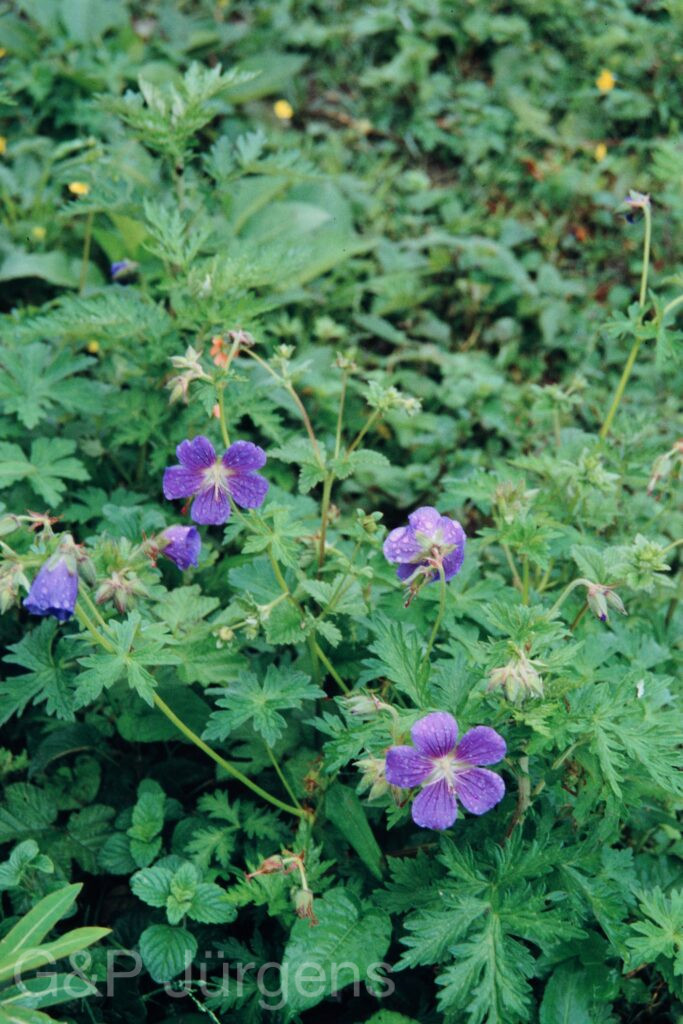
Nepal 99 89 ergebnis
West-Nepal Bhulbhule 3500m, June

Description

Geranium pratense, the meadow cranesbill, is a widespread perennial of temperate Eurasia. With over 190,000 GBIF occurrences it is abundantly documented across Britain, Germany, France, the Nordic and Baltic states, the Low Countries, central Europe and Russia, extending through Central Asia to the Himalaya. It grows in moist meadows, grassy slopes, streamsides and open woodland margins. In the high Himalaya it ascends to subalpine pastures; the illustrated plant was photographed at Bhulbhule in western Nepal at about 3,500 m, flowering in June, where it is a characteristic component of moist alpine-meadow turf during the early monsoon.

The plant forms a stout, branched rootstock bearing erect, glandular-pubescent stems 30–80 cm tall. The leaves are deeply palmately 5–7-lobed, the lobes themselves pinnatifid and sharply toothed, the basal leaves long-petiolate. The flowers are large and showy, 2.5–4 cm across, borne in pairs on long peduncles; the five petals are violet-blue with fine darker veins. The fruit is the characteristic geraniaceous schizocarp with an elongate beak that springs apart explosively at maturity, ejecting the five mericarps.

Geranium pratense is taxonomically variable across its vast range, with several recognised subspecies and forms; Himalayan populations have at times been segregated but are generally treated within the broad species. It is of least conservation concern, being common and adaptable, and is widely grown ornamentally with numerous cultivars. Its presence links the Himalayan flora biogeographically to the temperate grasslands of the western Palaearctic.

Author: L. · Sources: POWO (Kew), Flora of Nepal, Flora of Pakistan, GBIF, Yeo: Hardy Geraniums (2002)

D.Don

Garw 2005 271 ergebnis
India Garhwal Kunol 2650m, October

Description

Geranium wallichianum is a perennial cranesbill native to the Himalaya and adjacent mountain systems, distributed from Afghanistan and Pakistan through northern India (Kashmir, Himachal Pradesh, Uttarakhand) to Nepal, Bhutan, and southwestern China. It inhabits alpine and subalpine meadows, forest margins, open shrublands, and grassy slopes at elevations of 2,000–4,000 m, frequently forming extensive patches in disturbed and grazed areas. The species has been documented near Kunol in the Garhwal Himalaya at 2,650 m, where it flowers late into the autumn season in October.
The plant is a spreading to trailing perennial herb with a thick, woody rootstock and procumbent to ascending stems 20–60 cm long, covered in retrorse or patent hairs. Leaves are long-petiolate, orbicular in outline, 5–10 cm in diameter, deeply palmately divided into five to seven rhombic, further lobed and toothed segments. The flowers are large and showy, 3–4 cm in diameter, borne singly or in pairs on long, glandular-hairy pedicels. Petals are five, broadly obovate, typically violet-blue to lavender with a conspicuous white centre and darker veins radiating from the base. Stamens are ten with dark anthers. The fruit is a schizocarp with a persistent beak (rostrum) 2–3 cm long; at maturity the five mericarps separate elastically, each retaining a single seed.
Geranium wallichianum is among the most horticulturally significant Himalayan cranesbills, widely cultivated in temperate gardens worldwide since the nineteenth century. The cultivar 'Buxton's Variety' (syn. 'Buxton's Blue'), selected for its clear blue flowers with prominent white eyes, has received the Royal Horticultural Society's Award of Garden Merit and remains one of the most popular autumn-flowering hardy geraniums. In its native range, the species is ecologically important as a ground-cover plant that stabilizes soil on slopes and provides late-season nectar for pollinators. It is named after the Danish botanist Nathaniel Wallich, who collected extensively in Nepal and India.

Author: D.Don · Sources: POWO (Kew), GBIF, Flora of China Vol. 11, Yeo: Hardy Geraniums (2002), Annotated Checklist of the Flowering Plants of Nepal

(Royle) Raizada & Saxena

Garh 07 20 ergebnis
India Garhwal Ransi at Mandakini 1800m, June

Description

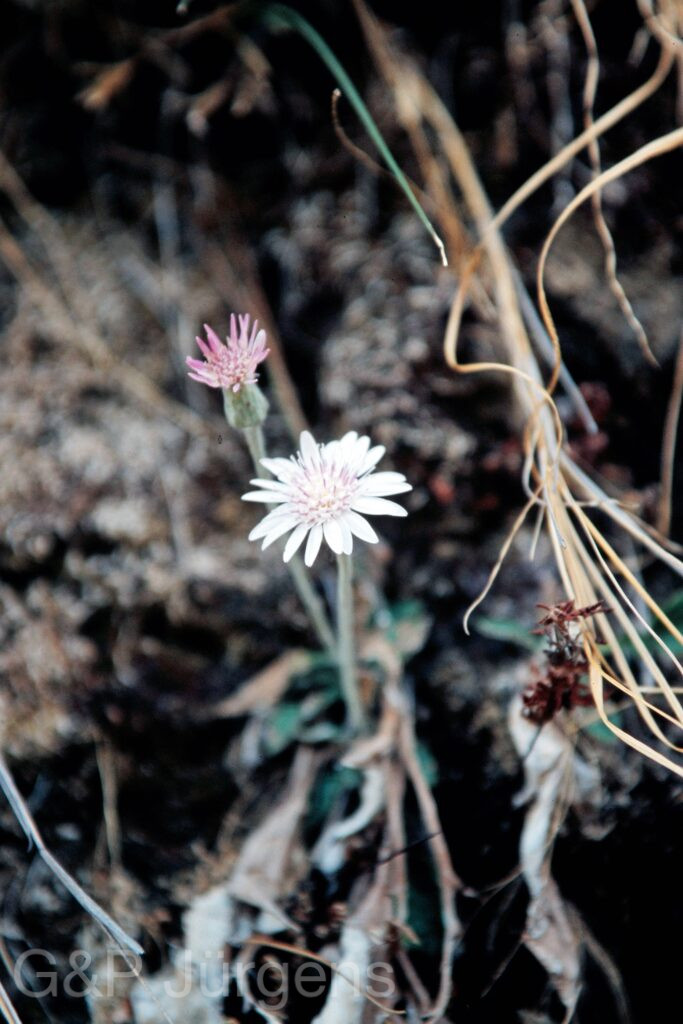
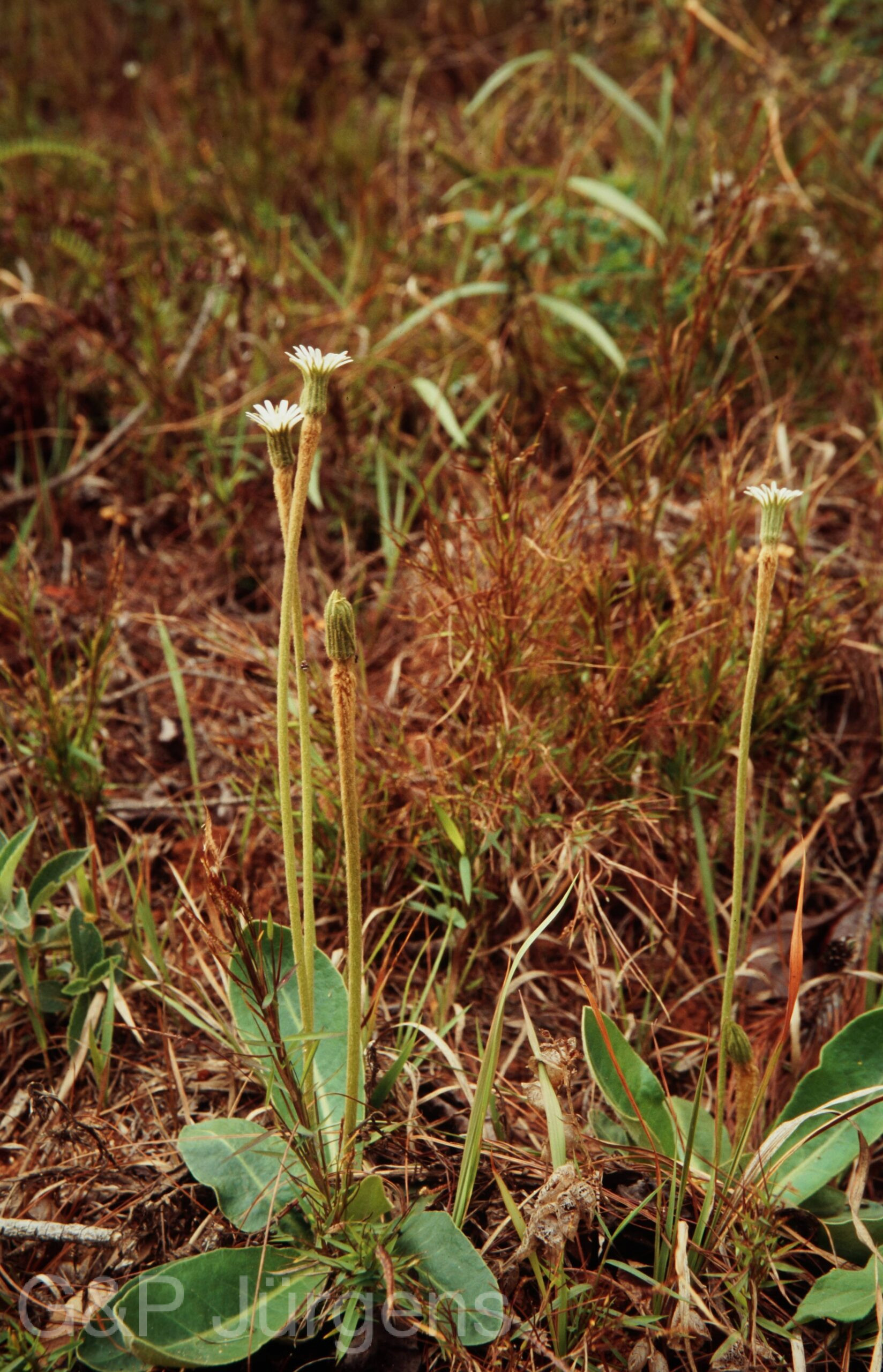
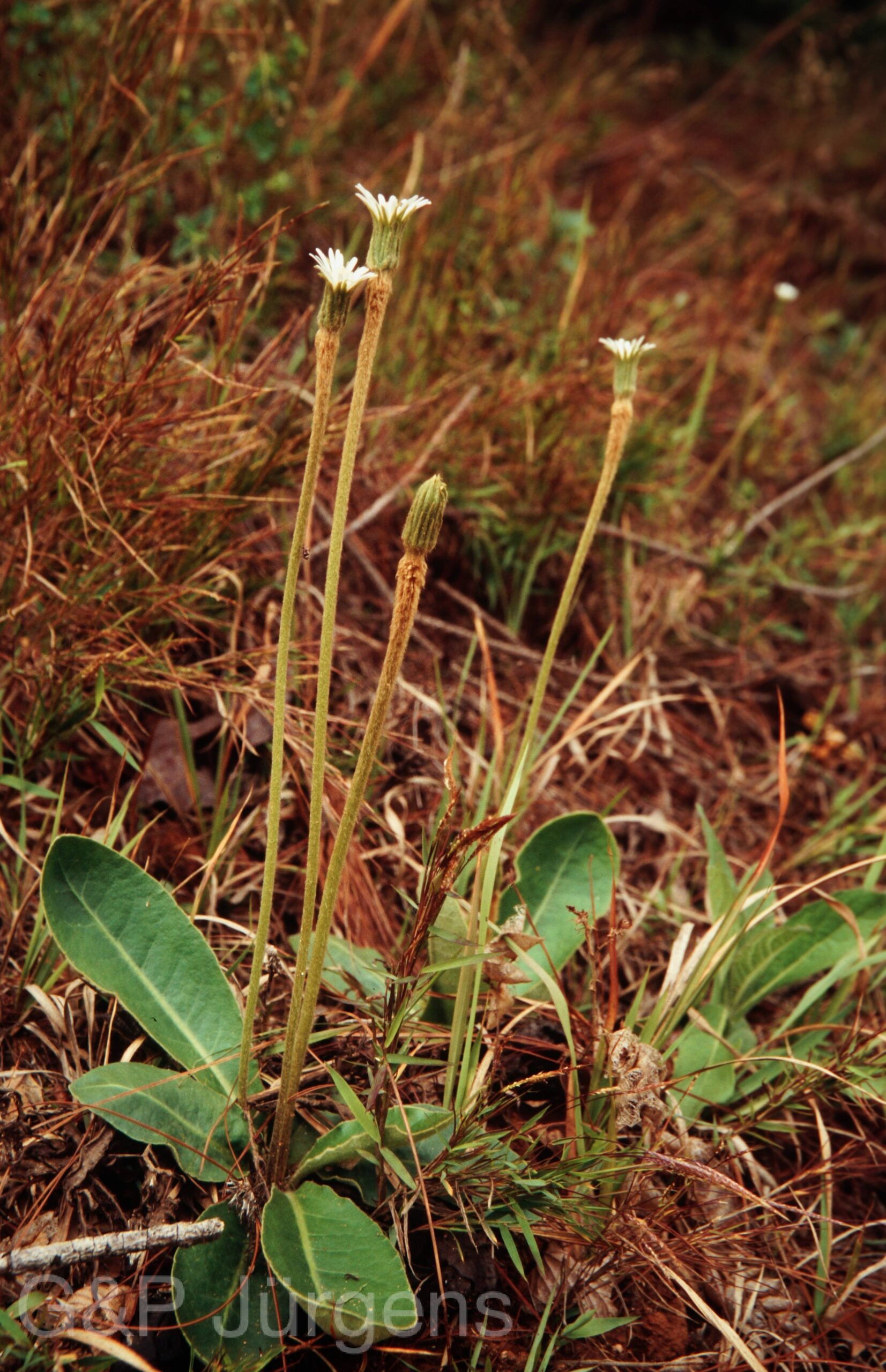
Gerbera gossypina is a western Himalayan herb recorded by GBIF from India and Pakistan, with only about 10 documented occurrences, reflecting both its restricted range and sparse collection history. It grows on open grassy slopes, sunny banks, forest clearings and rocky hillsides in the temperate zone, generally between about 1500 and 2800 m. The photographed plant was found in Garhwal, India, at Ransi by the Mandakini river at around 1800 m in June, a habitat characteristic of this woolly-leaved species among the herb-rich meadows of the western Himalayan foothills before the monsoon.

The species is a stemless or short-stemmed perennial forming a basal rosette from a thick rootstock. The leaves are oblong to obovate or lyrate, narrowed to a winged petiole, and densely clothed beneath with white to greyish cottony tomentum, the feature that gives the epithet gossypina. The flowering heads are solitary on long, erect, woolly scapes overtopping the rosette. Each radiate capitulum has an outer series of strap-shaped ligulate florets, white to pinkish above and often reddish beneath, surrounding numerous tubular disc florets within an involucre of imbricate bracts. The fruit is a ribbed, hairy cypsela bearing a pappus of fine bristles.

Gerbera gossypina (Royle) Raizada & Saxena is one of few representatives of this largely African and Asian genus in the Himalaya and a western-Himalayan element of phytogeographic interest. The very small number of records suggests it is genuinely localised, and its limited known range and scant documentation indicate its conservation status merits assessment, with field survey needed across Garhwal, Himachal and adjoining Pakistan.

Author: (Royle) Raizada & Saxena · Sources: POWO (Kew), GBIF, Flora of British India, Polunin & Stainton: Flowers of the Himalaya, taxonomic revisions of Gerbera (Asteraceae)

Beauverd

Description

Gerbera maxima is an eastern Himalayan perennial herb distributed across Nepal, northern India, Bhutan and adjacent south-central China (Yunnan, Xizang), the modest tally of around seventeen georeferenced GBIF records reflecting its scattered occurrence rather than true rarity. It favours open grassy hillsides, forest margins, terraced banks and disturbed sunny slopes in the subtropical to lower temperate belt. The photographed plant, from the Indrawati-Khola valley in the Helambu region of central Nepal at roughly 1750 m and flowering in May, typifies its mid-montane preference for warm, well-drained, often grazed openings.

The species forms a stout caudex from which arises a basal rosette of large, lyrate-pinnatifid to broadly obovate leaves that are densely white-tomentose beneath and greener above, the margins sinuate-dentate and the petioles winged. From the rosette a leafless, woolly scape bears a solitary, comparatively large radiate capitulum. The involucral bracts are imbricate and tomentose; the ray florets are bilabiate, typically pale pink to whitish or yellowish, surrounding numerous tubular disc florets. The fruit is a slender, ribbed cypsela tapering into a beak and crowned by a pappus of barbellate bristles, adapted to wind dispersal.

Gerbera (Asteraceae, tribe Mutisieae) is an Old World genus centred on Africa and Asia, and G. maxima is here treated as the accepted name. The two-lipped ray corollas place it within the mutisioid lineage, and its tomentose indumentum is a xeromorphic adaptation to insolated, seasonally dry montane slopes. No formal conservation assessment exists; its tolerance of grazing and disturbance suggests local resilience, though habitat conversion across the mid-hills warrants monitoring.

Author: Beauverd · Sources: POWO (Kew), GBIF, Flora of China, Annotated Checklist of the Flowering Plants of Nepal, Hand-Mazzetti revision of Asian Gerbera (Mutisieae monograph)

Geum elatum

by G & P Jürgens

Wall ex. G.Don.

Nepal 99 532 ergebnis
West-Nepal Churta-Khola 3600-3800m, June
Garw 2005 351 ergebnis
India Garhwal Patanathi 3800m, September

Description

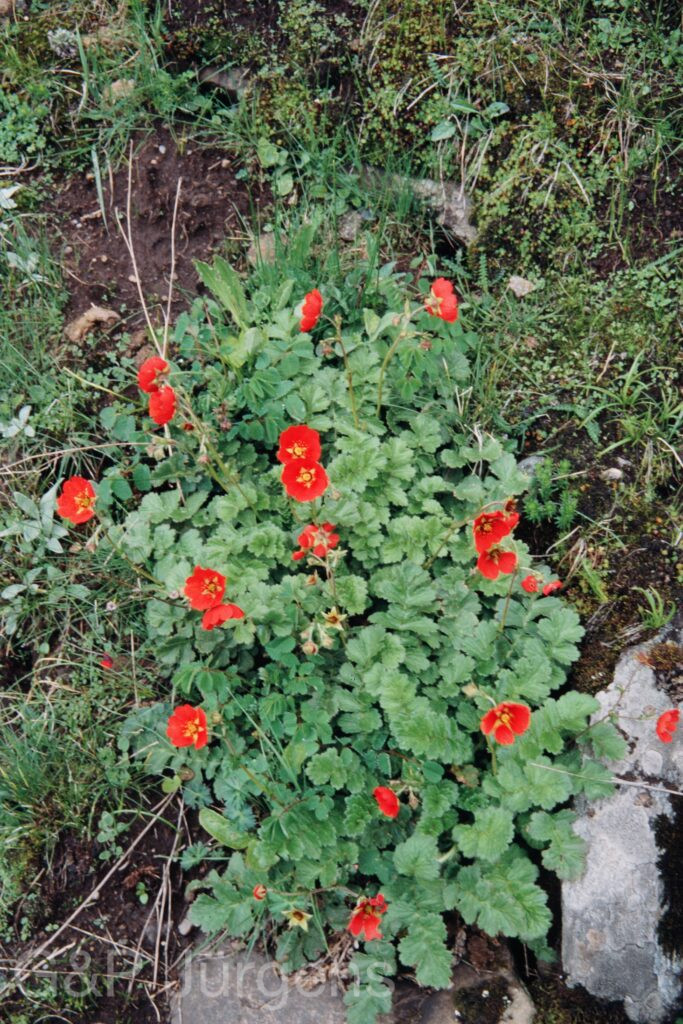
Geum elatum is a perennial herb of the high Himalaya, distributed along the alpine and subalpine belt from Pakistan and Afghanistan eastward through India, Nepal, Bhutan and south-western China. GBIF aggregates some 366 occurrences, densest in Nepal and the Indian Himalaya. It grows in open alpine meadows, moist grassy slopes, rocky ledges and snow-melt flushes, typically between about 3000 and 4500 m. The populations imaged in West-Nepal at Churta-Khola (3600-3800 m, June) and in Indian Garhwal at Patanathi (3800 m, September) typify its preference for cool, humid turf near the upper limit of vegetation.

The plant arises from a stout, scaly rhizome bearing a basal rosette of pinnate to lyrate-pinnatifid leaves, the terminal leaflet conspicuously enlarged, reniform to orbicular and crenate-lobed. Flowering stems are erect to ascending, simple or sparingly branched, bearing one to several comparatively large, nodding to suberect golden-yellow flowers. These have five spreading obovate petals, five reflexed sepals alternating with small epicalyx segments, numerous stamens, and many free carpels on a hairy receptacle. In fruit the styles elongate into persistent, often plumose or hooked awns, forming a globose head of achenes adapted to epizoochorous dispersal.

Geum elatum belongs to a Himalayan complex sometimes segregated under Acomastylis or Sieversia, and varieties (notably var. leiocarpum) have been recognised on indumentum and style characters. Its nodding, large-flowered habit and montane ecology distinguish it from lowland Geum species. As a widespread, locally common alpine perennial it is of no immediate conservation concern, though potentially sensitive to grazing and climate-driven upward shifts of the alpine zone.

Author: Wall ex. G.Don. · Sources: POWO (Kew), GBIF, Flora of China, Flora of Pakistan, Flora of Bhutan, Annotated Checklist of the Flowering Plants of Nepal, monograph of the genus Geum (Gajewski)

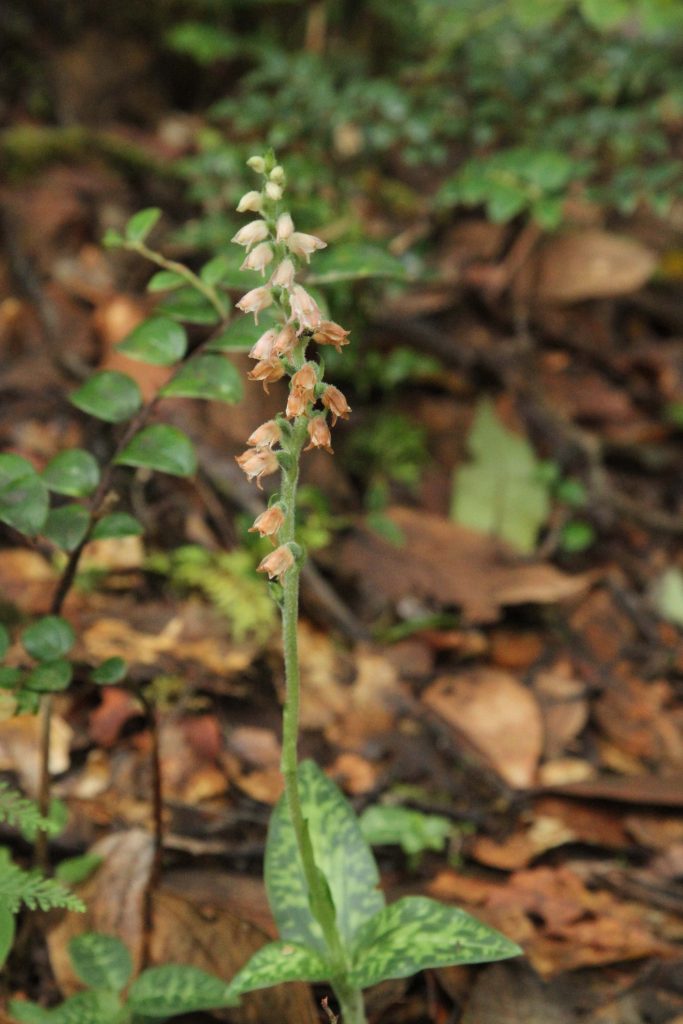
King & Pantl.

Bhutan2012 347
Bhutan Dochu-La 3000m, September

Description

Goodyera hemsleyana is a terrestrial orchid of the cool, humid temperate forests of the eastern Himalaya and adjoining southwestern China. Documented occurrences (21 GBIF records) span India, Nepal, China, Bhutan and Myanmar, following the moist mid- to upper-montane belt of the Sino-Himalayan region. The species favours the deep, mossy humus and leaf litter of shaded broadleaved and mixed conifer forest, typically between about 2500 and 3500 m. The illustrated material was gathered at Dochu-La in western Bhutan at roughly 3000 m in September, a pass clothed in cloud forest where rhododendron and fir provide the shade and atmospheric moisture this orchid requires.

The plant is a small, creeping geophyte arising from a slender, fleshy, decumbent rhizome that roots at the lower nodes. The leaves are few, gathered toward the base, ovate to elliptic, and characteristically marked with a fine reticulate venation that distinguishes the 'jewel orchid' alliance. The erect inflorescence is a pubescent scape bearing a rather lax, secund raceme of small white to greenish-white flowers. Each flower shows the connivent dorsal sepal and petals forming a hood over the column, spreading lateral sepals, and a saccate, concave lip with an incurved, often shortly bifid apex; the ovary is glandular-hairy and twisted.

Goodyera is a large, near-cosmopolitan genus within tribe Cranichideae, subtribe Goodyerinae, and G. hemsleyana belongs to the assemblage of Himalayan species described from the King & Pantling collections. Like its congeners it is mycoheterotrophic in establishment, dependent on rhizoctonia-type fungal symbionts in the forest humus, which restricts it to undisturbed old-growth stands. Though not formally assessed as threatened, its reliance on intact mossy forest makes it sensitive to logging and grazing pressure across its range.

Author: King & Pantl. · Sources: POWO (Kew), GBIF, Flora of Bhutan, Flora of China, The Orchids of Bhutan (Pearce & Cribb)