Orchideaceae

(D.Don) S.C.Chen & J.J.Wood

Nepal 97 408 P789
Nepal Tashigaon 3000m May

Description

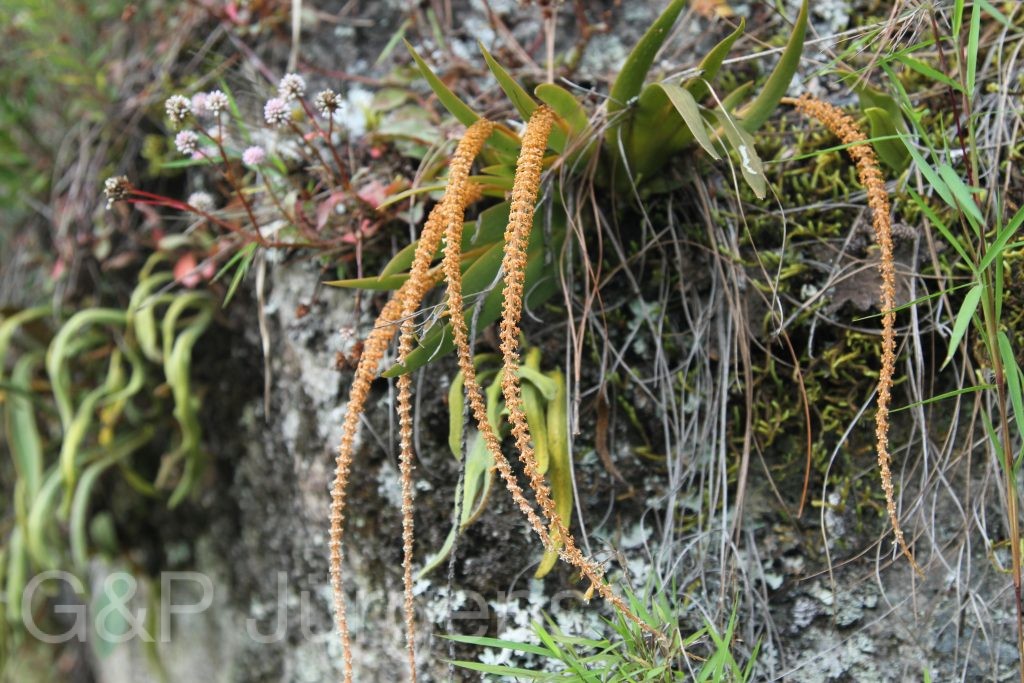
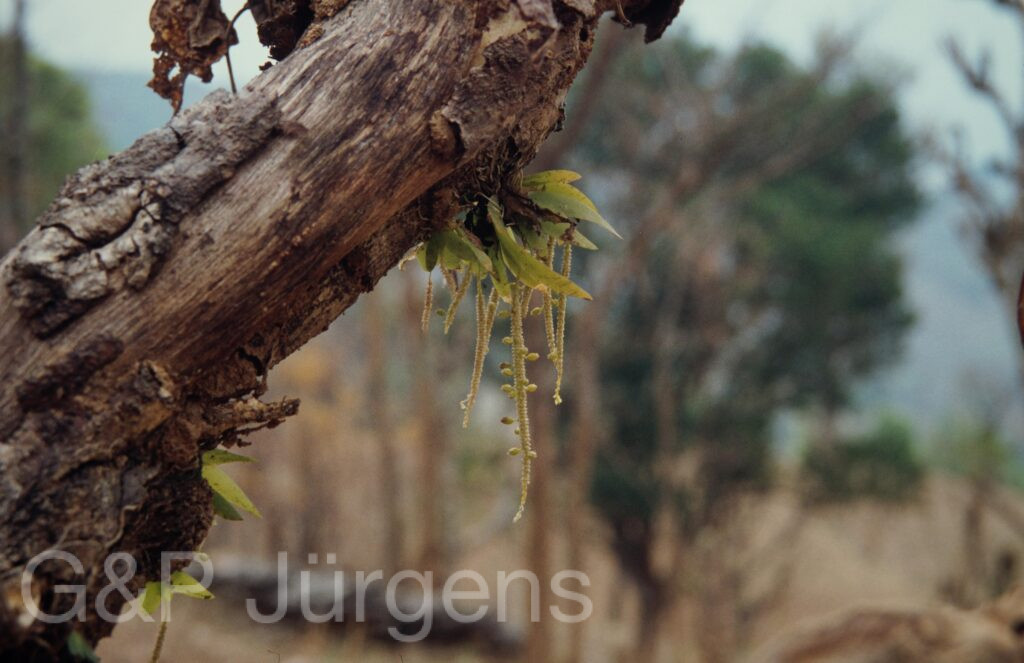
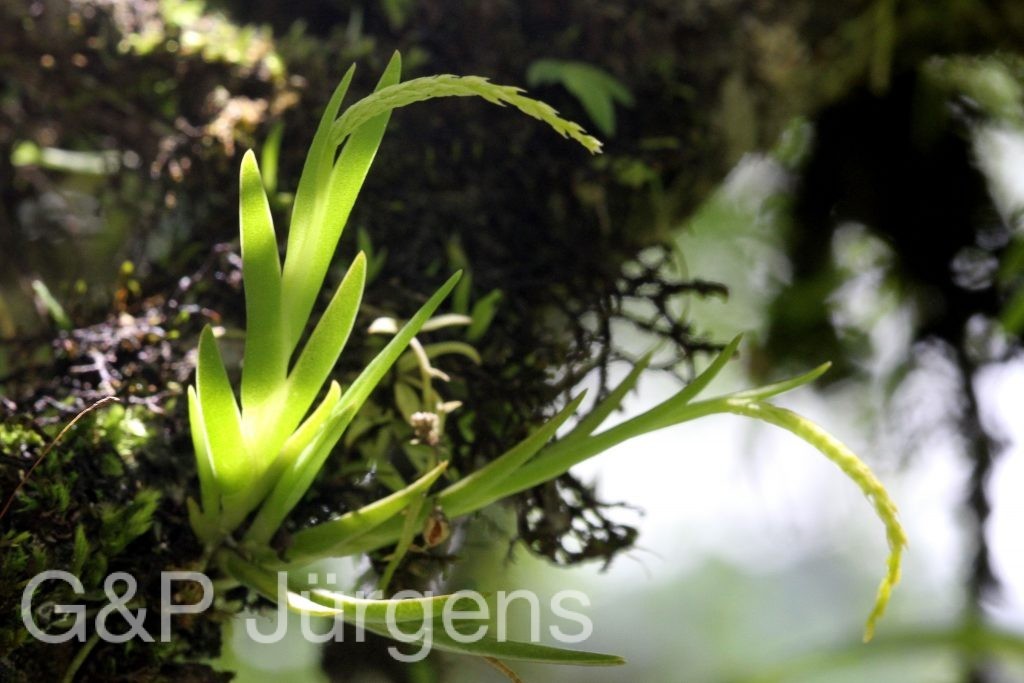
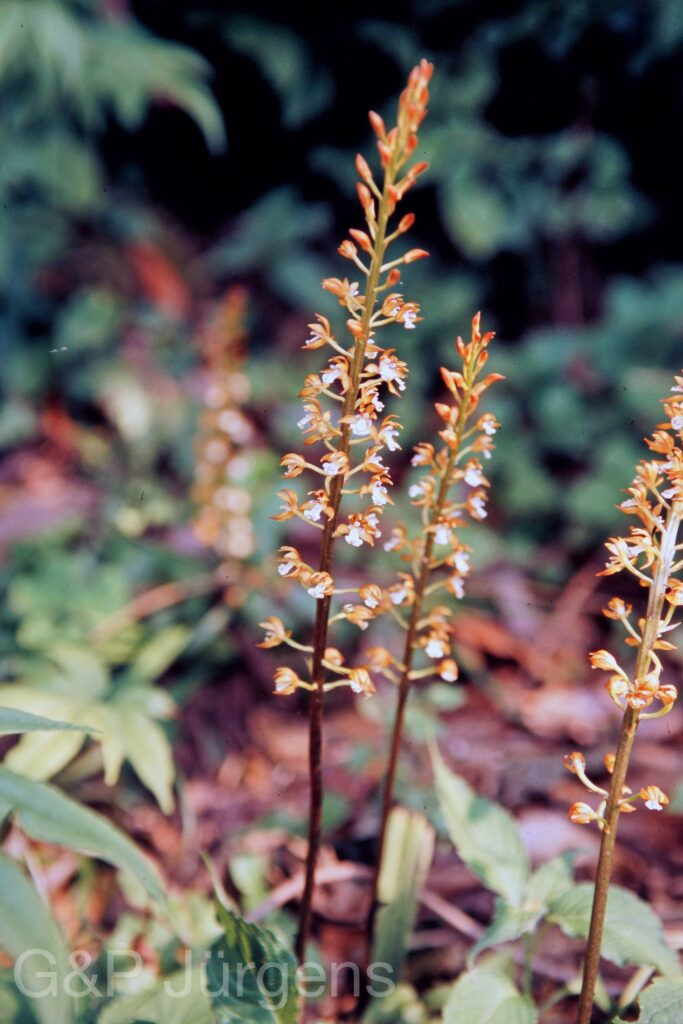
Mycaranthes floribunda is a widespread epiphytic orchid of tropical and subtropical Asia, recorded from India, Nepal, Bhutan, Bangladesh, Myanmar, Thailand, Laos, Cambodia, Vietnam and southern China. With some 182 georeferenced collections in GBIF, it is among the more frequently encountered species of its genus. In the eastern Himalaya it ascends into the temperate zone, as shown by material gathered near Tashigaon in eastern Nepal at around 3000 m in May. It grows chiefly as an epiphyte on the trunks and boughs of trees in humid broad-leaved and mixed evergreen forest, favouring mossy, shaded situations with reliable atmospheric moisture, and occasionally occurs lithophytically on shaded rock.

The plant forms clustered, slender, cane-like pseudostems arising from a short rhizome and clothed in persistent leaf bases. The leaves are several, distichous, narrowly elliptic to lanceolate, coriaceous and acute, articulated to sheathing bases. Inflorescences are lateral or terminal, erect to arching racemes bearing numerous small, densely arranged flowers, the axis and ovaries often furnished with fine mealy or hairy indument. The flowers are pale, the sepals ovate-lanceolate with a short mentum formed at the column foot, the petals narrower, and the trilobed labellum bearing low keels or calli on the disc. The fruit is a small ellipsoid capsule.

The species was originally described by D. Don and was transferred to Mycaranthes by S.C. Chen and J.J. Wood, reflecting the segregation of this lineage from the broadly circumscribed genus Eria, a realignment supported by molecular phylogenetic analyses of the Eriinae. Its wide elevational and geographic amplitude and tolerance of disturbed forest margins render it relatively secure across much of its range, though continuing deforestation locally reduces suitable epiphytic habitat.

Author: (D.Don) S.C.Chen & J.J.Wood · Sources: POWO (Kew), GBIF, Flora of Bhutan, Flora of China, Genera Orchidacearum
(King & Pantl.) Szlach.

BhutanPG2011 113
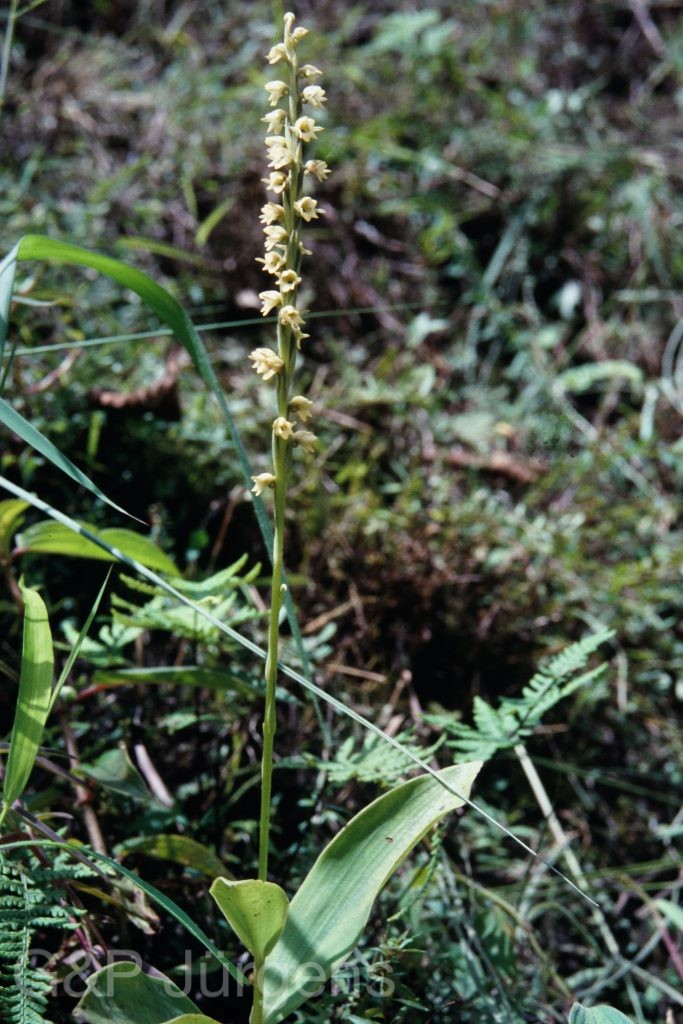
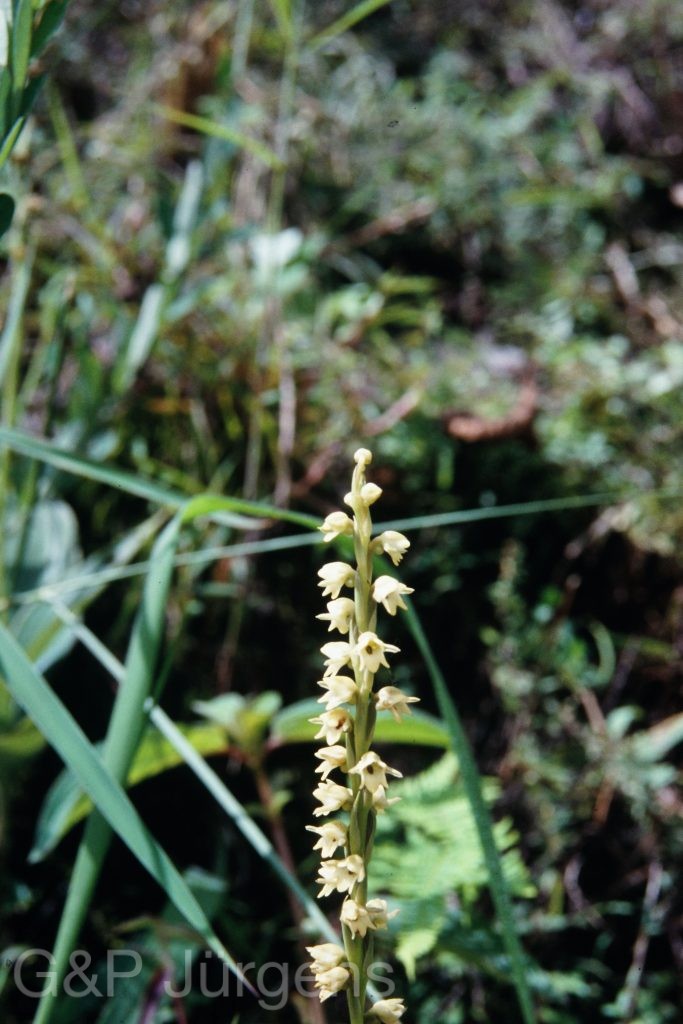
Bhutan Tsochenchen, 3500m June

Description

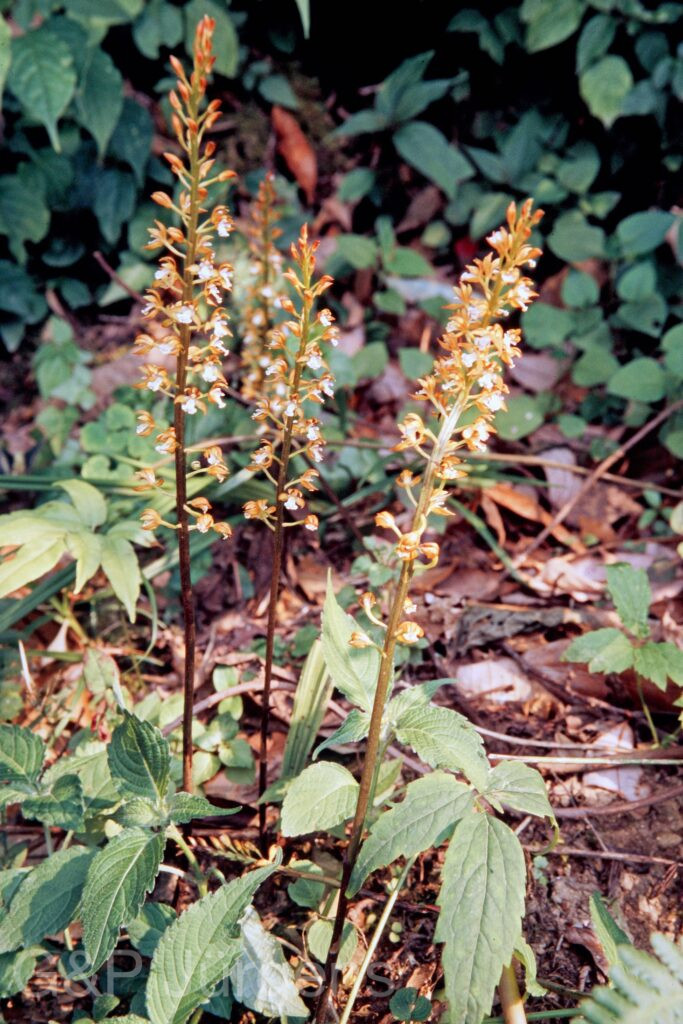
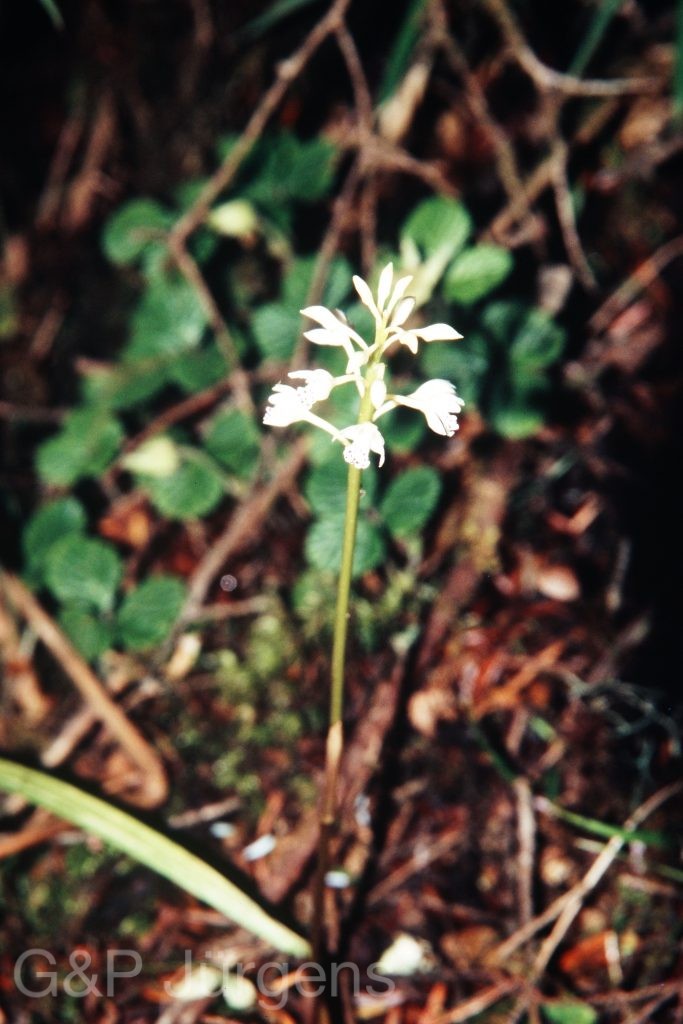
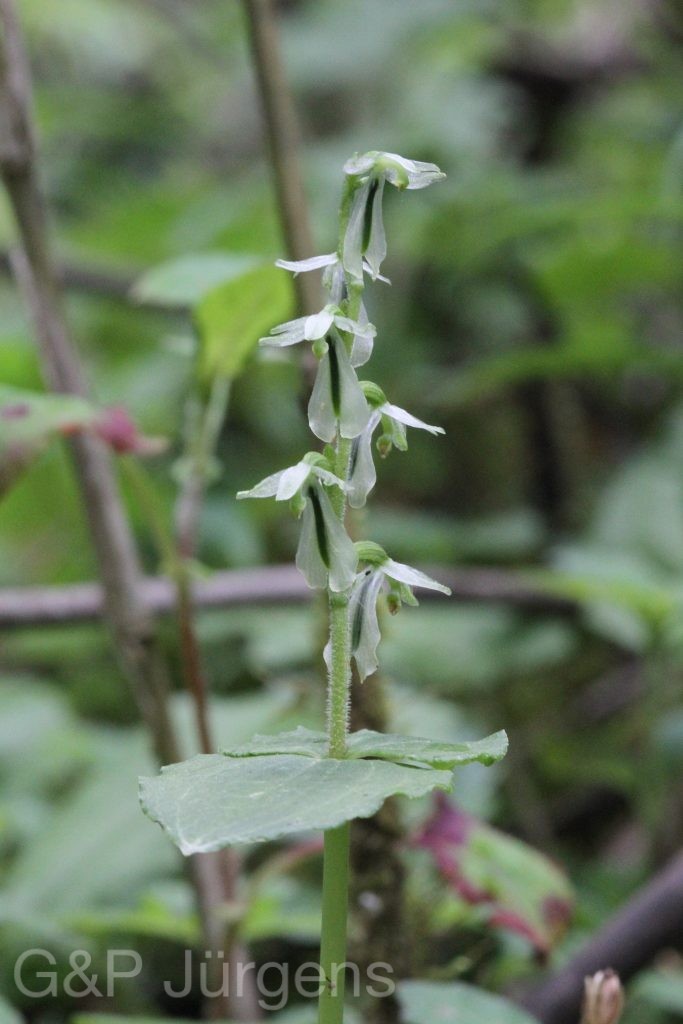
Neottia longicaulis is a terrestrial orchid of the cool, shaded forests of the eastern Himalaya, recorded from India, China, Bhutan and Nepal, with 23 GBIF occurrences reflecting a fairly narrow Sino-Himalayan distribution. It grows in damp, humus-rich leaf litter and mossy ground beneath conifer and mixed broadleaved forest, and in the moist scrub near the treeline, generally in the upper temperate to subalpine zone. The illustrated plant was found at Tsochenchen in Bhutan at about 3500 m in June, in the shaded, humus-floored fir and rhododendron forest where these inconspicuous orchids favour deep, undisturbed organic soils.

The plant is a slender, erect herb with a relatively long stem, as the epithet longicaulis indicates, bearing on its lower part a pair of opposite, broadly ovate to cordate leaves in the manner characteristic of the former genus Listera. The inflorescence is a lax raceme of small, green to yellowish-green flowers above the leaves. Each flower has spreading sepals and petals and a deeply two-lobed (bifid) pendent lip, the cleft forming two divergent arms; the column is short. The fruit is a small ellipsoid capsule containing dust-like seeds.

The basionym authority (King & Pantl.) Szlach. records the transfer of this species into Neottia, into which the genus Listera is now subsumed following phylogenetic evidence that the two are not separable. Neottia belongs to tribe Neottieae, a group spanning fully autotrophic 'twayblade' species and wholly mycoheterotrophic members. Dependent on intact, humus-rich shaded forest, N. longicaulis is sensitive to disturbance, and its small documented range warrants attention even though it has not been formally assessed.

Author: (King & Pantl.) Szlach. · Sources: POWO (Kew), GBIF, Flora of China, Flora of Bhutan, The Orchids of Bhutan (Pearce & Cribb)

Griff.

Bhutan2012 814 Kopie
Bhutan Zemgang 2000m, October
Bhutan2012 1146
Bhutan Tashiyangtse 1500m, October

Description

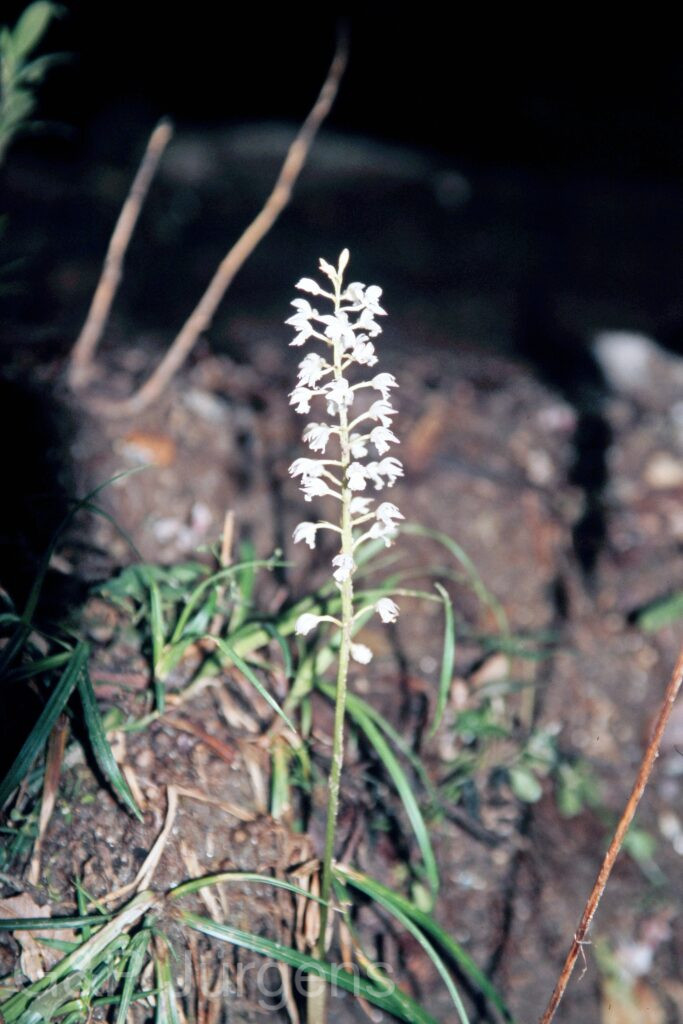
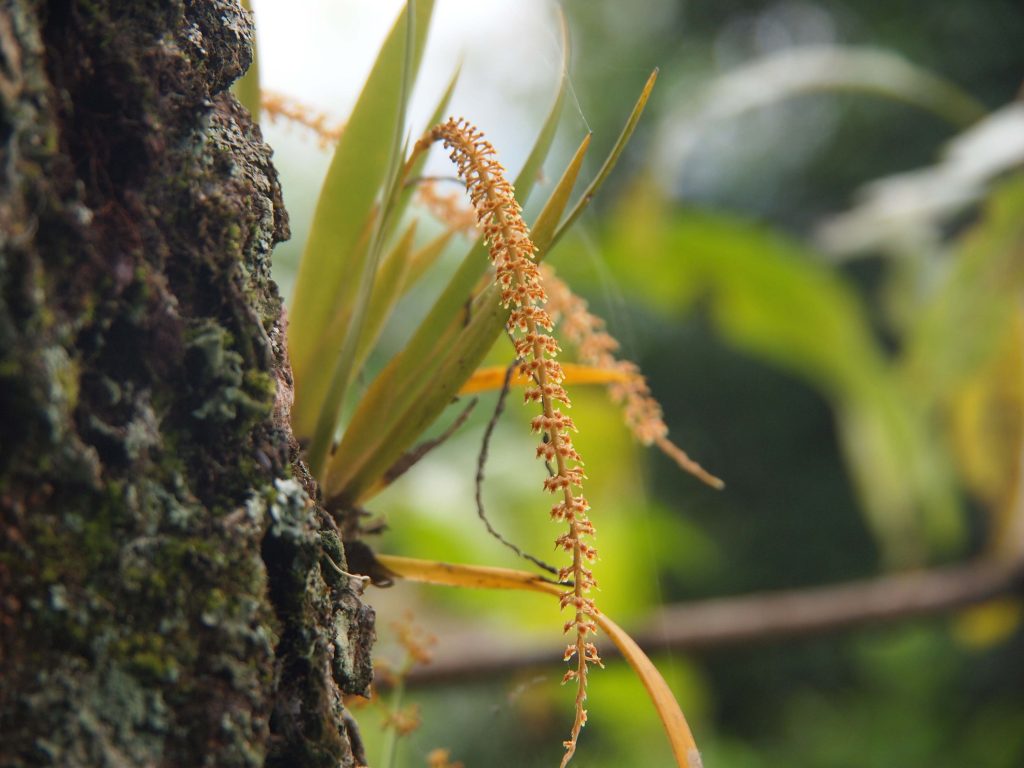
Oberonia acaulis is a small epiphytic orchid widespread across tropical and subtropical Asia, recorded from India, Nepal, Bhutan, China, Myanmar, Bangladesh, Thailand, Vietnam and beyond, with about 198 GBIF occurrences. It grows in warm, humid broad-leaved and subtropical forest, perched on tree trunks and branches in shaded, moist situations from the lowlands into the lower montane zone. The images document it in Bhutan at Zemgang around 2000 m and at Tashiyangtse near 1500 m, both in October, when the minute flowers are borne in dense spikes among forest epiphyte communities.

It is a tufted, dwarf epiphyte lacking pseudobulbs, with a short stem bearing a fan of equitant, laterally flattened (iris-like), fleshy leaves arranged in two ranks. From the centre of the fan arises a slender, erect to arching scape terminating in a long, densely many-flowered cylindrical raceme. The flowers are extremely small, numerous, yellowish to orange-brown, arranged in whorls; the labellum is the most conspicuous part, typically three-lobed with a divided or toothed apex, distinguishing the species within the genus. The fruit is a tiny ellipsoid capsule.

Oberonia is a large pantropical genus of "button orchids" notable for the diminutive size and great number of their flowers, which complicates field identification and rests heavily on the structure of the lip. The minute flowers are thought to be pollinated by small flies or midges. Like all orchids the genus is listed on CITES Appendix II; O. acaulis is widespread and common across its broad range and is not considered threatened.

Author: Griff. · Sources: POWO (Kew), GBIF, Flora of China, Flora of Bhutan, Flora of British India, Genera Orchidacearum (Vol. 4 Epidendroideae)

King & Pantl.

Nepal 1994 27 ergebnis
Ost-Nepal Kandbari 600m April

Description

Oberonia falcata is a small epiphytic orchid ranging through the lowland and submontane forests of the eastern Himalaya and Southeast Asia, recorded from India, Nepal, Bhutan, Myanmar (implied regionally), Thailand, Cambodia, Vietnam, Taiwan and Malaysia, with a modest 67 occurrences in GBIF. It grows on the trunks and branches of trees in warm, humid evergreen and semi-evergreen forest, generally at low to moderate elevations. The illustrated plant was collected in eastern Nepal near Kandbari (Khandbari) at about 600 m in April, a typically low, frost-free station consistent with the genus's preference for sheltered, shaded humid forest.

Like other Oberonia, the species is a tufted, stemless to short-stemmed epiphyte with a fan of distichous, laterally flattened (equitant), fleshy leaves that are falcate (sickle-shaped), as the epithet records. From the centre of the leaf-fan arises a slender erect to arching inflorescence densely covered with minute flowers arranged in whorls along the rachis. The individual flowers are tiny and inconspicuous, orange to brownish, with a deeply lobed lip characteristic of the genus; the column is very short. The fruit is a small ellipsoid capsule releasing dust-fine seeds.

Oberonia is a large pantropical Old World genus distinguished by its iris-like flattened leaf-fans and miniature whorled flowers, and species delimitation rests largely on lip morphology. As an epiphyte dependent on undisturbed humid forest canopy, O. falcata is vulnerable to deforestation and the harvesting of host trees across its range. Its minute, scentless flowers are thought to be pollinated by small insects, and like nearly all orchids it relies on mycorrhizal fungi for seed germination and establishment.

Author: King & Pantl. · Sources: POWO (Kew), GBIF, Flora of Bhutan, Orchids of Nepal, Genera Orchidacearum (Oberonia)

Lindl.

BhutanPG2011 35 ergebnis
Bhutan Wangdi 2000m, June

Description

Oberonia obcordata is a diminutive epiphytic orchid of the Eastern Himalaya and adjacent Southeast Asia, recorded from China, India, Nepal, Thailand and Bhutan, with around 40 occurrences in GBIF. It grows as an epiphyte on the trunks and branches of trees in humid subtropical to lower montane broad-leaved forest, generally at moderate elevations of roughly 1,000 to 2,200 m. The plant illustrated was photographed near Wangdue (Wangdi) in western Bhutan at about 2,000 m in June, where the species flowers in the warm, moist conditions of the early monsoon.

It is a small, tufted epiphyte without pseudobulbs, the short stem bearing a fan of laterally flattened, equitant, fleshy leaves arranged in two ranks, as is characteristic of the genus. The inflorescence is a slender, pendent to arching raceme densely crowded with very numerous, minute flowers arranged in whorls along the axis. The tiny flowers are yellowish to orange-brown; the small sepals and petals spread, and the labellum, from which the epithet derives, is obcordate and more or less notched at the apex. The column is very short, and the fruit is a minute ellipsoid capsule containing exceedingly fine seeds.

Oberonia is a large palaeotropical genus of dwarf, fan-leaved epiphytes distinguished chiefly by the form of the diminutive labellum, here obcordate and emarginate. The minute flowers are pollinated by small insects, and establishment is mycorrhiza-dependent. Inconspicuous and easily overlooked, the species is relatively poorly documented; though not specifically assessed, it shares the general CITES Appendix II protection of the family, and its persistence is linked to intact mid-elevation forest.

Author: Lindl. · Sources: POWO (Kew), GBIF, Flora of China, Flora of Bhutan, The Orchids of Bhutan (Pearce & Cribb), Pridgeon et al. Genera Orchidacearum

Lindl.

Garh 07 88 ergebnis
India Garhwal Trijugi Narayan 2500m, June
Garh 07 89 ergebnis
India Garhwal Trijugi Narayan 2500m, June

Description

Oreorchis foliosa is a terrestrial orchid distributed across the Himalaya and into south-western China, with verified occurrences in China, India, Nepal, Bhutan and Myanmar. It grows in the humus-rich shade of temperate broadleaved and coniferous forest, on mossy banks and among leaf litter, generally between about 2400 and 3500 m. The material illustrated, from Trijugi Narayan in Garhwal (India) at around 2500 m and from the Dochu-La in Bhutan near 3000 m, both in June, shows the species flowering in the pre- to early-monsoon period in its characteristic moist, lightly shaded forest-floor habitat.

The plant grows from a chain of subterranean corm-like pseudobulbs (corms) that store reserves through the dormant season. From these arise one or two narrowly lanceolate, plicate (longitudinally pleated) leaves, the foliose character noted in the epithet. The erect scape bears a many-flowered raceme of small flowers; the spreading sepals and petals are yellowish to brownish, and the three-lobed labellum is paler, marked with reddish to purple spots or streaks, with a small basal callus or short spur-like base. The fruit is a pendulous dehiscent capsule releasing the dust-fine seeds typical of the family.

The family is written here as in the source as "Orchideaceae"; the correctly formed family name is Orchidaceae. Oreorchis is a small Asian genus of subfamily Epidendroideae allied to Corallorhiza and Cremastra, and like many forest orchids depends on mycorrhizal fungi for germination and establishment. O. foliosa, described by Lindley, is widespread but typically thinly scattered; while not formally assessed as threatened, such forest-dwelling orchids are sensitive to habitat loss and to collection pressure.

Author: Lindl. · Sources: POWO (Kew), GBIF, Flora of China, Flora of Bhutan, Genera Orchidacearum (Pridgeon et al.)

(Rchb.f.) Garay

Bh2008 319 G494
Bhutan Jakar, 2950m April

Description

Papilionanthe vandarum is an epiphytic orchid distributed across the eastern Himalaya and adjoining Indo-Burmese ranges, with records from India, Nepal, Bhutan and Myanmar; GBIF documents some 49 occurrences, the additional points from Belgium, the United States and Great Britain reflecting cultivated material in botanical collections. It grows on tree trunks and mossy branches in humid broad-leaved and coniferous forest, frequently in the montane belt between roughly 1500 and 3000 m, where seasonal monsoon moisture alternates with a drier cool season. The photographed plant from Jakar in central Bhutan at about 2950 m, flowering in April, is typical of its upper elevational range, where it flowers before the summer rains.

The species is readily recognised by its monopodial, scrambling habit and slender, terete (pencil-like) leaves that replace the flattened laminae of most orchids, an adaptation reducing water loss in exposed epiphytic sites. Stems are elongate, branching and rooting freely along their length by means of thick, greyish aerial roots. The inflorescences are short, few-flowered racemes bearing large, showy flowers; sepals and petals are white to pale, broad and somewhat undulate, while the trilobed labellum is prominent, with a spurred base and a coloured throat. The fruit is a dry, elongate dehiscent capsule releasing innumerable dust-like seeds.

Formerly placed in Aerides and Vanda, the species was transferred to Papilionanthe (a small Asian genus of terete-leaved monopodial orchids) by Garay; its terete foliage and pendent habit distinguish it from true Vanda. Like all wild orchids it is listed on CITES Appendix II, and populations are locally threatened by forest clearance and over-collection, though it remains fairly widespread across its Himalayan range.

Author: (Rchb.f.) Garay · Sources: POWO (Kew), GBIF, Flora of Bhutan, Orchids of Bhutan, Genera Orchidacearum (Pridgeon et al.)

(Prain) Pennell

Nepal 99 478 ergebnis
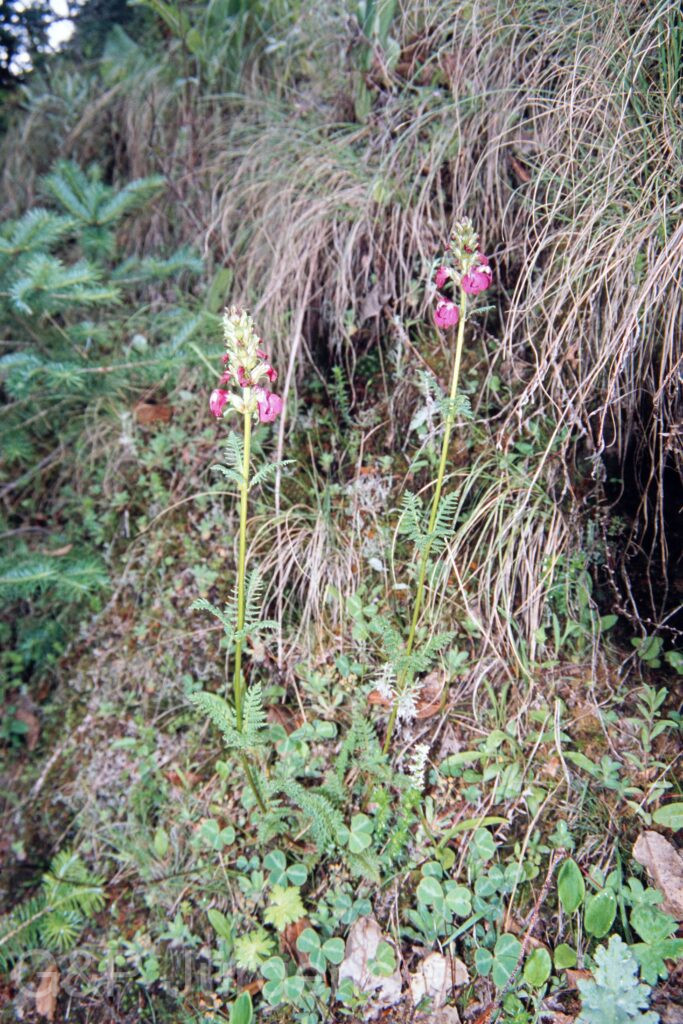
West-Nepal Churta-Khola 3300m, June

Description

Pedicularis pectinata subsp. palans is a hemiparasitic herb of the western and central Himalaya, recorded from India, Pakistan and Nepal, where GBIF documents a small number of occurrences (11). It inhabits open alpine and subalpine slopes, grazed meadows and stony pastures, typically between roughly 3000 and 4000 m. The photographed plant comes from the Churta Khola in West Nepal at about 3300 m, flowering in June, a setting of damp, herb-rich turf where snowmelt persists into early summer.

Like other members of the genus, it is a perennial forming a basal rosette and erect, leafy flowering stems. The leaves are pinnatisect with the pinnae themselves toothed (pectinate), giving the foliage a fern-like aspect. The flowers are borne in a dense terminal spike; each has a tubular, two-lipped corolla, the galea (upper lip) often beaked or prolonged and the lower lip three-lobed and spreading, in shades of pink to rose-purple. The fruit is a flattened, oblique capsule enclosing several seeds.

The name is treated by GBIF as a synonym, with Pedicularis pectinata palans regarded as the accepted taxon. Pedicularis (Orobanchaceae, here labelled Orchideaceae in the source) is a notoriously variable, root-hemiparasitic genus, drawing water and nutrients from host roots while retaining green photosynthetic tissue. Its Himalayan species are pollinated chiefly by bumblebees, the corolla architecture closely matched to bee morphology. Such infraspecific taxa are valued markers of alpine biogeography and warrant continued field study.

Author: (Prain) Pennell · Sources: POWO (Kew), GBIF, Flora of Nepal, Flora of Pakistan, Pennell's monograph of the Scrophulariaceae of the Himalaya

Lindl.

Sikkim2003 20 P24
Sikkim Rathong-Chu 1200m 08.2003
Sikkim2003 21 P25
Sikkim Rathong-Chu 1200m 08.2003

Description

Peristylus goodyeroides is a terrestrial orchid with a broad tropical and subtropical Asian range, the 545 GBIF records spanning China, the Indian subcontinent, Nepal, Bhutan, much of Southeast Asia, Taiwan, Hong Kong, Japan, Timor-Leste and Papua New Guinea. It occupies grassy slopes, open forest, forest margins and scrub from the lowlands to around 2000 m. The photographed plant was found in the Rathong-Chu valley of Sikkim at 1200 m in August, during the monsoon flowering period typical of the species at lower Himalayan elevations.

It is a tuberous geophyte producing an erect leafy stem 20-60 cm tall from ellipsoid underground tubers. The few to several leaves are clustered toward the lower-middle stem, ovate to elliptic-lanceolate, acuminate and sheathing at the base. The inflorescence is a many-flowered cylindrical raceme of small, greenish-white to pale green flowers subtended by lanceolate bracts. Each flower has connivent sepals and petals forming a hood, a small three-lobed lip with a short saccate or conical spur, and the column structure characteristic of the genus, lacking the distinct rostellar arms of related Habenaria.

The genus Peristylus, long confused with Habenaria, is distinguished by its short blunt spur and small viscidia, and P. goodyeroides is the widespread type-like species of the group. Its inconspicuous greenish flowers are pollinated by small insects, and the tuberous habit allows it to survive the seasonal dry period. Given its wide distribution and tolerance of disturbed grassland, it is among the more common members of the genus and is not regarded as threatened, though, like all orchids, it is listed under CITES Appendix II.

Author: Lindl. · Sources: POWO (Kew), GBIF, Flora of China, Flora of Bhutan, Pridgeon et al.: Genera Orchidacearum

(Banks) Blume

Bh2008 482 G750
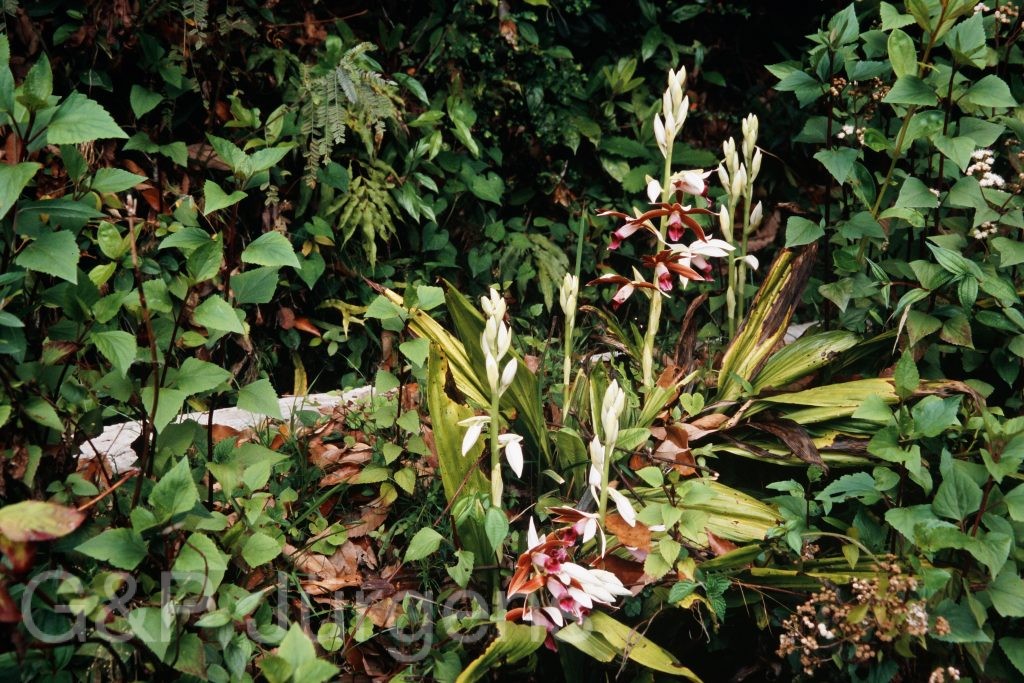
Bhutan Samtengang, 2040m April
Bh2008 483 P751
Bhutan Samtengang, 2040m April
Bh2008 485 G753
Bhutan Samtengang, 2040m April

Description

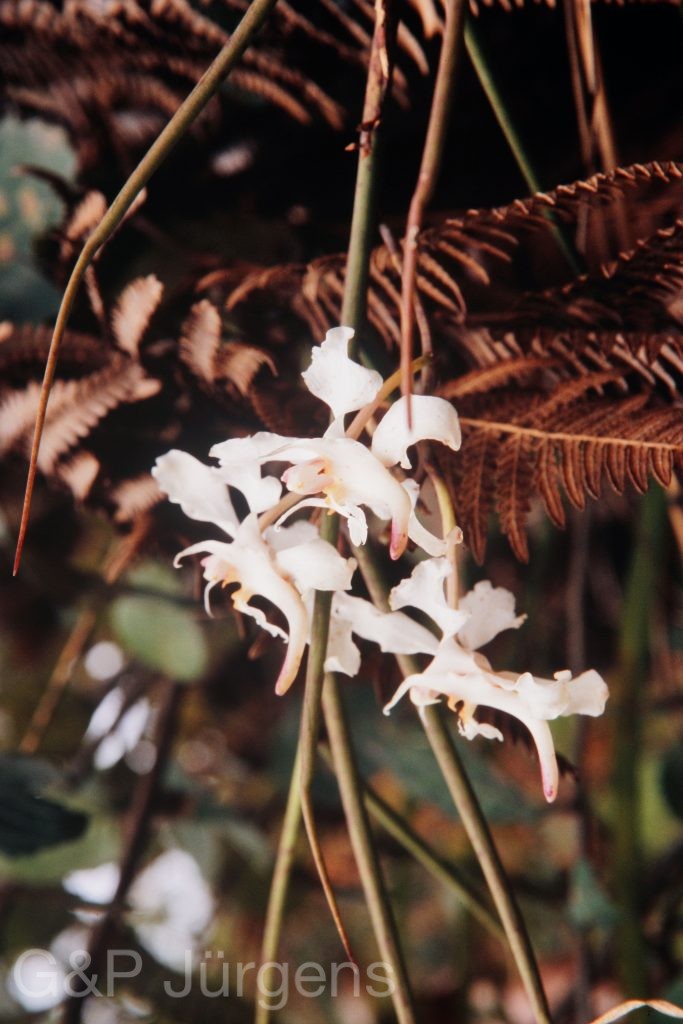
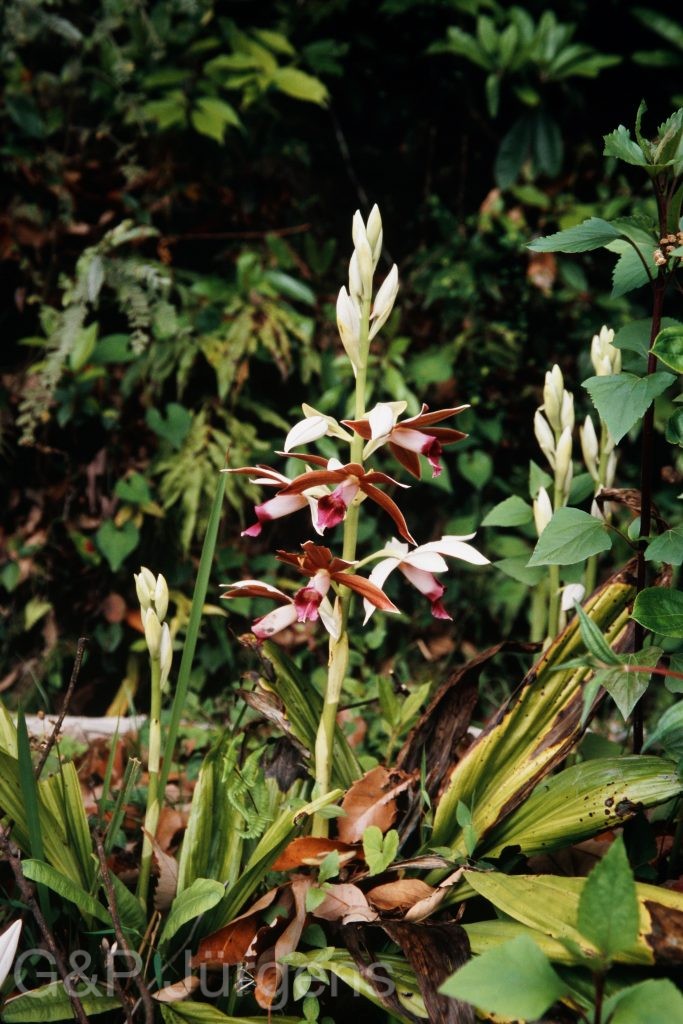
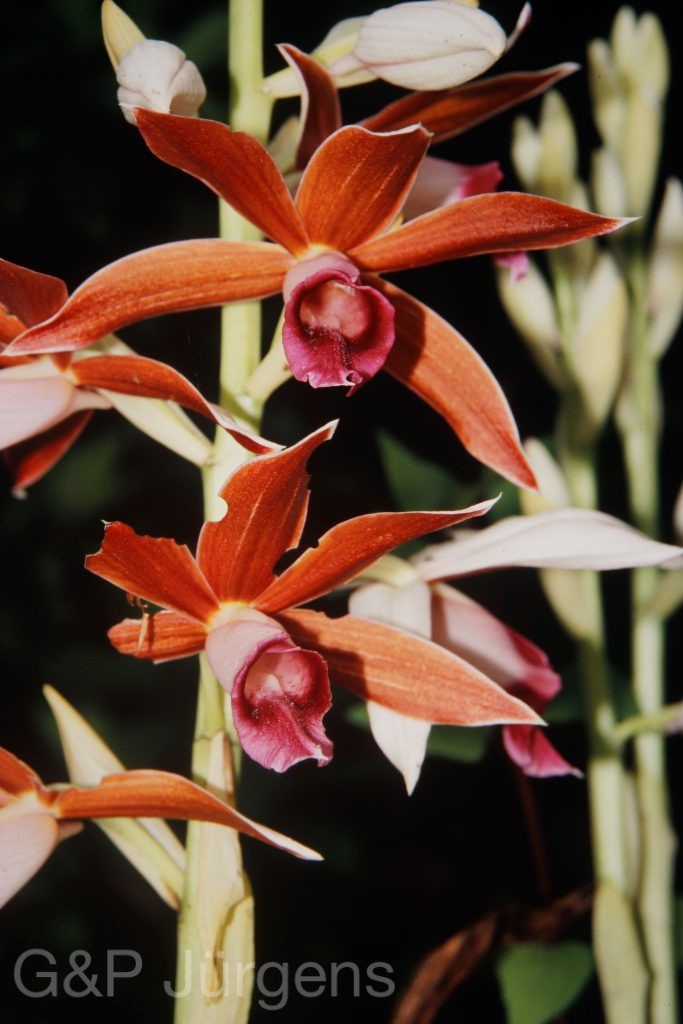
Phaius tankervilleae, the nun's-hood or swamp orchid, is a robust terrestrial orchid with an exceptionally wide Old World tropical and subtropical distribution, recorded from China, India, Bhutan, Indonesia, Malaysia, Papua New Guinea, Australia, the Pacific islands and many other regions, with around 660 occurrence records (some, as in the Americas and Caribbean, reflecting introduction). It grows in damp grassland, marsh margins, swampy forest clearings and moist roadside banks from the lowlands into the lower hills. The photographed plant from Samtengang in western Bhutan at 2040 m, flowering in April, lies toward the upper part of its montane range.

It is a large terrestrial orchid arising from clustered, conical pseudobulbs partly buried in the substrate. The leaves are few, large, broadly lanceolate, plicate (longitudinally pleated) and tapered to a sheathing base. The inflorescence is a tall, erect raceme bearing many showy flowers; the sepals and petals are similar, brownish-red to maroon within and silvery-white outside, while the prominent labellum is tubular and rolled, white flushed with rose-purple and yellow in the throat, with a short basal spur. The fruit is a pendulous capsule releasing innumerable dust-like seeds.

The accepted name Phaius tankervilleae, based on Banks's epithet and combined by Blume, is treated as current despite synonym status in the source dataset; the input family spelling "Orchideaceae" is a variant of the correct Orchidaceae. Like nearly all orchids it depends on mycorrhizal fungi for seed germination. Widely grown as an ornamental and broadly distributed in the wild, it is nonetheless locally threatened by wetland drainage and over-collection in parts of its range.

Author: (Banks) Blume · Sources: POWO (Kew), GBIF, Flora of China (Orchidaceae), Grierson & Long Flora of Bhutan, The Orchids of Bhutan (Pearce & Cribb), Seidenfaden's revisions of mainland Asian Orchidaceae