
King & Pantl.
Description
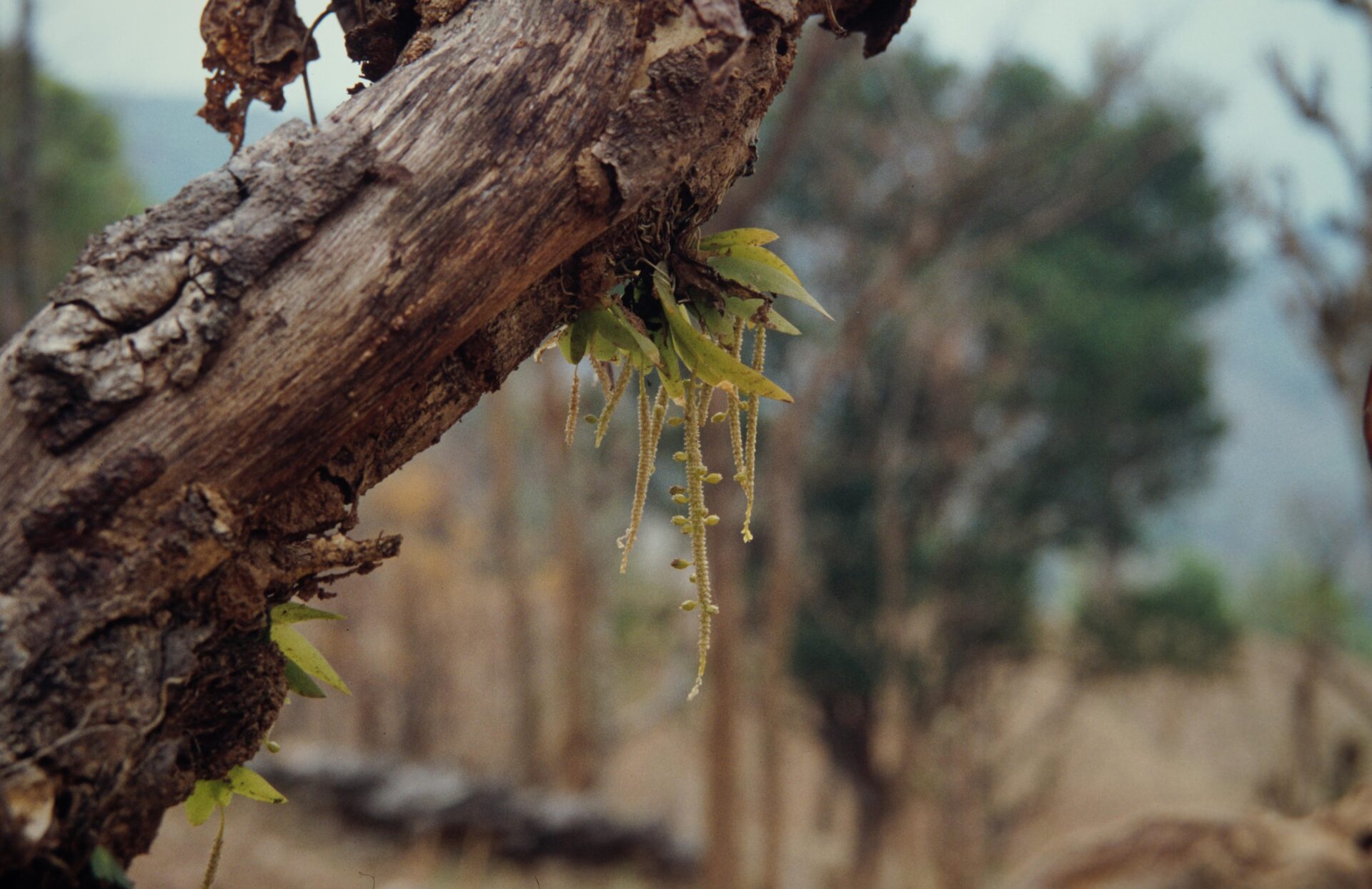
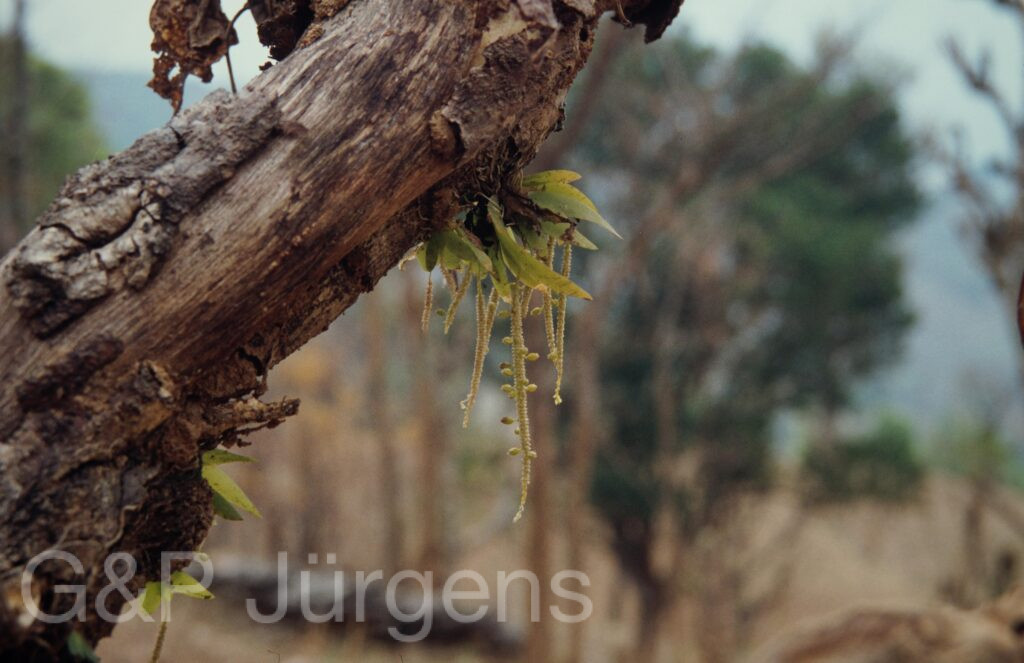
Oberonia falcata is a small epiphytic orchid ranging through the lowland and submontane forests of the eastern Himalaya and Southeast Asia, recorded from India, Nepal, Bhutan, Myanmar (implied regionally), Thailand, Cambodia, Vietnam, Taiwan and Malaysia, with a modest 67 occurrences in GBIF. It grows on the trunks and branches of trees in warm, humid evergreen and semi-evergreen forest, generally at low to moderate elevations. The illustrated plant was collected in eastern Nepal near Kandbari (Khandbari) at about 600 m in April, a typically low, frost-free station consistent with the genus's preference for sheltered, shaded humid forest.
Like other Oberonia, the species is a tufted, stemless to short-stemmed epiphyte with a fan of distichous, laterally flattened (equitant), fleshy leaves that are falcate (sickle-shaped), as the epithet records. From the centre of the leaf-fan arises a slender erect to arching inflorescence densely covered with minute flowers arranged in whorls along the rachis. The individual flowers are tiny and inconspicuous, orange to brownish, with a deeply lobed lip characteristic of the genus; the column is very short. The fruit is a small ellipsoid capsule releasing dust-fine seeds.
Oberonia is a large pantropical Old World genus distinguished by its iris-like flattened leaf-fans and miniature whorled flowers, and species delimitation rests largely on lip morphology. As an epiphyte dependent on undisturbed humid forest canopy, O. falcata is vulnerable to deforestation and the harvesting of host trees across its range. Its minute, scentless flowers are thought to be pollinated by small insects, and like nearly all orchids it relies on mycorrhizal fungi for seed germination and establishment.
Author: King & Pantl. · Sources: POWO (Kew), GBIF, Flora of Bhutan, Orchids of Nepal, Genera Orchidacearum (Oberonia)