
Lindl.
Description
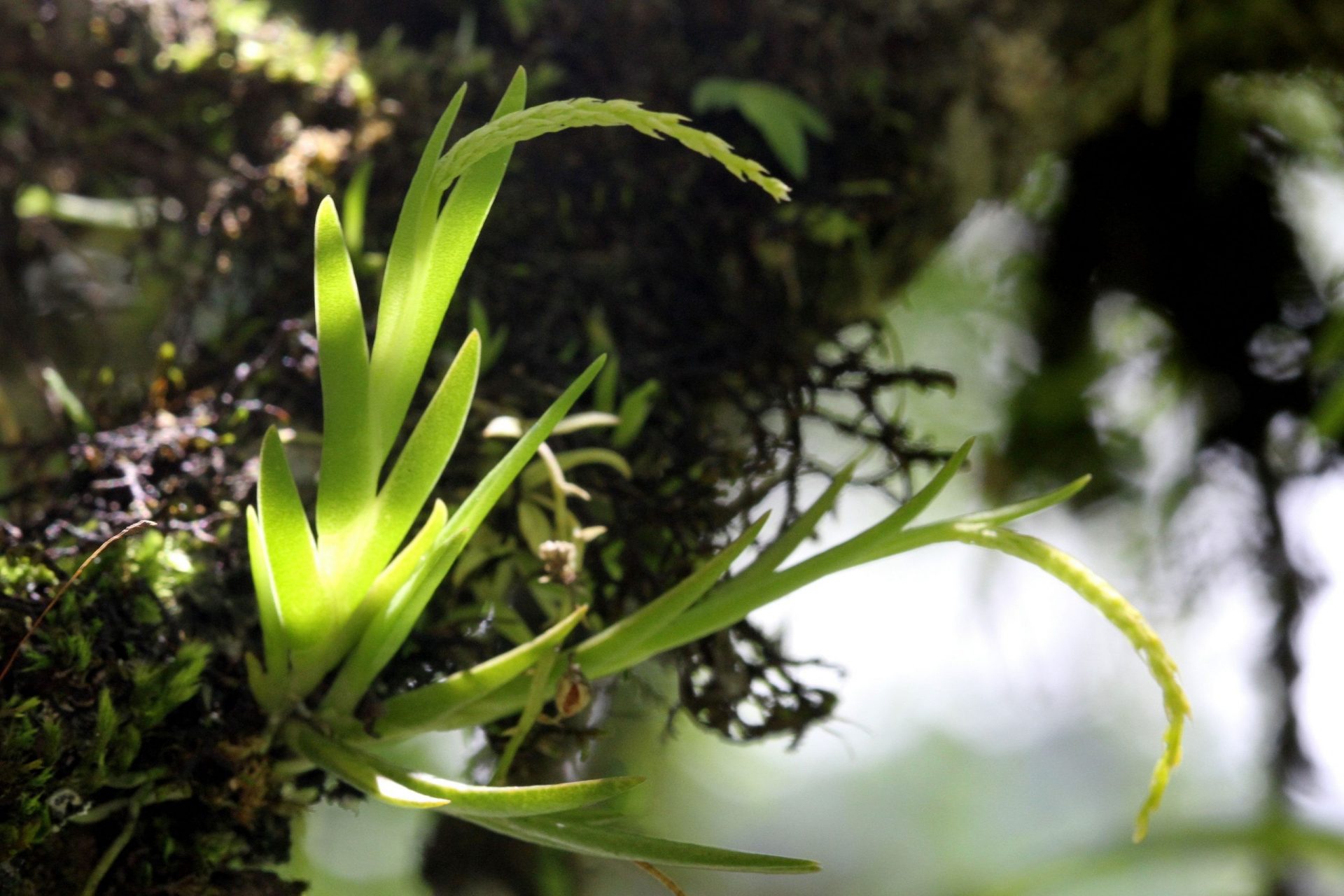
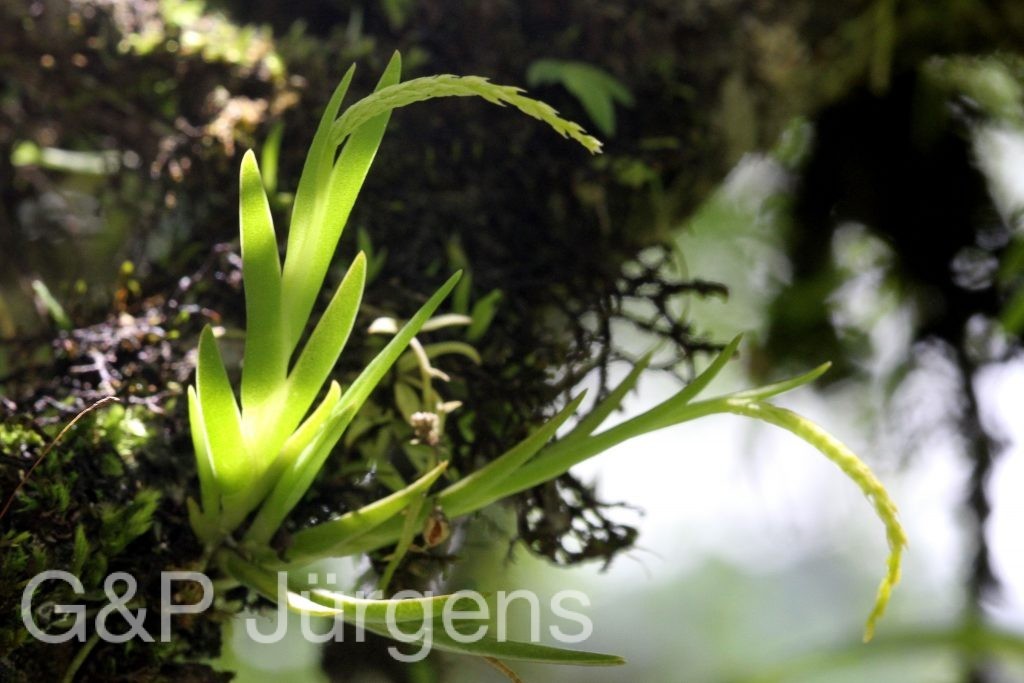
Oberonia obcordata is a diminutive epiphytic orchid of the Eastern Himalaya and adjacent Southeast Asia, recorded from China, India, Nepal, Thailand and Bhutan, with around 40 occurrences in GBIF. It grows as an epiphyte on the trunks and branches of trees in humid subtropical to lower montane broad-leaved forest, generally at moderate elevations of roughly 1,000 to 2,200 m. The plant illustrated was photographed near Wangdue (Wangdi) in western Bhutan at about 2,000 m in June, where the species flowers in the warm, moist conditions of the early monsoon.
It is a small, tufted epiphyte without pseudobulbs, the short stem bearing a fan of laterally flattened, equitant, fleshy leaves arranged in two ranks, as is characteristic of the genus. The inflorescence is a slender, pendent to arching raceme densely crowded with very numerous, minute flowers arranged in whorls along the axis. The tiny flowers are yellowish to orange-brown; the small sepals and petals spread, and the labellum, from which the epithet derives, is obcordate and more or less notched at the apex. The column is very short, and the fruit is a minute ellipsoid capsule containing exceedingly fine seeds.
Oberonia is a large palaeotropical genus of dwarf, fan-leaved epiphytes distinguished chiefly by the form of the diminutive labellum, here obcordate and emarginate. The minute flowers are pollinated by small insects, and establishment is mycorrhiza-dependent. Inconspicuous and easily overlooked, the species is relatively poorly documented; though not specifically assessed, it shares the general CITES Appendix II protection of the family, and its persistence is linked to intact mid-elevation forest.
Author: Lindl. · Sources: POWO (Kew), GBIF, Flora of China, Flora of Bhutan, The Orchids of Bhutan (Pearce & Cribb), Pridgeon et al. Genera Orchidacearum