Ranunculaceae

Royle

Garh 07 105 ergebnis 1
India Garhwal Meggu Kichatti 3100m, June

Description

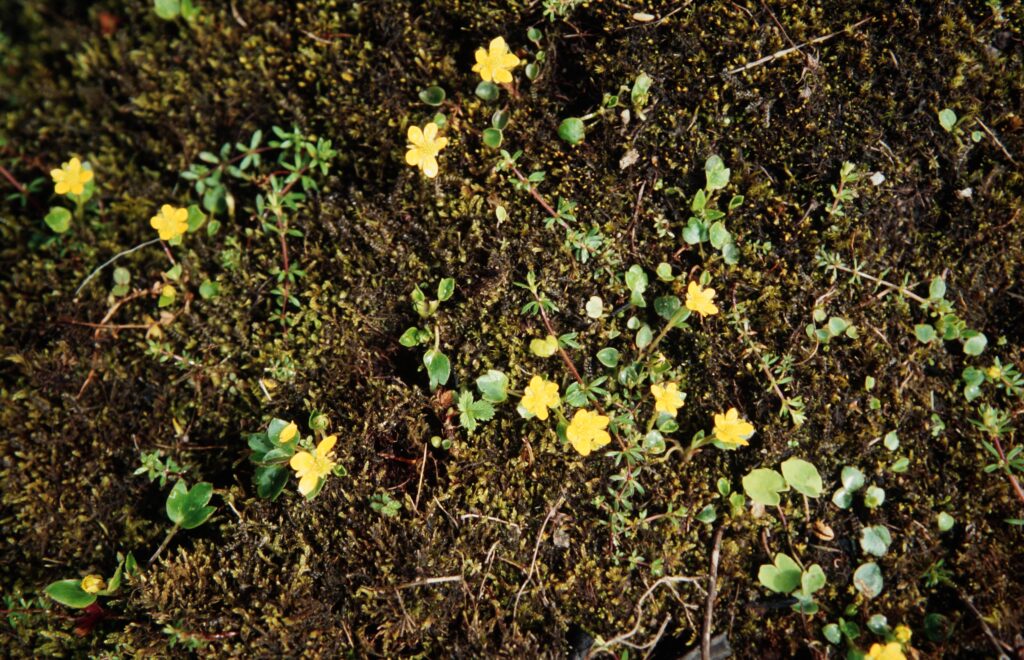
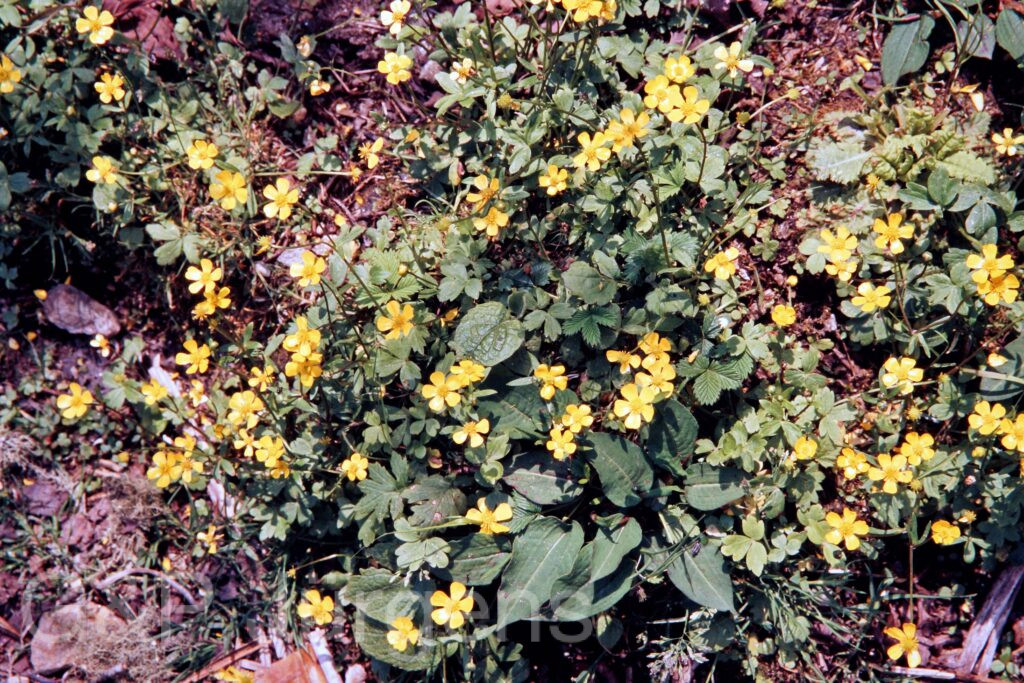
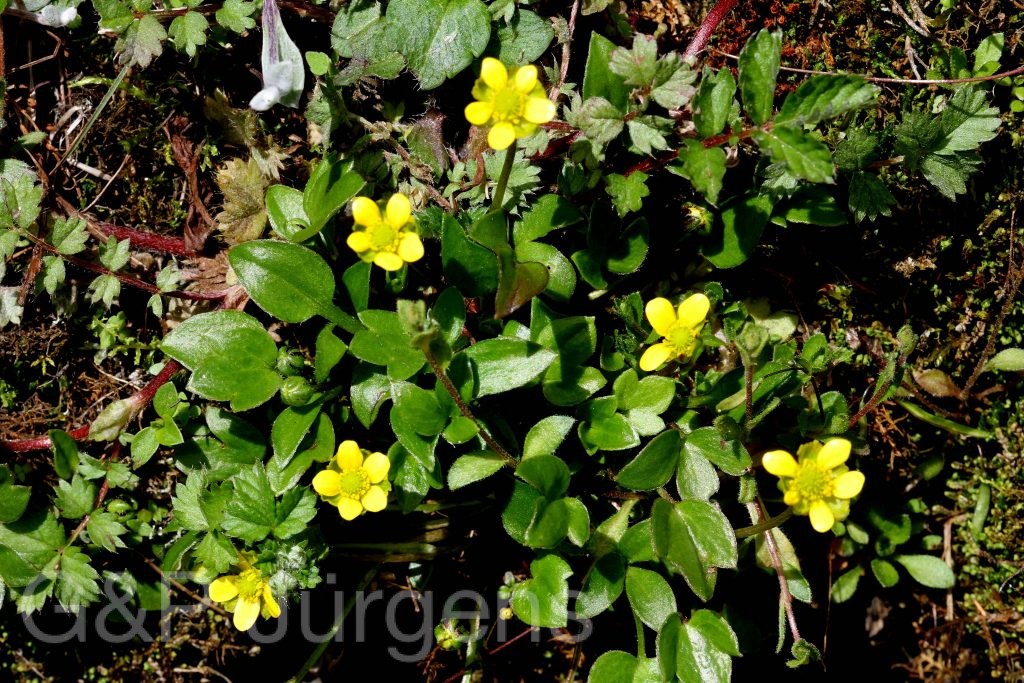
Ranunculus hirtellus is a widespread buttercup of the Himalaya and adjacent high mountains of Central Asia, recorded across India, Nepal, Pakistan, Afghanistan, China and Bhutan, its more than 770 georeferenced collections also reflecting extralimital and cultivated records in Iran, Japan, Korea and North America. It occupies alpine and subalpine meadows, open turf, moist grassy slopes and the margins of seasonal flushes, typically between about 2500 and 4500 m. The plant photographed at Meggu Kichatti in Garhwal at 3100 m in June shows its characteristic habitat in damp, herb-rich pasture during the early monsoon, when snowmelt keeps the soil moist.

It is a small perennial herb forming tufts from a short rootstock bearing fascicled, fibrous roots. The basal leaves are long-petioled, the blade orbicular to reniform and palmately three- to five-lobed or divided, the segments cuneate and again toothed or lobed, often hirsute with spreading hairs. Cauline leaves are smaller, sessile and more deeply dissected into narrow lobes. The flowering stems are erect to ascending and bear one to few solitary flowers; the five glossy golden-yellow petals each enclose a nectary scale and surround numerous stamens and free carpels. The fruit is an aggregate of glabrous to minutely pubescent achenes with a short, often curved beak.

Within the large and taxonomically complex genus Ranunculus, R. hirtellus belongs to a Himalayan assemblage of yellow-flowered alpine species distinguished by leaf dissection and achene characters, and it has frequently been confused with R. pulchellus and allies. Its broad altitudinal and geographic range, coupled with abundant occurrence data, indicates a secure conservation status. Like many high-elevation buttercups it contains acrid protoanemonin compounds that deter grazing, and it functions ecologically as an early-season nectar source for montane pollinators.

Author: Royle · Sources: POWO (Kew), GBIF, Flora of Pakistan, Flora of China, Annotated Checklist of the Flowering Plants of Nepal, Tamura's monograph of Ranunculaceae
Hand.-Mazz.

Sikkim2011 233
Sikkim Yumthang 3700m, June
Nepal 2001 304 ergebnis ergebnis
Nepal (Gorkha) Lambra Kharka 3200m, May

Description

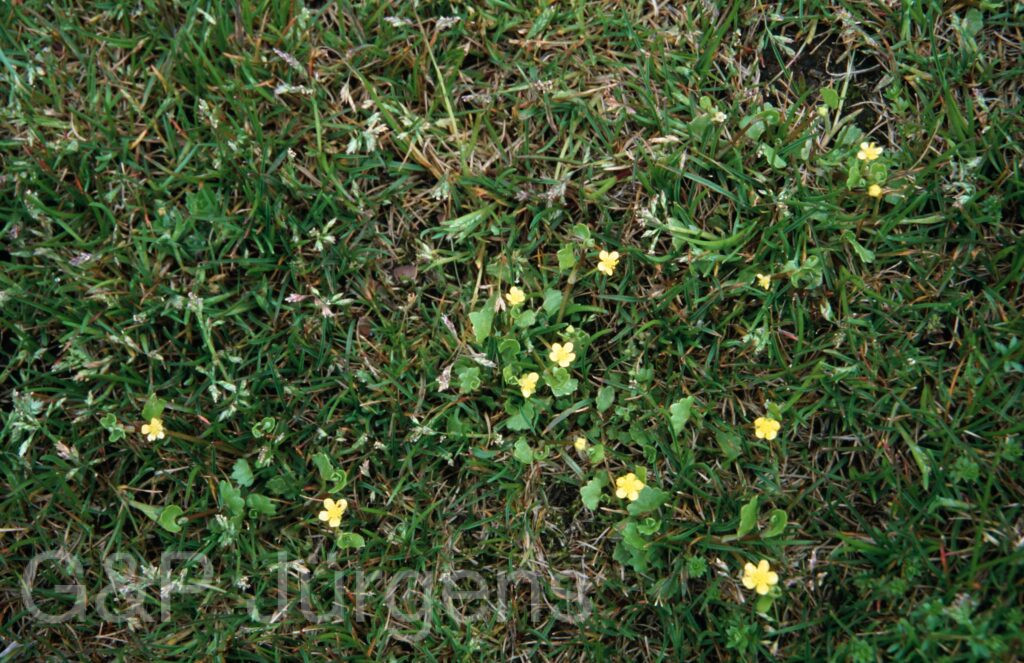
Ranunculus microphyllus is a Sino-Himalayan alpine buttercup whose core GBIF range (c. 399 occurrences) lies in China, Nepal, India and Bhutan, with scattered records elsewhere reflecting cultivated or misdetermined material. It grows in open alpine turf, moist meadows, snowmelt flushes, damp rock ledges and stream banks, typically between about 3000 and 4200 m. The cited localities—Yumthang in Sikkim at 3700 m in June, Lambra Kharka in the Nepalese Gorkha at 3200 m, and Sandakphu in West Bengal at 3200 m, both in May—illustrate its spring-to-early-summer flowering across moist, cool, high-elevation grasslands and seepage of the central and eastern Himalaya.

It is a small, tufted perennial herb, the stems low and ascending, often somewhat hairy, arising from a fibrous-rooted base. As the epithet implies the leaves are small; the basal leaves are petiolate and shallowly to deeply three-lobed or crenate, while the stem leaves are reduced and more dissected. The flowers are solitary or few, with the typical buttercup plan: five green sepals, five glossy bright-yellow petals each with a basal nectary, and numerous spirally arranged stamens and free carpels. The fruit is a globose head of small, slightly beaked achenes.

Described by Handel-Mazzetti, R. microphyllus belongs to the large, taxonomically intricate genus Ranunculus, in which the small-leaved Himalayan alpines form a closely related and often confused complex. It is locally common and not of conservation concern, though confined to moist high-altitude habitats sensitive to warming. Ecologically it is characteristic of snowmelt-fed alpine meadows, its open flowers offering accessible nectar and pollen to flies and other high-altitude insects.

Author: Hand.-Mazz. · Sources: POWO (Kew), GBIF, Flora of China, Annotated Checklist of the Flowering Plants of Nepal, Tamura monograph of Ranunculaceae
(Wall.) R.Br. ex. Wall.

Bhutan2012 357
Bhutan Dochu-La 2900m, September
Bhutan2014 609
Bhutan Phobjika 3100m, May
Sikkim2004 26 P41
Sikkim West-Bengal, Sambon 1850m April

Description

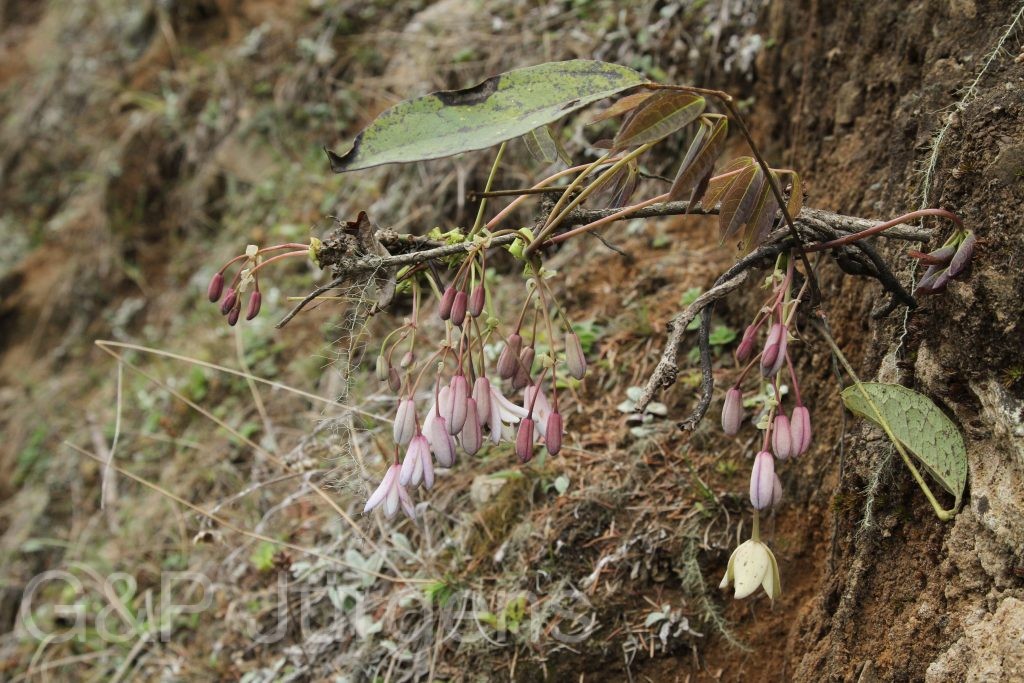
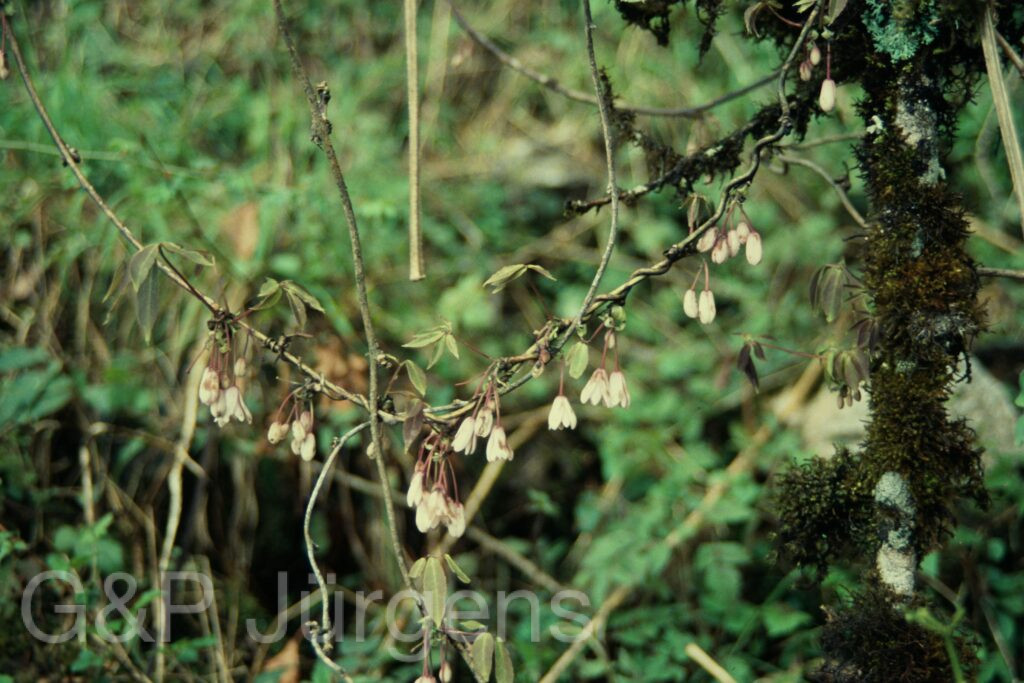
Stauntonia latifolia is a Himalayan woody climber distributed through China, India, Nepal, Bhutan and Myanmar, with GBIF aggregating some 517 occurrences across the warm temperate belt. It is a liana of moist broad-leaved and mixed forest, scrambling over shrubs and into the canopy along forest margins, ravines and streamsides typically between about 1500 and 3100 m. The accompanying records span this range well, from Sambon on the Sikkim–West Bengal border at 1850 m in April, through the Dochu-La in Bhutan at 2900 m in September, to Phobjika at 3100 m flowering in May, reflecting an extended phenology across elevation and longitude in the eastern Himalaya.

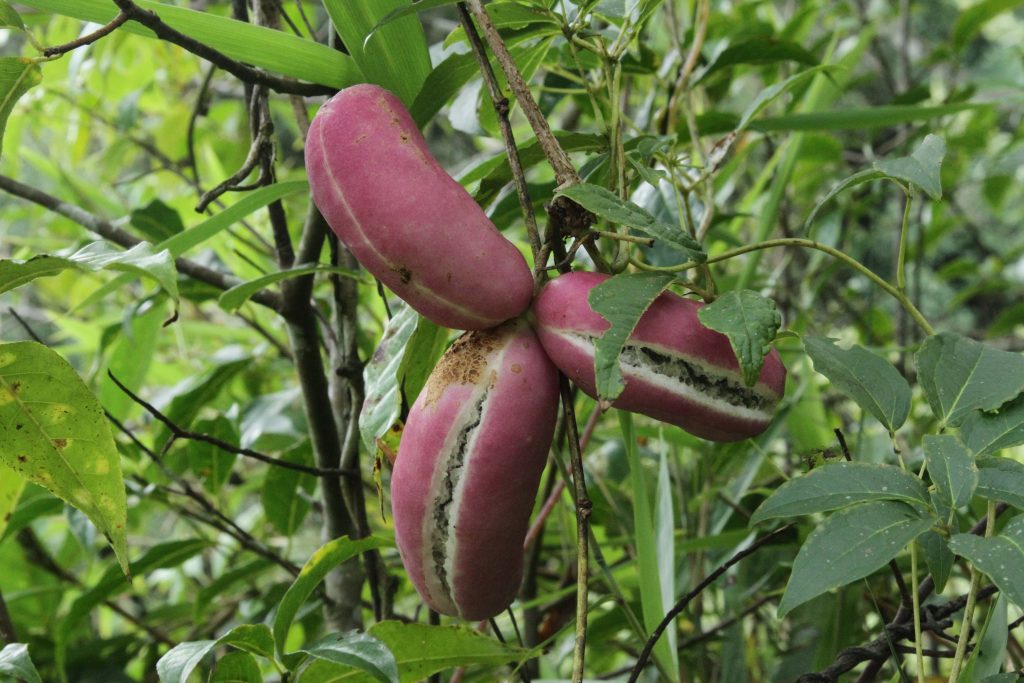
The family is here cited as Ranunculaceae, but the plant in fact belongs to the Lardizabalaceae; the description follows the true affinity. It is an evergreen twining climber with palmately compound leaves of three to seven leathery, entire, ovate to elliptic leaflets borne on long petioles. The plant is functionally monoecious, the flowers unisexual and borne in axillary racemes; they are greenish-white to purplish, lacking true petals, the showy parts being six sepals in two whorls, with six stamens in male flowers and three carpels in female ones. The fruit is a fleshy, oblong, purple berry-like follicle, edible and sweet, containing numerous black seeds embedded in a juicy pulp.

The taxon was described by Wallich and is widely treated under the synonym Holboellia latifolia, the generic limits between Holboellia and Stauntonia having been repeatedly debated and revised; under recent circumscriptions the Himalayan plant is placed in Stauntonia. The Lardizabalaceae are a small east-Asian and Chilean family of considerable phylogenetic interest as an early-diverging lineage of the Ranunculales. The succulent fruits are locally gathered and eaten and serve to disperse the seeds via birds and mammals; the species is common and faces no significant conservation concern.

Author: (Wall.) R.Br. ex. Wall. · Sources: POWO (Kew), GBIF, Flora of China, Flora of Bhutan, Annotated Checklist of the Flowering Plants of Nepal, monographic studies of Lardizabalaceae (Holboellia and Stauntonia)

DC.

BhutanPG2011 384
Bhutan Shele-La, 3600m September
Bhutan2012 33
Bhutan Shele-La, 3600m September
Bhutan2012 325
Bhutan Dochu-La, 3600m September
Nepal 95 137 P230 ergebnis
Nepal South of Rupina La 3650m October

Description

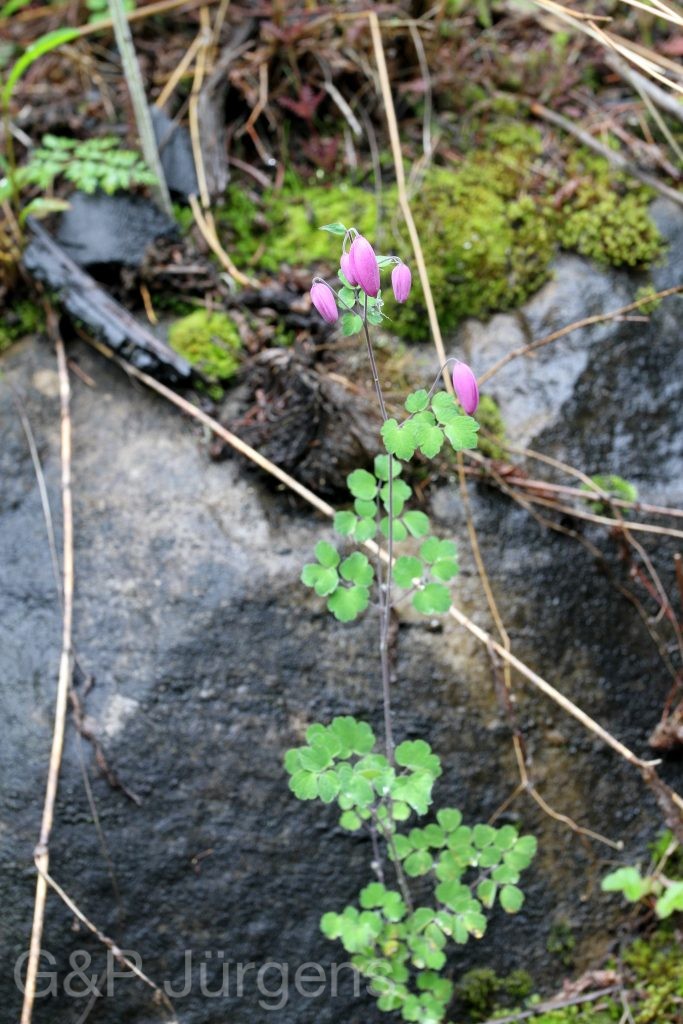
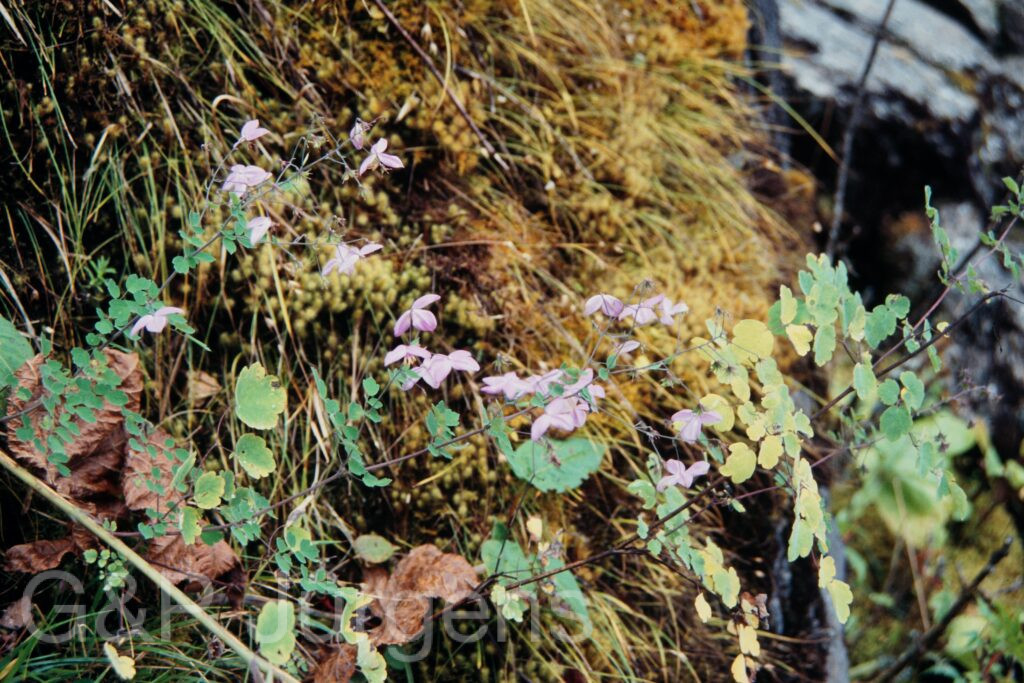
Thalictrum chelidonii is a Himalayan meadow-rue distributed through Nepal, north-east India, Bhutan and south-west China, with 178 georeferenced occurrences. It grows in moist, often partly shaded sites along forest margins, in subalpine scrub, on grassy and rocky slopes and beside streams in the upper temperate to subalpine zones. The cited collections at Shele-La and Dochu-La in Bhutan (both about 3600 m, September) and south of Rupina La in Nepal (3650 m, October) reflect its typical altitudinal range of roughly 2700-4000 m, where it flowers and fruits late in the growing season.

It is an erect perennial herb with slender, branching, often glaucous stems and large, two- to three-times ternately or pinnately compound leaves; the leaflets are rounded to obovate, lobed and toothed, recalling those of Aquilegia. Unlike many wind-pollinated meadow-rues, T. chelidonii has conspicuous flowers in which the four or five petaloid sepals are well developed, lilac to rose-purple, surrounding numerous spreading stamens with slender filaments. The carpels are several and free, ripening into a cluster of stipitate, longitudinally ribbed achenes that hang on slender stalks.

Within Ranunculaceae the genus Thalictrum is distinctive for its apetalous flowers in which sepals and stamens provide the floral display; the showy coloured sepals of this species point to insect rather than purely wind pollination. The pendent, winged-ribbed achenes aid dispersal. Widespread and locally common across the central and eastern Himalaya, the species is of no conservation concern, and like several relatives it contains isoquinoline alkaloids of ethnomedicinal interest.

Author: DC. · Sources: POWO (Kew), GBIF, Flora of Bhutan, Flora of China, Flora of Nepal, Tamura Ranunculaceae treatment (Die natürlichen Pflanzenfamilien)

Blume

Bhutan2012 407
Bhutan Wangdi 2500m, June

Description

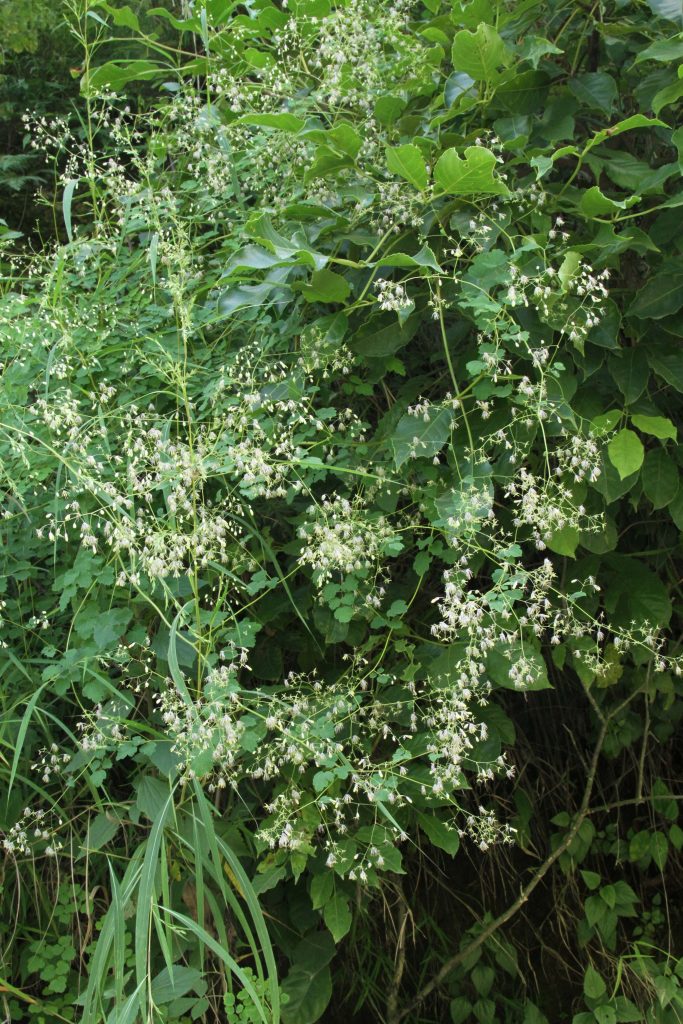
Thalictrum javanicum Blume is a widespread meadow-rue ranging across tropical and subtropical Asia. GBIF documents some 1366 occurrences from India, Sri Lanka, Nepal, Bhutan, Myanmar and southern China through Taiwan, Japan and into the Malesian uplands of Indonesia. It occupies moist, shaded habitats: streamsides, forest floors, damp ravines, clearings and grassy banks, mainly at middle elevations between roughly 1500 and 3000 m, descending lower in the tropics. The plant photographed near Wangdi in Bhutan at 2500 m in June, during the early monsoon, reflects its association with the cool, humid broad-leaved and conifer forest belt of the Himalaya.

It is a glabrous perennial herb forming erect stems 30-100 cm tall from a short rhizome. The leaves are two- to four-times ternately compound, the ultimate leaflets obovate to suborbicular, three-lobed and crenate at the apex, thin in texture, with conspicuous stipels at the divisions of the petiole. The inflorescence is a lax terminal panicle of small, apetalous flowers; the perianth consists of inconspicuous, caducous greenish sepals, the floral display provided instead by the numerous spreading stamens with slender filaments and oblong anthers. The fruit is a cluster of sessile to shortly stipitate, ribbed, ellipsoid achenes tipped by a short curved beak.

Thalictrum is a large, taxonomically intricate genus characterised by reduced, wind- and generalist-insect-pollinated flowers and considerable variation in stamen and achene morphology, generating a complex synonymy across its broad range. T. javanicum is among the most ecologically plastic species, tolerating a wide altitudinal and geographic span, which accounts for its abundant collection record. It is a common, unthreatened component of Asian montane forest understoreys, and several Thalictrum species, including this one, contain isoquinoline alkaloids used in regional ethnomedicine.

Author: Blume · Sources: POWO (Kew), GBIF, Flora of China, Flora of Bhutan, Flora of Java, Annotated Checklist of the Flowering Plants of Nepal

Franch.

BhutanPG2011 817 01 01
Bhutan Chele-La, 3700m July

Also: Iris Clarkei Hook.f.

Description

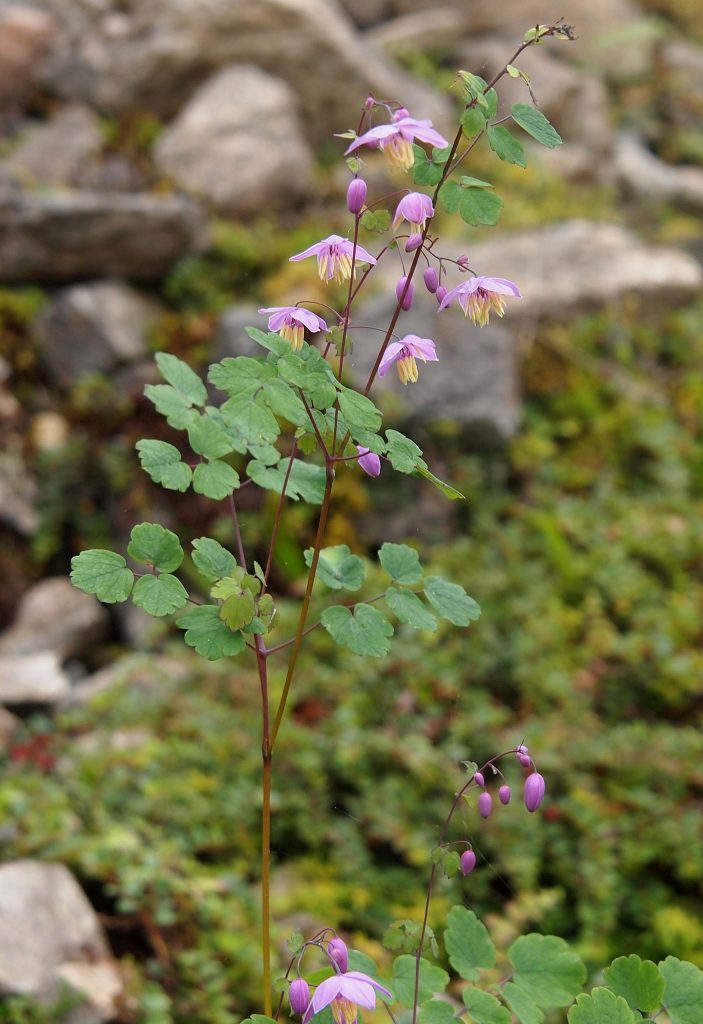
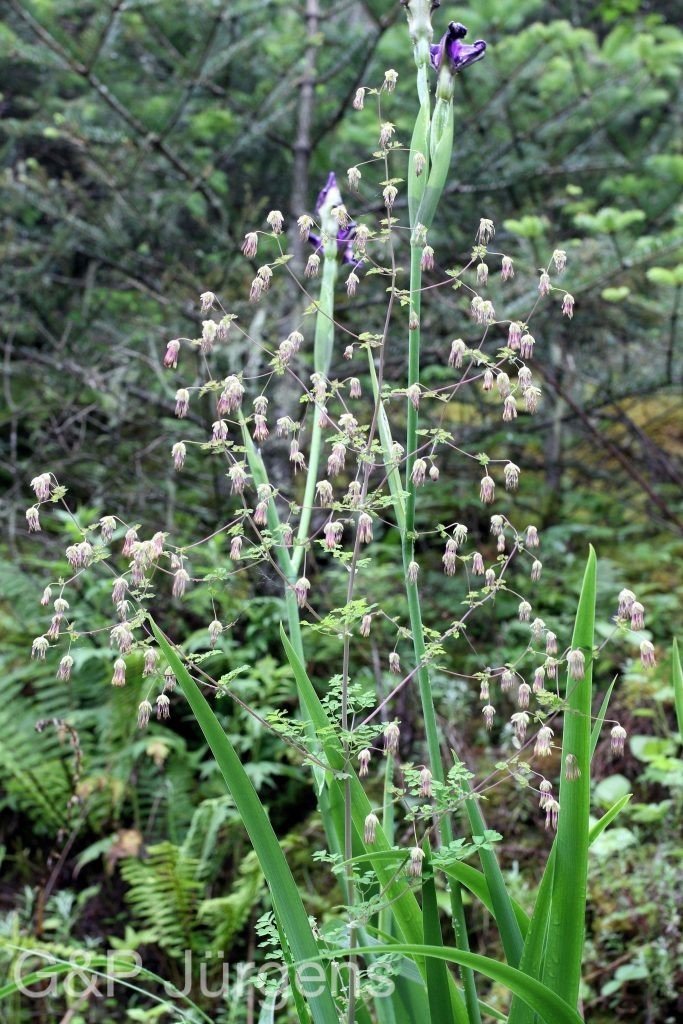
Thalictrum leuconotum is an alpine meadow rue distributed across the eastern Himalaya and adjacent Sino-Himalayan ranges, with verified records from China, Nepal and Bhutan (GBIF documents some 152 occurrences). It inhabits subalpine and alpine meadows, open grassy slopes, forest margins and the rocky banks of seasonal streams, typically between about 3000 and 4200 m. The species was photographed on the Chele-La in western Bhutan at 3700 m in July, a high pass where it flowers among dwarf rhododendron scrub and herbaceous turf during the brief growing season.

The plant is an erect perennial herb arising from a short, fibrous-rooted rhizome, the stems glabrous to minutely pubescent and branched in the upper part. The leaves are several times ternately compound, the ultimate leaflets thin, obovate to suborbicular and shallowly lobed or crenate, often glaucous and conspicuously whitish beneath, a feature alluded to in the epithet "leuconotum" (white-backed). The inflorescence is a lax, spreading panicle of small apetalous flowers; the showy parts are the numerous pendulous stamens with slender filaments, while the four caducous sepals are greenish to purplish. The fruit is a cluster of small, ribbed, stipitate achenes.

Within Thalictrum, a large and taxonomically intricate genus, T. leuconotum belongs to the broad assemblage of Sino-Himalayan species characterised by reduced perianths and reliance on wind pollination. Its glaucous, white-backed foliage and montane ecology distinguish it from sympatric congeners. As a widespread high-elevation herb of relatively undisturbed alpine pastures, it is not considered threatened, though localised grazing pressure and habitat change may affect populations across its range.

Author: Franch. · Sources: POWO (Kew), GBIF, Flora of Bhutan, Flora of China, Annotated Checklist of the Flowering Plants of Nepal, Monograph of Thalictrum (Boivin)

Wall.

Garw 2005 277 ergebnis
India Garhwal Kunol 2650m, October

Description

Thalictrum reniforme is a perennial herb distributed across the Himalayan arc from northern India through Nepal and Bhutan to southwestern China (Yunnan, Xizang, Sichuan). It occurs in moist, shaded habitats including forest margins, thickets, stream banks, and damp meadows at elevations of 1,800–3,500 m. The species is well represented in the western Himalayan foothills, as demonstrated by collections from Kunol in the Garhwal region of Uttarakhand, India, at 2,650 m, where plants have been observed in fruit as late as October.
The plant produces erect to ascending stems 30–80 cm tall from a short, fibrous-rooted rhizome. The leaves are bi- to triternately compound; the leaflets are distinctive for the genus, being reniform to orbicular, 1–3 cm wide, with a crenate to shallowly lobed margin. The leaflet surfaces are thin-textured and often glaucous beneath. The inflorescence is a lax, terminal panicle bearing numerous small, apetalous flowers. The sepals are four, ovate, greenish to purplish, caducous. The stamens are pendulous, with slender filaments and oblong anthers. The achenes are few per flower, stipitate, fusiform to obliquely ovoid, ribbed longitudinally, 3–5 mm long including the stipe.
Thalictrum reniforme is readily distinguished from most congeners by its conspicuously reniform leaflets, a character that inspired Wallich's specific epithet. The species belongs to a taxonomically challenging genus in which species boundaries are often obscured by morphological plasticity and hybridisation. With approximately 248 occurrence records in GBIF spanning India, Nepal, Bhutan, and China, it is moderately well collected. Ecologically, it contributes to the herbaceous understorey diversity of Himalayan temperate forests. No specific conservation concerns have been raised, though continued monitoring of its forest-dependent habitats remains advisable given ongoing pressures from logging and agricultural encroachment.

Author: Wall. · Sources: POWO (Kew), GBIF, Flora of China Vol. 6, Flora of Bhutan Vol. 1, Tamura: Thalictrum in Die Natürlichen Pflanzenfamilien (1995)

Hook.f. et Thomson

BhutanPG2011 73

Description

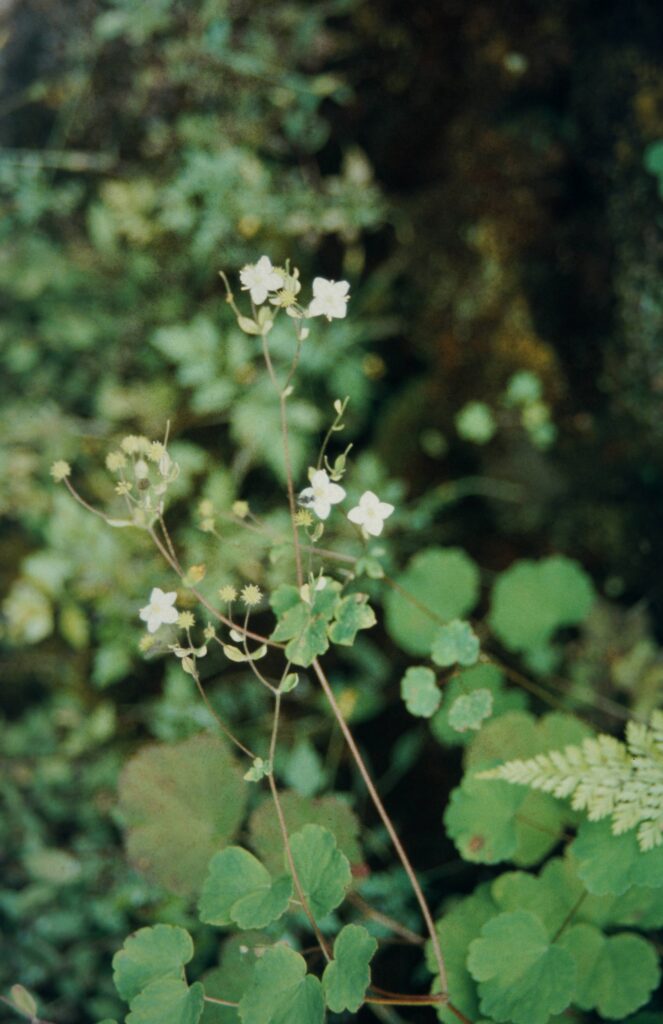
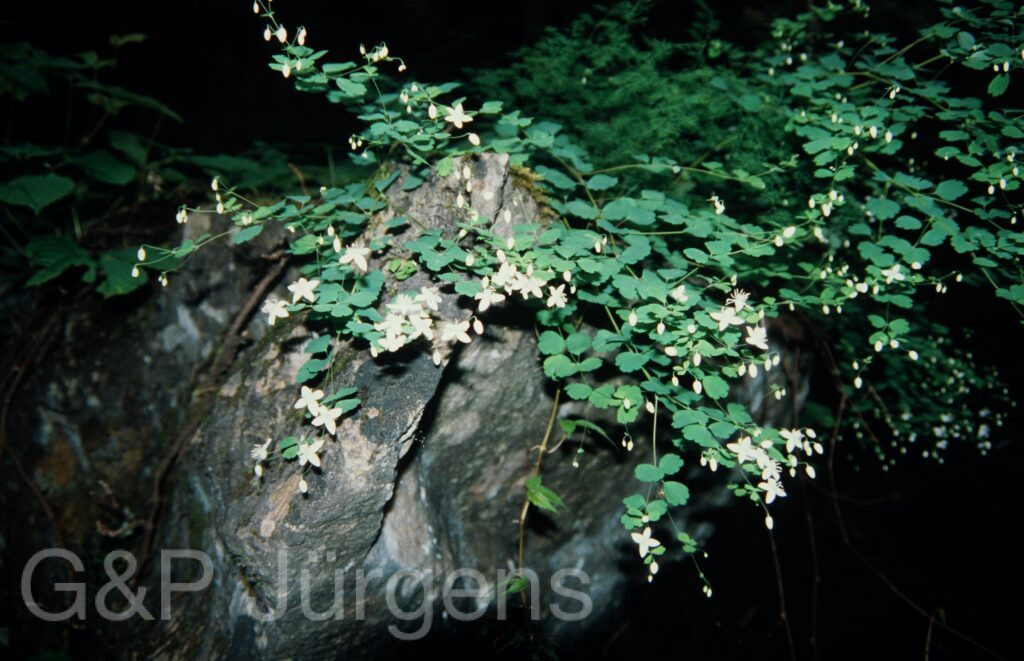
Thalictrum rostellatum is a meadow-rue of the temperate to subalpine Himalaya and adjacent China, recorded from China, Nepal, India, Bhutan and Myanmar, with some 258 occurrences aggregated in GBIF. It favours shaded, humus-rich slopes, the margins of forest, scrub and streamsides, and damp grassy banks within the broad-leaved and conifer forest belt of the Eastern Himalaya. Across its range it ascends through the montane and lower subalpine zones, where it grows in the dappled understorey alongside other moisture-loving herbs, flowering through the summer monsoon months.

It is a slender, glabrous perennial herb with a thin, creeping rhizome and erect, sparingly branched stems. The leaves are ternately decompound, the ultimate leaflets thin and membranous, obovate to broadly cuneate and shallowly lobed or toothed at the apex, often glaucous beneath. The inflorescence is a lax, few-flowered panicle of small, nodding flowers; as in the genus, the four pale sepals are caducous and petals are wanting, the floral display reduced to the pendulous stamens with filiform filaments and delicate anthers. The carpels are few and stipitate, ripening into small, stipitate achenes that bear a conspicuous slender beak, the rostellum from which the epithet derives.

The markedly beaked, stalked achenes are the principal character separating T. rostellatum from related Himalayan meadow-rues such as T. virgatum and T. reniforme. Like most Thalictrum it is anemophilous, the reduced, scentless flowers and exserted stamens reflecting wind pollination. Widespread and locally frequent through the Eastern Himalaya, it is of no particular conservation concern, though as a forest-understorey element its persistence depends on intact montane woodland.

Author: Hook.f. et Thomson · Sources: POWO (Kew), GBIF, Flora of China, Flora of Bhutan, Annotated Checklist of the Flowering Plants of Nepal, Boivin's revisionary studies of Thalictrum

Hook. f. & Thomson

Nepal 99 893 ergebnis
West-Nepal Suli-Khola 2800m, July

Description

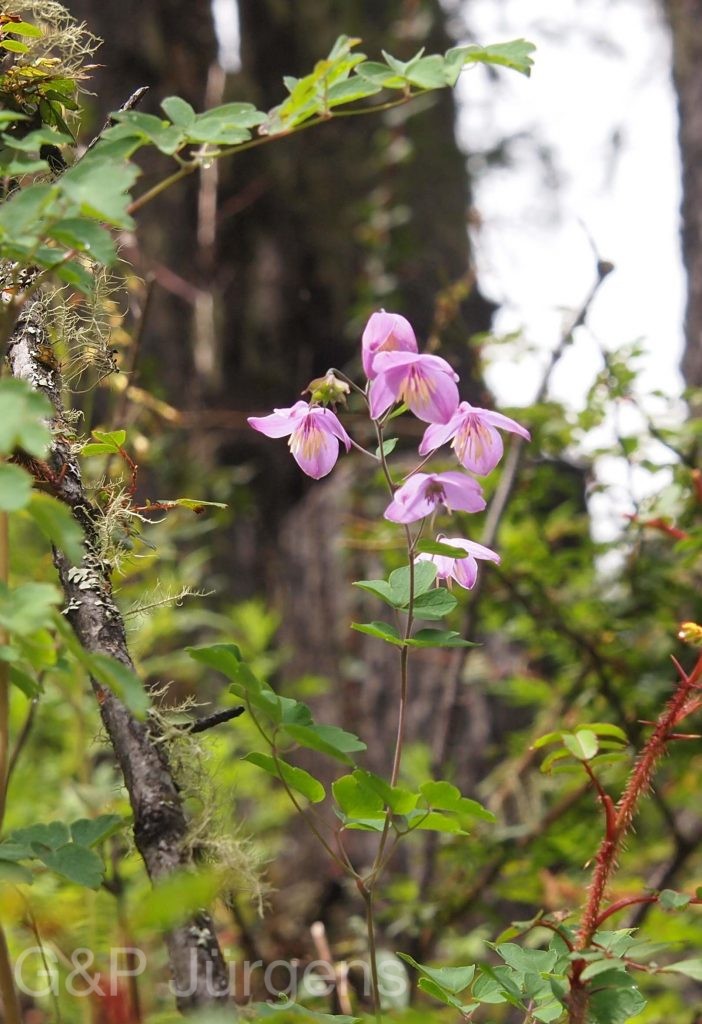
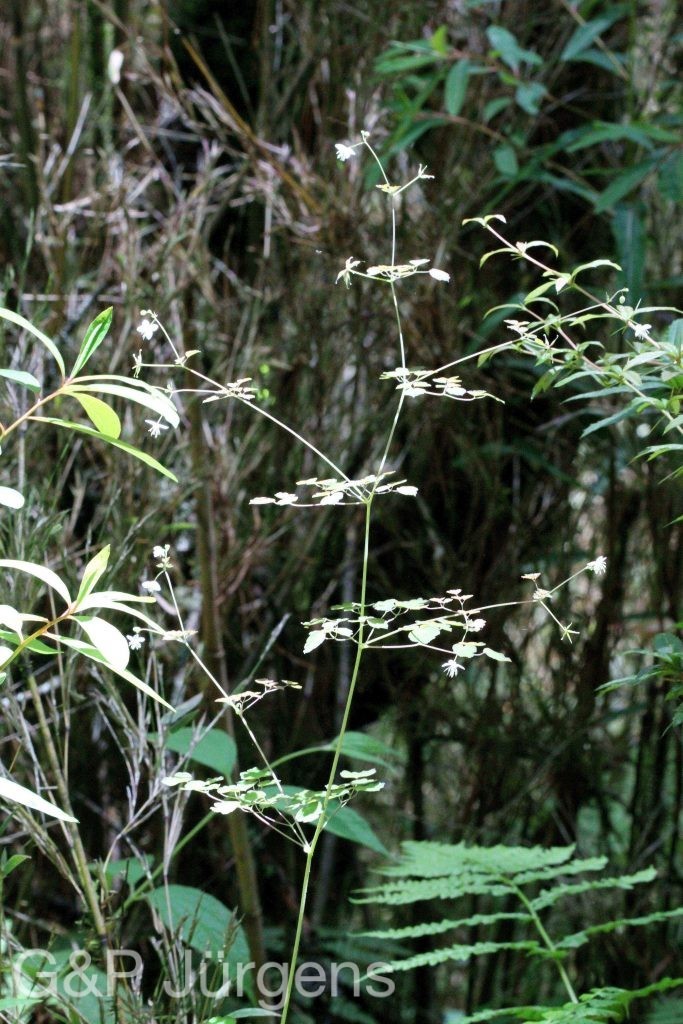
Thalictrum virgatum Hook.f. & Thomson is a widespread Sino-Himalayan meadow rue ranging from the Himalaya of Nepal, India and Bhutan eastward into south-western and central China; the comparatively large GBIF dataset of 498 occurrences attests to its abundance across the temperate Himalayan belt. It favours moist, shaded forest floors, streamsides, scrub margins and grassy slopes within the temperate to subalpine zone, broadly between 2400 and 4000 m. The photographed plant along the Suli-Khola in West Nepal at about 2800 m, flowering in July, is typical of its monsoon-season anthesis in the cool, humid, well-watered understorey of the moist temperate forest.

The species is a slender, erect, glabrous perennial herb with wiry, virgate stems arising from a short rootstock. The leaves are alternate and two- to three-pinnately compound, the ultimate leaflets small, thin, obovate to orbicular and shallowly three-lobed or crenate. The inflorescence is a lax, few-flowered, diffusely branched panicle or raceme; the small, pendulous flowers lack petals and instead bear four to five petaloid, caducous sepals that are whitish, pink-tinged or purplish. The numerous stamens have slender filaments and conspicuous anthers, giving the open flowers a delicate, dangling aspect. The fruit is a small cluster of stipitate, ribbed achenes.

Thalictrum is a large north-temperate genus of wind- and insect-pollinated petal-less Ranunculaceae, and T. virgatum belongs to the slender-stemmed, lax-panicled assemblage of the Sino-Himalaya. Its delicate habit and nodding pink-tinted flowers have brought it into specialist cultivation as a woodland ornamental. Being widespread, ecologically tolerant and locally common throughout the moist temperate Himalaya, it is of no conservation concern, and like many congeners it contains benzylisoquinoline alkaloids of pharmacological interest.

Author: Hook. f. & Thomson · Sources: POWO (Kew), GBIF, Flora of China, Flora of Bhutan, Annotated Checklist of the Flowering Plants of Nepal, B. A. Lecoyer — Monographie du genre Thalictrum

Lindl.

Description

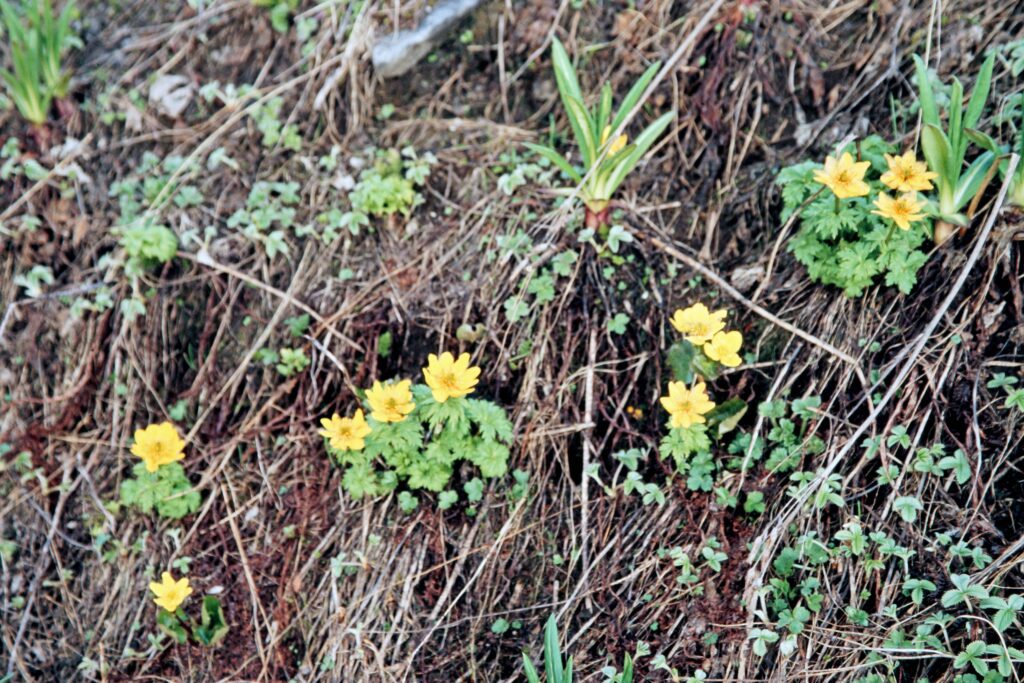
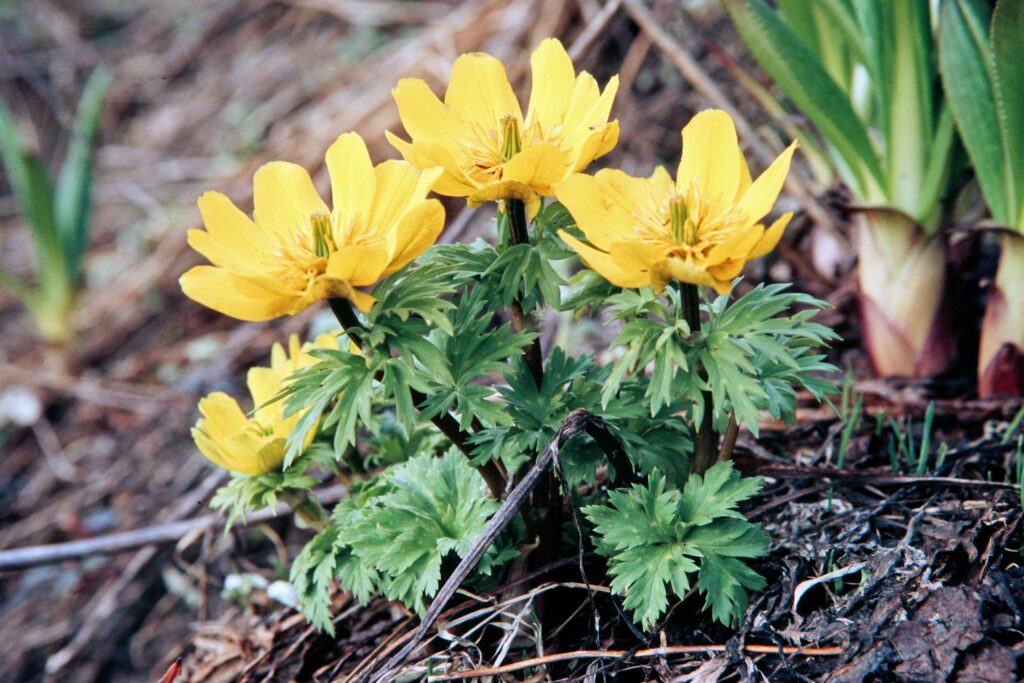
Trollius acaulis is a dwarf perennial of the high Himalaya, ranging along the alpine belt from Afghanistan and Pakistan through the western and central Himalaya into Nepal, Uttarakhand and Himachal Pradesh, and the western Tibetan Plateau in China. GBIF aggregates 188 georeferenced records, the species being strongest in the north-west. It grows in open alpine turf, moist grassy slopes, screes and snow-melt flushes, typically between 3000 and 4500 m. The plant photographed at Khiar Kutti in Garhwal at 3900 m in June is characteristic, flowering as the snow recedes.

It forms a compact, almost stemless herb arising from a short fibrous-rooted rhizome, the flowering stem reduced so the bloom appears to rest on the foliage (hence acaulis). The basal leaves are long-petiolate and palmately divided into deeply incised, toothed segments, glabrous and somewhat fleshy. The solitary flower is large, broadly cup-shaped and golden-yellow, the petaloid sepals enclosing numerous narrow nectariferous petals and a dense boss of stamens. The fruit is a head of many sessile, longitudinally veined follicles, each beaked and dehiscing ventrally to shed small angular seeds.

Within Ranunculaceae, Trollius (the globeflowers) is allied to Anemone and Ranunculus but set apart by its persistent petaloid sepals and clustered follicles. T. acaulis is among the most reduced, high-altitude members of the genus, its acaulescent habit an adaptation to short seasons, intense insolation and wind exposure. Like its congeners it yields acrid protoanemonin and is unpalatable to stock. Not assessed as threatened, it is nonetheless sensitive to overgrazing and the upward shift of climatic belts.

Author: Lindl. · Sources: POWO (Kew), GBIF, Flora of China Vol. 6, Flora of Pakistan, Flora of Bhutan Vol. 1, Annotated Checklist of the Flowering Plants of Nepal, Doroszewska monograph of the genus Trollius