
Franch.
Also: Iris Clarkei Hook.f.
Description
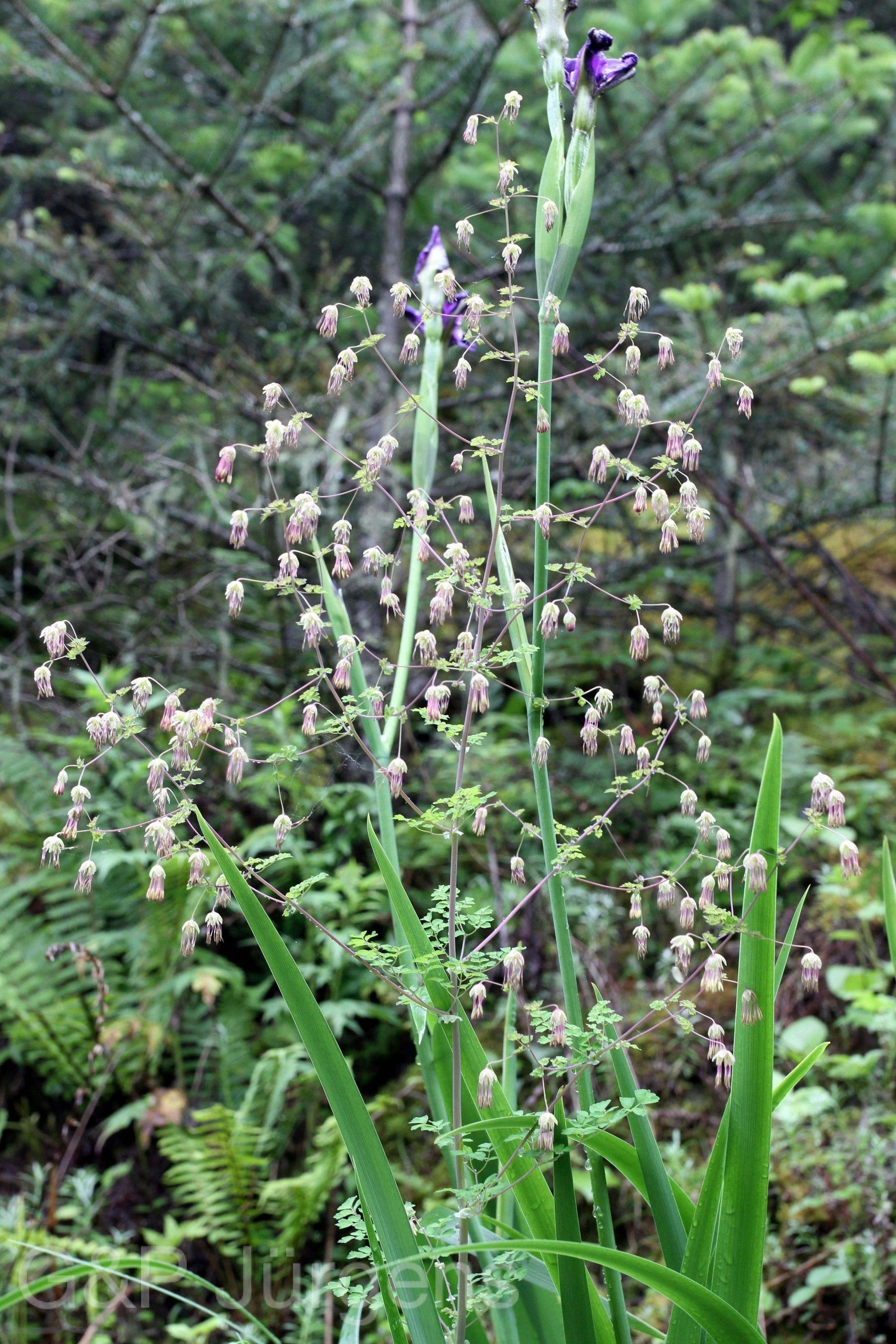
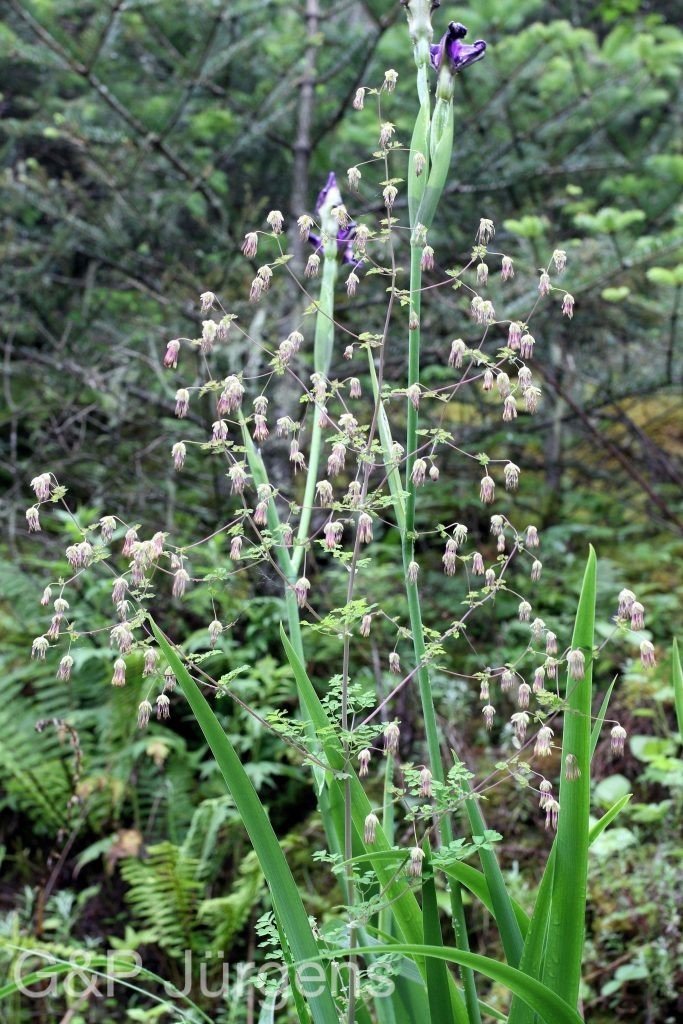
Thalictrum leuconotum is an alpine meadow rue distributed across the eastern Himalaya and adjacent Sino-Himalayan ranges, with verified records from China, Nepal and Bhutan (GBIF documents some 152 occurrences). It inhabits subalpine and alpine meadows, open grassy slopes, forest margins and the rocky banks of seasonal streams, typically between about 3000 and 4200 m. The species was photographed on the Chele-La in western Bhutan at 3700 m in July, a high pass where it flowers among dwarf rhododendron scrub and herbaceous turf during the brief growing season.
The plant is an erect perennial herb arising from a short, fibrous-rooted rhizome, the stems glabrous to minutely pubescent and branched in the upper part. The leaves are several times ternately compound, the ultimate leaflets thin, obovate to suborbicular and shallowly lobed or crenate, often glaucous and conspicuously whitish beneath, a feature alluded to in the epithet "leuconotum" (white-backed). The inflorescence is a lax, spreading panicle of small apetalous flowers; the showy parts are the numerous pendulous stamens with slender filaments, while the four caducous sepals are greenish to purplish. The fruit is a cluster of small, ribbed, stipitate achenes.
Within Thalictrum, a large and taxonomically intricate genus, T. leuconotum belongs to the broad assemblage of Sino-Himalayan species characterised by reduced perianths and reliance on wind pollination. Its glaucous, white-backed foliage and montane ecology distinguish it from sympatric congeners. As a widespread high-elevation herb of relatively undisturbed alpine pastures, it is not considered threatened, though localised grazing pressure and habitat change may affect populations across its range.
Author: Franch. · Sources: POWO (Kew), GBIF, Flora of Bhutan, Flora of China, Annotated Checklist of the Flowering Plants of Nepal, Monograph of Thalictrum (Boivin)