Tag:

Bhutan

Flowers of Bhutan — 1326 plant species documented across the Bhutanese Himalaya, from dense broadleaf and conifer forests to alpine scrub and meadows. Bhutan’s largely intact wilderness shelters an exceptional diversity of orchids, rhododendrons, primulas and Himalayan poppies, many of them regional endemics. Each species page includes a botanical description, distribution, habitat and flowering time, with the original photograph and its recorded altitude and locality.

Hook.f.

BhutanPG2011 53
Bhutan Jakar, 2500m June
BhutanPG2011 552011 Bhutan Buddleia colvilei
Bhutan Jakar, 2500m June

Description

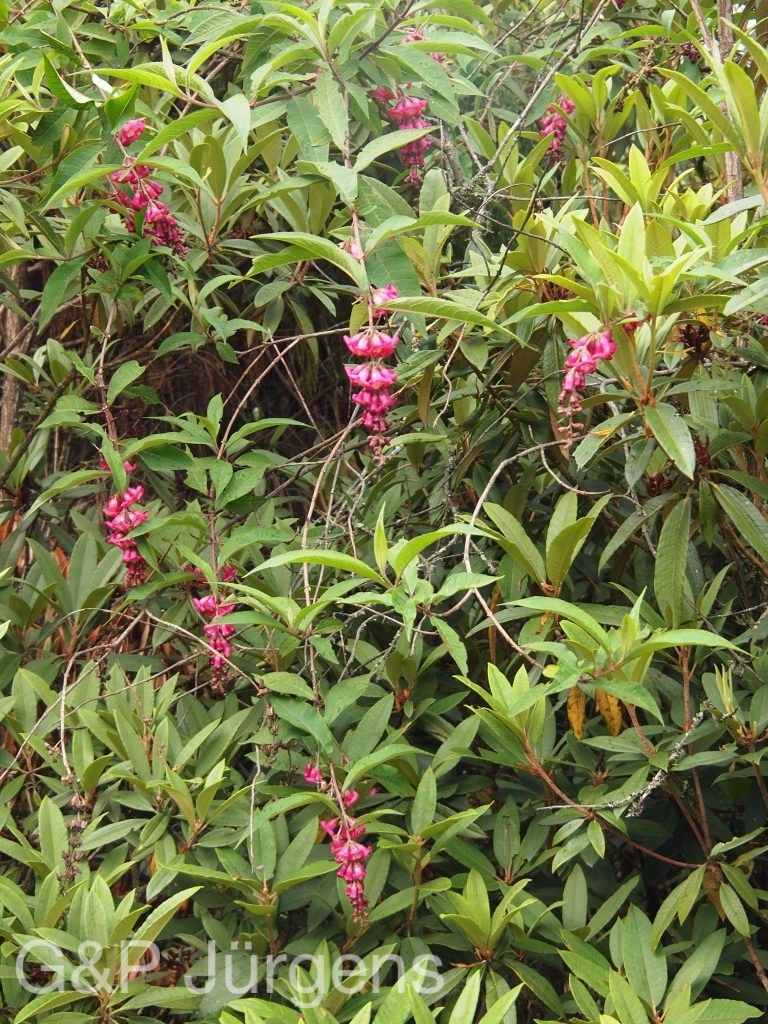
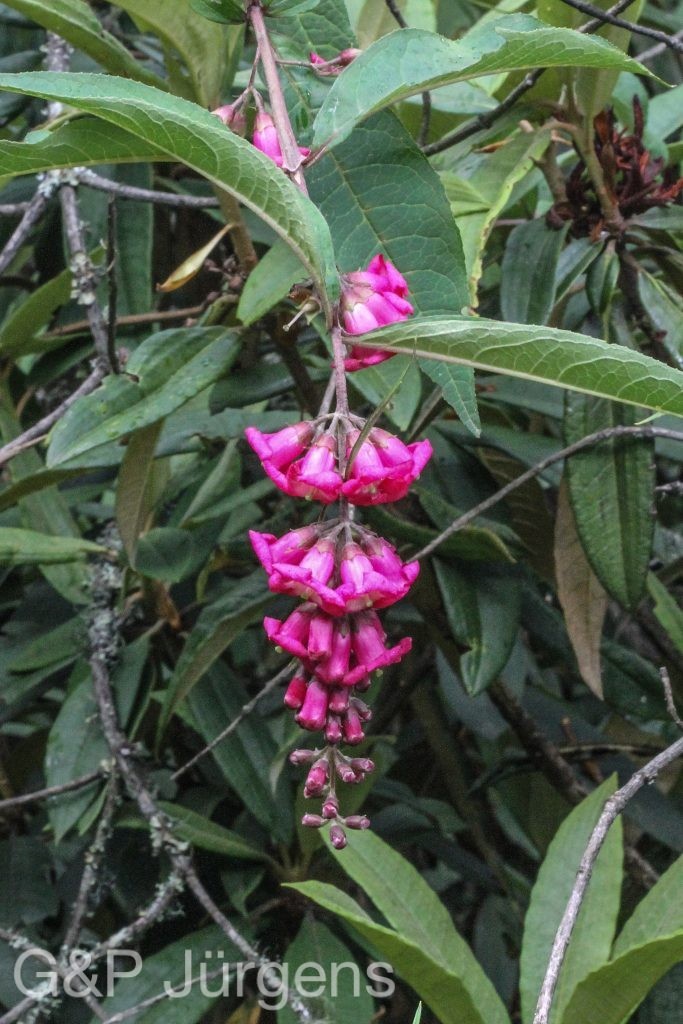
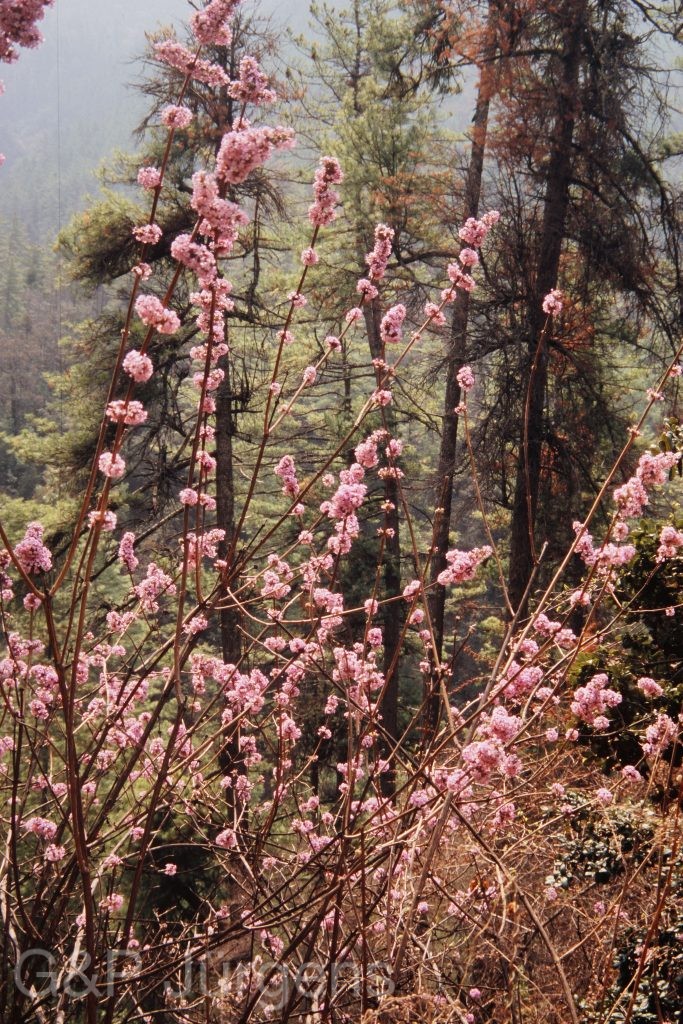
Buddleja colvilei is a large-flowered shrub or small tree of the eastern Himalaya, native to Bhutan, India, Nepal and China, and widely grown in temperate gardens, as its 166 occurrences from Britain, North America, New Zealand and Spain attest. In the wild it occupies open temperate forest margins, clearings, stream banks and shrubberies, typically between about 2400 and 4000 m. The plant recorded at Jakar in Bhutan at 2500 m in June represents its early-summer flowering within the moist temperate zone, where it forms a spreading, often arching woody framework.

The plant has stout branches with peeling bark and is clothed, especially when young, in a pale stellate or floccose indumentum. The leaves are opposite, lanceolate to elliptic, acuminate, with finely toothed margins, dark green above and paler and tomentose beneath. The inflorescence is a pendent terminal panicle of relatively few but exceptionally large flowers; the corolla is tubular with a flared, four-lobed limb, deep rose-red to crimson with a pale or whitish throat, and bears the largest flowers of any Buddleja. The fruit is a small two-valved septicidal capsule releasing numerous tiny seeds.

Buddleja is here placed in Scrophulariaceae following the family circumscription used in the source, though the genus is also treated in a segregate family Buddlejaceae and within an expanded Scrophulariaceae in current systems. B. colvilei is celebrated horticulturally for its outsized, vividly coloured flowers and has received garden awards. In its native range it remains locally frequent in disturbed and edge habitats and is not regarded as threatened.

Author: Hook.f. · Sources: POWO (Kew), GBIF, Flora of China, Flora of Bhutan, A Revision of the Genus Buddleja (Leeuwenberg), Flowers of the Himalaya (Polunin & Stainton)
Benth.

Bh2008 26 P45
Bhutan Doch-La, 1400m April
Bh2008 27 G47
Bhutan Doch-La, 1400m April

Description

Buddleja crispa is a shrub of the dry inner valleys and warm temperate slopes of the Himalaya and adjacent mountains, distributed through China, Pakistan, India, Nepal, Afghanistan and Bhutan, with close to 1100 occurrences in GBIF. It favours open, sunny, often rocky and somewhat arid sites: cliff ledges, river gravels, dry hillsides, roadside banks and the margins of cultivation, generally between about 1000 and 3000 m. The plant photographed at the Doch La in Bhutan at 1400 m in April, flowering in spring on a warm montane pass, is typical of its early-season bloom on exposed, well-drained slopes where its grey-felted foliage withstands strong insolation and seasonal drought.

The species is a much-branched, deciduous to semi-evergreen shrub reaching 1–4 m, densely clothed throughout in white to greyish stellate and woolly tomentum that gives it a markedly silvery appearance. The leaves are opposite, ovate to lanceolate, with crisped, crenate or dentate, often undulate margins (the source of the epithet), and a thick indumentum, particularly beneath. The fragrant flowers are borne in dense, terminal and axillary panicles; each has a tubular corolla that is lilac to pale purple with an orange or yellow throat, the four-lobed limb spreading. The fruit is a small, two-valved septicidal capsule containing numerous minute seeds.

Buddleja, formerly placed in its own family Buddlejaceae or in Loganiaceae, is now treated within an expanded Scrophulariaceae, as on the source page. B. crispa is a variable species across its wide range and has given rise to several named varieties and to horticultural selections valued for their scented, early flowers and tolerance of dry, sunny conditions. The flowers attract butterflies and other insects. The species is widespread, often pioneering on disturbed ground, and is not of conservation concern.

Author: Benth. · Sources: POWO (Kew), GBIF, Flora of China Vol. 15, Flora of Bhutan Vol. 2, Flora of Pakistan, A Revision of the Asiatic Species of Buddleja (Scrophulariaceae)

Benth.

Bhutan2015 445
  Bhutan Jakar 2900m, October
Bhutan2015 446
  Bhutan Jakar 3100m, October

Description

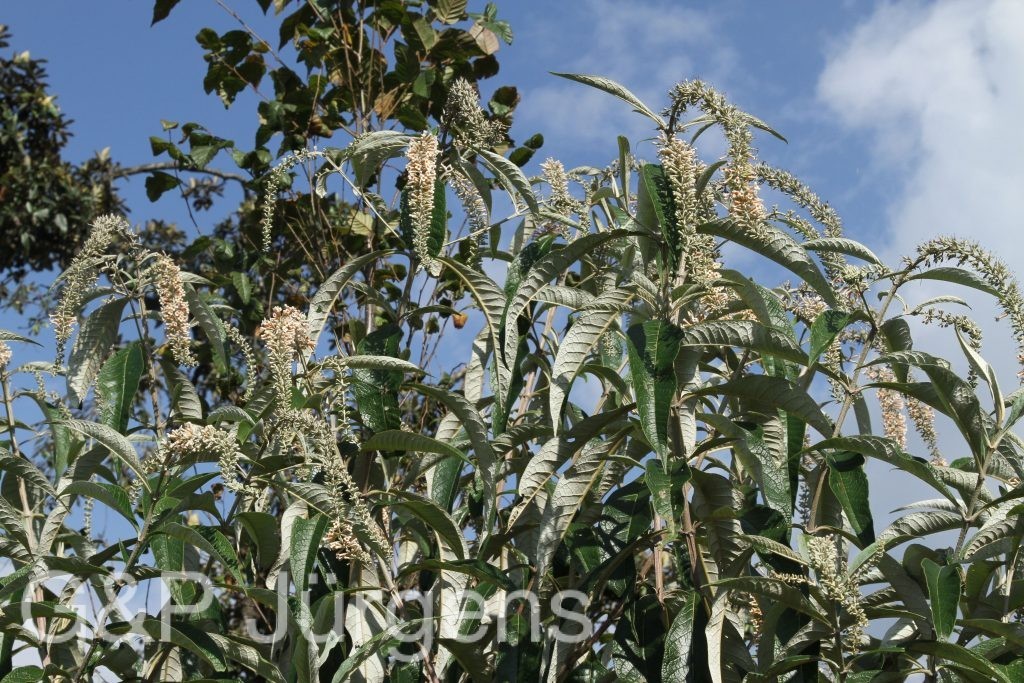
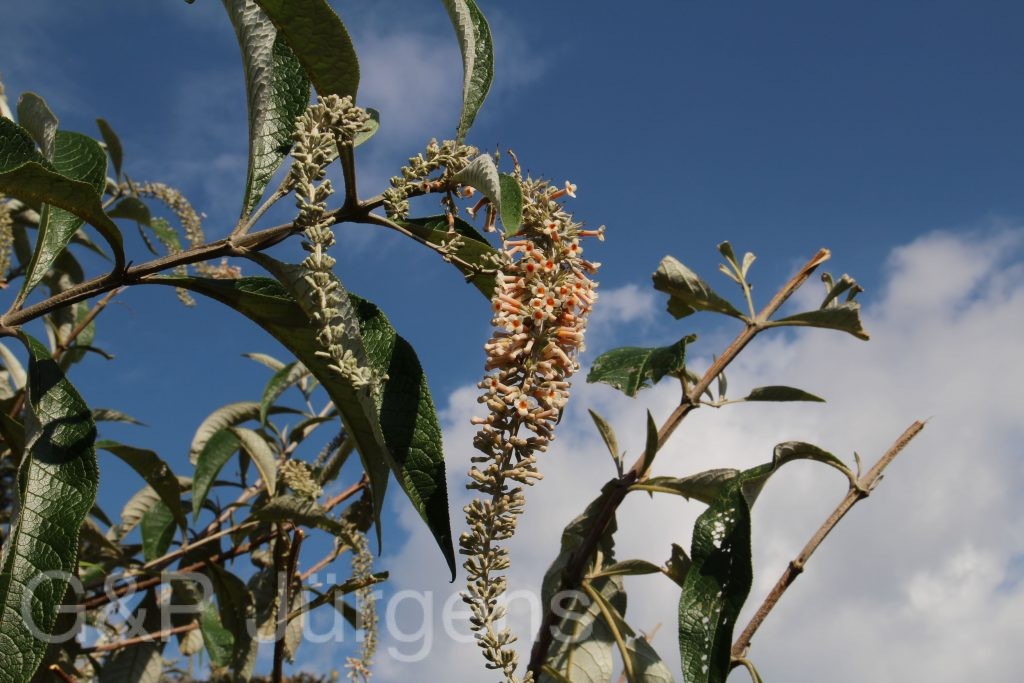
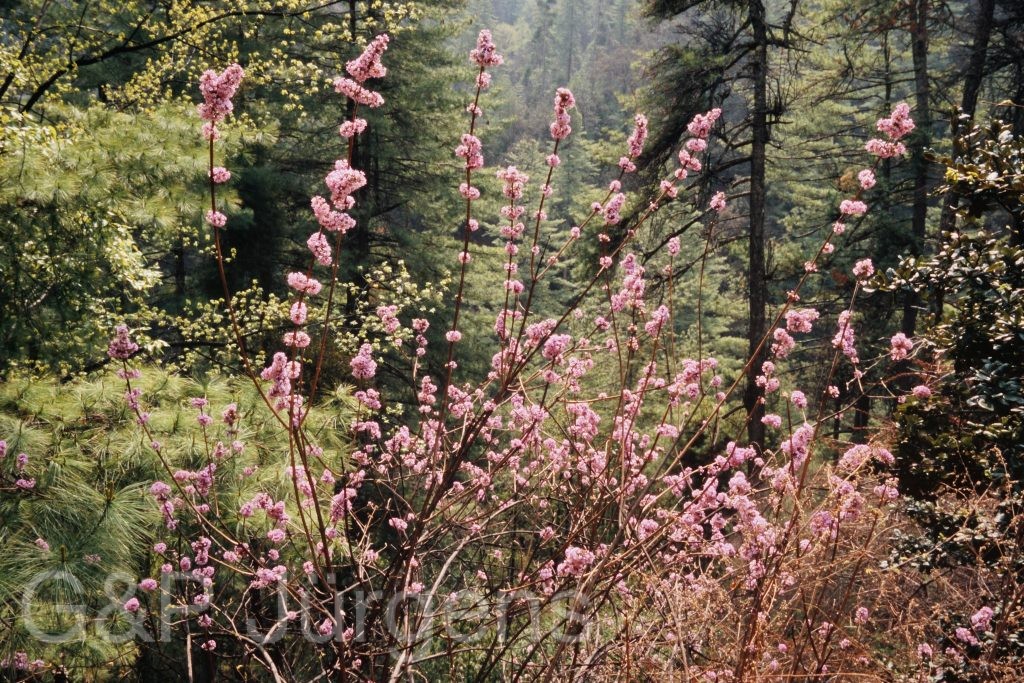
Buddleja macrostachya is a widespread Sino-Himalayan and Indochinese shrub, recorded from China, India, Vietnam, Myanmar, Thailand, Bhutan, Bangladesh and Nepal, with over 400 documented occurrences spanning the eastern Himalaya into mainland Southeast Asia. It is a plant of open hillsides, forest margins, thickets, roadsides and disturbed slopes in subtropical to temperate zones, generally between about 1000 and 3200 m. The illustrated plants from Jakar in central Bhutan at 2900 and 3100 m, flowering in October, demonstrate its autumn flowering at the upper end of its altitudinal range, where it forms conspicuous shrubs in sunny, often disturbed montane habitats.

It is a large shrub with quadrangular, densely stellate-tomentose young branches. The leaves are opposite, lanceolate to narrowly elliptic, long-acuminate, with a crenate-serrate margin, dark green and rugose above and grey- to fawn-tomentose beneath, the bases joined by an interpetiolar stipular line. The inflorescence is a long, narrow, interrupted spike-like thyrse (reflected in the epithet macrostachya, large-spiked) of many congested cymose clusters. Individual flowers are small, with a four-lobed campanulate corolla that is pale lilac to pink or purplish with an orange throat, and four included stamens. The fruit is a small, septicidal, two-valved capsule releasing numerous minute seeds.

Although listed here under Scrophulariaceae following the broad APG placement of Buddleja, the genus is also frequently treated in its own family Buddlejaceae; B. macrostachya Benth. is the accepted name. The nectar-rich, fragrant inflorescences attract butterflies, moths and other long-tongued insects, while the light, winged seeds are wind-dispersed. As a vigorous coloniser of open and disturbed ground it is common and widespread, and of least conservation concern.

Author: Benth. · Sources: POWO (Kew), GBIF, Flora of China Vol. 15, Flora of Bhutan Vol. 2, Flora of Nepal, Leeuwenberg The Loganiaceae of Africa and Buddleja revisions (monograph)

Wall.

Nepal 97 331 P656
Nepal Arun-Valley 1900m, May

Description

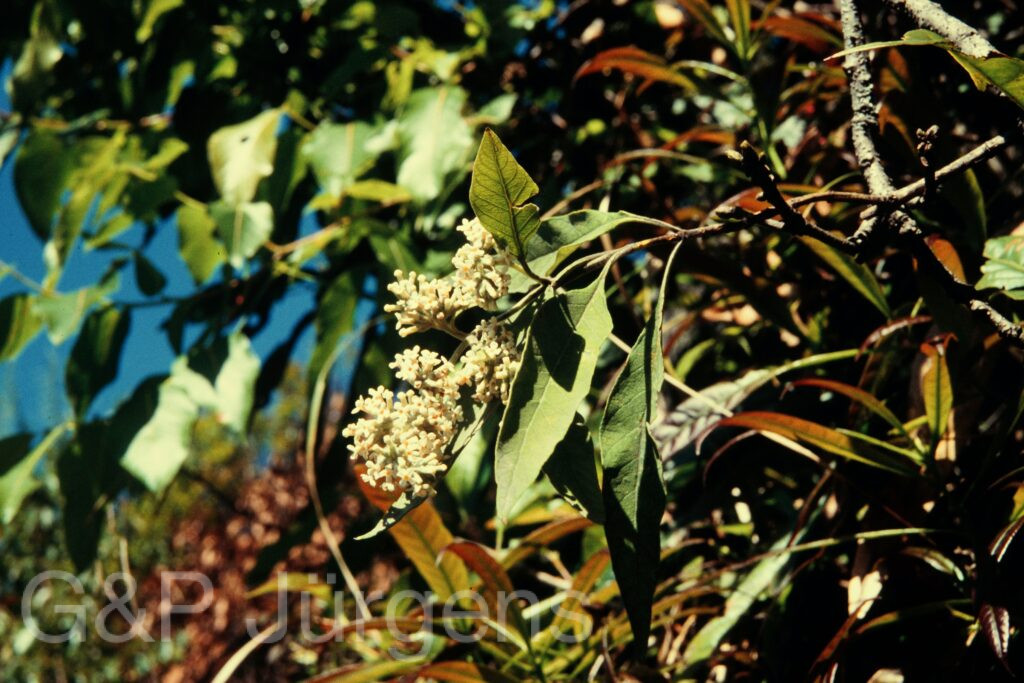
Buddleja paniculata is a shrubby butterfly-bush of the Himalaya and adjacent China, with GBIF occurrences across Nepal, northern India, Bhutan, Myanmar, Vietnam, Thailand and southwest China (further codes being cultivated and herbarium records). It favours open, sunny situations on dry slopes, river terraces, cliffs, roadsides and forest margins in the subtropical to warm-temperate zone, mostly between 1,000 and 2,800 m. The illustrated plant was photographed in the Arun Valley of eastern Nepal at about 1,900 m in May, where it flowers in the dry pre-monsoon season on stony, well-drained ground.

The plant is an erect, much-branched shrub 1-3 m tall with quadrangular, stellate-tomentose young branches. The leaves are opposite, lanceolate to ovate-lanceolate, with a green, somewhat rugose upper surface and a paler, densely stellate-hairy underside, and crenate-serrate margins. The flowers are small and fragrant, crowded into slender, often nodding panicles of cymose clusters; the corolla is tubular with four short lobes, white to pale lilac with an orange or yellow throat, and the calyx is densely tomentose. The fruit is a small, two-valved septicidal capsule releasing numerous minute, narrowly winged seeds dispersed by wind.

The genus Buddleja, formerly placed in its own family Buddlejaceae or in Loganiaceae, is now treated within an enlarged Scrophulariaceae. Buddleja paniculata is among the more cold-tolerant Asian species and an important early-season nectar source for butterflies and other insects. It is widespread, often colonising disturbed and degraded ground, and is not of conservation concern; some forms are grown ornamentally for their scented winter-to-spring bloom.

Author: Wall. · Sources: POWO (Kew), GBIF, Flora of China Vol. 19 (Buddlejaceae), Flora of Nepal, Leeuwenberg: The Loganiaceae of Africa – Buddleja revision works

Lindl.

Bh09 392 G619
Bhutan Mo-Chu, 1500m June

Description

Bulbophyllum affine is an epiphytic orchid widely distributed across East and Southeast Asia, from Nepal and northeast India (Sikkim, Assam) through Bhutan, Myanmar, and southern China to Taiwan, Vietnam, and Thailand. It inhabits humid broadleaved and mixed forests at 500–2,500 m elevation, growing on mossy trunks and branches, occasionally on rocks (lithophytic).

The plant produces ovoid to conical pseudobulbs 2–4 cm tall, set 3–8 cm apart on a stout, creeping rhizome. Each pseudobulb bears a single, leathery, elliptic to oblong leaf 8–15 cm long. The inflorescence is a nodding, densely many-flowered raceme 5–15 cm long, emerging from the base of the pseudobulb. The flowers are small, 5–8 mm across, yellowish-green to pale brown, densely arranged in a cylindrical spike. Sepals are lanceolate and acuminate; the lip is small, fleshy, and recurved, mobile on a thin strap connecting it to the column foot — a characteristic feature of Bulbophyllum enabling pollination by small flies.

Bulbophyllum is the largest genus in the Orchidaceae, comprising over 2,200 described species. B. affine belongs to section Cirrhopetalum and is distinguished from similar congeners by its densely flowered, cylindrical raceme and the prominent column stelidia.

Author: Lindl. · Sources: POWO (Kew), Flora of Bhutan Vol. 3, GBIF, Seidenfaden: Orchid Genera in Thailand XIV: Bulbophyllum (1979)

Rchb.f.

Bhutan2012 444
Bhutan Wangdi 2500m, September
Bhutan2012 1171 Kopie
Bhutan Tashiyangtse 2000m, October

Description

Bulbophyllum griffithii is an epiphytic orchid distributed from the eastern Himalayas (Nepal, northeast India, Bhutan) through southwest China (Yunnan) to Taiwan. The species is named after William Griffith (1810–1845), the pioneering British botanist who collected extensively in Bhutan and northeast India. It occurs in cool, humid montane forests at elevations of 1,500–2,800 m, favouring mossy tree trunks in the cloud forest zone.

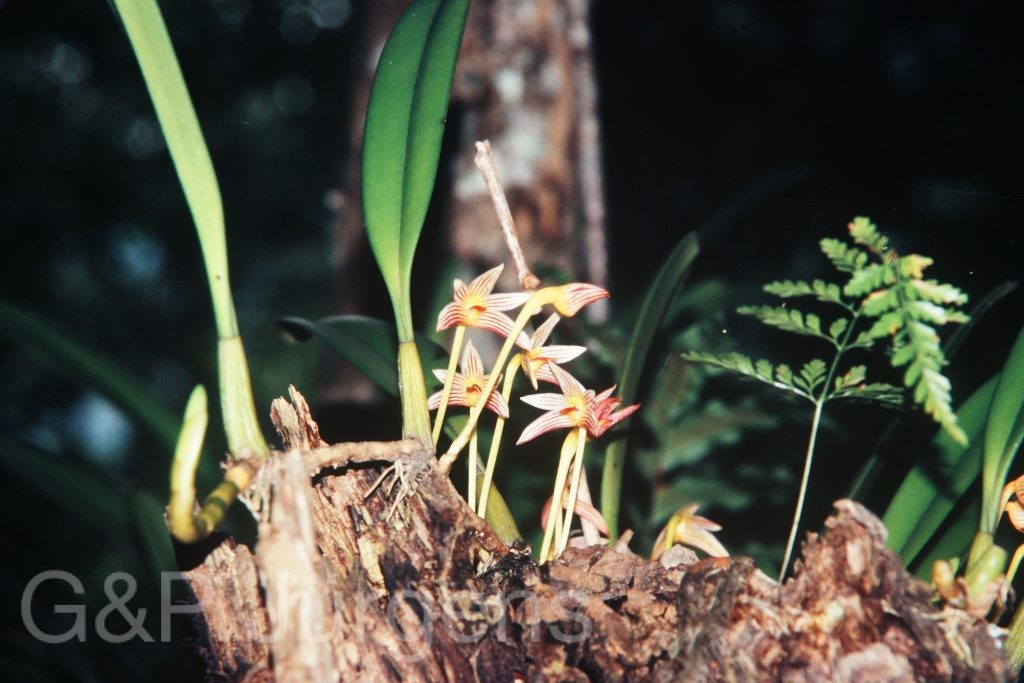
The pseudobulbs are ovoid to subglobose, 1.5–3 cm tall, widely spaced on a stout rhizome. Each bears a single, coriaceous, oblong-elliptic leaf 8–15 cm long. The inflorescence is an umbel-like, subglobose cluster of 5–12 flowers, carried on a slender peduncle 10–20 cm tall — a floral arrangement typical of section Cirrhopetalum. The flowers are about 2 cm across, pale yellow to greenish with purple-red stripes and spots. The dorsal sepal is erect, the lateral sepals elongated and twisted, and the lip is small, curved, and dark purple. Flowering occurs from August to October.

Within the complex taxonomy of Bulbophyllum section Cirrhopetalum, B. griffithii is recognised by its umbellate inflorescence with relatively few, medium-sized flowers and its distinctive striped pattern. GBIF records confirm a limited distribution centred on the eastern Himalayas and East Asia.

Author: Rchb.f. · Sources: POWO (Kew), Flora of Bhutan Vol. 3, GBIF, Pearce & Cribb: The Orchids of Bhutan (2002)

Lindl.

Bhutan2015 573
Bhutan Mo-Chu 1550m, October
Bhutan2015 574
Bhutan Mo-Chu 1550m, October

Description

Bulbophyllum hirtum is an epiphytic orchid distributed across the eastern Himalayas and Southeast Asia, from Nepal and northeast India through Bhutan, Myanmar, southwest China, Thailand, and Vietnam. It grows in warm to temperate broadleaved forests at 500–2,000 m elevation, on moss-covered tree trunks and larger branches, occasionally on rocks near streams.

The plant has ovoid, somewhat compressed pseudobulbs 1.5–2.5 cm tall, spaced 2–5 cm apart on a creeping rhizome. Each pseudobulb bears a single, elliptic-oblong, coriaceous leaf 6–12 cm long. The inflorescence is a lax raceme 5–15 cm long, carrying 5–15 flowers. The specific epithet 'hirtum' (meaning hairy) refers to the distinctive pubescence on the floral parts: the flowers are small, 6–10 mm across, yellowish to brownish-green with conspicuous fine hairs on the sepals and petals. The lip is fleshy, recurved, and densely papillose, dark purple, hinged to the column foot. Flowering occurs from September to November.

Bulbophyllum hirtum is classified within Bulbophyllum section Brachystachya. The pubescent flower surfaces are thought to play a role in pollinator attraction by enhancing both visual texture and scent dispersal, as the genus is predominantly pollinated by small flies (Diptera).

Author: Lindl. · Sources: POWO (Kew), Flora of Bhutan Vol. 3, GBIF, Vermeulen: Orchid Monographs 7: Bulbophyllum (1993)

Rchb.f.

Bhutan2015 56
Bhutan Wangdi Phodrang 2000m, October
Bhutan2012 341 1
Bhutan Dochu-La 3100m, September

Description

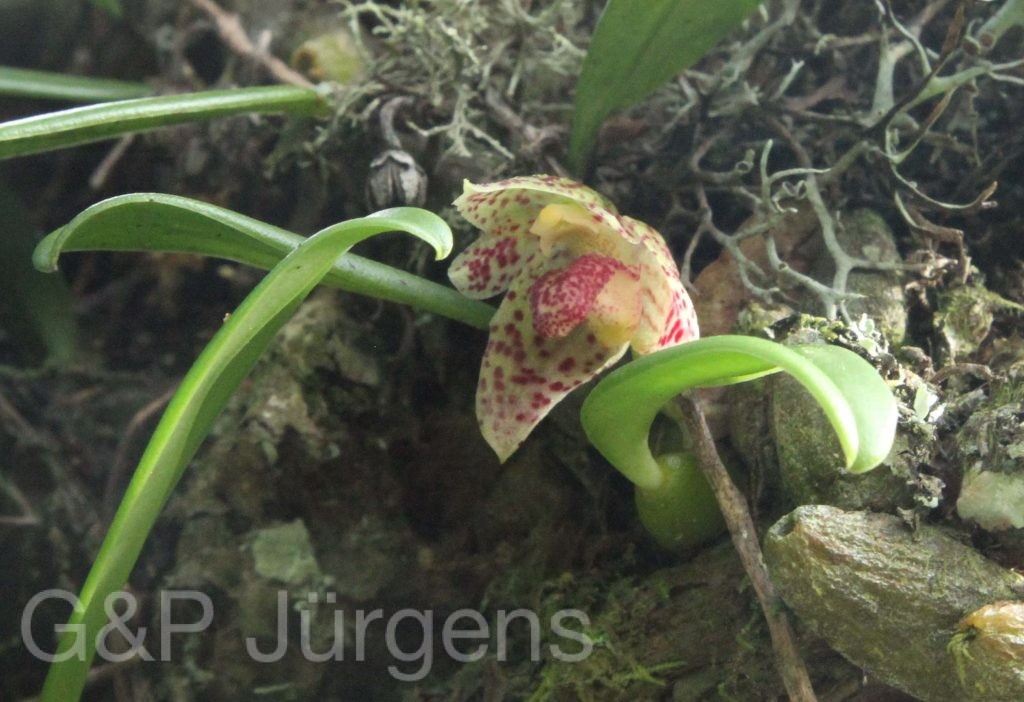
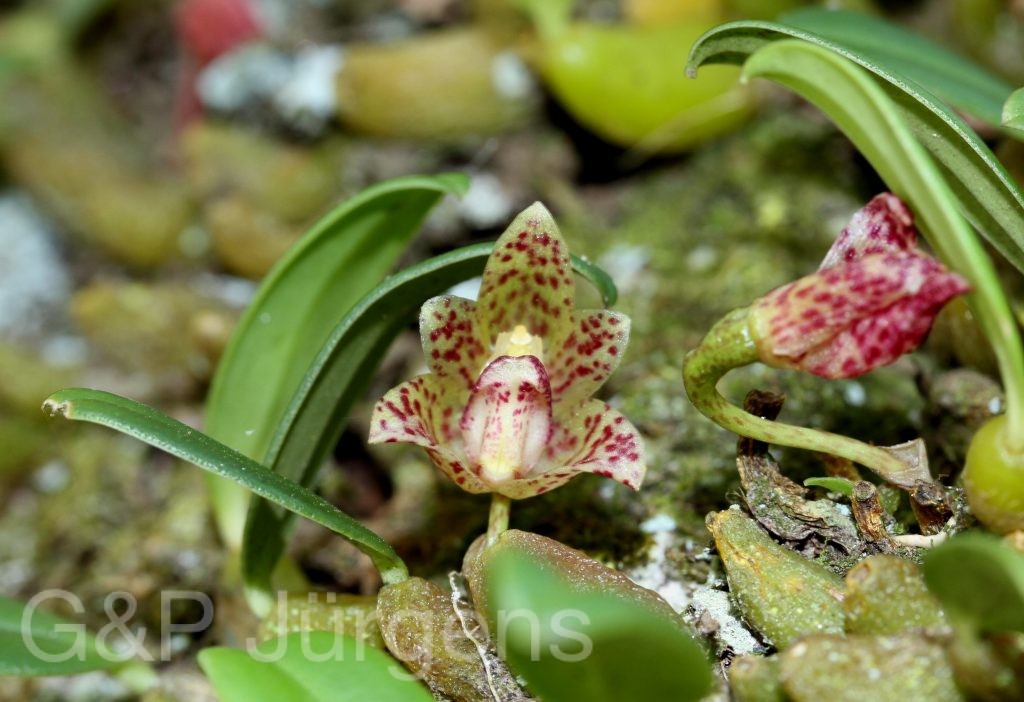
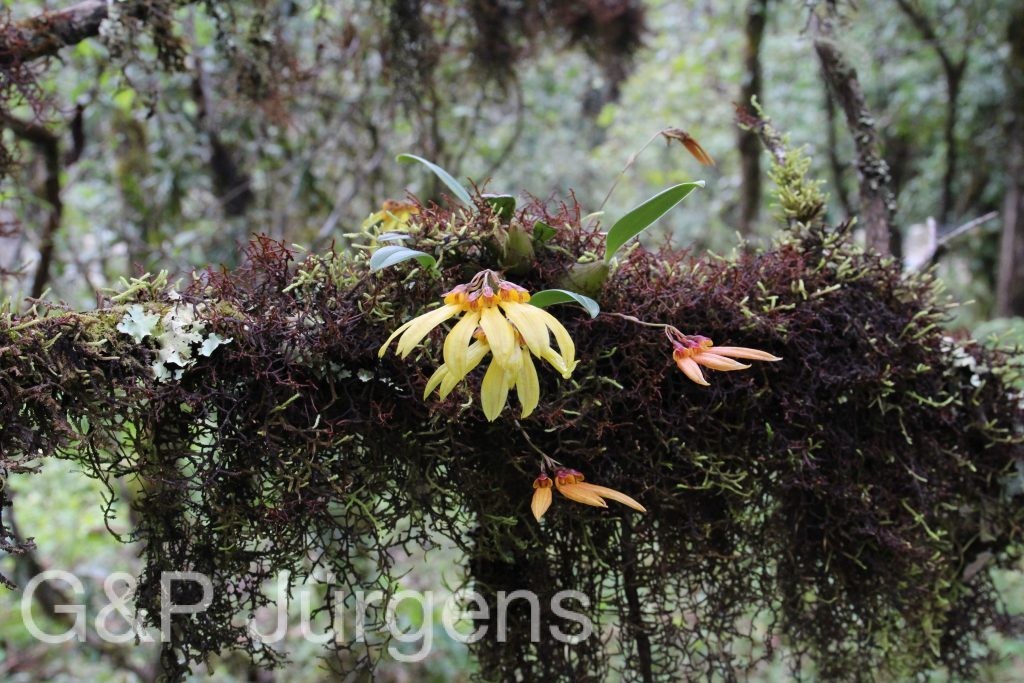
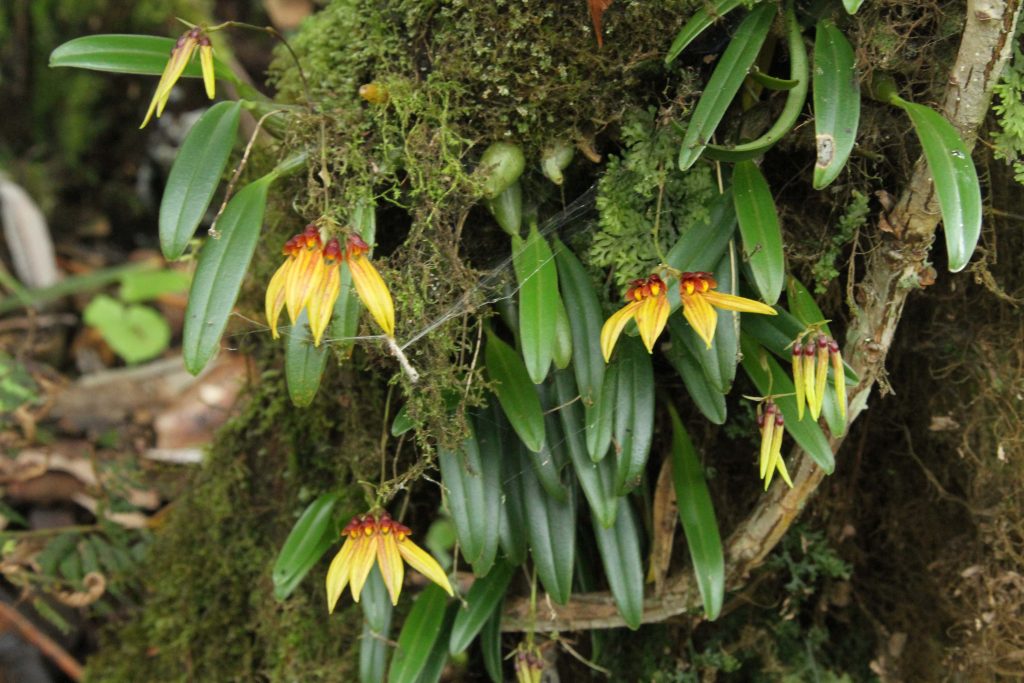
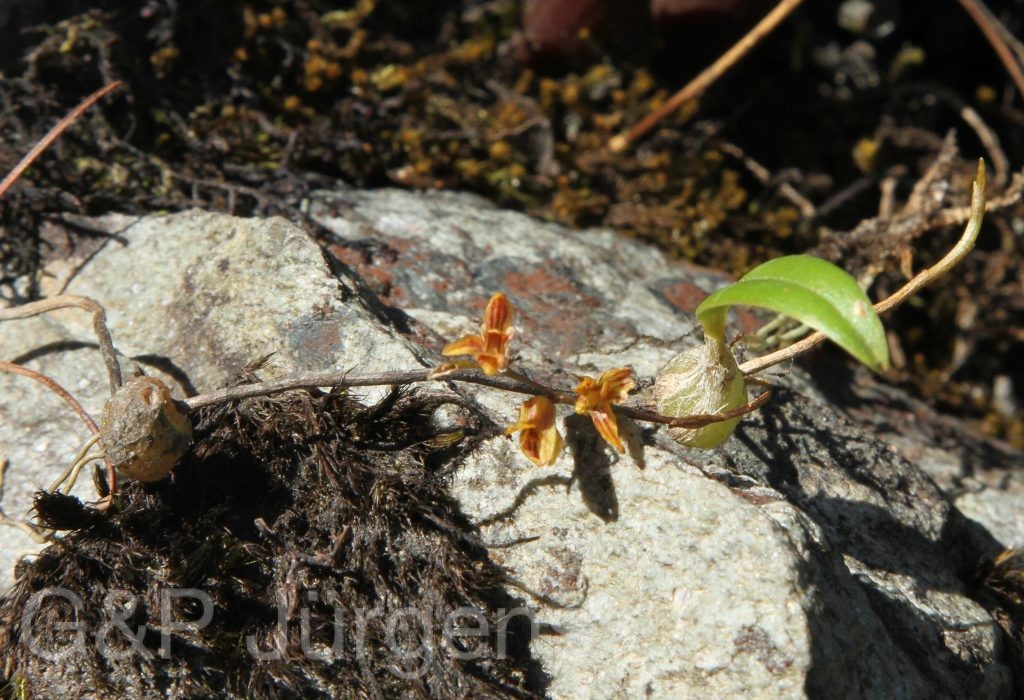
Bulbophyllum muscicola is a diminutive epiphytic orchid with a disjunct distribution from the eastern Himalayas (Nepal, northeast India, Bhutan) through Southeast Asia to New Guinea. The specific epithet 'muscicola' (moss-dweller) aptly describes its preferred microhabitat: the species grows embedded in moss mats on tree trunks and branches in cool, humid montane forests, typically at 1,200–3,100 m elevation.

This is one of the smallest Bulbophyllum species in the Himalayan flora. The pseudobulbs are minute, globose to ovoid, 3–8 mm tall, closely set on a threadlike, creeping rhizome. Each pseudobulb bears a single, fleshy, ovate leaf 1–3 cm long. The inflorescence is a solitary flower or a short, few-flowered raceme on a filiform peduncle 2–5 cm long. Flowers are tiny, 3–5 mm across, translucent yellow to orange, with the lateral sepals connate for most of their length. The lip is minute, fleshy, and mobile. Flowering occurs from September to November.

Due to its small size, B. muscicola is easily overlooked in the field and is probably under-recorded. Its occurrence at the Dochu-La pass in Bhutan at 3,100 m places it among the higher-altitude records for the genus in the eastern Himalayas.

Author: Rchb.f. · Sources: POWO (Kew), Flora of Bhutan Vol. 3, GBIF, Pearce & Cribb: The Orchids of Bhutan (2002)

Rchb.f.

Bhutan2015 44
Bhutan Wangdi Phodrang 2000m, October
Bhutan2015 53
Bhutan Wangdi Phodrang 2000m, October

Description

Bulbophyllum retusiusculum is a widespread epiphytic orchid ranging from the eastern Himalayas (Nepal, northeast India, Bhutan) through Myanmar, southern China, Taiwan, Vietnam, and Thailand. GBIF records document over 550 occurrences across this range. The species inhabits broadleaved and mixed forests at 800–2,500 m elevation, growing on tree trunks and branches in moderately humid conditions.

The pseudobulbs are narrowly ovoid to cylindrical, 1–2 cm tall, clustered on a short rhizome. Each bears a single, oblong-elliptic, leathery leaf 4–10 cm long with a slightly retuse (shallowly notched) apex — the feature reflected in the specific epithet 'retusiusculum'. The inflorescence is an erect to arching, densely many-flowered raceme 5–15 cm long. The flowers are minute, 3–4 mm across, arranged in a dense, cylindrical spike, typically pale yellowish-green to cream. The dorsal sepal is concave, the lateral sepals spreading, and the lip is small, fleshy, and recurved. Flowering occurs from September to November.

B. retusiusculum belongs to Bulbophyllum section Brachystachya, characterised by densely flowered, spike-like racemes. The species shows moderate morphological variation across its extensive range, particularly in flower colour and pseudobulb spacing.

Author: Rchb.f. · Sources: POWO (Kew), Flora of China Vol. 25, GBIF, Pearce & Cribb: The Orchids of Bhutan (2002)

Rchb.f.

Bhutan2012 1351
Bhutan Yankel 400m, October

Description

Bulbophyllum striatum is an epiphytic orchid confined to the eastern Himalayas and adjacent regions, with documented occurrences in northeast India (Sikkim, Assam, Meghalaya), Bhutan, Nepal, Bangladesh, and southwest China (Yunnan). It inhabits warm, humid subtropical and tropical forests at low to moderate elevations of 200–1,500 m — among the lower-altitude Bulbophyllum species in the Himalayan flora.

The pseudobulbs are ovoid, 2–3 cm tall, set at intervals on a stout, creeping rhizome. Each bears a single, oblong-lanceolate, coriaceous leaf 10–18 cm long. The inflorescence is an arching to pendent, laxly few-flowered raceme, 8–15 cm long, producing 3–8 flowers. The specific epithet 'striatum' (striped) refers to the conspicuous reddish-brown longitudinal striations on the sepals: flowers are 1.5–2 cm across, yellowish-green with prominent dark reddish-brown veining. The lip is dark purple, fleshy, curved, and mobile on the column foot. Flowering occurs from September to November.

The relatively low-altitude habitat of B. striatum at Yankel (400 m) in southern Bhutan reflects the warm, subtropical character of the Mo-Chu and lower Punatsangchu valleys, which harbour a distinct orchid flora adapted to high humidity and temperatures atypical for most of Bhutan.

Author: Rchb.f. · Sources: POWO (Kew), Flora of Bhutan Vol. 3, GBIF, Pearce & Cribb: The Orchids of Bhutan (2002)