Tag:

Bhutan

Flowers of Bhutan — 1326 plant species documented across the Bhutanese Himalaya, from dense broadleaf and conifer forests to alpine scrub and meadows. Bhutan’s largely intact wilderness shelters an exceptional diversity of orchids, rhododendrons, primulas and Himalayan poppies, many of them regional endemics. Each species page includes a botanical description, distribution, habitat and flowering time, with the original photograph and its recorded altitude and locality.

(Roth) O.Deg.

Bhutan2012 401
Bhutan Wangdi 2700m, September

Description

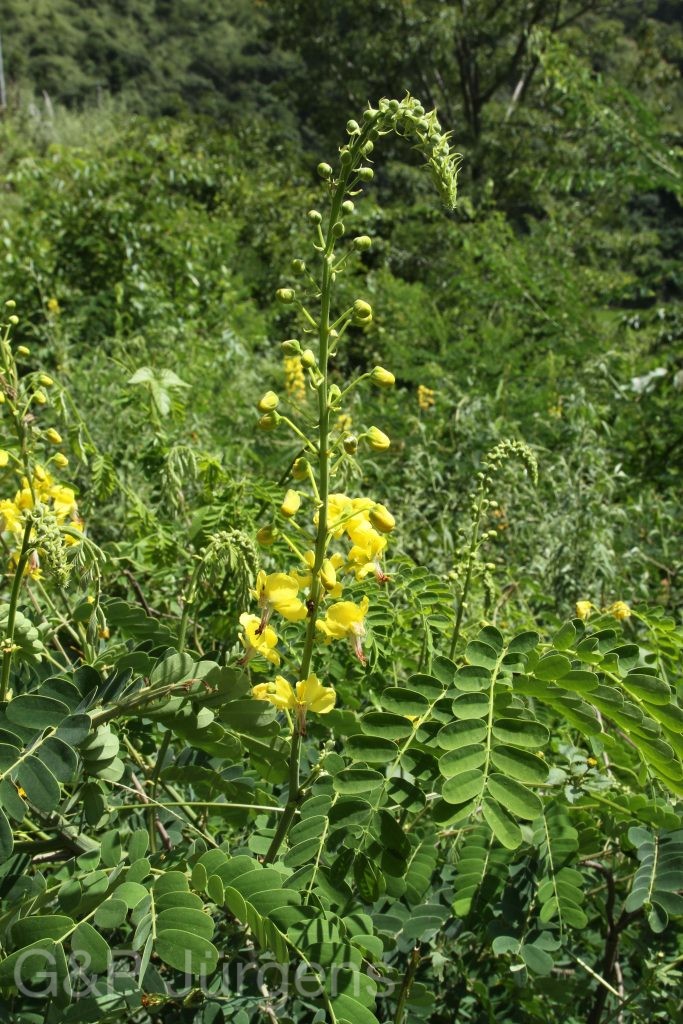
Biancaea decapetala (formerly Caesalpinia decapetala), the Mysore thorn, is a vigorous scrambling shrub native to tropical and subtropical Asia but now widely naturalised across the tropics; its 9040 GBIF occurrences span China, India and much of Asia together with Africa, Australia, the Americas and Pacific islands, reflecting an extensive introduced range. In its native Himalayan setting it grows in thickets, forest margins, riverbanks, scrub and waste ground from the lowlands to about 2700 m. The collection figured, from Wangdi in Bhutan at 2700 m in September, represents the upper subtropical edge of its range, where it forms dense thorny tangles on warm, disturbed valley slopes.

It is a robust, scandent shrub or liana with long arching woody branches armed with numerous stout, recurved prickles and a rusty-brown indumentum on young growth. The leaves are large, alternate and bipinnate, with several pairs of pinnae each bearing many small oblong leaflets. The inflorescence is an erect, elongate terminal raceme of showy flowers; the corolla is bright yellow with five slightly unequal petals (the epithet alluding to ten perianth parts), and the ten free stamens have hairy, reddish filaments. The fruit is a flattened, woody, oblong pod, beaked at the apex and indehiscent or tardily splitting, containing several seeds.

The genus on the source page is given as Caesalpinia; molecular and morphological studies have segregated this species into Biancaea (Fabaceae, subfamily Caesalpinioideae), the combination accepted by POWO. Used regionally for impenetrable hedges and in traditional medicine, the species is an aggressive coloniser and a serious invasive weed in South Africa, Australia and elsewhere, smothering native vegetation; it is consequently a biosecurity and conservation concern well beyond its native Asian range.

Author: (Roth) O.Deg. · Sources: POWO (Kew), GBIF, Flora of China, Flora of Bhutan, Legumes of the World (Caesalpinioideae)
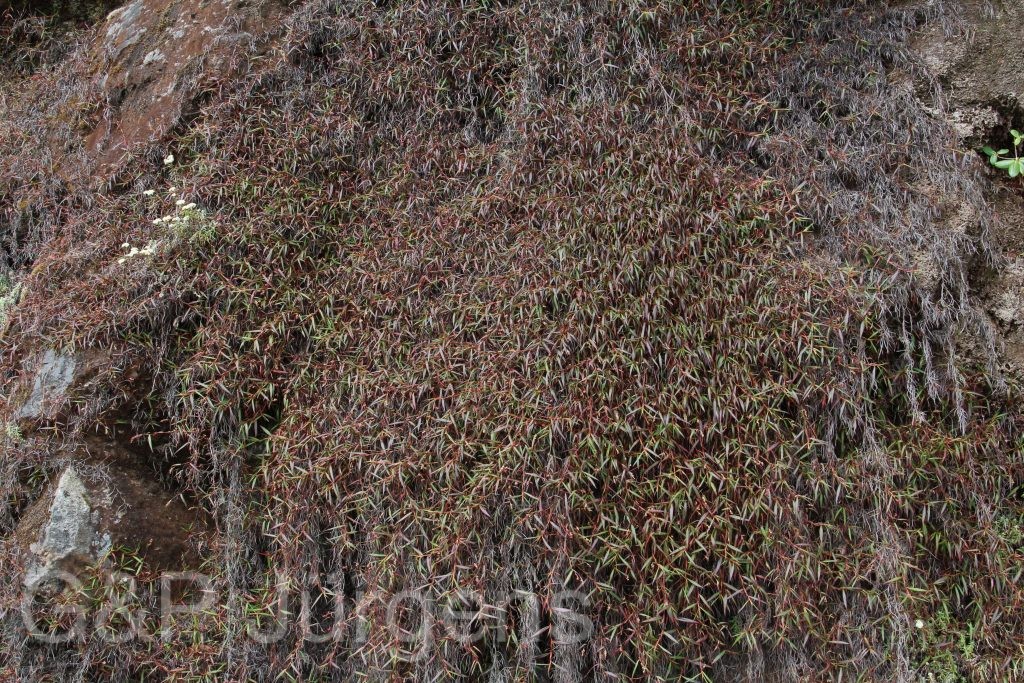
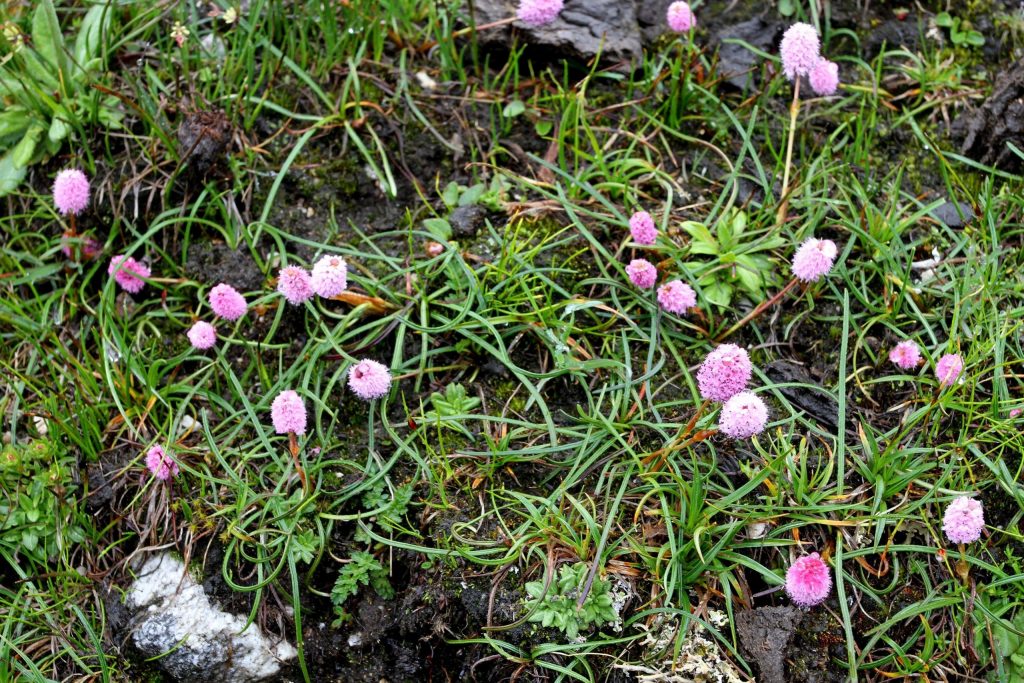
Bistorta emodi

by GP Jürgens

(Meisn.) H.Hara

Bhutan2015 385
BH15
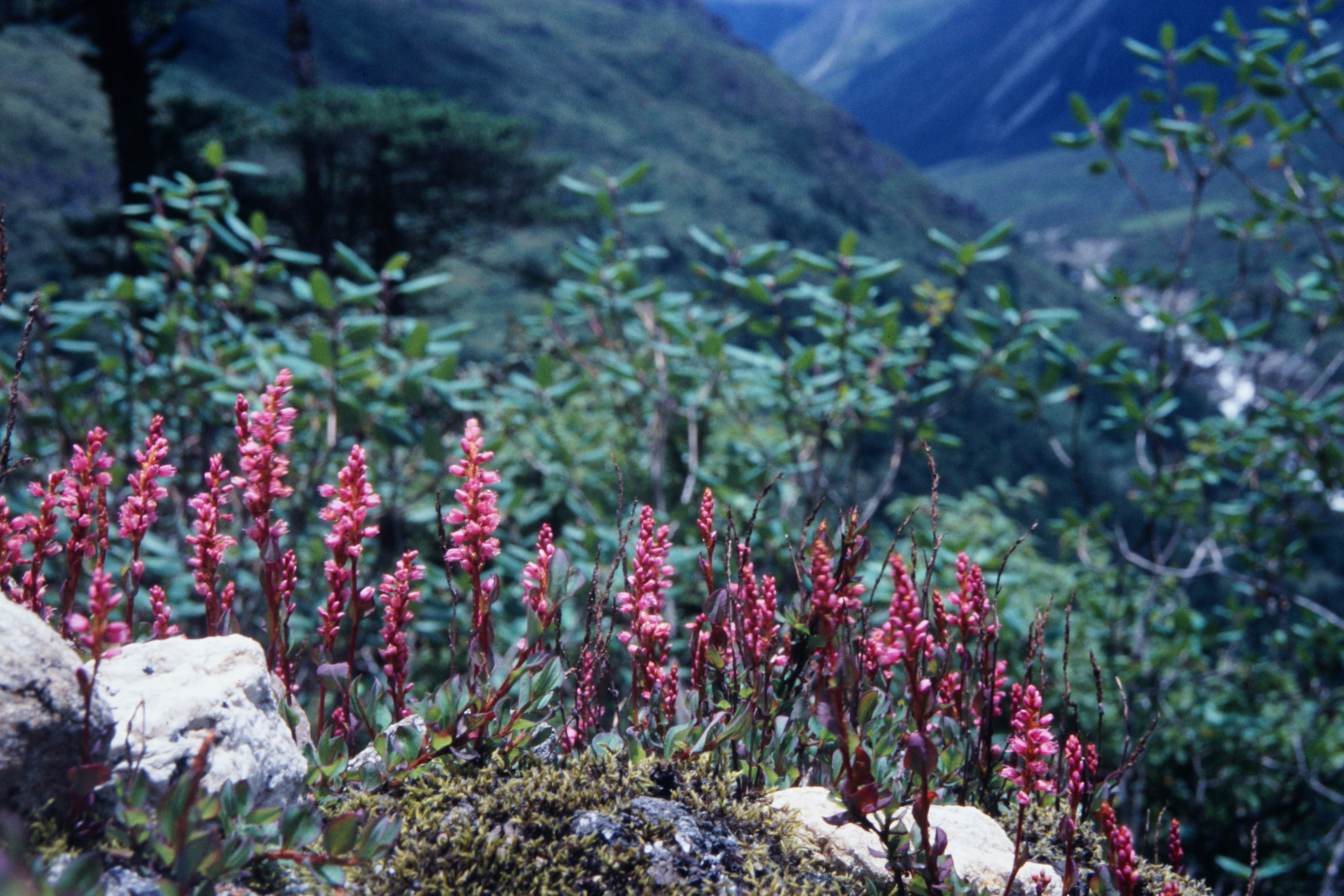
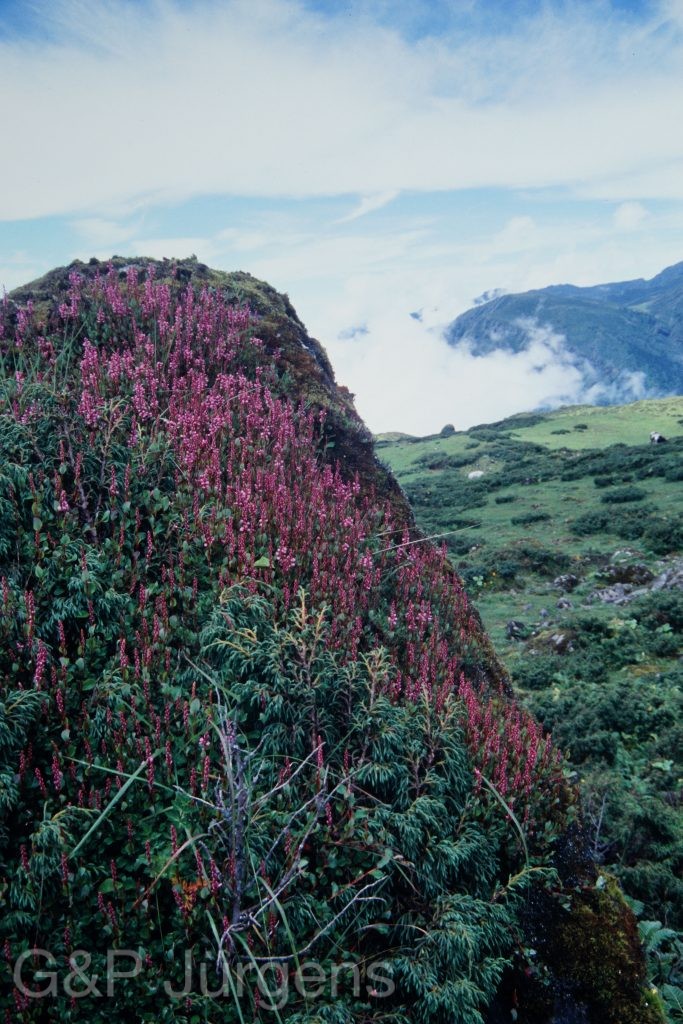
BhutanPG2011 569 01 scaled
Bhutan Ludlow-Sherriff-TrailMiluthang, 4350m July

Description

Bistorta emodi (Meisn.) H.Hara is an alpine knotweed of the Himalaya and adjacent China, recorded from about 363 collections in China, Nepal, India, Bhutan and Myanmar, with scattered extralimital reports. It grows in moist alpine meadows, dwarf-shrub heath, streamsides, seepages and damp rocky slopes in the alpine and upper subalpine zone, broadly between about 3500 and 4800 m. The plant photographed on the Ludlow-Sherriff trail at Miluthang in Bhutan at 4350 m in July occupies the cool, moisture-retentive high pastures that are characteristic of the species during the monsoon flowering period.

This is a perennial herb arising from a stout, often contorted, woody rhizome. The stems are erect and simple, sheathed at the nodes by tubular, membranous ochreae diagnostic of the family. Basal and lower leaves are long-petioled with ovate to lanceolate blades, often cordate or truncate at the base, the upper leaves smaller and sessile. The inflorescence is a dense, terminal, cylindrical to oblong spike of small flowers, the perianth pink to reddish or white, five-parted, with eight stamens; the lower part of the spike sometimes bears bulbils. The fruit is a small, trigonous, dark, shining achene enclosed in the persistent perianth.

The species belongs to Bistorta, segregated from Polygonum sensu lato (under which it appears as Polygonum emodi) and supported by molecular phylogenetics as a distinct lineage within Polygonaceae. Its rhizomes store carbohydrates that fuel rapid flowering in the short alpine summer, and the nectariferous spikes attract diverse insects. Widespread and often locally abundant in high Himalayan pasture, B. emodi is not of conservation concern, though it forms an important component of grazed alpine grassland.

Author: (Meisn.) H.Hara · Sources: POWO (Kew), GBIF, Flora of China, Flora of Bhutan, Flora of Nepal, revision of Bistorta / Polygonaceae

(Hook. f.) Grierson

BhutanPG2011 500
Bhutan Ludlow-Sherriff-Trail Mangde-Chu, 3950m July

Description

Bistorta griffithii (Hook. f.) Grierson is an alpine perennial herb of the eastern Himalaya, ranging through Bhutan, Sikkim and northern India into south-western China (Xizang, Yunnan) and northern Myanmar; the GBIF record of around 176 occurrences also includes herbarium-based citations from the United Kingdom and the United States. It is a plant of high alpine meadows, damp turf, rocky slopes and the upper margins of Rhododendron scrub, favouring cool, moisture-retentive soils kept wet by snowmelt and monsoon mist. The illustrated material was gathered along the Ludlow-Sherriff Trail at Mangde-Chu in central Bhutan at 3950 m in July, typical of the short midsummer flowering window in the upper alpine zone where this species reaches its display.

The plant arises from a short, thick, somewhat woody and contorted rhizome, producing erect, simple, unbranched stems. Basal leaves are long-petiolate with ovate to lanceolate or oblong blades, the margins entire and the lower surface often paler or thinly hairy; cauline leaves are few, smaller and shortly petiolate to sessile, subtended by membranous, tubular ochreae characteristic of the family. The inflorescence is a solitary, dense, terminal cylindrical to oblong spike of small flowers; perianth segments are five, white to pale pink, with eight stamens and a trifid style. As in many bistorts the lower flowers may be replaced by reddish bulbils. The fruit is a small, trigonous, dark brown shining achene enclosed by the persistent perianth.

Formerly placed in the broadly circumscribed genus Polygonum, this species is now treated in Bistorta on the basis of its perennial habit, unbranched flowering stems and dense terminal spikes. It is closely allied to other Himalayan bistorts such as B. macrophylla and B. vivipara, from which it is distinguished by leaf shape and inflorescence characters. Ecologically it contributes to the herbaceous turf grazed by livestock and wild ungulates, and the production of bulbils provides an effective means of vegetative propagation in the short, harsh alpine growing season. It has not been formally assessed for conservation but appears locally frequent within suitable habitat.

Author: (Hook. f.) Grierson · Sources: POWO (Kew), GBIF, Flora of Bhutan, Flora of China, Polygonaceae monograph (Hong & Steward)

(D.Don) Soják

Bh09 76 P130 2
Bhutan Jili-La 3600m, June

Description

Bistorta macrophylla is a perennial herb widely distributed across the Himalaya and the Sino-Himalayan highlands, centred on China, Nepal, India and Bhutan and with scattered records reflecting its broad range and frequent cultivation (gbif_countries: CN, NP, IN, US, BT, ZZ, GB, MM, NZ, TH, JP, NO, RU); GBIF lists some 1887 occurrences, making it one of the better-documented Himalayan knotweeds. It thrives in alpine and subalpine meadows, open grassy slopes, damp turf and the margins of forest clearings, often forming conspicuous colonies. The illustrated record is from Jili-La in Bhutan at about 3600 m in June, typical of its early-summer flowering in moist high-mountain grassland.

The plant arises from a thick, contorted, blackish rhizome and produces erect, simple, unbranched flowering stems. The basal and lower leaves are large, long-petiolate, narrowly oblong to lanceolate, with the blade often decurrent on the petiole and a whitish, papery undersurface; the cauline leaves are smaller and increasingly sessile, sheathing the stem with the membranous ocreae characteristic of the family. The inflorescence is a dense, terminal, cylindrical spike of small flowers with a pink to rose-purple perianth of five tepals, sometimes with bulbils replacing lower flowers. The fruit is a small, trigonous, dark achene.

Formerly included in a broad Polygonum or Persicaria, the species is now placed in the segregate genus Bistorta, supported by molecular phylogenetics of Polygonaceae. Its stout, starchy rhizomes are gathered locally as food and in folk medicine, and it is a familiar component of Himalayan alpine pasture. Common and widespread, B. macrophylla is of no conservation concern.

Author: (D.Don) Soják · Sources: POWO (Kew), GBIF, Flora of Nepal, Flora of China, Annotated Checklist of the Flowering Plants of Nepal, Polygonaceae account in The Families and Genera of Vascular Plants

H.Lév.

Nepal 99 35 ergebnis
West-Nepal Nyor Gaad 2700m, June

Description

Bistorta milletii is a Sino-Himalayan knotweed distributed through China, Nepal, India and Bhutan, with GBIF recording 185 occurrences along this temperate to subalpine arc. It grows in open grassy slopes, moist meadows, forest margins and rocky banks, broadly between about 2500 and 4000 m. The illustrated plant was photographed in West Nepal at Nyor Gaad at 2700 m in June, a representative mid-montane meadow station where the species flowers through the early summer. It commonly forms patches in damp turf alongside other alpine and subalpine herbs.

The plant is a rhizomatous perennial herb arising from a stout, often contorted rhizome that anchors it in the sward. Basal leaves are long-petiolate with ovate-lanceolate to narrowly elliptic blades, the base cuneate to subcordate and the lower surface frequently pale; the membranous, tubular ochreae sheathing the stem are diagnostic of the family. The flowering stem is simple and erect, terminating in a dense, cylindrical, spike-like raceme. The small flowers have a five-parted, petaloid perianth, deep pink to red, with eight exserted stamens and a superior ovary bearing three styles. The fruit is a small, trigonous, dark brown achene enclosed in the persistent perianth.

The species belongs to genus Bistorta, segregated from Polygonum sensu lato and supported as a distinct lineage by molecular work; the input file's alternate web slug references the related B. affinis. POWO and GBIF accept the name B. milletii. As a meadow component with starch-rich rhizomes, members of the genus are locally grazed and occasionally used as famine food.

Author: H.Lév. · Sources: POWO (Kew), GBIF, Flora of China, Flora of Bhutan, Annotated Checklist of the Flowering Plants of Nepal, A Systematic Revision of Bistorta (Polygonaceae)

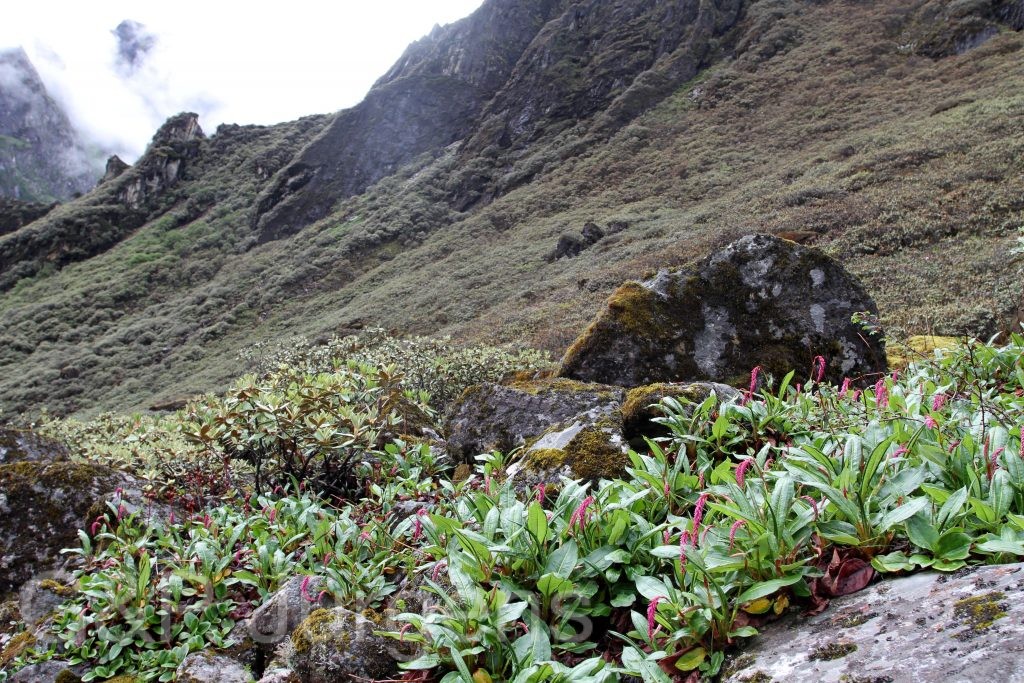
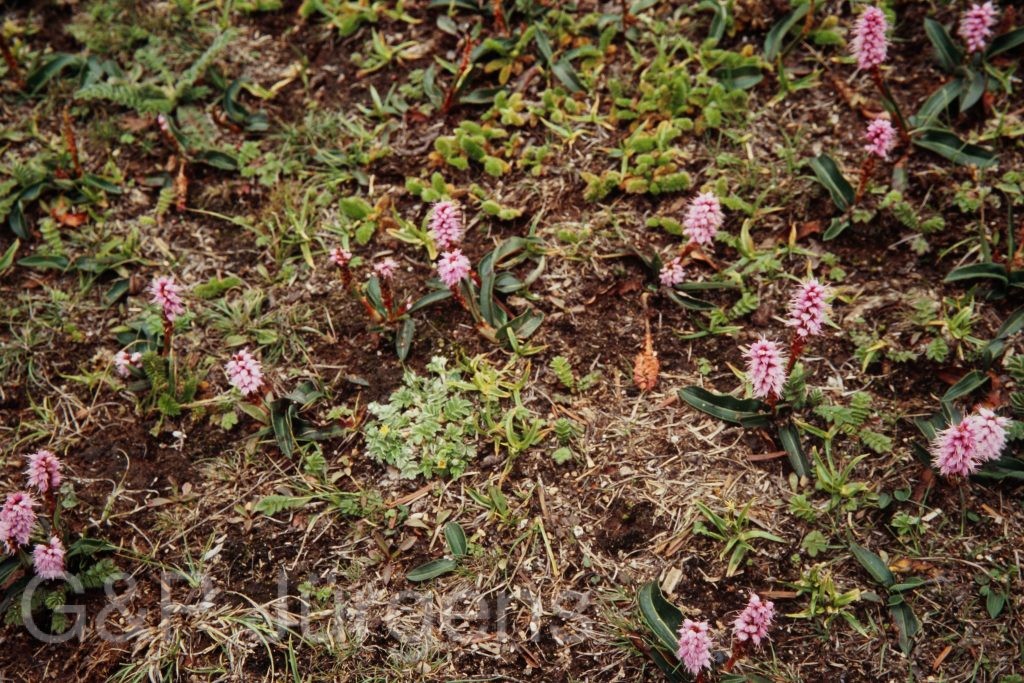
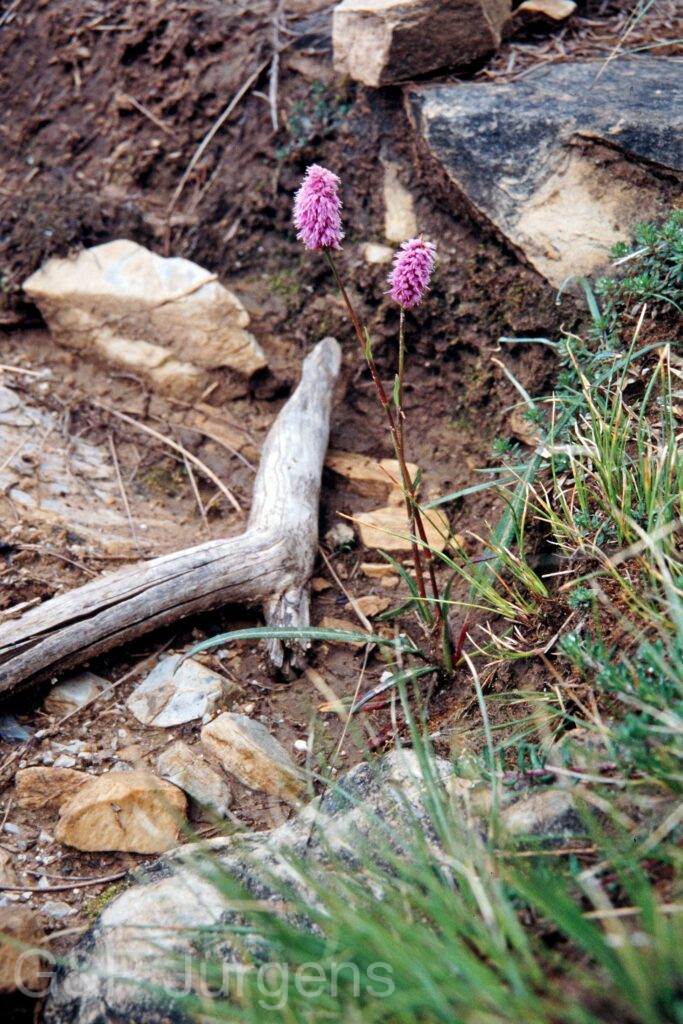
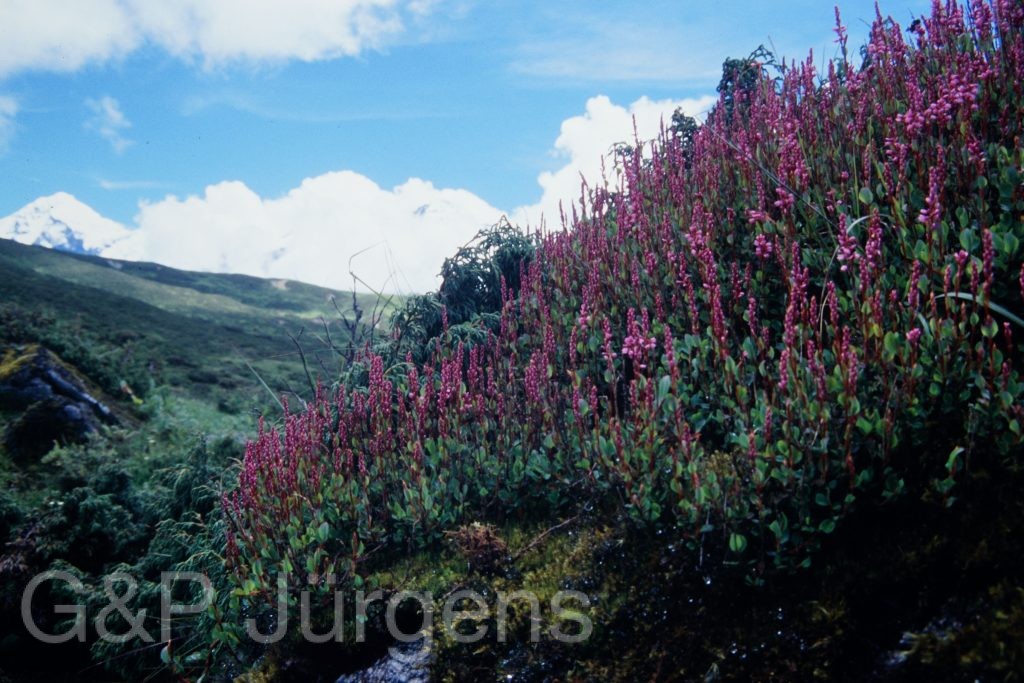
Greene

Sikkim2003 117 G157
Sikkim below Dzongri 4100m 08.2003
Sikkim2003 208 P291
Sikkim below Dzongri 4100m 08.2003
Sikkim2003 118 G158
Sikkim below Dzongri 4100m 08.2003

Description

Bistorta vacciniifolia is a Sino-Himalayan alpine perennial distributed along the high mountain arc from Pakistan and northern India through Nepal, Sikkim and Bhutan into south-western China. The 525 GBIF records concentrate in this native range, with scattered occurrences in the Netherlands, Great Britain, New Zealand, Belgium, Norway and the United States representing rock-garden cultivation. It grows on open alpine slopes, rocky banks, moraines and the margins of dwarf-shrub heath, typically between about 3000 and 4500 m. The plant photographed below Dzongri in Sikkim at 4100 m in August captures it in flower during the late-monsoon alpine season on such stony, well-drained ground.

It is a low, mat- or cushion-forming herb arising from a stout, woody, often branched rhizome. The numerous slender, ascending stems bear small, leathery, ovate to elliptic leaves resembling those of Vaccinium, glabrous and shining above, paler beneath, with revolute margins, and sheathing membranous ochreae at the nodes. The inflorescence is a short, dense, terminal spike of bright rose-pink to deep red flowers, each with a five-lobed perianth, eight stamens and exserted styles. The fruit is a small, trigonous, dark brown nut enclosed by the persistent perianth.

Formerly placed in a broadly circumscribed Polygonum and still encountered under Persicaria, the species is now treated within Bistorta, the bistort knotweeds. Its cushion habit, woody rhizome and leathery evergreen leaves are adaptations to wind-exposed, frost-prone alpine ridges. Widespread and locally common across its range, it is of no conservation concern, though it remains an attractive component of high Himalayan moraine and heath communities.

Author: Greene · Sources: POWO (Kew), GBIF, Flora of Bhutan, Flora of China, Annotated Checklist of the Flowering Plants of Nepal

Wedd.

Bhutan2012 693
Bhutan Galephu 900m, September

Description

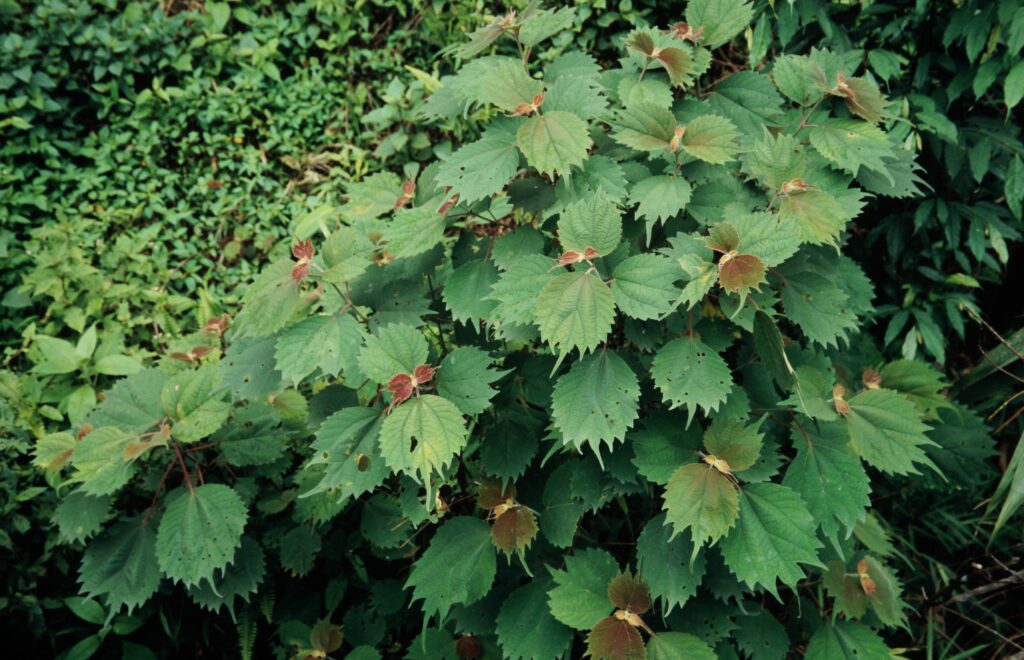
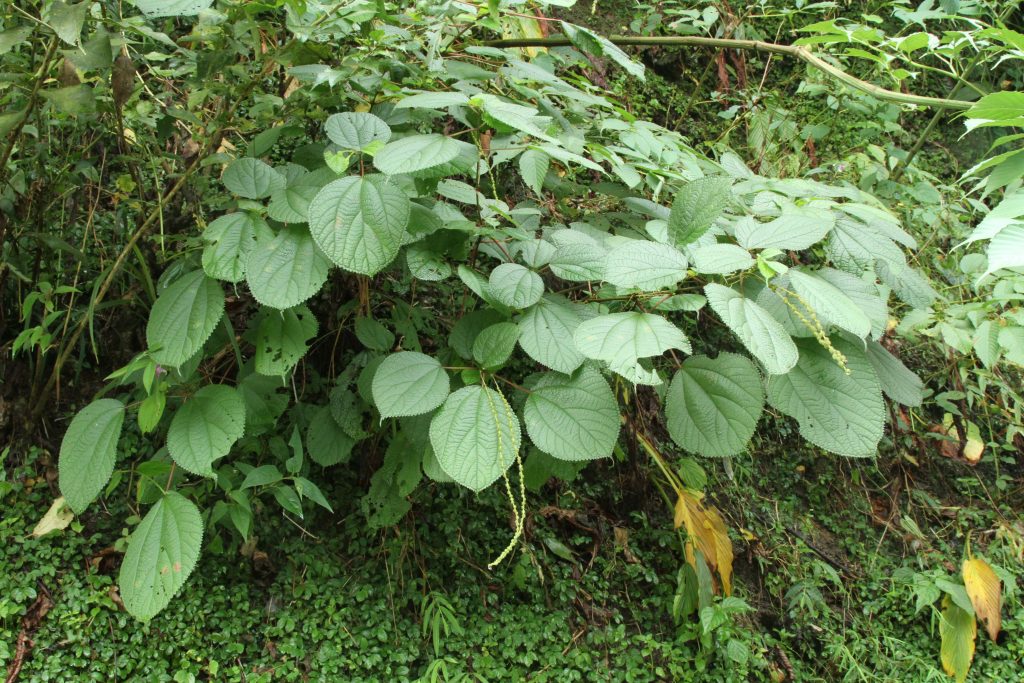
Boehmeria hamiltoniana is a subtropical shrub or tall herb of the Himalayan foothills and adjacent Southeast Asia, recorded from India, China, Nepal, Thailand, Bhutan, Myanmar and Indonesia across some 115 GBIF occurrences. The illustrated plant was photographed at Galephu in southern Bhutan at about 900 m in September. It grows in warm, humid lowland and submontane settings, along forest margins, streamsides, ravines and disturbed ground generally below about 1500 m, favouring shaded, moist, fertile soils.

The plant is a perennial herb or soft-wooded shrub with erect, sometimes pubescent stems. The leaves are opposite or alternate, ovate to ovate-lanceolate, with a serrate or dentate margin and an acuminate apex, three-nerved from the base and often roughish or hairy. As in the Urticaceae the flowers are small, greenish and unisexual, lacking petals; they are densely aggregated into slender, often interrupted axillary spikes or panicles. The female flowers develop into small dry achenes enclosed in the persistent perianth, each containing a single seed.

Boehmeria belongs to the nettle family but, unlike true nettles, lacks stinging hairs. The genus includes the economically important ramie (Boehmeria nivea), valued for its strong bast fibres, and several Himalayan species are used locally for cordage. Wind plays a role in pollination of the inconspicuous flowers. B. hamiltoniana is widespread and ecologically tolerant of disturbance, and is therefore of least conservation concern, persisting readily along trails and forest edges.

Author: Wedd. · Sources: POWO (Kew), GBIF, Flora of China, Flora of Bhutan, Flora of Nepal, Friis & Wilmot-Dear – Revision of Boehmeria (Urticaceae)

Wedd. ex D.G.Long

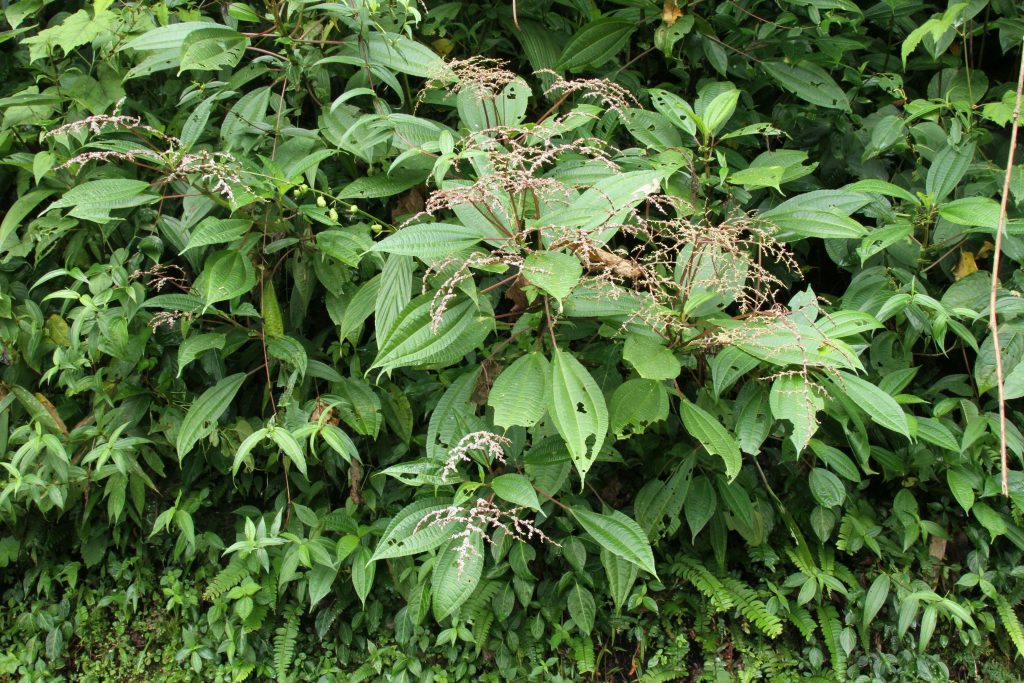
Bhutan2015 116
Bhutan Galephug 600m, October
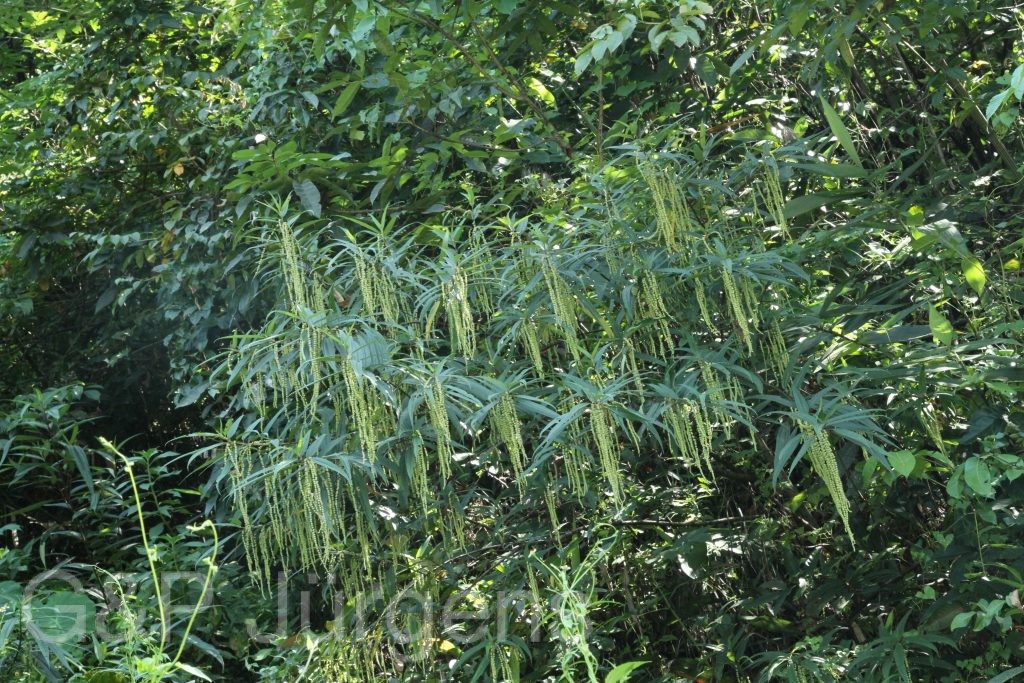
Bhutan2015 117
Bhutan Galephug 600m, October

Description

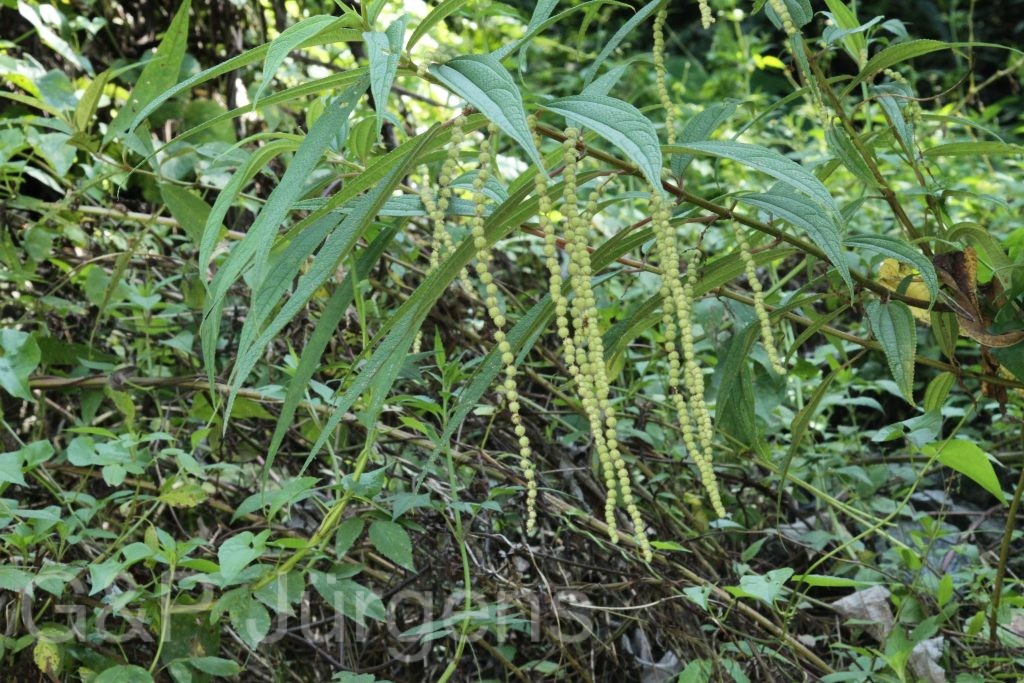
Boehmeria penduliflora is a shrubby false-nettle distributed from the Himalaya and southern China through Indochina and Southeast Asia, with GBIF documenting nearly 2000 occurrences including naturalised records on Indian Ocean islands such as Reunion and Mauritius. It favours warm, humid lowland and submontane settings: streambanks, forest margins, roadside thickets and disturbed scrub on moist soils. The photographed plant grows in southern Bhutan at Gelephu around 600 m, in flower or fruit in October; the species is most frequent below about 1500 m in the subtropical foothill zone where it can form sizeable bushes.

The plant is a much-branched, erect to spreading shrub reaching two to three metres, with terete, finely pubescent young stems and, unlike true nettles, no stinging hairs. The leaves are opposite or subopposite, narrowly lanceolate to elliptic, long-acuminate, serrate-margined and three-nerved from the base, scabrid above and paler beneath. The minute unisexual flowers are densely clustered in glomerules arranged along slender, pendulous axillary spikes, a feature reflected in the epithet penduliflora. The fruit is a small ellipsoid achene enclosed in the persistent perianth.

Boehmeria belongs to the tribe Boehmerieae of the Urticaceae and includes the economically important ramie; B. penduliflora yields a usable bast fibre and is browsed by livestock, with leaves used as fodder and occasionally in traditional medicine. Its drooping inflorescences and lanceolate leaves readily distinguish it within the genus. Widespread, vigorous and tolerant of disturbance, it is of least concern and has naturalised well beyond its native Asian range as a hedge and fibre plant.

Author: Wedd. ex D.G.Long · Sources: POWO (Kew), GBIF, Flora of China, Flora of Bhutan, Boehmeria revision (Wilmot-Dear & Friis)

D.Don

Sikkim 2006 258 ergebnis
India West-Bengal, Lingza 1300m, May

Description

Boehmeria ternifolia is a shrubby member of the nettle family ranging through the eastern Himalaya and adjacent regions, recorded from Nepal, India and Bhutan, with GBIF documenting nearly two hundred occurrences across these countries; scattered records from France and the United States represent herbarium and cultivated holdings rather than wild populations. It is a plant of warm-temperate to subtropical broadleaved forest, favouring shaded ravines, streamsides, moist forest margins and roadside banks, typically between roughly 1000 and 2200 m. The specimen illustrated from Lingza in the Darjeeling district of West Bengal at about 1300 m, in May, is representative of these humid mid-elevation forests of the Sikkim-Darjeeling Himalaya, where high rainfall and deep shade favour the soft-leaved, non-stinging habit of the genus.

The plant is an erect shrub or subshrub with woody lower stems and herbaceous, often four-angled younger branches that lack stinging hairs. The leaves are characteristically arranged in whorls of three (occasionally opposite), the basis of the epithet ternifolia; they are ovate to lanceolate, with a long-acuminate apex, serrate margins and a three-veined base, the lamina thin and somewhat rough above. Stipules are present and soon falling. The minute unisexual flowers are borne in slender, interrupted axillary spikes or glomerules, the staminate flowers with a four-lobed perianth and four stamens, the pistillate flowers tubular and enclosing a single ovary with a filiform stigma. The fruit is a small achene tightly invested by the persistent perianth.

Boehmeria is a pantropical and warm-temperate genus best known for ramie (B. nivea), an important bast-fibre crop, and several Himalayan species likewise yield serviceable cordage fibres from their stems. The whorled, ternate leaf arrangement of B. ternifolia is a useful diagnostic character separating it from the many opposite-leaved congeners of the region. As a common, ecologically tolerant forest-edge shrub with a wide elevational and geographic span, it is of no conservation concern, and its abundance along disturbed margins suggests considerable resilience to moderate human impact within the eastern Himalayan forest belt.

Author: D.Don · Sources: POWO (Kew), GBIF, Flora of China Vol. 5, Flora of Bhutan Vol. 1 Part 2, Flora of Nepal, A Revision of Boehmeria (Urticaceae) (W.T. Wang and C.J. Chen)

(Hornem.) Friis & Wilmot-Dear

Bhutan2012 730
Bhutan Galephu 500m, October

Description

Boehmeria virgata subsp. macrophylla (Hornem.) Friis & Wilmot-Dear is a widespread paleotropical shrub of the nettle family, recorded by GBIF in over 2500 occurrences across an extraordinarily broad range that includes India (IN), Nepal (NP), China (CN), Thailand (TH) and Indonesia (ID), as well as much of tropical Africa (Tanzania, Cameroon, Gabon, Uganda, Angola), the Indian Ocean islands (Madagascar, Réunion, Mauritius, Comoros) and Australia (AU). It occupies forest margins, streambanks, clearings and disturbed secondary vegetation at low to mid elevations, and was photographed at Galephu in southern Bhutan at 500 m in October, in the warm subtropical foothills.

The plant is a shrub or coarse perennial herb with terete, often pubescent stems. The leaves are large, alternate or subopposite, broadly ovate to elliptic with a serrate margin, acuminate apex and three prominent basal veins, the lower surface frequently pale and softly hairy. As in all Boehmeria, the foliage lacks the stinging hairs found elsewhere in Urticaceae. The plant is monoecious, with minute unisexual flowers crowded into globose clusters arranged along slender, often elongate, interrupted spike-like inflorescences; female flowers have a tubular perianth enclosing a single ovule. The fruit is a small achene enclosed in the persistent, sometimes winged perianth.

This taxon belongs to a polymorphic complex that has been treated under various names including Boehmeria macrophylla, and the subspecific rank reflects Friis and Wilmot-Dear's revision integrating the Asian and African material. Wind pollination and the dust-like achenes account for its vast distribution. Stem fibres of Boehmeria species, notably ramie, are economically important, and the plant readily colonises disturbed ground, making it a frequent component of regenerating tropical and subtropical forest.

Author: (Hornem.) Friis & Wilmot-Dear · Sources: POWO (Kew), GBIF, Flora of Bhutan, Flora of China, Urticaceae revision (Friis & Wilmot-Dear)