Tag:

Bhutan

Flowers of Bhutan — 1326 plant species documented across the Bhutanese Himalaya, from dense broadleaf and conifer forests to alpine scrub and meadows. Bhutan’s largely intact wilderness shelters an exceptional diversity of orchids, rhododendrons, primulas and Himalayan poppies, many of them regional endemics. Each species page includes a botanical description, distribution, habitat and flowering time, with the original photograph and its recorded altitude and locality.

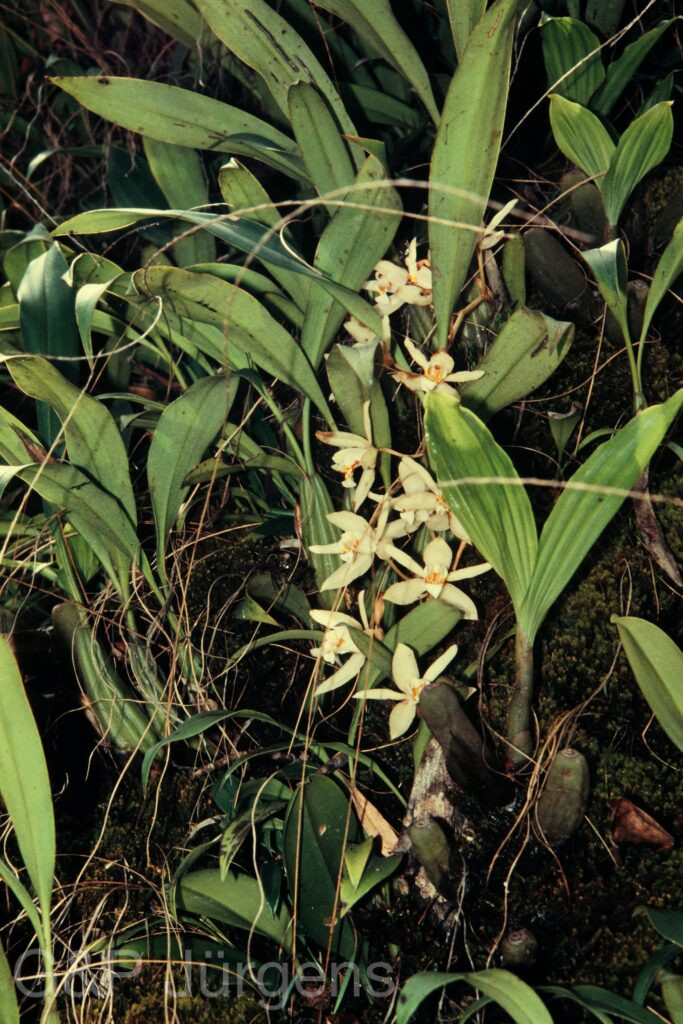
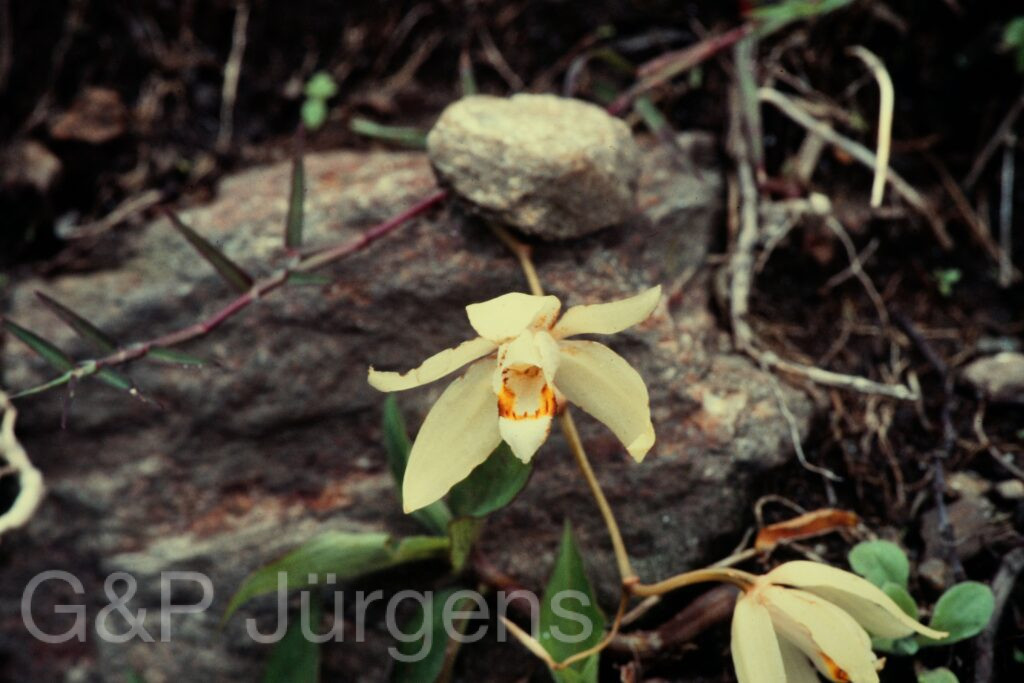
Lindl.

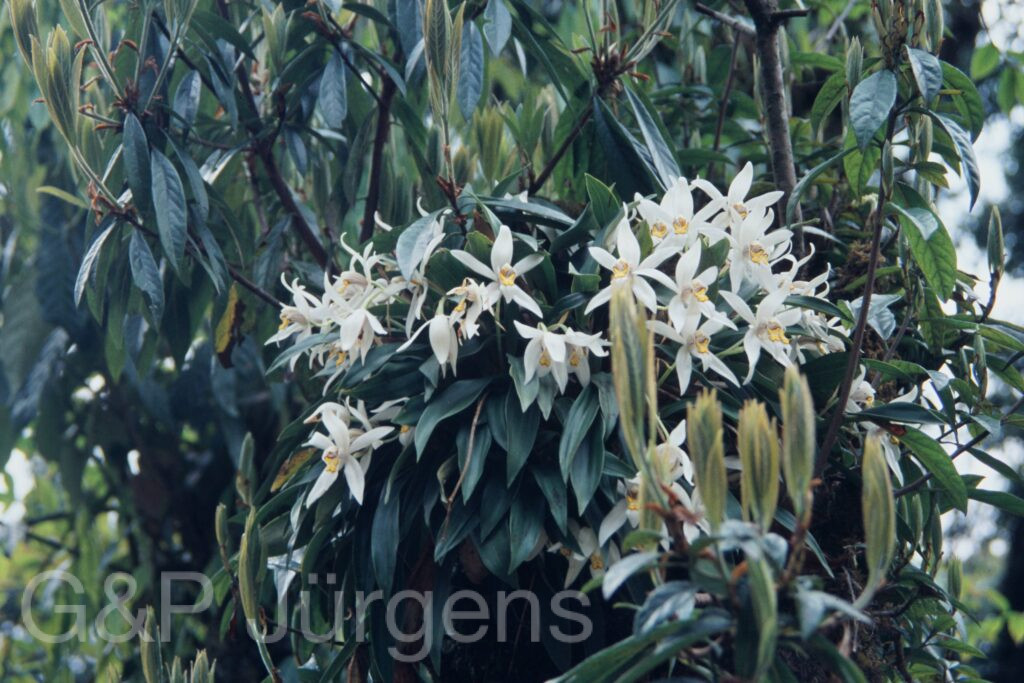
Nepal 97 444 G862
Nepal Tashigaon 2900m May
Nepal 97 446 P864
Nepal Tashigaon 2900m May

Description

Coelogyne flaccida Lindl. is an epiphytic orchid of the Himalaya and Southeast Asia, recorded from China, India, Nepal, Bhutan, Thailand, Laos, Vietnam and Myanmar, with cultivated records widely scattered elsewhere; GBIF documents around 243 occurrences. It grows as an epiphyte, occasionally a lithophyte, on mossy tree trunks and shaded rocks in broadleaved evergreen and mixed forest, generally between about 900 and 2300 m, though montane records reach higher. The photographed plant was found at Tashigaon in Nepal at about 2900 m in May, at the upper, cooler edge of its range where this pseudobulbous orchid flowers in spring on humid, well-shaded substrates.

The plant is sympodial, with clustered, oblong to ovoid pseudobulbs borne on a creeping rhizome, each pseudobulb bearing one or two apical, plicate, lanceolate to elliptic leaves. The inflorescence is a pendent, laxly several-flowered raceme arising from the base of the pseudobulb. The flowers are fragrant, the sepals and petals creamy-white to pale buff and somewhat flaccid (the epithet flaccida), and the trilobed labellum is marked with conspicuous yellow to orange-brown keels and reddish-brown veining on the side lobes. The fruit is a ribbed dehiscent capsule releasing dust-like seeds.

Within the large Asiatic genus Coelogyne, this species belongs to the white-flowered, pendent-racemed group allied to C. cristata and C. corymbosa and is widely grown by orchid enthusiasts. Like other epiphytic orchids it depends on undisturbed humid forest and mycorrhizal partners for germination. Although fairly widespread, wild populations are vulnerable to habitat loss and collection, and all Coelogyne are listed on CITES Appendix II, regulating international trade.

Author: Lindl. · Sources: POWO (Kew), GBIF, Flora of China, Flora of Bhutan, Annotated Checklist of the Flowering Plants of Nepal, Clayton The Genus Coelogyne: A Synopsis
Lindl.

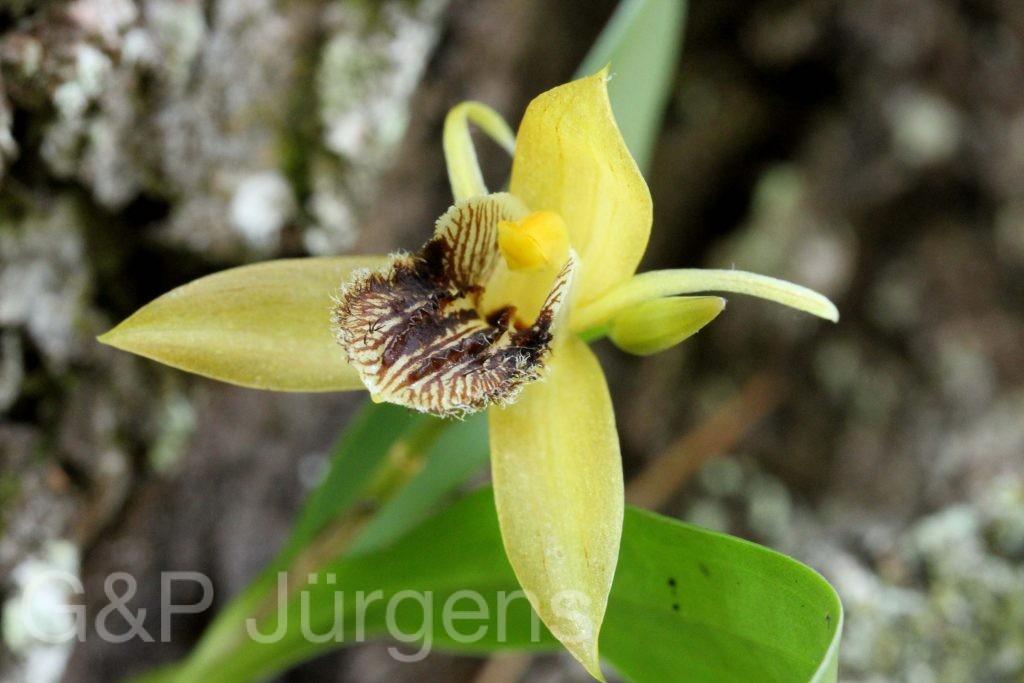
Bhutan2012 468
Bhutan Wangdi 2500m, September

Description

Coelogyne ovalis Lindl. is an epiphytic orchid of the Himalaya and northern Southeast Asia, recorded by GBIF from China, India, Nepal, Bhutan, Myanmar, Thailand, Vietnam, Malaysia and Indonesia, with cultivated records from Europe and North America, totalling some 235 occurrences. It grows as an epiphyte, and occasionally a lithophyte, on mossy trunks and rocks in humid evergreen and mixed montane forest, typically between about 1000 and 2500 m. The plant photographed near Wangdi in Bhutan at about 2500 m in September, at the close of the monsoon, represents the upper part of this range, where cool, perennially moist conditions favour the genus.

The species has a creeping rhizome bearing well-spaced, ovoid to oblong-cylindric pseudobulbs, each topped by two thin-textured, plicate, lanceolate to elliptic leaves that taper to a stalked base. The inflorescence arises from the apex of a developing or mature pseudobulb and carries one or a few comparatively large flowers in succession. The sepals and petals are narrow and pale yellowish to buff or olive-tinged; the broad three-lobed labellum is the showiest part, marked with rich brown to maroon blotches and bearing fringed keels along the disc, with erect lateral lobes flanking the column.

Coelogyne is a large Asian genus of subtribe Coelogyninae, and C. ovalis is placed in section Fuliginosae, characterised by successively produced, brown-marked flowers. It is reasonably widespread and is grown in cultivation, so it is not regarded as globally threatened, although wild populations are pressured by habitat loss and over-collection; like all orchids it is listed on CITES Appendix II. Its broad Indo-Himalayan to Sundaic range makes it a good example of the orchid connection between the Himalaya and Southeast Asia.

Author: Lindl. · Sources: POWO (Kew), GBIF, Flora of Bhutan, Flora of China, Pradhan Indian Orchids, Clayton monograph The Genus Coelogyne

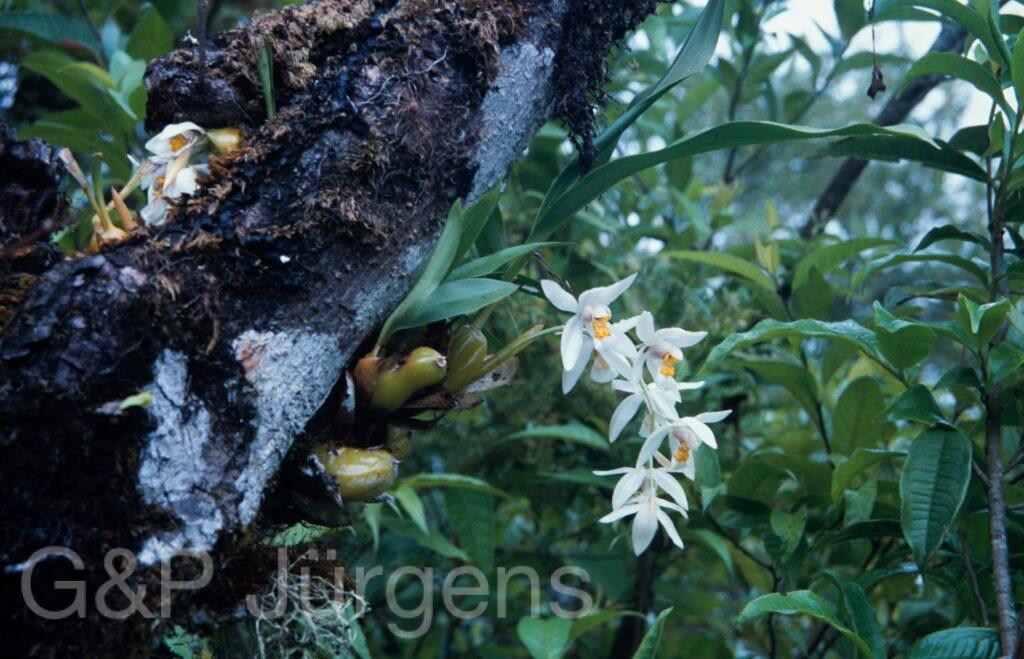
Lindl.

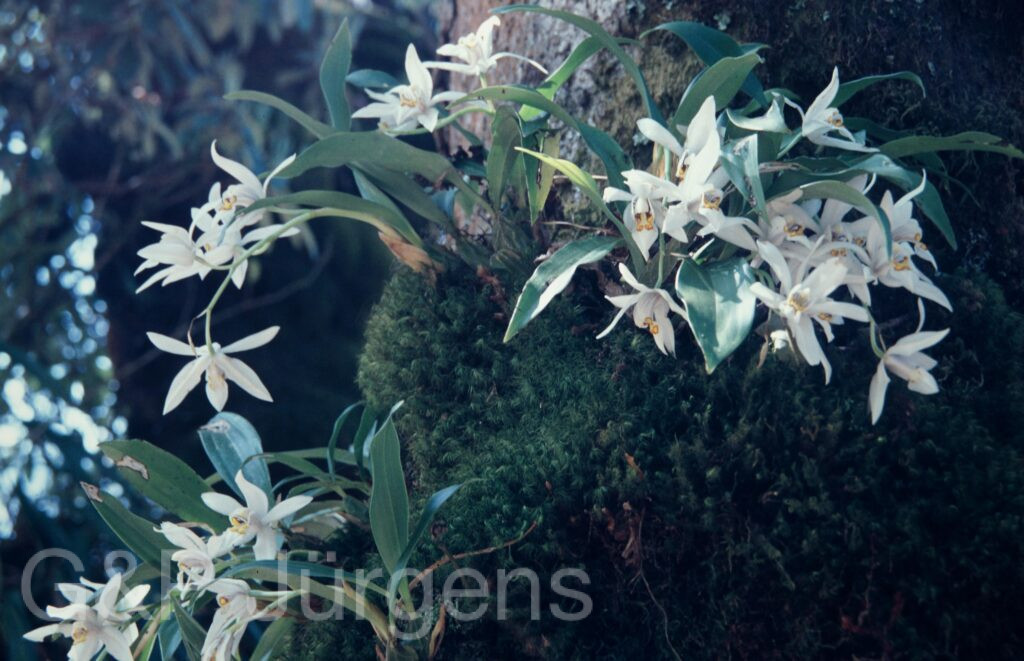
Nepal 2001 237 ergebnis ergebnis
Nepal (Gorkha) Niuli Kharka 2500m, May
Sikkim2004 334 G595 ergebnis
Sikkim Choka 3330m, April
Nepal 1994 288 ergebnis
Ost-Nepal Milka-Danda 2850m, May 

Description

Coelogyne punctulata Lindl. is an epiphytic orchid of the Himalaya and neighbouring mountains, recorded from India, Nepal, Bhutan, China, Myanmar, Vietnam and Bangladesh (225 GBIF occurrences). It grows on mossy trunks and branches, and occasionally as a lithophyte on shaded rocks, in temperate broad-leaved and mixed forest, generally between 2000 and 3300 m. It was documented in Nepal at Niuli Kharka in Gorkha around 2500 m and at Milka-Danda in the east near 2850 m, both in May, and in Sikkim at Choka at 3330 m in April, reflecting the cool, humid mid-montane forests it favours.

It is a sympodial epiphyte with closely set, ovoid to oblong pseudobulbs borne on a creeping rhizome, each bearing one or two plicate, elliptic-lanceolate leaves narrowed to a petiole-like base. The inflorescence is a few-flowered raceme arising with the new growth. The flowers are white to pale cream, the elliptic sepals and narrower petals spreading, and the showy trilobed labellum marked with yellow or orange keels and reddish-brown to ochre spotting on the disc, the lateral lobes erect about the column. The fruit is a ribbed, dehiscent capsule releasing dust-fine seeds.

Coelogyne is a large Asian genus and C. punctulata sits within the section of small-flowered white-and-spotted species; it has at times been confused with the related C. nitida, a synonymy reflected in the original page reference. The deceptive, nectarless flowers are pollinated by bees, and the minute wind-dispersed seeds depend on mycorrhizal fungi for germination. As a forest epiphyte it is vulnerable to habitat loss and orchid collection, concerns shared across wild-harvested Coelogyne, and the genus is listed under CITES Appendix II.

Author: Lindl. · Sources: POWO (Kew), GBIF, Flora of China, Flora of Bhutan, The Orchids of the Sikkim-Himalaya (King & Pantling), Coelogyne monograph (Clayton, The Genus Coelogyne)

Lindl.

Nepal 2001 464 ergebnis ergebnis
Nepal (Gorkha) Gunda 1700m, May

Description

Coelogyne uniflora (long known as Panisea uniflora) is an epiphytic orchid distributed across the eastern Himalaya and Indochina, ranging from Nepal, Sikkim and Bhutan through northeast India to southern China, Myanmar, Thailand, Laos, Cambodia and Malaysia; GBIF records 90 occurrences across this range. It grows as an epiphyte on mossy trunks and branches, and occasionally as a lithophyte on shaded rocks, in humid subtropical to lower temperate broad-leaved and evergreen forest, generally between about 1000 and 2200 m. The photographed plant from Gunda in the Gorkha district of Nepal at 1700 m in May illustrates its flowering at the onset of the monsoon, when atmospheric humidity in these mid-montane forests is high.

It is a small, tufted, sympodial epiphyte with closely spaced, ovoid to cylindrical pseudobulbs borne on a creeping rhizome, each pseudobulb bearing one or two narrowly lanceolate, plicate leaves. The inflorescence is short and few-flowered, usually carrying a single relatively large flower (whence uniflora) at or near the base of the new growth. The flower has spreading, pale creamy-white to yellowish sepals and petals; the lip (labellum) is three-lobed, often marked with reddish-brown to orange and bearing low keels on the disc, the lateral lobes erect. The column is slender and the fruit a ribbed dehiscent capsule releasing dust-like seeds.

The species exemplifies recent generic realignments within the Coelogyninae (Orchidaceae): the genus Panisea has been subsumed into a broadly circumscribed Coelogyne on molecular phylogenetic grounds, so the wp_link "panisea-uniflora" reflects the former placement while Coelogyne uniflora is the currently accepted name. Like other coelogynes it produces minute wind-dispersed seeds dependent on mycorrhizal fungi for germination. Though wide-ranging, epiphytic orchids are sensitive to deforestation and collection and are afforded CITES Appendix II protection.

Author: Lindl. · Sources: POWO (Kew), GBIF, Flora of China Vol. 25, Flora of Bhutan Vol. 3, Flora of Nepal, The Genus Coelogyne: A Synopsis (Clayton & Pradhan)
B.Heyne ex Schult.

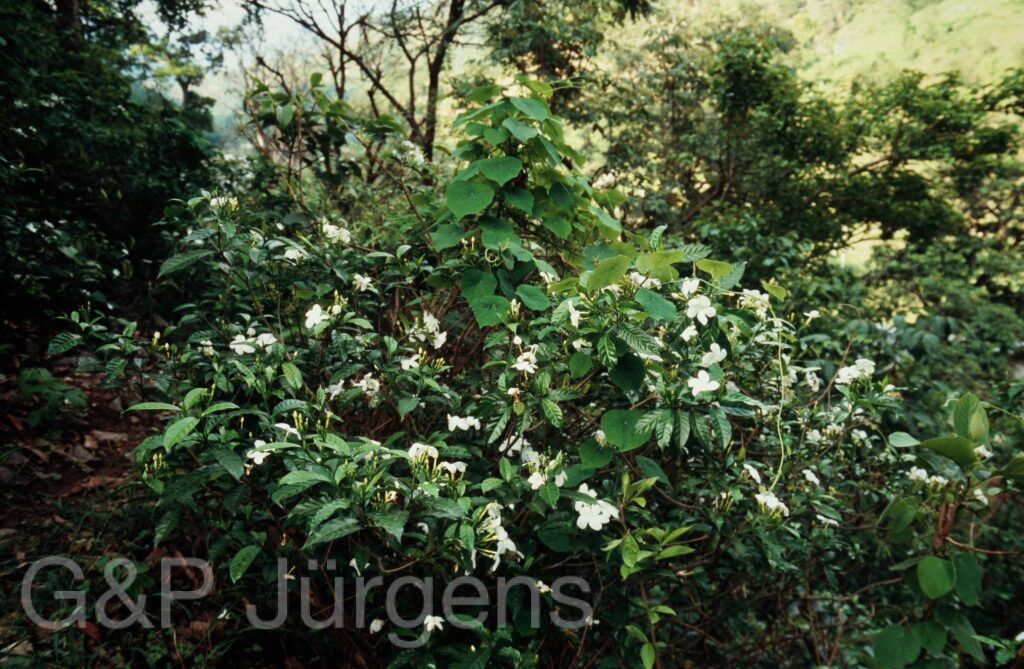
Nepal 2009 124 ergebnis
Nepal Helambu Melanele Pul 850, May

Description

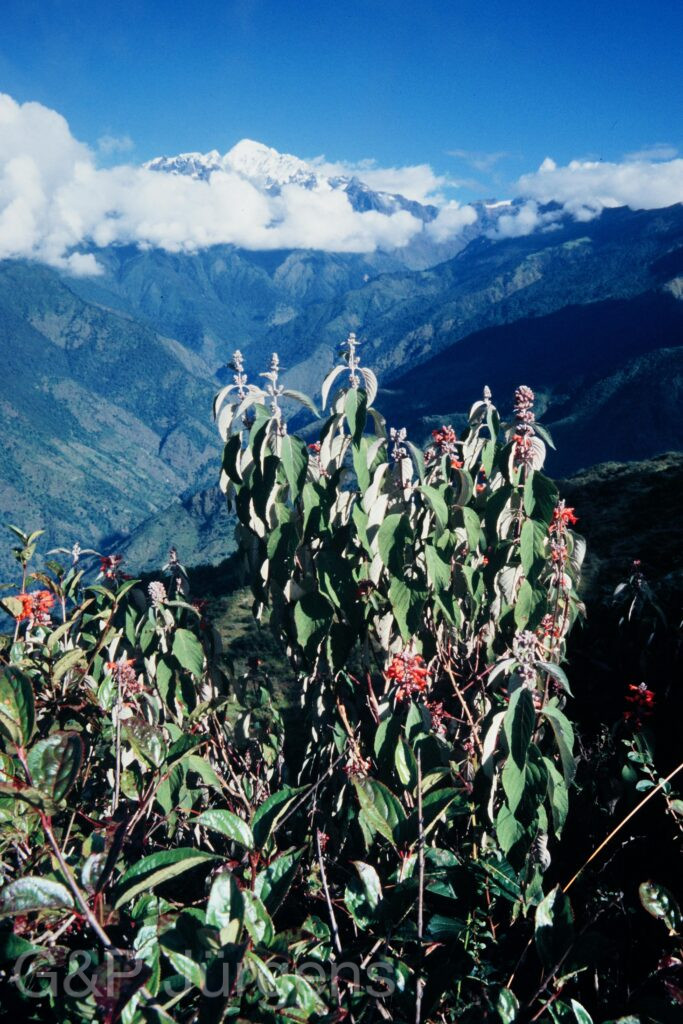
Coffea benghalensis, the Bengal coffee, is a shrub of the warm subtropical lowlands and lower hills of the Indian subcontinent and Indo-Burmese region, recorded from India, Nepal, Bangladesh, Bhutan, China and Indonesia. It grows in the understorey of moist subtropical broad-leaved forest, along forest margins, ravines and shaded stream banks at low elevations. The specimen photographed at Melanele Pul in the Helambu region of Nepal at 850 m in May is a typical occurrence in the warm foothill forest zone, flowering in the pre-monsoon season when the white blossoms appear briefly along the branches.

It is a small, glabrous, evergreen shrub with slender, opposite branches. The leaves are opposite, ovate to elliptic and acuminate, thin-textured and glossy, with conspicuous interpetiolar stipules characteristic of the Rubiaceae. The fragrant flowers are borne in axillary clusters, sessile or nearly so against the stem; each has a small calyx and a white, salverform corolla with usually five to seven spreading lobes and a slender tube, the stamens inserted in the throat. The fruit is a small fleshy drupe (berry) that ripens dark, containing the characteristic paired, plano-convex seeds, the coffee beans of the genus.

Coffea is a palaeotropical genus of the Rubiaceae centred on Africa and Madagascar but with a small Asian contingent including C. benghalensis, described by B.Heyne ex Schult. Although it lacks the commercial importance of C. arabica and C. canephora, it is of botanical interest as one of the few coffees native to mainland Asia and is locally used. Its sweetly scented, short-lived flowers are insect-pollinated, and the fleshy drupes are dispersed by birds and other animals through the foothill forests it inhabits.

Author: B.Heyne ex Schult. · Sources: POWO (Kew), GBIF, Flora of China, Annotated Checklist of the Flowering Plants of Nepal, Flora of British India, Davis et al. taxonomic revision of Coffea (Rubiaceae)

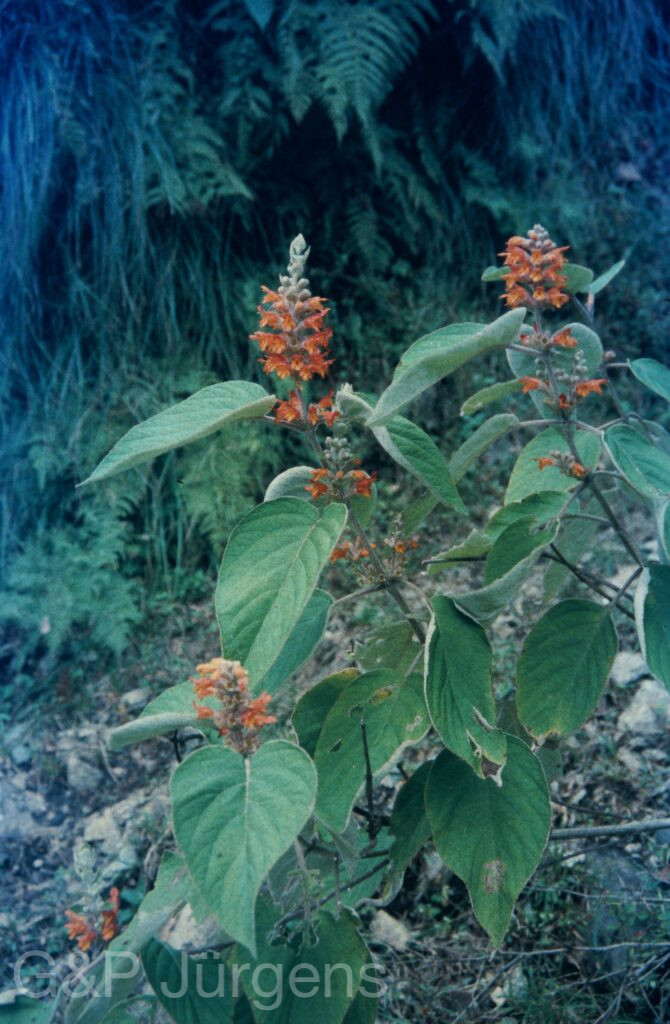
Wall.

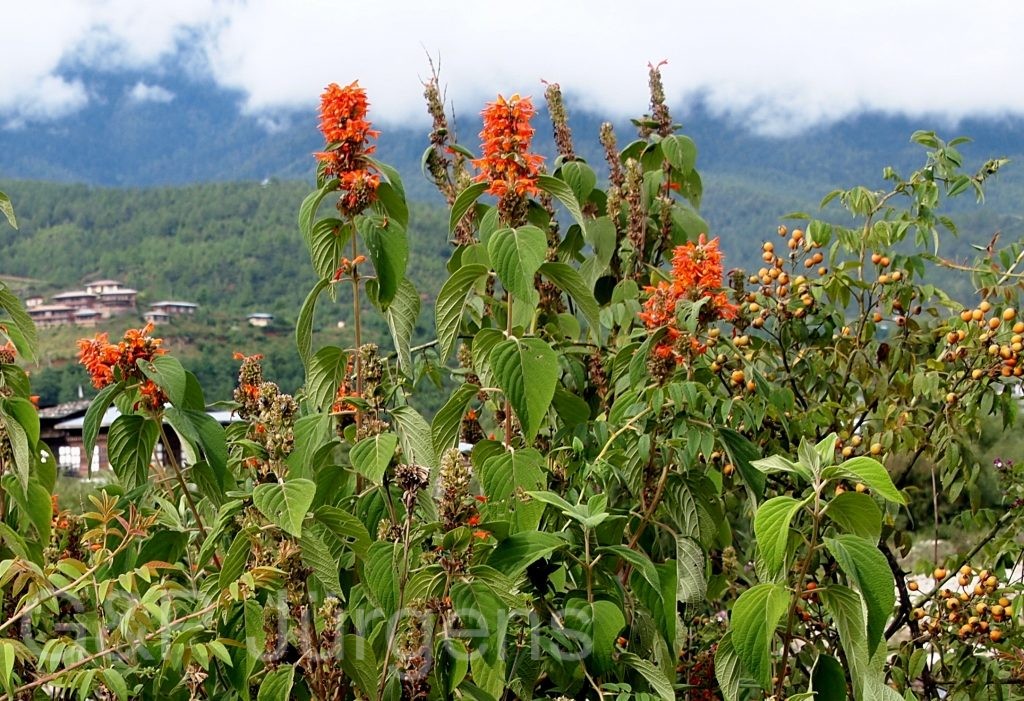
Bhutan2012 13
Bhutan Paro, 2300m September
Nepal 95 95 P164 ergebnis
Nepal Barphak 2000m October
Garw 2005 209 ergebnis ergebnis
India Garhwal Pana 2800m, September

Description

Colquhounia coccinea is a showy shrubby mint of the Himalaya and southwestern China. GBIF records it from China, Nepal, India, Bhutan, Thailand and Myanmar, with cultivated and introduced occurrences in Australia, Europe and North America, totalling around 670 records. It grows in open forest, scrub, thickets and along hill slopes and roadsides in the warm temperate zone, generally between 1500 and 3000 m. The populations illustrated were photographed at Paro in Bhutan (2300 m), Barphak in Nepal (2000 m) and Pana in Garhwal, India (2800 m), flowering in September and October, its characteristic autumn flowering season in the Himalayan foothills.

It is a robust, sprawling or semi-scandent shrub up to 2-3 m, the stems and foliage clothed in stellate or felted indumentum. The opposite leaves are ovate to lanceolate, acuminate, crenate-serrate and rugose, greyish-tomentose beneath. The flowers are borne in dense axillary cymose clusters; the curved, tubular, two-lipped corolla is brilliant scarlet to orange-red, well exserted from the calyx, with four didynamous stamens. The fruit is unusual among Lamiaceae in that the nutlets are winged, an adaptation favouring wind dispersal from the often steep slopes the plant occupies.

Colquhounia is a small Sino-Himalayan genus of subfamily Lamioideae, and the winged nutlets and tubular red corollas distinguish it within the family. The vivid scarlet, nectar-rich tubular flowers are adapted to bird pollination, notably by sunbirds, an uncommon strategy in the predominantly bee-pollinated mints. Long valued as an ornamental and frost-tender garden shrub, the species is widespread and locally common, and is not of conservation concern.

Author: Wall. · Sources: POWO (Kew), GBIF, Flora of China, Flora of Bhutan, Annotated Checklist of the Flowering Plants of Nepal, Phylogeny and classification of subfamily Lamioideae (Lamiaceae)

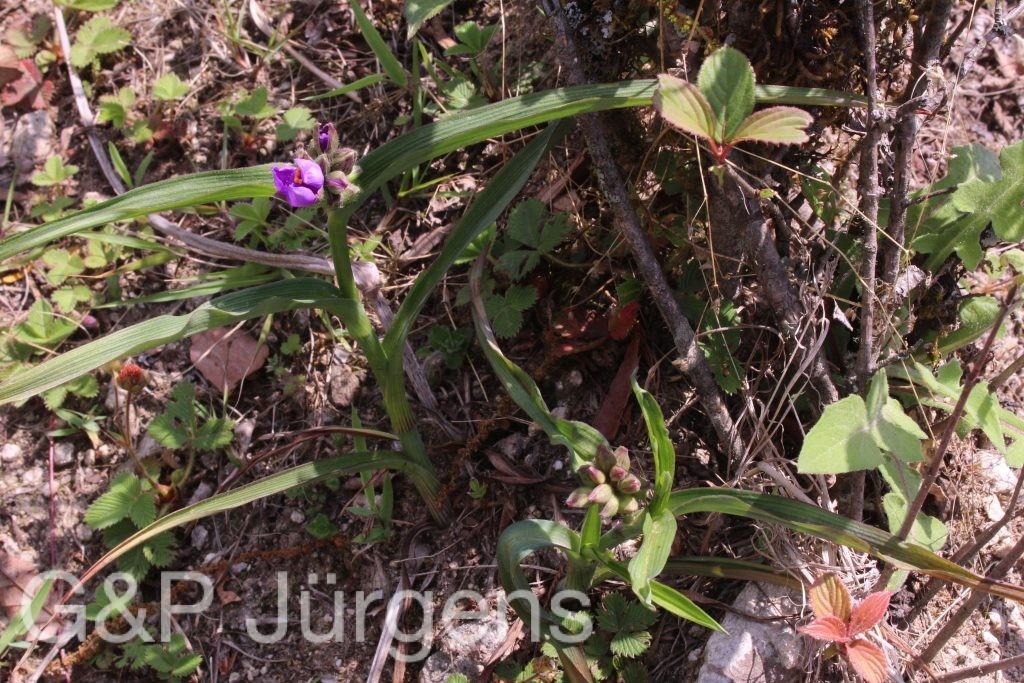
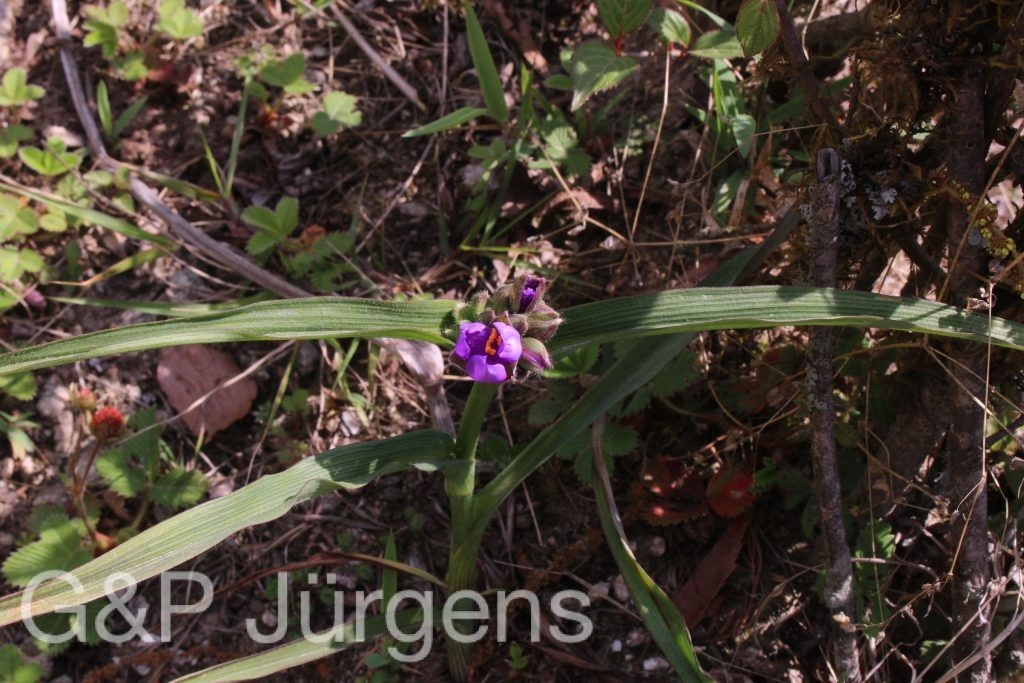
Edgew.

Bhutan2014 817
Bhutan Punaka 1310m, May
Bhutan2014 818
Bhutan Punaka 1310m, May

Description

Commelina maculata is a perennial herb of the Himalaya and adjacent Asian mountains, recorded by GBIF from China, Nepal, India, Thailand, Bhutan, Myanmar, Vietnam and Sri Lanka across about 310 occurrences. It grows in moist, often shaded places, along forest margins, on grassy and rocky banks, beside paths and watercourses, and in disturbed ground, generally at low to middle elevations. The plant photographed at Punakha in western Bhutan at about 1310 m, flowering in May, occupies the warm temperate valley habitat where this species is common in the early monsoon season.

The plant has ascending to decumbent, somewhat fleshy stems that root at the lower nodes, with sheathing leaf bases typical of the family. The leaves are alternate, lanceolate to ovate-lanceolate, with entire margins and a closed basal sheath, often with a fringe of hairs at the sheath mouth. The flowers emerge from a folded, boat-shaped spathe and are zygomorphic, with three sepals and three petals of which the two upper petals are larger and conspicuously blue, the lower one reduced and paler; there are six stamens, several modified as staminodes with cruciform antherodes. Each flower is ephemeral, opening for part of a single day. The fruit is a small loculicidal capsule containing few rugose seeds.

Commelina is a large pantropical genus whose Asian montane species, including C. maculata, are distinguished by spathe form, seed sculpturing and indumentum. The fleeting, nectarless flowers rely on pollen-foraging insects, and the staminodes function as a visual lure. As a plant of disturbed and marginal habitats the species is weedy, resilient and widely distributed, and it is of no conservation concern. Its broad Indo-Malayan to Himalayan range reflects the success of the genus in seasonally moist, sunny situations.

Author: Edgew. · Sources: POWO (Kew), GBIF, Flora of China, Flora of Bhutan, Faden Commelinaceae studies, Annotated Checklist of the Flowering Plants of Nepal

(Craib) B.L.Burtt

Bhutan2012 1027
Bhutan Trithangebe 900m, October
Bhutan2012 1028
Bhutan Trithangebe 900m, October

Description

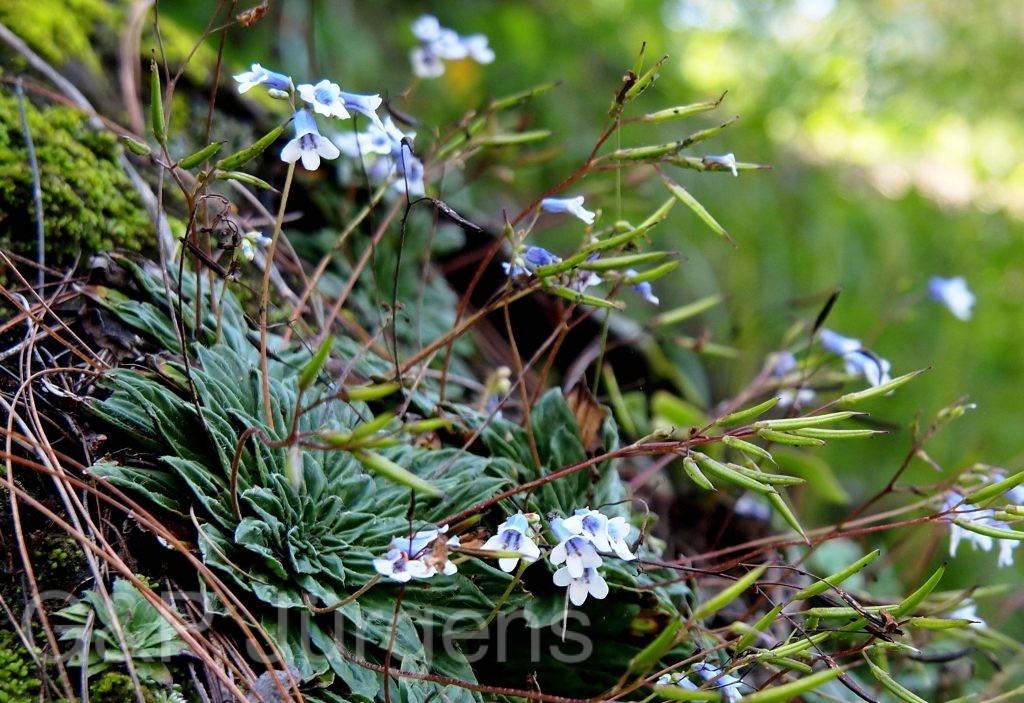
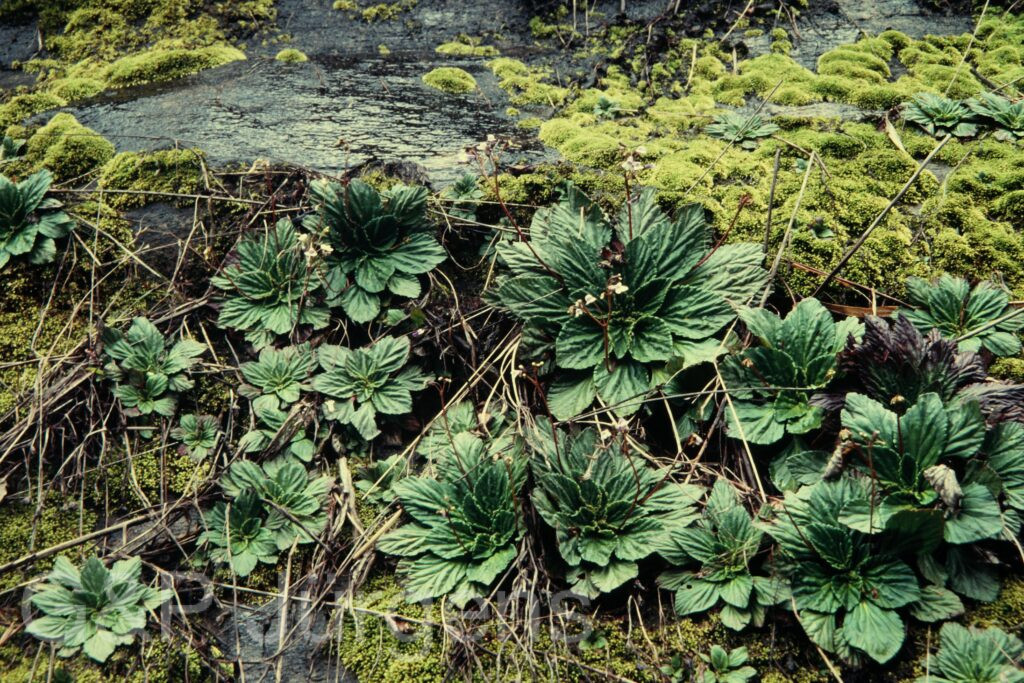
Corallodiscus cooperi is a narrowly distributed rosette herb of the eastern Himalaya, so far reliably known only from Bhutan, where the few catalogued occurrences point to a restricted, possibly endemic or near-endemic range. As with other members of the genus it is a lithophyte, growing on shaded, mossy rock faces, cliff ledges and boulders, often in the spray zone of streams or on damp, well-drained crags. The plant photographed at Trithangebe in Bhutan at 900 m in October occupies the warm subtropical foothill belt, lower than the montane elevations favoured by several congeners, flowering or fruiting into the autumn on its rocky substrate.

It is a small, perennial, acaulescent herb forming a dense, appressed basal rosette of leaves. The leaves are obovate to spathulate, thick-textured, with a green, often rugose and sparsely hairy upper surface and a densely brown- or rusty-tomentose lower surface, the margins crenate to entire. From the rosette arise slender, leafless scapes bearing few-flowered cymes; the flowers are small and weakly zygomorphic, with a tubular to campanulate, five-lobed corolla of blue to violet or purplish hue, and four didynamous stamens. The fruit is a slender, elongate capsule containing numerous minute seeds.

The placement here under "Corallodiscinae" reflects the subtribal rank of Corallodiscus within Gesneriaceae (subfamily Didymocarpoideae); the genus is a small Sino-Himalayan group of rosette-forming rock plants allied to Didymocarpus and Oreocharis. Its members are characteristically tolerant of seasonal desiccation. Given its apparently very limited known range, C. cooperi warrants attention as a potential narrow endemic of conservation interest, dependent on undisturbed rocky habitats.

Author: (Craib) B.L.Burtt · Sources: POWO (Kew), Flora of China Vol. 18, Flora of Bhutan Vol. 2, GBIF, Weber: Gesneriaceae in The Families and Genera of Vascular Plants

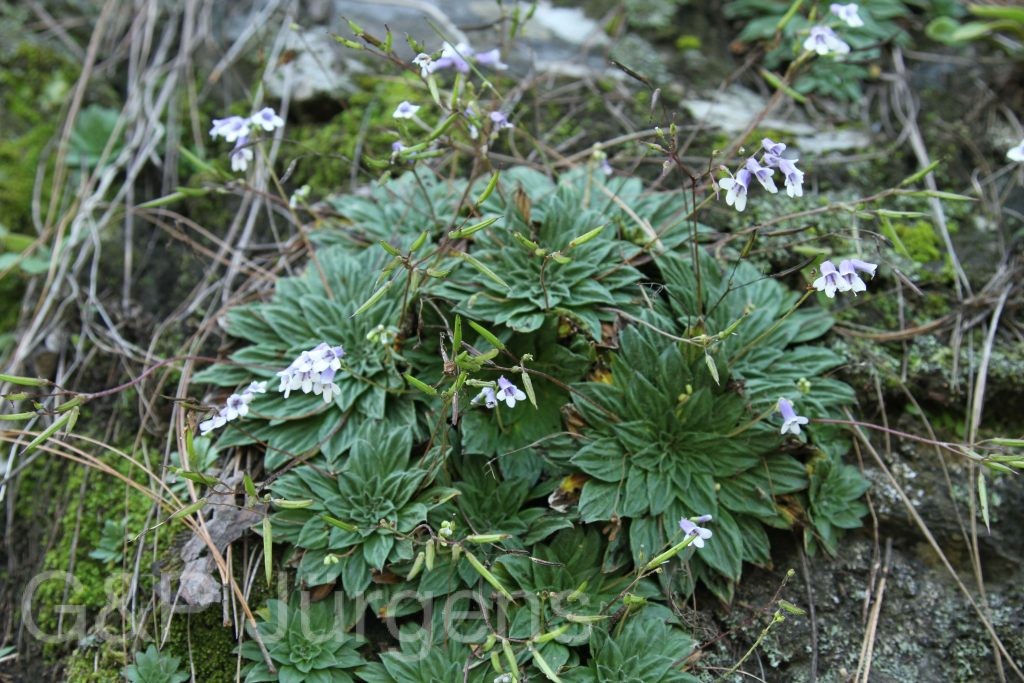
(Wall. ex R.Br.) B.L.Burtt

Nepal 97 369 P725
Nepal Arun-Valley 1750m May
Nepal 99 927 ergebnis
West-Nepal Roha 2750m, July

Description

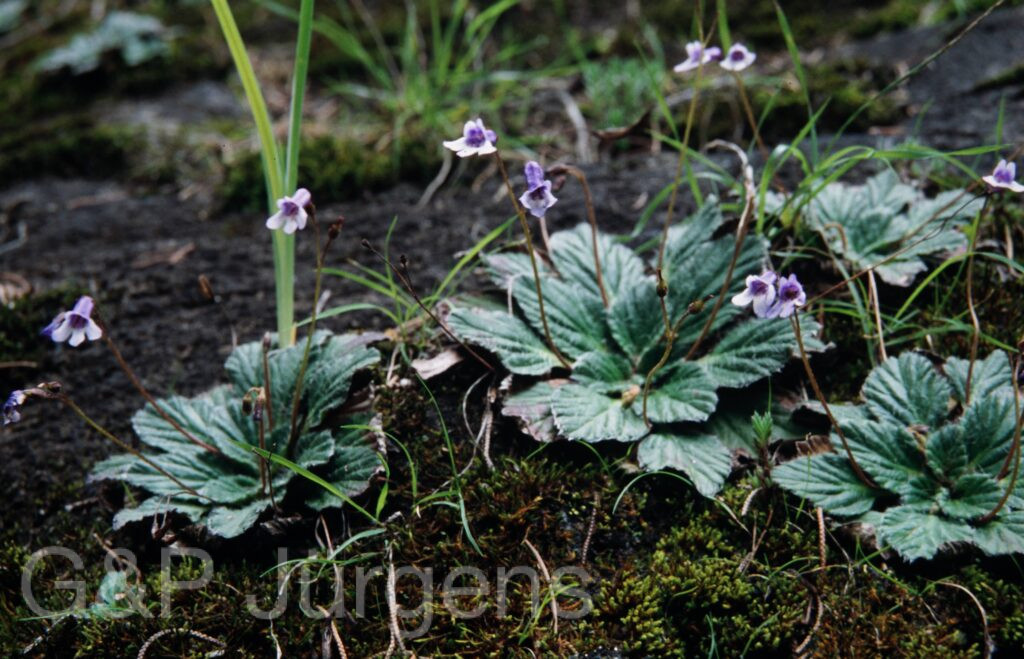
Corallodiscus lanuginosus (Wall. ex R.Br.) B.L.Burtt is a rosette-forming, rupicolous perennial of the Gesneriaceae, distributed across the Himalaya and southwest China. GBIF data (over 2,000 occurrences) record it from China, Nepal, India, Bhutan, Pakistan, Myanmar, and Thailand, indicating a broad Sino-Himalayan range. It was photographed in Nepal in the Arun Valley (1,750 m, May) and at Roha in west Nepal (2,750 m, July), reflecting its occurrence on shaded, mossy cliff faces, rock crevices, and boulders in montane forest, generally between about 1,500 and 3,500 m where humidity is high.

The plant forms a compact basal rosette of leaves pressed against the rock surface. The leaves are obovate to elliptic, with a crenate margin, the upper surface dark green and rugose, the lower surface densely clothed in woolly, rusty to whitish hairs (hence "lanuginosus"). Slender, leafless scapes bear cymose clusters of flowers; the corolla is tubular-campanulate and bluish-violet to purple with a paler throat, with the slightly oblique limb and reduced fertile stamens typical of the genus. The fruit is a slender capsule.

Corallodiscus belongs to the Old World Gesneriaceae (subfamily Didymocarpoideae) and is closely allied to the lithophytic Himalayan radiation that includes Didymocarpus and allies; the input subtribe name reflects this placement. Many populations exhibit poikilohydric, resurrection-like desiccation tolerance, surviving dry periods on exposed rock and reviving with the monsoon. Widespread and locally common on cliffs, the species is not considered threatened.

Author: (Wall. ex R.Br.) B.L.Burtt · Sources: POWO (Kew), Flora of China Vol. 18, Flora of Bhutan Vol. 2, GBIF, Burtt: Studies in the Gesneriaceae of the Old World

Wall.

Nepal 97 354 P693
Nepal Arun-Valley 1650m May

Description

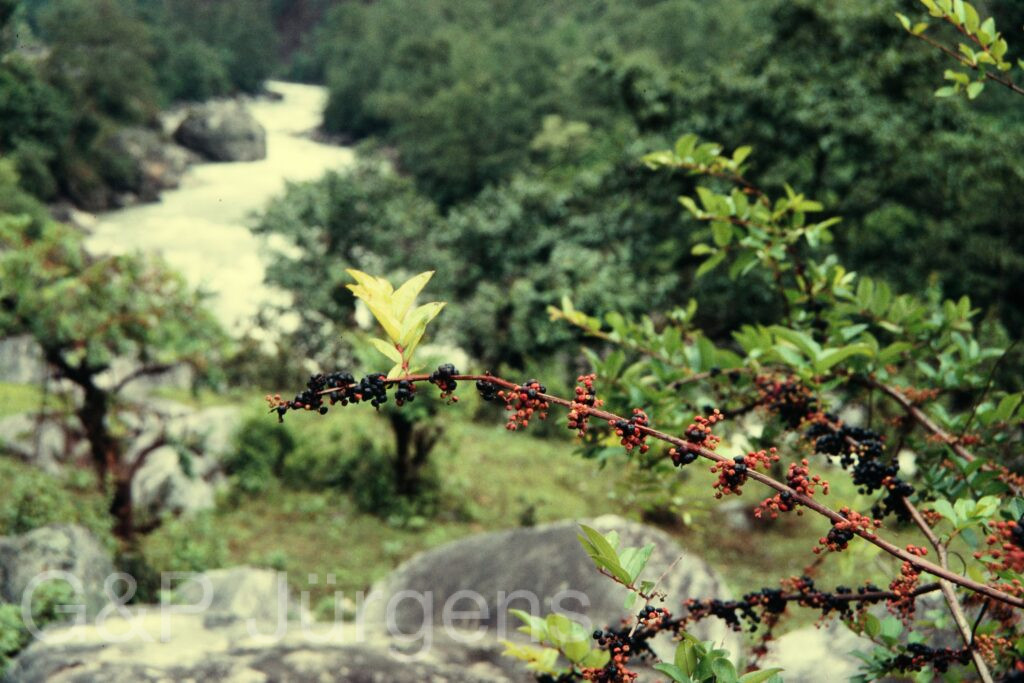
Coriaria nepalensis is a shrub of the Himalaya and adjacent mountains of western China, ranging from Pakistan through the Indian Himalaya, Nepal and Bhutan to south-western China and Myanmar. GBIF aggregates around 1880 occurrences, including scattered introductions in Europe and Japan where it is grown as a curiosity. It is a vigorous colonist of open hillsides, landslips, riverbanks, terrace edges and disturbed ground, often forming thickets on poor soils between about 1000 and 3000 m. The plant from the Arun Valley of eastern Nepal at 1650 m in May is characteristic of its role as a pioneer of the subtropical to warm-temperate hill zone.

It is a much-branched deciduous shrub with arching, reddish, four-angled young branchlets. The leaves are opposite or whorled, sessile or subsessile, ovate to ovate-lanceolate, entire and conspicuously three- to five-veined from the base. The small flowers are borne in slender axillary or terminal racemes, with five sepals and five small petals; after flowering the petals enlarge, becoming fleshy and dark purple-black, closely investing the cluster of achene-like fruitlets to form a juicy, mulberry-like pseudo-fruit. These succulent infructescences are bird-dispersed but, like the whole plant, are highly poisonous, containing the convulsant sesquiterpene coriamyrtin.

Coriariaceae is a small, isolated family of the single genus Coriaria, with a remarkable disjunct distribution across the Mediterranean, eastern Asia, the Himalaya, New Zealand and the Americas, a textbook case of relictual biogeography. C. nepalensis fixes atmospheric nitrogen through root nodules harbouring the actinomycete Frankia, underpinning its success on impoverished, eroded substrates. Widespread and weedy in its native range, it is of no conservation concern, though its toxicity is locally significant to livestock.

Author: Wall. · Sources: POWO (Kew), GBIF, Flora of China Vol. 11, Flora of Bhutan Vol. 1, Flora of Pakistan, Annotated Checklist of the Flowering Plants of Nepal, Skog revision of Coriaria