
B.Heyne ex Schult.
Description
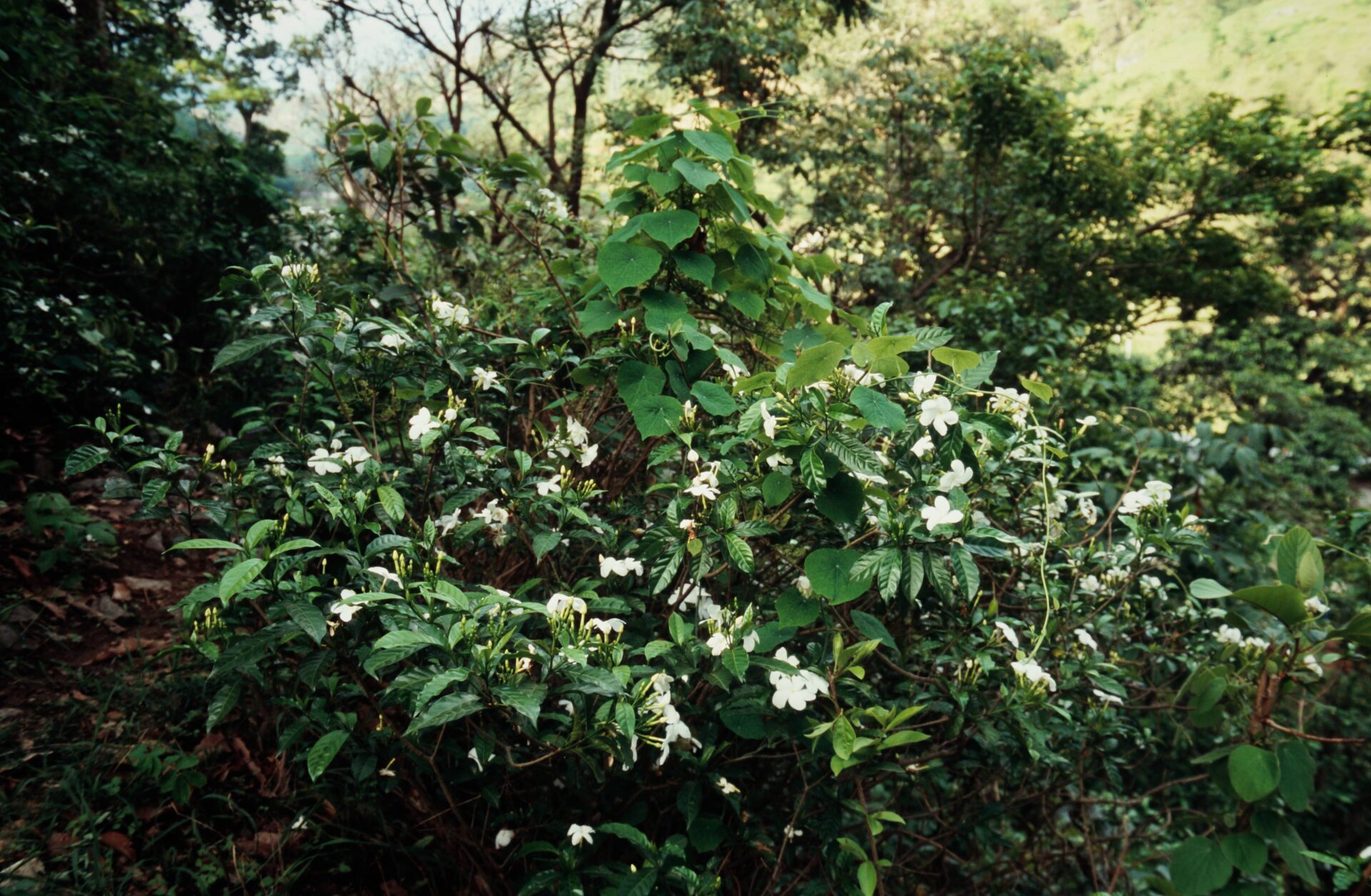
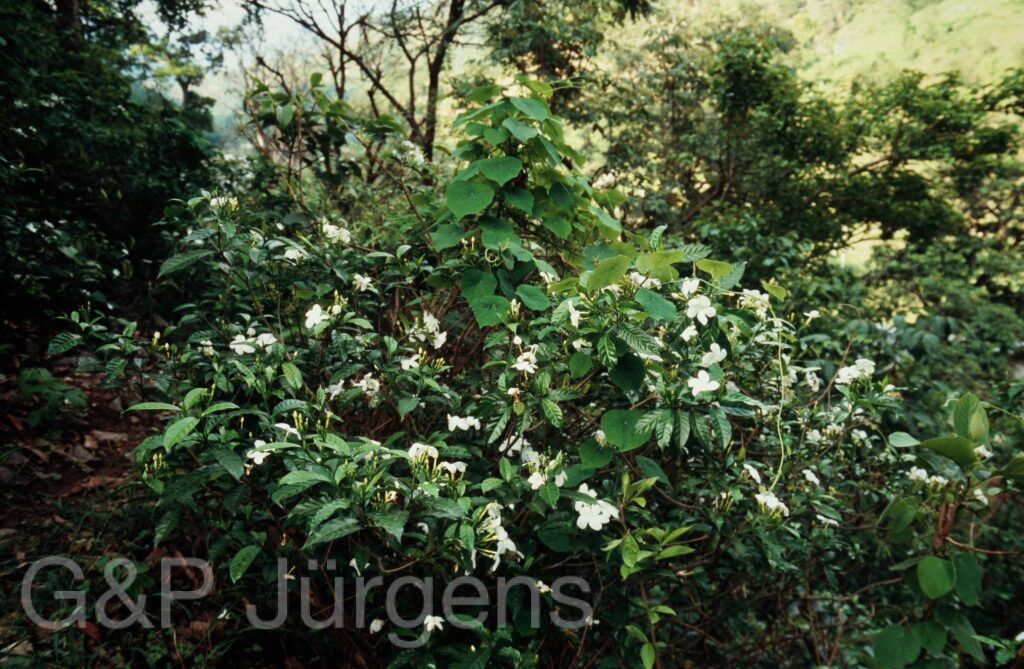
Coffea benghalensis, the Bengal coffee, is a shrub of the warm subtropical lowlands and lower hills of the Indian subcontinent and Indo-Burmese region, recorded from India, Nepal, Bangladesh, Bhutan, China and Indonesia. It grows in the understorey of moist subtropical broad-leaved forest, along forest margins, ravines and shaded stream banks at low elevations. The specimen photographed at Melanele Pul in the Helambu region of Nepal at 850 m in May is a typical occurrence in the warm foothill forest zone, flowering in the pre-monsoon season when the white blossoms appear briefly along the branches.
It is a small, glabrous, evergreen shrub with slender, opposite branches. The leaves are opposite, ovate to elliptic and acuminate, thin-textured and glossy, with conspicuous interpetiolar stipules characteristic of the Rubiaceae. The fragrant flowers are borne in axillary clusters, sessile or nearly so against the stem; each has a small calyx and a white, salverform corolla with usually five to seven spreading lobes and a slender tube, the stamens inserted in the throat. The fruit is a small fleshy drupe (berry) that ripens dark, containing the characteristic paired, plano-convex seeds, the coffee beans of the genus.
Coffea is a palaeotropical genus of the Rubiaceae centred on Africa and Madagascar but with a small Asian contingent including C. benghalensis, described by B.Heyne ex Schult. Although it lacks the commercial importance of C. arabica and C. canephora, it is of botanical interest as one of the few coffees native to mainland Asia and is locally used. Its sweetly scented, short-lived flowers are insect-pollinated, and the fleshy drupes are dispersed by birds and other animals through the foothill forests it inhabits.
Author: B.Heyne ex Schult. · Sources: POWO (Kew), GBIF, Flora of China, Annotated Checklist of the Flowering Plants of Nepal, Flora of British India, Davis et al. taxonomic revision of Coffea (Rubiaceae)