
Hook.f.
Description
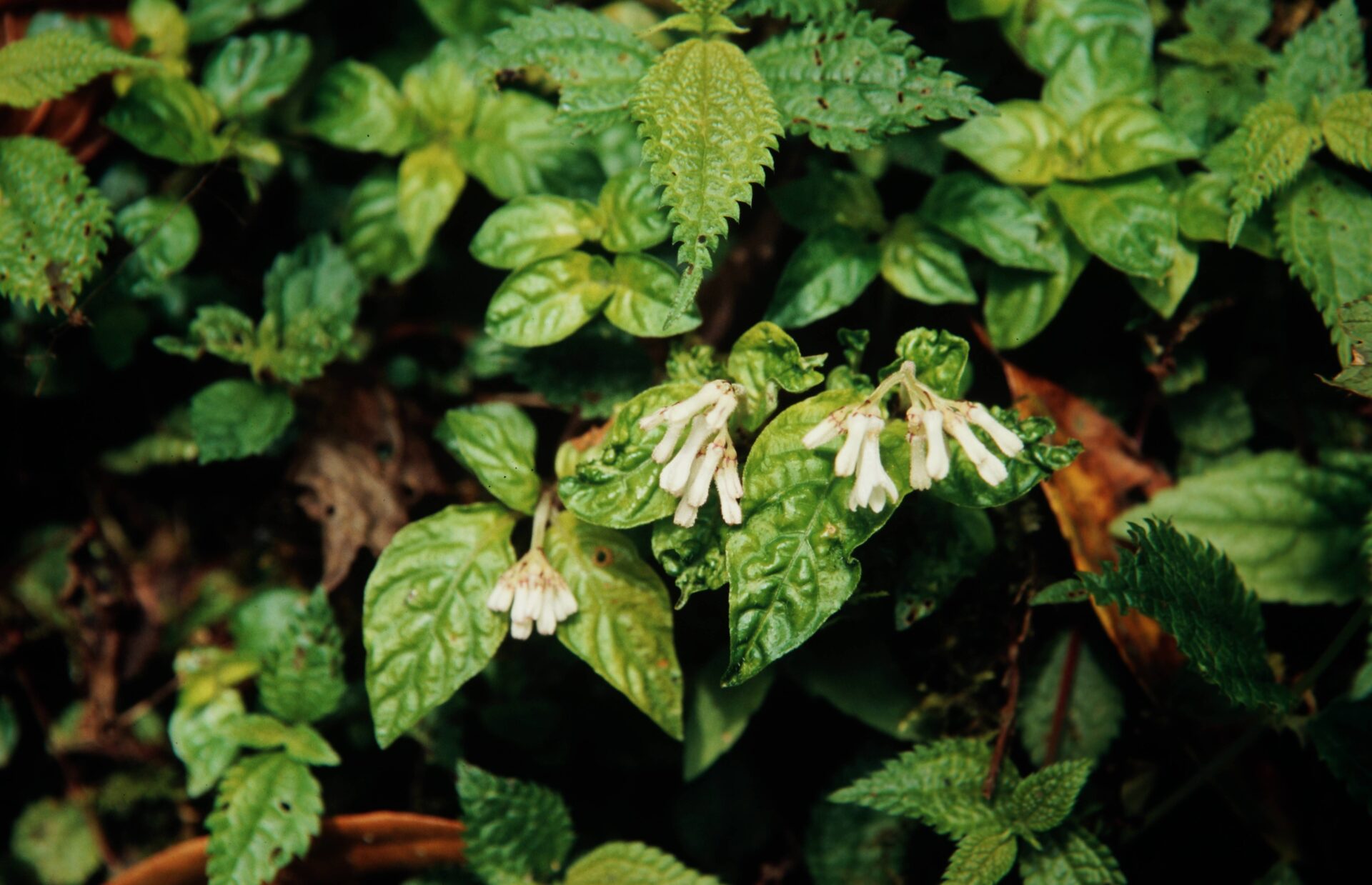
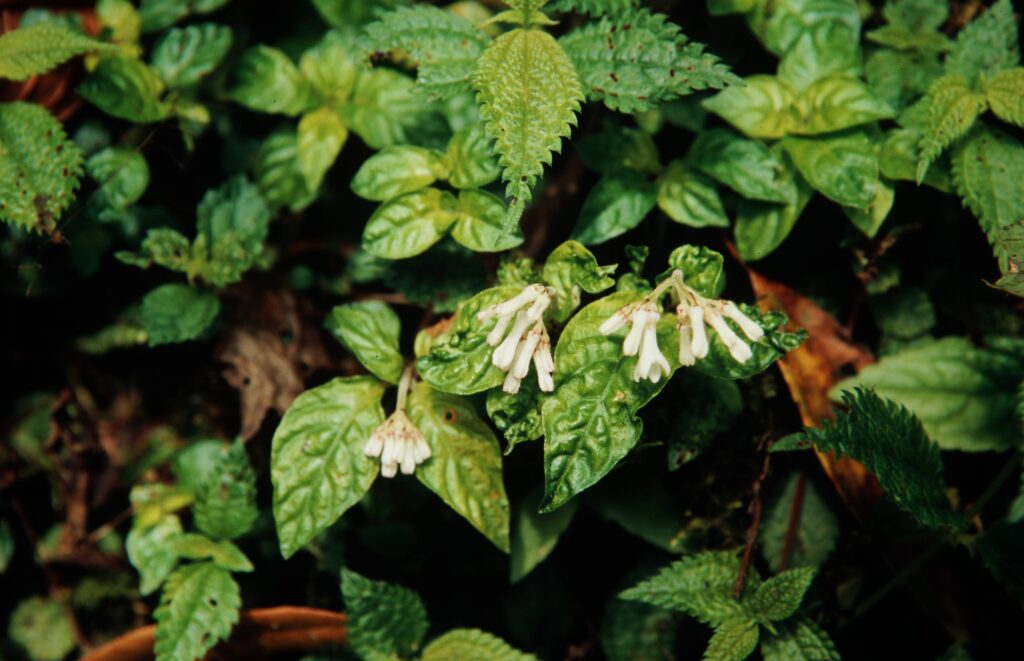
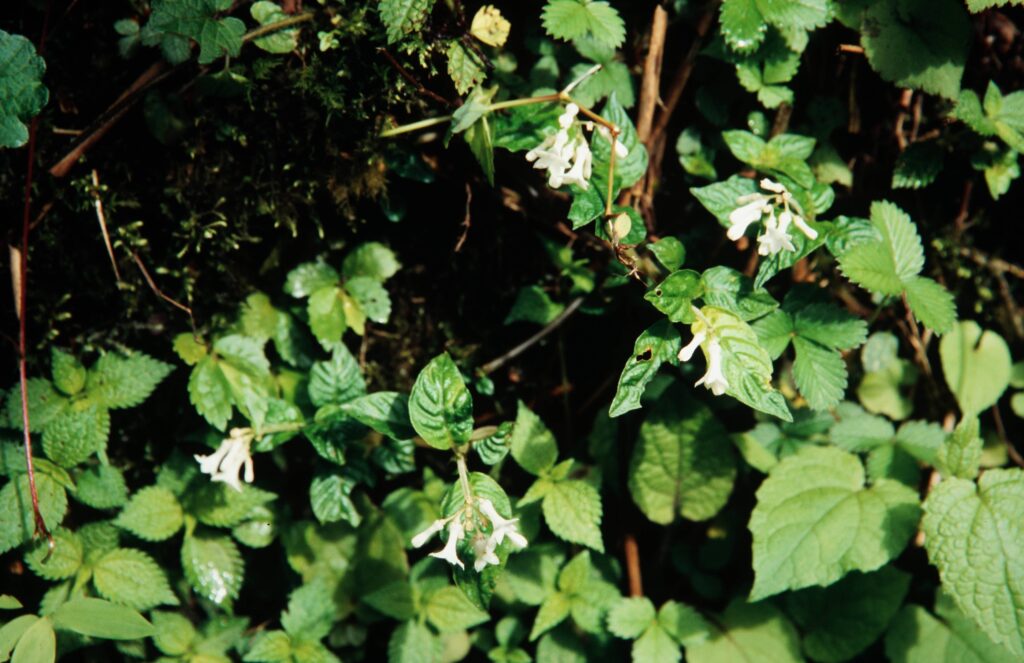
Ophiorrhiza treutleri is an eastern Himalayan understorey herb confined to India, Nepal and Bhutan, documented by roughly 39 georeferenced records that cluster in the moist mid-montane forests of the region. It is a plant of shaded, humid habitats, growing on the floor of dense evergreen and mixed broadleaved forest, along streamsides, mossy banks and damp ravines where atmospheric humidity remains high throughout the year. The specimen photographed at Tolung in West Bengal (India) at about 2200 m in May reflects its typical occurrence in the cool, perpetually damp montane belt, where it flowers in spring beneath a closed canopy.
It is a small perennial or weakly suffrutescent herb with slender, often decumbent stems that root at the lower nodes and bear a sparse indumentum. The leaves are opposite, ovate to elliptic-lanceolate, acuminate at the apex and somewhat asymmetric at the base, with conspicuous lateral venation and small interpetiolar stipules characteristic of the family. The inflorescence is a terminal, scorpioid cyme; the flowers are small, white to pinkish and tubular, with a five-lobed corolla and an inferior bilocular ovary. As in many Ophiorrhiza, the species is distylous, producing pin and thrum flowers. The fruit is a characteristically broad, didymous (two-lobed) capsule that dehisces loculicidally to release numerous minute angular seeds.
Ophiorrhiza belongs to the tribe Ophiorrhizeae of the Rubiaceae and is notable for the accumulation of camptothecin and related alkaloids, which has drawn pharmacological interest to several species. The heterostyly of O. treutleri promotes outcrossing through insect-mediated pollination, while its capsular fruits are adapted to rain-splash and gravity dispersal in the still air of the forest floor. As an obligate shade species tied to undisturbed montane forest, it is vulnerable to canopy opening, and its conservation is effectively linked to the protection of intact eastern Himalayan woodland.
Author: Hook.f. · Sources: POWO (Kew), GBIF, Flora of China Vol. 19, Flora of Bhutan Vol. 2, Flora of Nepal, Deb & Mondal Revision of the Genus Ophiorrhiza (Rubiaceae)