Tag:

Bhutan

Flowers of Bhutan — 1326 plant species documented across the Bhutanese Himalaya, from dense broadleaf and conifer forests to alpine scrub and meadows. Bhutan’s largely intact wilderness shelters an exceptional diversity of orchids, rhododendrons, primulas and Himalayan poppies, many of them regional endemics. Each species page includes a botanical description, distribution, habitat and flowering time, with the original photograph and its recorded altitude and locality.

Buch.-Ham. ex D. Don
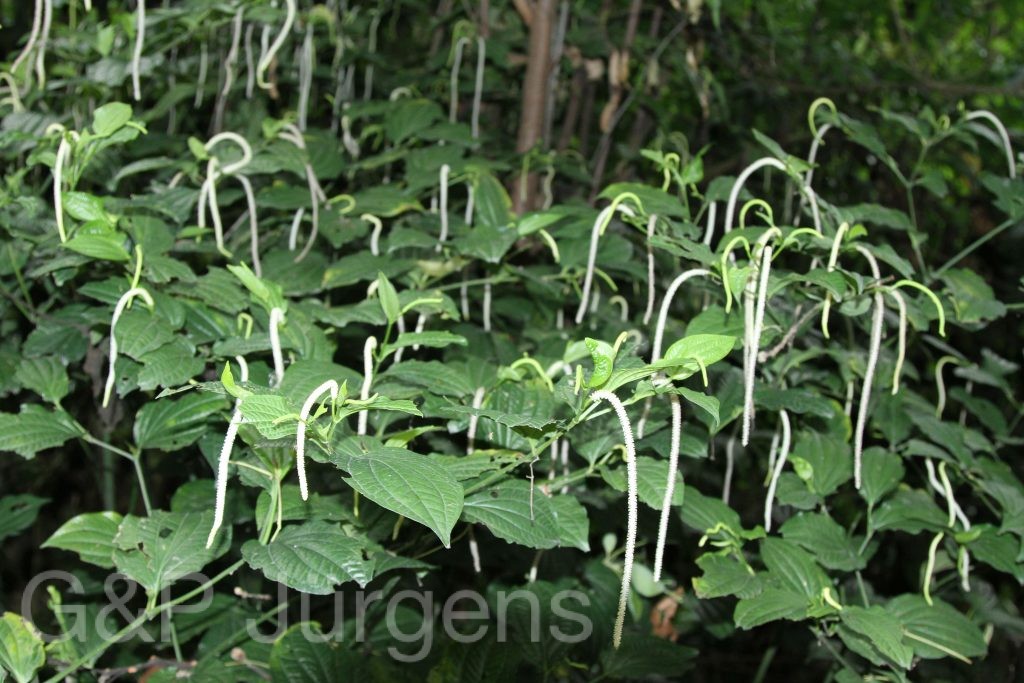
Bhutan2014 293
Bhutan Trithangebe near a farmhouse 800m, May

Description

Piper suipigua (Buch.-Ham. ex D. Don) is a climbing pepper of the family Piperaceae distributed across the eastern and central Himalaya and adjacent regions, occurring in India, Nepal, Bhutan, Bangladesh, Thailand and southern China. The roughly 200 GBIF records indicate a relatively narrow but well-defined sub-Himalayan range. It is a plant of warm-temperate to subtropical forest, growing as a root-climber on tree trunks and over rocks, and is frequently encountered in the disturbed margins of cultivation and around dwellings, as reflected in the Bhutanese record from Trithangebe near a farmhouse at 800 m in May. It typically occurs from the foothills to about 1,500 m.

The plant is a woody to herbaceous climber attaching by adventitious clasping roots at the nodes, with somewhat swollen, jointed stems. The leaves are alternate, ovate to ovate-cordate, entire, acuminate at the apex and palmately several-nerved from near the base, the lower surface frequently glandular-dotted. The minute, perianth-less flowers are densely crowded on slender, pendulous or erect spikes opposed to the leaves, each subtended by a peltate bract; the species is generally dioecious. The fruit is a small, sessile, fleshy drupe aggregated into a fleshy fruiting spike.

Piper is a very large pantropical genus of considerable economic importance, including the source of black pepper (P. nigrum) and betel (P. betle). P. suipigua is one of several Himalayan wild peppers whose aromatic leaves and fruits are used locally as a condiment, masticatory and in folk medicine. The genus is characterised by its sympodial growth, swollen nodes and minute flowers densely packed on opposed spikes. Locally common in suitable habitat, the species is not regarded as being of conservation concern.

Author: Buch.-Ham. ex D. Don · Sources: POWO (Kew), Flora of Bhutan Vol. 1, GBIF, Flora of China Vol. 4, Gardner: Pipers of Nepal and the Himalaya
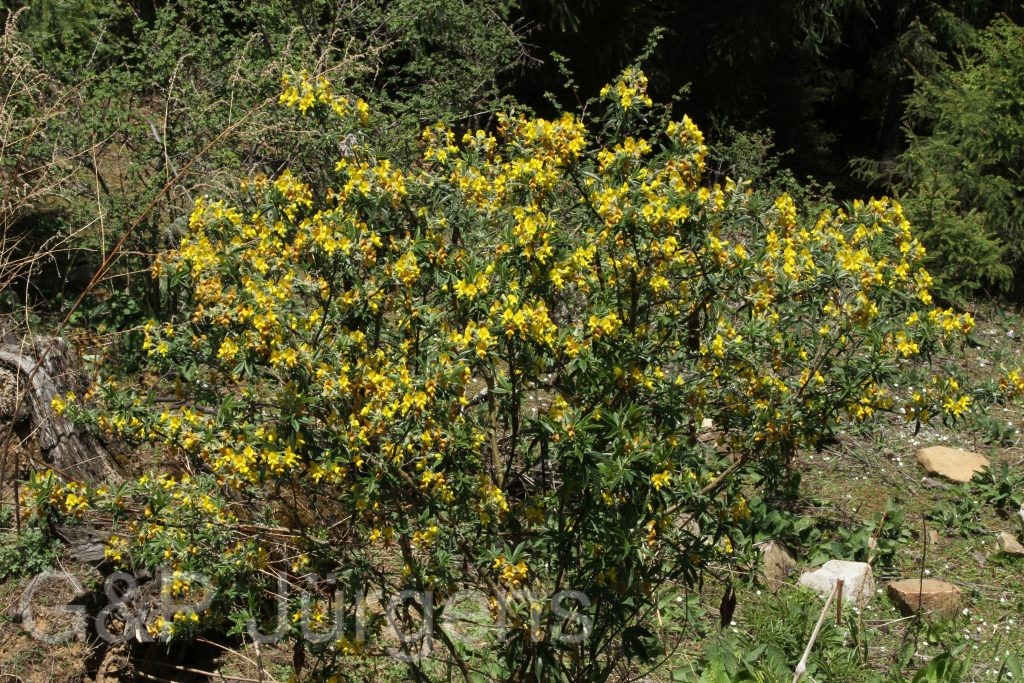
(Hook.) Sweet

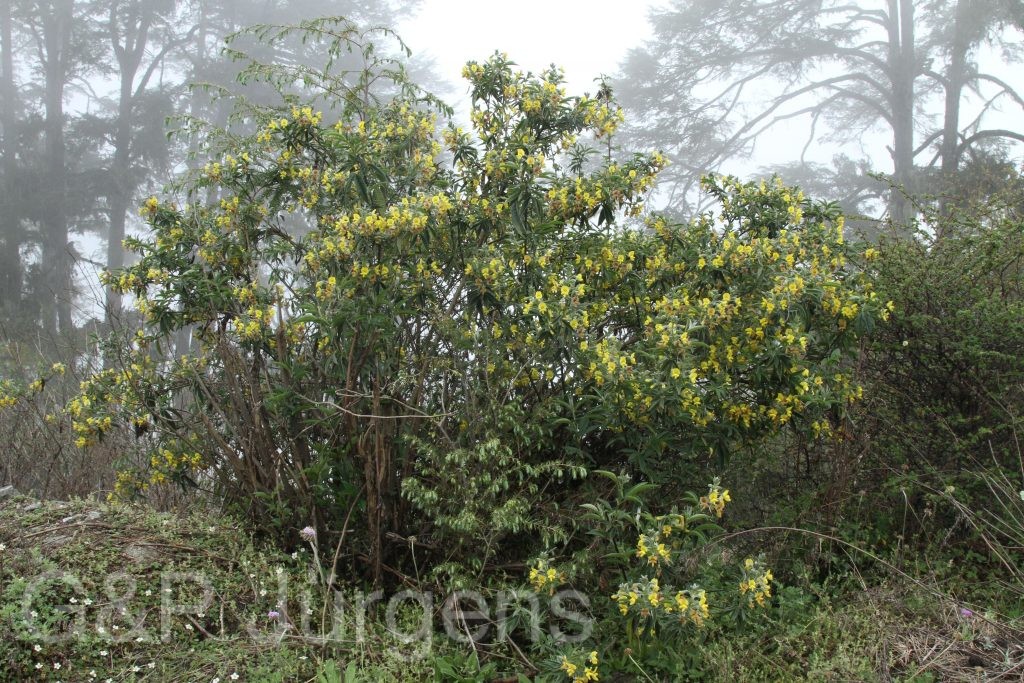
Bhutan2014 342
Bhutan Tumching-La 3000m, May
Bhutan2014 886
Bhutan Chele-La 3300m, May

Description

Piptanthus nepalensis is a Sino-Himalayan shrub distributed along the southern flank of the great ranges from Nepal and northern India eastward through Bhutan into south-western China (Yunnan, Sichuan, Xizang), with outlying records in Myanmar; the species is widely cultivated and naturalised in temperate gardens, accounting for the European, North American and Antipodean records (GB, DE, BE, NL, US, CA, NZ) among its more than 1600 georeferenced occurrences. It favours open scrub, forest margins, rocky slopes and stream banks in the upper montane and subalpine belts, typically between about 2500 and 4000 m. The populations on the Bhutanese passes of Tumching-La (3000 m) and Chele-La (3300 m), flowering with the spring thaw in May, are characteristic of its habitat among Rhododendron and conifer scrub.

It is a deciduous to semi-evergreen shrub reaching 1-4 m, with stout greenish branchlets bearing silky-pubescent young growth. The leaves are trifoliolate, long-petiolate and stipulate, the leaflets elliptic to lanceolate, dark green and glabrescent above, glaucous and appressed-silky beneath. The showy golden-yellow papilionaceous flowers, 2.5-3 cm long, are borne in terminal erect racemes; the calyx is bilabiate and silky, and the standard, wings and keel are typical of the tribe Thermopsideae. The fruit is a flattened, elongate, dehiscent legume to 12 cm, glaucous-pubescent and containing several dark reniform seeds.

Piptanthus is a small genus of the broadly defined Thermopsideae allied to Thermopsis and Anagyris, distinguished by its woody habit and trifoliolate leaves. Long-cultivated for its early bloom, P. nepalensis hosts nitrogen-fixing rhizobia that aid colonisation of skeletal soils. It is not considered threatened, being abundant across a broad range, though its toxic quinolizidine alkaloids deter browsing.

Author: (Hook.) Sweet · Sources: POWO (Kew), GBIF, Flora of China, Flora of Bhutan, Flora of Nepal, Turner's revision of Piptanthus (Thermopsideae)

(D.C.) Rehder & E.H. Wilson

Bhutan2014 26
Bhutan Samdrup 850m, May

Description

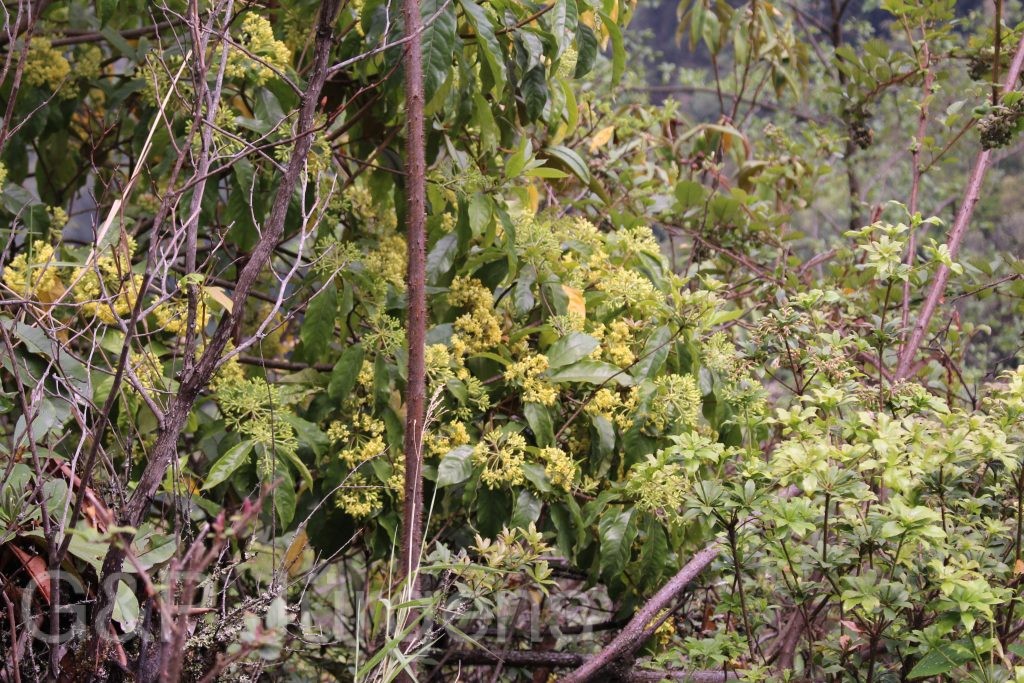
Pittosporum napaulense is an evergreen tree of the Himalaya and adjacent uplands, distributed from northern India and Nepal through Bhutan into southwestern China and Myanmar, with records also from Thailand; GBIF documents over two hundred occurrences across this range. It is a plant of subtropical to warm-temperate broadleaved forest, forest margins and ravine slopes, generally found between about 800 and 2000 m. The tree photographed at Samdrup in southern Bhutan at 850 m, in flower in May, exemplifies this preference for the warm, humid lower foothill forests of the eastern Himalaya, where it grows as an understorey to canopy tree and produces its fragrant flowers in late spring before the onset of the heaviest monsoon rains.

The plant is a small to medium-sized tree with smooth grey bark and glabrous twigs. The leaves are alternate but often crowded toward the branch tips in a pseudo-whorled arrangement, elliptic to oblong-lanceolate, leathery, entire and glossy, with the margins sometimes faintly wavy. The flowers are borne in terminal corymbose panicles and are creamy white to pale yellow and sweetly fragrant; each flower is five-merous, with free petals whose lower portions cohere into a tube and spreading upper lobes, five stamens, and a superior ovary. The fruit is a globose to ovoid woody capsule that splits into valves to expose numerous small seeds embedded in a sticky, resinous orange-red pulp, the viscid coating that gives the genus its name (Pittosporum, "pitch-seed") and aids dispersal by birds.

Pittosporum is a largely Old World genus of trees and shrubs centred on the tropics and subtropics of Asia, Australasia and the Pacific, and P. napaulense is the principal Himalayan representative. The family name is rendered "Pittosporaceaea" in the source; the accepted spelling is Pittosporaceae. The resinous, sticky-seeded capsules are a hallmark of the family, and the bark and leaves of this and related species have featured in local traditional medicine. As a widespread and ecologically adaptable forest tree spanning several countries and a broad elevational band, P. napaulense is not considered threatened, though its lower-elevation forest habitat is subject to ongoing pressure from agriculture and settlement in the densely populated eastern Himalayan foothills.

Author: (D.C.) Rehder & E.H. Wilson · Sources: POWO (Kew), GBIF, Flora of China Vol. 9, Flora of Bhutan Vol. 1 Part 2, Flora of Nepal, A Monograph of the Asian species of Pittosporum (Wenbin Zhang and Hua Peng)

(Hook.f.) Kraenzl.

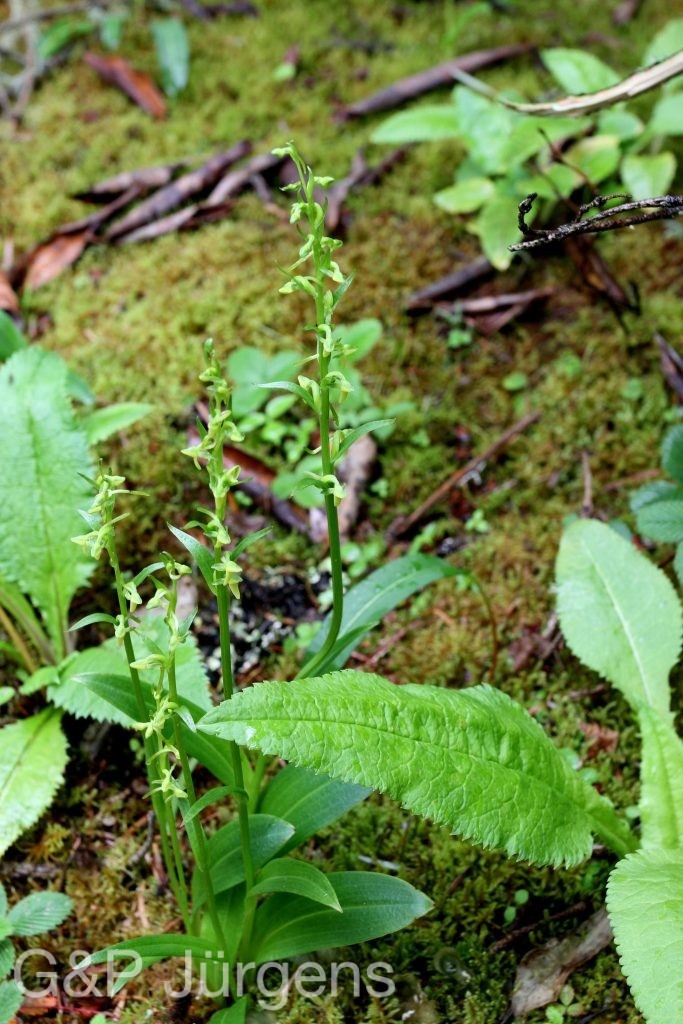
Nepal 99 395 ergebnis
Nepal, Dzongri 3800m, June

Description

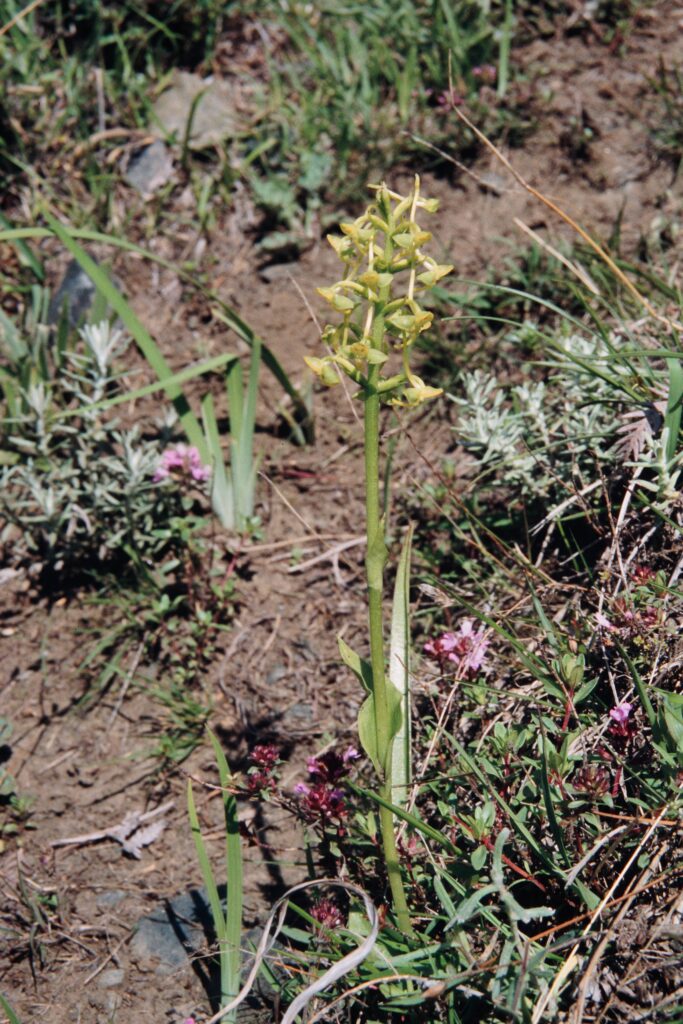
Platanthera concinna (Hook.f.) Kraenzl. is a terrestrial orchid of the high eastern Himalaya. GBIF records, though few (around two dozen occurrences), place it in India and Bhutan, with an anomalous South African record almost certainly representing misidentification or a database error; in practice it is a narrowly Himalayan species. It grows in alpine and subalpine meadows, grassy slopes and open scrub near and above the treeline, at elevations of roughly 3,000 to 4,200 m. The plant recorded at Dzongri at 3,800 m, flowering in June, is characteristic of its high-elevation summer anthesis on humid alpine turf.

The species is a slender, erect terrestrial herb arising from ellipsoid to fusiform root-tubers. The stem bears a few narrow, lanceolate to oblong cauline leaves that sheath at the base. The inflorescence is a lax to moderately dense terminal raceme of small flowers, typically greenish to greenish-white; the dorsal sepal and petals form a hood, the lateral sepals spread, and the lip is narrow and entire to obscurely lobed with a slender, descending spur containing nectar, adapted to pollination by long-tongued insects.

Platanthera is a large, mainly north-temperate genus of butterfly-orchids, and the Himalayan species form a taxonomically difficult complex once dispersed among Habenaria and allied genera. The limited number of records reflects both its restricted high-altitude habitat and undercollection. As an alpine orchid with a small documented range, it warrants conservation attention, and like all Orchidaceae it is protected under CITES Appendix II.

Author: (Hook.f.) Kraenzl. · Sources: POWO (Kew), GBIF, Flora of Bhutan Vol. 3 Part 3 (Orchids), Flora of China Vol. 25, Pearce & Cribb: The Orchids of Bhutan (2002)

(Hook.f.) Soó

Sikkim2003 96 P133
Sikkim above Chora 3600m 08.2003
Sikkim2003 97 P134
Sikkim above Chora 3600m 08.2003

Description

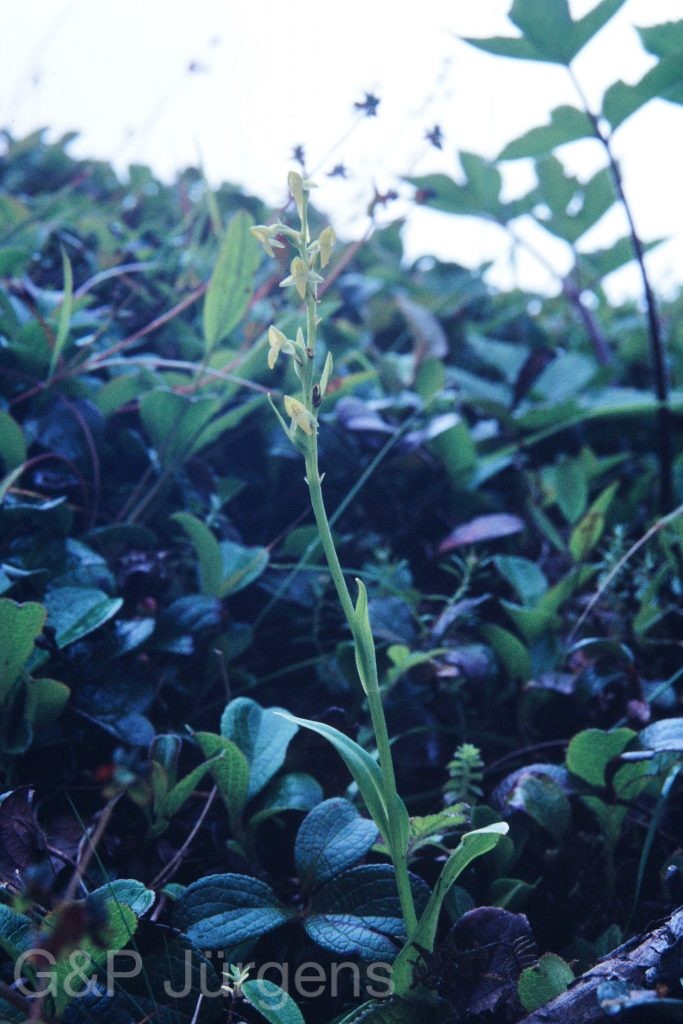
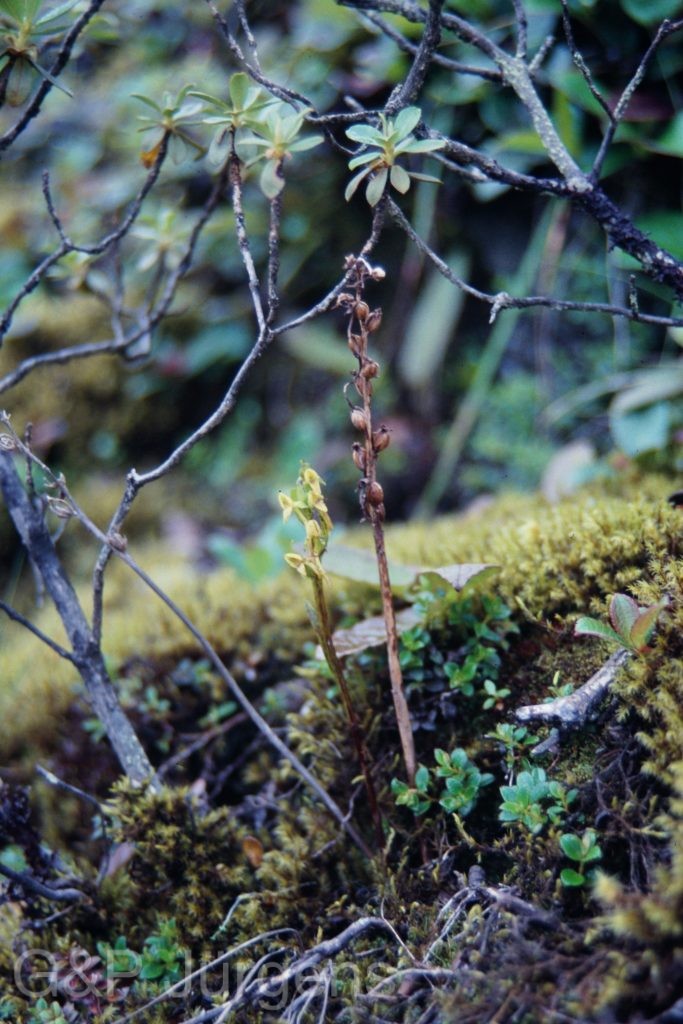
Platanthera leptocaulon is a terrestrial orchid of the eastern Himalaya and adjacent mountains of south-western China, recorded from Sikkim and the rest of northern India, Nepal, Bhutan, Myanmar and Yunnan and Sichuan in China. The roughly 67 georeferenced collections concentrate in the high subalpine to alpine belt, where the species occupies moist open turf, the margins of dwarf-shrub thickets and grassy hollows kept damp by snowmelt. The plant photographed above Chora in Sikkim at 3600 m in August typifies its habitat, flowering during the late-summer monsoon at elevations of roughly 3000-4200 m on humus-rich, well-drained slopes.

It is a slender, glabrous herb arising from ovoid to fusiform root-tubers, the erect stem comparatively thin and wiry (the epithet leptocaulon meaning "slender-stemmed"). The few cauline leaves are oblong-lanceolate to linear, sheathing at the base and grading upwards into bracts. The lax terminal raceme bears small greenish to greenish-white flowers; the dorsal sepal and petals are connivent to form a hood over the column, the lateral sepals spreading, and the entire, narrowly oblong labellum extends backwards into a slender cylindrical spur. The viscidia are naked and the pollinia are attached by slender caudicles, with fruit a small erect dehiscent capsule releasing dust-like seed.

The genus Platanthera is a large Holarctic and Asian assemblage centred on temperate and montane regions, and P. leptocaulon belongs to the species-rich Sino-Himalayan radiation, the basionym having been transferred by Soo from Habenaria. Like most members of the genus it depends on mycorrhizal fungi for germination and probably on long-tongued nocturnal pollinators attracted to the spurred flowers. Though not formally assessed, its broad transboundary range and tolerance of grazed alpine pasture suggest reasonable security, but populations remain vulnerable to overgrazing and the warming-driven upslope contraction of alpine grassland.

Author: (Hook.f.) Soó · Sources: POWO (Kew), GBIF, Flora of China, Flora of Bhutan, The Genus Platanthera (Orchidaceae) monograph

(Hook.f.) Soó

BhutanPG2011 818 01 01
Bhutan Chele-La 3500m, July

Description

Platanthera stenantha (Hook.f.) Soó is a terrestrial orchid of the Himalaya and western China, recorded by GBIF from China, Nepal, India, Myanmar and Bhutan across some 138 occurrences. It inhabits open subalpine and alpine slopes, grassy meadows, and the edges of Rhododendron and birch scrub, typically between about 3000 and 4000 m. The plant photographed on the Chele-La pass in Bhutan at around 3500 m in July, at the height of the monsoon flowering season, exemplifies its association with cool, moist, well-lit high-montane grassland.

The species grows from elongate, fleshy root-tubers and produces an erect leafy stem bearing several oblong to lanceolate cauline leaves that grade upwards into bracts. The inflorescence is a slender, fairly dense terminal raceme of small greenish to yellowish-green flowers, the specific epithet stenantha referring to their narrow form. The dorsal sepal and petals form a loose hood over the column, the lateral sepals spread, and the narrow, tongue-shaped labellum hangs downward and is prolonged at its base into a slender spur, usually about equalling or exceeding the ovary, that holds nectar for moth or butterfly pollinators.

Platanthera is a large genus of tribe Orchideae characterised by its spurred labellum and widely separated, often divergent pollinia-bearing anther cells. Platanthera stenantha belongs among the green-flowered Sino-Himalayan species and is distinguished from its relatives by floral proportions and spur length. With a moderately wide distribution it is not regarded as globally threatened, but its high-grassland habitat is subject to grazing and climatic pressures, and like all orchids it falls under CITES Appendix II.

Author: (Hook.f.) Soó · Sources: POWO (Kew), GBIF, Flora of Bhutan, Flora of China, Pearce and Cribb Orchids of Bhutan, World Checklist of Orchidaceae

Wall.

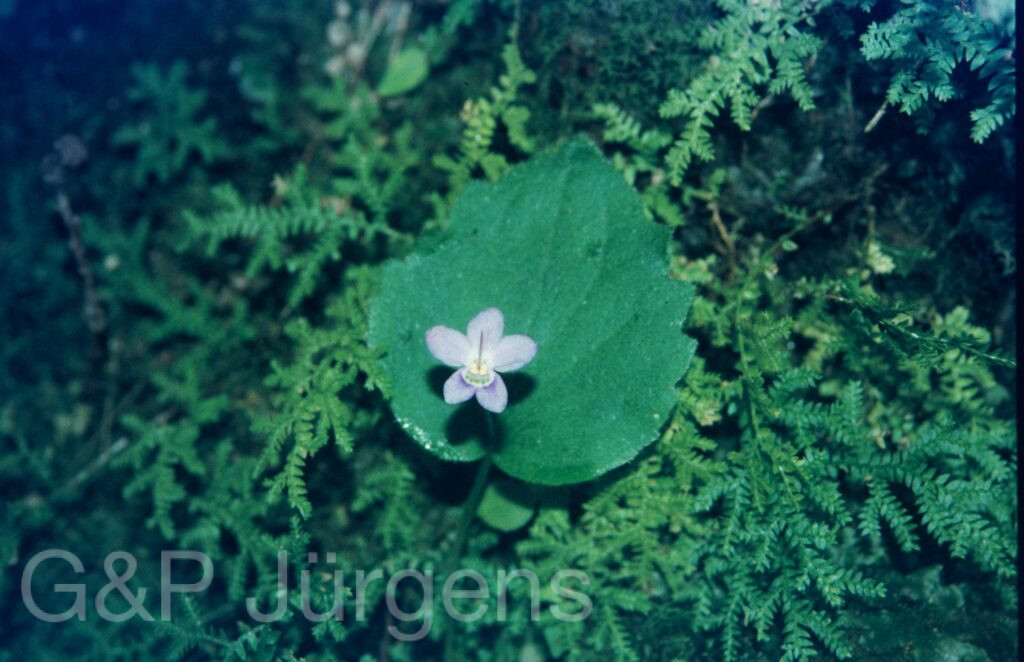
Garw 2005 222 ergebnis ergebnis
India Garhwal Simkarok 2700m, September

Description

Platystemma violoides is a small Himalayan herb of the Gesneriaceae, restricted to the western and central Himalaya in Nepal, India, Bhutan and adjacent China, with around 179 recorded occurrences across this comparatively narrow range. It is a chasmophyte of moist, shaded rock faces, damp cliffs and mossy boulders, often in spray zones and on dripping banks within temperate forest, flowering toward the close of the monsoon. In the Indian Garhwal Himalaya it occupies the middle montane belt, as documented by the collection at Simkarok at about 2700 m in September, when the plants are in flower on rain-soaked rock.

The plant is a delicate annual or short-lived perennial that develops a single, large, suborbicular to broadly ovate leaf, cordate at the base, softly hairy and shallowly toothed, pressed against the rock surface in the manner of a monophyllous gesneriad. From the base of the leaf arises a slender scape bearing one or a few showy flowers; the corolla is broadly campanulate to rotate and violet to purplish-blue, recalling a violet and giving the epithet violoides, with a short tube, spreading lobes and two to four stamens. The fruit is a small capsule releasing numerous minute seeds.

The family in this record is given as Leptoboeinae, the subtribe of Old World Gesneriaceae to which the monotypic genus Platystemma belongs, alongside Loxostigma, Leptoboea and related rock-dwelling herbs; the species is properly placed in Gesneriaceae. Its single-leaved habit and adaptation to vertical rock microhabitats parallel those of other Himalayan gesneriads such as Corallodiscus and the African Streptocarpus. Confined to specialised cliff niches, P. violoides is naturally local though not currently regarded as threatened, its persistence depending on the integrity of shaded, perennially moist rock habitats.

Author: Wall. · Sources: POWO (Kew), GBIF, Flora of China Vol. 18, Flora of Bhutan Vol. 2, Flora of Nepal, Weber & Burtt classification of Gesneriaceae

Andrews

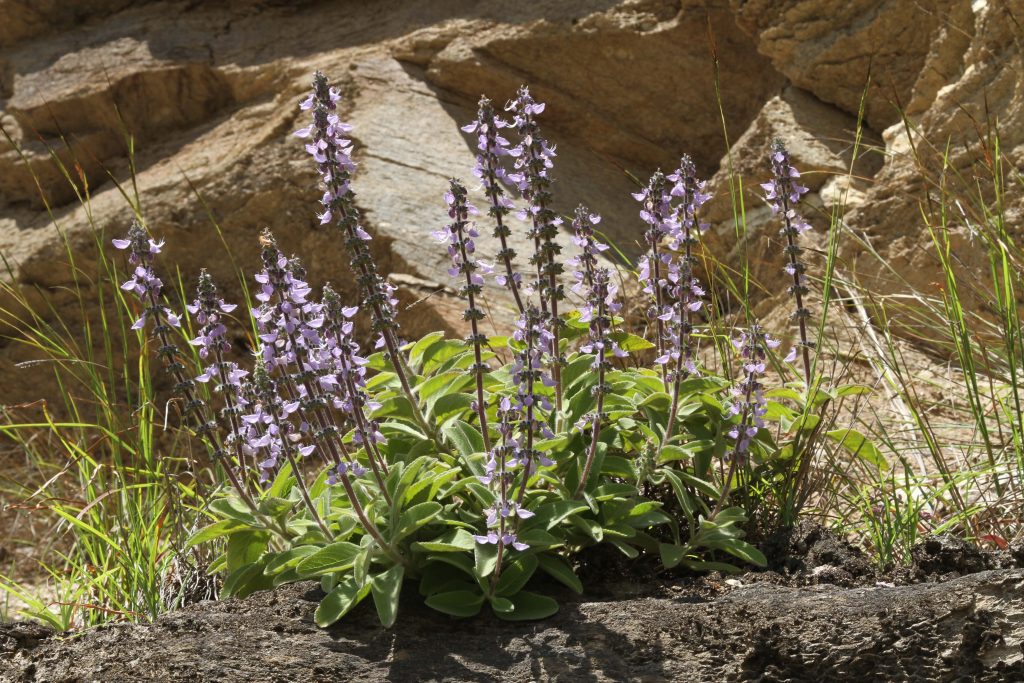
Bhutan2012 398
Bhutan Wangdi 2600m, September

Description

Plectranthus barbatus Andrews is an aromatic perennial herb or subshrub with a broad palaeotropical distribution, recorded from tropical and southern Africa (Ethiopia, Kenya, Tanzania, South Africa) and the Arabian Peninsula through to the Indian subcontinent, Nepal, Bhutan and Sri Lanka, where it is both native and widely cultivated and naturalised. In the Himalaya it grows on warm, dry, rocky banks, terrace margins, scrub and open hill slopes, often near villages. The photographed plant from Wangdi (Wangdue Phodrang) in Bhutan at 2600 m, flowering in September at the close of the monsoon, illustrates its tolerance of sunny, well-drained sites in the lower-temperate zone. GBIF treats the listed name as a synonym, with Plectranthus barbatus the accepted name.

The plant forms an erect, branching, softly woody-based herb with quadrangular, finely pubescent stems. The opposite leaves are broadly ovate, crenate-margined, somewhat fleshy and strongly aromatic, narrowing to a winged petiole and densely glandular and hairy. The flowers are borne in whorls along elongate, terminal racemose inflorescences; the bilabiate corolla is blue to violet-blue, with a short upper lip and a deflexed, boat-shaped lower lip enclosing the four didynamous stamens. As in other Lamiaceae the fruit comprises four smooth nutlets seated in the persistent calyx.

Long cultivated for medicine and as a hedge plant, P. barbatus (often called Coleus forskohlii in pharmacological literature) is the principal source of the diterpenoid forskolin, which has driven extensive cultivation across India and Africa. Its taxonomy is complicated by this synonymy and by horticultural movement blurring native and introduced ranges. The species is not of conservation concern, being weedy, easily propagated and widely naturalised.

Author: Andrews · Sources: POWO (Kew), GBIF, Flora of Bhutan, Flora of Tropical East Africa (Lamiaceae), Plectranthus and Allied Genera (Lukhoba, Simmonds & Paton)

(Lindl.) Rollisson

Sikkim2011 381
Sikkim Lachen 2600m, June
Nepal 2001 262 ergebnis ergebnis
Nepal (Gorkha) Jaurey Kharka 2700m, May
Nepal 2001 263 ergebnis ergebnis
Nepal (Gorkha) Jaurey Kharka 2700m, May

Description

Pleione hookeriana is a small epiphytic and lithophytic orchid of the eastern Himalaya and Indochina, distributed across Nepal, India, Bhutan, China and Laos, with about 204 GBIF occurrences. It inhabits cool, humid montane forest, growing on mossy tree trunks, branches and shaded rocks in the temperate zone, favouring situations with abundant atmospheric moisture. The images document it in Sikkim near Lachen at about 2600 m in June and in the Gorkha district of Nepal at Jaurey Kharka around 2700 m in May, where it flowers on moss-clad substrates as the monsoon approaches.

It is a dwarf, deciduous orchid growing from a small annual pseudobulb that bears a single plicate leaf. The flower is solitary and produced with or just before the leaf on a short scape arising from the base of the pseudobulb. The sepals and petals are narrow, spreading and pale pink to rose-lilac; the labellum is comparatively large, obovate, fringed at the margin, and marked within by a yellow to brown-spotted, lamellate throat that contrasts with the paler perianth. The column is slender and winged. The fruit is a dry dehiscent capsule releasing dust-like seeds.

Pleione hookeriana is the smallest-flowered species of its genus and is distinguished by its diminutive habit and patterned lip. Like all Pleione it has an annual pseudobulb cycle and depends on mycorrhizal fungi for seed germination. The showy lip and contrasting throat markings attract bee pollinators in spring. As an attractive orchid it is subject to horticultural collection, and the entire genus is listed on CITES Appendix II, regulating international trade.

Author: (Lindl.) Rollisson · Sources: POWO (Kew), GBIF, Flora of China, Flora of Bhutan, The Genus Pleione (Cribb & Butterfield), CITES Appendices

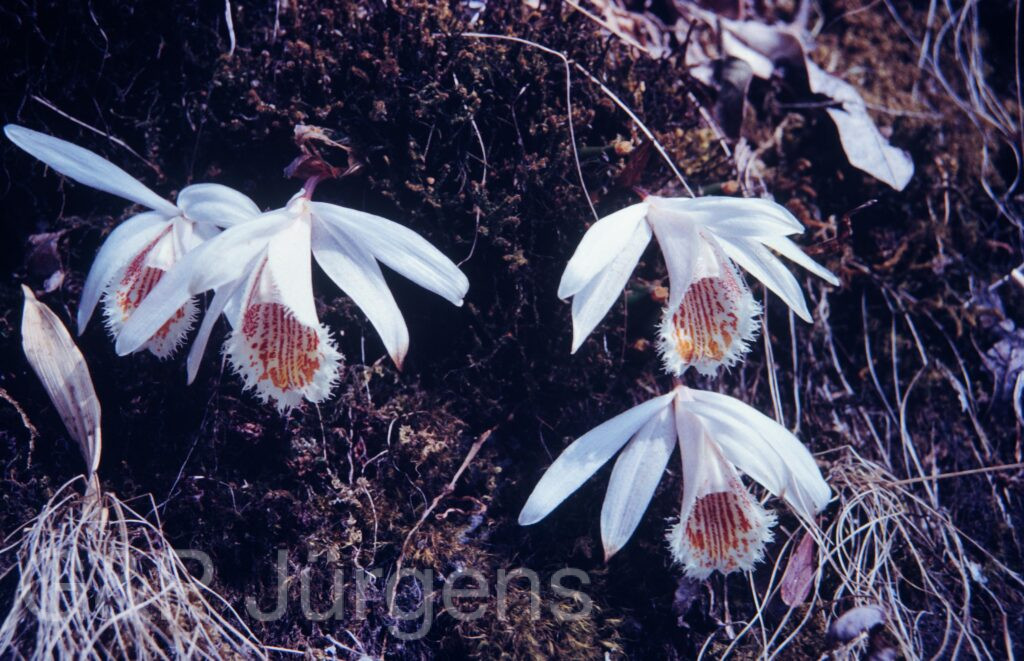
(Sm.) D.Don

Nepal1992 42 P60 ergebnis
Nepal Nundhaki 1500m March 
Nepal1992 56 P81 ergebnis
Nepal Nundhaki 1500m March 
Nepal1992 242 P359 ergebnis
Nepal Nundhaki 1500m March 

Description

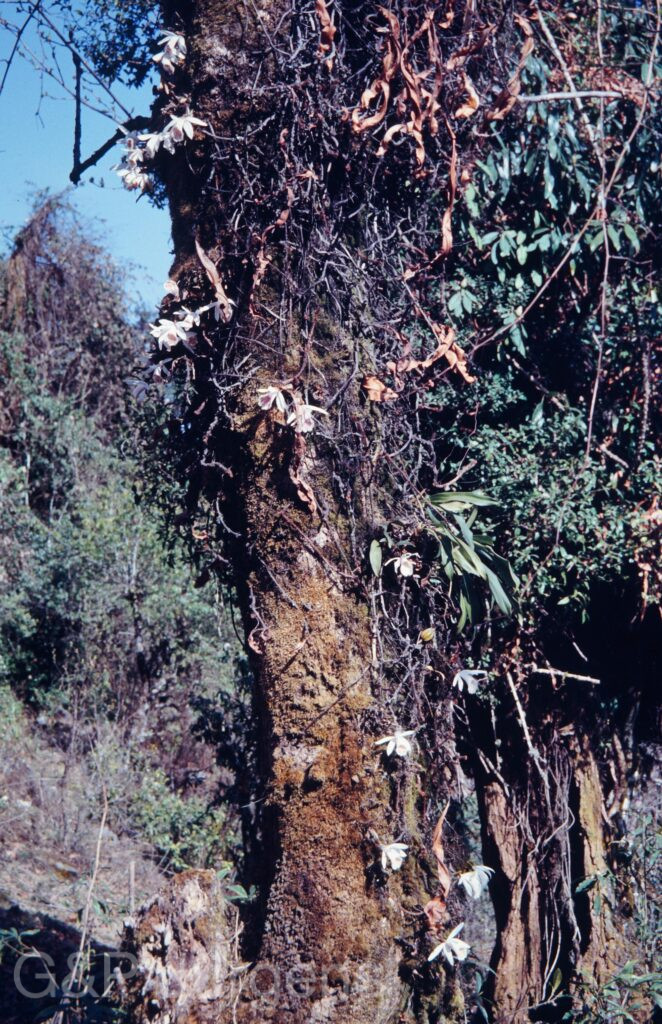
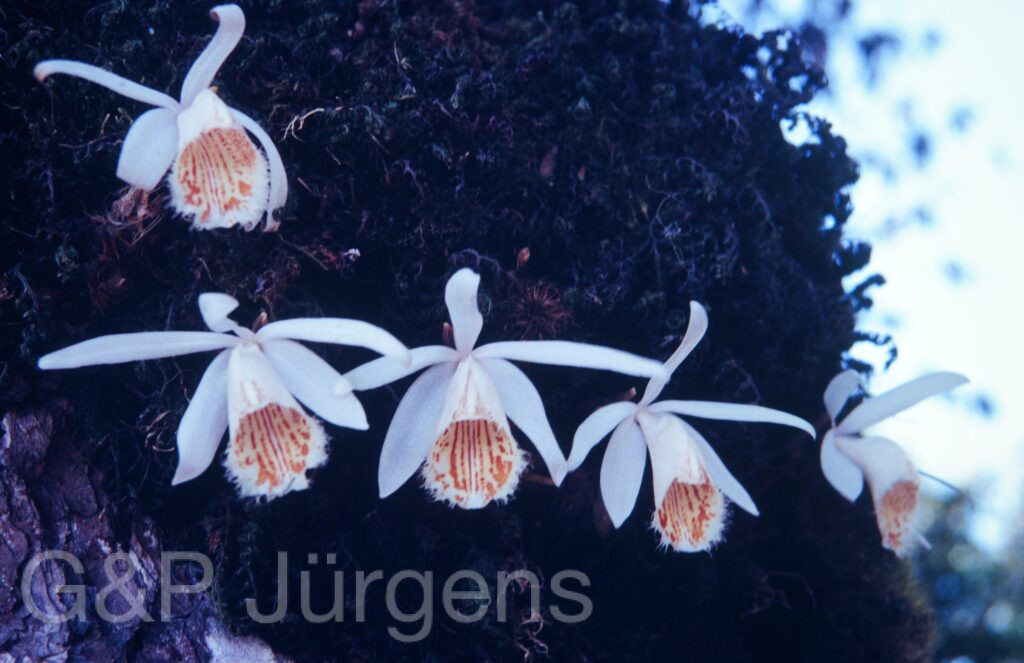
Pleione humilis is a dwarf orchid of the Himalaya and adjoining mountains, native to Nepal, India, Bhutan, Myanmar and Thailand, with around 136 georeferenced occurrences across this eastern arc. It grows chiefly as an epiphyte on mossy tree trunks and branches, and occasionally as a lithophyte on shaded, humus-covered rocks, in cool, humid temperate forest. The illustrated plant from Nundhaki in Nepal, at about 1500 m and flowering in March, exemplifies the species' habit of blooming in late winter to early spring, characteristically before or as the new leaves expand at relatively low montane elevations.

The plant grows from small, flask- to top-shaped, often warty pseudobulbs, each producing a single (occasionally paired) plicate, deciduous leaf. The flowers, usually borne singly on a short scape from the base of the pseudobulb, are large for the plant's size and showy, with spreading, narrow, white to pale pink sepals and petals. The conspicuous trumpet-shaped labellum is broadly funnel-form and frilled at the margin, white marked within by yellow to brown and red blotches and bearing several toothed or fringed keels (lamellae) along the disc. The slender, winged column lies enclosed within the lip, and the fruit is a ribbed dehiscent capsule shedding dust-like seeds.

Pleione is a small genus of about two dozen Sino-Himalayan and Southeast Asian orchids, much admired and cultivated, of which P. humilis is one of the winter-flowering, single-leaved species. As with all orchids it is protected under CITES Appendix II, and wild populations are threatened by collection for horticulture and by clearance of the moist forest on which the epiphytic plants depend; conservation therefore hinges on protecting both the species and its montane forest habitat.

Author: (Sm.) D.Don · Sources: POWO (Kew), GBIF, Flora of Bhutan (Orchidaceae), Flora of China (Orchidaceae), Cribb & Butterfield: The Genus Pleione (monograph)